CHAPTER THREE
CHAPTER THREE
POLITICS
POLITICS,
,
ECONOMY
ECONOMY AND
AND SOCIETY
SOCIETY IN
IN
ETHIOPIA
ETHIOPIA AND
AND THE
THE
HORN
HORN TO THE END OF THE
TO THE END OF THE
THIRTEENTH CENTURY
THIRTEENTH CENTURY
3.1. Emergence of States
One important factor for the emergence of states was
the beginning of
beginning of sedentary agriculture
sedentary agriculture.
Families preferred to live together forming larger
communities for
better security
better security
to
to help each other
help each other in hard works.
hard works.
Therefore, states were formed mainly through
the expansion of agriculture that gave rise to class
class
differentiation.
differentiation.
 Furthermore, the growth of trade facilitated the
development of states
development of states.
farmers acquired surplus produce to exchange
exchange with
better tools and clothes
better tools and clothes with the artisans
who were able to specialize in the production of
these items
Gradually, intermediaries (traders) also began to buy the
products of both to take to
predetermined places or markets for exchange
State refers to an autonomous political unit having
population,
 defined territory,
 sovereignty
government with the power to decree and enforce laws
State was the outcome of regular cultural process.
states arose independently in different places and at
different times
Favorable environmental conditions helped to hasten
the rate of transformation in some regions.
Religious leaders such as shamans played prominent role
in maintaining
the social and religious affairs of their people
during the initial formation of the states
religious elites were gradually replaced by chiefs
Then they began collecting regular and
compulsory tributes which amounted to protection
payments
with which they maintained themselves,
their supporters chiefly the army,
the bureaucracy and other followers
Ethiopia and the Horn is one of the regions in Africa
where early state formation took place.
From small beginnings, such states gradually
developed into
powerful kingdoms
even empires with a well-demarcated social
structure
Early state in Ethiopia and the Horn were stronger than
their neighbors and eventually dominated them.
This was due to
Geographical proximity to and control of the
international water bodies along with their ports like
Red Sea,
Red Sea,
 Gulf of Aden
Gulf of Aden
Indian Ocean
Indian Ocean
3.2. Ancient States
3.2. Ancient States
3.2.1. North and Northeast
A. Punt
A. Punt
Punt was the earliest recorded state in Ethiopia and the Horn
The evidence on Punt
Punt comes from Egyptian hieroglyphic
writings
accompanied by vivid paintings that describes
describes series
series
of
of naval
naval expedition,
expedition,
which the Egyptian Pharaohs sent
sent to Punt
Pharaoh Sahure (2743-2731 B.C.) sent
sent expedition to
collect myrrh, ebony and electrum (gold and silver alloy)
During Pharaoh Asosi, treasurer of God Bawardede took
dancing dwarf “dink" to Egypt from Punt.
The best described and illustrated expedition was which
undertaken by the order of the famous Egyptian Queen
Hatshepsut (1490-1468 B.C.), whose expedition
expedition is
documented
documented at her tomb in Dier El Bahri
She sent five ships under the leadership of Black
Nubian Captain Nehasi via Wadi-Tumilat
The expedition was warmly welcomed by
the Puntites King Perehu, his wife Ati, sons,
daughters and followers.
The expedition
expedition was able to return collecting
frank incense, cinnamon,
sweet smelling woods (sandal), spices,
 ivory, rhinoceros horn, leopard and
leopard skins,
ostrich feathers and egg, live monkeys,
giraffes, people
Hatshepsut presented some parts of the items to her god,
Amun
It was because of the ritual importance of their
exports that Puntites were also known as
Khebis of the Ta Netjeru (divine or ghosts land)
Iron, bronze, asses, foxes, cattle, animals fur, dying and
medicinal plants were also exported from Punt to Egypt
In return, from Egypt the following were imported to
Punt
axes, daggers, swords, knives, sickles, clothes,
bracelets, necklaces, beads and other trinkets
Scholars have not reached agreement as to the exact
location of Punt
1. The varieties of incense and myrrh mentioned in the
writings have suggested
 it was in northern or northeastern Somalia
northern or northeastern Somalia
2. some scholars while others are inclined more towards
Northern Ethiopia
Northern Ethiopia
because of the reference to gold, ivory and monkeys
The latter reinforce their arguing at that early period
Egyptian sailboats might not have been strong enough
to pass through
the Strait of Bab-el Mandeb into the Gulf of Aden
and the Indian Ocean.
3. Considering the two suggestions, still some others argue
that
it probably stretched from Swakim or Massawa to
Babel Mandeb (Gate of Tears) and Cape Guardafui.
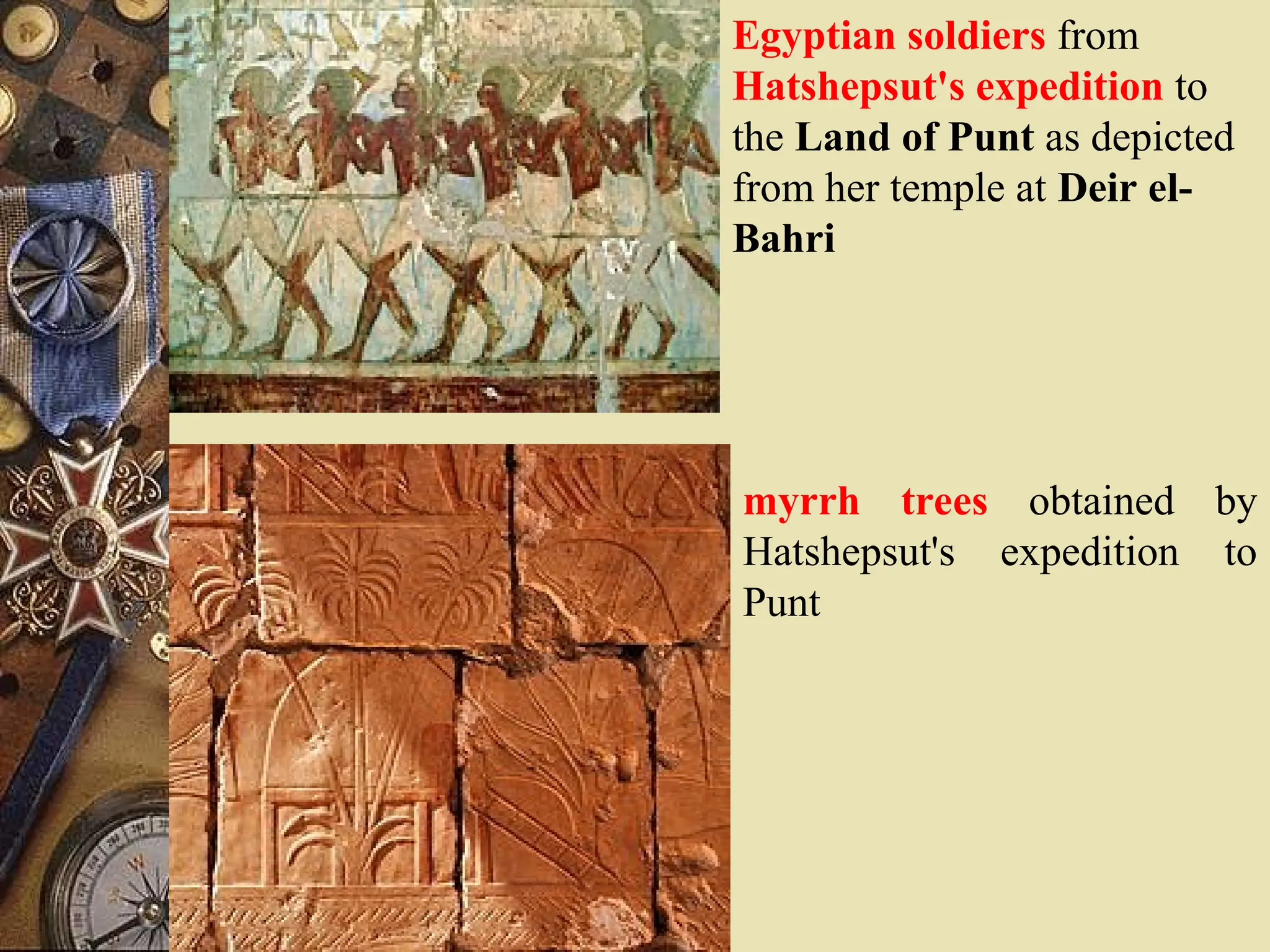
Egyptian soldiers from
Hatshepsut's expedition to
the Land of Punt as depicted
from her temple at Deir el-
Bahri
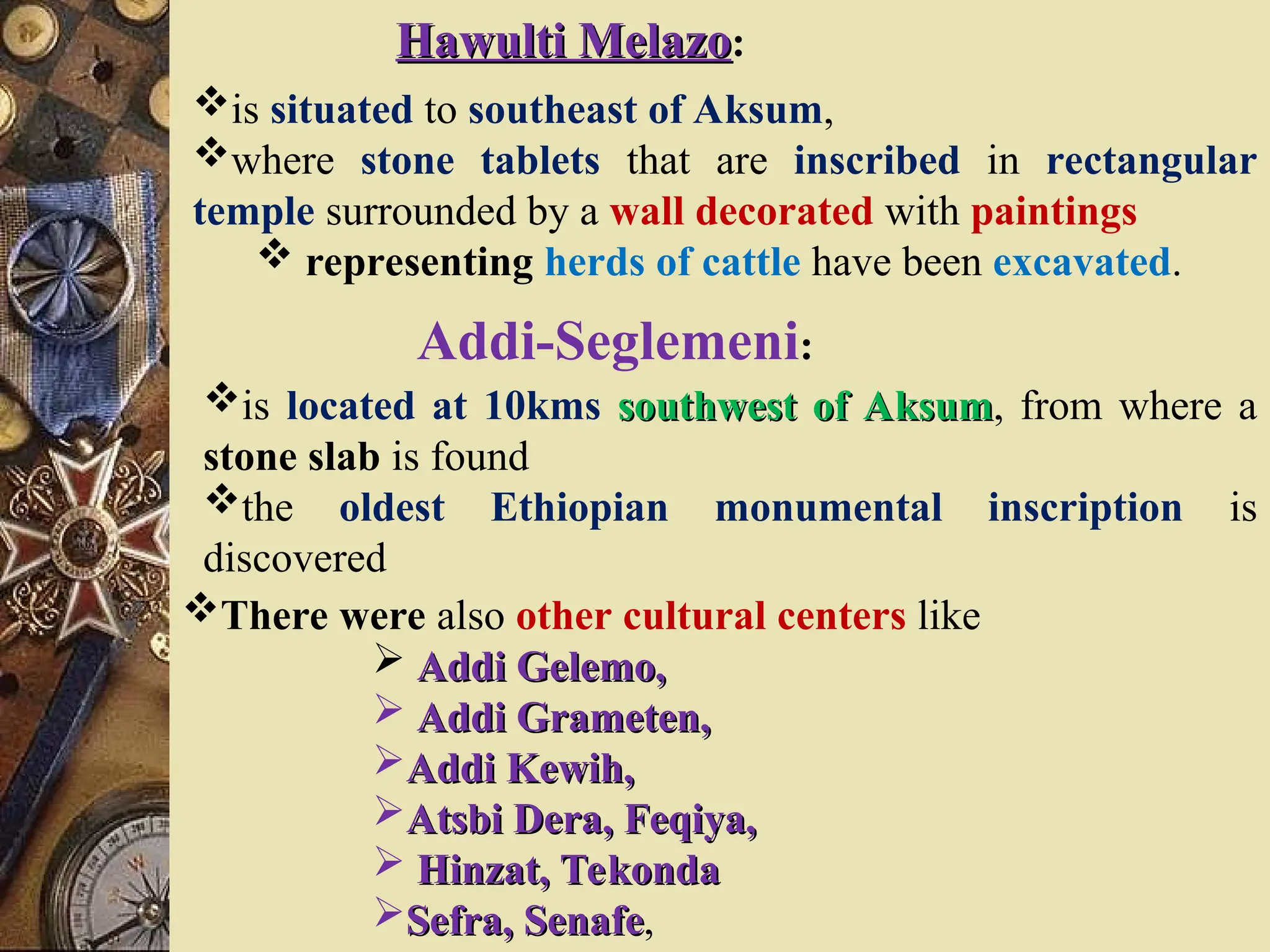
myrrh trees obtained by
Hatshepsut's expedition to
Punt
Supposed location around the Red Sea and
major travel routes by land and sea
B. Da’amat and Other Cultural Centers in
Northern Ethiopia and Eritrea
The state known as Da’amat had a center a little to the
south of Aksum
Inscription of the king of Da’amat tentatively dated to the
fifth century BC shows that
he used politico religious title
politico religious title known as Mukarib.
Various gods and goddesses were worshipped
 in the Da’amat state and northern Ethiopian pre-
Aksumite cultural centers
Such as
Almouqah (principal god),
 Astarr (Venus god),
Na’uran (light god),
Shamsi (sun god),
Sin (moon god)
There were similar practices in South Arabia at the time
There were a number of cultural centers
number of cultural centers in northern
Ethiopia. The major ones are:
Yeha
is located 30 kms to the northeast of Aksum
It was the oldest of these centers
It probably emerged around 1, 000 BC as a small
emporium
where South Arabian merchants
South Arabian merchants and their
agents
agents bought and stored
ivory, rhinoceros horn and other
commodities coming from the interior
It seems that the period of its prosperity (zenith) was
from about 750 to 500 B.C
Remains of walls of some of its buildings and stone
masonry as well as still standing temple
 inscriptions indicate Yeha’s glory
Hawulti Melazo
Hawulti Melazo:
is situated to southeast of Aksum,
where stone tablets that are inscribed in rectangular
temple surrounded by a wall decorated with paintings
 representing herds of cattle have been excavated.
Addi-Seglemeni:
is located at 10kms southwest of Aksum
southwest of Aksum, from where a
stone slab is found
the oldest Ethiopian monumental inscription is
discovered
There were also other cultural centers like
 Addi Gelemo,
Addi Gelemo,
 Addi Grameten,
Addi Grameten,
Addi Kewih,
Addi Kewih,
Atsbi Dera, Feqiya,
Atsbi Dera, Feqiya,
 Hinzat, Tekonda
Hinzat, Tekonda
Sefra, Senafe
Sefra, Senafe,
Sun and crescent
emblems on a
Matara stele
lack of vowel
marks in the
Ge'ez script,
C. The Aksumite State
The nucleus of the Aksumite state was formed around 200-
100 B.C.
Initially, its power was limited to a relatively small
area comprising the town of Aksum and its environs
Gradually,, it expanded to include large territories in all
directions.
In its heyday,
In its heyday, Aksumite territories extended from
the Red Sea coast in the East to the Western edge of
Ethiopian plateau the vast Nile Valley in the west
from the northern most corner of Eritrea and possibly
as far south as northern parts of Shewa
According to Periplus of Erithrean Sea,
Adulis on the western coast
western coast of the Red Sea
Red Sea was the
major port of Aksum
major port of Aksum
The long distance trade routes from Adulis and other posts
on the Red Sea coast passed inland through such centers as
Kaskasse, Coloe, Matara and even further west
across Takaze River.
The document also mentioned
 ports of Aden (Eudaemon)
Gulf like Avalites (Zayla)
Malabo (Berbera),
Indian Ocean Benadir Coasts like
Serapion (Moqadishu), Nicon (Brava) and
Merca
The major items of export of the Aksumite state consisted
mainly of the natural products such as
ivory, myrrh, emerald, frankincense
some spices (like ginger, cassia and cinnamon),
 gold, rhinoceros horns, hippopotamus hides,
tortoise shells and some curiosity animals like apes
In turn, a number of manufactured products were
imported like
garments and textiles from Egypt, India, the Roman
Empire, and Persia;
glassware and jewelry from Egypt
 metallic sheets, tools or utensils of various kinds, oil
and wine from the regions of Roman Empire and Syria
During Aksumite period there was inter state relation for
this there are some evidences
Zoscales
Zoscales (c. 76-89), the then king of Aksum, used to
speak the
Greek language, the Lingua Franca of Greco-
Roman world.
Aksum also had relations with Ceylon (Sri Lanka) and
Laodicea (Asia Minor)
During Aksumite period there was the internal long
distance trade
Christian Topography, describes Aksum and a
distant region called Sasu,
most probably in Beni Shangul and the adjoining
lands beyond the Blue Nile
Aksumite kings had extensive contacts with the outside
world notably with the South Arabian region,
 leading to exchange of ideas
exchange of ideas,
, material
material and
spiritual culture
Sometimes such contacts involved conflicts between the
two regions.
One of such known recorded conflict between areas on
both sides of the sea took place around 200 A.D.
peoples in Southern Arabian Peninsula, in present day
Yemen,
had difficulties in defending themselves against the
army of the Aksumite king, Gadarat.
From the third to the seventh centuries, Aksumite kings
like Aphilas, Endybis, Wazeba, Ezana, Ousanas II,
Aphilas, Endybis, Wazeba, Ezana, Ousanas II, etc.
 minted and issued different kinds of coins
kinds of coins in gold
gold,
silver
silver and bronze for
both overseas and local transactions.
At the time Aksum was one of the four great powers of the
world
Roman Empire,
 Persia,
 China
Aksum
It was a major naval and trading power from the first to
the seventh centuries.
Aksumite ships were the main means
main means of transporting
goods
In those days, Aksum was the only one with
sufficient sources of timber for ship building
the technology for it existed in Adulis.
Aksum had a large fleet of ships, which was used not
only for trade but also for its wars across the Red Sea
Kaleb (r. 500-35) expanded overseas territories of Aksum
beyond Himyar and Saba
but the local prince Dhu-Nuwas
local prince Dhu-Nuwas was converted to
Judaism, marched to Zafar
Zafar and Nagran
Nagran,
killed many Christians
then Byzantine Vasaliev Justinian (r. 527-65) with
sanctification of Patriarch Timit III (518-538) provided
Kaleb with a number of ships to transport armies led
by Julianos and Nonossus against Dhu Nuwas
Dhu Nuwas was defeated and Kaleb appointed
Abraha as governor of Arabia until 570 A. D
Kaleb was succeeded
succeeded by his son Gabra Masqal (535-
48) who built a church at Zur Amba in Gayint
Gayint
It was during Gabra Maskal that Yared developed
Ethiopian Orthodox Church liturgical songs and hymns
hymns
The Aksumite state begun to decline
decline since the late seventh
century because of internal and external challenges.
Natural factors
environmental degradation,
decline in agricultural productivity
possibly plague infestation started to weaken it
External Challenges
With the destruction of the port of Adulis by the Arabs
around 702,
the international lifeline of the state was cut.
Aksumite international trade came under the control of the
rising and expanding Arab Muslims
expanding Arab Muslims,
It isolating the Aksum state from its old commercial
and diplomatic partners.
Consequently, the Aksumite state declined
Aksumite state declined economically
economically
Internal challenges
Aksumite hegemony was challenged by local rebellions.
 For example rebellions of
the Beja people
Beja people ,
,
the Agaw people
Agaw people
Queen Bani al Hamwiyah (Yodit)
Queen Bani al Hamwiyah (Yodit) finally
sealed the collapse of the Aksumite state
However, as a civilization, Aksum had a profound impact
upon the peoples of the Horn of Africa on its successors
the Zagwe,
 ‘Solomonic Dynasty’,
the Gondarine period etc.
Some of its achievements of the Aksumite State include
Sub-Saharan Africa’s only surviving indigenous script
calendar
EOC hymns and chants,
paintings
diversified ceramic
lithic tools, ivory curving,
urbanization
sophisticated building traditions (palaces, stele, rock-
hewn churches)
it also developed complex administrative and governance
system,
agricultural system including irrigation etc
D. Zagwe Dynasty
D. Zagwe Dynasty
After its decline, the center of Aksumite state shifted
southwards to Kubar rural highland in the territory of
the Agaw,
 one of the ancient inhabitants of the land between
the Eritrean Plateau and Jema River,
and to the west up to the Blue Nile valleys
This apparently gave Agaw elites
Agaw elites the opportunity to take
part in Aksumite state structure
serving as soldiers and functionaries
soldiers and functionaries for at least four
centuries.
After integrating so well with Aksumite ruling class,
they successfully
successfully took over the state
administration
Accordingly, the Agaw prince Merra Teklehaimanot
married Masobe Worq,
the daughter
daughter of the last Aksumite king
last Aksumite king Dil Na'od
Dil Na'od.
Later he overthrew his father-in-law and took control
of power.
Merra-Teklehaimanot's successors
successors include
Yimirahana Kirstos
Yimirahana Kirstos,
, Harbe, Lalibela
Harbe, Lalibela (1160-1211),
Ne'akuto La'ab, Yetbarek
Ne'akuto La'ab, Yetbarek etc
 Notwithstanding the debates, the Zagwe Dynasty is
believed to have ruled from c. 1150 to 1270
The Zagwe Dynasty made its center
 in Bugna District within Wag and Lasta,
more exactly at Adafa near Roha (Lalibela).
The territory of the Zagwe kingdom extended from
highland provinces of the ancient Aksumite kingdom
in the north down
to northern Shewa in the south
the Lake Tana region
the northern part of what is today Gojjam in the west
The Agaw maintained the ancient Aksumite traditions
almost intact.
Zagwe rulers renewed
renewed cultural and trade contact with
eastern Mediterranean region
The most important export items included
slaves, ivory
rare spices
cotton, linen, silver and copper vessels,
various types of drags and newly minted coins were
imported.
Furthermore, the Zagwe period was
a golden age in Ethiopia's paintings
the translation of some religious works from Arabic
into Ge'ez.
Zagwe rulers are best known for the construction of
cave, semi-hewn and monolithic churches
churches:
1. Cave:
 with some decoration inside, almost similar with
natural cave, e.g. Bete-Mesqel.
2. Semi-hewn:
 this and the monolithic churches that have become
UNESCO world heritage are unique in constructions
 They are not totally separated from the surrounding
rock.
 Their roofs or walls are still attached to the rock,
 eg. Bete Denagil, Bete Debresina/Mikael, Bete
Golgota, Bete Merqoriwos, Bete Gabri’el-Rufa’el
and Bete Abba Libanos.
3. Monolithic:
with detailed decoration in the interior and exterior parts.
They are completely separated (carved out) from
surrounding rock,
eg. Bete Amanuel, Bete Giyorgis, Bete Mariyam and
Bete Medhanialem.
Among the eleven churches of Lalibela, Bete
Medhanelem is the largest of all
Bete Giyorgis is said to be the most finely built in the
shape of the Cross.
Lalibela wanted to establish the second Jerusalem, and
mitigate or even avoid difficulties,
which Ethiopian Christians encountered in their
journey to the Holy Lands
This was done by constructing churches based on the
model of Holy Lands in Israel
Bete Abba Libanos Semi-hewn
Monolithic church of
Bete Giyorgis,
Bete Medhanialem
Bete Amanuel
The
The Zagwe Dynasty came to end
Zagwe Dynasty came to end due to
due to internal problems
internal problems
of
of royal succession
royal succession
oppositions
oppositions from
from groups
groups claiming
claiming descent
descent from the
from the
ancient rulers of Aksum
The
The latter
latter considered
considered Zagwe kings “illegitimate
Zagwe kings “illegitimate
rulers”
rulers” based on the
based on the legend of the Queen of Sheba
legend of the Queen of Sheba
The
The legend
legend was in turn
was in turn based
based on a
on a book
book known as
known as
Kebra-Negest (Glory of Kings
Kebra-Negest (Glory of Kings)
)
that was
that was translated from
translated from Coptic to Arabic
Coptic to Arabic and then
and then
into
into Ge’ez
Ge’ez
based on the legend, the power claimants contend that
“Solomonic” Dynasty ruled the Aksumite state
until its power was “usurped” by the Zagwes.
Yekuno-Amlak (r. 1270-1285), who claimed decent from
the last Aksumite king Dilna’od,
organized his forces with the assistance of the
ecclesiastical hierarchy
engaged the last king of Zagwe, Yetbarek in battle
Yetbarek was killed in Gaynt and Yekuno-Amlak took
the state power proclaiming
the “restoration” of “Solomonic Dynasty
restoration” of “Solomonic Dynasty.
.
3.2.2. East, Central, Southern, and Western States
3.2.2.1. Bizamo, Damot, Enarya and Gafat
A) Bizamo:
 It was a kingdom located on the southern bend of Abay
River
 just opposite to the present districts of Gojjam and
around the current Wambara area.
 It was founded in the 8
8th
th
century
century and had early
connections with Damot
Damot.
B) Damot
Damot:
It was strong kingdom that expanded its territories into
most of the lands to south of Abay
north of Lake Turkana as well as west of Awash and
east of Didessa.
Motalami was a prominent king of Damot in the 13th
century.
C) Enarya
Enarya:
It was a kingdom in the Gibe region in south-western
Ethiopia.
The royal clan was Hinnare Bushasho (Hinnario Busaso).
Hinnare Bushasho (Hinnario Busaso).
Enarya kingship was a divine one: the king (Hinnare-
the king (Hinnare-
Tato
Tato)
) was secluded and considered as sacred.
He communicated visitors through an intermediary, Afe
Busho.
In the 9th
century, Aksumite king Digna-Jan is said to
have led a campaign into Enarya,
accompanied by Orthodox Christian priests carrying arks
of covenant (tabots).
D) Gafat:
D) Gafat:
historically, the territory of Gafat
territory of Gafat lies
south of Abay (Blue Nile) River adjoining Damot on
the south western periphery of the Christian Kingdom.
Semitic speaking population related to Adere and the
Gurage inhabited it.
It is not clear from available records whether the Gafat
formed a “state” or not,
“state” or not,
but Gafat mountains provided a rich source of gold.
rich source of gold.
Despite efforts by Christian evangelists, the Gafat
Gafat largely
remained practitioners
practitioners of their own indigenous religion.
As of early medieval period, Gafat was paying tribute to
the Christian Kingdom mainly in cattle,
which came from six districts, among which
Gambo and Shat are Gafat clan names.
The province was ruled by the title of Awalamo
Awalamo.
After the spread of Islam since the beginning of the 8th
century,
Muslim communities and states had been established at
many locations
especially along the main trade routes from Zeila
Zeila and
its many branches penetrating the interior.
These states include:
A)Shewa:
Makhzumi Khalid ibn al-Walid, who claimed decent from
Mecca, set up Makhzumite Sultanate in 896 A. D (283 A.H.)
 on north-eastern foothill of Shewa.
B)Fatagar:
was founded around Minjar, Shenkora and Ada’a in the 11th
century.
It was a hilly lowland area with thoroughly cultivated
fields of wheat and barley, fruits,
It was also extensive grazing grounds full of numerous
herds of cattle, sheep and goats.
C) Dawaro:
It was Located
 south of Fatagar between upper waters of Awash and
WabiShebelle
extending to Charchar in Northeast and Gindhir in
Southeast.
It was much smaller than Ifat, but resembled.
They have a currency called hakuna in which transition
takes place.
D) Bali:
It was an extensive kingdom occupying high plateau,
separating basins of Shebelle and Rift valley Lakes.
Bali was one of the largest of Ethiopia’s Muslim
provinces.
Its economic activity
economic activity resembles those of other nearby
Muslim lands.
Trade was mainly based on barter exchanging cattle, sheep,
cloth etc.
It had strong army composed of cavalry and infantry.
E. Ifat:
It was a state located in the adjacent to Shewan Sultanate.
Its territory ran from northeast south-westerly in the
Afar plain eastward to the Awash.
It was established by Umar Walasma, who claimed decent
from Hashamite clan and came from Arabia between 1271
and 1285.
He intervened between quarrelsome Makzumite princes
DilMarrah
DilMarrah and Dil-Gamis
Dil-Gamis, weakened and annexed the
sultanate of Shewa.
The sultanate was fertile and well watered.
well watered.
Its inhabitants earned their living from cultivation of
wheat, sorghum, millet and teff, and animal husbandry.
Sugar cane, bananas, variety of fruits, beans, squashes,
cucumbers, and cabbage completed the diet.
Chat was described for the first time as being consumed as a
stimulant.
F. Others:
autonomous states mutually independent states like
Arababani (between Hadiya and Dawwaro), Biqulzar,
Dera (between Dawaro and Bali), Fadise, Gidaya, Hargaya,
Harla, Kwilgora, Qadise, Sharkah (West of Dawaro and
North of Bali in Arsi) and Sim were established and
flourished.
3.3. External Contacts
Ethiopia and the Horn had contacts with Egypt since at
least 3,000 B. C.
It had very close relations with all commercially active
South Arabian Kingdoms starting before 1,000 B.C.
The introduction of Christianity to Aksum established a
new pattern of relation between the region and Egypt.
Until the introduction of Islam into Egypt and the general
reduction of the Christians into minority,
 relations between the two were fairly smooth and
friendly.
Following the introduction of Christianity,
 Aksum had established close relationship with the
East Roman or Byzantine Empire.
Yet, in the 7th
century, this relation became
complicated and began to deteriorate.
The rapid expansion of the Muslim Arabs through the
Near and Middle East, North Africa and the Nile valley led to
 the decline of Aksumite land routes and shipping
lines.
Successive Egyptian Muslim rulers began to use the
consecration and sending of a bishop
as an instrument to further their own foreign policy
objectives
The coming to power of the Mamluk in Egypt was
followed by the persecution of religious minorities.
Moreover, the Mamluk presented a barrier to the contacts
between Christian Ethiopia and European states.
There was Ethiopian Christian pilgrims to the Holy land
of Jerusalem.
When pilgrims
pilgrims met their fellow Christians of Europe
fellow Christians of Europe in
the holy places, they transmitted information about
 the EOC
EOC and about the territorial extent
territorial extent of the
Christian Kingdom
Christian Kingdom.
.
From the information, the Europeans began to
consider Ethiopian Christian Kingdom
Ethiopian Christian Kingdom
as a very powerful and wealthy state existing in the
Horn of Africa.
Consequently, they wanted to use this imaginary strong
Christian power
in their struggle against the Muslim powers in the
Holy land.
Around the middle of the 12th
century, a myth about a very
rich and powerful Christian ruler known as Prester John began
to circulate in Europe.
The legend was developed when the balance of the
crusade war fought over Jerusalem
 between the Christians of Europe and the Muslims
of the Middle East was in favor of the Muslims.
The geographical location of the country of Prester John
was not known to Europe for over a century.
However, the Europeans began to regard Ethiopian
Christian Kingdom as the land of Prester John.
land of Prester John.
Then, they began to search for the location of the Kingdom
and to make an alliance with it.
3.4. Economic Formations
A. Agriculture and Land Tenure System
The main stay of ancient states' economy in highland areas
was plough agriculture.
Land has always been one of the most precious possessions
of human society throughout history.
The rules according to which members of the society
members of the society hold,
share, and use land constitute is known as the land tenure
system.
The most ancient system of land holding in many parts of
Ethiopia and the Horn is the communal land tenure system.
Communal right to land is a group right.
Here group refers to the family, the clan and the other
lineage groups to which the individual belonged.
Each of these groups had communal right to the land
they lived in
freely exploited the resources of the land.
Peasants in the north had rist rights in their respective
areas.
Rist is a kind of communal birth right to land by
members of the families and clans whose ancestors had
settled and lived in the area over long periods.
It is inherited from generation to generation in
accordance to with customary law.
Most of the subjects of the state had the rist rights.
The rist owners were known as bale
bale-
-rist
rist.
.
Yet, they paid tributes to the state and all land
belonged to the state theoretically.
Tribute was collected through a complex hierarchy of
state functionaries or officials
 this officials given gult right over the areas and
populations they administered on behalf of the central
government.
Gult is a right to levy tribute on rist owners’ produce.
The tribute collected by bale-gults, partly allotted for
their own up keep and the rest were sent to the imperial
centre.
Gult right that became hereditary was called Riste-Gult
 as famous well placed officials used to transfer their
position to their offspring.
B. Handicraft
Indigenous handcraft technology had existed since the
ancient period.
The social, economic and political conditions of ancient
states had allowed
the emergence of artisans in various fields with
diverse forms and applications including
 metalwork
 pottery,
 tannery, carpentry,
 masonry, weaving,
jewellery, basketry and others.
Metal workers produced spears’ points, swords , javelins,
bows, arrows, traps, slings, slashers, shields, knives, axes,
sickles, hoes, ploughshares, spades, machetes, hatchets, iron
tripods, ornaments etc.
Carpenters engaged in carving wood implements like doors,
windows, stools, chairs, tables, beds, headrests, mortars,
bowls, beams, yoke, stilt, coffins etc.
potters produced ceramic utensils like saucepan, ovens, jar,
pot, kettle, cooking tripod, plates, granary etc.
Tanners produced leather tools used for bed, bed cover,
saddles, harness, ropes, footwear, prayer mats, sacks, honey
and butter container, drinking cup and clothes until replaced
by weavers’ cotton dresses
However, the artisans were mostly despised and
marginalized because of the general wrong public attitude.
The ruling classes mostly spent their accumulated
wealth on imported luxurious items rather than
 the domestic technology.
Due to this, the locally produced agricultural implements
and house furniture did not show
any significant improvement and sophistication.
C. Trade
Trade was another important economic activity of ancient
states that obtained considerable income from
both internal and international trade.
Ethiopia and the Horn was crisscrossed by various trade
routes connecting various market places in all directions.
3.5. Socio-cultural Achievements
A. Architecture
As the states expanded, architecture also began to
flourish
one of the unique architectural technologies was the
engraving of stele around the third century AD.
There were totally fifty eight steles in and around Aksum
that can be grouped into
well made and decorated,
 half completed
megaliths (not hewn).
As local tradition says, the steles were engraved specifically
at Gobodara
Then which they were transported and planted in
Aksum.
The longest one of these stele measures 33meters heights
(the first in the world).
It is highly decorated in all of its four sides.
It represents a-14 storied building with many windows
and a false door at the bottom.
 It also bears pre-Christian symbols, which are a disc
and a crescent half moon) at the top.
Some scholars suggest that this giant stele was broken
while the people were trying to erect it
The second longest obelisk measures 24 meters height
that was successfully erected
represents a ten-storied building with many windows
and a false door at the bottom.
The third longest stele measures 21 meters
represents a nine-storied building with many windows
and a false door at the bottom.
 It is smooth at the back of its side with no decoration
The Zagwe churches are one of the finest architecture of
artistic achievements of the Christian world
Due to this they were registered by UNESCO as part
of world cultural heritage in 1978.
 Further refinement can be observed in the construction
and decoration of the rock hewn churches
Zagwe architecture used a softer material like
sandstone
sandstone, which was cut and shaped all round,
except the floor, into a variety of delicately
decorated churches.
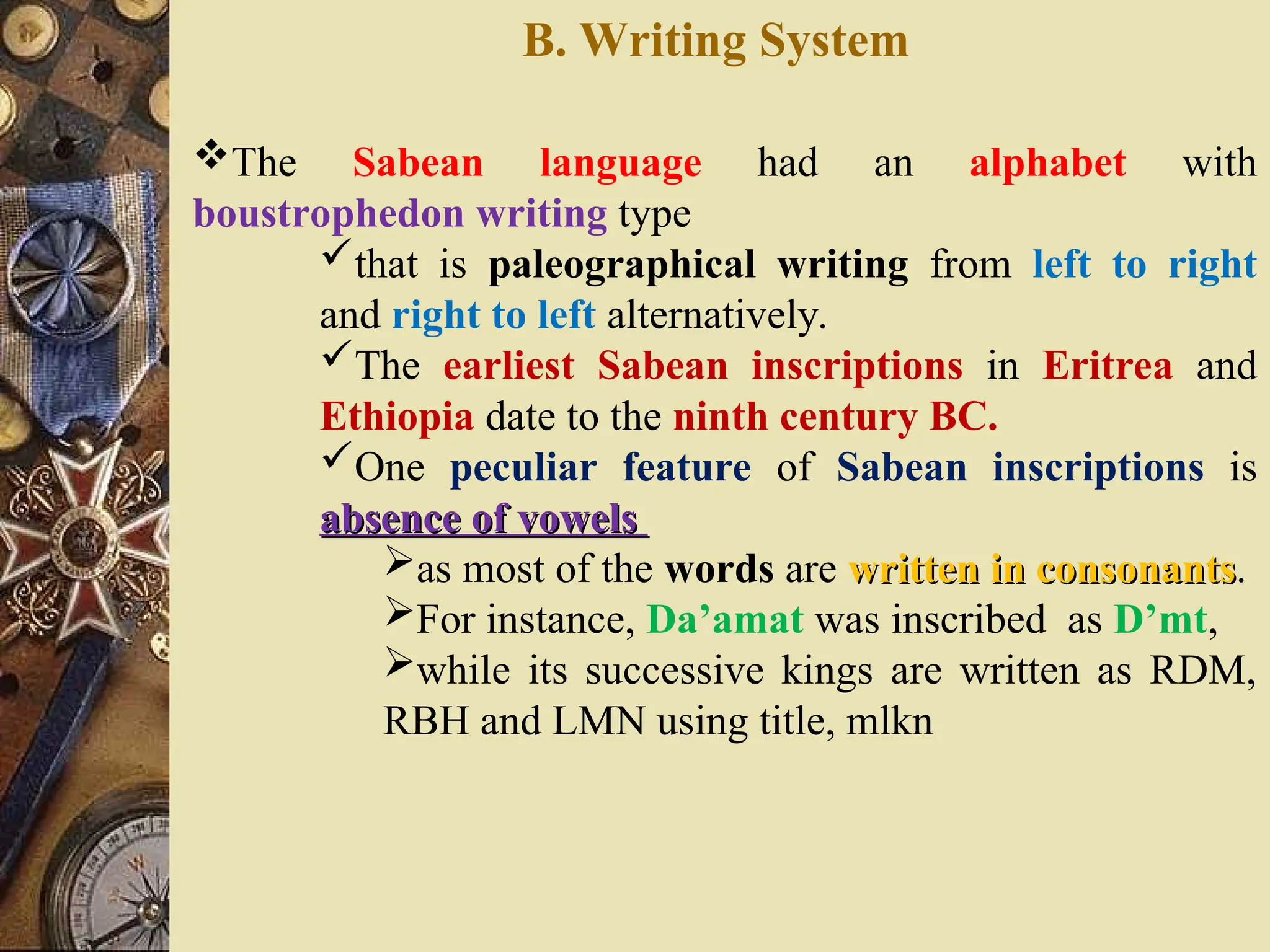
B. Writing System
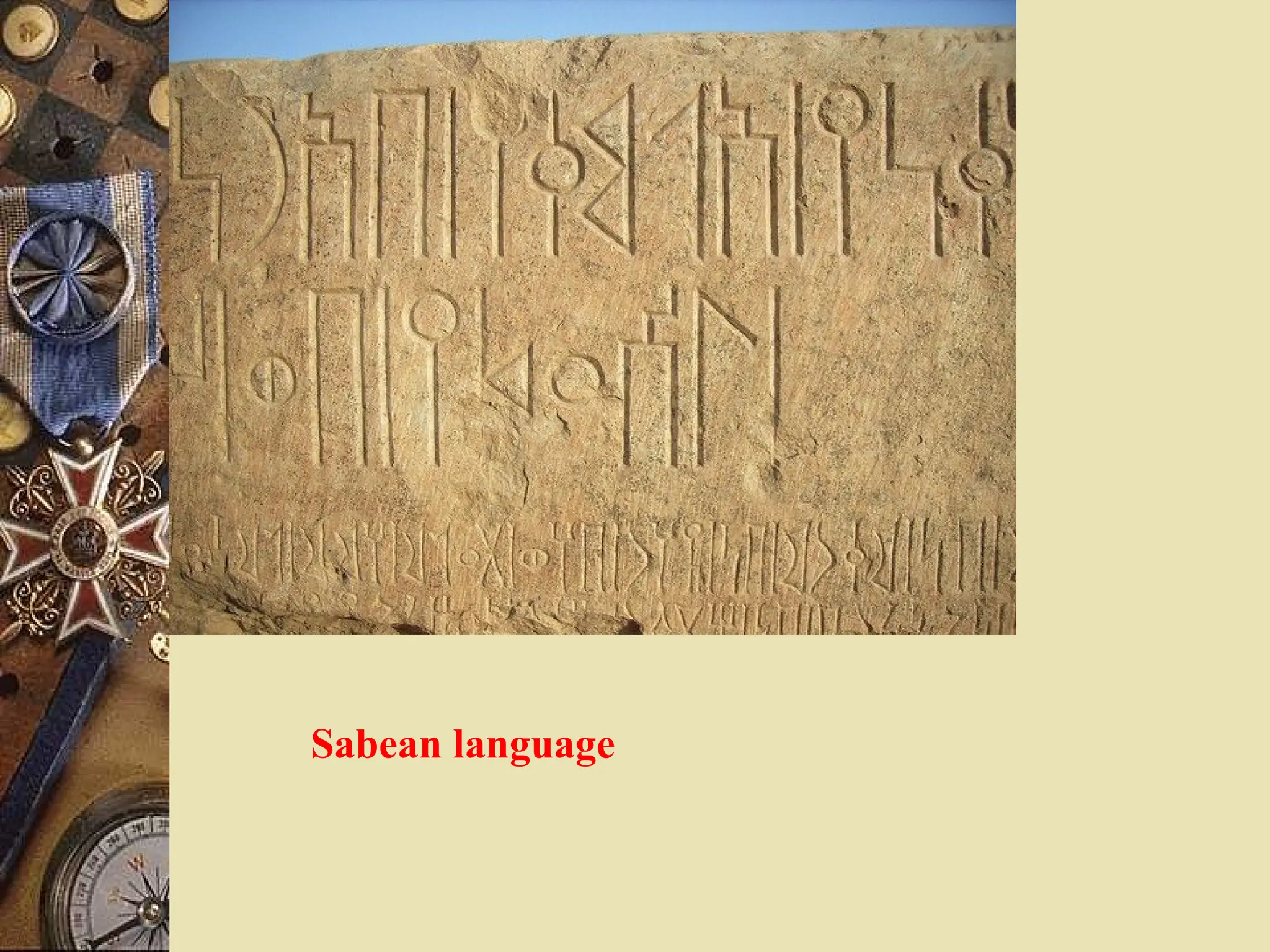
The Sabean language had an alphabet with
boustrophedon writing type
that is paleographical writing from left to right
and right to left alternatively.
The earliest Sabean inscriptions in Eritrea and
Ethiopia date to the ninth century BC.
One peculiar feature of Sabean inscriptions is
absence of vowels
absence of vowels
as most of the words are written in consonants
written in consonants.
For instance, Da’amat was inscribed as D’mt,
while its successive kings are written as RDM,
RBH and LMN using title, mlkn
Sabean language
After the seventh and sixth centuries BC, however,
variants of script arose,
This evolution can be seen most clearly in evidence
from inscriptions
inscriptions mainly graffiti
graffiti on rocks and caves.
 By the first century AD, "Ge ez alphabet" arose
ʽ ,
an abjad (26 consonant letters only) written left-to-right
with letters identical to the first-order forms of modern
vocalized alphabet
the first completely vocalized texts known are
inscriptions by Ezana
(who left trilingual inscriptions in Greek, Sabean
and Ge'ez) c. 330 AD,
vocalized letters predate him by some years,
as vocalized letter exists in Wazeba’s coin
some 30 or so years before
The process was developed under the influence of
Christian scripture by adding vocalic diacritics for vowels,
u, i, a, e, ə, o, to the consonantal letters in a recognizable
Ethiopia's ancient indigenous writing system has
immense contribution to the development of
literature,
art
the writing of history.
C. Calendar
People needed to know and remember the times
when the rains would begin and end as well as the rise
and fall of the water level
In due course, calendars were invented.
In most cases, the length of the month was based on the
movement of the moon or the apparent movement of the sun.
Otherwise, the number of days in the week or in the year
varied from region to region
Calendars were developed and adopted among various
peoples of Ethiopia and the Horn.
Oromo calendar
Oromo calendar has been based on astronomical
observations of moon in conjunction with seven or eight
particular stars or group of stars called
Urjii Dhahaa (guiding stars) and Bakkalcha (morning
star)
There are 29.5 dates in a month and 354 days in 12
months of a year.
Pillars (dated 300 B.C.), which were discovered in
northwestern Kenya
northwestern Kenya from 1978-86 by
Archaeologists Lynch, Robbins and Doyl have
suggested
They enlighten site used to develop Oromo calendar.
 In connection with this, c. 900 A. D. Oromo person
Waqlim is said to have taken
art of shaping phallic bowls to Zimbabwe.
The Sidama calendar
The Sidama calendar
The Sidama calendar rotates following movements of
stars with 13 months a year,
12 of which are divided equally into 28 days while
the thirteenth month has 29 days.
 The Sidama week has only 4 days (Dikko, Dela, Qawado
and Qawalanka)
hence each month has 7 weeks.
Nominated Mote (King) is presented to Fiche Chambalala,
New Year ritual, for Qetela or popular demonstration.
Ethiopic solar calendar
Ethiopic solar calendar has 12 months of 30 days plus 5 or
6 (is added every 4 years)
Epagomenal days, which comprise a thirteenth
month.
A gap of 7–8 years between Ethiopic and Gregorian
calendars results from
alternative calculation in determining date of
Annunciation.
Thus, the first day of the year, 1 Meskerem/Enkutatash
is usually September 11 (Gregorian).
However, it falls on September 12 in years before the
Gregorian leap year.
The Ethiopic solar calendar has evolved to become the
official calendar of the country.
The Muslim (Islamic) calendar
The Muslim (Islamic) calendar is a lunar calendar
consisting of 12 months in a year of 354 or 355 days.
It employs the Hijra year of 622 AD, in which Mohammed
and his followers made flight from Mecca to Medina
And established the first Muslim community (ummah).
Dates in this era are usually denoted AH (After Hijra, "in
the year of the Hijra").
 Years prior to the Hijra are reckoned as BH ("Before the
Hijra").
To sum up, Calendars were developed and adopted
among various peoples of Ethiopia and the Horn
Other peoples like the Agaw, Halaba, Hadiya,
Wolayta, Gedeo, the Nilotes, etc have their own dating
system.
D. Numerals
Numerals appeared in Ethiopia and the Horn at the
beginning of fourth century AD.
 Ge ez
ʽ
Ge ez
ʽ uses numeral system
numeral system comparable to the Hebrew,
Arabic and Greek numerals,
 but it lacks individual characters for multiples of 100.
Numbers are over and underlined in proper
typesetting, combined to make a single bar
but some less sophisticated fonts cannot render this
and show separate bars above and below each
character.

History chapter Three for freshman students

  • 1.
    CHAPTER THREE CHAPTER THREE POLITICS POLITICS, , ECONOMY ECONOMYAND AND SOCIETY SOCIETY IN IN ETHIOPIA ETHIOPIA AND AND THE THE HORN HORN TO THE END OF THE TO THE END OF THE THIRTEENTH CENTURY THIRTEENTH CENTURY
  • 2.
    3.1. Emergence ofStates One important factor for the emergence of states was the beginning of beginning of sedentary agriculture sedentary agriculture. Families preferred to live together forming larger communities for better security better security to to help each other help each other in hard works. hard works.
  • 3.
    Therefore, states wereformed mainly through the expansion of agriculture that gave rise to class class differentiation. differentiation.  Furthermore, the growth of trade facilitated the development of states development of states. farmers acquired surplus produce to exchange exchange with better tools and clothes better tools and clothes with the artisans who were able to specialize in the production of these items Gradually, intermediaries (traders) also began to buy the products of both to take to predetermined places or markets for exchange
  • 4.
    State refers toan autonomous political unit having population,  defined territory,  sovereignty government with the power to decree and enforce laws State was the outcome of regular cultural process. states arose independently in different places and at different times Favorable environmental conditions helped to hasten the rate of transformation in some regions. Religious leaders such as shamans played prominent role in maintaining the social and religious affairs of their people during the initial formation of the states
  • 5.
    religious elites weregradually replaced by chiefs Then they began collecting regular and compulsory tributes which amounted to protection payments with which they maintained themselves, their supporters chiefly the army, the bureaucracy and other followers
  • 6.
    Ethiopia and theHorn is one of the regions in Africa where early state formation took place. From small beginnings, such states gradually developed into powerful kingdoms even empires with a well-demarcated social structure Early state in Ethiopia and the Horn were stronger than their neighbors and eventually dominated them. This was due to Geographical proximity to and control of the international water bodies along with their ports like Red Sea, Red Sea,  Gulf of Aden Gulf of Aden Indian Ocean Indian Ocean
  • 8.
    3.2. Ancient States 3.2.Ancient States 3.2.1. North and Northeast 3.2.1. North and Northeast A. Punt A. Punt Punt was the earliest recorded state in Ethiopia and the Horn The evidence on Punt Punt comes from Egyptian hieroglyphic writings accompanied by vivid paintings that describes describes series series of of naval naval expedition, expedition, which the Egyptian Pharaohs sent sent to Punt Pharaoh Sahure (2743-2731 B.C.) sent sent expedition to collect myrrh, ebony and electrum (gold and silver alloy) During Pharaoh Asosi, treasurer of God Bawardede took dancing dwarf “dink" to Egypt from Punt.
  • 9.
    The best describedand illustrated expedition was which undertaken by the order of the famous Egyptian Queen Hatshepsut (1490-1468 B.C.), whose expedition expedition is documented documented at her tomb in Dier El Bahri She sent five ships under the leadership of Black Nubian Captain Nehasi via Wadi-Tumilat The expedition was warmly welcomed by the Puntites King Perehu, his wife Ati, sons, daughters and followers. The expedition expedition was able to return collecting frank incense, cinnamon, sweet smelling woods (sandal), spices,  ivory, rhinoceros horn, leopard and leopard skins, ostrich feathers and egg, live monkeys, giraffes, people
  • 10.
    Hatshepsut presented someparts of the items to her god, Amun It was because of the ritual importance of their exports that Puntites were also known as Khebis of the Ta Netjeru (divine or ghosts land) Iron, bronze, asses, foxes, cattle, animals fur, dying and medicinal plants were also exported from Punt to Egypt In return, from Egypt the following were imported to Punt axes, daggers, swords, knives, sickles, clothes, bracelets, necklaces, beads and other trinkets
  • 11.
    Scholars have notreached agreement as to the exact location of Punt 1. The varieties of incense and myrrh mentioned in the writings have suggested  it was in northern or northeastern Somalia northern or northeastern Somalia 2. some scholars while others are inclined more towards Northern Ethiopia Northern Ethiopia because of the reference to gold, ivory and monkeys The latter reinforce their arguing at that early period Egyptian sailboats might not have been strong enough to pass through the Strait of Bab-el Mandeb into the Gulf of Aden and the Indian Ocean. 3. Considering the two suggestions, still some others argue that it probably stretched from Swakim or Massawa to Babel Mandeb (Gate of Tears) and Cape Guardafui.
  • 12.
    Egyptian soldiers from Hatshepsut'sexpedition to the Land of Punt as depicted from her temple at Deir el- Bahri myrrh trees obtained by Hatshepsut's expedition to Punt
  • 13.
    Supposed location aroundthe Red Sea and major travel routes by land and sea
  • 14.
    B. Da’amat andOther Cultural Centers in Northern Ethiopia and Eritrea The state known as Da’amat had a center a little to the south of Aksum Inscription of the king of Da’amat tentatively dated to the fifth century BC shows that he used politico religious title politico religious title known as Mukarib. Various gods and goddesses were worshipped  in the Da’amat state and northern Ethiopian pre- Aksumite cultural centers Such as Almouqah (principal god),  Astarr (Venus god), Na’uran (light god), Shamsi (sun god), Sin (moon god) There were similar practices in South Arabia at the time
  • 15.
    There were anumber of cultural centers number of cultural centers in northern Ethiopia. The major ones are: Yeha is located 30 kms to the northeast of Aksum It was the oldest of these centers It probably emerged around 1, 000 BC as a small emporium where South Arabian merchants South Arabian merchants and their agents agents bought and stored ivory, rhinoceros horn and other commodities coming from the interior It seems that the period of its prosperity (zenith) was from about 750 to 500 B.C Remains of walls of some of its buildings and stone masonry as well as still standing temple  inscriptions indicate Yeha’s glory
  • 17.
    Hawulti Melazo Hawulti Melazo: issituated to southeast of Aksum, where stone tablets that are inscribed in rectangular temple surrounded by a wall decorated with paintings  representing herds of cattle have been excavated. Addi-Seglemeni: is located at 10kms southwest of Aksum southwest of Aksum, from where a stone slab is found the oldest Ethiopian monumental inscription is discovered There were also other cultural centers like  Addi Gelemo, Addi Gelemo,  Addi Grameten, Addi Grameten, Addi Kewih, Addi Kewih, Atsbi Dera, Feqiya, Atsbi Dera, Feqiya,  Hinzat, Tekonda Hinzat, Tekonda Sefra, Senafe Sefra, Senafe,
  • 18.
    Sun and crescent emblemson a Matara stele lack of vowel marks in the Ge'ez script,
  • 19.
    C. The AksumiteState The nucleus of the Aksumite state was formed around 200- 100 B.C. Initially, its power was limited to a relatively small area comprising the town of Aksum and its environs Gradually,, it expanded to include large territories in all directions. In its heyday, In its heyday, Aksumite territories extended from the Red Sea coast in the East to the Western edge of Ethiopian plateau the vast Nile Valley in the west from the northern most corner of Eritrea and possibly as far south as northern parts of Shewa
  • 20.
    According to Periplusof Erithrean Sea, Adulis on the western coast western coast of the Red Sea Red Sea was the major port of Aksum major port of Aksum The long distance trade routes from Adulis and other posts on the Red Sea coast passed inland through such centers as Kaskasse, Coloe, Matara and even further west across Takaze River. The document also mentioned  ports of Aden (Eudaemon) Gulf like Avalites (Zayla) Malabo (Berbera), Indian Ocean Benadir Coasts like Serapion (Moqadishu), Nicon (Brava) and Merca
  • 21.
    The major itemsof export of the Aksumite state consisted mainly of the natural products such as ivory, myrrh, emerald, frankincense some spices (like ginger, cassia and cinnamon),  gold, rhinoceros horns, hippopotamus hides, tortoise shells and some curiosity animals like apes In turn, a number of manufactured products were imported like garments and textiles from Egypt, India, the Roman Empire, and Persia; glassware and jewelry from Egypt  metallic sheets, tools or utensils of various kinds, oil and wine from the regions of Roman Empire and Syria
  • 22.
    During Aksumite periodthere was inter state relation for this there are some evidences Zoscales Zoscales (c. 76-89), the then king of Aksum, used to speak the Greek language, the Lingua Franca of Greco- Roman world. Aksum also had relations with Ceylon (Sri Lanka) and Laodicea (Asia Minor)
  • 23.
    During Aksumite periodthere was the internal long distance trade Christian Topography, describes Aksum and a distant region called Sasu, most probably in Beni Shangul and the adjoining lands beyond the Blue Nile Aksumite kings had extensive contacts with the outside world notably with the South Arabian region,  leading to exchange of ideas exchange of ideas, , material material and spiritual culture Sometimes such contacts involved conflicts between the two regions. One of such known recorded conflict between areas on both sides of the sea took place around 200 A.D. peoples in Southern Arabian Peninsula, in present day Yemen, had difficulties in defending themselves against the army of the Aksumite king, Gadarat.
  • 24.
    From the thirdto the seventh centuries, Aksumite kings like Aphilas, Endybis, Wazeba, Ezana, Ousanas II, Aphilas, Endybis, Wazeba, Ezana, Ousanas II, etc.  minted and issued different kinds of coins kinds of coins in gold gold, silver silver and bronze for both overseas and local transactions. At the time Aksum was one of the four great powers of the world Roman Empire,  Persia,  China Aksum
  • 25.
    It was amajor naval and trading power from the first to the seventh centuries. Aksumite ships were the main means main means of transporting goods In those days, Aksum was the only one with sufficient sources of timber for ship building the technology for it existed in Adulis. Aksum had a large fleet of ships, which was used not only for trade but also for its wars across the Red Sea
  • 26.
    Kaleb (r. 500-35)expanded overseas territories of Aksum beyond Himyar and Saba but the local prince Dhu-Nuwas local prince Dhu-Nuwas was converted to Judaism, marched to Zafar Zafar and Nagran Nagran, killed many Christians then Byzantine Vasaliev Justinian (r. 527-65) with sanctification of Patriarch Timit III (518-538) provided Kaleb with a number of ships to transport armies led by Julianos and Nonossus against Dhu Nuwas Dhu Nuwas was defeated and Kaleb appointed Abraha as governor of Arabia until 570 A. D Kaleb was succeeded succeeded by his son Gabra Masqal (535- 48) who built a church at Zur Amba in Gayint Gayint It was during Gabra Maskal that Yared developed Ethiopian Orthodox Church liturgical songs and hymns hymns
  • 27.
    The Aksumite statebegun to decline decline since the late seventh century because of internal and external challenges. Natural factors environmental degradation, decline in agricultural productivity possibly plague infestation started to weaken it External Challenges With the destruction of the port of Adulis by the Arabs around 702, the international lifeline of the state was cut. Aksumite international trade came under the control of the rising and expanding Arab Muslims expanding Arab Muslims, It isolating the Aksum state from its old commercial and diplomatic partners. Consequently, the Aksumite state declined Aksumite state declined economically economically
  • 28.
    Internal challenges Aksumite hegemonywas challenged by local rebellions.  For example rebellions of the Beja people Beja people , , the Agaw people Agaw people Queen Bani al Hamwiyah (Yodit) Queen Bani al Hamwiyah (Yodit) finally sealed the collapse of the Aksumite state However, as a civilization, Aksum had a profound impact upon the peoples of the Horn of Africa on its successors the Zagwe,  ‘Solomonic Dynasty’, the Gondarine period etc.
  • 29.
    Some of itsachievements of the Aksumite State include Sub-Saharan Africa’s only surviving indigenous script calendar EOC hymns and chants, paintings diversified ceramic lithic tools, ivory curving, urbanization sophisticated building traditions (palaces, stele, rock- hewn churches) it also developed complex administrative and governance system, agricultural system including irrigation etc
  • 32.
    D. Zagwe Dynasty D.Zagwe Dynasty After its decline, the center of Aksumite state shifted southwards to Kubar rural highland in the territory of the Agaw,  one of the ancient inhabitants of the land between the Eritrean Plateau and Jema River, and to the west up to the Blue Nile valleys This apparently gave Agaw elites Agaw elites the opportunity to take part in Aksumite state structure serving as soldiers and functionaries soldiers and functionaries for at least four centuries. After integrating so well with Aksumite ruling class, they successfully successfully took over the state administration
  • 33.
    Accordingly, the Agawprince Merra Teklehaimanot married Masobe Worq, the daughter daughter of the last Aksumite king last Aksumite king Dil Na'od Dil Na'od. Later he overthrew his father-in-law and took control of power. Merra-Teklehaimanot's successors successors include Yimirahana Kirstos Yimirahana Kirstos, , Harbe, Lalibela Harbe, Lalibela (1160-1211), Ne'akuto La'ab, Yetbarek Ne'akuto La'ab, Yetbarek etc  Notwithstanding the debates, the Zagwe Dynasty is believed to have ruled from c. 1150 to 1270
  • 34.
    The Zagwe Dynastymade its center  in Bugna District within Wag and Lasta, more exactly at Adafa near Roha (Lalibela). The territory of the Zagwe kingdom extended from highland provinces of the ancient Aksumite kingdom in the north down to northern Shewa in the south the Lake Tana region the northern part of what is today Gojjam in the west
  • 35.
    The Agaw maintainedthe ancient Aksumite traditions almost intact. Zagwe rulers renewed renewed cultural and trade contact with eastern Mediterranean region The most important export items included slaves, ivory rare spices cotton, linen, silver and copper vessels, various types of drags and newly minted coins were imported.
  • 36.
    Furthermore, the Zagweperiod was a golden age in Ethiopia's paintings the translation of some religious works from Arabic into Ge'ez. Zagwe rulers are best known for the construction of cave, semi-hewn and monolithic churches churches: 1. Cave:  with some decoration inside, almost similar with natural cave, e.g. Bete-Mesqel. 2. Semi-hewn:  this and the monolithic churches that have become UNESCO world heritage are unique in constructions  They are not totally separated from the surrounding rock.  Their roofs or walls are still attached to the rock,  eg. Bete Denagil, Bete Debresina/Mikael, Bete Golgota, Bete Merqoriwos, Bete Gabri’el-Rufa’el and Bete Abba Libanos.
  • 37.
    3. Monolithic: with detaileddecoration in the interior and exterior parts. They are completely separated (carved out) from surrounding rock, eg. Bete Amanuel, Bete Giyorgis, Bete Mariyam and Bete Medhanialem. Among the eleven churches of Lalibela, Bete Medhanelem is the largest of all Bete Giyorgis is said to be the most finely built in the shape of the Cross. Lalibela wanted to establish the second Jerusalem, and mitigate or even avoid difficulties, which Ethiopian Christians encountered in their journey to the Holy Lands This was done by constructing churches based on the model of Holy Lands in Israel
  • 38.
  • 39.
    Monolithic church of BeteGiyorgis, Bete Medhanialem Bete Amanuel
  • 40.
    The The Zagwe Dynastycame to end Zagwe Dynasty came to end due to due to internal problems internal problems of of royal succession royal succession oppositions oppositions from from groups groups claiming claiming descent descent from the from the ancient rulers of Aksum ancient rulers of Aksum The The latter latter considered considered Zagwe kings “illegitimate Zagwe kings “illegitimate rulers” rulers” based on the based on the legend of the Queen of Sheba legend of the Queen of Sheba The The legend legend was in turn was in turn based based on a on a book book known as known as Kebra-Negest (Glory of Kings Kebra-Negest (Glory of Kings) ) that was that was translated from translated from Coptic to Arabic Coptic to Arabic and then and then into into Ge’ez Ge’ez based on the legend, the power claimants contend that “Solomonic” Dynasty ruled the Aksumite state until its power was “usurped” by the Zagwes.
  • 41.
    Yekuno-Amlak (r. 1270-1285),who claimed decent from the last Aksumite king Dilna’od, organized his forces with the assistance of the ecclesiastical hierarchy engaged the last king of Zagwe, Yetbarek in battle Yetbarek was killed in Gaynt and Yekuno-Amlak took the state power proclaiming the “restoration” of “Solomonic Dynasty restoration” of “Solomonic Dynasty. .
  • 42.
    3.2.2. East, Central,Southern, and Western States 3.2.2. East, Central, Southern, and Western States 3.2.2.1. Bizamo, Damot, Enarya and Gafat 3.2.2.1. Bizamo, Damot, Enarya and Gafat A) Bizamo:  It was a kingdom located on the southern bend of Abay River  just opposite to the present districts of Gojjam and around the current Wambara area.  It was founded in the 8 8th th century century and had early connections with Damot Damot.
  • 43.
    B) Damot Damot: It wasstrong kingdom that expanded its territories into most of the lands to south of Abay north of Lake Turkana as well as west of Awash and east of Didessa. Motalami was a prominent king of Damot in the 13th century.
  • 44.
    C) Enarya Enarya: It wasa kingdom in the Gibe region in south-western Ethiopia. The royal clan was Hinnare Bushasho (Hinnario Busaso). Hinnare Bushasho (Hinnario Busaso). Enarya kingship was a divine one: the king (Hinnare- the king (Hinnare- Tato Tato) ) was secluded and considered as sacred. He communicated visitors through an intermediary, Afe Busho.
  • 45.
    In the 9th century,Aksumite king Digna-Jan is said to have led a campaign into Enarya, accompanied by Orthodox Christian priests carrying arks of covenant (tabots).
  • 46.
    D) Gafat: D) Gafat: historically,the territory of Gafat territory of Gafat lies south of Abay (Blue Nile) River adjoining Damot on the south western periphery of the Christian Kingdom. Semitic speaking population related to Adere and the Gurage inhabited it. It is not clear from available records whether the Gafat formed a “state” or not, “state” or not, but Gafat mountains provided a rich source of gold. rich source of gold.
  • 47.
    Despite efforts byChristian evangelists, the Gafat Gafat largely remained practitioners practitioners of their own indigenous religion. As of early medieval period, Gafat was paying tribute to the Christian Kingdom mainly in cattle, which came from six districts, among which Gambo and Shat are Gafat clan names. The province was ruled by the title of Awalamo Awalamo.
  • 48.
    After the spreadof Islam since the beginning of the 8th century, Muslim communities and states had been established at many locations especially along the main trade routes from Zeila Zeila and its many branches penetrating the interior. These states include: A)Shewa: Makhzumi Khalid ibn al-Walid, who claimed decent from Mecca, set up Makhzumite Sultanate in 896 A. D (283 A.H.)  on north-eastern foothill of Shewa.
  • 49.
    B)Fatagar: was founded aroundMinjar, Shenkora and Ada’a in the 11th century. It was a hilly lowland area with thoroughly cultivated fields of wheat and barley, fruits, It was also extensive grazing grounds full of numerous herds of cattle, sheep and goats.
  • 50.
    C) Dawaro: It wasLocated  south of Fatagar between upper waters of Awash and WabiShebelle extending to Charchar in Northeast and Gindhir in Southeast. It was much smaller than Ifat, but resembled. They have a currency called hakuna in which transition takes place.
  • 51.
    D) Bali: It wasan extensive kingdom occupying high plateau, separating basins of Shebelle and Rift valley Lakes. Bali was one of the largest of Ethiopia’s Muslim provinces. Its economic activity economic activity resembles those of other nearby Muslim lands. Trade was mainly based on barter exchanging cattle, sheep, cloth etc. It had strong army composed of cavalry and infantry.
  • 52.
    E. Ifat: It wasa state located in the adjacent to Shewan Sultanate. Its territory ran from northeast south-westerly in the Afar plain eastward to the Awash. It was established by Umar Walasma, who claimed decent from Hashamite clan and came from Arabia between 1271 and 1285. He intervened between quarrelsome Makzumite princes DilMarrah DilMarrah and Dil-Gamis Dil-Gamis, weakened and annexed the sultanate of Shewa.
  • 53.
    The sultanate wasfertile and well watered. well watered. Its inhabitants earned their living from cultivation of wheat, sorghum, millet and teff, and animal husbandry. Sugar cane, bananas, variety of fruits, beans, squashes, cucumbers, and cabbage completed the diet. Chat was described for the first time as being consumed as a stimulant.
  • 54.
    F. Others: autonomous statesmutually independent states like Arababani (between Hadiya and Dawwaro), Biqulzar, Dera (between Dawaro and Bali), Fadise, Gidaya, Hargaya, Harla, Kwilgora, Qadise, Sharkah (West of Dawaro and North of Bali in Arsi) and Sim were established and flourished.
  • 55.
    3.3. External Contacts Ethiopiaand the Horn had contacts with Egypt since at least 3,000 B. C. It had very close relations with all commercially active South Arabian Kingdoms starting before 1,000 B.C. The introduction of Christianity to Aksum established a new pattern of relation between the region and Egypt. Until the introduction of Islam into Egypt and the general reduction of the Christians into minority,  relations between the two were fairly smooth and friendly.
  • 56.
    Following the introductionof Christianity,  Aksum had established close relationship with the East Roman or Byzantine Empire. Yet, in the 7th century, this relation became complicated and began to deteriorate. The rapid expansion of the Muslim Arabs through the Near and Middle East, North Africa and the Nile valley led to  the decline of Aksumite land routes and shipping lines.
  • 57.
    Successive Egyptian Muslimrulers began to use the consecration and sending of a bishop as an instrument to further their own foreign policy objectives The coming to power of the Mamluk in Egypt was followed by the persecution of religious minorities. Moreover, the Mamluk presented a barrier to the contacts between Christian Ethiopia and European states.
  • 58.
    There was EthiopianChristian pilgrims to the Holy land of Jerusalem. When pilgrims pilgrims met their fellow Christians of Europe fellow Christians of Europe in the holy places, they transmitted information about  the EOC EOC and about the territorial extent territorial extent of the Christian Kingdom Christian Kingdom. . From the information, the Europeans began to consider Ethiopian Christian Kingdom Ethiopian Christian Kingdom as a very powerful and wealthy state existing in the Horn of Africa.
  • 59.
    Consequently, they wantedto use this imaginary strong Christian power in their struggle against the Muslim powers in the Holy land. Around the middle of the 12th century, a myth about a very rich and powerful Christian ruler known as Prester John began to circulate in Europe. The legend was developed when the balance of the crusade war fought over Jerusalem  between the Christians of Europe and the Muslims of the Middle East was in favor of the Muslims.
  • 60.
    The geographical locationof the country of Prester John was not known to Europe for over a century. However, the Europeans began to regard Ethiopian Christian Kingdom as the land of Prester John. land of Prester John. Then, they began to search for the location of the Kingdom and to make an alliance with it.
  • 61.
    3.4. Economic Formations A.Agriculture and Land Tenure System The main stay of ancient states' economy in highland areas was plough agriculture. Land has always been one of the most precious possessions of human society throughout history. The rules according to which members of the society members of the society hold, share, and use land constitute is known as the land tenure system.
  • 62.
    The most ancientsystem of land holding in many parts of Ethiopia and the Horn is the communal land tenure system. Communal right to land is a group right. Here group refers to the family, the clan and the other lineage groups to which the individual belonged. Each of these groups had communal right to the land they lived in freely exploited the resources of the land.
  • 63.
    Peasants in thenorth had rist rights in their respective areas. Rist is a kind of communal birth right to land by members of the families and clans whose ancestors had settled and lived in the area over long periods. It is inherited from generation to generation in accordance to with customary law. Most of the subjects of the state had the rist rights.
  • 64.
    The rist ownerswere known as bale bale- -rist rist. . Yet, they paid tributes to the state and all land belonged to the state theoretically. Tribute was collected through a complex hierarchy of state functionaries or officials  this officials given gult right over the areas and populations they administered on behalf of the central government.
  • 65.
    Gult is aright to levy tribute on rist owners’ produce. The tribute collected by bale-gults, partly allotted for their own up keep and the rest were sent to the imperial centre. Gult right that became hereditary was called Riste-Gult  as famous well placed officials used to transfer their position to their offspring.
  • 66.
    B. Handicraft Indigenous handcrafttechnology had existed since the ancient period. The social, economic and political conditions of ancient states had allowed the emergence of artisans in various fields with diverse forms and applications including  metalwork  pottery,  tannery, carpentry,  masonry, weaving, jewellery, basketry and others.
  • 67.
    Metal workers producedspears’ points, swords , javelins, bows, arrows, traps, slings, slashers, shields, knives, axes, sickles, hoes, ploughshares, spades, machetes, hatchets, iron tripods, ornaments etc. Carpenters engaged in carving wood implements like doors, windows, stools, chairs, tables, beds, headrests, mortars, bowls, beams, yoke, stilt, coffins etc.
  • 68.
    potters produced ceramicutensils like saucepan, ovens, jar, pot, kettle, cooking tripod, plates, granary etc. Tanners produced leather tools used for bed, bed cover, saddles, harness, ropes, footwear, prayer mats, sacks, honey and butter container, drinking cup and clothes until replaced by weavers’ cotton dresses
  • 69.
    However, the artisanswere mostly despised and marginalized because of the general wrong public attitude. The ruling classes mostly spent their accumulated wealth on imported luxurious items rather than  the domestic technology. Due to this, the locally produced agricultural implements and house furniture did not show any significant improvement and sophistication.
  • 70.
    C. Trade Trade wasanother important economic activity of ancient states that obtained considerable income from both internal and international trade. Ethiopia and the Horn was crisscrossed by various trade routes connecting various market places in all directions.
  • 71.
    3.5. Socio-cultural Achievements 3.5.Socio-cultural Achievements A. Architecture As the states expanded, architecture also began to flourish one of the unique architectural technologies was the engraving of stele around the third century AD. There were totally fifty eight steles in and around Aksum that can be grouped into well made and decorated,  half completed megaliths (not hewn). As local tradition says, the steles were engraved specifically at Gobodara Then which they were transported and planted in Aksum.
  • 72.
    The longest oneof these stele measures 33meters heights (the first in the world). It is highly decorated in all of its four sides. It represents a-14 storied building with many windows and a false door at the bottom.  It also bears pre-Christian symbols, which are a disc and a crescent half moon) at the top. Some scholars suggest that this giant stele was broken while the people were trying to erect it
  • 73.
    The second longestobelisk measures 24 meters height that was successfully erected represents a ten-storied building with many windows and a false door at the bottom. The third longest stele measures 21 meters represents a nine-storied building with many windows and a false door at the bottom.  It is smooth at the back of its side with no decoration
  • 74.
    The Zagwe churchesare one of the finest architecture of artistic achievements of the Christian world Due to this they were registered by UNESCO as part of world cultural heritage in 1978.  Further refinement can be observed in the construction and decoration of the rock hewn churches Zagwe architecture used a softer material like sandstone sandstone, which was cut and shaped all round, except the floor, into a variety of delicately decorated churches.
  • 75.
    B. Writing System TheSabean language had an alphabet with boustrophedon writing type that is paleographical writing from left to right and right to left alternatively. The earliest Sabean inscriptions in Eritrea and Ethiopia date to the ninth century BC. One peculiar feature of Sabean inscriptions is absence of vowels absence of vowels as most of the words are written in consonants written in consonants. For instance, Da’amat was inscribed as D’mt, while its successive kings are written as RDM, RBH and LMN using title, mlkn
  • 76.
  • 77.
    After the seventhand sixth centuries BC, however, variants of script arose, This evolution can be seen most clearly in evidence from inscriptions inscriptions mainly graffiti graffiti on rocks and caves.  By the first century AD, "Ge ez alphabet" arose ʽ , an abjad (26 consonant letters only) written left-to-right with letters identical to the first-order forms of modern vocalized alphabet the first completely vocalized texts known are inscriptions by Ezana (who left trilingual inscriptions in Greek, Sabean and Ge'ez) c. 330 AD, vocalized letters predate him by some years, as vocalized letter exists in Wazeba’s coin some 30 or so years before
  • 78.
    The process wasdeveloped under the influence of Christian scripture by adding vocalic diacritics for vowels, u, i, a, e, ə, o, to the consonantal letters in a recognizable Ethiopia's ancient indigenous writing system has immense contribution to the development of literature, art the writing of history.
  • 79.
    C. Calendar People neededto know and remember the times when the rains would begin and end as well as the rise and fall of the water level In due course, calendars were invented. In most cases, the length of the month was based on the movement of the moon or the apparent movement of the sun. Otherwise, the number of days in the week or in the year varied from region to region
  • 80.
    Calendars were developedand adopted among various peoples of Ethiopia and the Horn. Oromo calendar Oromo calendar has been based on astronomical observations of moon in conjunction with seven or eight particular stars or group of stars called Urjii Dhahaa (guiding stars) and Bakkalcha (morning star) There are 29.5 dates in a month and 354 days in 12 months of a year. Pillars (dated 300 B.C.), which were discovered in northwestern Kenya northwestern Kenya from 1978-86 by Archaeologists Lynch, Robbins and Doyl have suggested They enlighten site used to develop Oromo calendar.  In connection with this, c. 900 A. D. Oromo person Waqlim is said to have taken art of shaping phallic bowls to Zimbabwe.
  • 81.
    The Sidama calendar TheSidama calendar The Sidama calendar rotates following movements of stars with 13 months a year, 12 of which are divided equally into 28 days while the thirteenth month has 29 days.  The Sidama week has only 4 days (Dikko, Dela, Qawado and Qawalanka) hence each month has 7 weeks. Nominated Mote (King) is presented to Fiche Chambalala, New Year ritual, for Qetela or popular demonstration.
  • 82.
    Ethiopic solar calendar Ethiopicsolar calendar has 12 months of 30 days plus 5 or 6 (is added every 4 years) Epagomenal days, which comprise a thirteenth month. A gap of 7–8 years between Ethiopic and Gregorian calendars results from alternative calculation in determining date of Annunciation. Thus, the first day of the year, 1 Meskerem/Enkutatash is usually September 11 (Gregorian). However, it falls on September 12 in years before the Gregorian leap year. The Ethiopic solar calendar has evolved to become the official calendar of the country.
  • 83.
    The Muslim (Islamic)calendar The Muslim (Islamic) calendar is a lunar calendar consisting of 12 months in a year of 354 or 355 days. It employs the Hijra year of 622 AD, in which Mohammed and his followers made flight from Mecca to Medina And established the first Muslim community (ummah). Dates in this era are usually denoted AH (After Hijra, "in the year of the Hijra").  Years prior to the Hijra are reckoned as BH ("Before the Hijra").
  • 84.
    To sum up,Calendars were developed and adopted among various peoples of Ethiopia and the Horn Other peoples like the Agaw, Halaba, Hadiya, Wolayta, Gedeo, the Nilotes, etc have their own dating system.
  • 85.
    D. Numerals Numerals appearedin Ethiopia and the Horn at the beginning of fourth century AD.  Ge ez ʽ Ge ez ʽ uses numeral system numeral system comparable to the Hebrew, Arabic and Greek numerals,  but it lacks individual characters for multiples of 100. Numbers are over and underlined in proper typesetting, combined to make a single bar but some less sophisticated fonts cannot render this and show separate bars above and below each character.
Editor's Notes