The 8 Worst-Managed
Projects of All Time
How you can learn from
history with better planning,
communication, and foresight
An Introduction to Failure
Most projects start out as great ideas. But, somewhere
along the way, mistakes are made, communication
breaks down, and, most projects—70% of them— end
up late, over budget, and on the way to the project
dumpster.
An Introduction to Failure
The following 8 projects failed epically, but therein are
contained lessons any smart work manager can benefit
from, like:
• The value of getting project goals aligned
• The wisdom of controlling requirements and budget
• The need to set and adhere to realistic deadlines
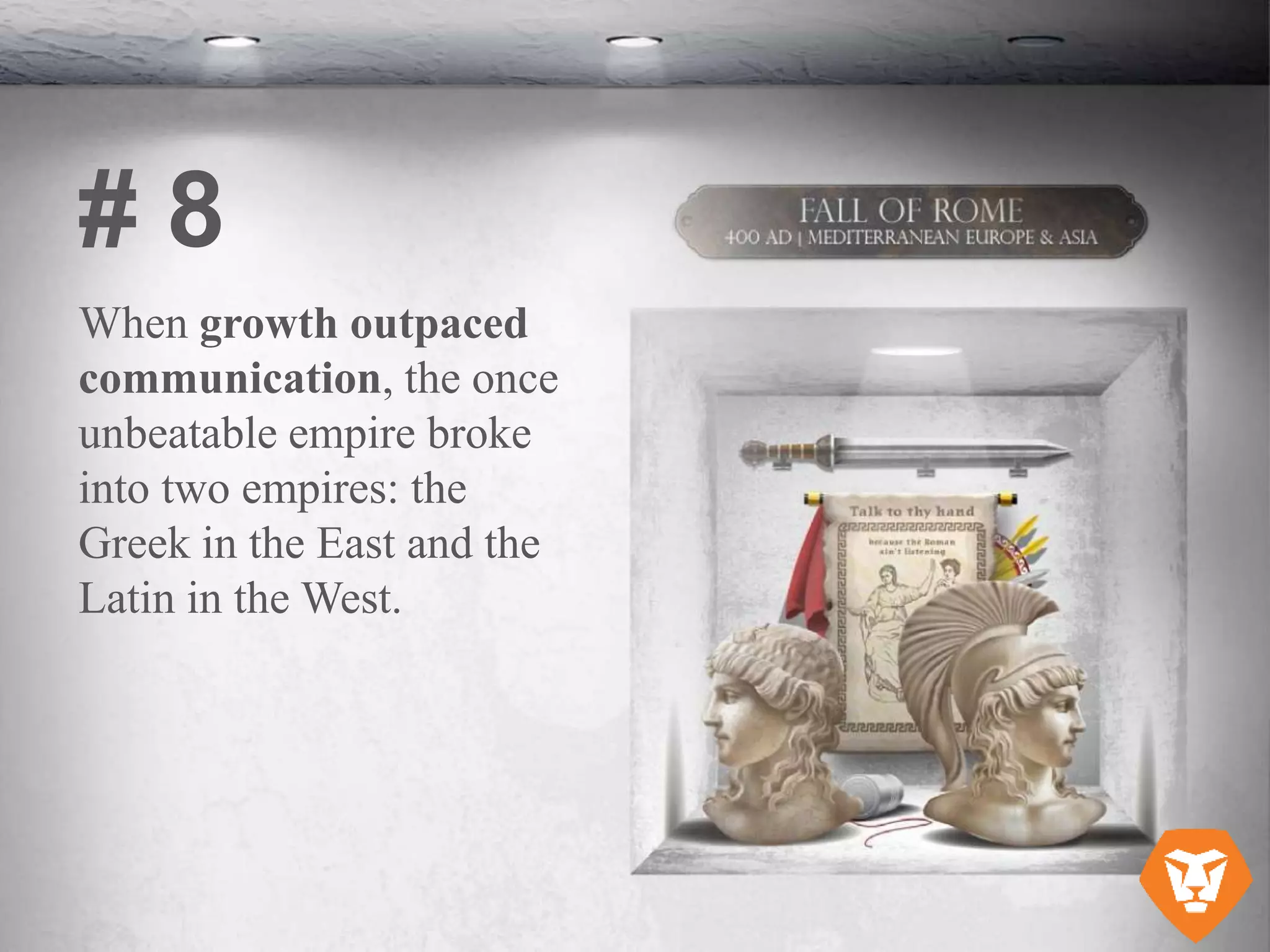
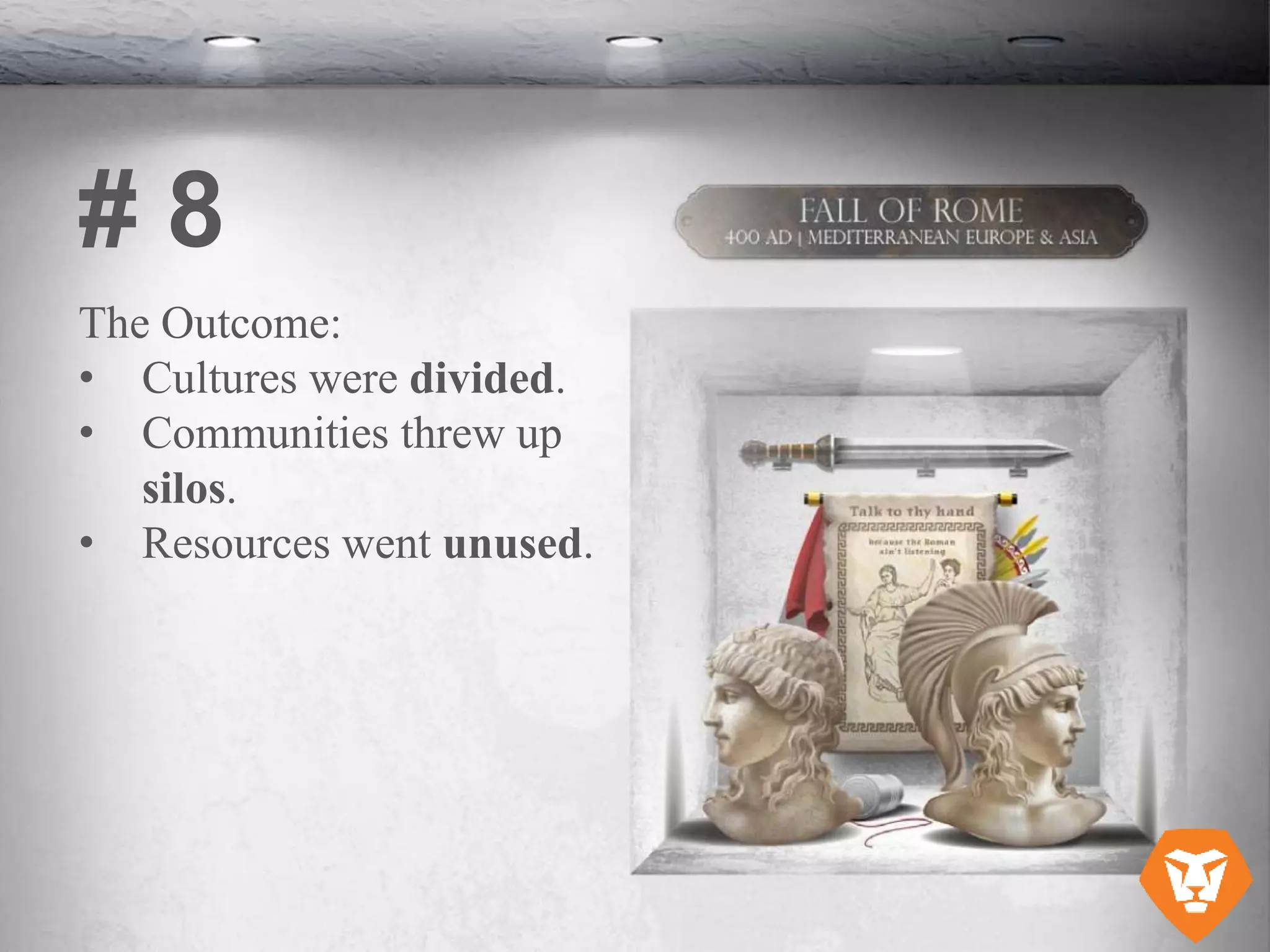
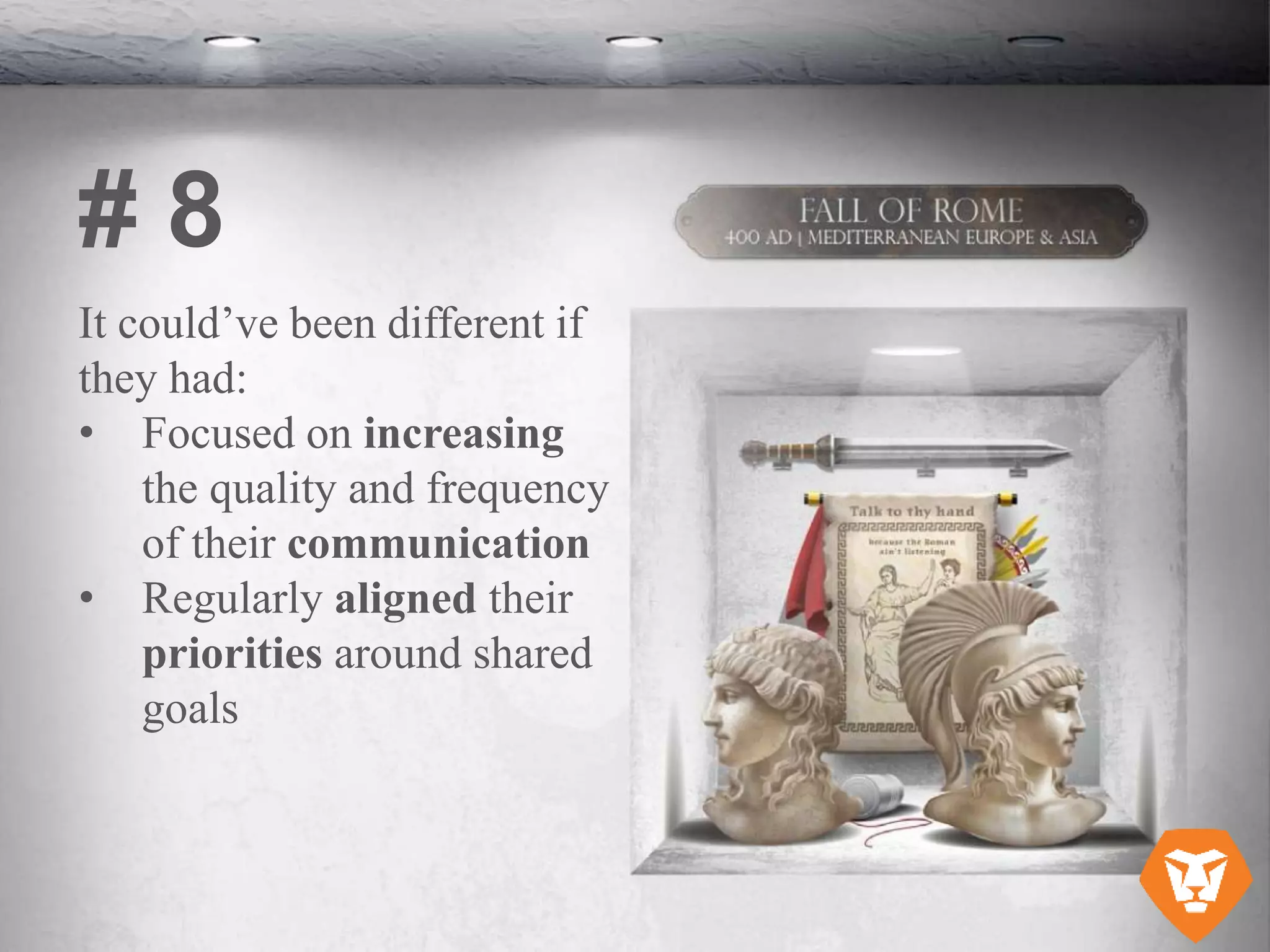
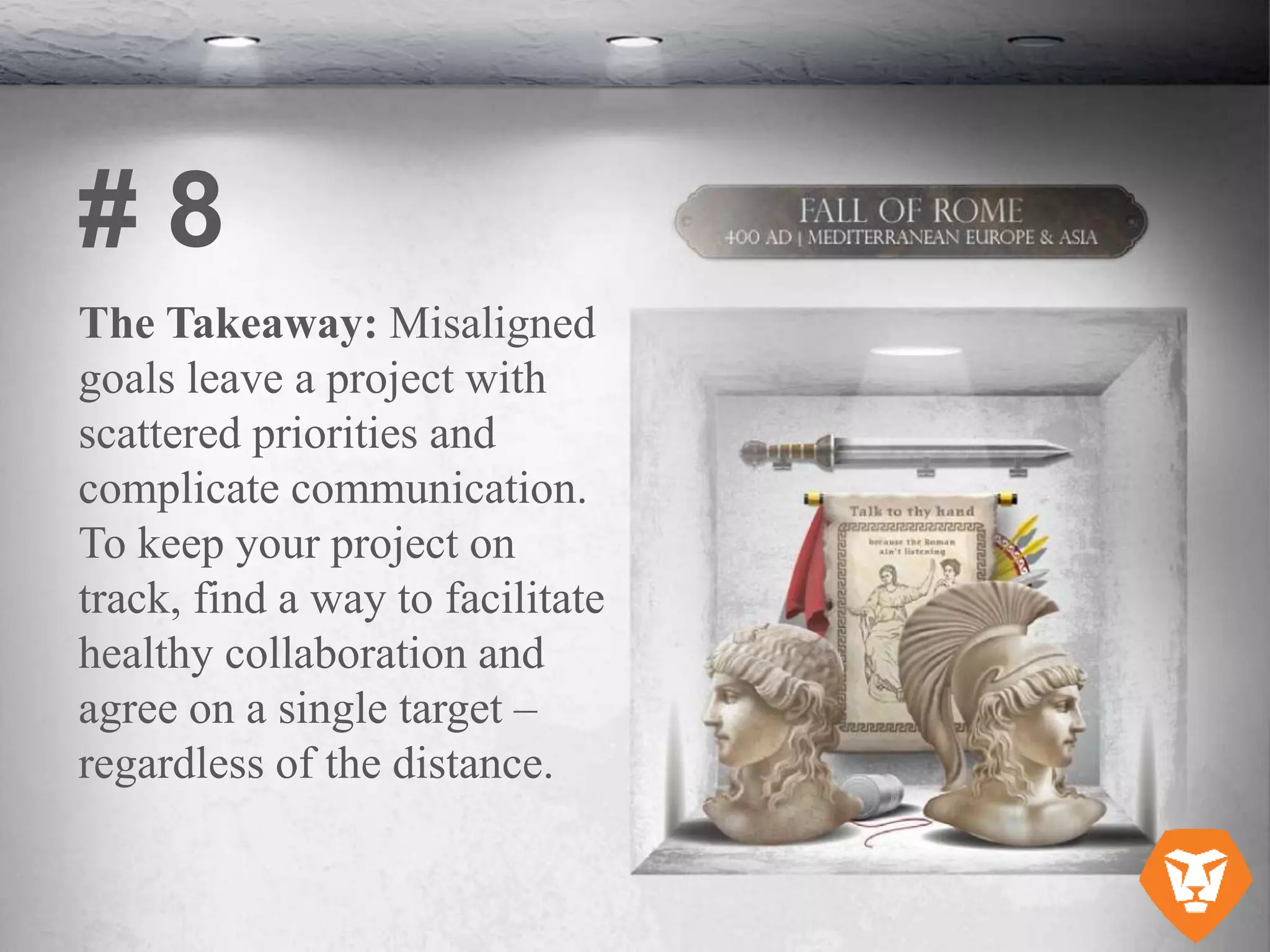
When growth outpaced
communication, the once
unbeatable empire broke
into two empires: the
Greek in the East and the
Latin in the West.
# 8
The Outcome:
• Cultures were divided.
• Communities threw up
silos.
• Resources went unused.
# 8
It could’ve been different if
they had:
• Focused on increasing
the quality and frequency
of their communication
• Regularly aligned their
priorities around shared
goals
# 8
The Takeaway: Misaligned
goals leave a project with
scattered priorities and
complicate communication.
To keep your project on
track, find a way to facilitate
healthy collaboration and
agree on a single target –
regardless of the distance.
# 8
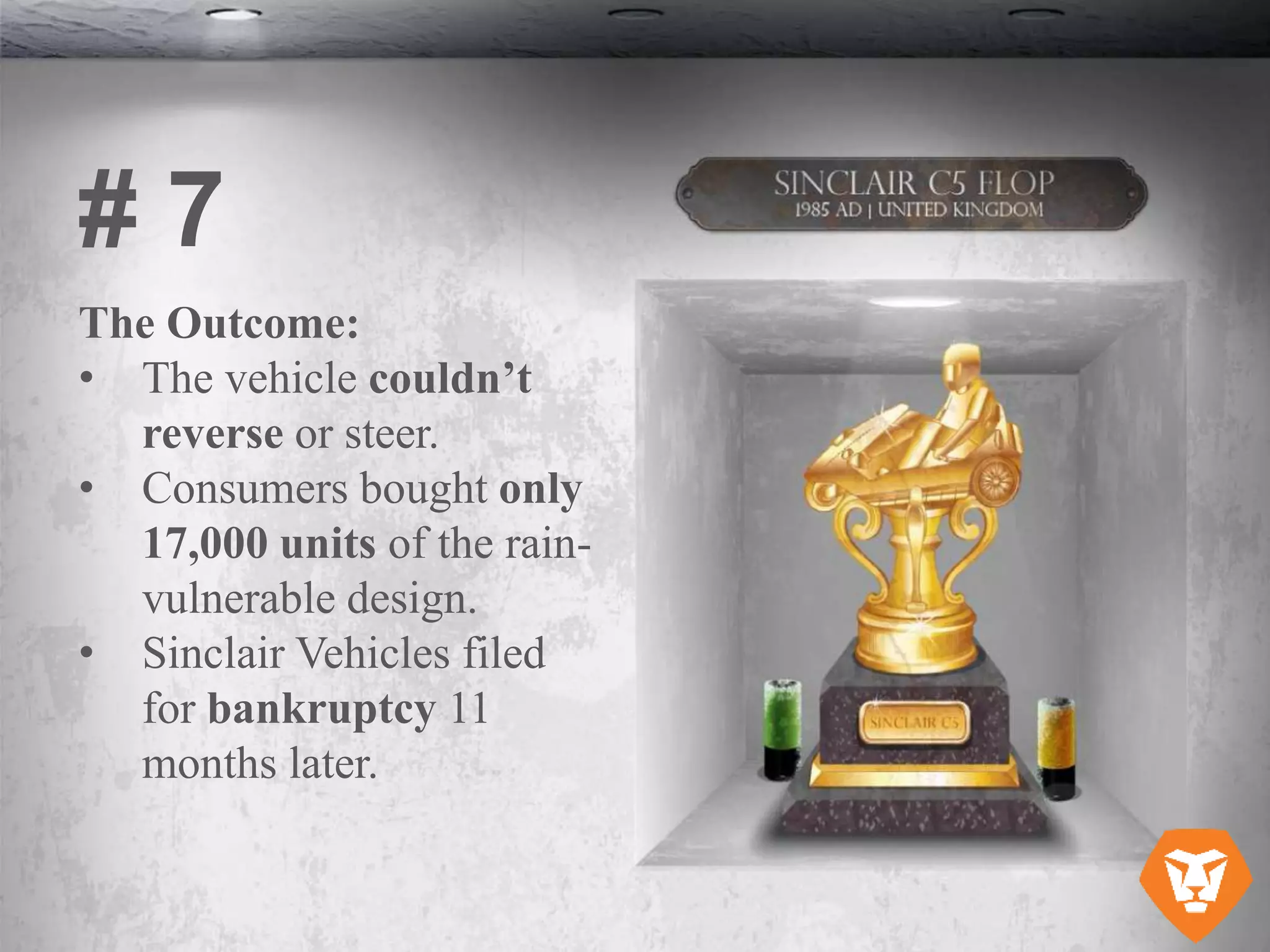
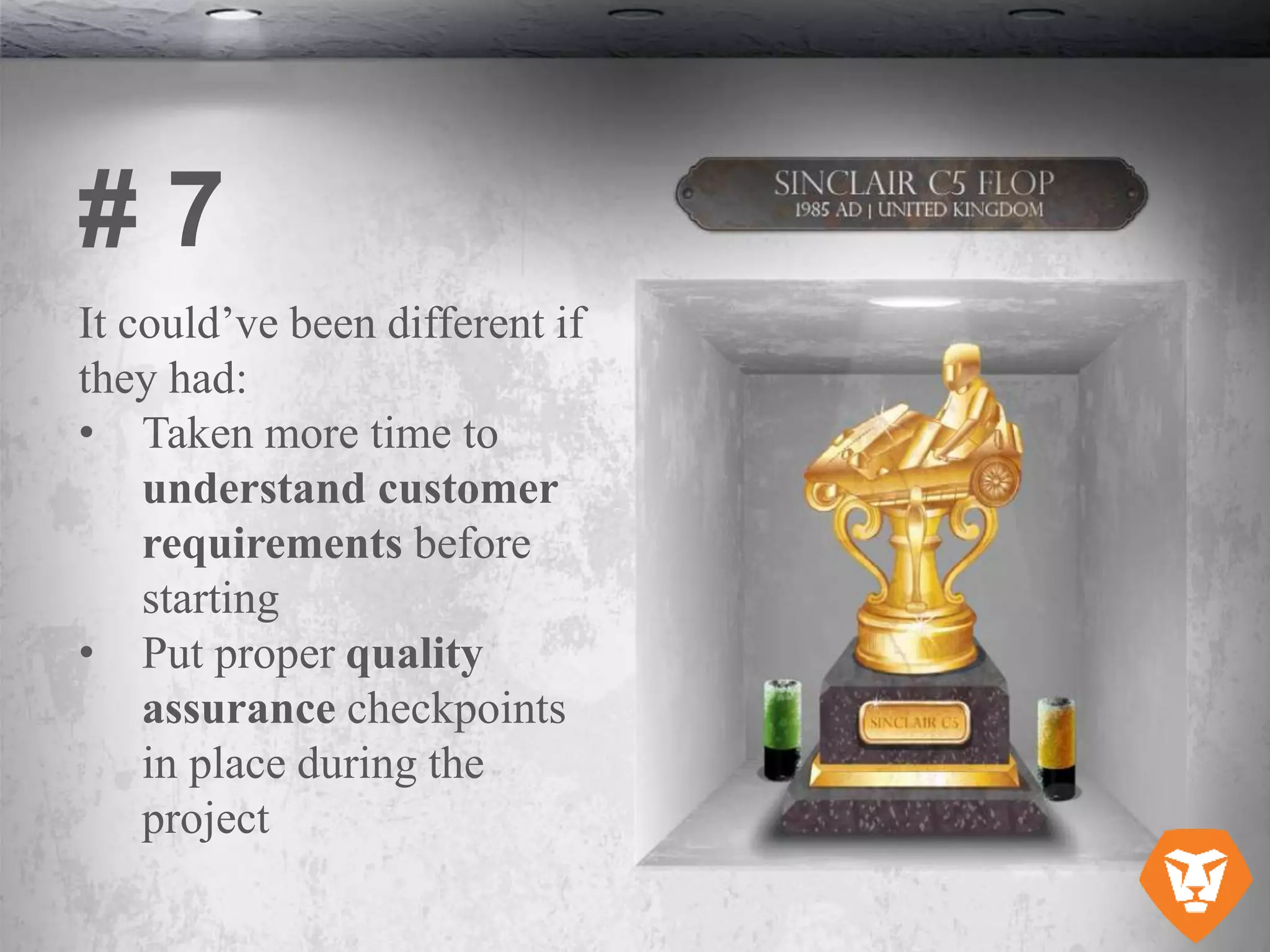
The roofless Sinclair C5
was supposed to be a better,
more affordable way to
commute. Unfortunately, it
went into production
without considering one
immutable fact: its market
was in the rain-heavy
United Kingdom.
# 7
The Outcome:
• The vehicle couldn’t
reverse or steer.
• Consumers bought only
17,000 units of the rain-
vulnerable design.
• Sinclair Vehicles filed
for bankruptcy 11
months later.
# 7
It could’ve been different if
they had:
• Taken more time to
understand customer
requirements before
starting
• Put proper quality
assurance checkpoints
in place during the
project
# 7
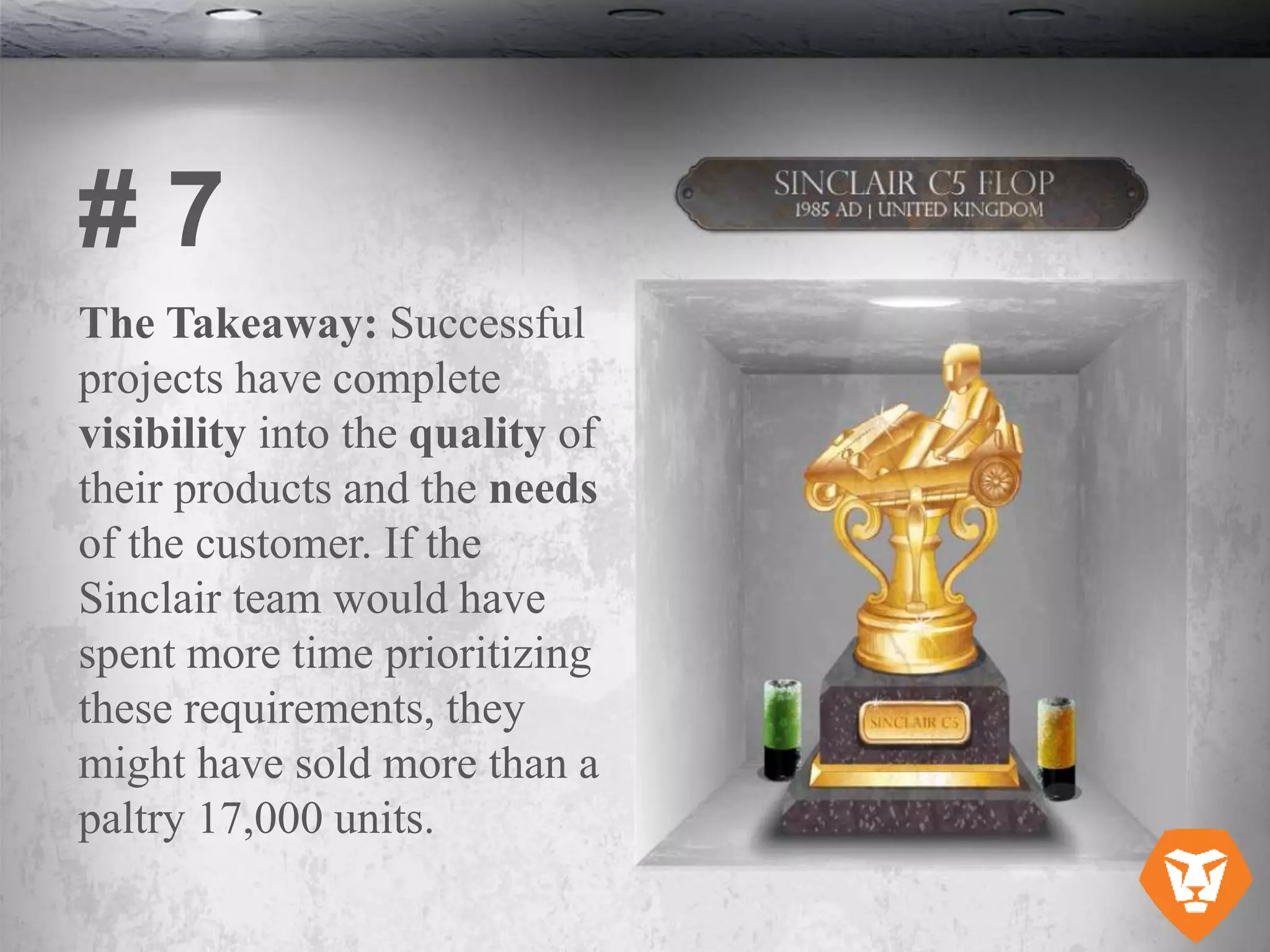
The Takeaway: Successful
projects have complete
visibility into the quality of
their products and the needs
of the customer. If the
Sinclair team would have
spent more time prioritizing
these requirements, they
might have sold more than a
paltry 17,000 units.
# 7
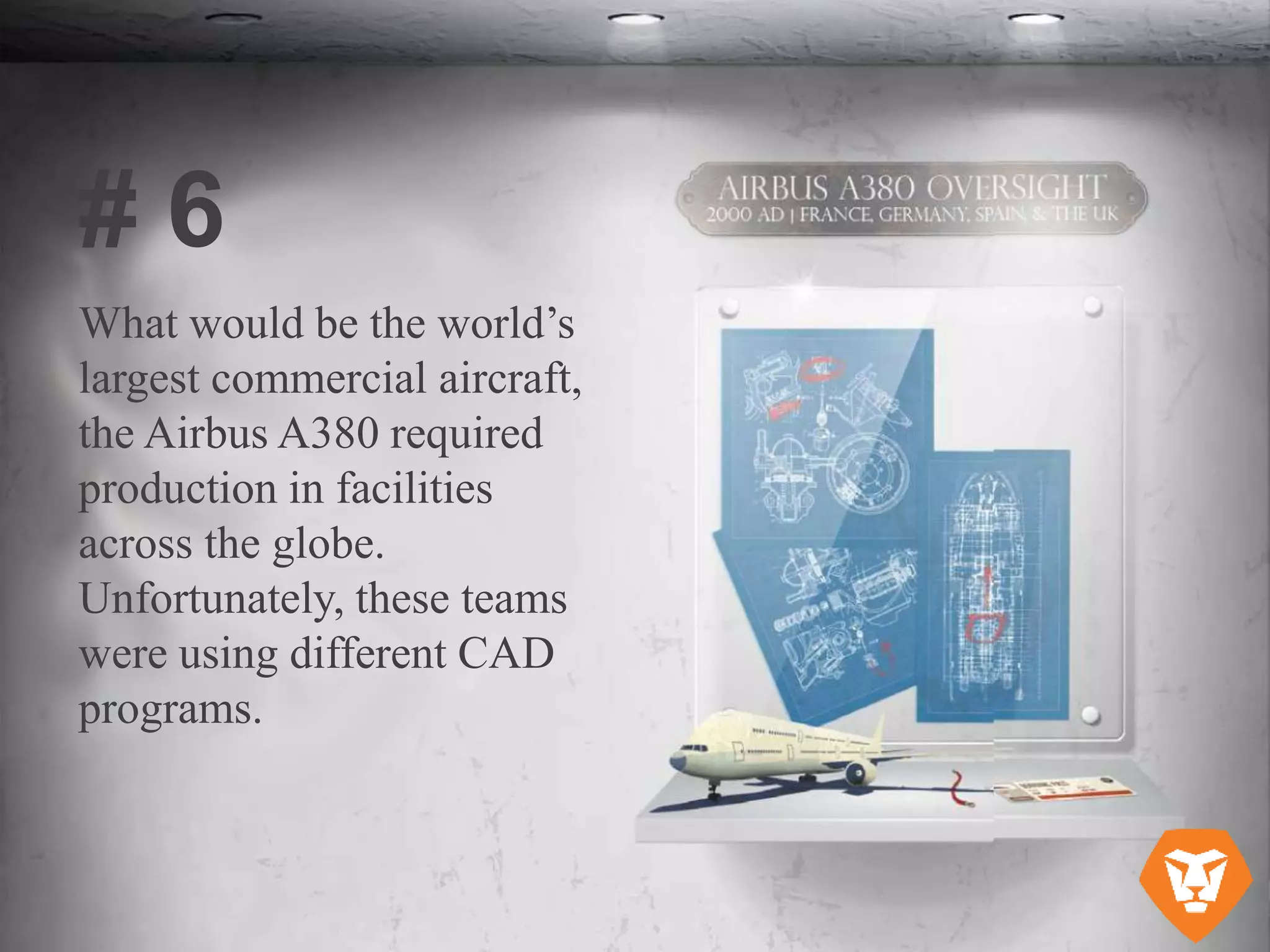
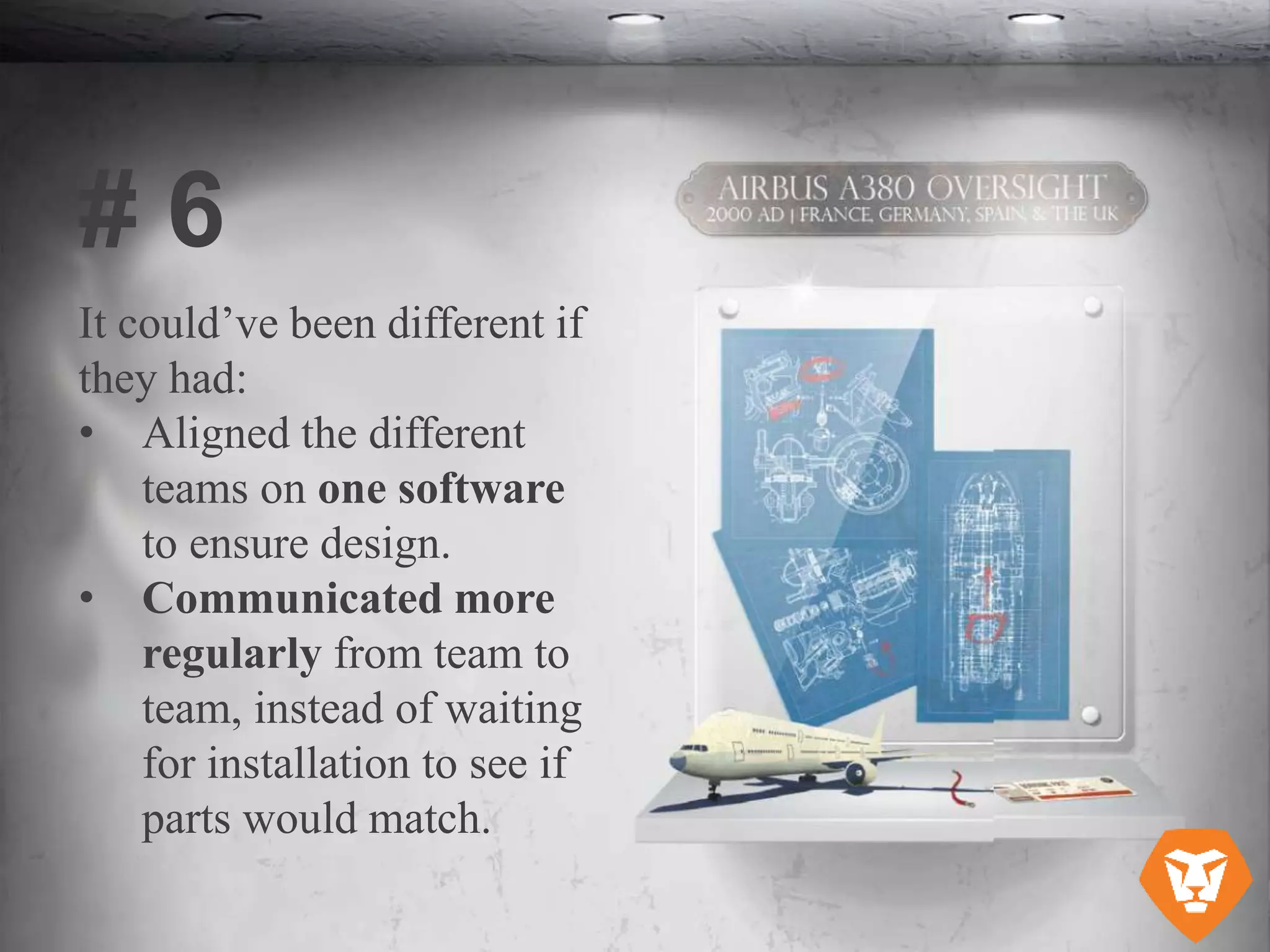
What would be the world’s
largest commercial aircraft,
the Airbus A380 required
production in facilities
across the globe.
Unfortunately, these teams
were using different CAD
programs.
# 6
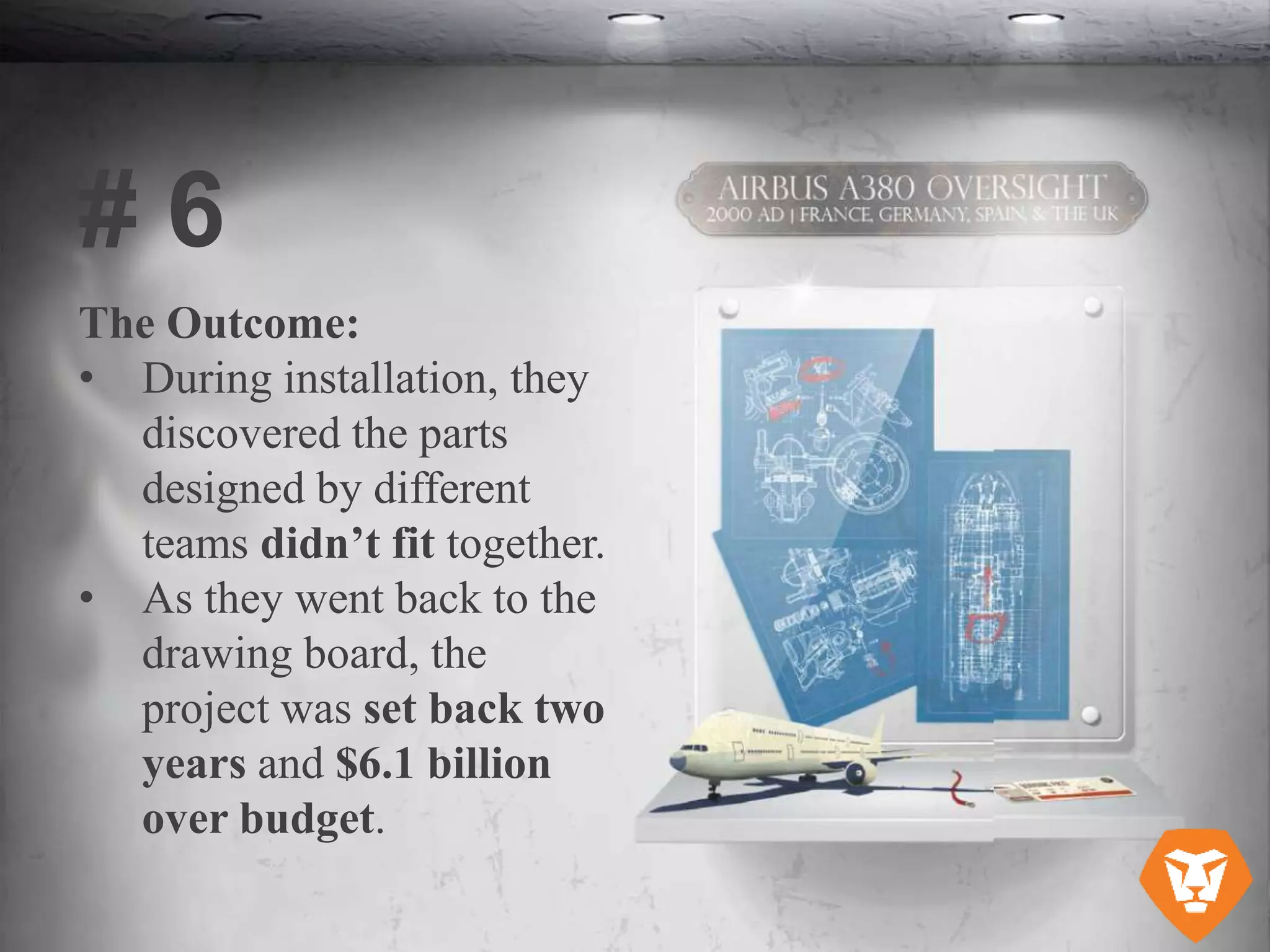
The Outcome:
• During installation, they
discovered the parts
designed by different
teams didn’t fit together.
• As they went back to the
drawing board, the
project was set back two
years and $6.1 billion
over budget.
# 6
It could’ve been different if
they had:
• Aligned the different
teams on one software
to ensure design.
• Communicated more
regularly from team to
team, instead of waiting
for installation to see if
parts would match.
# 6
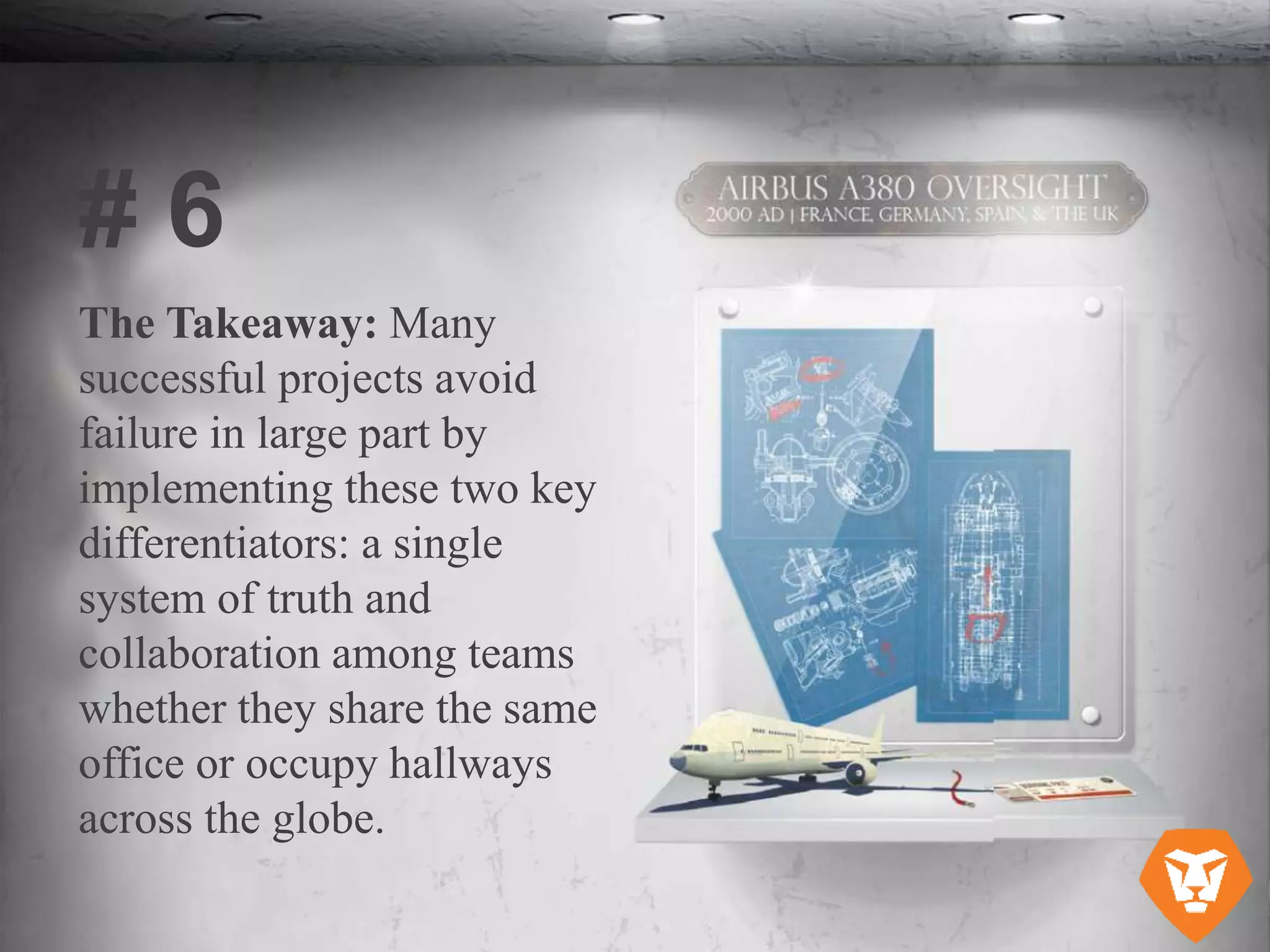
The Takeaway: Many
successful projects avoid
failure in large part by
implementing these two key
differentiators: a single
system of truth and
collaboration among teams
whether they share the same
office or occupy hallways
across the globe.
# 6
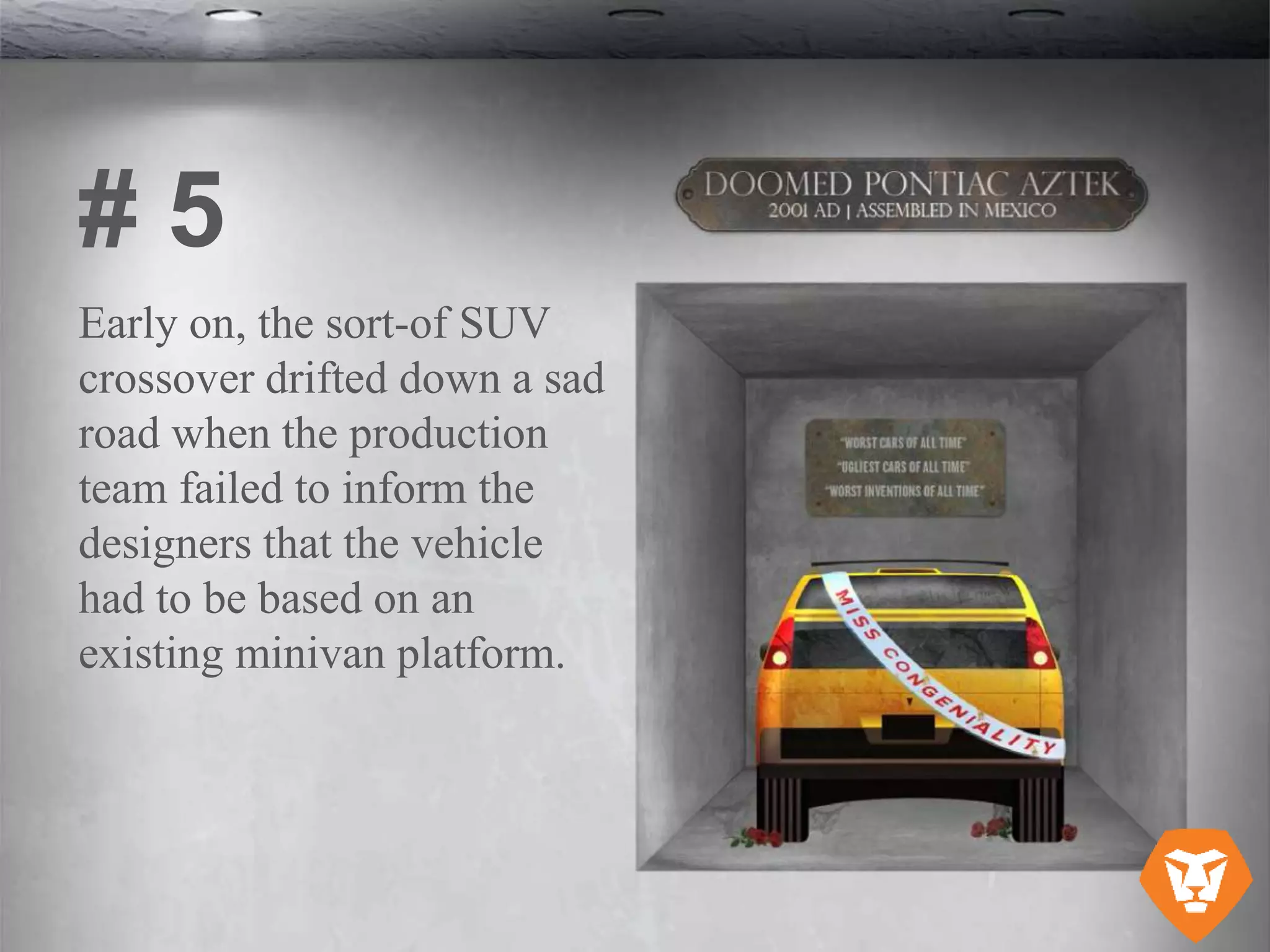
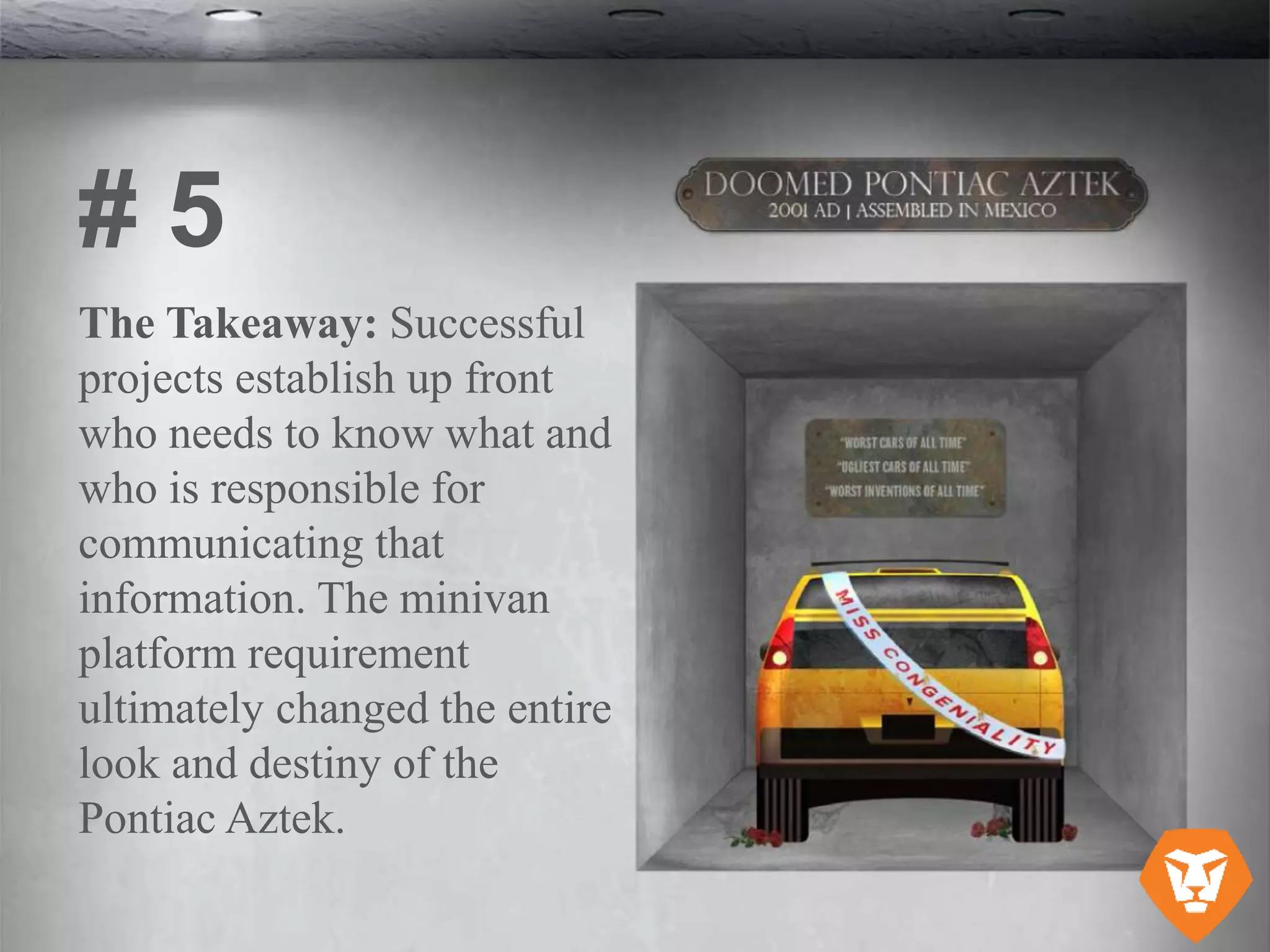
Early on, the sort-of SUV
crossover drifted down a sad
road when the production
team failed to inform the
designers that the vehicle
had to be based on an
existing minivan platform.
# 5
The Outcome:
• It was dubbed “one of the
ugliest cars ever made.”
• The vehicle’s target
audience rejected its
look, price, and add-ons.
• GM sold only 27,322
units, short even of its
modest break-even
estimates.
# 5
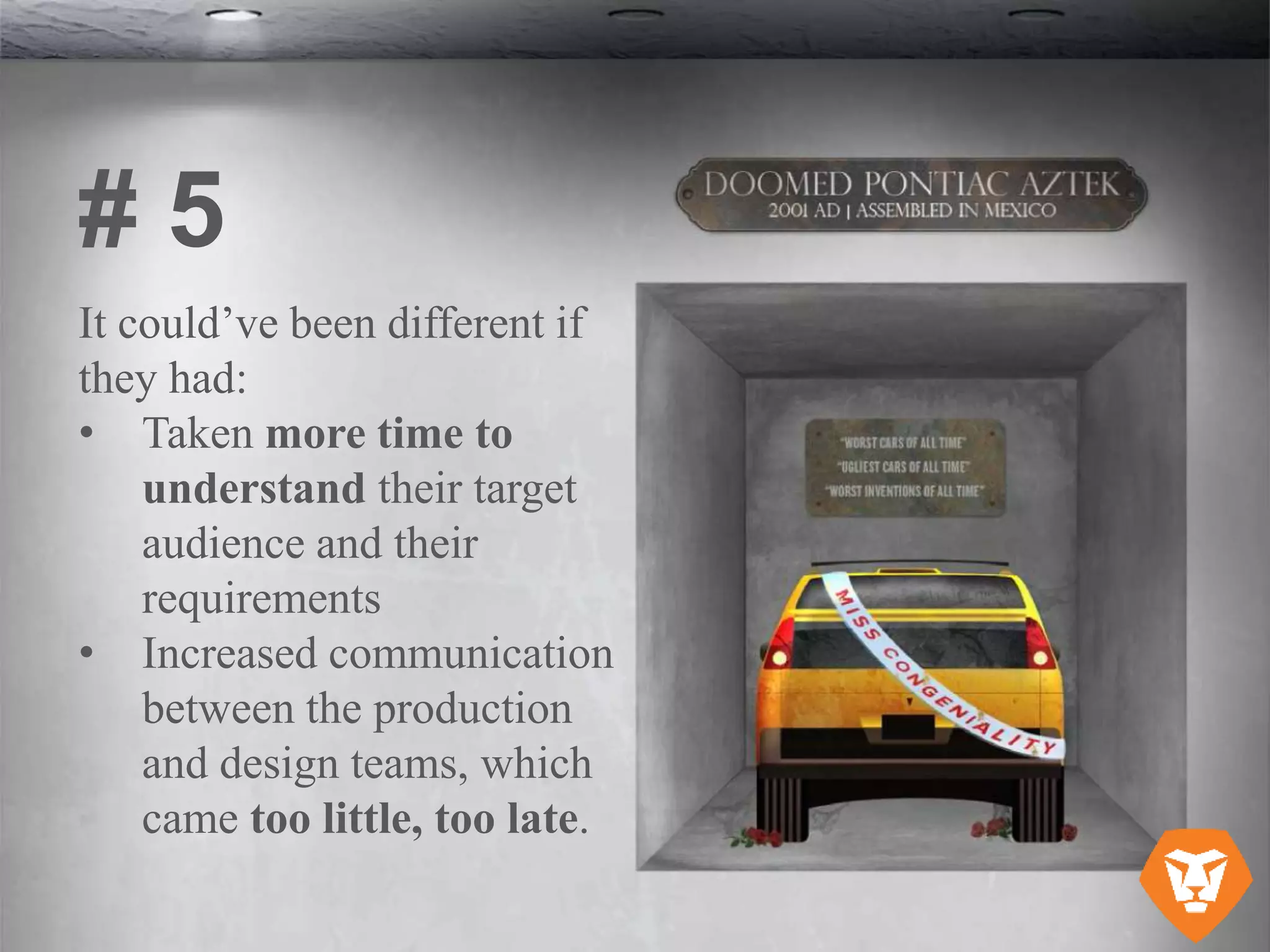
It could’ve been different if
they had:
• Taken more time to
understand their target
audience and their
requirements
• Increased communication
between the production
and design teams, which
came too little, too late.
# 5
The Takeaway: Successful
projects establish up front
who needs to know what and
who is responsible for
communicating that
information. The minivan
platform requirement
ultimately changed the entire
look and destiny of the
Pontiac Aztek.
# 5
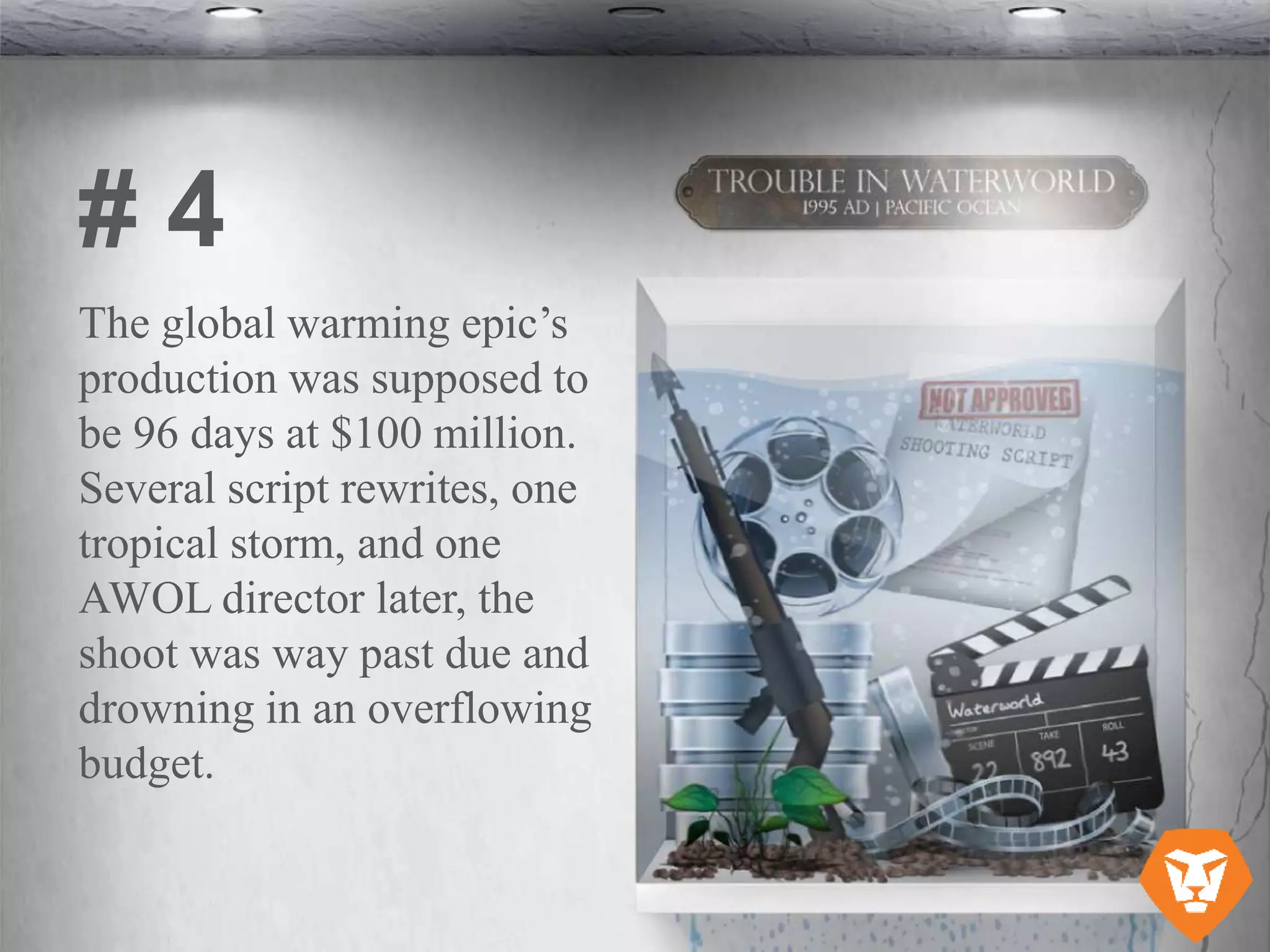
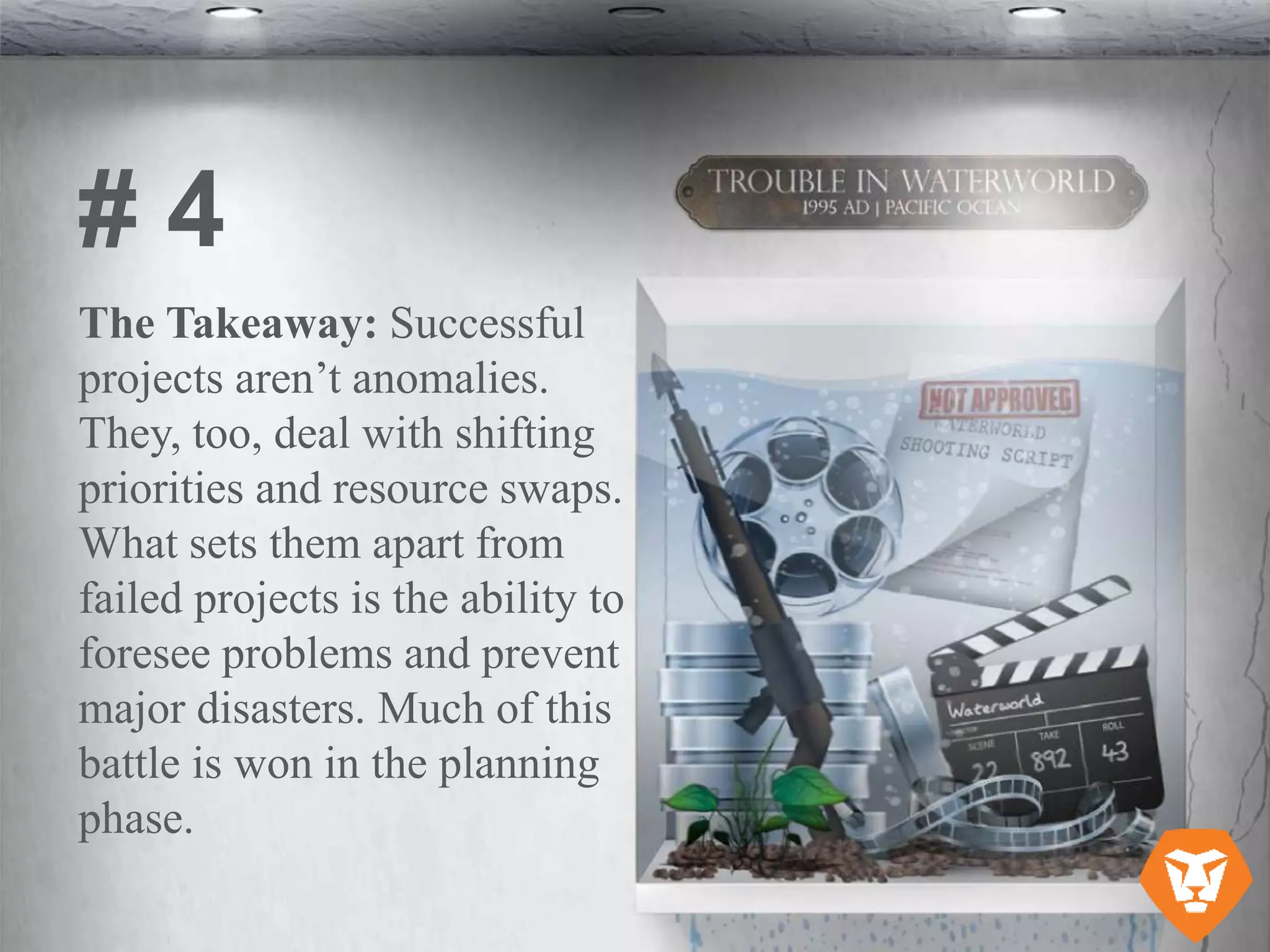
The global warming epic’s
production was supposed to
be 96 days at $100 million.
Several script rewrites, one
tropical storm, and one
AWOL director later, the
shoot was way past due and
drowning in an overflowing
budget.
# 4
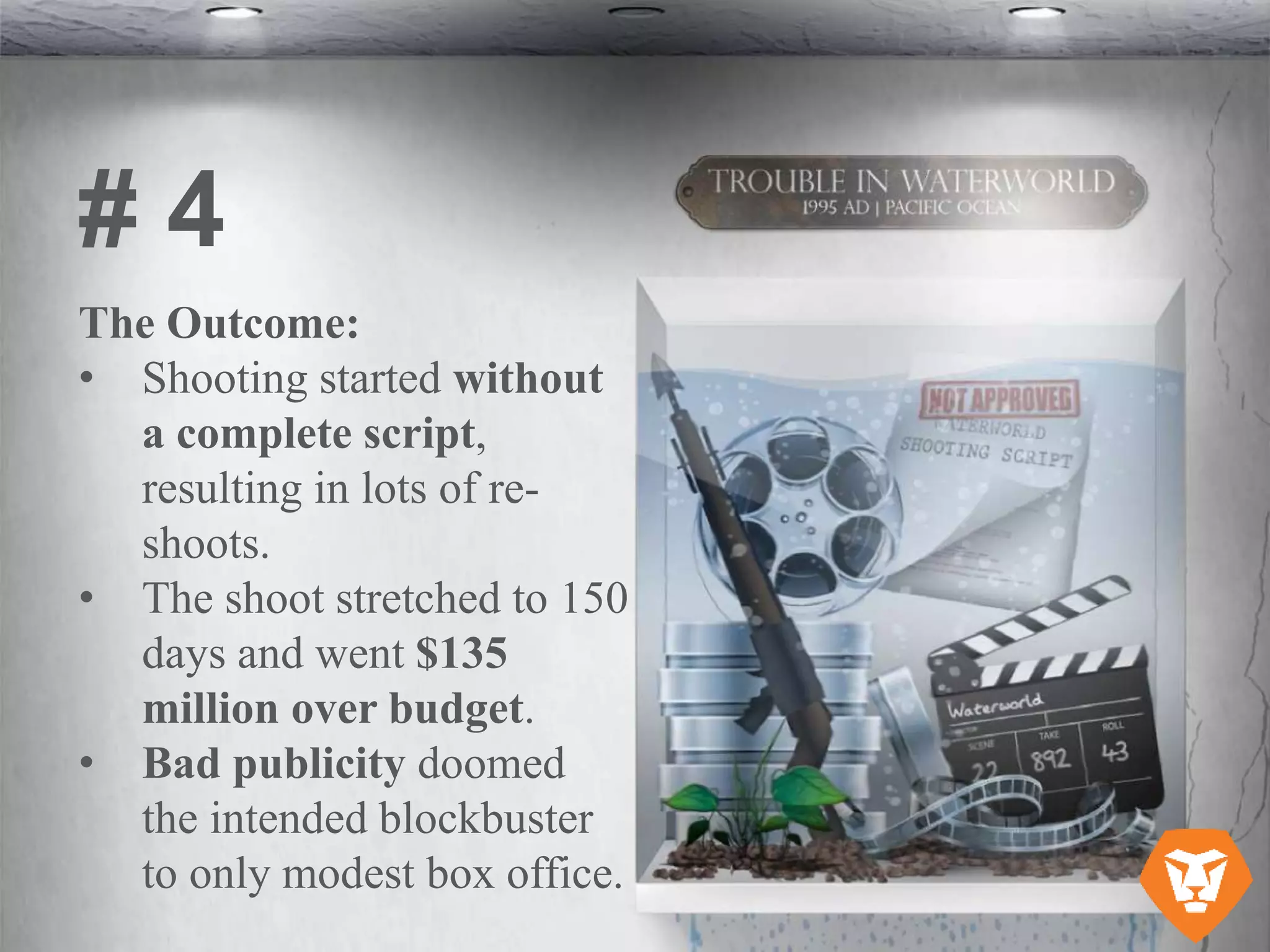
The Outcome:
• Shooting started without
a complete script,
resulting in lots of re-
shoots.
• The shoot stretched to 150
days and went $135
million over budget.
• Bad publicity doomed
the intended blockbuster
to only modest box office.
# 4
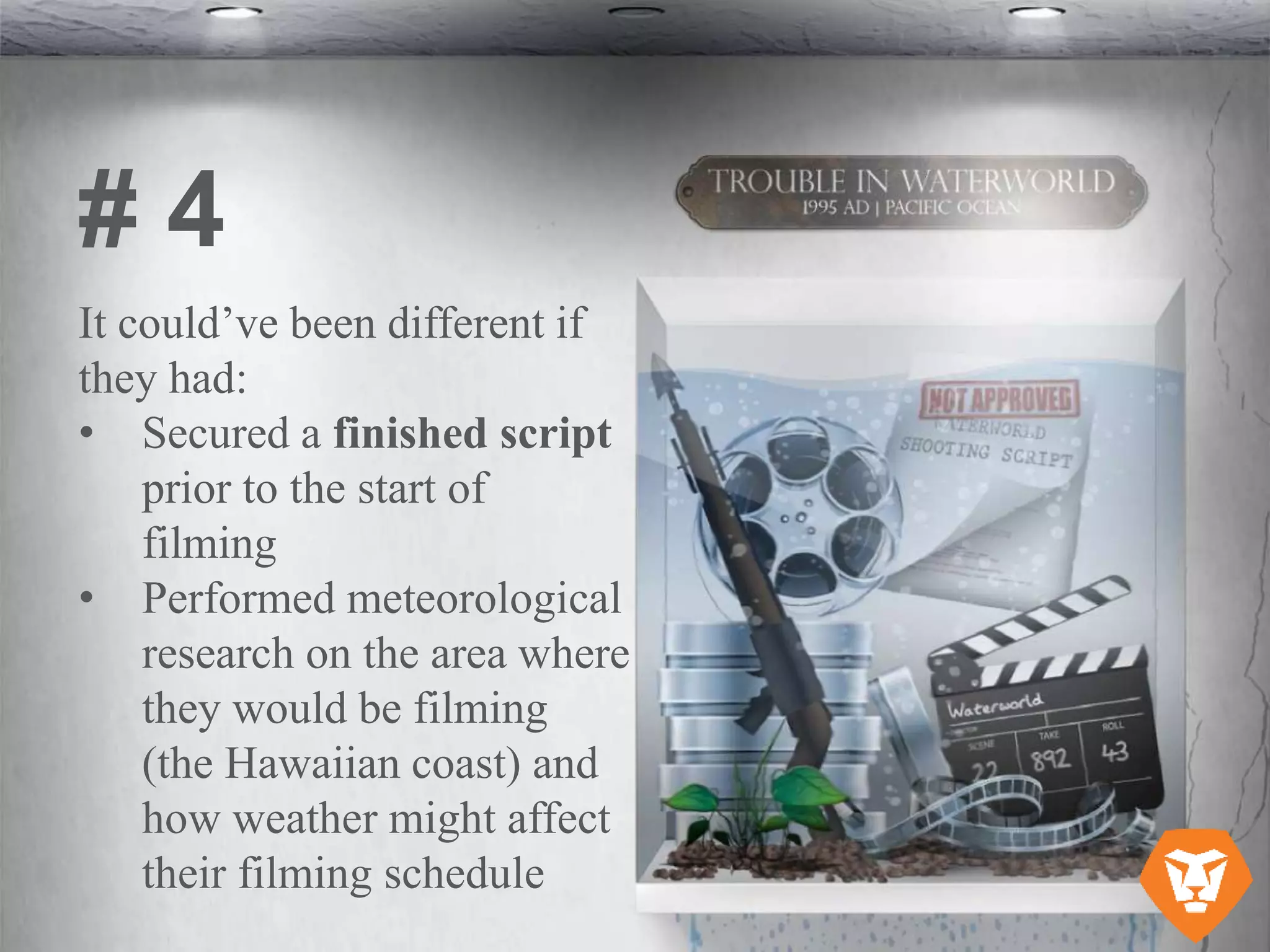
It could’ve been different if
they had:
• Secured a finished script
prior to the start of
filming
• Performed meteorological
research on the area where
they would be filming
(the Hawaiian coast) and
how weather might affect
their filming schedule
# 4
The Takeaway: Successful
projects aren’t anomalies.
They, too, deal with shifting
priorities and resource swaps.
What sets them apart from
failed projects is the ability to
foresee problems and prevent
major disasters. Much of this
battle is won in the planning
phase.
# 4
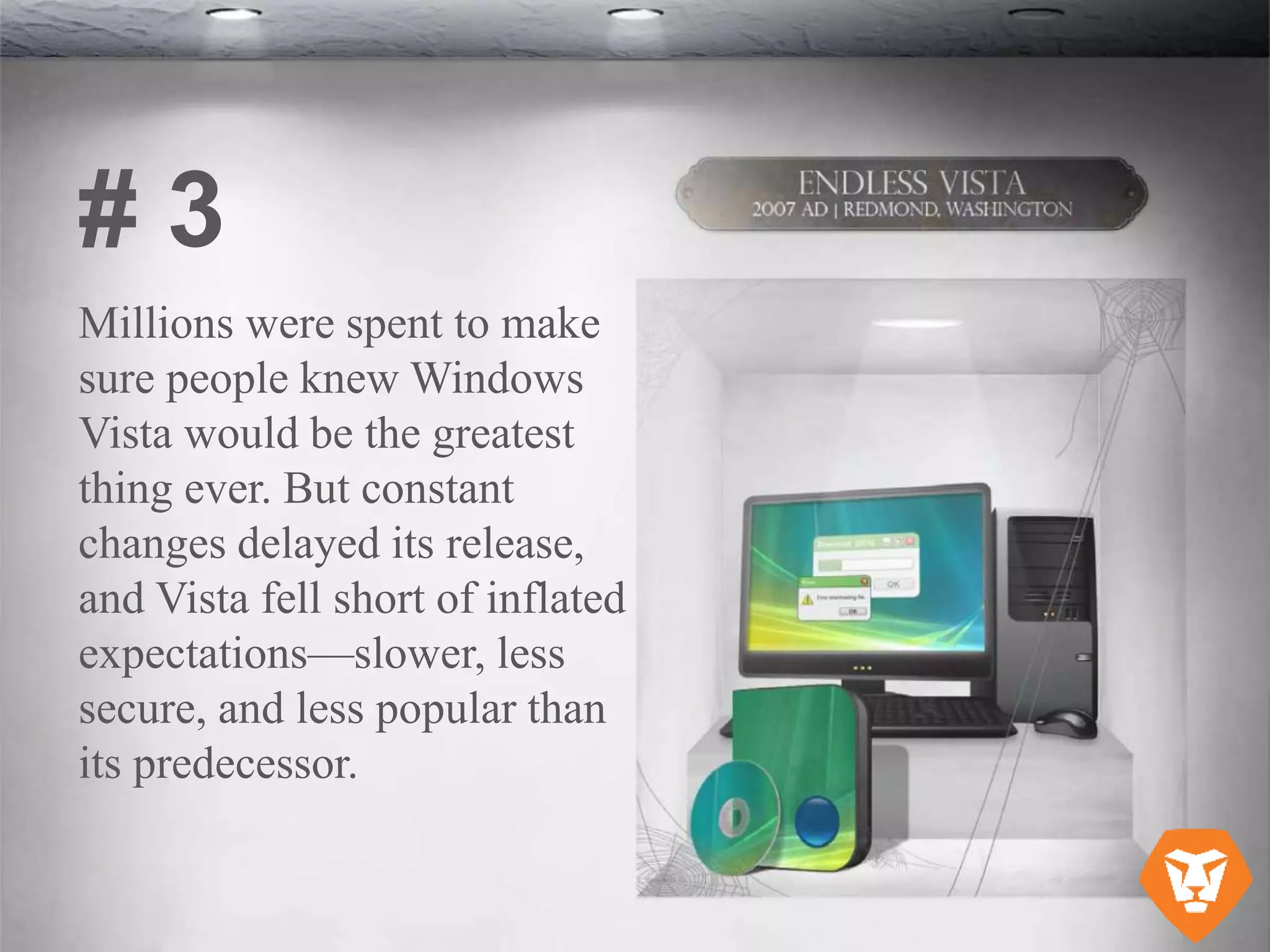
Millions were spent to make
sure people knew Windows
Vista would be the greatest
thing ever. But constant
changes delayed its release,
and Vista fell short of inflated
expectations—slower, less
secure, and less popular than
its predecessor.
# 3
The Outcome:
• One-third of all new PC
owners abandoned Vista
in favor of Windows XP.
• Delays caused Vista to be
released in the slowest
selling season of the year.
• Existing software on the
market wasn’t
compatible with Vista.
# 3
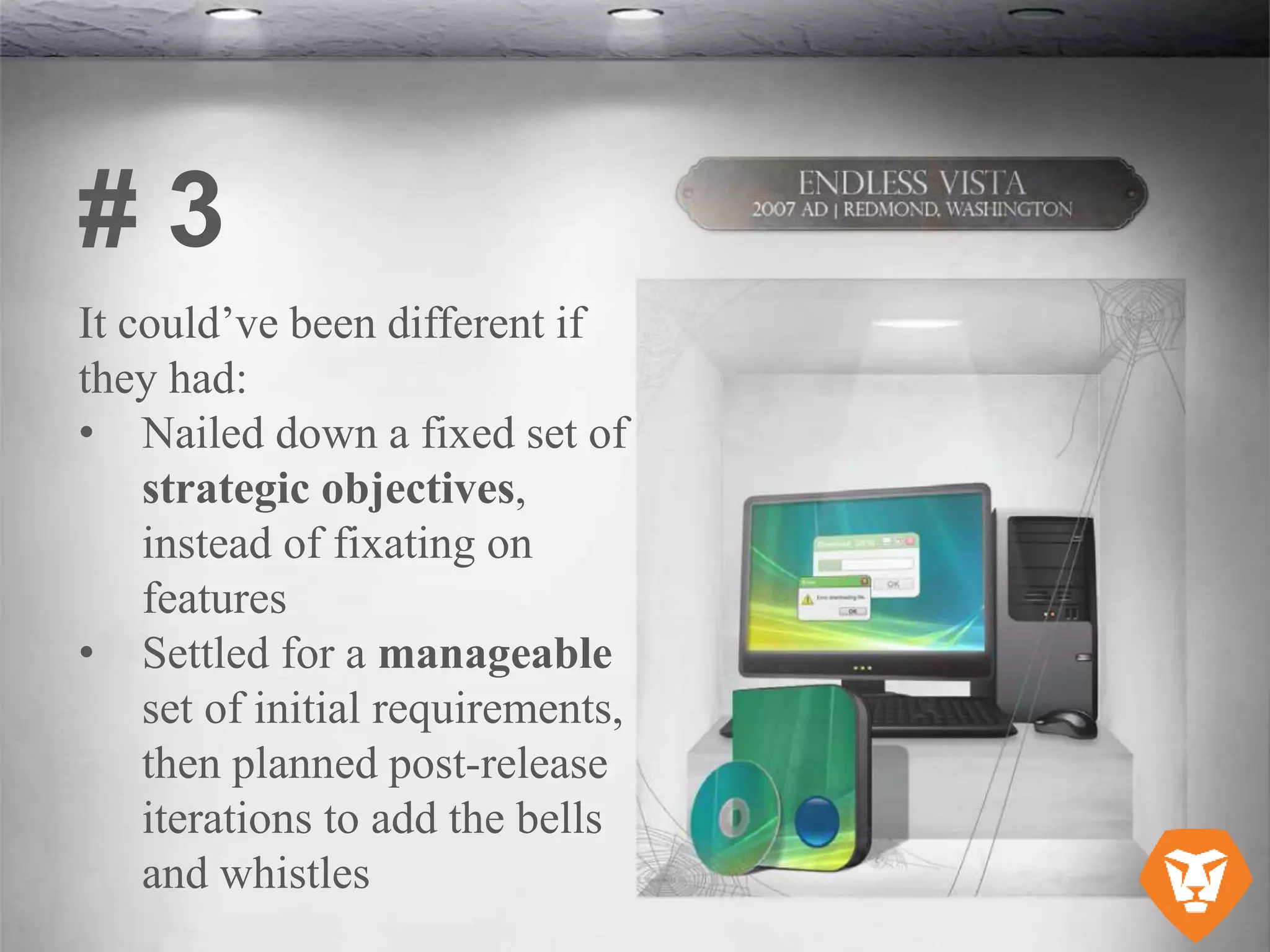
It could’ve been different if
they had:
• Nailed down a fixed set of
strategic objectives,
instead of fixating on
features
• Settled for a manageable
set of initial requirements,
then planned post-release
iterations to add the bells
and whistles
# 3
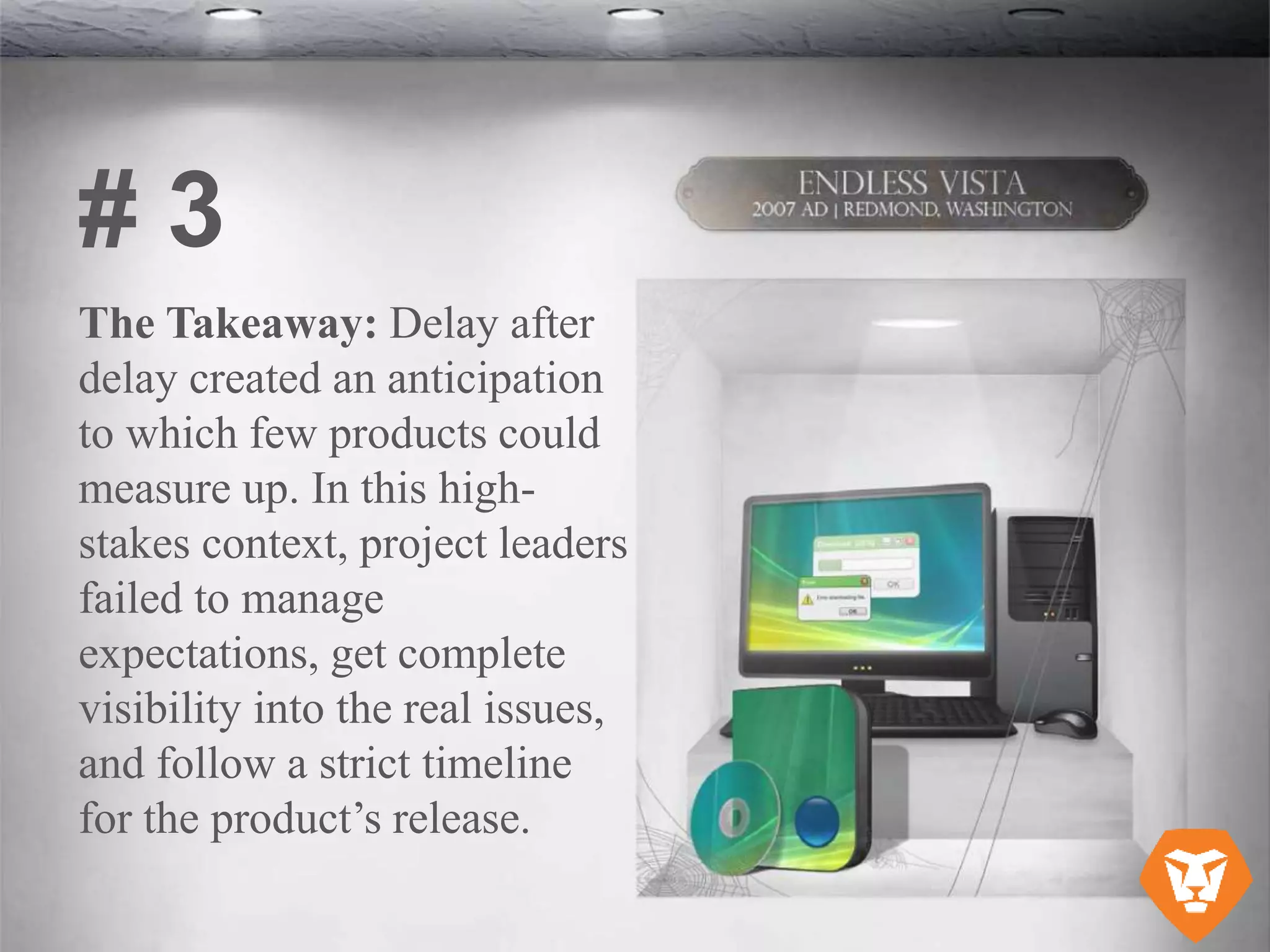
The Takeaway: Delay after
delay created an anticipation
to which few products could
measure up. In this high-
stakes context, project leaders
failed to manage
expectations, get complete
visibility into the real issues,
and follow a strict timeline
for the product’s release.
# 3
When Knight Capital was
brought on to work on new
code for a new SEC program,
an aggressive deadline was
set. It’s highly likely, experts
say, that Knight Capital, short
on time, went to production
with test code.
# 2
The Outcome:
• A glitch cost the company
$440 million in the first
30 minutes of trading—3x
their annual earnings.
• Company stock fell 75%
in just two days.
• The company nearly went
bankrupt and had to take
out a $400-million line of
credit.
# 2
It could’ve been different if
they had:
• Invested in better resource
management to forecast
how long the project
would feasibly take and
avoid setting an arbitrary
deadline
• Established a more robust
quality assurance process
# 2
The Takeaway: Successful
projects utilize the resources
they have and outsource work
they can’t complete if they’re
on a deadline. Successful
project managers build in
time for proper QA.
# 2
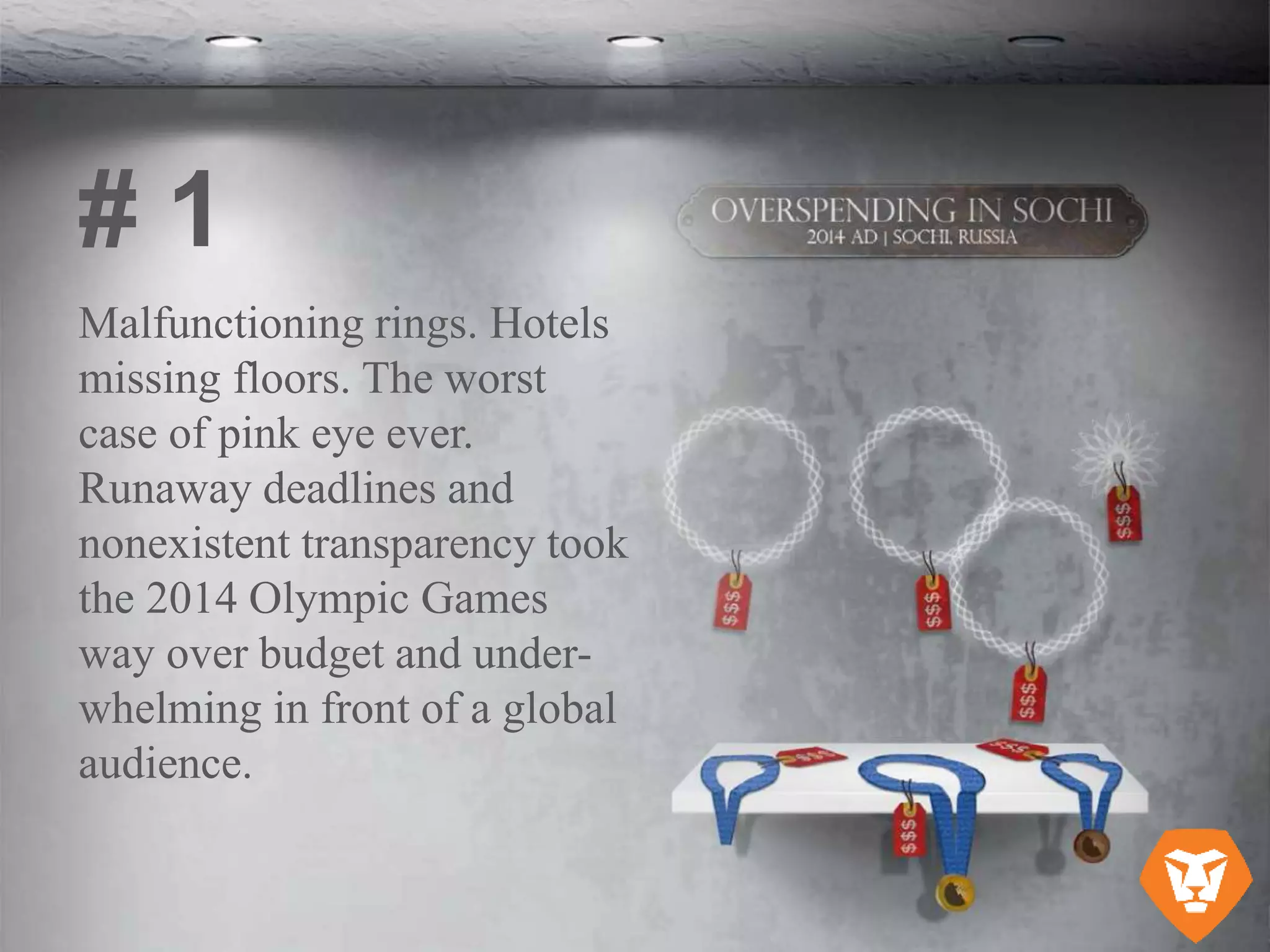
Malfunctioning rings. Hotels
missing floors. The worst
case of pink eye ever.
Runaway deadlines and
nonexistent transparency took
the 2014 Olympic Games
way over budget and under-
whelming in front of a global
audience.
# 1
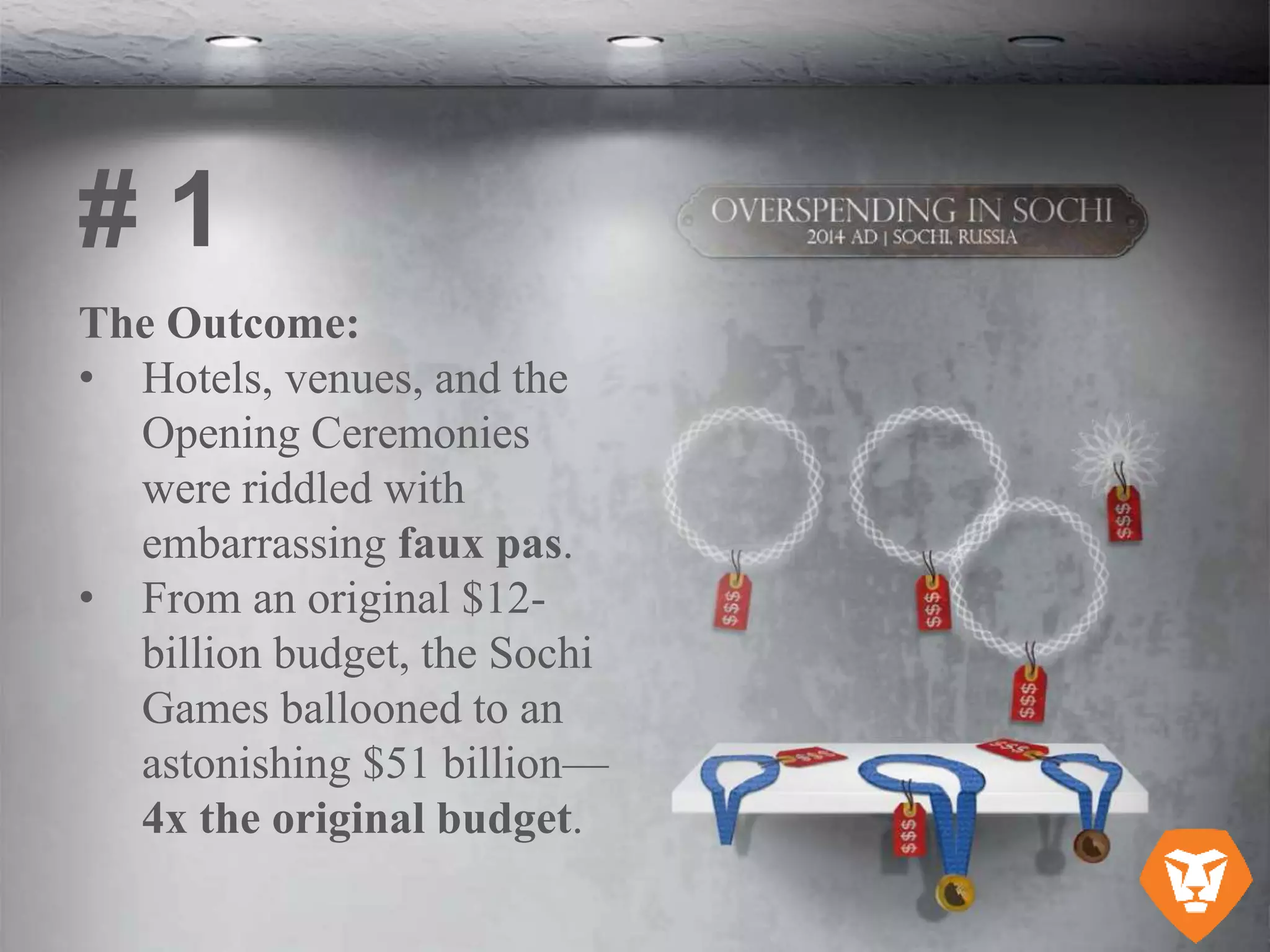
The Outcome:
• Hotels, venues, and the
Opening Ceremonies
were riddled with
embarrassing faux pas.
• From an original $12-
billion budget, the Sochi
Games ballooned to an
astonishing $51 billion—
4x the original budget.
# 1
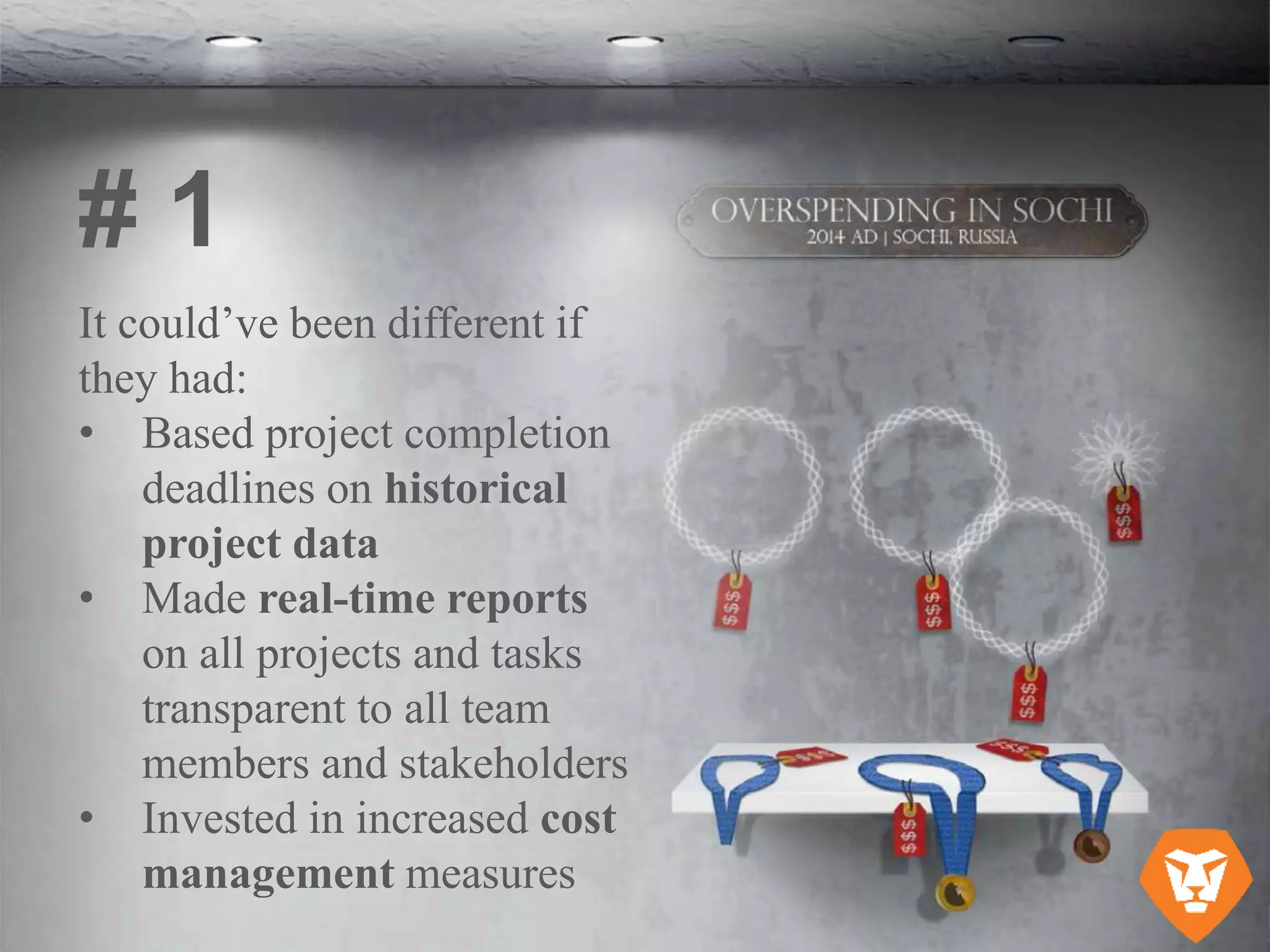
It could’ve been different if
they had:
• Based project completion
deadlines on historical
project data
• Made real-time reports
on all projects and tasks
transparent to all team
members and stakeholders
• Invested in increased cost
management measures
# 1
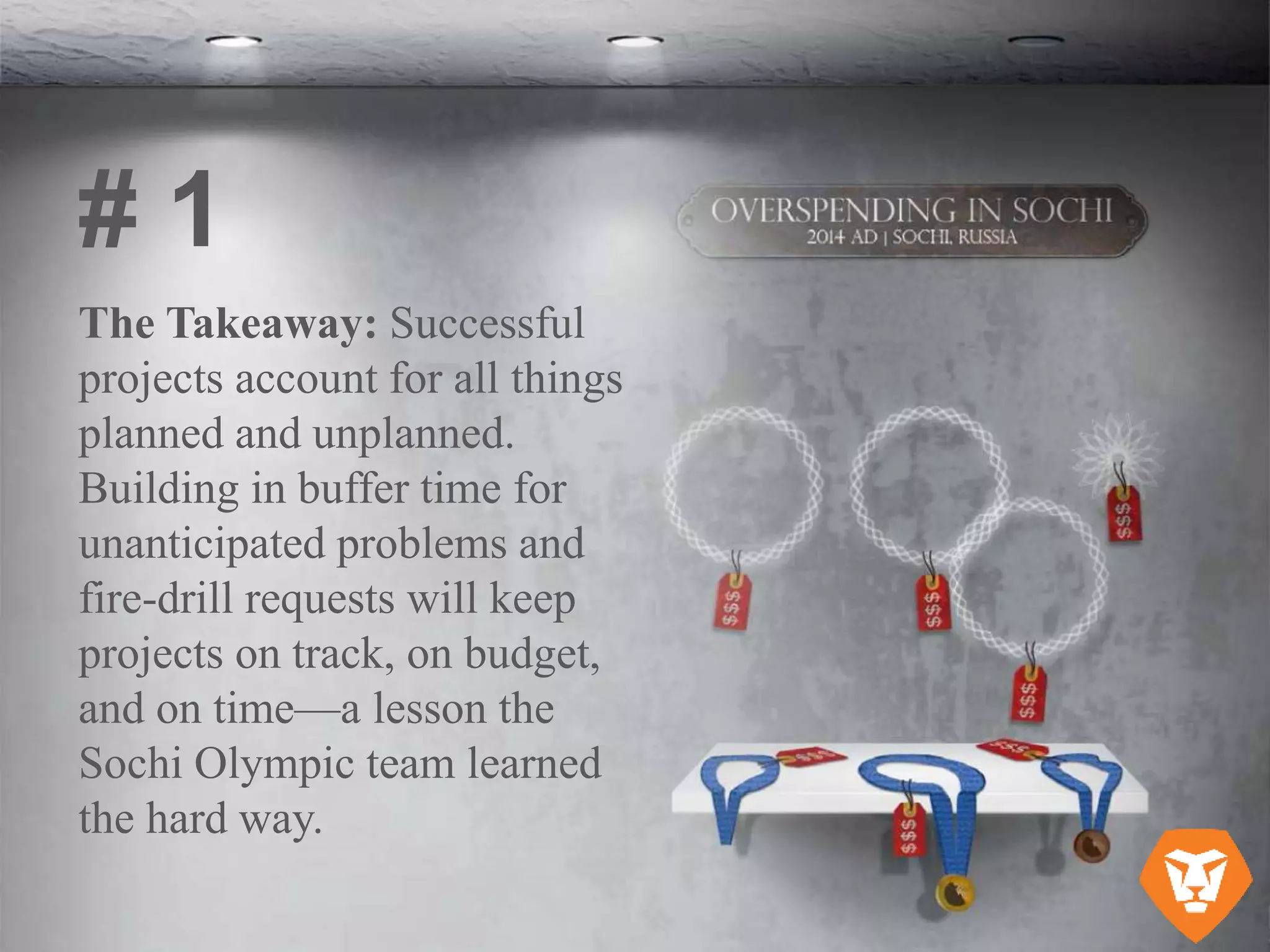
The Takeaway: Successful
projects account for all things
planned and unplanned.
Building in buffer time for
unanticipated problems and
fire-drill requests will keep
projects on track, on budget,
and on time—a lesson the
Sochi Olympic team learned
the hard way.
# 1
A Conclusion to Failure
Yes, hindsight is 20/20. However, with rare exception,
even the biggest project failures can be avoided by
improving requirements-gathering, alignment, and
estimates during the planning phase and increasing
communication and reporting during production.
The 8 Worst Managed Projects of All Time

The 8 Worst Managed Projects of All Time

  • 1.
    The 8 Worst-Managed Projectsof All Time How you can learn from history with better planning, communication, and foresight
  • 2.
    An Introduction toFailure Most projects start out as great ideas. But, somewhere along the way, mistakes are made, communication breaks down, and, most projects—70% of them— end up late, over budget, and on the way to the project dumpster.
  • 3.
    An Introduction toFailure The following 8 projects failed epically, but therein are contained lessons any smart work manager can benefit from, like: • The value of getting project goals aligned • The wisdom of controlling requirements and budget • The need to set and adhere to realistic deadlines
  • 4.
    When growth outpaced communication,the once unbeatable empire broke into two empires: the Greek in the East and the Latin in the West. # 8
  • 5.
    The Outcome: • Cultureswere divided. • Communities threw up silos. • Resources went unused. # 8
  • 6.
    It could’ve beendifferent if they had: • Focused on increasing the quality and frequency of their communication • Regularly aligned their priorities around shared goals # 8
  • 7.
    The Takeaway: Misaligned goalsleave a project with scattered priorities and complicate communication. To keep your project on track, find a way to facilitate healthy collaboration and agree on a single target – regardless of the distance. # 8
  • 8.
    The roofless SinclairC5 was supposed to be a better, more affordable way to commute. Unfortunately, it went into production without considering one immutable fact: its market was in the rain-heavy United Kingdom. # 7
  • 9.
    The Outcome: • Thevehicle couldn’t reverse or steer. • Consumers bought only 17,000 units of the rain- vulnerable design. • Sinclair Vehicles filed for bankruptcy 11 months later. # 7
  • 10.
    It could’ve beendifferent if they had: • Taken more time to understand customer requirements before starting • Put proper quality assurance checkpoints in place during the project # 7
  • 11.
    The Takeaway: Successful projectshave complete visibility into the quality of their products and the needs of the customer. If the Sinclair team would have spent more time prioritizing these requirements, they might have sold more than a paltry 17,000 units. # 7
  • 12.
    What would bethe world’s largest commercial aircraft, the Airbus A380 required production in facilities across the globe. Unfortunately, these teams were using different CAD programs. # 6
  • 13.
    The Outcome: • Duringinstallation, they discovered the parts designed by different teams didn’t fit together. • As they went back to the drawing board, the project was set back two years and $6.1 billion over budget. # 6
  • 14.
    It could’ve beendifferent if they had: • Aligned the different teams on one software to ensure design. • Communicated more regularly from team to team, instead of waiting for installation to see if parts would match. # 6
  • 15.
    The Takeaway: Many successfulprojects avoid failure in large part by implementing these two key differentiators: a single system of truth and collaboration among teams whether they share the same office or occupy hallways across the globe. # 6
  • 16.
    Early on, thesort-of SUV crossover drifted down a sad road when the production team failed to inform the designers that the vehicle had to be based on an existing minivan platform. # 5
  • 17.
    The Outcome: • Itwas dubbed “one of the ugliest cars ever made.” • The vehicle’s target audience rejected its look, price, and add-ons. • GM sold only 27,322 units, short even of its modest break-even estimates. # 5
  • 18.
    It could’ve beendifferent if they had: • Taken more time to understand their target audience and their requirements • Increased communication between the production and design teams, which came too little, too late. # 5
  • 19.
    The Takeaway: Successful projectsestablish up front who needs to know what and who is responsible for communicating that information. The minivan platform requirement ultimately changed the entire look and destiny of the Pontiac Aztek. # 5
  • 20.
    The global warmingepic’s production was supposed to be 96 days at $100 million. Several script rewrites, one tropical storm, and one AWOL director later, the shoot was way past due and drowning in an overflowing budget. # 4
  • 21.
    The Outcome: • Shootingstarted without a complete script, resulting in lots of re- shoots. • The shoot stretched to 150 days and went $135 million over budget. • Bad publicity doomed the intended blockbuster to only modest box office. # 4
  • 22.
    It could’ve beendifferent if they had: • Secured a finished script prior to the start of filming • Performed meteorological research on the area where they would be filming (the Hawaiian coast) and how weather might affect their filming schedule # 4
  • 23.
    The Takeaway: Successful projectsaren’t anomalies. They, too, deal with shifting priorities and resource swaps. What sets them apart from failed projects is the ability to foresee problems and prevent major disasters. Much of this battle is won in the planning phase. # 4
  • 24.
    Millions were spentto make sure people knew Windows Vista would be the greatest thing ever. But constant changes delayed its release, and Vista fell short of inflated expectations—slower, less secure, and less popular than its predecessor. # 3
  • 25.
    The Outcome: • One-thirdof all new PC owners abandoned Vista in favor of Windows XP. • Delays caused Vista to be released in the slowest selling season of the year. • Existing software on the market wasn’t compatible with Vista. # 3
  • 26.
    It could’ve beendifferent if they had: • Nailed down a fixed set of strategic objectives, instead of fixating on features • Settled for a manageable set of initial requirements, then planned post-release iterations to add the bells and whistles # 3
  • 27.
    The Takeaway: Delayafter delay created an anticipation to which few products could measure up. In this high- stakes context, project leaders failed to manage expectations, get complete visibility into the real issues, and follow a strict timeline for the product’s release. # 3
  • 28.
    When Knight Capitalwas brought on to work on new code for a new SEC program, an aggressive deadline was set. It’s highly likely, experts say, that Knight Capital, short on time, went to production with test code. # 2
  • 29.
    The Outcome: • Aglitch cost the company $440 million in the first 30 minutes of trading—3x their annual earnings. • Company stock fell 75% in just two days. • The company nearly went bankrupt and had to take out a $400-million line of credit. # 2
  • 30.
    It could’ve beendifferent if they had: • Invested in better resource management to forecast how long the project would feasibly take and avoid setting an arbitrary deadline • Established a more robust quality assurance process # 2
  • 31.
    The Takeaway: Successful projectsutilize the resources they have and outsource work they can’t complete if they’re on a deadline. Successful project managers build in time for proper QA. # 2
  • 32.
    Malfunctioning rings. Hotels missingfloors. The worst case of pink eye ever. Runaway deadlines and nonexistent transparency took the 2014 Olympic Games way over budget and under- whelming in front of a global audience. # 1
  • 33.
    The Outcome: • Hotels,venues, and the Opening Ceremonies were riddled with embarrassing faux pas. • From an original $12- billion budget, the Sochi Games ballooned to an astonishing $51 billion— 4x the original budget. # 1
  • 34.
    It could’ve beendifferent if they had: • Based project completion deadlines on historical project data • Made real-time reports on all projects and tasks transparent to all team members and stakeholders • Invested in increased cost management measures # 1
  • 35.
    The Takeaway: Successful projectsaccount for all things planned and unplanned. Building in buffer time for unanticipated problems and fire-drill requests will keep projects on track, on budget, and on time—a lesson the Sochi Olympic team learned the hard way. # 1
  • 36.
    A Conclusion toFailure Yes, hindsight is 20/20. However, with rare exception, even the biggest project failures can be avoided by improving requirements-gathering, alignment, and estimates during the planning phase and increasing communication and reporting during production.