Tathagat Varma


Tathagat Varma
 Session 1/12: 13-May-2010
    There are no WRONG questions, no WRONG
     answers - I expect you to interact, question and
     disagree 
    Don’t assume anything blindly!
    Pedagogy:
       25% teaching (slides and references will be shared)
       25% classroom and online discussion (no slides for this !)
       25% self-study (your individual effort !)
          o  Expect you to read 2-3 general books and articles
         25% seminar / project / article (working as a team)
          o  Expect you to read 1-2 advanced books and relevant articles
    I don’t know everything  Let’s learn together !
Key	
  Knowledge	
  Areas	
                                                                Topics	
  
Strategic	
  Management	
                 Introduc1on,	
  Linking	
  Strategic	
  Planning	
  to	
  new	
  product	
  development	
  
New	
  Product	
  Development	
           New	
  Product	
  Development	
  /	
  New	
  Service	
  Development,	
  selec1ng	
  the	
  right	
  
                                          project,	
  Cost-­‐Benefit	
  Analysis,	
  Financial	
  Ra1os	
  (CF,	
  DCF,	
  NAV,	
  IRR),	
  Project	
  
                                          Lifecycle	
  
Project	
  Ini1a1on	
                     Charter,	
  Contract,	
  Preparing	
  a	
  Business	
  Case	
  
Project	
  Planning	
                     Scoping,	
  SoW,	
  WBS,	
  Es1ma1on,	
  Iden1fy	
  Stakeholders,	
  Risk	
  Management,	
  
                                          Organiza1on	
  Structure	
  (including	
  people	
  issues,	
  repor1ng	
  rela1onships,	
  etc.),	
  
                                          Staffing,	
  Budge1ng,	
  Scheduling,	
  PERT,	
  CPM,	
  GanT	
  Chart,	
  Quality	
  Project	
  
                                          Communica1ons	
  (Mee1ng,	
  Repor1ng),	
  Sobcotractor	
  Management	
  
Project	
  Execu1on	
                     Project	
  Execu1on,	
  Managing	
  Stakeholders	
  and	
  influencing	
  key	
  stakeholders,	
  
                                          Communica1on	
  Strategies	
  (including	
  using	
  modern	
  tools	
  like	
  Social	
  networking,	
  
                                          Video	
  conf,	
  TwiTer,	
  web	
  based	
  PM	
  tools,	
  Online	
  query	
  of	
  project	
  status	
  etc),	
  
                                          Overcoming	
  Poli1cal	
  Resistance	
  
Project	
  Control	
                      Project	
  Control:	
  EVM,	
  Metrics,	
  Project	
  Reviews,	
  Change	
  Management,	
  Project	
  
                                          Survival	
  Strategies	
  
Project	
  Closure	
                      Closure,	
  Evalua1on,	
  Post-­‐closure	
  
Misc.	
  Topics	
                         Project	
  Manager	
  Competencies,	
  Project	
  Success	
  Factors,	
  Managing	
  Troubled	
  
                                          Projects	
  
Introduc1on	
  to	
  addi1onal	
                PMBOK,	
  So]ware	
  Development	
  Lifecycles,	
  Agile	
  /	
  Scrum,	
  Megaprojects,	
  TOC,	
  
topics	
  (1me	
  &	
  interest	
  willing)	
   PRINCE2	
  
Yahoo! Presentation, Confidential   4   4/17/11
4/17/11
6   4/17/11
7   4/17/11
8   4/17/11
9   4/17/11
10   4/17/11
11   4/17/11
12   4/17/11
13   4/17/11
14   4/17/11
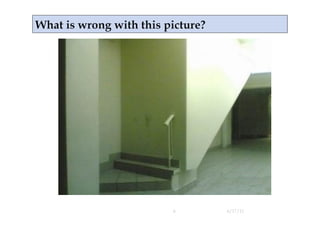
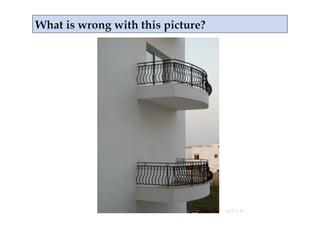
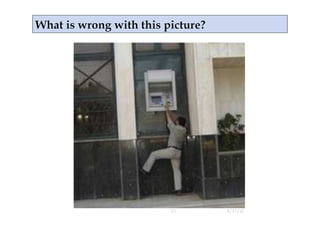
    Civil engineering problem?
    Poor execution?
    Wrong requirements?
    Inadequate validation?
    Just one worker’s mistake?
    Bad design?
    Late requirement changes?
    Very minor issue?
    Your judgment ____________________


                         15        4/17/11
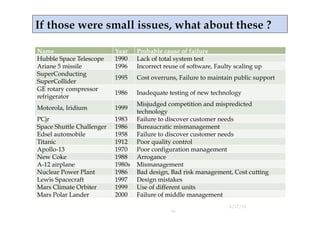
Name                       Year    Probable cause of failure
Hubble Space Telescope     1990    Lack of total system test
Ariane 5 missile           1996    Incorrect reuse of software, Faulty scaling up
SuperConducting
                           1995    Cost overruns, Failure to maintain public support
SuperCollider
GE rotary compressor
                           1986    Inadequate testing of new technology
refrigerator
                                   Misjudged competition and mispredicted
Motorola, Iridium          1999
                                   technology
PCjr                       1983    Failure to discover customer needs
Space Shuttle Challenger   1986    Bureaucratic mismanagement
Edsel automobile           1958    Failure to discover customer needs
Titanic                    1912    Poor quality control
Apollo-13                  1970    Poor configuration management
New Coke                   1988    Arrogance
A-12 airplane              1980s   Mismanagement
Nuclear Power Plant        1986    Bad design, Bad risk management, Cost cutting
Lewis Spacecraft           1997    Design mistakes
Mars Climate Orbiter       1999    Use of different units
Mars Polar Lander          2000    Failure of middle management
                                                                    4/17/11
                                               16
    Infamous for being late, buggy and costly
    Holy Grail of Software Development:
     “Faster, Better, Cheaper”
    Software development is typically considered
       A ‘creative
                  process’
       A ‘wicked problem’
    The ‘predictable’ Waterfall model has been
     blamed for poor project performance
       New thought is about using ‘adaptive’
       processes


                             17          4/17/11
    Scope: fixed, changing, feature creep, “Featuritis”
    Size: size of software, development cost, number of people
    Schedule: length of schedule, fixed schedule, variable schedule
    Complexity: Volume Complexity, Innovation, NPD
    Development Paradigm: Waterfall, Agile, Kanban,…
    Location of teams: collocated, distributed, virtual
    Quality requirements: 6δ, Mil-Standards, FDA, 99.999,
     Enterprise Class, Web, HA, Mission-critical
    Technology: existing, brand new, evolving,
    Team Structure: Command & Control, Democratic, etc.
    People: Skills, Experience, Domain Knowledge
    Tasks/activities: partitionable vs. division of labor, expertise vs.
     fungibility, task dependencies, uncertainties, risks, estimates,


                                        18
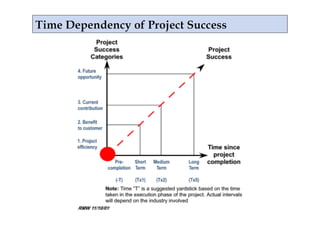
  On-time
  On-cost

  On-quality

  On-specs
  User Experience

  Performance / NFRs

  Deliver Business Benefits

  …any many more !!!

                  19       4/17/11
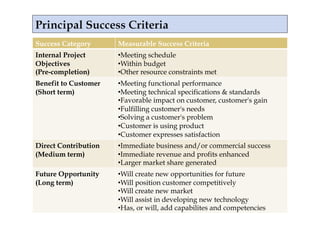
Success Category      Measurable Success Criteria
Internal Project      • Meeting schedule
Objectives            • Within budget
(Pre-completion)      • Other resource constraints met
Benefit to Customer   • Meeting functional performance
(Short term)          • Meeting technical specifications & standards
                      • Favorable impact on customer, customer's gain
                      • Fulfilling customer's needs
                      • Solving a customer's problem
                      • Customer is using product
                      • Customer expresses satisfaction
Direct Contribution   • Immediate business and/or commercial success
(Medium term)         • Immediate revenue and profits enhanced
                      • Larger market share generated
Future Opportunity    • Will create new opportunities for future
(Long term)           • Will position customer competitively
                      • Will create new market
                      • Will assist in developing new technology
                      • Has, or will, add capabilites and competencies
Full
                    Project
                                          Benefits
                    Focus
                                         Realization
Completed On-time
   /on- budget


                                          Business
                    Disaster
                                           Focus


                         Delivered Expected
                              Benefits
                                    22                 4/17/11
23   4/17/11
24   4/17/11
25   4/17/11
Yahoo! Presentation, Confidential   26   4/17/11
27   4/17/11
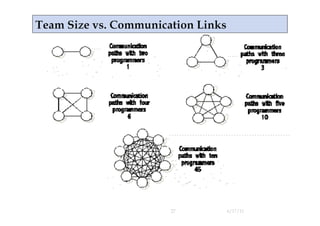
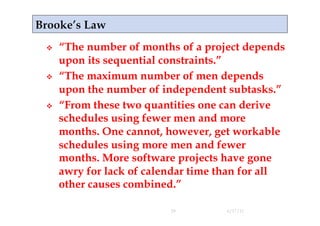
    “Adding manpower to a late software project
     makes it later”, The Mythical Man-Month,
     1975
    “The number of months of a project depends
     upon its sequential constraints.”
    “The maximum number of men depends
     upon the number of independent subtasks.”
    “From these two quantities one can derive
     schedules using fewer men and more
     months. One cannot, however, get workable
     schedules using more men and fewer
     months. More software projects have gone
     awry for lack of calendar time than for all
     other causes combined.”

                          29        4/17/11
30   4/17/11
Yahoo! Presentation, Confidential   31   4/17/11
32   4/17/11
33   4/17/11
34   4/17/11
35   4/17/11
36   4/17/11
37   4/17/11
38   4/17/11
39   4/17/11
40   4/17/11
How does a
project get
 late by a
month ???


41       4/17/11
     The most authoritative and comprehensive survey on IT
      project performance since last 15+ years
     "This year's results show a marked decrease in project
      success rates, with 32% of all projects succeeding which
      are delivered on time, on budget, with required features
      and functions" says Jim Johnson, chairman of The
      Standish Group, "44% were challenged which are late,
      over budget, and/or with less than the required features
      and functions and 24% failed which are cancelled prior to
      completion or delivered and never used."
     "These numbers represent a downtick in the success rates
      from the previous study, as well as a significant increase
      in the number of failures", says Jim Crear, Standish
      Group CIO, "They are low point in the last five study
      periods. This year's results represent the highest failure
      rate in over a decade"
                                  42            4/17/11
    Successful: deliver on-time, on-budget, with required
     features and functions
    Challenged: late, overbudget, and/or with less then
     the required features and functions
    Failed: cancelled prior to completion or delivered and
     never used


             2009   2006   2004   2002   2000   1998   1996   1994
Successful   32%    35%    29%    34%    28%    26%    27%    16%
Challenged 44%      19%    53%    15%    23%    28%    40%    31%
Failed       24%    46%    18%    51%    49%    46%    33%    53%


                                  43              4/17/11
    No Silver Bullet (NSB): there is no single
     development, in either technology or
     management technique, which by itself
     promises even one order-of-magnitude
     improvement within a decade in productivity, in
     reliability, in simplicity – Fred Brookes, 1986
    High-level languages ?
    4GL?
    OOP?
    Reuse?
    Offshoring?
    Rapid Prototyping?
    What next ?


                              44       4/17/11
    Many projects 25 years behind time
    Key Trends from 937 big projects (20+ Cr):
         Schedule Overrun on projects has come down from 62% to 51%
          (considered insignificant) in the past 18 years
         Cost Overrun has seen a huge dip. In May 1991, the cost overrun was more
          than 62%. By September 2009, it came down to 12%
    Schedule Performance:
         486 time overrun,
         258 projects on schedule,
         only 17 are ahead of schedule
         delay ranges between 1 month and 324 months
         Worst-hit is the road transport and highways ministries - 162 out of 184
          projects under these ministries are running behind schedule
    Cost Performance:
         300+ projects account for a cost overrun of Rs 77,518 cr, 54%.
         Ministries-wise, the railways' cost overrun on projects is pegged at 82%
          above original
    Report attributed the time and cost overruns to factors including
     inadequate funding, geological surprises and changes in the
     scope of projects
1.    Enthusiasm
2.    Disillusionment
3.    Panic
4.    Search for the
      Guilty
5.    Punishment of
      the Innocent
6.    Praise and
      Honors for the
      Non-Participants

Project Management 01

  • 1.
    Tathagat Varma Tathagat Varma Session 1/12: 13-May-2010
  • 2.
      There are no WRONG questions, no WRONG answers - I expect you to interact, question and disagree    Don’t assume anything blindly!   Pedagogy:   25% teaching (slides and references will be shared)   25% classroom and online discussion (no slides for this !)   25% self-study (your individual effort !) o  Expect you to read 2-3 general books and articles   25% seminar / project / article (working as a team) o  Expect you to read 1-2 advanced books and relevant articles   I don’t know everything  Let’s learn together !
  • 3.
    Key  Knowledge  Areas   Topics   Strategic  Management   Introduc1on,  Linking  Strategic  Planning  to  new  product  development   New  Product  Development   New  Product  Development  /  New  Service  Development,  selec1ng  the  right   project,  Cost-­‐Benefit  Analysis,  Financial  Ra1os  (CF,  DCF,  NAV,  IRR),  Project   Lifecycle   Project  Ini1a1on   Charter,  Contract,  Preparing  a  Business  Case   Project  Planning   Scoping,  SoW,  WBS,  Es1ma1on,  Iden1fy  Stakeholders,  Risk  Management,   Organiza1on  Structure  (including  people  issues,  repor1ng  rela1onships,  etc.),   Staffing,  Budge1ng,  Scheduling,  PERT,  CPM,  GanT  Chart,  Quality  Project   Communica1ons  (Mee1ng,  Repor1ng),  Sobcotractor  Management   Project  Execu1on   Project  Execu1on,  Managing  Stakeholders  and  influencing  key  stakeholders,   Communica1on  Strategies  (including  using  modern  tools  like  Social  networking,   Video  conf,  TwiTer,  web  based  PM  tools,  Online  query  of  project  status  etc),   Overcoming  Poli1cal  Resistance   Project  Control   Project  Control:  EVM,  Metrics,  Project  Reviews,  Change  Management,  Project   Survival  Strategies   Project  Closure   Closure,  Evalua1on,  Post-­‐closure   Misc.  Topics   Project  Manager  Competencies,  Project  Success  Factors,  Managing  Troubled   Projects   Introduc1on  to  addi1onal   PMBOK,  So]ware  Development  Lifecycles,  Agile  /  Scrum,  Megaprojects,  TOC,   topics  (1me  &  interest  willing)   PRINCE2  
  • 4.
  • 5.
  • 6.
    6 4/17/11
  • 7.
    7 4/17/11
  • 8.
    8 4/17/11
  • 9.
    9 4/17/11
  • 10.
    10 4/17/11
  • 11.
    11 4/17/11
  • 12.
    12 4/17/11
  • 13.
    13 4/17/11
  • 14.
    14 4/17/11
  • 15.
      Civil engineering problem?   Poor execution?   Wrong requirements?   Inadequate validation?   Just one worker’s mistake?   Bad design?   Late requirement changes?   Very minor issue?   Your judgment ____________________ 15 4/17/11
  • 16.
    Name Year Probable cause of failure Hubble Space Telescope 1990 Lack of total system test Ariane 5 missile 1996 Incorrect reuse of software, Faulty scaling up SuperConducting 1995 Cost overruns, Failure to maintain public support SuperCollider GE rotary compressor 1986 Inadequate testing of new technology refrigerator Misjudged competition and mispredicted Motorola, Iridium 1999 technology PCjr 1983 Failure to discover customer needs Space Shuttle Challenger 1986 Bureaucratic mismanagement Edsel automobile 1958 Failure to discover customer needs Titanic 1912 Poor quality control Apollo-13 1970 Poor configuration management New Coke 1988 Arrogance A-12 airplane 1980s Mismanagement Nuclear Power Plant 1986 Bad design, Bad risk management, Cost cutting Lewis Spacecraft 1997 Design mistakes Mars Climate Orbiter 1999 Use of different units Mars Polar Lander 2000 Failure of middle management 4/17/11 16
  • 17.
      Infamous for being late, buggy and costly   Holy Grail of Software Development: “Faster, Better, Cheaper”   Software development is typically considered   A ‘creative process’   A ‘wicked problem’   The ‘predictable’ Waterfall model has been blamed for poor project performance   New thought is about using ‘adaptive’ processes 17 4/17/11
  • 18.
      Scope: fixed, changing, feature creep, “Featuritis”   Size: size of software, development cost, number of people   Schedule: length of schedule, fixed schedule, variable schedule   Complexity: Volume Complexity, Innovation, NPD   Development Paradigm: Waterfall, Agile, Kanban,…   Location of teams: collocated, distributed, virtual   Quality requirements: 6δ, Mil-Standards, FDA, 99.999, Enterprise Class, Web, HA, Mission-critical   Technology: existing, brand new, evolving,   Team Structure: Command & Control, Democratic, etc.   People: Skills, Experience, Domain Knowledge   Tasks/activities: partitionable vs. division of labor, expertise vs. fungibility, task dependencies, uncertainties, risks, estimates, 18
  • 19.
      On-time   On-cost  On-quality   On-specs   User Experience   Performance / NFRs   Deliver Business Benefits   …any many more !!! 19 4/17/11
  • 21.
    Success Category Measurable Success Criteria Internal Project  • Meeting schedule Objectives • Within budget (Pre-completion) • Other resource constraints met Benefit to Customer • Meeting functional performance (Short term) • Meeting technical specifications & standards • Favorable impact on customer, customer's gain • Fulfilling customer's needs • Solving a customer's problem • Customer is using product • Customer expresses satisfaction Direct Contribution • Immediate business and/or commercial success (Medium term) • Immediate revenue and profits enhanced • Larger market share generated Future Opportunity • Will create new opportunities for future (Long term) • Will position customer competitively • Will create new market • Will assist in developing new technology • Has, or will, add capabilites and competencies
  • 22.
    Full Project Benefits Focus Realization Completed On-time /on- budget Business Disaster Focus Delivered Expected Benefits 22 4/17/11
  • 23.
    23 4/17/11
  • 24.
    24 4/17/11
  • 25.
    25 4/17/11
  • 26.
  • 27.
    27 4/17/11
  • 28.
      “Adding manpower to a late software project makes it later”, The Mythical Man-Month, 1975
  • 29.
      “The number of months of a project depends upon its sequential constraints.”   “The maximum number of men depends upon the number of independent subtasks.”   “From these two quantities one can derive schedules using fewer men and more months. One cannot, however, get workable schedules using more men and fewer months. More software projects have gone awry for lack of calendar time than for all other causes combined.” 29 4/17/11
  • 30.
    30 4/17/11
  • 31.
  • 32.
    32 4/17/11
  • 33.
    33 4/17/11
  • 34.
    34 4/17/11
  • 35.
    35 4/17/11
  • 36.
    36 4/17/11
  • 37.
    37 4/17/11
  • 38.
    38 4/17/11
  • 39.
    39 4/17/11
  • 40.
    40 4/17/11
  • 41.
    How does a projectget late by a month ??? 41 4/17/11
  • 42.
      The most authoritative and comprehensive survey on IT project performance since last 15+ years   "This year's results show a marked decrease in project success rates, with 32% of all projects succeeding which are delivered on time, on budget, with required features and functions" says Jim Johnson, chairman of The Standish Group, "44% were challenged which are late, over budget, and/or with less than the required features and functions and 24% failed which are cancelled prior to completion or delivered and never used." "These numbers represent a downtick in the success rates from the previous study, as well as a significant increase in the number of failures", says Jim Crear, Standish Group CIO, "They are low point in the last five study periods. This year's results represent the highest failure rate in over a decade" 42 4/17/11
  • 43.
      Successful: deliver on-time, on-budget, with required features and functions   Challenged: late, overbudget, and/or with less then the required features and functions   Failed: cancelled prior to completion or delivered and never used 2009 2006 2004 2002 2000 1998 1996 1994 Successful 32% 35% 29% 34% 28% 26% 27% 16% Challenged 44% 19% 53% 15% 23% 28% 40% 31% Failed 24% 46% 18% 51% 49% 46% 33% 53% 43 4/17/11
  • 44.
      No Silver Bullet (NSB): there is no single development, in either technology or management technique, which by itself promises even one order-of-magnitude improvement within a decade in productivity, in reliability, in simplicity – Fred Brookes, 1986   High-level languages ?   4GL?   OOP?   Reuse?   Offshoring?   Rapid Prototyping?   What next ? 44 4/17/11
  • 45.
      Many projects 25 years behind time   Key Trends from 937 big projects (20+ Cr):   Schedule Overrun on projects has come down from 62% to 51% (considered insignificant) in the past 18 years   Cost Overrun has seen a huge dip. In May 1991, the cost overrun was more than 62%. By September 2009, it came down to 12%   Schedule Performance:   486 time overrun,   258 projects on schedule,   only 17 are ahead of schedule   delay ranges between 1 month and 324 months   Worst-hit is the road transport and highways ministries - 162 out of 184 projects under these ministries are running behind schedule   Cost Performance:   300+ projects account for a cost overrun of Rs 77,518 cr, 54%.   Ministries-wise, the railways' cost overrun on projects is pegged at 82% above original   Report attributed the time and cost overruns to factors including inadequate funding, geological surprises and changes in the scope of projects
  • 47.
    1.  Enthusiasm 2.  Disillusionment 3.  Panic 4.  Search for the Guilty 5.  Punishment of the Innocent 6.  Praise and Honors for the Non-Participants