PROJECT MANAGEMENT FOR DIRECTORS
For Australian Institute of Company Directors
James Baker
Director Ars Imperatoria Consulting
JULY 23, 2019
Overview
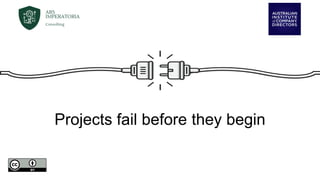
Projects fail before they begin
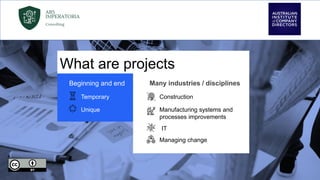
Beginning and end
Temporary
Unique
Many industries / disciplines
Construction
Manufacturing systems and
processes improvements
IT
Managing change
What are projects
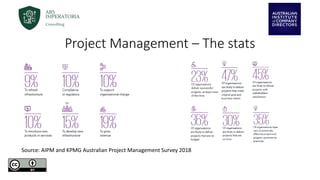
Project Management – The stats
Source: AIPM and KPMG Australian Project Management Survey 2018
Project Management – The stats
Source: AIPM and KPMG Australian Project Management Survey 2018
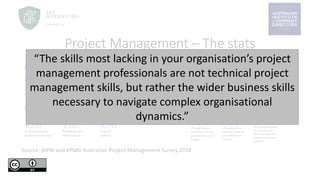
“The skills most lacking in your organisation’s project
management professionals are not technical project
management skills, but rather the wider business skills
necessary to navigate complex organisational
dynamics.”
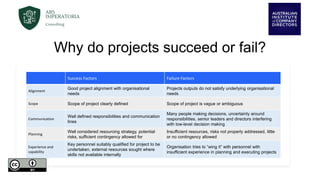
Why do projects succeed or fail?
Success Factors Failure Factors
Alignment
Good project alignment with organisational
needs
Projects outputs do not satisfy underlying organisational
needs
Scope Scope of project clearly defined Scope of project is vague or ambiguous
Communication
Well defined responsibilities and communication
lines
Many people making decisions, uncertainty around
responsibilities, senior leaders and directors interfering
with low-level decision making
Planning
Well considered resourcing strategy, potential
risks, sufficient contingency allowed for
Insufficient resources, risks not properly addressed, little
or no contingency allowed
Experience and
capability
Key personnel suitably qualified for project to be
undertaken, external resources sought where
skills not available internally
Organisation tries to “wing it” with personnel with
insufficient experience in planning and executing projects
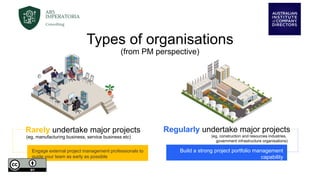
Types of organisations
(from PM perspective)
Rarely undertake major projects
(eg, manufacturing business, service business etc)
Engage external project management professionals to
guide your team as early as possible
Regularly undertake major projects
(eg, construction and resources industries,
government infrastructure organisations)
Build a strong project portfolio management
capability
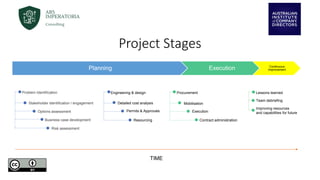
Project Stages
Planning Execution Continuous
Improvement
Problem Identification
Stakeholder identification / engagement
Options assessment
Business case development
Risk assessment
Engineering & design
Detailed cost analysis
Permits & Approvals
Resourcing
Procurement
Mobilisation
Execution
Contract administration
Lessons learned
Team debriefing
Improving resources
and capabilities for future
TIME
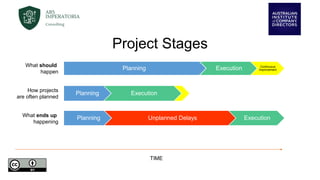
Project Stages
Planning Execution Continuous
Improvement
What should
happen
Planning Execution
How projects
are often planned
Planning Unplanned Delays ExecutionWhat ends up
happening
TIME
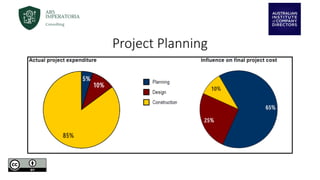
Project Planning
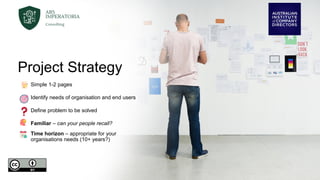
Project Strategy
Simple 1-2 pages
Identify needs of organisation and end users
Define problem to be solved
Familiar – can your people recall?
Time horizon – appropriate for your
organisations needs (10+ years?)
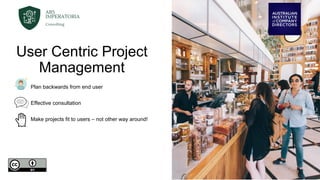
User Centric Project
Management
Plan backwards from end user
Effective consultation
Make projects fit to users – not other way around!
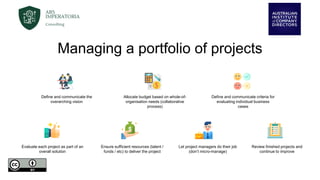
Managing a portfolio of projects
Define and communicate the
overarching vision
Allocate budget based on whole-of-
organisation needs (collaborative
process)
Define and communicate criteria for
evaluating individual business
cases
Evaluate each project as part of an
overall solution
Ensure sufficient resources (talent /
funds / etc) to deliver the project
Let project managers do their job
(don’t micro-manage)
Review finished projects and
continue to improve
• Big impact on effectiveness of project planning and execution.
• Poor culture can result in:
• Manager reluctance to delegate / consult in planning phase
• Decision makers stalling rather than making a “risky” decision
• Project managers being scared of passing on “bad news”
• Lack of collaboration between divisions
• Demotivated team members not engaged with
problem identification
Organizational Culture &
PROJECT MANAGEMENT
Contractors
Your contractors are project
partners – treat them as such
• Fair contract terms
• Don’t keep them waiting (especially
during tender evaluations!)
Assign risk appropriately
• Risk borne by the party best positioned
to manage it
• The project owner ends up paying
for it!
• Invest in early stage project planning – projects fail before they begin!
• Project strategy – keep it to 1-2 pages
• Engage stakeholders and experts from the beginning
• Design projects around your end users
• Project teams depend on clear vision from their leaders
• Contractors are your project partners
• Bad culture = bad projects
Key
Takeaways
“The seeds of problems are laid down early. Initial
planning is the most vital part of a project. The review
of most failed projects or project problems indicate the
disasters were well planned to happen from the start.”
Jerry Madden
Associate Director of Flight Projects, NASA
CREATIVE COMMONS
This material is released under creative commons. The
more we all adopt best practices, the better we all are.
You are free to use and modify these slides as you wish
(just please let me know if you make it better!).

AICD Presentation - Project Management for Directors

  • 1.
    PROJECT MANAGEMENT FORDIRECTORS For Australian Institute of Company Directors James Baker Director Ars Imperatoria Consulting JULY 23, 2019
  • 2.
  • 3.
  • 4.
    Beginning and end Temporary Unique Manyindustries / disciplines Construction Manufacturing systems and processes improvements IT Managing change What are projects
  • 5.
    Project Management –The stats Source: AIPM and KPMG Australian Project Management Survey 2018
  • 6.
    Project Management –The stats Source: AIPM and KPMG Australian Project Management Survey 2018 “The skills most lacking in your organisation’s project management professionals are not technical project management skills, but rather the wider business skills necessary to navigate complex organisational dynamics.”
  • 7.
    Why do projectssucceed or fail? Success Factors Failure Factors Alignment Good project alignment with organisational needs Projects outputs do not satisfy underlying organisational needs Scope Scope of project clearly defined Scope of project is vague or ambiguous Communication Well defined responsibilities and communication lines Many people making decisions, uncertainty around responsibilities, senior leaders and directors interfering with low-level decision making Planning Well considered resourcing strategy, potential risks, sufficient contingency allowed for Insufficient resources, risks not properly addressed, little or no contingency allowed Experience and capability Key personnel suitably qualified for project to be undertaken, external resources sought where skills not available internally Organisation tries to “wing it” with personnel with insufficient experience in planning and executing projects
  • 8.
    Types of organisations (fromPM perspective) Rarely undertake major projects (eg, manufacturing business, service business etc) Engage external project management professionals to guide your team as early as possible Regularly undertake major projects (eg, construction and resources industries, government infrastructure organisations) Build a strong project portfolio management capability
  • 9.
    Project Stages Planning ExecutionContinuous Improvement Problem Identification Stakeholder identification / engagement Options assessment Business case development Risk assessment Engineering & design Detailed cost analysis Permits & Approvals Resourcing Procurement Mobilisation Execution Contract administration Lessons learned Team debriefing Improving resources and capabilities for future TIME
  • 10.
    Project Stages Planning ExecutionContinuous Improvement What should happen Planning Execution How projects are often planned Planning Unplanned Delays ExecutionWhat ends up happening TIME
  • 11.
  • 12.
    Project Strategy Simple 1-2pages Identify needs of organisation and end users Define problem to be solved Familiar – can your people recall? Time horizon – appropriate for your organisations needs (10+ years?)
  • 13.
    User Centric Project Management Planbackwards from end user Effective consultation Make projects fit to users – not other way around!
  • 14.
    Managing a portfolioof projects Define and communicate the overarching vision Allocate budget based on whole-of- organisation needs (collaborative process) Define and communicate criteria for evaluating individual business cases Evaluate each project as part of an overall solution Ensure sufficient resources (talent / funds / etc) to deliver the project Let project managers do their job (don’t micro-manage) Review finished projects and continue to improve
  • 15.
    • Big impacton effectiveness of project planning and execution. • Poor culture can result in: • Manager reluctance to delegate / consult in planning phase • Decision makers stalling rather than making a “risky” decision • Project managers being scared of passing on “bad news” • Lack of collaboration between divisions • Demotivated team members not engaged with problem identification Organizational Culture & PROJECT MANAGEMENT
  • 16.
    Contractors Your contractors areproject partners – treat them as such • Fair contract terms • Don’t keep them waiting (especially during tender evaluations!) Assign risk appropriately • Risk borne by the party best positioned to manage it • The project owner ends up paying for it!
  • 17.
    • Invest inearly stage project planning – projects fail before they begin! • Project strategy – keep it to 1-2 pages • Engage stakeholders and experts from the beginning • Design projects around your end users • Project teams depend on clear vision from their leaders • Contractors are your project partners • Bad culture = bad projects Key Takeaways
  • 18.
    “The seeds ofproblems are laid down early. Initial planning is the most vital part of a project. The review of most failed projects or project problems indicate the disasters were well planned to happen from the start.” Jerry Madden Associate Director of Flight Projects, NASA
  • 19.
    CREATIVE COMMONS This materialis released under creative commons. The more we all adopt best practices, the better we all are. You are free to use and modify these slides as you wish (just please let me know if you make it better!).