Presented To
Sir Adeel Javed
Common Causes of Project
Failures with Real World
Examples
Presented By
Ahmed Imran (FA20-BSI-003)
Ayesha Sahar (FA20-BSI-020)
Dua Rehan (FA20-BSI-022)
Syeda Fatima Sureya (FA20-BSI-065)
Syeda Fizza Batool (FA20-BSI-066)
Warda Noor (FA20-BSI-070)
What Exactly is a Failed Project?
Poor Product Requirements
Poor Communication
Insufficient Stakeholder
Management
Unrealistic Expectations
Unidentified Project Constraints
No Risk Management
Table of
Contents
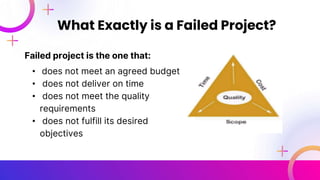
Failed project is the one that:
• does not meet an agreed budget
• does not deliver on time
• does not meet the quality
requirements
• does not fulfill its desired
objectives
What Exactly is a Failed Project?
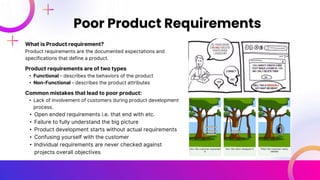
What is Product requirement?
Product requirements are the documented expectations and
specifications that define a product.
Product requirements are of two types
• Functional – describes the behaviors of the product
• Non-Functional – describes the product attributes
Common mistakes that lead to poor product:
• Lack of involvement of customers during product development
process.
• Open ended requirements i.e. that end with etc.
• Failure to fully understand the big picture
• Product development starts without actual requirements
• Confusing yourself with the customer
• Individual requirements are never checked against
projects overall objectives
Poor Product Requirements
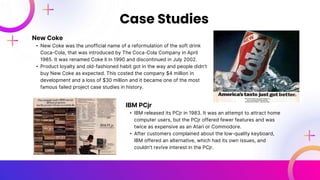
New Coke
• New Coke was the unofficial name of a reformulation of the soft drink
Coca-Cola, that was introduced by The Coca-Cola Company in April
1985. It was renamed Coke II in 1990 and discontinued in July 2002.
• Product loyalty and old-fashioned habit got in the way and people didn’t
buy New Coke as expected. This costed the company $4 million in
development and a loss of $30 million and it became one of the most
famous failed project case studies in history.
Case Studies
IBM PCjr
• IBM released its PCjr in 1983. It was an attempt to attract home
computer users, but the PCjr offered fewer features and was
twice as expensive as an Atari or Commodore.
• After customers complained about the low-quality keyboard,
IBM offered an alternative, which had its own issues, and
couldn’t revive interest in the PCjr.
• The tools that can be used that enable the use of the stakeholders’ time
efficiently and get a clear picture of the requirements
• Power up communication with visuals
• Use templates to support you
• Do your homework properly
• Involve different people from different roles when defining the user
requirements
• When you’re interviewing the user/client/customer, ensure there are experts in
that meeting.
• Consider inviting different members of the project to the interviews with
clients for requirements gathering.
How to prevent it?
Nowadays, communication is more complex than ever! With today’s app overload, it’s hard to know
when, where and how you should surface important project updates.
Common Communication Mistakes:
• Roles and responsibilities are not identified or are not clearly communicated to all the
stakeholders.
• Priorities of different communication channels are not identified.
• No records of oral communication.
• National specifics and corporate culture are not taken into account.
• Manager blocks direct effective communication between technical specialists.
• The bad news is glossed over when being presented to customers, managers, and stakeholders.
• Meetings are not effective.
• No time is spent on the development of a communication plan.
Poor Communication
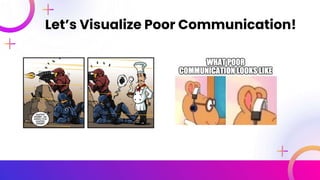
Let’s Visualize Poor Communication!
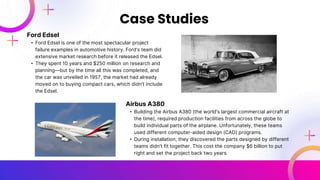
Ford Edsel
• Ford Edsel is one of the most spectacular project
failure examples in automotive history. Ford’s team did
extensive market research before it released the Edsel.
• They spent 10 years and $250 million on research and
planning—but by the time all this was completed, and
the car was unveiled in 1957, the market had already
moved on to buying compact cars, which didn’t include
the Edsel.
Case Studies
Airbus A380
• Building the Airbus A380 (the world’s largest commercial aircraft at
the time), required production facilities from across the globe to
build individual parts of the airplane. Unfortunately, these teams
used different computer-aided design (CAD) programs.
• During installation, they discovered the parts designed by different
teams didn’t fit together. This cost the company $6 billion to put
right and set the project back two years.
• Create—and share—a communication
plan.
• Limit the number of communication
channels in use.
• Don’t call for a meeting unless it’s
“essential”.
• Use email only for important project
details.
• Identify a single trusted source of
information.
• Use tools like Jira, trello, slack etc.
How to prevent it?
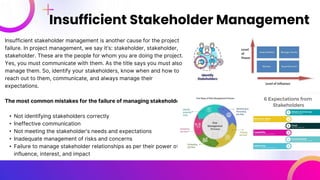
Insufficient stakeholder management is another cause for the project
failure. In project management, we say it’s: stakeholder, stakeholder,
stakeholder. These are the people for whom you are doing the project.
Yes, you must communicate with them. As the title says you must also
manage them. So, identify your stakeholders, know when and how to
reach out to them, communicate, and always manage their
expectations.
The most common mistakes for the failure of managing stakeholders:
• Not identifying stakeholders correctly
• Ineffective communication
• Not meeting the stakeholder’s needs and expectations
• Inadequate management of risks and concerns
• Failure to manage stakeholder relationships as per their power of
influence, interest, and impact
Insufficient Stakeholder Management
Denver Airport Baggage Issue
• The Denver International Airport was to become one of the most notorious examples
of project failure in 1990’s.
• When Denver International Airport was under construction it announced an exciting
automated system for handling luggage.
• Denver Airport had ambitious plans to route passenger’s bags to and from aircraft
without significant human intervention.
• The fully automated baggage system was to be the first of its kind to reduce the
airports reliance on manual labor and hopefully result in a faster service for travelers.
• However, the project was more complex than anticipated and, as a result it went 16
months past the deadline and cost the city $560 million.
• Key stakeholders were excluded from initial decision-making meetings and so when
they were asked for feedback, they had huge changes and it was difficult to
implement these essential changes. There was a huge lack of communication,
engagement.
Case Study (1)
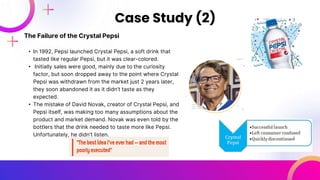
The Failure of the Crystal Pepsi
• In 1992, Pepsi launched Crystal Pepsi, a soft drink that
tasted like regular Pepsi, but it was clear-colored.
• Initially sales were good, mainly due to the curiosity
factor, but soon dropped away to the point where Crystal
Pepsi was withdrawn from the market just 2 years later,
they soon abandoned it as it didn’t taste as they
expected.
• The mistake of David Novak, creator of Crystal Pepsi, and
Pepsi itself, was making too many assumptions about the
product and market demand. Novak was even told by the
bottlers that the drink needed to taste more like Pepsi.
Unfortunately, he didn’t listen.
Case Study (2)
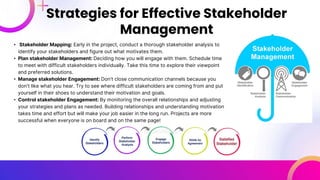
• Stakeholder Mapping: Early in the project, conduct a thorough stakeholder analysis to
identify your stakeholders and figure out what motivates them.
• Plan stakeholder Management: Deciding how you will engage with them. Schedule time
to meet with difficult stakeholders individually. Take this time to explore their viewpoint
and preferred solutions.
• Manage stakeholder Engagement: Don't close communication channels because you
don't like what you hear. Try to see where difficult stakeholders are coming from and put
yourself in their shoes to understand their motivation and goals.
• Control stakeholder Engagement: By monitoring the overall relationships and adjusting
your strategies and plans as needed. Building relationships and understanding motivation
takes time and effort but will make your job easier in the long run. Projects are more
successful when everyone is on board and on the same page!
Strategies for Effective Stakeholder
Management
Another key reason projects fail is unrealistic expectations. If the
project plan is too optimistic or not grounded in reality, it can get
messy quickly. This happens often when various stakeholders have
differing views on what they think the project will accomplish.
When you want to do something fast, with a limited budget, and a
reduced team, it can really make your project fail. It is easy to
underestimate the time and effort needed to complete work.
Unrealistic Expectations
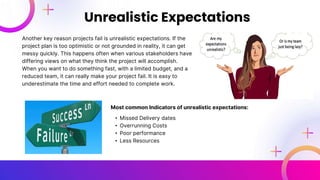
Most common Indicators of unrealistic expectations:
• Missed Delivery dates
• Overrunning Costs
• Poor performance
• Less Resources
The $440 Million Software Error at Knight Capital
• In 2012, Knight Capital was brought on to work on new code for a new
SEC program.
• This trading software contained a flaw that became apparent only
after the software was activated when the New York Stock Exchange
(NYSE) opened that day.
• The errant software sent Knight on a buying spree, snapping up 150
different stocks at a total cost of around $7 billion, all in the first hour
of trading.
• An over-optimistic deadline caused them to go to
production with test code. After production, a glitch cost
the company $440 million within the first 30 minutes of
trading, and company stock fell 75% within just two days.
Case Study (1)
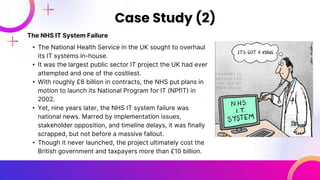
The NHS IT System Failure
• The National Health Service in the UK sought to overhaul
its IT systems in-house.
• It was the largest public sector IT project the UK had ever
attempted and one of the costliest.
• With roughly £6 billion in contracts, the NHS put plans in
motion to launch its National Program for IT (NPfIT) in
2002.
• Yet, nine years later, the NHS IT system failure was
national news. Marred by implementation issues,
stakeholder opposition, and timeline delays, it was finally
scrapped, but not before a massive fallout.
• Though it never launched, the project ultimately cost the
British government and taxpayers more than £10 billion.
Case Study (2)
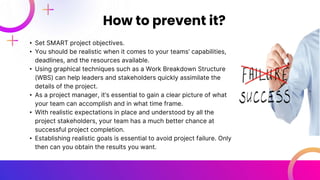
• Set SMART project objectives.
• You should be realistic when it comes to your teams’ capabilities,
deadlines, and the resources available.
• Using graphical techniques such as a Work Breakdown Structure
(WBS) can help leaders and stakeholders quickly assimilate the
details of the project.
• As a project manager, it’s essential to gain a clear picture of what
your team can accomplish and in what time frame.
• With realistic expectations in place and understood by all the
project stakeholders, your team has a much better chance at
successful project completion.
• Establishing realistic goals is essential to avoid project failure. Only
then can you obtain the results you want.
How to prevent it?
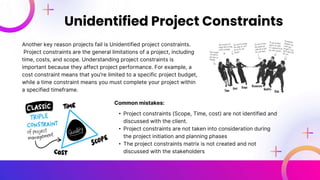
Another key reason projects fail is Unidentified project constraints.
Project constraints are the general limitations of a project, including
time, costs, and scope. Understanding project constraints is
important because they affect project performance. For example, a
cost constraint means that you're limited to a specific project budget,
while a time constraint means you must complete your project within
a specified timeframe.
Unidentified Project Constraints
Common mistakes:
• Project constraints (Scope, Time, cost) are not identified and
discussed with the client.
• Project constraints are not taken into consideration during
the project initiation and planning phases
• The project constraints matrix is not created and not
discussed with the stakeholders
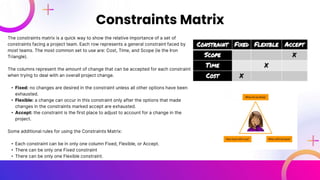
The constraints matrix is a quick way to show the relative importance of a set of
constraints facing a project team. Each row represents a general constraint faced by
most teams. The most common set to use are: Cost, Time, and Scope (ie the Iron
Triangle).
The columns represent the amount of change that can be accepted for each constraint
when trying to deal with an overall project change.
• Fixed: no changes are desired in the constraint unless all other options have been
exhausted.
• Flexible: a change can occur in this constraint only after the options that made
changes in the constraints marked accept are exhausted.
• Accept: the constraint is the first place to adjust to account for a change in the
project.
Some additional rules for using the Constraints Matrix:
• Each constraint can be in only one column Fixed, Flexible, or Accept.
• There can be only one Fixed constraint
• There can be only one Flexible constraint.
Constraints Matrix
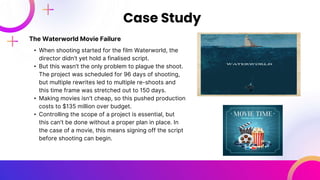
The Waterworld Movie Failure
• When shooting started for the film Waterworld, the
director didn’t yet hold a finalised script.
• But this wasn’t the only problem to plague the shoot.
The project was scheduled for 96 days of shooting,
but multiple rewrites led to multiple re-shoots and
this time frame was stretched out to 150 days.
• Making movies isn’t cheap, so this pushed production
costs to $135 million over budget.
• Controlling the scope of a project is essential, but
this can’t be done without a proper plan in place. In
the case of a movie, this means signing off the script
before shooting can begin.
Case Study
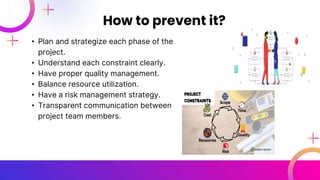
• Plan and strategize each phase of the
project.
• Understand each constraint clearly.
• Have proper quality management.
• Balance resource utilization.
• Have a risk management strategy.
• Transparent communication between
project team members.
How to prevent it?
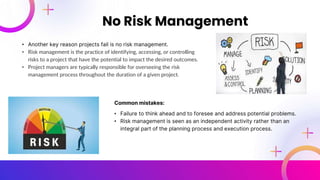
• Another key reason projects fail is no risk management.
• Risk management is the practice of identifying, accessing, or controlling
risks to a project that have the potential to impact the desired outcomes.
• Project managers are typically responsible for overseeing the risk
management process throughout the duration of a given project.
No Risk Management
Common mistakes:
• Failure to think ahead and to foresee and address potential problems.
• Risk management is seen as an independent activity rather than an
integral part of the planning process and execution process.
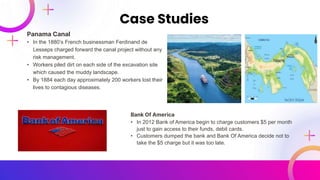
Panama Canal
• In the 1880’s French businessman Ferdinand de
Lesseps charged forward the canal project without any
risk management.
• Workers piled dirt on each side of the excavation site
which caused the muddy landscape.
• By 1884 each day approximately 200 workers lost their
lives to contagious diseases.
Case Studies
Bank Of America
• In 2012 Bank of America begin to charge customers $5 per month
just to gain access to their funds, debit cards.
• Customers dumped the bank and Bank Of America decide not to
take the $5 charge but it was too late.
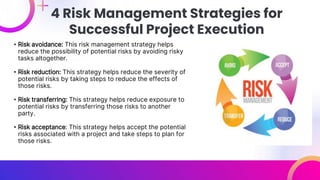
• Risk avoidance: This risk management strategy helps
reduce the possibility of potential risks by avoiding risky
tasks altogether.
• Risk reduction: This strategy helps reduce the severity of
potential risks by taking steps to reduce the effects of
those risks.
• Risk transferring: This strategy helps reduce exposure to
potential risks by transferring those risks to another
party.
• Risk acceptance: This strategy helps accept the potential
risks associated with a project and take steps to plan for
those risks.
4 Risk Management Strategies for
Successful Project Execution
THANK YOU
Any Questions? Ask away :)

Project Management Presentation.pptx

  • 1.
    Presented To Sir AdeelJaved Common Causes of Project Failures with Real World Examples Presented By Ahmed Imran (FA20-BSI-003) Ayesha Sahar (FA20-BSI-020) Dua Rehan (FA20-BSI-022) Syeda Fatima Sureya (FA20-BSI-065) Syeda Fizza Batool (FA20-BSI-066) Warda Noor (FA20-BSI-070)
  • 2.
    What Exactly isa Failed Project? Poor Product Requirements Poor Communication Insufficient Stakeholder Management Unrealistic Expectations Unidentified Project Constraints No Risk Management Table of Contents
  • 3.
    Failed project isthe one that: • does not meet an agreed budget • does not deliver on time • does not meet the quality requirements • does not fulfill its desired objectives What Exactly is a Failed Project?
  • 4.
    What is Productrequirement? Product requirements are the documented expectations and specifications that define a product. Product requirements are of two types • Functional – describes the behaviors of the product • Non-Functional – describes the product attributes Common mistakes that lead to poor product: • Lack of involvement of customers during product development process. • Open ended requirements i.e. that end with etc. • Failure to fully understand the big picture • Product development starts without actual requirements • Confusing yourself with the customer • Individual requirements are never checked against projects overall objectives Poor Product Requirements
  • 5.
    New Coke • NewCoke was the unofficial name of a reformulation of the soft drink Coca-Cola, that was introduced by The Coca-Cola Company in April 1985. It was renamed Coke II in 1990 and discontinued in July 2002. • Product loyalty and old-fashioned habit got in the way and people didn’t buy New Coke as expected. This costed the company $4 million in development and a loss of $30 million and it became one of the most famous failed project case studies in history. Case Studies IBM PCjr • IBM released its PCjr in 1983. It was an attempt to attract home computer users, but the PCjr offered fewer features and was twice as expensive as an Atari or Commodore. • After customers complained about the low-quality keyboard, IBM offered an alternative, which had its own issues, and couldn’t revive interest in the PCjr.
  • 6.
    • The toolsthat can be used that enable the use of the stakeholders’ time efficiently and get a clear picture of the requirements • Power up communication with visuals • Use templates to support you • Do your homework properly • Involve different people from different roles when defining the user requirements • When you’re interviewing the user/client/customer, ensure there are experts in that meeting. • Consider inviting different members of the project to the interviews with clients for requirements gathering. How to prevent it?
  • 7.
    Nowadays, communication ismore complex than ever! With today’s app overload, it’s hard to know when, where and how you should surface important project updates. Common Communication Mistakes: • Roles and responsibilities are not identified or are not clearly communicated to all the stakeholders. • Priorities of different communication channels are not identified. • No records of oral communication. • National specifics and corporate culture are not taken into account. • Manager blocks direct effective communication between technical specialists. • The bad news is glossed over when being presented to customers, managers, and stakeholders. • Meetings are not effective. • No time is spent on the development of a communication plan. Poor Communication
  • 8.
    Let’s Visualize PoorCommunication!
  • 9.
    Ford Edsel • FordEdsel is one of the most spectacular project failure examples in automotive history. Ford’s team did extensive market research before it released the Edsel. • They spent 10 years and $250 million on research and planning—but by the time all this was completed, and the car was unveiled in 1957, the market had already moved on to buying compact cars, which didn’t include the Edsel. Case Studies Airbus A380 • Building the Airbus A380 (the world’s largest commercial aircraft at the time), required production facilities from across the globe to build individual parts of the airplane. Unfortunately, these teams used different computer-aided design (CAD) programs. • During installation, they discovered the parts designed by different teams didn’t fit together. This cost the company $6 billion to put right and set the project back two years.
  • 10.
    • Create—and share—acommunication plan. • Limit the number of communication channels in use. • Don’t call for a meeting unless it’s “essential”. • Use email only for important project details. • Identify a single trusted source of information. • Use tools like Jira, trello, slack etc. How to prevent it?
  • 11.
    Insufficient stakeholder managementis another cause for the project failure. In project management, we say it’s: stakeholder, stakeholder, stakeholder. These are the people for whom you are doing the project. Yes, you must communicate with them. As the title says you must also manage them. So, identify your stakeholders, know when and how to reach out to them, communicate, and always manage their expectations. The most common mistakes for the failure of managing stakeholders: • Not identifying stakeholders correctly • Ineffective communication • Not meeting the stakeholder’s needs and expectations • Inadequate management of risks and concerns • Failure to manage stakeholder relationships as per their power of influence, interest, and impact Insufficient Stakeholder Management
  • 12.
    Denver Airport BaggageIssue • The Denver International Airport was to become one of the most notorious examples of project failure in 1990’s. • When Denver International Airport was under construction it announced an exciting automated system for handling luggage. • Denver Airport had ambitious plans to route passenger’s bags to and from aircraft without significant human intervention. • The fully automated baggage system was to be the first of its kind to reduce the airports reliance on manual labor and hopefully result in a faster service for travelers. • However, the project was more complex than anticipated and, as a result it went 16 months past the deadline and cost the city $560 million. • Key stakeholders were excluded from initial decision-making meetings and so when they were asked for feedback, they had huge changes and it was difficult to implement these essential changes. There was a huge lack of communication, engagement. Case Study (1)
  • 13.
    The Failure ofthe Crystal Pepsi • In 1992, Pepsi launched Crystal Pepsi, a soft drink that tasted like regular Pepsi, but it was clear-colored. • Initially sales were good, mainly due to the curiosity factor, but soon dropped away to the point where Crystal Pepsi was withdrawn from the market just 2 years later, they soon abandoned it as it didn’t taste as they expected. • The mistake of David Novak, creator of Crystal Pepsi, and Pepsi itself, was making too many assumptions about the product and market demand. Novak was even told by the bottlers that the drink needed to taste more like Pepsi. Unfortunately, he didn’t listen. Case Study (2)
  • 14.
    • Stakeholder Mapping:Early in the project, conduct a thorough stakeholder analysis to identify your stakeholders and figure out what motivates them. • Plan stakeholder Management: Deciding how you will engage with them. Schedule time to meet with difficult stakeholders individually. Take this time to explore their viewpoint and preferred solutions. • Manage stakeholder Engagement: Don't close communication channels because you don't like what you hear. Try to see where difficult stakeholders are coming from and put yourself in their shoes to understand their motivation and goals. • Control stakeholder Engagement: By monitoring the overall relationships and adjusting your strategies and plans as needed. Building relationships and understanding motivation takes time and effort but will make your job easier in the long run. Projects are more successful when everyone is on board and on the same page! Strategies for Effective Stakeholder Management
  • 15.
    Another key reasonprojects fail is unrealistic expectations. If the project plan is too optimistic or not grounded in reality, it can get messy quickly. This happens often when various stakeholders have differing views on what they think the project will accomplish. When you want to do something fast, with a limited budget, and a reduced team, it can really make your project fail. It is easy to underestimate the time and effort needed to complete work. Unrealistic Expectations Most common Indicators of unrealistic expectations: • Missed Delivery dates • Overrunning Costs • Poor performance • Less Resources
  • 16.
    The $440 MillionSoftware Error at Knight Capital • In 2012, Knight Capital was brought on to work on new code for a new SEC program. • This trading software contained a flaw that became apparent only after the software was activated when the New York Stock Exchange (NYSE) opened that day. • The errant software sent Knight on a buying spree, snapping up 150 different stocks at a total cost of around $7 billion, all in the first hour of trading. • An over-optimistic deadline caused them to go to production with test code. After production, a glitch cost the company $440 million within the first 30 minutes of trading, and company stock fell 75% within just two days. Case Study (1)
  • 17.
    The NHS ITSystem Failure • The National Health Service in the UK sought to overhaul its IT systems in-house. • It was the largest public sector IT project the UK had ever attempted and one of the costliest. • With roughly £6 billion in contracts, the NHS put plans in motion to launch its National Program for IT (NPfIT) in 2002. • Yet, nine years later, the NHS IT system failure was national news. Marred by implementation issues, stakeholder opposition, and timeline delays, it was finally scrapped, but not before a massive fallout. • Though it never launched, the project ultimately cost the British government and taxpayers more than £10 billion. Case Study (2)
  • 18.
    • Set SMARTproject objectives. • You should be realistic when it comes to your teams’ capabilities, deadlines, and the resources available. • Using graphical techniques such as a Work Breakdown Structure (WBS) can help leaders and stakeholders quickly assimilate the details of the project. • As a project manager, it’s essential to gain a clear picture of what your team can accomplish and in what time frame. • With realistic expectations in place and understood by all the project stakeholders, your team has a much better chance at successful project completion. • Establishing realistic goals is essential to avoid project failure. Only then can you obtain the results you want. How to prevent it?
  • 19.
    Another key reasonprojects fail is Unidentified project constraints. Project constraints are the general limitations of a project, including time, costs, and scope. Understanding project constraints is important because they affect project performance. For example, a cost constraint means that you're limited to a specific project budget, while a time constraint means you must complete your project within a specified timeframe. Unidentified Project Constraints Common mistakes: • Project constraints (Scope, Time, cost) are not identified and discussed with the client. • Project constraints are not taken into consideration during the project initiation and planning phases • The project constraints matrix is not created and not discussed with the stakeholders
  • 20.
    The constraints matrixis a quick way to show the relative importance of a set of constraints facing a project team. Each row represents a general constraint faced by most teams. The most common set to use are: Cost, Time, and Scope (ie the Iron Triangle). The columns represent the amount of change that can be accepted for each constraint when trying to deal with an overall project change. • Fixed: no changes are desired in the constraint unless all other options have been exhausted. • Flexible: a change can occur in this constraint only after the options that made changes in the constraints marked accept are exhausted. • Accept: the constraint is the first place to adjust to account for a change in the project. Some additional rules for using the Constraints Matrix: • Each constraint can be in only one column Fixed, Flexible, or Accept. • There can be only one Fixed constraint • There can be only one Flexible constraint. Constraints Matrix
  • 21.
    The Waterworld MovieFailure • When shooting started for the film Waterworld, the director didn’t yet hold a finalised script. • But this wasn’t the only problem to plague the shoot. The project was scheduled for 96 days of shooting, but multiple rewrites led to multiple re-shoots and this time frame was stretched out to 150 days. • Making movies isn’t cheap, so this pushed production costs to $135 million over budget. • Controlling the scope of a project is essential, but this can’t be done without a proper plan in place. In the case of a movie, this means signing off the script before shooting can begin. Case Study
  • 22.
    • Plan andstrategize each phase of the project. • Understand each constraint clearly. • Have proper quality management. • Balance resource utilization. • Have a risk management strategy. • Transparent communication between project team members. How to prevent it?
  • 23.
    • Another keyreason projects fail is no risk management. • Risk management is the practice of identifying, accessing, or controlling risks to a project that have the potential to impact the desired outcomes. • Project managers are typically responsible for overseeing the risk management process throughout the duration of a given project. No Risk Management Common mistakes: • Failure to think ahead and to foresee and address potential problems. • Risk management is seen as an independent activity rather than an integral part of the planning process and execution process.
  • 24.
    Panama Canal • Inthe 1880’s French businessman Ferdinand de Lesseps charged forward the canal project without any risk management. • Workers piled dirt on each side of the excavation site which caused the muddy landscape. • By 1884 each day approximately 200 workers lost their lives to contagious diseases. Case Studies Bank Of America • In 2012 Bank of America begin to charge customers $5 per month just to gain access to their funds, debit cards. • Customers dumped the bank and Bank Of America decide not to take the $5 charge but it was too late.
  • 25.
    • Risk avoidance:This risk management strategy helps reduce the possibility of potential risks by avoiding risky tasks altogether. • Risk reduction: This strategy helps reduce the severity of potential risks by taking steps to reduce the effects of those risks. • Risk transferring: This strategy helps reduce exposure to potential risks by transferring those risks to another party. • Risk acceptance: This strategy helps accept the potential risks associated with a project and take steps to plan for those risks. 4 Risk Management Strategies for Successful Project Execution
  • 26.