




Productivity Tips
31 Tricks That Might Just Get You Out Of The Office On Time
Who doesn’t want to get more done in less time?
For all the people who find that all the hours in the day aren’t enough to get done
all the tasks on their to-do list, any trick to milk out of the day one more completed
task is gold.
Drawing on the wealth of work management tips on the Talking Work Blog and the
knowledge of other experts, we’ve amassed a list of 31 productivity tips so
powerful, you just might leave the office on time…
1. Get a good night’s sleep
A lack of sleep is not correlated with an increase in productivity!
Workers who logged 6 or less hours of sleep per night were significantly less productive
than those who got 7-8 hours.
2. Eat healthy food
“Not all foods are processed by our bodies at the same rate. Some foods, like pasta, bread,
cereal and soda, release their glucose quickly, leading to a burst of energy followed by a
slump. Others, like high fat meals (think cheeseburgers and BLTs) provide more sustained
energy, but require our digestive system to work harder, reducing oxygen levels in the brain
and making us groggy.”
—Ron Friedman, “What You Eat Affects Your Productivity,” Harvard Business Review
3. Drink water
One study found:
Dehydrated workers saw a 12% decrease in their productivity.
Workers with moderate dehydration saw impaired motor tracking, attention, and
arithmetic efficiency.
23% reduction in reaction time when subjects were 4% dehydrated.
Source: “Avoid dehydration in the workplace” by Mike Markovsky, Industrial Safety &
Hygiene News
4. Insist on receiving all of your requests in one place
“One way this could be done—since 63 percent of marketers still receive most work
requests by email—is to create an alias email account, like
workrequest@companyname.com. In addition, create a standard work request form that is
customizable and is easily accessible. There will be an instant reduction in distractions from
all the random requests and you will be able to find your entire to-do list in one place.”
—Natalie Ward, Marketing Manager, Workfront
5. Beware of “under-the-table” requests
Those little favors inevitably push out other stuff you were planning on getting done.
Either:
you end up burning the midnight oil to get caught up or
your stuff ends up late and you look incompetent
“No more ‘quick favors’. No more drive-by requests. Think of tasks the way you
think of financial transactions—nothing is allowed to happen off the books.
Every single task must be documented and accounted for.”
—Marcus Varner, Senior Content Marketing Manager, Workfront
6. Set up clear priorities
Being productive is more than just getting stuff done; it’s about getting the most
valuable stuff done.
Consider these criteria for prioritizing:
Alignment to company goals and strategy
Rank of the requestor
Due date of the request
7. Connect your tasks to your goals
“We work a lot. We work more than ever before. We’re logging many more hours,
processing mountains more email and other communications. We’re just DOING lots and
lots more than ever before. But we’re less happy, less certain that we’re accomplishing
our goals, and less sure of what we need.”
—Chris Brogan, CEO, Owner Media Group
“What you’re doing today impacts what you’ll accomplish this week. Bucket up all the
todays into a month, and then stack twelve of these up, and what you did TODAY
reflects on your full year.”
—Chris Brogan, CEO, Owner Media Group
8. Say no
“Of course, no one likes to have conflict in the workplace, especially when it comes to
higher-ups, or perhaps worse, clients and customers. The last thing you want is to
damage a business relationship. However, it's easy to forget that can also happen if you
say ‘yes' to everything. Sometimes pushing back is necessary for the benefit of the
company—and your team's sanity.”
—Heather Hurst, Director of Corporate Marketing, Workfront
9. Stop multitasking
“People who are regularly bombarded with several streams of electronic information
do not pay attention, control their memory or switch from one job to another as well
as those who prefer to complete one task at a time.”
—Adam Gorlick, “Media multitaskers pay mental price, Stanford study shows,”
Stanford News
“Multitasking rarely works, despite what nearly everyone says. When you multitask, you
simply accomplish each task less effectively. Your brain tries to switch back and forth
between different tasks, and a significant part of your day is lost.”
—Brand Turner, “4 Productivity Tips That Changed My Life This Year,” Entrepreneur
10. Establish “no-interruption” time
When asked what would do the most to boost their productivity, 25% of office workers
said uninterrupted blocks of time.
Source: “2016-17 U.S. State of Enterprise Work Report,” Workfront
“You may not have an office, but you have the ability to show everyone around
you’re busy. Put on a set of headphones—even if you don’t listen to anything—to
visibly queue your colleagues you’re focused and shouldn’t be bothered. If someone
approaches you, politely ask them to come back at the end of your work meeting
with yourself. They’ll get used to letting you do your work.”
—Jason Falls, Digital Strategist & Keynote Speaker
11. Create a productivity-optimized workspace
You’ve hopefully discovered your productivity sweet spot, those ideal work conditions
where you can focus your attention like a laser beam and fly through tasks like a bullet
train.
Know what your sweet spot looks like, understand how each component affects your
productivity, and to optimize your workspace accordingly.
12. Ditch the open workspace
One study on open-offices found:
Most workers were frustrated by the effect of constant distractions on their
performance
Half took issue with the lack of sound privacy
30% complained about the lack of visual privacy
Source: Jungsoo Kim, “Workspace satisfaction: The privacy-communication
trade-off in open-plan offices,” Journal of Environmental Psychology
“While employees feel like they’re part of a laid-back, innovative enterprise, the
environment ultimately damages workers’ attention spans, productivity, creative
thinking, and satisfaction.”
—Lindsey Kaufman, Writer, The Washington Post
13. Work from home
A recent Stanford study found:
10% of U.S. workers work from home
Their performance levels have increased by 13%
14. Or from the library or the coffee shop
Noisy kids or roommates at home?
Coffee shops, libraries, and other wifi-connected public places provide suitable
replacement workspaces.
15. Think outside the 9-5
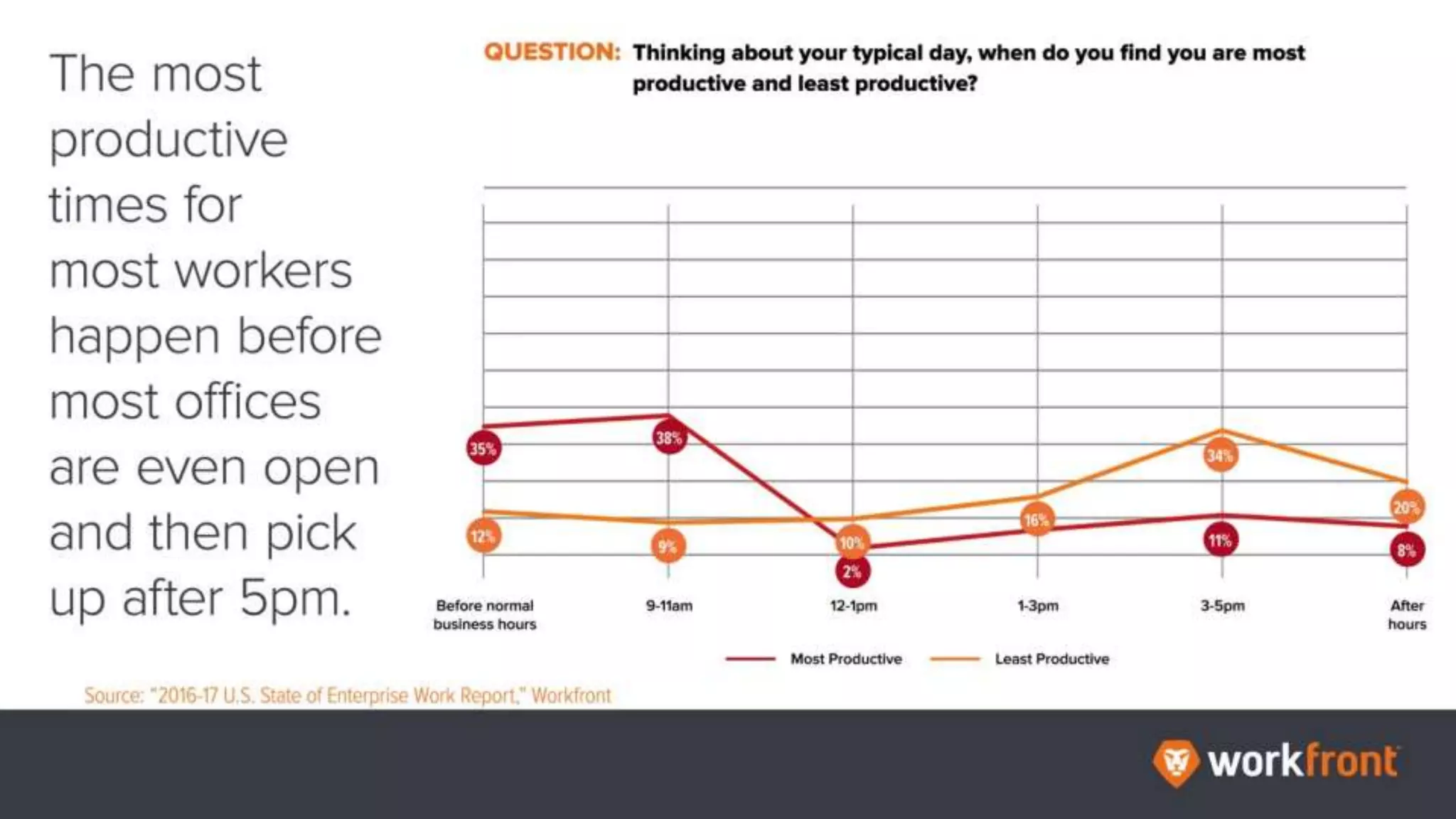
The most productive times for most workers happen before most offices are even open
and then pick up after 5pm.
16. Organize your work stuff in one place
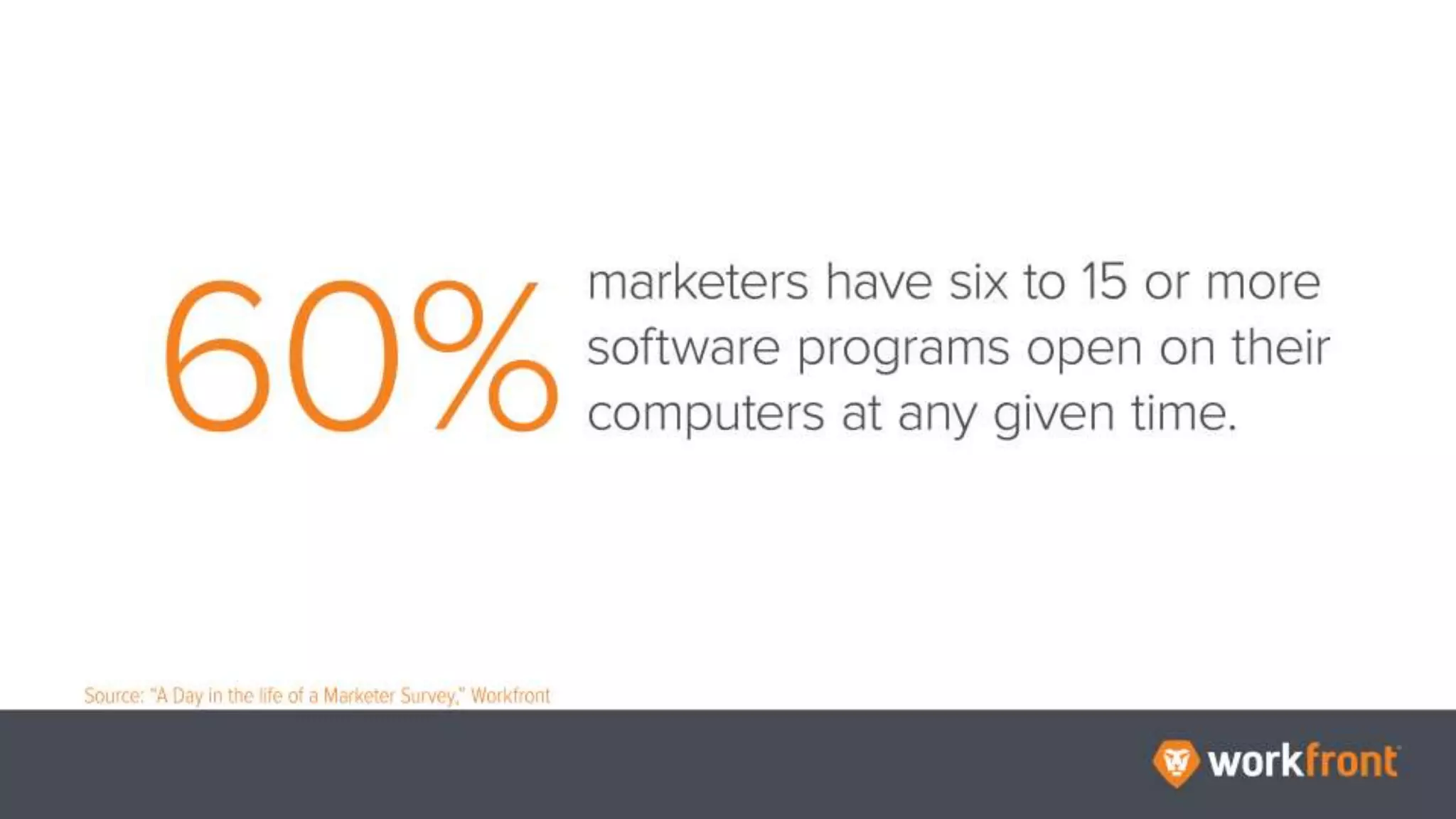
60% of marketers have six to 15 or more software programs open on the computers
at any given time.
Source: “A Day in the life of a Marketer Survey,” Workfront
“Use a central calendaring and project-management tool to keep yourself on
track...Make sure that that whatever system you use syncs everything (your calendar,
meetings, travel, To Do, and tasks) in one place. A bonus is being able to track your
time and manage resources.”
—Ann Handley, Chief Content Officer, MarketingProfs
17. Take time to communicate at the beginning
“On average, 30-35% of project time in marketing is spent on rework, including revisiting
decisions, waiting for approvals, redoing work, and correcting errors. Make it a point to
start your work with clear and collaborative communication among your team, clients,
and execs. Work together to create a clear communication plan. Everyone needs to know
how to share details about a project and clear deadlines to work toward.”
—Natalie Ward, Marketing Manager, Workfront
18. Invest in templates
There’s no need to reinvent the wheel every time you sit down to work on a
project. You can build templates for your most recurring types of work.
Templates also ensure you’re consistently covering all of your bases and applying
best practices.
19. Schedule everything
“Enter a calendar item at the beginning and/or end of every day to review your calendar
entries. While this may seem like an unnecessary or redundant step to take, remember,
you're dealing with you—someone who can't stay organized or on-task. Forcing yourself to
follow a schedule that includes reviewing your schedule is going to help you break the mold
and actually know your schedule.”
—Jason Falls, Digital Strategist & Keynote Speaker
20. Aggregate your admin time
Email, phone calls, and excessive meetings are sucking away your precious time.
“During the day, I never answer my phone unless it is a scheduled call I am expecting.
If people don’t leave a message, I just saved myself time and aggravation. During the
lunch hour and in the evening, I will spend an hour or so on email, social media
content, and phone calls … [I]f you are a slave to all of the messaging coming at you,
productivity will slide.”
—Mark Schaefer, Author, Blogger & Social Media Marketing Strategy Consultant
21. Do the hard thing second
“Ease into your weekday by doing one easy work thing first, then immediately launch
into the Hard Thing (the thing that requires the think). Key here is actually putting that
Hard Thing second, though—not third or fourth or fiftieth. Taking this approach creates
some momentum and sets you on the path toward accomplishment. Which is what you
want, because the Overlord of Momentum is the mortal enemy of that scoundrel
Robber-Baron, Procrastination.”
—Ann Handley, Chief Content Officer, MarketingProfs
22. Take breaks
“Use train time, bus time or queuing time for thinking or unwinding, rather than
using it for yet another ten minutes of information overload. You’ll feel less frantic if
you take these opportunities for time out as they’re offered.”
—Francis Booth, Contributor, Forbes
23. Use a meeting agenda
If you’re going to be more productive, you’ve got to cut down on meetings and
rein in the ones you can’t get out of.
Your best bet here is a meeting agenda.
24. Limit meeting time
“People generally don't need as much time as they ask for...Meetings are time vampires. Be
ruthless in managing this endemic productivity drain so you can focus on high value tasks.”
—Bruna Martiuzzi, President & Founder, Clarion Enterprises
25. Limit phone notifications
Make sure none of your devices are set to ping you when new messages come
in.
26. Track your time
“A creative team that doesn't track time is a creative team that has little visibility into
its productivity and efficiency.”
—Sam Petersen, Marketing Manager, Workfront
27. Set up data-driven deadlines
You can’t pull this off consistently without some data gathering on your past
performance:
Time tracking
Accurate documentation of your workflow for your common request types
28. Tame that review and approval phase
A content marketer survey found:
For 65% of content marketers, the approval process sets back projects 3 days or
more
Source: “2015 Content Marketing World Survey,” Workfront
Apply some structure to the approval phase:
Establish the exact numbers of review cycles with stakeholders
Establish the dates by which those cycles will be completed
Hold stakeholders accountable to those dates
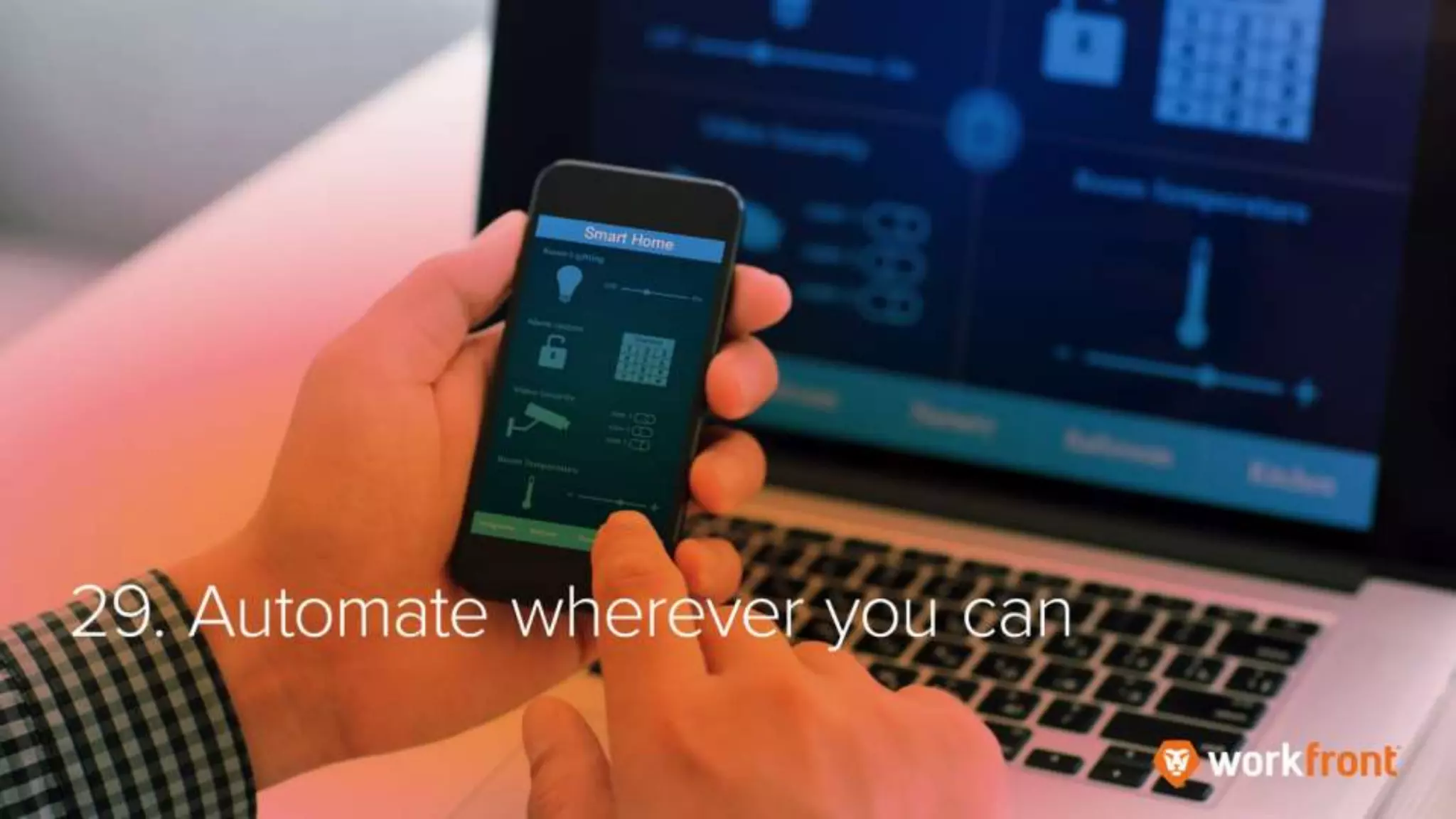
29. Automate wherever you can
Manual work probably makes up a big portion of your work. The host of tools out
there that can automate much of that work for you.
30. Get objective about productivity
The numbers don’t lie. They can reveal strengths and weaknesses we didn’t know we
had. They can highlight opportunities for improvement that would’ve otherwise
flown under the radar.
If we’re really serious about improving our productivity we’ve got to get down to the
actual numbers of:
how much we produce in a given time frame
how long it takes
where we tend to falter
31. Be ready for cultural pushback
Productivity needs a champion in every office. But also realize that productivity
can’t be forced.
Focus on making incremental changes that will increase your and your team’s
productivity over time.
31 Productivity Tips

31 Productivity Tips

  • 1.
    Productivity Tips 31 TricksThat Might Just Get You Out Of The Office On Time
  • 2.
    Who doesn’t wantto get more done in less time? For all the people who find that all the hours in the day aren’t enough to get done all the tasks on their to-do list, any trick to milk out of the day one more completed task is gold. Drawing on the wealth of work management tips on the Talking Work Blog and the knowledge of other experts, we’ve amassed a list of 31 productivity tips so powerful, you just might leave the office on time…
  • 3.
    1. Get agood night’s sleep
  • 4.
    A lack ofsleep is not correlated with an increase in productivity! Workers who logged 6 or less hours of sleep per night were significantly less productive than those who got 7-8 hours.
  • 5.
  • 6.
    “Not all foodsare processed by our bodies at the same rate. Some foods, like pasta, bread, cereal and soda, release their glucose quickly, leading to a burst of energy followed by a slump. Others, like high fat meals (think cheeseburgers and BLTs) provide more sustained energy, but require our digestive system to work harder, reducing oxygen levels in the brain and making us groggy.” —Ron Friedman, “What You Eat Affects Your Productivity,” Harvard Business Review
  • 7.
  • 8.
    One study found: Dehydratedworkers saw a 12% decrease in their productivity. Workers with moderate dehydration saw impaired motor tracking, attention, and arithmetic efficiency. 23% reduction in reaction time when subjects were 4% dehydrated. Source: “Avoid dehydration in the workplace” by Mike Markovsky, Industrial Safety & Hygiene News
  • 9.
    4. Insist onreceiving all of your requests in one place
  • 10.
    “One way thiscould be done—since 63 percent of marketers still receive most work requests by email—is to create an alias email account, like workrequest@companyname.com. In addition, create a standard work request form that is customizable and is easily accessible. There will be an instant reduction in distractions from all the random requests and you will be able to find your entire to-do list in one place.” —Natalie Ward, Marketing Manager, Workfront
  • 11.
    5. Beware of“under-the-table” requests
  • 12.
    Those little favorsinevitably push out other stuff you were planning on getting done. Either: you end up burning the midnight oil to get caught up or your stuff ends up late and you look incompetent
  • 13.
    “No more ‘quickfavors’. No more drive-by requests. Think of tasks the way you think of financial transactions—nothing is allowed to happen off the books. Every single task must be documented and accounted for.” —Marcus Varner, Senior Content Marketing Manager, Workfront
  • 14.
    6. Set upclear priorities
  • 15.
    Being productive ismore than just getting stuff done; it’s about getting the most valuable stuff done. Consider these criteria for prioritizing: Alignment to company goals and strategy Rank of the requestor Due date of the request
  • 16.
    7. Connect yourtasks to your goals
  • 17.
    “We work alot. We work more than ever before. We’re logging many more hours, processing mountains more email and other communications. We’re just DOING lots and lots more than ever before. But we’re less happy, less certain that we’re accomplishing our goals, and less sure of what we need.” —Chris Brogan, CEO, Owner Media Group
  • 18.
    “What you’re doingtoday impacts what you’ll accomplish this week. Bucket up all the todays into a month, and then stack twelve of these up, and what you did TODAY reflects on your full year.” —Chris Brogan, CEO, Owner Media Group
  • 19.
  • 20.
    “Of course, noone likes to have conflict in the workplace, especially when it comes to higher-ups, or perhaps worse, clients and customers. The last thing you want is to damage a business relationship. However, it's easy to forget that can also happen if you say ‘yes' to everything. Sometimes pushing back is necessary for the benefit of the company—and your team's sanity.” —Heather Hurst, Director of Corporate Marketing, Workfront
  • 21.
  • 22.
    “People who areregularly bombarded with several streams of electronic information do not pay attention, control their memory or switch from one job to another as well as those who prefer to complete one task at a time.” —Adam Gorlick, “Media multitaskers pay mental price, Stanford study shows,” Stanford News
  • 23.
    “Multitasking rarely works,despite what nearly everyone says. When you multitask, you simply accomplish each task less effectively. Your brain tries to switch back and forth between different tasks, and a significant part of your day is lost.” —Brand Turner, “4 Productivity Tips That Changed My Life This Year,” Entrepreneur
  • 24.
  • 25.
    When asked whatwould do the most to boost their productivity, 25% of office workers said uninterrupted blocks of time. Source: “2016-17 U.S. State of Enterprise Work Report,” Workfront
  • 26.
    “You may nothave an office, but you have the ability to show everyone around you’re busy. Put on a set of headphones—even if you don’t listen to anything—to visibly queue your colleagues you’re focused and shouldn’t be bothered. If someone approaches you, politely ask them to come back at the end of your work meeting with yourself. They’ll get used to letting you do your work.” —Jason Falls, Digital Strategist & Keynote Speaker
  • 27.
    11. Create aproductivity-optimized workspace
  • 28.
    You’ve hopefully discoveredyour productivity sweet spot, those ideal work conditions where you can focus your attention like a laser beam and fly through tasks like a bullet train. Know what your sweet spot looks like, understand how each component affects your productivity, and to optimize your workspace accordingly.
  • 29.
    12. Ditch theopen workspace
  • 30.
    One study onopen-offices found: Most workers were frustrated by the effect of constant distractions on their performance Half took issue with the lack of sound privacy 30% complained about the lack of visual privacy Source: Jungsoo Kim, “Workspace satisfaction: The privacy-communication trade-off in open-plan offices,” Journal of Environmental Psychology
  • 31.
    “While employees feellike they’re part of a laid-back, innovative enterprise, the environment ultimately damages workers’ attention spans, productivity, creative thinking, and satisfaction.” —Lindsey Kaufman, Writer, The Washington Post
  • 32.
  • 33.
    A recent Stanfordstudy found: 10% of U.S. workers work from home Their performance levels have increased by 13%
  • 34.
    14. Or fromthe library or the coffee shop
  • 35.
    Noisy kids orroommates at home? Coffee shops, libraries, and other wifi-connected public places provide suitable replacement workspaces.
  • 36.
  • 37.
    The most productivetimes for most workers happen before most offices are even open and then pick up after 5pm.
  • 38.
    16. Organize yourwork stuff in one place
  • 39.
    60% of marketershave six to 15 or more software programs open on the computers at any given time. Source: “A Day in the life of a Marketer Survey,” Workfront
  • 40.
    “Use a centralcalendaring and project-management tool to keep yourself on track...Make sure that that whatever system you use syncs everything (your calendar, meetings, travel, To Do, and tasks) in one place. A bonus is being able to track your time and manage resources.” —Ann Handley, Chief Content Officer, MarketingProfs
  • 41.
    17. Take timeto communicate at the beginning
  • 42.
    “On average, 30-35%of project time in marketing is spent on rework, including revisiting decisions, waiting for approvals, redoing work, and correcting errors. Make it a point to start your work with clear and collaborative communication among your team, clients, and execs. Work together to create a clear communication plan. Everyone needs to know how to share details about a project and clear deadlines to work toward.” —Natalie Ward, Marketing Manager, Workfront
  • 43.
    18. Invest intemplates
  • 44.
    There’s no needto reinvent the wheel every time you sit down to work on a project. You can build templates for your most recurring types of work. Templates also ensure you’re consistently covering all of your bases and applying best practices.
  • 45.
  • 46.
    “Enter a calendaritem at the beginning and/or end of every day to review your calendar entries. While this may seem like an unnecessary or redundant step to take, remember, you're dealing with you—someone who can't stay organized or on-task. Forcing yourself to follow a schedule that includes reviewing your schedule is going to help you break the mold and actually know your schedule.” —Jason Falls, Digital Strategist & Keynote Speaker
  • 47.
  • 48.
    Email, phone calls,and excessive meetings are sucking away your precious time.
  • 49.
    “During the day,I never answer my phone unless it is a scheduled call I am expecting. If people don’t leave a message, I just saved myself time and aggravation. During the lunch hour and in the evening, I will spend an hour or so on email, social media content, and phone calls … [I]f you are a slave to all of the messaging coming at you, productivity will slide.” —Mark Schaefer, Author, Blogger & Social Media Marketing Strategy Consultant
  • 50.
    21. Do thehard thing second
  • 51.
    “Ease into yourweekday by doing one easy work thing first, then immediately launch into the Hard Thing (the thing that requires the think). Key here is actually putting that Hard Thing second, though—not third or fourth or fiftieth. Taking this approach creates some momentum and sets you on the path toward accomplishment. Which is what you want, because the Overlord of Momentum is the mortal enemy of that scoundrel Robber-Baron, Procrastination.” —Ann Handley, Chief Content Officer, MarketingProfs
  • 52.
  • 53.
    “Use train time,bus time or queuing time for thinking or unwinding, rather than using it for yet another ten minutes of information overload. You’ll feel less frantic if you take these opportunities for time out as they’re offered.” —Francis Booth, Contributor, Forbes
  • 54.
    23. Use ameeting agenda
  • 55.
    If you’re goingto be more productive, you’ve got to cut down on meetings and rein in the ones you can’t get out of. Your best bet here is a meeting agenda.
  • 56.
  • 57.
    “People generally don'tneed as much time as they ask for...Meetings are time vampires. Be ruthless in managing this endemic productivity drain so you can focus on high value tasks.” —Bruna Martiuzzi, President & Founder, Clarion Enterprises
  • 58.
    25. Limit phonenotifications
  • 59.
    Make sure noneof your devices are set to ping you when new messages come in.
  • 60.
  • 61.
    “A creative teamthat doesn't track time is a creative team that has little visibility into its productivity and efficiency.” —Sam Petersen, Marketing Manager, Workfront
  • 62.
    27. Set updata-driven deadlines
  • 63.
    You can’t pullthis off consistently without some data gathering on your past performance: Time tracking Accurate documentation of your workflow for your common request types
  • 64.
    28. Tame thatreview and approval phase
  • 65.
    A content marketersurvey found: For 65% of content marketers, the approval process sets back projects 3 days or more Source: “2015 Content Marketing World Survey,” Workfront
  • 66.
    Apply some structureto the approval phase: Establish the exact numbers of review cycles with stakeholders Establish the dates by which those cycles will be completed Hold stakeholders accountable to those dates
  • 67.
  • 68.
    Manual work probablymakes up a big portion of your work. The host of tools out there that can automate much of that work for you.
  • 69.
    30. Get objectiveabout productivity
  • 70.
    The numbers don’tlie. They can reveal strengths and weaknesses we didn’t know we had. They can highlight opportunities for improvement that would’ve otherwise flown under the radar. If we’re really serious about improving our productivity we’ve got to get down to the actual numbers of: how much we produce in a given time frame how long it takes where we tend to falter
  • 71.
    31. Be readyfor cultural pushback
  • 72.
    Productivity needs achampion in every office. But also realize that productivity can’t be forced. Focus on making incremental changes that will increase your and your team’s productivity over time.