What’s really happening in UK
companies?
5 Shocking Revelations From Workfront’s
2016 Uk State of Enterprise Work Report
Introduction
Office workers and the organisations they work in are constantly striving
to be more productive, to rise to the increasing intensity of competition
in their markets. But what keeps them from being as productive,
effective, and competitive as they aspire to be? To answer this question,
Workfront, the leading provider of enterprise work management
solutions, surveyed 2,051 UK officer workers. The results of the survey
might surprise you…
Finding #1: UK officer workers think of themselves as productive
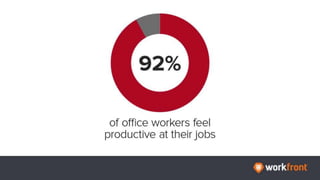
92% of officer workers
feel productive at their
jobs
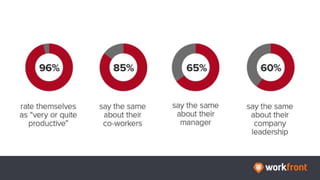
96% rate themselves as “very or quite productive”
85% say the same about their co-workers
65% say the same about their manager
60% say the same about company leadership
Finding #2: This productivity comes at a cost
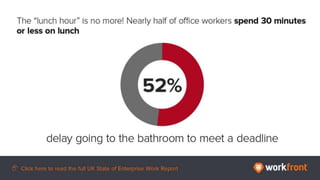
The “lunch hour” is no more! Nearly half of office workers spend 30 minutes or less on
lunch
52% delay going to the bathroom to meet a deadline
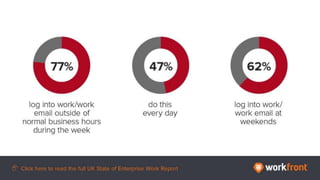
77% log into work/work email outside of normal business hours during the week
47% do this every day
62% log into work/work email at weekends
In other words, to be more productive, office workers must “create” extra time from lunch,
bathroom breaks, mornings, evenings, and weekends.
What’s driving this?
Finding #3: Office workers aren’t getting their real work done during standard work hours
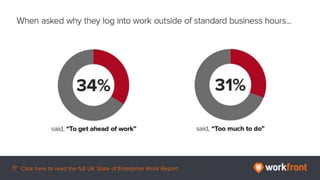
When asked why they log into work outside of standard business hours…
34% said, “To get ahead of work”
31% said, “Too much work to do”
Which raises the question: what is keeping office workers from completing their real work
within standard business hours?
Finding #4: Phone calls, meetings, and email are pushing out real work
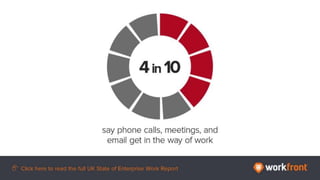
4 in 10 say phone calls, meetings, and email get in the way of work
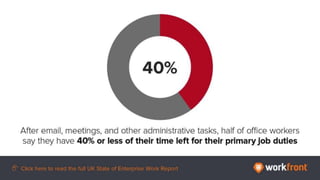
After email, meetings, and other administrative tasks, half of office workers say they
have 40% or less of their time left for their primary job duties
In other words, much of our efforts at workplace communication are keeping workers from
doing the work they were hired to do.
Finding #5: Poor work communication is causing inter-departmental conflict
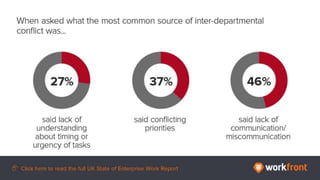
When asked what the most common source of inter-departmental conflict was…
27% said lack of understanding about timing or urgency of tasks
37% said conflicting priorities
46% said lack of communication/miscommunication
Finding #6: That conflict is killing more than just productivity
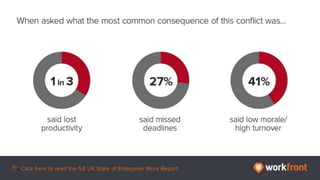
When asked what the most common consequence of this conflict was…
1 in 3 said lost productivity
27% said missed deadlines
41% said low morale/high turnover
5 Shocking Revelations From the UK Workplace

5 Shocking Revelations From the UK Workplace

  • 1.
    What’s really happeningin UK companies? 5 Shocking Revelations From Workfront’s 2016 Uk State of Enterprise Work Report
  • 2.
    Introduction Office workers andthe organisations they work in are constantly striving to be more productive, to rise to the increasing intensity of competition in their markets. But what keeps them from being as productive, effective, and competitive as they aspire to be? To answer this question, Workfront, the leading provider of enterprise work management solutions, surveyed 2,051 UK officer workers. The results of the survey might surprise you…
  • 3.
    Finding #1: UKofficer workers think of themselves as productive
  • 4.
    92% of officerworkers feel productive at their jobs
  • 5.
    96% rate themselvesas “very or quite productive” 85% say the same about their co-workers 65% say the same about their manager 60% say the same about company leadership
  • 6.
    Finding #2: Thisproductivity comes at a cost
  • 7.
    The “lunch hour”is no more! Nearly half of office workers spend 30 minutes or less on lunch 52% delay going to the bathroom to meet a deadline
  • 8.
    77% log intowork/work email outside of normal business hours during the week 47% do this every day 62% log into work/work email at weekends
  • 9.
    In other words,to be more productive, office workers must “create” extra time from lunch, bathroom breaks, mornings, evenings, and weekends. What’s driving this?
  • 10.
    Finding #3: Officeworkers aren’t getting their real work done during standard work hours
  • 11.
    When asked whythey log into work outside of standard business hours… 34% said, “To get ahead of work” 31% said, “Too much work to do”
  • 12.
    Which raises thequestion: what is keeping office workers from completing their real work within standard business hours?
  • 13.
    Finding #4: Phonecalls, meetings, and email are pushing out real work
  • 14.
    4 in 10say phone calls, meetings, and email get in the way of work
  • 15.
    After email, meetings,and other administrative tasks, half of office workers say they have 40% or less of their time left for their primary job duties
  • 16.
    In other words,much of our efforts at workplace communication are keeping workers from doing the work they were hired to do.
  • 17.
    Finding #5: Poorwork communication is causing inter-departmental conflict
  • 18.
    When asked whatthe most common source of inter-departmental conflict was… 27% said lack of understanding about timing or urgency of tasks 37% said conflicting priorities 46% said lack of communication/miscommunication
  • 19.
    Finding #6: Thatconflict is killing more than just productivity
  • 20.
    When asked whatthe most common consequence of this conflict was… 1 in 3 said lost productivity 27% said missed deadlines 41% said low morale/high turnover