BADCamp 2020:
Classic Website Blunders
October 16, 2020
1
Overview
● Intro
● Blunders
● Avoiding blunders
● Process
● Conclusion
2
Intro
3
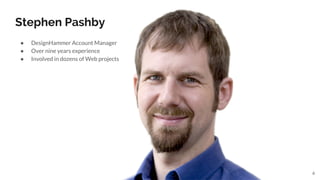
Stephen Pashby
4
● DesignHammer Account Manager
● Over nine years experience
● Involved in dozens of Web projects
“Impressive Project Management Statistics”
● Most organizations have a 70% project failure rate
● On average, projects go over budget by 27% of their intended cost
● 55% of project managers cited budget overrun as a reason for project failure
● Only 64% of projects meet their goals
● 78% reported that their business was not aligned with project goals
● 75% believe their projects are always or usually slated to fail from the beginning
Source: https://learn.g2.com/project-management-statistics
5
6
Why not? How
hard could it be?
Should we build
a new website?
Our story includes…
● Fencing
● Fighting
● Torture
● Revenge
● Giants
● Monsters
● Chases
● Escapes
● True love
● Miracles
7
8
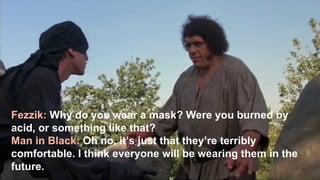
Fezzik: Why do you wear a mask? Were you burned by
acid, or something like that?
Man in Black: Oh no, it’s just that they’re terribly
comfortable. I think everyone will be wearing them in the
future.
Blunders: classic or otherwise
9
10
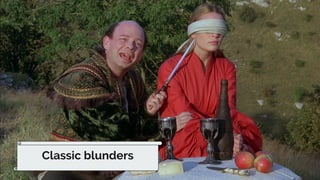
Classic blunders
Classic blunders
● The most famous is “Never get involved in a land war in Asia.”
● But only slightly less well known is this: “Never go in against a Sicilian when death is on the line.”
Source: Vizzini, The Sicilian
11
12
Lack of business case
● Blunder: Project lacks a use case or business need
● Risk: Project is a waste of time and money
● When: Project is typically doomed from the start
● Why: There needs to be a reason
● Fix: Identify organizational goals, and determine how the project aligns before investing time
13
14
Unrealistic expectations
● Blunder: Resources (time and money) are always constrained, be reasonable in what can be done
● Risk: Project doesn’t start, project isn’t completed, feature creep
● When: Any time, but typically during Project Definition or Planning
● Why: Compromise and reasonable expectation increase likelihood of success
● Fix: Look at projects that have similar budgets and schedules. Don’t look at groups orders of
magnitude larger to set project requirements
15
16
Insufficient schedule
● Blunder: Not allowing enough calendar time to successfully complete the project
● Risk: Project will be late or fail (if a hard deadline)
● When: Project is typically doomed from the start
● Why: Complex systems with interdependent parts take time (see Man Month Myth)
● Fix: Involve leadership in setting project goals and metrics of success and at key approval stages
17
18
Absent or
uninvolved leadership
Absent or uninvolved leadership
● Blunder: Inadequate access to stakeholders/leadership during project
● Risk: Lack of leadership involvement at critical stages can lead to rejection of the entire project
● When: Project Definition, Discovery and Planning or Production
● Why: Leadership input and critical for project to align with organizational goals
● Fix: Involve leadership in setting project goals and metrics of success and at key approval stages
19
20
Junior project manager
● Blunder: Junior staff member tasted with managing project
● Risk: Lacks authority to make decisions, or require staff to provide support
● When: Generally doomed from the start
● Why: Project manager needs either authority to make decisions/assign staff to tasks
● Fix: Senior staff need to be responsible to maximize efficiency. Senior support of junior project
manager can work, but usually takes longer, and more prone to error.
21
22
Communication
breakdown
Communication breakdown
● Blunder: Irregular meetings, inadequate documentation
● Risk: Misunderstandings will cause work to need to be redone
● When: Any stage
● Why: Documentation will avoid errors, and provide reminders of why decisions were made
● Fix: Regular meetings with notes circulated, approved, and accessible afterwards, documented
approval steps
23
24
Design by committee
Design by committee
● Blunder: Too many people involved in decision making
● Risk: Project will be late and over budget, not really satisfy anyone
● When: Production, but stage is set in Planning
● Why: “Too many cooks spoil the soup”
● Fix: Rely on a small group of decision makers, ideally with one who can make ultimate decisions
25
26
Vanishing volunteers
● Blunder: Entrusting mission critical tasks to volunteers that may leave at anytime
● Risk: May not complete tasks, or may disappear when support is necessary
● When: Production or Support
● Why: You get what you pay for
● Fix: Avoid a single point of failure, particularly in mission critical systems
27
28
Blinded by buzzwords
Blinded by buzzword
● Blunder: Becoming distracted from your core goals by the latest web fad or bleeding edge
technology
● Risk: May increase project cost or complexity without delivering a compelling ROI
● When: Discovery and Planning
● Why: Just because you can do something, doesn’t mean you should
● Fix: Focus on the project goals and allow these to guide design and technology choices
29
30
Ignoring risks
Ignoring risks
● Blunder: Failing to identify project risks and discuss mitigation
● Risk: Project failure due to everything not going as planned
● When: Project Definition, Discovery and Planning or Production
● Why: The unexpected (or inconceivable) frequently happens
● Fix: Identify potential risks and determine appropriate mitigations should the risks manifest
31
Avoiding blunders
32
Avoiding blunders
● Enure project aligns with organizational goals
● Align expectations with available resources
● Involve appropriate stakeholders to provide input, feedback, and approval
● Get feedback from potential users through surveys or user testing
● Follow an appropriate process including communication, feedback, and approvals
33
34
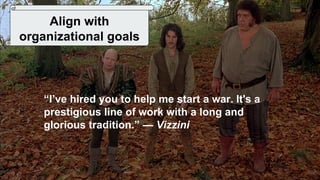
Align with
organizational goals
“I’ve hired you to help me start a war. It's a
prestigious line of work with a long and
glorious tradition.” — Vizzini
Align with organizational goals
● How does this project fit in with the organization’s mission and vision?
● Core organizational focus?
● Discrete tactical initiative?
● Vanity project/boondoggle?
● Understanding this can guide appropriate scope and resourcing
35
36
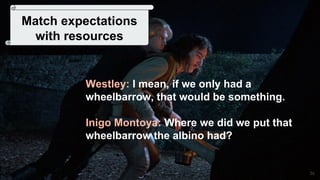
Match expectations
with resources
Westley: I mean, if we only had a
wheelbarrow, that would be something.
Inigo Montoya: Where we did we put that
wheelbarrow the albino had?
Match expectations with resources
● A well-resourced project that delivers a core organizational focus can realistically have one type of
expectations
● A department project resourced with chewing gum and bailing wire should realistically have much
more modest expectations
● If you are not investing the resources of Apple, should you expect Apple levels of polish?
● “Get used to disappointment.”
37
38
Stakeholder
involvement
Fezzik: EVERYBODY MOVE!
Inigo Montoya: Thank you.
Stakeholder involvement
● Line up the stakeholders you need to have involved, to make sure the right people weigh in
throughout the process, including:
● Technical requirements
● Information architecture
● Design
● User acceptance testing
● Final sign-off
● Involved the right people at the right time can help keep your project on schedule and minimize
costly re-work
39
40
User surveys & user
testing
“What did this do to you? Tell me. And
remember, this is for posterity, so be
honest — how do you feel?”
— Count Rugen
User surveys & user testing
● Ultimately, whether users can find your website useful and compelling will determine your success
or failure
● Engaging with your users to learn how they will interact with your content and functionality can
help you avoid blunders
● Common user testing tools include:
● User Surveys
● Card Sorts
● Tree Testing
● Usability Testing
41
42
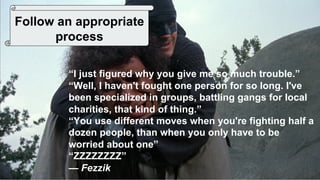
Follow an appropriate
process
“I just figured why you give me so much trouble.”
“Well, I haven't fought one person for so long. I've
been specialized in groups, battling gangs for local
charities, that kind of thing.”
“You use different moves when you're fighting half a
dozen people, than when you only have to be
worried about one”
“ZZZZZZZZ”
— Fezzik
Follow an appropriate process
● Following an appropriate process will help you avoid many blunders
● Making sure you have the right sign-off from the right stakeholders can help with questions later
when busy stakeholders do not remember what they approved
● Documentation can help you remember not only what you and your team decided, but why it was
decided
● Best practices for development can simplify maintenance and reduce the cost of future
development
43
Process
44
Process overview
● Project Definition/Resourcing
● Discovery & Planning
● Production
● Post-Launch
45
46
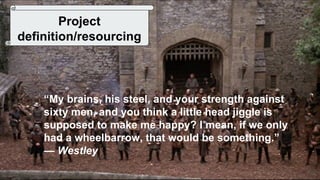
Project
definition/resourcing
“My brains, his steel, and your strength against
sixty men, and you think a little head jiggle is
supposed to make me happy? I mean, if we only
had a wheelbarrow, that would be something.”
— Westley
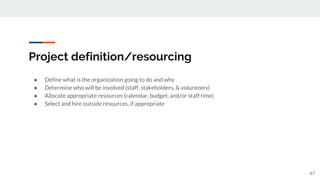
Project definition/resourcing
● Define what is the organization going to do and why
● Determine who will be involved (staff, stakeholders, & volunteers)
● Allocate appropriate resources (calendar, budget, and/or staff time)
● Select and hire outside resources, if appropriate
47
48
Discovery & planning
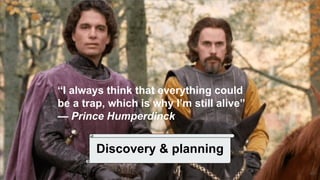
“I always think that everything could
be a trap, which is why I’m still alive”
— Prince Humperdinck
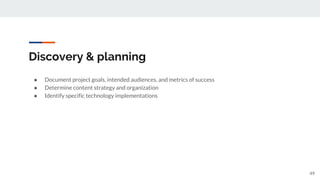
Discovery & planning
● Document project goals, intended audiences, and metrics of success
● Determine content strategy and organization
● Identify specific technology implementations
49
50
Production
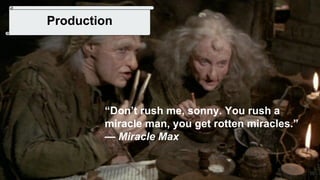
“Don’t rush me, sonny. You rush a
miracle man, you get rotten miracles.”
— Miracle Max
Production
● Design process
● Development
● Content migration
● Testing
51
52
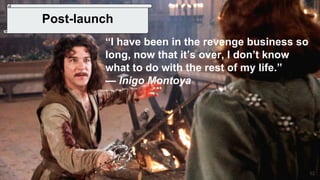
Post-launch
“I have been in the revenge business so
long, now that it’s over, I don’t know
what to do with the rest of my life.”
— Inigo Montoya
Post-launch
● On-going maintenance
● Content updates
● New feature development
53
Conclusion
54
Conclusion
● Use a process
● Avoid blunders that doom a project from the start
● Mitigate the effects of blunders that kill potentially successful projects
55
56
Thank you
BADCamp 2020!
BADCamp 2020
Coming up next
Friday 11 am
● Accessible SVGs: Inclusiveness Beyond Patterns with
Carie Fisher
● Decoupling Drupal: Gatsby Live Preview from the
same project with Chad Carlson
● Making a better community, better software, and a
better world with Tara King, Ruby Sinreich, and Elli
Lugwigson
BADCamp 2020
Coming up next
Friday 10:45 am ● Coffee Break with amazee.io in the Expo Hall

Classic Website Blunders

  • 1.
    BADCamp 2020: Classic WebsiteBlunders October 16, 2020 1
  • 2.
    Overview ● Intro ● Blunders ●Avoiding blunders ● Process ● Conclusion 2
  • 3.
  • 4.
    Stephen Pashby 4 ● DesignHammerAccount Manager ● Over nine years experience ● Involved in dozens of Web projects
  • 5.
    “Impressive Project ManagementStatistics” ● Most organizations have a 70% project failure rate ● On average, projects go over budget by 27% of their intended cost ● 55% of project managers cited budget overrun as a reason for project failure ● Only 64% of projects meet their goals ● 78% reported that their business was not aligned with project goals ● 75% believe their projects are always or usually slated to fail from the beginning Source: https://learn.g2.com/project-management-statistics 5
  • 6.
    6 Why not? How hardcould it be? Should we build a new website?
  • 7.
    Our story includes… ●Fencing ● Fighting ● Torture ● Revenge ● Giants ● Monsters ● Chases ● Escapes ● True love ● Miracles 7
  • 8.
    8 Fezzik: Why doyou wear a mask? Were you burned by acid, or something like that? Man in Black: Oh no, it’s just that they’re terribly comfortable. I think everyone will be wearing them in the future.
  • 9.
  • 10.
  • 11.
    Classic blunders ● Themost famous is “Never get involved in a land war in Asia.” ● But only slightly less well known is this: “Never go in against a Sicilian when death is on the line.” Source: Vizzini, The Sicilian 11
  • 12.
  • 13.
    Lack of businesscase ● Blunder: Project lacks a use case or business need ● Risk: Project is a waste of time and money ● When: Project is typically doomed from the start ● Why: There needs to be a reason ● Fix: Identify organizational goals, and determine how the project aligns before investing time 13
  • 14.
  • 15.
    Unrealistic expectations ● Blunder:Resources (time and money) are always constrained, be reasonable in what can be done ● Risk: Project doesn’t start, project isn’t completed, feature creep ● When: Any time, but typically during Project Definition or Planning ● Why: Compromise and reasonable expectation increase likelihood of success ● Fix: Look at projects that have similar budgets and schedules. Don’t look at groups orders of magnitude larger to set project requirements 15
  • 16.
  • 17.
    Insufficient schedule ● Blunder:Not allowing enough calendar time to successfully complete the project ● Risk: Project will be late or fail (if a hard deadline) ● When: Project is typically doomed from the start ● Why: Complex systems with interdependent parts take time (see Man Month Myth) ● Fix: Involve leadership in setting project goals and metrics of success and at key approval stages 17
  • 18.
  • 19.
    Absent or uninvolvedleadership ● Blunder: Inadequate access to stakeholders/leadership during project ● Risk: Lack of leadership involvement at critical stages can lead to rejection of the entire project ● When: Project Definition, Discovery and Planning or Production ● Why: Leadership input and critical for project to align with organizational goals ● Fix: Involve leadership in setting project goals and metrics of success and at key approval stages 19
  • 20.
  • 21.
    Junior project manager ●Blunder: Junior staff member tasted with managing project ● Risk: Lacks authority to make decisions, or require staff to provide support ● When: Generally doomed from the start ● Why: Project manager needs either authority to make decisions/assign staff to tasks ● Fix: Senior staff need to be responsible to maximize efficiency. Senior support of junior project manager can work, but usually takes longer, and more prone to error. 21
  • 22.
  • 23.
    Communication breakdown ● Blunder:Irregular meetings, inadequate documentation ● Risk: Misunderstandings will cause work to need to be redone ● When: Any stage ● Why: Documentation will avoid errors, and provide reminders of why decisions were made ● Fix: Regular meetings with notes circulated, approved, and accessible afterwards, documented approval steps 23
  • 24.
  • 25.
    Design by committee ●Blunder: Too many people involved in decision making ● Risk: Project will be late and over budget, not really satisfy anyone ● When: Production, but stage is set in Planning ● Why: “Too many cooks spoil the soup” ● Fix: Rely on a small group of decision makers, ideally with one who can make ultimate decisions 25
  • 26.
  • 27.
    Vanishing volunteers ● Blunder:Entrusting mission critical tasks to volunteers that may leave at anytime ● Risk: May not complete tasks, or may disappear when support is necessary ● When: Production or Support ● Why: You get what you pay for ● Fix: Avoid a single point of failure, particularly in mission critical systems 27
  • 28.
  • 29.
    Blinded by buzzword ●Blunder: Becoming distracted from your core goals by the latest web fad or bleeding edge technology ● Risk: May increase project cost or complexity without delivering a compelling ROI ● When: Discovery and Planning ● Why: Just because you can do something, doesn’t mean you should ● Fix: Focus on the project goals and allow these to guide design and technology choices 29
  • 30.
  • 31.
    Ignoring risks ● Blunder:Failing to identify project risks and discuss mitigation ● Risk: Project failure due to everything not going as planned ● When: Project Definition, Discovery and Planning or Production ● Why: The unexpected (or inconceivable) frequently happens ● Fix: Identify potential risks and determine appropriate mitigations should the risks manifest 31
  • 32.
  • 33.
    Avoiding blunders ● Enureproject aligns with organizational goals ● Align expectations with available resources ● Involve appropriate stakeholders to provide input, feedback, and approval ● Get feedback from potential users through surveys or user testing ● Follow an appropriate process including communication, feedback, and approvals 33
  • 34.
    34 Align with organizational goals “I’vehired you to help me start a war. It's a prestigious line of work with a long and glorious tradition.” — Vizzini
  • 35.
    Align with organizationalgoals ● How does this project fit in with the organization’s mission and vision? ● Core organizational focus? ● Discrete tactical initiative? ● Vanity project/boondoggle? ● Understanding this can guide appropriate scope and resourcing 35
  • 36.
    36 Match expectations with resources Westley:I mean, if we only had a wheelbarrow, that would be something. Inigo Montoya: Where we did we put that wheelbarrow the albino had?
  • 37.
    Match expectations withresources ● A well-resourced project that delivers a core organizational focus can realistically have one type of expectations ● A department project resourced with chewing gum and bailing wire should realistically have much more modest expectations ● If you are not investing the resources of Apple, should you expect Apple levels of polish? ● “Get used to disappointment.” 37
  • 38.
  • 39.
    Stakeholder involvement ● Lineup the stakeholders you need to have involved, to make sure the right people weigh in throughout the process, including: ● Technical requirements ● Information architecture ● Design ● User acceptance testing ● Final sign-off ● Involved the right people at the right time can help keep your project on schedule and minimize costly re-work 39
  • 40.
    40 User surveys &user testing “What did this do to you? Tell me. And remember, this is for posterity, so be honest — how do you feel?” — Count Rugen
  • 41.
    User surveys &user testing ● Ultimately, whether users can find your website useful and compelling will determine your success or failure ● Engaging with your users to learn how they will interact with your content and functionality can help you avoid blunders ● Common user testing tools include: ● User Surveys ● Card Sorts ● Tree Testing ● Usability Testing 41
  • 42.
    42 Follow an appropriate process “Ijust figured why you give me so much trouble.” “Well, I haven't fought one person for so long. I've been specialized in groups, battling gangs for local charities, that kind of thing.” “You use different moves when you're fighting half a dozen people, than when you only have to be worried about one” “ZZZZZZZZ” — Fezzik
  • 43.
    Follow an appropriateprocess ● Following an appropriate process will help you avoid many blunders ● Making sure you have the right sign-off from the right stakeholders can help with questions later when busy stakeholders do not remember what they approved ● Documentation can help you remember not only what you and your team decided, but why it was decided ● Best practices for development can simplify maintenance and reduce the cost of future development 43
  • 44.
  • 45.
    Process overview ● ProjectDefinition/Resourcing ● Discovery & Planning ● Production ● Post-Launch 45
  • 46.
    46 Project definition/resourcing “My brains, hissteel, and your strength against sixty men, and you think a little head jiggle is supposed to make me happy? I mean, if we only had a wheelbarrow, that would be something.” — Westley
  • 47.
    Project definition/resourcing ● Definewhat is the organization going to do and why ● Determine who will be involved (staff, stakeholders, & volunteers) ● Allocate appropriate resources (calendar, budget, and/or staff time) ● Select and hire outside resources, if appropriate 47
  • 48.
    48 Discovery & planning “Ialways think that everything could be a trap, which is why I’m still alive” — Prince Humperdinck
  • 49.
    Discovery & planning ●Document project goals, intended audiences, and metrics of success ● Determine content strategy and organization ● Identify specific technology implementations 49
  • 50.
    50 Production “Don’t rush me,sonny. You rush a miracle man, you get rotten miracles.” — Miracle Max
  • 51.
    Production ● Design process ●Development ● Content migration ● Testing 51
  • 52.
    52 Post-launch “I have beenin the revenge business so long, now that it’s over, I don’t know what to do with the rest of my life.” — Inigo Montoya
  • 53.
    Post-launch ● On-going maintenance ●Content updates ● New feature development 53
  • 54.
  • 55.
    Conclusion ● Use aprocess ● Avoid blunders that doom a project from the start ● Mitigate the effects of blunders that kill potentially successful projects 55
  • 56.
  • 57.
    BADCamp 2020 Coming upnext Friday 11 am ● Accessible SVGs: Inclusiveness Beyond Patterns with Carie Fisher ● Decoupling Drupal: Gatsby Live Preview from the same project with Chad Carlson ● Making a better community, better software, and a better world with Tara King, Ruby Sinreich, and Elli Lugwigson
  • 58.
    BADCamp 2020 Coming upnext Friday 10:45 am ● Coffee Break with amazee.io in the Expo Hall