THAIMINE
&
THIAMINE DEFICIENCY
SPECIAL EMPHASIS ON THE
INFANTILE FORM
DR AJAZ A MIR
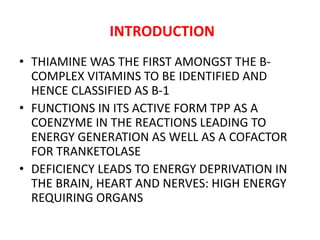
INTRODUCTION
• THIAMINE WAS THE FIRST AMONGST THE B-
COMPLEX VITAMINS TO BE IDENTIFIED AND
HENCE CLASSIFIED AS B-1
• FUNCTIONS IN ITS ACTIVE FORM TPP AS A
COENZYME IN THE REACTIONS LEADING TO
ENERGY GENERATION AS WELL AS A COFACTOR
FOR TRANKETOLASE
• DEFICIENCY LEADS TO ENERGY DEPRIVATION IN
THE BRAIN, HEART AND NERVES: HIGH ENERGY
REQUIRING ORGANS
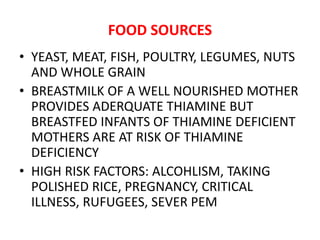
FOOD SOURCES
• YEAST, MEAT, FISH, POULTRY, LEGUMES, NUTS
AND WHOLE GRAIN
• BREASTMILK OF A WELL NOURISHED MOTHER
PROVIDES ADERQUATE THIAMINE BUT
BREASTFED INFANTS OF THIAMINE DEFICIENT
MOTHERS ARE AT RISK OF THIAMINE
DEFICIENCY
• HIGH RISK FACTORS: ALCOHLISM, TAKING
POLISHED RICE, PREGNANCY, CRITICAL
ILLNESS, RUFUGEES, SEVER PEM
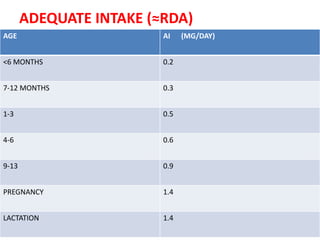
ADEQUATE INTAKE (≈RDA)
AGE AI (MG/DAY)
<6 MONTHS 0.2
7-12 MONTHS 0.3
1-3 0.5
4-6 0.6
9-13 0.9
PREGNANCY 1.4
LACTATION 1.4
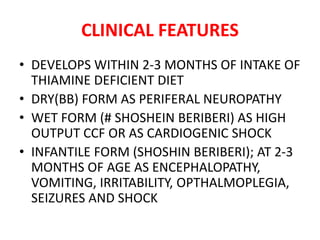
CLINICAL FEATURES
• DEVELOPS WITHIN 2-3 MONTHS OF INTAKE OF
THIAMINE DEFICIENT DIET
• DRY(BB) FORM AS PERIFERAL NEUROPATHY
• WET FORM (# SHOSHEIN BERIBERI) AS HIGH
OUTPUT CCF OR AS CARDIOGENIC SHOCK
• INFANTILE FORM (SHOSHIN BERIBERI); AT 2-3
MONTHS OF AGE AS ENCEPHALOPATHY,
VOMITING, IRRITABILITY, OPTHALMOPLEGIA,
SEIZURES AND SHOCK
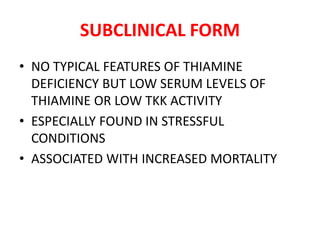
SUBCLINICAL FORM
• NO TYPICAL FEATURES OF THIAMINE
DEFICIENCY BUT LOW SERUM LEVELS OF
THIAMINE OR LOW TKK ACTIVITY
• ESPECIALLY FOUND IN STRESSFUL
CONDITIONS
• ASSOCIATED WITH INCREASED MORTALITY
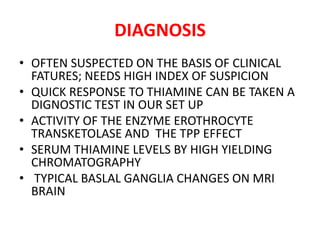
DIAGNOSIS
• OFTEN SUSPECTED ON THE BASIS OF CLINICAL
FATURES; NEEDS HIGH INDEX OF SUSPICION
• QUICK RESPONSE TO THIAMINE CAN BE TAKEN A
DIGNOSTIC TEST IN OUR SET UP
• ACTIVITY OF THE ENZYME EROTHROCYTE
TRANSKETOLASE AND THE TPP EFFECT
• SERUM THIAMINE LEVELS BY HIGH YIELDING
CHROMATOGRAPHY
• TYPICAL BASLAL GANGLIA CHANGES ON MRI
BRAIN
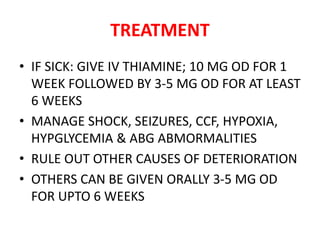
TREATMENT
• IF SICK: GIVE IV THIAMINE; 10 MG OD FOR 1
WEEK FOLLOWED BY 3-5 MG OD FOR AT LEAST
6 WEEKS
• MANAGE SHOCK, SEIZURES, CCF, HYPOXIA,
HYPGLYCEMIA & ABG ABMORMALITIES
• RULE OUT OTHER CAUSES OF DETERIORATION
• OTHERS CAN BE GIVEN ORALLY 3-5 MG OD
FOR UPTO 6 WEEKS
PREVENTION
• PROPER MATERNAL DIET
• COMPLEMENTARY FEEDS RICH IN THIAMINE
• PARBOILING
• CONSUMES LEGUMES AND NUTS IF TAKING
POLISHED RICE
• FORTIFICATION OF CEREALS
• THIAMINE IN TPN
ADVERSE EFFECTS AND TOXICITIES
NONE REPORTED
RESEARCH ARTICLES
INFANTILE THIAMINE DEFICIENCY
American Journal of Clinical Nutrition 1966 Vol.18 No.4 pp.275-7
Childhood Thiamine Deficiency in Northern Thailand.
• 45 children suspected of having beriberi were
admitted, 91% were under the age of 1 year, with a
peak in incidence between 1 and 3 months
• In Thailand a high mortality occurs in infants in the
second month of life and a correlation between the
mortality and thiamine deficiency is suggested. Similar
trends in mortality associated with infantile beriberi
have been recorded in India [this Bulletin, 1942, v. 39,
330] and Vietnam (Tu, Contribution to the study of
infantile beriberi in Vietnam, Saigon. Thesis, 1954,
Hanoi). W. R. Aykroyd.
ANZJOG. First published: August 1985
Thiamine Deficiency – A Neglected Problem of Infants and Mothers –
Possible Relationships to Sudden Infant Death Syndrome
• Summary: i) An unexpectedly high incidence of
biochemical thiamine deficiency (erythrocyte
transketolase) was found in groups of mothers and infants,
selected for apparent health from a westernized Caucasian
community in Australia.
• Deficiency was common in mothers at term but not their
infants, and in apparently healthy older infants but not
their mothers. These findings can be explained by
preferential delivery of thiamine to the fetus, at the
expense of the pregnant mother; after delivery the mother
recovers, and the infant becomes depleted.
• The incidence of thiamine deficiency was high in ‘near-
miss' sudden infant death syndrome (SIDS) infants and their
mothers, and in siblings of SIDS.
The Journal of Pediatrics. Volume 110, Issue 6, June 1987, Pages 888-892
Infantile beriberi presenting as sub acute necrotizing
encephalomyelopathy
• Subacute necrotizing encephalomyelopathy
(Leigh disease) is a degenerative nervous system
disorder with no known cause or cure. 1
Definitive antemortem diagnosis is precluded
because of the variable, nonspecific clinical
picture and the absence of a consistent
biochemical abnormality. We describe severe
iatrogenic infantile beriberi in which the clinical,
radiologic, and biochemical findings were
indistinguishable from those of the acute form of
subacute necrotizing encephalomyelopathy.
Journal of Parenteral and Enteral Nutrition. January 1, 1991
Severe Lactic Acidosis Related to Acute Thiamine Deficiency
• The authors report a case of severe lactic acidosis in a 3-year-old
boy, after 20 days of total parenteral nutrition without vitamin
supplementation. This child with acute lymphoblastic leukemia
underwent a period of severe refractory lactic acidosis (pH between
6.81 and 7.00 and a serum lactate level up to 38 mmol/liter) leading
to cardiac arrest. After the initial resuscitation and the subsequent
treatment of shock and vitamin K deficiency, acute peritoneal
dialysis was instituted to correct the severe lactic acidosis. Initial
low plasma thiamine levels confirmed the diagnosis of thiamine
deficiency. An associated transient pancreatic dysfunction was also
noted. The patient's overall course with thiamine replacement
therapy led to a complete recovery within 5 days and no sequelae
were noted after 12 months.
Acta Pediatrica. Volume 81, Issue 9. September 1992: Pages 723–724
Shoshin beriberi in an infant of a thiamine-deficient mother
• The classical form of thiamine deficiency in
children is comprised of peripheral neuropathy,
encephalopathy and high-output cardiac failure,
predominantly right-sided. “Shoshin beriberi”
cardiac failure has a different presentation, with
vasoconstriction, hypotension and severe
metabolic acidosis. A three-month breast-fed
infant developed these features (biochemical
tests confirmed the diagnosis). His mother,
although non-symptomatic, had biochemical
evidence of thiamine deficiency.
© 2001 American Society for Clinical Nutrition
Maternal thiamine deficiency: still a problem in some world communities1,2
Roger F Butterworth
• in this issue of the Journal describes a high incidence of
postpartum thiamine deficiency (assessed by using the
erythrocyte transketolase activation assay) in a group
of Karen women from a refugee camp on the Thailand-
Burma border. Up to 58% of these women were
thiamine deficient at 3 mo postpartum despite the
distribution in their rations of what appeared to be
adequate dietary thiamine supplements. Thiamine
supplementation was limited during pregnancy to
women with peripheral neuropathy and other clinical
signs of beriberi. This nutritional policy was started
when it was recognized that infantile beriberi is a
major cause of infant mortality in this population.
Pediatrics. February 2005, VOLUME 115 / ISSUE 2
Outbreak of Life-Threatening Thiamine Deficiency in Infants in
Israel Caused by a Defective Soy-Based Formula
• After the index case, an additional 8 infants were identified in our
centers by medical history, physical examination, and laboratory
testing
• Early symptoms were nonspecific and included mainly vomiting (n =
8), lethargy (n = 7), irritability (n = 5), abdominal distension (n = 4),
diarrhea (n = 4), respiratory symptoms (n = 4), developmental delay
(n = 3), and failure to thrive (n = 2).
• Conclusions. Clinician awareness of the possibility of thiamine
deficiency even in well-nourished infants is important for early
recognition and prevention of irreversible brain damage. Therapy
with large doses of thiamine should be initiated at the earliest
suspicion of vitamin depletion, even before laboratory evidence is
available and before neurologic or cardiologic symptoms appear.
PLOS. Published: February 22, 2011
Clinically Unapparent Infantile Thiamin Deficiency in Laos
• Overt infantile beriberi is relatively easy to diagnose but may
be the tip of a much larger iceberg of deficiency. A significant
proportion of infants admitted with other diseases, such as
acute respiratory infection or diarrhoea, may also have
clinically unapparent thiamin deficiency contributing to the
illness, and thiamin treatment may improve their outcome
• This study suggests that a substantial minority of infants
(13.4%) admitted without clinical evidence of beriberi had
biochemical thiamin deficiency.
• There is evidence that gastrointestinal absorption of thiamin
is saturated at doses of >5 mg [5], suggesting that oral doses
above this give limited, if any, benefit
BMJ. Infantile Wernicke's encephalopathy 2015……FROM KASHMIR
Umar Amin Qureshi1, Nisar Ahmad Wani2, Kaiser Ahmad3, Muhammad Irshad3, Iram Ali3
• Three exclusively breastfed male infants (Case 1,
3 months; Case 2, 7 months; and Case 3,
6 months of age) presented to our emergency
department with vomiting, bilateral non-
fatiguable ptosis and altered sensorium in form of
lethargy, excessive crying and moaning (figures 1
and 2). Ophthalmic examination in addition
revealed abduction deficits. There was no
nystagmus. The rest of CNS examination was
unremarkable. Maternal dietary history was
notable for a diet consisting of polished rice as a
Pediatric Radiology. January 2016, Volume 46, Issue 1: 96–103…….FROM KASHMIR
Infantile encephalitic beriberi: magnetic resonance imaging findings
• Hyperintense lesions on T2-weighted images were seen
symmetrically in the putamen in all patients, in the
caudate nuclei in 16/22 (73%), the thalami in 7/22
(32%) and the globi pallidi in 3/22 (14%) of the infants.
Altered signal intensity lesions in the cerebral cortex
were seen in 7/22 (32%). The mammillary bodies were
seen in one infant and the periaqueductal gray matter
in two. There was restricted diffusion in 14/22 (64%),
and 6/8 children with no evidence of restriction had
been imaged ≥10 days after presentation. MR
spectroscopy showed increased lactate peak in 6/8
infants (75%).
Nutrition. 2016 Feb;32(2):213-6. …….FROM KASHMIR
Thiamine responsive acute life threatening metabolic acidosis in exclusively
breast-fed infants.
Qureshi UA1, Sami A2, Altaf U3, Ahmad K2, Iqbal J4, Wani NA5, Mir Z2, Ali I2.
• Twenty three infants (Eleven male; Twelve female) in the age range
of 32 days to 4 months had a pH of ≤7 at admission. Onset of
moaning was immediate (2-24 hours). Blood lactate levels were
more than 15mmol/L. Blood thiamine levels of six infants in whom
it was done ranged from 11-69 nmol/L (control 78-185 nmol/L). All
infants were exclusively breast fed. Maternal staple diet consisted
of polished rice. All mothers consumed rice after washing it thrice.
Twelve lactating mothers were on customary dietary restrictions.
Practice of straining rice after cooking was observed in thirteen. The
commonest symptoms were irritability (82%) and reflux (56%).
Commonest signs were tachycardia (100%) and moaning (73%). At
presentation 52% were in cardiogenic shock. Response to thiamine
was dramatic with moaning and irritability subsiding in two hours
and tachycardia in four hours. Adequate perfusion was achieved in
one hour. Eighteen patients seen at six months follow up had
normal neurodevelopment.
Indian Heart J. 2017 Jan - Feb;69(1):24-27. Aug 2…….FROM KASHMIR
Shoshin beriberi-thiamine responsive pulmonary hypertension
in exclusively breastfed infants: A study from northern India.
Mean age at presentation was 78.45±30.7 days. All
infants were exclusively breastfed. 86.2% of
mothers were on customary dietary restrictions.
Biventricular failure and tachycardia was commonly
present. There were four deaths in our series. Acute
metabolic acidosis was a universal feature with a
mean pH of 7.21±0.15. Pulmonary hypertension
was present in all patients on admission.
Intravenous thiamine 100mg/kg IV stat was given
immediately after documenting pulmonary
hypertension. Repeat echocardiography showed
complete resolution of pulmonary hypertension

Thaimine

  • 1.
    THAIMINE & THIAMINE DEFICIENCY SPECIAL EMPHASISON THE INFANTILE FORM DR AJAZ A MIR
  • 2.
    INTRODUCTION • THIAMINE WASTHE FIRST AMONGST THE B- COMPLEX VITAMINS TO BE IDENTIFIED AND HENCE CLASSIFIED AS B-1 • FUNCTIONS IN ITS ACTIVE FORM TPP AS A COENZYME IN THE REACTIONS LEADING TO ENERGY GENERATION AS WELL AS A COFACTOR FOR TRANKETOLASE • DEFICIENCY LEADS TO ENERGY DEPRIVATION IN THE BRAIN, HEART AND NERVES: HIGH ENERGY REQUIRING ORGANS
  • 3.
    FOOD SOURCES • YEAST,MEAT, FISH, POULTRY, LEGUMES, NUTS AND WHOLE GRAIN • BREASTMILK OF A WELL NOURISHED MOTHER PROVIDES ADERQUATE THIAMINE BUT BREASTFED INFANTS OF THIAMINE DEFICIENT MOTHERS ARE AT RISK OF THIAMINE DEFICIENCY • HIGH RISK FACTORS: ALCOHLISM, TAKING POLISHED RICE, PREGNANCY, CRITICAL ILLNESS, RUFUGEES, SEVER PEM
  • 4.
    ADEQUATE INTAKE (≈RDA) AGEAI (MG/DAY) <6 MONTHS 0.2 7-12 MONTHS 0.3 1-3 0.5 4-6 0.6 9-13 0.9 PREGNANCY 1.4 LACTATION 1.4
  • 5.
    CLINICAL FEATURES • DEVELOPSWITHIN 2-3 MONTHS OF INTAKE OF THIAMINE DEFICIENT DIET • DRY(BB) FORM AS PERIFERAL NEUROPATHY • WET FORM (# SHOSHEIN BERIBERI) AS HIGH OUTPUT CCF OR AS CARDIOGENIC SHOCK • INFANTILE FORM (SHOSHIN BERIBERI); AT 2-3 MONTHS OF AGE AS ENCEPHALOPATHY, VOMITING, IRRITABILITY, OPTHALMOPLEGIA, SEIZURES AND SHOCK
  • 6.
    SUBCLINICAL FORM • NOTYPICAL FEATURES OF THIAMINE DEFICIENCY BUT LOW SERUM LEVELS OF THIAMINE OR LOW TKK ACTIVITY • ESPECIALLY FOUND IN STRESSFUL CONDITIONS • ASSOCIATED WITH INCREASED MORTALITY
  • 7.
    DIAGNOSIS • OFTEN SUSPECTEDON THE BASIS OF CLINICAL FATURES; NEEDS HIGH INDEX OF SUSPICION • QUICK RESPONSE TO THIAMINE CAN BE TAKEN A DIGNOSTIC TEST IN OUR SET UP • ACTIVITY OF THE ENZYME EROTHROCYTE TRANSKETOLASE AND THE TPP EFFECT • SERUM THIAMINE LEVELS BY HIGH YIELDING CHROMATOGRAPHY • TYPICAL BASLAL GANGLIA CHANGES ON MRI BRAIN
  • 8.
    TREATMENT • IF SICK:GIVE IV THIAMINE; 10 MG OD FOR 1 WEEK FOLLOWED BY 3-5 MG OD FOR AT LEAST 6 WEEKS • MANAGE SHOCK, SEIZURES, CCF, HYPOXIA, HYPGLYCEMIA & ABG ABMORMALITIES • RULE OUT OTHER CAUSES OF DETERIORATION • OTHERS CAN BE GIVEN ORALLY 3-5 MG OD FOR UPTO 6 WEEKS
  • 9.
    PREVENTION • PROPER MATERNALDIET • COMPLEMENTARY FEEDS RICH IN THIAMINE • PARBOILING • CONSUMES LEGUMES AND NUTS IF TAKING POLISHED RICE • FORTIFICATION OF CEREALS • THIAMINE IN TPN
  • 10.
    ADVERSE EFFECTS ANDTOXICITIES NONE REPORTED
  • 11.
  • 12.
    American Journal ofClinical Nutrition 1966 Vol.18 No.4 pp.275-7 Childhood Thiamine Deficiency in Northern Thailand. • 45 children suspected of having beriberi were admitted, 91% were under the age of 1 year, with a peak in incidence between 1 and 3 months • In Thailand a high mortality occurs in infants in the second month of life and a correlation between the mortality and thiamine deficiency is suggested. Similar trends in mortality associated with infantile beriberi have been recorded in India [this Bulletin, 1942, v. 39, 330] and Vietnam (Tu, Contribution to the study of infantile beriberi in Vietnam, Saigon. Thesis, 1954, Hanoi). W. R. Aykroyd.
  • 13.
    ANZJOG. First published:August 1985 Thiamine Deficiency – A Neglected Problem of Infants and Mothers – Possible Relationships to Sudden Infant Death Syndrome • Summary: i) An unexpectedly high incidence of biochemical thiamine deficiency (erythrocyte transketolase) was found in groups of mothers and infants, selected for apparent health from a westernized Caucasian community in Australia. • Deficiency was common in mothers at term but not their infants, and in apparently healthy older infants but not their mothers. These findings can be explained by preferential delivery of thiamine to the fetus, at the expense of the pregnant mother; after delivery the mother recovers, and the infant becomes depleted. • The incidence of thiamine deficiency was high in ‘near- miss' sudden infant death syndrome (SIDS) infants and their mothers, and in siblings of SIDS.
  • 14.
    The Journal ofPediatrics. Volume 110, Issue 6, June 1987, Pages 888-892 Infantile beriberi presenting as sub acute necrotizing encephalomyelopathy • Subacute necrotizing encephalomyelopathy (Leigh disease) is a degenerative nervous system disorder with no known cause or cure. 1 Definitive antemortem diagnosis is precluded because of the variable, nonspecific clinical picture and the absence of a consistent biochemical abnormality. We describe severe iatrogenic infantile beriberi in which the clinical, radiologic, and biochemical findings were indistinguishable from those of the acute form of subacute necrotizing encephalomyelopathy.
  • 15.
    Journal of Parenteraland Enteral Nutrition. January 1, 1991 Severe Lactic Acidosis Related to Acute Thiamine Deficiency • The authors report a case of severe lactic acidosis in a 3-year-old boy, after 20 days of total parenteral nutrition without vitamin supplementation. This child with acute lymphoblastic leukemia underwent a period of severe refractory lactic acidosis (pH between 6.81 and 7.00 and a serum lactate level up to 38 mmol/liter) leading to cardiac arrest. After the initial resuscitation and the subsequent treatment of shock and vitamin K deficiency, acute peritoneal dialysis was instituted to correct the severe lactic acidosis. Initial low plasma thiamine levels confirmed the diagnosis of thiamine deficiency. An associated transient pancreatic dysfunction was also noted. The patient's overall course with thiamine replacement therapy led to a complete recovery within 5 days and no sequelae were noted after 12 months.
  • 16.
    Acta Pediatrica. Volume81, Issue 9. September 1992: Pages 723–724 Shoshin beriberi in an infant of a thiamine-deficient mother • The classical form of thiamine deficiency in children is comprised of peripheral neuropathy, encephalopathy and high-output cardiac failure, predominantly right-sided. “Shoshin beriberi” cardiac failure has a different presentation, with vasoconstriction, hypotension and severe metabolic acidosis. A three-month breast-fed infant developed these features (biochemical tests confirmed the diagnosis). His mother, although non-symptomatic, had biochemical evidence of thiamine deficiency.
  • 17.
    © 2001 AmericanSociety for Clinical Nutrition Maternal thiamine deficiency: still a problem in some world communities1,2 Roger F Butterworth • in this issue of the Journal describes a high incidence of postpartum thiamine deficiency (assessed by using the erythrocyte transketolase activation assay) in a group of Karen women from a refugee camp on the Thailand- Burma border. Up to 58% of these women were thiamine deficient at 3 mo postpartum despite the distribution in their rations of what appeared to be adequate dietary thiamine supplements. Thiamine supplementation was limited during pregnancy to women with peripheral neuropathy and other clinical signs of beriberi. This nutritional policy was started when it was recognized that infantile beriberi is a major cause of infant mortality in this population.
  • 18.
    Pediatrics. February 2005,VOLUME 115 / ISSUE 2 Outbreak of Life-Threatening Thiamine Deficiency in Infants in Israel Caused by a Defective Soy-Based Formula • After the index case, an additional 8 infants were identified in our centers by medical history, physical examination, and laboratory testing • Early symptoms were nonspecific and included mainly vomiting (n = 8), lethargy (n = 7), irritability (n = 5), abdominal distension (n = 4), diarrhea (n = 4), respiratory symptoms (n = 4), developmental delay (n = 3), and failure to thrive (n = 2). • Conclusions. Clinician awareness of the possibility of thiamine deficiency even in well-nourished infants is important for early recognition and prevention of irreversible brain damage. Therapy with large doses of thiamine should be initiated at the earliest suspicion of vitamin depletion, even before laboratory evidence is available and before neurologic or cardiologic symptoms appear.
  • 19.
    PLOS. Published: February22, 2011 Clinically Unapparent Infantile Thiamin Deficiency in Laos • Overt infantile beriberi is relatively easy to diagnose but may be the tip of a much larger iceberg of deficiency. A significant proportion of infants admitted with other diseases, such as acute respiratory infection or diarrhoea, may also have clinically unapparent thiamin deficiency contributing to the illness, and thiamin treatment may improve their outcome • This study suggests that a substantial minority of infants (13.4%) admitted without clinical evidence of beriberi had biochemical thiamin deficiency. • There is evidence that gastrointestinal absorption of thiamin is saturated at doses of >5 mg [5], suggesting that oral doses above this give limited, if any, benefit
  • 20.
    BMJ. Infantile Wernicke'sencephalopathy 2015……FROM KASHMIR Umar Amin Qureshi1, Nisar Ahmad Wani2, Kaiser Ahmad3, Muhammad Irshad3, Iram Ali3 • Three exclusively breastfed male infants (Case 1, 3 months; Case 2, 7 months; and Case 3, 6 months of age) presented to our emergency department with vomiting, bilateral non- fatiguable ptosis and altered sensorium in form of lethargy, excessive crying and moaning (figures 1 and 2). Ophthalmic examination in addition revealed abduction deficits. There was no nystagmus. The rest of CNS examination was unremarkable. Maternal dietary history was notable for a diet consisting of polished rice as a
  • 21.
    Pediatric Radiology. January2016, Volume 46, Issue 1: 96–103…….FROM KASHMIR Infantile encephalitic beriberi: magnetic resonance imaging findings • Hyperintense lesions on T2-weighted images were seen symmetrically in the putamen in all patients, in the caudate nuclei in 16/22 (73%), the thalami in 7/22 (32%) and the globi pallidi in 3/22 (14%) of the infants. Altered signal intensity lesions in the cerebral cortex were seen in 7/22 (32%). The mammillary bodies were seen in one infant and the periaqueductal gray matter in two. There was restricted diffusion in 14/22 (64%), and 6/8 children with no evidence of restriction had been imaged ≥10 days after presentation. MR spectroscopy showed increased lactate peak in 6/8 infants (75%).
  • 22.
    Nutrition. 2016 Feb;32(2):213-6.…….FROM KASHMIR Thiamine responsive acute life threatening metabolic acidosis in exclusively breast-fed infants. Qureshi UA1, Sami A2, Altaf U3, Ahmad K2, Iqbal J4, Wani NA5, Mir Z2, Ali I2. • Twenty three infants (Eleven male; Twelve female) in the age range of 32 days to 4 months had a pH of ≤7 at admission. Onset of moaning was immediate (2-24 hours). Blood lactate levels were more than 15mmol/L. Blood thiamine levels of six infants in whom it was done ranged from 11-69 nmol/L (control 78-185 nmol/L). All infants were exclusively breast fed. Maternal staple diet consisted of polished rice. All mothers consumed rice after washing it thrice. Twelve lactating mothers were on customary dietary restrictions. Practice of straining rice after cooking was observed in thirteen. The commonest symptoms were irritability (82%) and reflux (56%). Commonest signs were tachycardia (100%) and moaning (73%). At presentation 52% were in cardiogenic shock. Response to thiamine was dramatic with moaning and irritability subsiding in two hours and tachycardia in four hours. Adequate perfusion was achieved in one hour. Eighteen patients seen at six months follow up had normal neurodevelopment.
  • 23.
    Indian Heart J.2017 Jan - Feb;69(1):24-27. Aug 2…….FROM KASHMIR Shoshin beriberi-thiamine responsive pulmonary hypertension in exclusively breastfed infants: A study from northern India. Mean age at presentation was 78.45±30.7 days. All infants were exclusively breastfed. 86.2% of mothers were on customary dietary restrictions. Biventricular failure and tachycardia was commonly present. There were four deaths in our series. Acute metabolic acidosis was a universal feature with a mean pH of 7.21±0.15. Pulmonary hypertension was present in all patients on admission. Intravenous thiamine 100mg/kg IV stat was given immediately after documenting pulmonary hypertension. Repeat echocardiography showed complete resolution of pulmonary hypertension