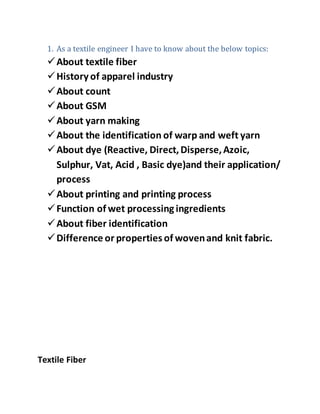
1. As a textile engineer I have to know about the below topics:
About textile fiber
History of apparel industry
About count
About GSM
About yarn making
About the identification of warp and weft yarn
About dye (Reactive, Direct,Disperse,Azoic,
Sulphur, Vat, Acid , Basic dye)and their application/
process
About printing and printing process
Function of wet processing ingredients
About fiber identification
Difference or properties of wovenand knit fabric.
Textile Fiber
2. What is Textile?
According to old concept textile means “to weave” but according to modern concept textile
means everything that means weaving, knitting, dyeing, printing, spinning etc.
Fiber:
Fiber is a soft, flexible material that length will be thousands time higher than its diameter.
Generally fibers are used as a raw material of yarn. Sometimes fabric is directly produced from
fiber.
For example: Cotton, Jute, Silk, Wool, Polyester, Nylon, and Acrylic.
Textile fiber properties:
To be a textile fiber the fiber should have some features such as:
1. Certain length
2. Certain strength
3. Certain fineness
4. Crimp
Classificationof textile fiber:
1. Natural fiber
2. Manmade/Synthetic fiber
Natural fiber:
1. Seed fiber——->(cotton & kapok)
2. Bast fiber——->(jute, flax)
3. Leaf fiber——->(sisal, hemp)
4. Animal fiber—->(wool, silk, camel, alpaca)
5. Fruit fiber—-—>(coir, coconut)
6. Mineral fiber–->(asbestose)
Manmade/Synthetic fiber:
1. Semi synthetic fiber————>(viscose, rayon)
2. 100% or fully synthetic fiber
100% or fully synthetic fiber:
1. Polyester fiber
2. Polyamide fiber——->(nylon)
3. Acrylic fiber
4. Spandex fiber
What is spinning?
Spinning is a process by which plant, animal or synthetic fibers are twisted together to form
yarn.
What is the history of apparel industry inBangladesh?
 In 1960 Riaz garments established which export only local garments. But in 1973 it
changed its name to Riaz Garments Ltd. & started to export by selling 10,000 pieces of
shirt to France.
 In 1979 Desh garments Ltd. establish which the first joint venture industry in
Bangladesh.
 In 1980, Young one (49%) & trexim (51%) equity formed a company named young one
Bangladesh which exported padded & non padded jackets to Sweden.
 In 1982 there were only 47 apparel industries.
 But 1984-85 there were 587, & 1999 there were 2900 apparel industry in the country.
 Now the number of apparel industry in Bangladesh is 6,600.
 Average growth rate of garment export is 22%.
What are the properties of knittedfabrics?
Interlooping, Stretchable, Absorbent, Light in weight, Comfortable in wear, it shrinks.
What are the properties of wovenfabrics?
 No possibility to shrinkage.
 By using warp and weft yarn we can create a design of woven fabric.
 Interlacement should be happen.
3. Yarn Count
Yarn:Yarn is a product which has substantial length & relatively small cross section consisting
of fibers or filaments with or without twist.
Yarn count:
Count is a numerical expression by which we can define its fineness or coarseness.
There are two basic systems of yarn numbering:
1. Direct system (mass per unit length)
2. Indirect system (length per unit mass)
1.Direct systemcount calculating formula:
N =
𝐖 𝐱 𝐥
𝐋
Example of direct systems: Tex, Denier, Jute etc.
2. In-direct systemcount calculating formula:
N =
𝐋 𝐱 𝐰
𝐖 𝐱 𝐥
Example of indirect systems: Cotton (Ne), Metric (Nm), Worsted etc.
What is count (Ne): Weight of 840 yds is equal to 1 pound.
What is 30 Ne: It is defined as the 30 hank (840x30 yds.) of length per pound of yarn.
What is Tex: It is defined as the weight in grams per km of yarn.
What is 10 Tex: It is defined as 10 gm. of weight per km of yarn.
What is 110 denier: It is defined as 110 gm. of weight per 9 km of yarn.
What is Unit of Length& Weight (mass) in direct counting system?
Name of the System Unit of mass Unit of length
Tex Gm. Km
Denier Gm. 9km
Jute Pound(lb.) 14,400 yards (spindle)
What is Unit of Length& Weight (mass) in indirect counting system?
Count conversion:
For direct todirect system:
We know that for Direct to Direct system,
Unknown count × Unit mass/ Unit length = Given count × Unit mass/ Unit length
Example:
Denier × 1gm/9km = Tex × 1gm/1km
Denier = Tex × 1gm × 9km/ 1gm × 1km
Denier = 9× Tex
For Indirect toIndirect system:
We know that for Indirect to Indirect system,
Unknown count × Unit length/ Unit mass = Given count × Unit length/ Unit mass
Direct toIndirect system:
We know that for Direct to Indirect system,
Unknown count × Unit mass/ Unit length = 1/Given count × Unit length/ Unit mass
Name of the System Unit of length Unit of mass
Cotton (British or English) 840 yards(hank) Pound(lb.)
Metric 1Km 1Kg
Worsted 560 yards (hank) Pound (lb.)
As a textile engineer youhave toknow some common units:
Units are given below;
1kg = 1000gm, 1lb = 453.6gm, 1km = 1000m, 1m = 1.0936yds, 1yds = 0.9144m, 16 ounces = 1lb,
1lb = 7000grains, 1 ounce = 437.5 grains, 1 gallon = 4.5 litter, 1kg = 2.204 lb.
4. GSM Measurement
What do you mean by GSM measurement?
GSM is a measurement of fabric weight. GSM means Gram per Square Meter that means
weight of one square meter fabric in gram. GSM is measured by GSM cutter by following
equation;
 GSM = Sample weight × Diameter constant
Here, diameter constant depends on the diameter of GSM cutter. Its formula is given below;
 Diameter constant =
4×10⁴
πd2
 For knitted fabric GSM =
WPI×CPI×SL(mm)
Count(Ne)×840
x 0.91
 For Woven fabric GSM =
EPI
Warp Count
× Crimp% +
PPI
Weft Count
× Crimp%
How we can calculate below term?
Wales per inch: At first we will take a 10 inch fabric. Then unraveling the yarn and divided the
total yarn by 10 inch. So finally we get the wales per inch.
Course per inch: At first we will take a 5 inch fabric. Then unraveling the yarn and divided the
total yarn by 5 inch. So finally we get the course per inch.
Picks per inch: The number of weft threads per inch.
Ends per inch: The number of warp threads per inch.
What is stitchlength?
When we will straight a total loop then which length we will get this length is called stitch
length. Its unit is mm.
How can we identify warpand weft threads of a fabric?
 The direction of selvedge is wrap direction.
 In most cases EPI is more than PPI.
 Warp yarn is finer than weft yarn.
 Warp yarn contains size particle and relatively hairy.
 Weft yarns crimp percentage is more than warp.
How can we identify fiber?
I. Burn test: Here we will identify the fiber sample by burning which help us to find out
that the fiber or yarn is 100% cotton, wool, polyester and acrylic or not.
II. Solubility test: Here we will identify the fiber sample by chemical treatment by using
different type of chemical which help us to find out that the fiber or yarn is 100%
cotton, wool, polyester and acrylic or not.
Explainthe solubility of fiber and their color, smell and fume?
Fiber Name Chemical Color Smell
Cotton 70% H2SO4 Grey Paper burn
Wool/Silk 5% NaOCL Greyish Hair skin burn
Nylon 20% HCL White Plastic burn
Polyester 100% Meta-
Cresol
White Plastic burn
Acrylic/Spandex 100% Di-methyl
form amide
Grey Light skin burn
Acetate 100% Acetate
acid
Grey Like chemical
Manufacturing: Manufacturing is a process by which we can convert row materials into
finished goods.
FLOW CHART FOR CARDED YARN
Input Process Function of M/C Output
Row cotton Blow Room To open the baled
fiber into small
tuft
Lap
Lap Carding Individualized the
fiber
Card sliver
Card sliver Breaker Draw frame Straighten the
fiber
Drawn sliver
Drawn sliver Finisher Draw frame Improve fiber
uniformity
Drawn sliver
Drawn sliver Simplex Make thinner of
drawn sliver &
insert small
amount of twist
into roving
Roving
Roving Ring frame Draft the roving,
twisted the
drafted strand &
winding the yarn
Yarn(cone)
Yarn(cone) Finishing Remove dirt Yarn (package)
FLOW CHART FOR COMBED YARN
Some important definitionis givenbelow:
Lap: Lap is a compress layer or sheet of cotton, wool etc.
Sliver: Sliver is a loose, untwisted fibers produce in carding.
Roving: Roving is a collection of relatively fine fibrous strand used in the final process of
spinning.
Ginning: Ginning is a process for separating the seed from the cotton fiber.
Lint: Row cotton after ginning is called lint.
Linters: Row cotton still attached to the seed after ginning is called linters.
Input Process Wastage % Output
Row cotton Blow room 3 Lap
Lap Carding 4 Card sliver
Card sliver Pre Comb. Drawing 0.5 Pre Drawn
sliver
Pre Drawn sliver Lap former 0.5 Lap
Lap Comber 12-18 Combed
sliver
Combed sliver Post Comb. Drawing 0.5 Post Comb.
Sliver
Post Comb. Sliver Simplex 0.5 Roving
Roving Ring Frame 2-3 Combed
Yarn
Combed Yarn Cone Winding 1 Yarn
Importance of row cotton
 Row cotton represents at least (50-75) % manufacturing cost.
 And accounts for (80-90) % of the yarn quality.
 Brand name of cottonfiber
Brand name Country
Pima USA
Raja CIS
Giza Egypt
Andy Australia
SUV in India
Delta Bangladesh
5. Dyeing:Dyeing is a process by which we can produce coloron the fabric surface. Dyeing
can be done on the wholefabric surface where only one coloris used.
Applicationof Dyes
Name of Dyes Application
Acid dye Manmade fiber (Nylon),
Natural fiber (Silk, Wool)
Basic dye Jute, Acrylic
Vat dye Manmade fiber (Viscose),
Natural fiber (Cotton, Silk, Wool)
Disperse dye Nylon, Polyester, Acrylic, Tri-acetate, Di-acetate
Direct Dye Manmade fiber (Viscose),
Natural fiber (Cotton)
Reactive dye Cotton, Wool, Silk, Viscose, Nylon
Sulfur dye Cotton, Viscose
Mordant dye Cotton, Wool, Silk
Pigment Cotton, Manmade fiber
N.B
1. Acid, basic & disperse dye is not suitable for cotton.
2. Direct, disperse, basic & sulfur dye is not suitable for wool& silk.
3. Vat, direct, reactive & sulfur dye is suitable for cotton.
4. Disperse dye is suitable for mam-made fiber.
5. Reactive dye is suitable for cellulosic fiber.
Why reactive dye is best for cottondyeing?
 Reactive dye is suitable for cellulosic fibers and produce permanent color by covalent
bond between dye and fiber.
 Reactive dyes have very good wash fastness.
 Reactive dye gives brighter shades and has moderate rubbing fastness.
 Reactive dyes have good fastness properties.
That’s why reactive dyes are most commonly used for dyeing cotton fiber.
Direct dye
What is direct dye?
Direct dye is water soluble anionic dye.
Why it is anionic dye? It is anionic dye because in reaction the anionic part is take place.
Why direct dye is so called direct dye?
Direct dyes have direct affinity towards cellulosic fiber (cotton, viscose) & it can be applied
directly in fiber without help of any assistant.
Which medium we use for direct dye in textile industry?
Direct dyes are usually applied in neutral & slightly alkaline medium.
What is self-leveling direct dye?
These dyes are capable of dyeing without help of any other chemical.
What is after treatment?
After treatment is a process which is applied for increasing for fastness properties of dyed
material after dyeing.
For increasing washing fastness what can we do?
We will treat the dyed material with formaldehyde.
For increasing light fastness what can we do?
We will treat the dyed material with cupper salt.
Which type of factor is responsible for the dye exhaustion offiber?
Time, Temperature, material liquor ratio, PH
etc.
Vat dye
What is vat dye?
Vat dyes are water insoluble cationic dye.
Why it is so called vat dye?
The dye is named from the container vat that’s why it is called vat dye.
You know that vat dye is water insoluble so how can we soluble it?
We can make the soluble of vat dyes by applying strong reducing agent (Hydrose) by vating
process.
Which type of dye we use in denim industry?
Most of the denim industries of our country use vat dye because of rubbing fastness properties.
Tell me some properties of vat dyes?
 Washing & perspiration properties of vat dyes are so good.
 Light fastness properties of vat dyes are extremely good.
Acid dye
What is acid dye?
Acid dyes are water soluble anionic dye.
Which types of fiber we can dye by acid dye?
By acid dye we can dye protein fiber like wool, silk etc. because it has direct affinity towards
protein fiber.
Can we color manmade fiber like nylon by using acid dye?
Yes we can because color fastness properties of acid dye are suitable for manmade fiber.
Basic dye
What is basic dye?
Basic dyes are water soluble cationic dyes.
Which types of fiber we can dye by basic dye?
By basic dye we can dye bast fiber like jute, acrylic fiber because it has direct affinity
towards this fiber.
Some dyeing faults are givenbelow;
Technical deficiency/fault of reactive dye:
Hydrolysis of dye: Hydrolysis is the main problem in dyeing with reactive dye. The reaction
of dye with water is called hydrolysis. It is happen when the dye solution kept for long time.
Remedies of deficiency: Wash the fabric with soap and soda ash at right temperature.
Technical deficiency/fault of sulfur dye:
Bronziness andtendering: Bronziness and tendering is the main problem when dyeing with
sulfur dye. It can be happen when the material are kept for long time into dye bath. It also can
be due to excessive heat, dyestuff and presence of ion as an impurity.
Remedies of deficiency: Treatment the dyed fabric with dilute solution of Na2S at 30℃.
Technical deficiency/fault of dispersedye: Levelness dyeing is the main problems when
dyeing with disperse dye.
Remedies of deficiency: Treatment the dyed fabric with leveling agent.
Moisture Regainof Fibers
Fibre Moisture Regain(%)
Cotton 8.5
Silk 11
Wool 16
Viscose Rayon 13
Acetate fibre 6.5
Nylon6, 6.6 4
Acrylic fibre 1-2
Polyester(PET) fibre 0.4
Jute 13.75
Flax and hemp 10-12
List of chemical auxiliaries whichone usedinwet processing unit andtheir
functionare givenbelow;
Agent Name Example Function
Acid Sulfuric acid (H2SO4),
Hydrochloric acid (HCl).
Acid is used to control the pH
(1-7). Acid decreases the pH
of solution.
Basic/Alkalis Sodium hydroxide NaOH,
Ammonium sulfate(NH₄)₂SO₄
Basic increase the pH (7-14) of
the solution. This also used as
scouring agent.
Peroxide killer Hydrogen peroxide H2O2 Used to killed peroxide which
is remaining in the material
because it is harmful for
material?
Bleaching agent Sodium hypochlorite (NaClO)
Calciumhypochlorite
Ca (ClO) ₂.
Bleaching is carried out before
dying. It is used for removing
natural color from gray yarn,
fabric. As a result increase dye
absorption.
Scouring agent Caustic soda,
Sodium bi carbonate
(NaHCO₃)
Scouring agent is used to
remove natural impurities
such as dirt, dust, fat, wax etc.
Electrolyte/ Salt Sodium chloride (NaCl),
Hydrochloric ac id ,
Sodium hydroxide.
Increase the exhaustion rate
of dying process. The amount
of salt depends on shade
percentage of the material.
Antifoaming agent Silicone(Si), Glycol Antifoaming agent is used to
prevent the foam formation
during, printing bleaching.
Foam formed reduces the
dying take up percentage.
Sequestering agent Amino-carboxylic acids,
Hydroxyl-carboxylic acids.
Sequestering agent is used to
reduce hardness of water.
Softening agent Polyvinyl Acetate(PVA),
Stearic acid (C18H36O2).
Softening agent is used to
increase the softness of the
material. It is also used as a
finishing material.
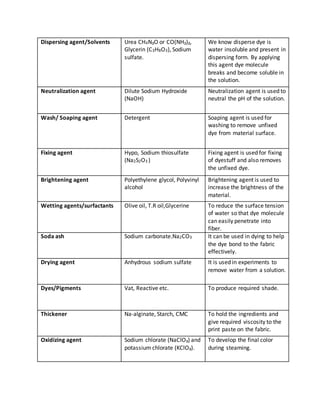
Dispersing agent/Solvents Urea CH4N₂O or CO(NH₂)₂,
Glycerin (C3H8O3), Sodium
sulfate.
We know disperse dye is
water insoluble and present in
dispersing form. By applying
this agent dye molecule
breaks and become soluble in
the solution.
Neutralization agent Dilute Sodium Hydroxide
(NaOH)
Neutralization agent is used to
neutral the pH of the solution.
Wash/ Soaping agent Detergent Soaping agent is used for
washing to remove unfixed
dye from material surface.
Fixing agent Hypo, Sodium thiosulfate
(Na2S2O3 )
Fixing agent is used for fixing
of dyestuff and also removes
the unfixed dye.
Brightening agent Polyethylene glycol, Polyvinyl
alcohol
Brightening agent is used to
increase the brightness of the
material.
Wetting agents/surfactants Olive oil, T.R oil,Glycerine To reduce the surface tension
of water so that dye molecule
can easily penetrate into
fiber.
Soda ash Sodium carbonate,Na2CO3 It can be used in dying to help
the dye bond to the fabric
effectively.
Drying agent Anhydrous sodium sulfate It is used in experiments to
remove water from a solution.
Dyes/Pigments Vat, Reactive etc. To produce required shade.
Thickener Na-alginate, Starch, CMC To hold the ingredients and
give required viscosity to the
print paste on the fabric.
Oxidizing agent Sodium chlorate (NaClO₃) and
potassium chlorate (KClO₃).
To develop the final color
during steaming.
Reducing agent Sodium hydrosulphite
(NaHSO4)
To make insoluble dyes to
soluble.
Catalyst and oxygen carrier Copper sulfate (Cu SO4),
Ammonium
vanadate (NH₄VO₃)
To prevent fiber damage
during steaming.
Carrier and swelling agent Polyethylene glycol, Phenols
(C₆H6O).
To swell the fiber structure
and reduce crystallinity.
Miscellaneous agent Urea, Glycerin Absorb moisture from air.
Levelling agents Sulfonated oils, carboxylic
acid, silicone etc.
Leveling agent is used to
control the exhaustion rate of
dye so that it can penetrate
evenly and slowly.
Anti-creasing agent Lubricant To reduce creasing tendency.
So, we should use the chemical auxiliaries according to theirscope of use.
Why curing is done after printing?
Curing' prints means making them permanent, so that the fabric cannot be washed. The main
objective of curing is to increase the color fastness.
Why there is increase inluster of yarnafter mercerization?
We know that cotton fiber swells in strong caustic soda solution, which change its cross section
from kidney shape to almost circular shaped. If the fibers are placed under a tension and
washed to reduce the caustic soda concentration below a particular limit then there is an
increase in the luster of the fiber.
Printing: Printing is a process by which we can produce color on the fabric surface at some
specific place according to its design. Printing is applicable only for fabric where single or multi-
color can be used only one side of fabric.
Printing process:
1) At first pretreatment of cotton fabric.
2) Printing paste is prepared by using printing ingredients.
3) Then fabric placed on the printing table and print paste is put on it. 4) After that making an
impression of the print paste on the fabric surface.
5) Finally we get the printed fabric of required dyes.
After treatment:
1. Drying at (140-160)℃ for (4-6) min
2. Steaming at (100-102)℃ for (5-10) min
3. Washing off- Dying to remove unfixed dye.
What is the difference betweentextileandgarments?
Textile meaning everything relating to fabric.
Garments: Garments refer to the product which generally wears that means it covers/protect
human-body.
Clothing:Clothing refers to the finish piece of fabric that can be used for the purpose of body
or bed.
6. Weaving process:
Yarn collect from spinning mill Weft yarn
Winding/Pre winding (Cone, Pirn winding etc.)
Warping
Sizing (Warp yarn)
Drafting/Drawing (Passing of yarn through drop wire/heald eye)
Denting (Passing of yarn through reed)
Looming
Weaving
Wovenfabric: Plain fabric (Shirt, Muslin cloth), Twill fabric (Jeans 2/2, Gabardine 2/10), Satin
fabric (Ribbon, Curtains, and Gowns), Braid fabric (Matt, Lace Ropes).
Knitting process:
Yarn collect from spinning mill
Cree-ling (Place the yarn into creel)
Feeding the yarn into m/c by positive feeder, tension device, yarn guide etc.
Set the m/c as per design & GSM
Finally knitting the fabric in tabular form
Withdraw the fabric & weighting
Inspection
Knitting fabric:
Weft knit: Single jersey fabric/plain knitting (T-shirt, Hosiery), Double jersey fabric/Rib (Collar,
Cuff, Socks), Interlock (Sportswear, Trouser, Underwear).
Warp knit: Net, Lingerie, gloves, eveningwear etc.
Non-woven process:
Raw material (Fiber that can be collect directly or from polymer)
Carding ( Card sliver)
Batt formation ( Sheet web)
Bonding ( Needle punching)
Apply resin by spray
Heating
Non-woven (Roll form)
Non-wovenfabric: All types of bags, Baby diapers, Bandage, Caps, Carpets, Shoe covers,
Draw strings. Tapes, Table cloths etc.
Carding
It’s the heart of spinning process. This is where the flock from bales will be open into individual
fiber. Thus, it will ease to remove the excess impurities on the fiber surface. At this point, short
fiber which not suitable for production in terms of length requirements will be eliminated.
Yarn manufacturing process,
Fiber
Blow-room process
Carding
Combing
Drawing/Drafting/Denting
Roving
Yarn
Why polyester fiber thread is ideal than cotton?
Polyester is generally strong, durable, and colorfast because it is made from filament but it has
a problem that is, this thread is not soft so there is a change to tear the fabric. On the other
hand cotton thread is soft but not so strong if we compare with polyester because it is made
from spun yarn.
Micronaire value: The average weight of 1 inch length of fiber. It is a measure of fiber fineness
and maturity. An airflow instrument is used to measure the air permeability of a constant mass
of cotton fibers compressed to a fixed volume of air. A micronaire of 3 or below is considered
low micronaire and immature fiber, and 3-5 is considered high micronaire and mature fiber.
Sewing:Sewing is a process by which we can join the fabric by the use of needle and thread.
Its main purpose is to produce seam.
Seam:Seam is a line of joining fabric or a stitch line where fabrics are joined together which is
done by various fabric arrangements.
Properties of agood seam:
Properties of good seams are given below;
 Smooth fabric joints.
 Even stitches.
 Stitch should be in required areas.
 Stitch variation is not allowed.
 Achievement of strength, elasticity, Durability, security and comfort.
Seam types:We have 8 types of seam.
Stitchtypes:We have six types of stitchthat are givenbelow;
Stitchclass-100(Singlethreadchainstitch)
Stitchclass-200(Handstitch)
Stitchclass-300(Lock stitch)
Stitchclass-400(Multi-threadchainstitch)
Stitchclass-500(Over edge stitch)
Stitchclass-600(Covering chainstitch)
Stitch
Sewing problem:
 Open seam
 Broken stitch
 Skip stitch
 Seam pucker(Wrinkle appearance on the seamline)
What are the garments manufacturing sequence?
Stepwise garments manufacturing sequence on industrial basis is given below:
Idea generation
↓
Design / Sketching
↓
Pattern Design
↓
Sample Making
↓
Production Pattern
↓
Grading
↓
Marker Making
↓
Spreading
↓
Cutting
↓
Sewing
↓
Finishing
↓
Final Inspection
↓
Packing
↓
Delivery
Pattern: Pattern is a hard paper is which we draw different parts of a garment according to its
measurement. It also include seam allowance, trimming allowance, dirt’s, and pleats. Pattern is
used to cut fabric.
Marker making: Marker is a thin paper in which all the pattern pieces are arranged so that
we can get different size garments with minimum fabric wastage. Generally marker is placed on
the fabric which will be cut for sewing.
Objectives of marker making:
 Marker is used as a cutting guide for fabric.
 Reduced fabric wastage by using marker.
 It saves time and cost.
What is marker efficiency?
Marker efficiency is the ratio between the area covered by pattern pieces in the marker & the
total area of the marker paper. It is expressed by %.
Tell me the factors whichinfluencing marker efficiency?
 Marker length: More length more marker efficiency.
 Fabric characteristics: Usually symmetrical fabric provides higher marker efficiency
than non- symmetrical fabric.
 Size of the garments: Smaller & larger size of the garment lead to less marker
efficiency & medium size of the garment gives higher efficiency.
 Marker width: More width more marker efficiency because easier to marker plan.
What is marker mode?
Marker mode is determined by the symmetry & directionality of fabric.
There are four type of marker mode.
I. Nap-either-way: In this way just maintaining grain line.
II. Nap-one-way: In this way just maintaining one direction.
III. Nap-up & down way: In this way one side can be place on the marker in one direction &
another side placed in opposed direction.
IV. Group way: In this way just maintaining side to side direction that means the garment
are laid together.
Interlining: Interlining is a layer of fabric inserted between the two layers of a garment. It is also
considered as an accessory.
Why we use interlining?
The causes are given below;
 To support, reinforce & controls areas of garments.
 To retain actual shape of the garments components.
 To make the garments beautiful, strong & attractive.
 To get better hand feel & performance.
Why polyester coated interlining is ideal interlining?
It is ideal because;
 It is both that means dry cleanable & water washable.
 This type of resin can be applied in all kinds of fabric.
What should be the required time, temperature & pressure for fusing?
 Time: Fusing time should be control between (5-20) s.
 Temperature: Temperature should be maintained between (150-175)℃.
 Pressure: Pressure should be uniform & sufficient during fusing.
7. Merchandising:
Merchandising is one kind of mediator who is involved in garments trade. The word came from
‘’Merchandise’’ which means goods that are bought and sold.
Garments merchandising means buying raw materials, accessories, producing garments,
maintaining required quality and exporting the product within schedule time.
The person who is related in merchandising is called merchandiser who handles the foreign
buyers and acts as a seller.
Finally we can say that merchandisers are the bridge between industry and the buyers.
Flow char of merchandising:
Contact with buyer (Collect news from EPB)
Receive enquiry sheet (Where indicate target price, measurement, what type of goods he/she
wants etc.)
Sample develop
Consumption of material
Costing of material with CM (Price coding)
Negotiate with buyer
Order sheet receive (Where all information should be include such as color, size, carton,
measurement, amount of garments etc.)
Receive master L/C
Booking fabric and accessories
Open back to back L/C (Booking fabric and accessories with the help of master L/C maximum
70%)
Sample approving
Receive fabric and accessories
Swatch card making and approval (Where we will attach all garments sample so that every
sector can use same goods)
Approval for bulk production
Pre-production meeting (PPM) [Where 4 person should be present PM, merchandiser, buyer,
Quality person]
Start bulk production with test cutting
Line inspection
Ex-work
Pre-shipment inspection (PSI)
Shipment
Ex-factory
Closed file
 Test cutting: Bulk production start with test cutting that means making small amount of
product such as from 1, 00,000 piece to 200 piece garments.
 Pre and post order merchandising: Pre order merchandising is before master L/C
receive and than post order merchandising.
 SOP (Standard Operating Procedure): They provide it so that we cannot change
product. To ensure same goods.
Basic quality of a merchandiser:
 Good command in ‘’English’’ because you have to negotiate with foreign buyer.
 Adequate knowledge on technical term such as SOP, GSP, PPM, PSI, CM, CMT etc. for
accurate and efficient communication with buyer.
 Good knowledge on fiber, yarn, fabric, dyeing, printing, finishing, embroidery, dyes and
chemicals, color fastness, accessories, garments production etc.
 Good knowledge on garments inspection system.
 Adequate knowledge on factory profile specially for buying house merchandiser.
 Must be known about computer literacy-mail, and internet.
 Right consumption and costing knowledge.
 Order getting ability.
Consumption: Quantity of raw materials for making complete garments such as amount of
fabric, sewing thread, button, label, and other accessories.
Costing: Amount for making a complete garment.
There are two costing process;
a) Direct cost: Direct costs are the costs that are directly involve to the production of a
specific goods.
Example: Fabric cost, accessories cost, labor cost etc.
b) Indirect cost: Indirect costs are the costs that are not directly involve to the production
of a specific goods. Indirect costs are (15-20) %.
Example: Labor transport cost, electricity cost, security, building rent etc.
Counting of button:
Button is counted by Gross (G) or Great Gross (GG).
1 Gross = 12 dozen = 12 x 12 = 144 pcs.
1 Great Gross = 12 Gross = 12 x 12 x 12 = 1728 pcs.
N.B: 12 x 1 dozen (12 pcs) = 12 x 12
Textile care symbol:
Convert ‘’Tex’’ number to ‘’Ticket’’ number:
‘’Ticket’’ number =
1000
Tex number
x 3
AQL
AQL: Maximum percentage of defect that can be accepted on a particular sample size.
Test
Chemical test (All color fastness & shrinkage test) Visual test
IPC PPC Du.PC FRI
IPC: Initial production check such as fabric fault
PPC: Pre-production check such as pattern, marker fault
Du.PC: During production check such as sewing fault
FRI: Final random inspection such as finished garments fault
Garments defects:
Three types of defects aree present in garments. That are given below;
1. Critical defects: The defects which is unsafe, hazardous for the end user is called critical
defects. Example: Needle break, azo group etc.
2. Major defects: The defects which reduce the functionality,usability, marketability of the
garments. Example: Any stitching problem, button problem etc.
3. Minor defects: The defects which are not affected the garments but it can damage
product quality. Example: Joining of label problem,spot etc.
Sample:Sample is a reference garments which is done by designer. If required any correction
such as style, design, measurement, size sample are made.
8. Singeing: Singeingis a mechanical process bywhich we can remove hairy fiber from fabric
or yarn surface byburningor heatingprocess.
Objectives of singeing
 To remove hairy fiber from fabric surface
 To improve the quality of fabric
 To clean & increasing smoothness of fabric
 Increasing luster & fabric strength
Bio-polishing: Bio-polishing is a chemical process by which we remove hairy or loose fiber
from fabric surface by the enzymatic action of cellulose.
Objectives of bio-polishing
 To remove hairy or loose fiber.
 To make the fabric softer & smoother.
 To reduce the pilling tendency of cloths.
Limitation:Fabric will be weak after bio-polishing process.
Desizing:Desizing is the first process of finishing that means to remove the sizing materials
from the warp yarn as well as woven fabric.
Objectives of desizing
 To remove size material from fabric surface.
 To improve the water absorbency of woven fabric.
What is the modern desizing process?
Enzymatic desizing:It is an enzymatic process where amylase enzyme is used to remove the
size material from yarn as well as fabric by enzymatic action.
Flow chart for textilewet processing
Woven fabric collection from weaving industry
Woven fabric inspection
Singeing
Desizing
Scouring
Bleaching
Dyeing Mercerizing Printing
Finishing
Final inspection
Finish fabric delivery into garments industry

Viva Question For Textile Engineer

  • 1.
    1. As atextile engineer I have to know about the below topics: About textile fiber History of apparel industry About count About GSM About yarn making About the identification of warp and weft yarn About dye (Reactive, Direct,Disperse,Azoic, Sulphur, Vat, Acid , Basic dye)and their application/ process About printing and printing process Function of wet processing ingredients About fiber identification Difference or properties of wovenand knit fabric. Textile Fiber
  • 2.
    2. What isTextile? According to old concept textile means “to weave” but according to modern concept textile means everything that means weaving, knitting, dyeing, printing, spinning etc. Fiber: Fiber is a soft, flexible material that length will be thousands time higher than its diameter. Generally fibers are used as a raw material of yarn. Sometimes fabric is directly produced from fiber. For example: Cotton, Jute, Silk, Wool, Polyester, Nylon, and Acrylic. Textile fiber properties: To be a textile fiber the fiber should have some features such as: 1. Certain length 2. Certain strength 3. Certain fineness 4. Crimp Classificationof textile fiber: 1. Natural fiber 2. Manmade/Synthetic fiber Natural fiber: 1. Seed fiber——->(cotton & kapok) 2. Bast fiber——->(jute, flax) 3. Leaf fiber——->(sisal, hemp) 4. Animal fiber—->(wool, silk, camel, alpaca) 5. Fruit fiber—-—>(coir, coconut) 6. Mineral fiber–->(asbestose) Manmade/Synthetic fiber:
  • 3.
    1. Semi syntheticfiber————>(viscose, rayon) 2. 100% or fully synthetic fiber 100% or fully synthetic fiber: 1. Polyester fiber 2. Polyamide fiber——->(nylon) 3. Acrylic fiber 4. Spandex fiber What is spinning? Spinning is a process by which plant, animal or synthetic fibers are twisted together to form yarn. What is the history of apparel industry inBangladesh?  In 1960 Riaz garments established which export only local garments. But in 1973 it changed its name to Riaz Garments Ltd. & started to export by selling 10,000 pieces of shirt to France.  In 1979 Desh garments Ltd. establish which the first joint venture industry in Bangladesh.  In 1980, Young one (49%) & trexim (51%) equity formed a company named young one Bangladesh which exported padded & non padded jackets to Sweden.  In 1982 there were only 47 apparel industries.  But 1984-85 there were 587, & 1999 there were 2900 apparel industry in the country.  Now the number of apparel industry in Bangladesh is 6,600.  Average growth rate of garment export is 22%. What are the properties of knittedfabrics? Interlooping, Stretchable, Absorbent, Light in weight, Comfortable in wear, it shrinks. What are the properties of wovenfabrics?  No possibility to shrinkage.  By using warp and weft yarn we can create a design of woven fabric.  Interlacement should be happen.
  • 4.
    3. Yarn Count Yarn:Yarnis a product which has substantial length & relatively small cross section consisting of fibers or filaments with or without twist. Yarn count: Count is a numerical expression by which we can define its fineness or coarseness. There are two basic systems of yarn numbering: 1. Direct system (mass per unit length) 2. Indirect system (length per unit mass) 1.Direct systemcount calculating formula: N = 𝐖 𝐱 𝐥 𝐋 Example of direct systems: Tex, Denier, Jute etc. 2. In-direct systemcount calculating formula: N = 𝐋 𝐱 𝐰 𝐖 𝐱 𝐥 Example of indirect systems: Cotton (Ne), Metric (Nm), Worsted etc. What is count (Ne): Weight of 840 yds is equal to 1 pound. What is 30 Ne: It is defined as the 30 hank (840x30 yds.) of length per pound of yarn. What is Tex: It is defined as the weight in grams per km of yarn. What is 10 Tex: It is defined as 10 gm. of weight per km of yarn. What is 110 denier: It is defined as 110 gm. of weight per 9 km of yarn. What is Unit of Length& Weight (mass) in direct counting system? Name of the System Unit of mass Unit of length Tex Gm. Km Denier Gm. 9km Jute Pound(lb.) 14,400 yards (spindle)
  • 5.
    What is Unitof Length& Weight (mass) in indirect counting system? Count conversion: For direct todirect system: We know that for Direct to Direct system, Unknown count × Unit mass/ Unit length = Given count × Unit mass/ Unit length Example: Denier × 1gm/9km = Tex × 1gm/1km Denier = Tex × 1gm × 9km/ 1gm × 1km Denier = 9× Tex For Indirect toIndirect system: We know that for Indirect to Indirect system, Unknown count × Unit length/ Unit mass = Given count × Unit length/ Unit mass Direct toIndirect system: We know that for Direct to Indirect system, Unknown count × Unit mass/ Unit length = 1/Given count × Unit length/ Unit mass Name of the System Unit of length Unit of mass Cotton (British or English) 840 yards(hank) Pound(lb.) Metric 1Km 1Kg Worsted 560 yards (hank) Pound (lb.)
  • 6.
    As a textileengineer youhave toknow some common units: Units are given below; 1kg = 1000gm, 1lb = 453.6gm, 1km = 1000m, 1m = 1.0936yds, 1yds = 0.9144m, 16 ounces = 1lb, 1lb = 7000grains, 1 ounce = 437.5 grains, 1 gallon = 4.5 litter, 1kg = 2.204 lb. 4. GSM Measurement What do you mean by GSM measurement? GSM is a measurement of fabric weight. GSM means Gram per Square Meter that means weight of one square meter fabric in gram. GSM is measured by GSM cutter by following equation;  GSM = Sample weight × Diameter constant Here, diameter constant depends on the diameter of GSM cutter. Its formula is given below;  Diameter constant = 4×10⁴ πd2  For knitted fabric GSM = WPI×CPI×SL(mm) Count(Ne)×840 x 0.91  For Woven fabric GSM = EPI Warp Count × Crimp% + PPI Weft Count × Crimp% How we can calculate below term? Wales per inch: At first we will take a 10 inch fabric. Then unraveling the yarn and divided the total yarn by 10 inch. So finally we get the wales per inch. Course per inch: At first we will take a 5 inch fabric. Then unraveling the yarn and divided the total yarn by 5 inch. So finally we get the course per inch. Picks per inch: The number of weft threads per inch. Ends per inch: The number of warp threads per inch.
  • 7.
    What is stitchlength? Whenwe will straight a total loop then which length we will get this length is called stitch length. Its unit is mm. How can we identify warpand weft threads of a fabric?  The direction of selvedge is wrap direction.  In most cases EPI is more than PPI.  Warp yarn is finer than weft yarn.  Warp yarn contains size particle and relatively hairy.  Weft yarns crimp percentage is more than warp. How can we identify fiber? I. Burn test: Here we will identify the fiber sample by burning which help us to find out that the fiber or yarn is 100% cotton, wool, polyester and acrylic or not. II. Solubility test: Here we will identify the fiber sample by chemical treatment by using different type of chemical which help us to find out that the fiber or yarn is 100% cotton, wool, polyester and acrylic or not. Explainthe solubility of fiber and their color, smell and fume? Fiber Name Chemical Color Smell Cotton 70% H2SO4 Grey Paper burn Wool/Silk 5% NaOCL Greyish Hair skin burn Nylon 20% HCL White Plastic burn Polyester 100% Meta- Cresol White Plastic burn Acrylic/Spandex 100% Di-methyl form amide Grey Light skin burn Acetate 100% Acetate acid Grey Like chemical
  • 8.
    Manufacturing: Manufacturing isa process by which we can convert row materials into finished goods. FLOW CHART FOR CARDED YARN Input Process Function of M/C Output Row cotton Blow Room To open the baled fiber into small tuft Lap Lap Carding Individualized the fiber Card sliver Card sliver Breaker Draw frame Straighten the fiber Drawn sliver Drawn sliver Finisher Draw frame Improve fiber uniformity Drawn sliver Drawn sliver Simplex Make thinner of drawn sliver & insert small amount of twist into roving Roving Roving Ring frame Draft the roving, twisted the drafted strand & winding the yarn Yarn(cone) Yarn(cone) Finishing Remove dirt Yarn (package)
  • 9.
    FLOW CHART FORCOMBED YARN Some important definitionis givenbelow: Lap: Lap is a compress layer or sheet of cotton, wool etc. Sliver: Sliver is a loose, untwisted fibers produce in carding. Roving: Roving is a collection of relatively fine fibrous strand used in the final process of spinning. Ginning: Ginning is a process for separating the seed from the cotton fiber. Lint: Row cotton after ginning is called lint. Linters: Row cotton still attached to the seed after ginning is called linters. Input Process Wastage % Output Row cotton Blow room 3 Lap Lap Carding 4 Card sliver Card sliver Pre Comb. Drawing 0.5 Pre Drawn sliver Pre Drawn sliver Lap former 0.5 Lap Lap Comber 12-18 Combed sliver Combed sliver Post Comb. Drawing 0.5 Post Comb. Sliver Post Comb. Sliver Simplex 0.5 Roving Roving Ring Frame 2-3 Combed Yarn Combed Yarn Cone Winding 1 Yarn
  • 10.
    Importance of rowcotton  Row cotton represents at least (50-75) % manufacturing cost.  And accounts for (80-90) % of the yarn quality.  Brand name of cottonfiber Brand name Country Pima USA Raja CIS Giza Egypt Andy Australia SUV in India Delta Bangladesh
  • 11.
    5. Dyeing:Dyeing isa process by which we can produce coloron the fabric surface. Dyeing can be done on the wholefabric surface where only one coloris used. Applicationof Dyes Name of Dyes Application Acid dye Manmade fiber (Nylon), Natural fiber (Silk, Wool) Basic dye Jute, Acrylic Vat dye Manmade fiber (Viscose), Natural fiber (Cotton, Silk, Wool) Disperse dye Nylon, Polyester, Acrylic, Tri-acetate, Di-acetate Direct Dye Manmade fiber (Viscose), Natural fiber (Cotton) Reactive dye Cotton, Wool, Silk, Viscose, Nylon Sulfur dye Cotton, Viscose Mordant dye Cotton, Wool, Silk Pigment Cotton, Manmade fiber N.B 1. Acid, basic & disperse dye is not suitable for cotton. 2. Direct, disperse, basic & sulfur dye is not suitable for wool& silk. 3. Vat, direct, reactive & sulfur dye is suitable for cotton. 4. Disperse dye is suitable for mam-made fiber. 5. Reactive dye is suitable for cellulosic fiber.
  • 12.
    Why reactive dyeis best for cottondyeing?  Reactive dye is suitable for cellulosic fibers and produce permanent color by covalent bond between dye and fiber.  Reactive dyes have very good wash fastness.  Reactive dye gives brighter shades and has moderate rubbing fastness.  Reactive dyes have good fastness properties. That’s why reactive dyes are most commonly used for dyeing cotton fiber. Direct dye What is direct dye? Direct dye is water soluble anionic dye. Why it is anionic dye? It is anionic dye because in reaction the anionic part is take place. Why direct dye is so called direct dye? Direct dyes have direct affinity towards cellulosic fiber (cotton, viscose) & it can be applied directly in fiber without help of any assistant. Which medium we use for direct dye in textile industry? Direct dyes are usually applied in neutral & slightly alkaline medium. What is self-leveling direct dye? These dyes are capable of dyeing without help of any other chemical. What is after treatment? After treatment is a process which is applied for increasing for fastness properties of dyed material after dyeing. For increasing washing fastness what can we do? We will treat the dyed material with formaldehyde. For increasing light fastness what can we do? We will treat the dyed material with cupper salt.
  • 13.
    Which type offactor is responsible for the dye exhaustion offiber? Time, Temperature, material liquor ratio, PH etc. Vat dye What is vat dye? Vat dyes are water insoluble cationic dye. Why it is so called vat dye? The dye is named from the container vat that’s why it is called vat dye. You know that vat dye is water insoluble so how can we soluble it? We can make the soluble of vat dyes by applying strong reducing agent (Hydrose) by vating process. Which type of dye we use in denim industry? Most of the denim industries of our country use vat dye because of rubbing fastness properties. Tell me some properties of vat dyes?  Washing & perspiration properties of vat dyes are so good.  Light fastness properties of vat dyes are extremely good. Acid dye What is acid dye? Acid dyes are water soluble anionic dye. Which types of fiber we can dye by acid dye? By acid dye we can dye protein fiber like wool, silk etc. because it has direct affinity towards protein fiber. Can we color manmade fiber like nylon by using acid dye? Yes we can because color fastness properties of acid dye are suitable for manmade fiber.
  • 14.
    Basic dye What isbasic dye? Basic dyes are water soluble cationic dyes. Which types of fiber we can dye by basic dye? By basic dye we can dye bast fiber like jute, acrylic fiber because it has direct affinity towards this fiber. Some dyeing faults are givenbelow; Technical deficiency/fault of reactive dye: Hydrolysis of dye: Hydrolysis is the main problem in dyeing with reactive dye. The reaction of dye with water is called hydrolysis. It is happen when the dye solution kept for long time. Remedies of deficiency: Wash the fabric with soap and soda ash at right temperature. Technical deficiency/fault of sulfur dye: Bronziness andtendering: Bronziness and tendering is the main problem when dyeing with sulfur dye. It can be happen when the material are kept for long time into dye bath. It also can be due to excessive heat, dyestuff and presence of ion as an impurity. Remedies of deficiency: Treatment the dyed fabric with dilute solution of Na2S at 30℃. Technical deficiency/fault of dispersedye: Levelness dyeing is the main problems when dyeing with disperse dye. Remedies of deficiency: Treatment the dyed fabric with leveling agent.
  • 15.
    Moisture Regainof Fibers FibreMoisture Regain(%) Cotton 8.5 Silk 11 Wool 16 Viscose Rayon 13 Acetate fibre 6.5 Nylon6, 6.6 4 Acrylic fibre 1-2 Polyester(PET) fibre 0.4 Jute 13.75 Flax and hemp 10-12
  • 16.
    List of chemicalauxiliaries whichone usedinwet processing unit andtheir functionare givenbelow; Agent Name Example Function Acid Sulfuric acid (H2SO4), Hydrochloric acid (HCl). Acid is used to control the pH (1-7). Acid decreases the pH of solution. Basic/Alkalis Sodium hydroxide NaOH, Ammonium sulfate(NH₄)₂SO₄ Basic increase the pH (7-14) of the solution. This also used as scouring agent. Peroxide killer Hydrogen peroxide H2O2 Used to killed peroxide which is remaining in the material because it is harmful for material? Bleaching agent Sodium hypochlorite (NaClO) Calciumhypochlorite Ca (ClO) ₂. Bleaching is carried out before dying. It is used for removing natural color from gray yarn, fabric. As a result increase dye absorption. Scouring agent Caustic soda, Sodium bi carbonate (NaHCO₃) Scouring agent is used to remove natural impurities such as dirt, dust, fat, wax etc. Electrolyte/ Salt Sodium chloride (NaCl), Hydrochloric ac id , Sodium hydroxide. Increase the exhaustion rate of dying process. The amount of salt depends on shade percentage of the material. Antifoaming agent Silicone(Si), Glycol Antifoaming agent is used to prevent the foam formation during, printing bleaching. Foam formed reduces the dying take up percentage. Sequestering agent Amino-carboxylic acids, Hydroxyl-carboxylic acids. Sequestering agent is used to reduce hardness of water. Softening agent Polyvinyl Acetate(PVA), Stearic acid (C18H36O2). Softening agent is used to increase the softness of the material. It is also used as a finishing material.
  • 17.
    Dispersing agent/Solvents UreaCH4N₂O or CO(NH₂)₂, Glycerin (C3H8O3), Sodium sulfate. We know disperse dye is water insoluble and present in dispersing form. By applying this agent dye molecule breaks and become soluble in the solution. Neutralization agent Dilute Sodium Hydroxide (NaOH) Neutralization agent is used to neutral the pH of the solution. Wash/ Soaping agent Detergent Soaping agent is used for washing to remove unfixed dye from material surface. Fixing agent Hypo, Sodium thiosulfate (Na2S2O3 ) Fixing agent is used for fixing of dyestuff and also removes the unfixed dye. Brightening agent Polyethylene glycol, Polyvinyl alcohol Brightening agent is used to increase the brightness of the material. Wetting agents/surfactants Olive oil, T.R oil,Glycerine To reduce the surface tension of water so that dye molecule can easily penetrate into fiber. Soda ash Sodium carbonate,Na2CO3 It can be used in dying to help the dye bond to the fabric effectively. Drying agent Anhydrous sodium sulfate It is used in experiments to remove water from a solution. Dyes/Pigments Vat, Reactive etc. To produce required shade. Thickener Na-alginate, Starch, CMC To hold the ingredients and give required viscosity to the print paste on the fabric. Oxidizing agent Sodium chlorate (NaClO₃) and potassium chlorate (KClO₃). To develop the final color during steaming.
  • 18.
    Reducing agent Sodiumhydrosulphite (NaHSO4) To make insoluble dyes to soluble. Catalyst and oxygen carrier Copper sulfate (Cu SO4), Ammonium vanadate (NH₄VO₃) To prevent fiber damage during steaming. Carrier and swelling agent Polyethylene glycol, Phenols (C₆H6O). To swell the fiber structure and reduce crystallinity. Miscellaneous agent Urea, Glycerin Absorb moisture from air. Levelling agents Sulfonated oils, carboxylic acid, silicone etc. Leveling agent is used to control the exhaustion rate of dye so that it can penetrate evenly and slowly. Anti-creasing agent Lubricant To reduce creasing tendency. So, we should use the chemical auxiliaries according to theirscope of use. Why curing is done after printing? Curing' prints means making them permanent, so that the fabric cannot be washed. The main objective of curing is to increase the color fastness. Why there is increase inluster of yarnafter mercerization? We know that cotton fiber swells in strong caustic soda solution, which change its cross section from kidney shape to almost circular shaped. If the fibers are placed under a tension and washed to reduce the caustic soda concentration below a particular limit then there is an increase in the luster of the fiber.
  • 19.
    Printing: Printing isa process by which we can produce color on the fabric surface at some specific place according to its design. Printing is applicable only for fabric where single or multi- color can be used only one side of fabric. Printing process: 1) At first pretreatment of cotton fabric. 2) Printing paste is prepared by using printing ingredients. 3) Then fabric placed on the printing table and print paste is put on it. 4) After that making an impression of the print paste on the fabric surface. 5) Finally we get the printed fabric of required dyes. After treatment: 1. Drying at (140-160)℃ for (4-6) min 2. Steaming at (100-102)℃ for (5-10) min 3. Washing off- Dying to remove unfixed dye. What is the difference betweentextileandgarments? Textile meaning everything relating to fabric. Garments: Garments refer to the product which generally wears that means it covers/protect human-body. Clothing:Clothing refers to the finish piece of fabric that can be used for the purpose of body or bed.
  • 20.
    6. Weaving process: Yarncollect from spinning mill Weft yarn Winding/Pre winding (Cone, Pirn winding etc.) Warping Sizing (Warp yarn) Drafting/Drawing (Passing of yarn through drop wire/heald eye) Denting (Passing of yarn through reed) Looming Weaving Wovenfabric: Plain fabric (Shirt, Muslin cloth), Twill fabric (Jeans 2/2, Gabardine 2/10), Satin fabric (Ribbon, Curtains, and Gowns), Braid fabric (Matt, Lace Ropes). Knitting process: Yarn collect from spinning mill Cree-ling (Place the yarn into creel) Feeding the yarn into m/c by positive feeder, tension device, yarn guide etc. Set the m/c as per design & GSM Finally knitting the fabric in tabular form Withdraw the fabric & weighting Inspection Knitting fabric: Weft knit: Single jersey fabric/plain knitting (T-shirt, Hosiery), Double jersey fabric/Rib (Collar, Cuff, Socks), Interlock (Sportswear, Trouser, Underwear). Warp knit: Net, Lingerie, gloves, eveningwear etc.
  • 21.
    Non-woven process: Raw material(Fiber that can be collect directly or from polymer) Carding ( Card sliver) Batt formation ( Sheet web) Bonding ( Needle punching) Apply resin by spray Heating Non-woven (Roll form) Non-wovenfabric: All types of bags, Baby diapers, Bandage, Caps, Carpets, Shoe covers, Draw strings. Tapes, Table cloths etc. Carding It’s the heart of spinning process. This is where the flock from bales will be open into individual fiber. Thus, it will ease to remove the excess impurities on the fiber surface. At this point, short fiber which not suitable for production in terms of length requirements will be eliminated. Yarn manufacturing process, Fiber Blow-room process Carding Combing Drawing/Drafting/Denting Roving Yarn
  • 22.
    Why polyester fiberthread is ideal than cotton? Polyester is generally strong, durable, and colorfast because it is made from filament but it has a problem that is, this thread is not soft so there is a change to tear the fabric. On the other hand cotton thread is soft but not so strong if we compare with polyester because it is made from spun yarn. Micronaire value: The average weight of 1 inch length of fiber. It is a measure of fiber fineness and maturity. An airflow instrument is used to measure the air permeability of a constant mass of cotton fibers compressed to a fixed volume of air. A micronaire of 3 or below is considered low micronaire and immature fiber, and 3-5 is considered high micronaire and mature fiber. Sewing:Sewing is a process by which we can join the fabric by the use of needle and thread. Its main purpose is to produce seam. Seam:Seam is a line of joining fabric or a stitch line where fabrics are joined together which is done by various fabric arrangements. Properties of agood seam: Properties of good seams are given below;  Smooth fabric joints.  Even stitches.  Stitch should be in required areas.  Stitch variation is not allowed.  Achievement of strength, elasticity, Durability, security and comfort.
  • 23.
    Seam types:We have8 types of seam. Stitchtypes:We have six types of stitchthat are givenbelow; Stitchclass-100(Singlethreadchainstitch) Stitchclass-200(Handstitch) Stitchclass-300(Lock stitch) Stitchclass-400(Multi-threadchainstitch) Stitchclass-500(Over edge stitch) Stitchclass-600(Covering chainstitch) Stitch
  • 24.
    Sewing problem:  Openseam  Broken stitch  Skip stitch  Seam pucker(Wrinkle appearance on the seamline) What are the garments manufacturing sequence? Stepwise garments manufacturing sequence on industrial basis is given below: Idea generation ↓ Design / Sketching ↓ Pattern Design ↓ Sample Making ↓ Production Pattern ↓ Grading ↓ Marker Making ↓ Spreading ↓ Cutting ↓ Sewing ↓
  • 25.
    Finishing ↓ Final Inspection ↓ Packing ↓ Delivery Pattern: Patternis a hard paper is which we draw different parts of a garment according to its measurement. It also include seam allowance, trimming allowance, dirt’s, and pleats. Pattern is used to cut fabric. Marker making: Marker is a thin paper in which all the pattern pieces are arranged so that we can get different size garments with minimum fabric wastage. Generally marker is placed on the fabric which will be cut for sewing. Objectives of marker making:  Marker is used as a cutting guide for fabric.  Reduced fabric wastage by using marker.  It saves time and cost. What is marker efficiency? Marker efficiency is the ratio between the area covered by pattern pieces in the marker & the total area of the marker paper. It is expressed by %. Tell me the factors whichinfluencing marker efficiency?  Marker length: More length more marker efficiency.  Fabric characteristics: Usually symmetrical fabric provides higher marker efficiency than non- symmetrical fabric.  Size of the garments: Smaller & larger size of the garment lead to less marker efficiency & medium size of the garment gives higher efficiency.  Marker width: More width more marker efficiency because easier to marker plan.
  • 26.
    What is markermode? Marker mode is determined by the symmetry & directionality of fabric. There are four type of marker mode. I. Nap-either-way: In this way just maintaining grain line. II. Nap-one-way: In this way just maintaining one direction. III. Nap-up & down way: In this way one side can be place on the marker in one direction & another side placed in opposed direction. IV. Group way: In this way just maintaining side to side direction that means the garment are laid together. Interlining: Interlining is a layer of fabric inserted between the two layers of a garment. It is also considered as an accessory. Why we use interlining? The causes are given below;  To support, reinforce & controls areas of garments.  To retain actual shape of the garments components.  To make the garments beautiful, strong & attractive.  To get better hand feel & performance. Why polyester coated interlining is ideal interlining? It is ideal because;  It is both that means dry cleanable & water washable.  This type of resin can be applied in all kinds of fabric. What should be the required time, temperature & pressure for fusing?  Time: Fusing time should be control between (5-20) s.  Temperature: Temperature should be maintained between (150-175)℃.  Pressure: Pressure should be uniform & sufficient during fusing.
  • 27.
    7. Merchandising: Merchandising isone kind of mediator who is involved in garments trade. The word came from ‘’Merchandise’’ which means goods that are bought and sold. Garments merchandising means buying raw materials, accessories, producing garments, maintaining required quality and exporting the product within schedule time. The person who is related in merchandising is called merchandiser who handles the foreign buyers and acts as a seller. Finally we can say that merchandisers are the bridge between industry and the buyers. Flow char of merchandising: Contact with buyer (Collect news from EPB) Receive enquiry sheet (Where indicate target price, measurement, what type of goods he/she wants etc.) Sample develop Consumption of material Costing of material with CM (Price coding) Negotiate with buyer Order sheet receive (Where all information should be include such as color, size, carton, measurement, amount of garments etc.) Receive master L/C Booking fabric and accessories Open back to back L/C (Booking fabric and accessories with the help of master L/C maximum 70%) Sample approving Receive fabric and accessories Swatch card making and approval (Where we will attach all garments sample so that every sector can use same goods) Approval for bulk production
  • 28.
    Pre-production meeting (PPM)[Where 4 person should be present PM, merchandiser, buyer, Quality person] Start bulk production with test cutting Line inspection Ex-work Pre-shipment inspection (PSI) Shipment Ex-factory Closed file  Test cutting: Bulk production start with test cutting that means making small amount of product such as from 1, 00,000 piece to 200 piece garments.  Pre and post order merchandising: Pre order merchandising is before master L/C receive and than post order merchandising.  SOP (Standard Operating Procedure): They provide it so that we cannot change product. To ensure same goods. Basic quality of a merchandiser:  Good command in ‘’English’’ because you have to negotiate with foreign buyer.  Adequate knowledge on technical term such as SOP, GSP, PPM, PSI, CM, CMT etc. for accurate and efficient communication with buyer.  Good knowledge on fiber, yarn, fabric, dyeing, printing, finishing, embroidery, dyes and chemicals, color fastness, accessories, garments production etc.  Good knowledge on garments inspection system.  Adequate knowledge on factory profile specially for buying house merchandiser.  Must be known about computer literacy-mail, and internet.  Right consumption and costing knowledge.  Order getting ability.
  • 29.
    Consumption: Quantity ofraw materials for making complete garments such as amount of fabric, sewing thread, button, label, and other accessories. Costing: Amount for making a complete garment. There are two costing process; a) Direct cost: Direct costs are the costs that are directly involve to the production of a specific goods. Example: Fabric cost, accessories cost, labor cost etc. b) Indirect cost: Indirect costs are the costs that are not directly involve to the production of a specific goods. Indirect costs are (15-20) %. Example: Labor transport cost, electricity cost, security, building rent etc. Counting of button: Button is counted by Gross (G) or Great Gross (GG). 1 Gross = 12 dozen = 12 x 12 = 144 pcs. 1 Great Gross = 12 Gross = 12 x 12 x 12 = 1728 pcs. N.B: 12 x 1 dozen (12 pcs) = 12 x 12
  • 30.
  • 31.
    Convert ‘’Tex’’ numberto ‘’Ticket’’ number: ‘’Ticket’’ number = 1000 Tex number x 3 AQL AQL: Maximum percentage of defect that can be accepted on a particular sample size. Test Chemical test (All color fastness & shrinkage test) Visual test IPC PPC Du.PC FRI IPC: Initial production check such as fabric fault PPC: Pre-production check such as pattern, marker fault Du.PC: During production check such as sewing fault FRI: Final random inspection such as finished garments fault Garments defects: Three types of defects aree present in garments. That are given below; 1. Critical defects: The defects which is unsafe, hazardous for the end user is called critical defects. Example: Needle break, azo group etc. 2. Major defects: The defects which reduce the functionality,usability, marketability of the garments. Example: Any stitching problem, button problem etc. 3. Minor defects: The defects which are not affected the garments but it can damage product quality. Example: Joining of label problem,spot etc. Sample:Sample is a reference garments which is done by designer. If required any correction such as style, design, measurement, size sample are made.
  • 32.
    8. Singeing: Singeingisa mechanical process bywhich we can remove hairy fiber from fabric or yarn surface byburningor heatingprocess. Objectives of singeing  To remove hairy fiber from fabric surface  To improve the quality of fabric  To clean & increasing smoothness of fabric  Increasing luster & fabric strength Bio-polishing: Bio-polishing is a chemical process by which we remove hairy or loose fiber from fabric surface by the enzymatic action of cellulose. Objectives of bio-polishing  To remove hairy or loose fiber.  To make the fabric softer & smoother.  To reduce the pilling tendency of cloths. Limitation:Fabric will be weak after bio-polishing process. Desizing:Desizing is the first process of finishing that means to remove the sizing materials from the warp yarn as well as woven fabric. Objectives of desizing  To remove size material from fabric surface.  To improve the water absorbency of woven fabric. What is the modern desizing process? Enzymatic desizing:It is an enzymatic process where amylase enzyme is used to remove the size material from yarn as well as fabric by enzymatic action.
  • 33.
    Flow chart fortextilewet processing Woven fabric collection from weaving industry Woven fabric inspection Singeing Desizing Scouring Bleaching Dyeing Mercerizing Printing Finishing Final inspection Finish fabric delivery into garments industry