Evaluating textbooks and materials By  Porntip Bodeepongse
Role and purpose of  a course book in the past As the curriculum instead of a reference As an end product, not a starting  point **It should be a route map for a  course.
Cunningworth (1995:7) states the roles of coursebooks in ELT as: a resource for presentation material a source of activities for learner practice and communicative interaction a reference source a syllabus a resource for self-access work a support for less experienced teachers
3 options for teachers (Ansary & Babari, 2002) Teachers need and use textbooks. Teachers do not need and use textbooks. They produce their own materials. Teachers select a textbook and supplement some other materials to perfect it.
Why teachers use textbooks: Extremely difficult to develop materials Time-consuming and demanding process to develop new materials Teachers have limited time. Textbooks lessen preparation time, provide ready-made activities and provide concrete samples of classroom progress through which external stakeholders can be satisfied.
Arguments for using textbooks Framework that regulates and times the program For Ss, no textbook = no purpose and learning is not taken seriously A textbook can serve as a syllabus. Provides ready-made teaching texts and learning tasks Without a book= out of focus & Ts-dependent Security, guidance and support
Problems Teachers are not properly trained on how to choose, adapt, evaluate and use their coursebooks. Curricula has not met with the practical needs in the classroom. Students have little or no role or involvement in book selection process.
Cunningworth (1984:6) “ No course book will totally be suited to a particular teaching situation. The teacher will have to find his own way of using it and adapting it if necessary. So we should not be looking for the perfect course book which meets all our requirements, but rather for the best possible fit what the book offers and what we as teachers and students need.”
Things to take into consideration: objectives, goals, methods and approaches of the language program teachers’ background teaching styles students’ needs students’ learning preferences/ styles
Method of evaluation Hartley (1994:163) addresses 3 content areas to be checked: Does the book meet the teaching objectives? Is there sufficient depth and breadth of material? Will it need to be supplemented?
Using a checklist Factors to be considered: (Garinger, 2001.“Textbook Evaluation”. TEFL Web Journal.) Practical considerations Availability and value Layout/ physical characteristics Cultural component
Using a checklist (cont.) Language related considerations Skills Language Exercises User definition
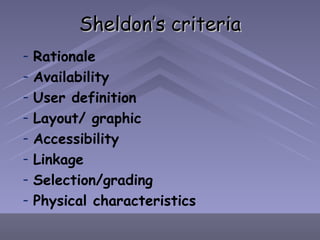
Sheldon’s criteria Rationale Availability User definition Layout/ graphic Accessibility Linkage Selection/grading Physical characteristics
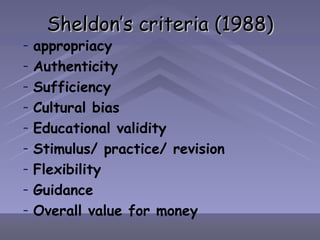
Sheldon’s criteria (1988) appropriacy Authenticity Sufficiency Cultural bias Educational validity Stimulus/ practice/ revision Flexibility Guidance Overall value for money

Textbook evaluation

  • 1.
    Evaluating textbooks andmaterials By Porntip Bodeepongse
  • 2.
    Role and purposeof a course book in the past As the curriculum instead of a reference As an end product, not a starting point **It should be a route map for a course.
  • 3.
    Cunningworth (1995:7) statesthe roles of coursebooks in ELT as: a resource for presentation material a source of activities for learner practice and communicative interaction a reference source a syllabus a resource for self-access work a support for less experienced teachers
  • 4.
    3 options forteachers (Ansary & Babari, 2002) Teachers need and use textbooks. Teachers do not need and use textbooks. They produce their own materials. Teachers select a textbook and supplement some other materials to perfect it.
  • 5.
    Why teachers usetextbooks: Extremely difficult to develop materials Time-consuming and demanding process to develop new materials Teachers have limited time. Textbooks lessen preparation time, provide ready-made activities and provide concrete samples of classroom progress through which external stakeholders can be satisfied.
  • 6.
    Arguments for usingtextbooks Framework that regulates and times the program For Ss, no textbook = no purpose and learning is not taken seriously A textbook can serve as a syllabus. Provides ready-made teaching texts and learning tasks Without a book= out of focus & Ts-dependent Security, guidance and support
  • 7.
    Problems Teachers arenot properly trained on how to choose, adapt, evaluate and use their coursebooks. Curricula has not met with the practical needs in the classroom. Students have little or no role or involvement in book selection process.
  • 8.
    Cunningworth (1984:6) “No course book will totally be suited to a particular teaching situation. The teacher will have to find his own way of using it and adapting it if necessary. So we should not be looking for the perfect course book which meets all our requirements, but rather for the best possible fit what the book offers and what we as teachers and students need.”
  • 9.
    Things to takeinto consideration: objectives, goals, methods and approaches of the language program teachers’ background teaching styles students’ needs students’ learning preferences/ styles
  • 10.
    Method of evaluationHartley (1994:163) addresses 3 content areas to be checked: Does the book meet the teaching objectives? Is there sufficient depth and breadth of material? Will it need to be supplemented?
  • 11.
    Using a checklistFactors to be considered: (Garinger, 2001.“Textbook Evaluation”. TEFL Web Journal.) Practical considerations Availability and value Layout/ physical characteristics Cultural component
  • 12.
    Using a checklist(cont.) Language related considerations Skills Language Exercises User definition
  • 13.
    Sheldon’s criteria RationaleAvailability User definition Layout/ graphic Accessibility Linkage Selection/grading Physical characteristics
  • 14.
    Sheldon’s criteria (1988)appropriacy Authenticity Sufficiency Cultural bias Educational validity Stimulus/ practice/ revision Flexibility Guidance Overall value for money