Supervisor;
■ Mam Saima Saeed
● Abid Rashid 30
● Syed Adeed 53
● Muhammad Arif 09
● Syed Jawad 44
● Syed Hassan 49
● Naseer ud Din 06
Conducted by;
Creating english
textbook
english text book
A textbook or course book (UK English) is a
manual of instruction in any branch of study.
Textbooks are produced according to the
demands of educational institutions.
Schoolbooks are textbooks and other books
used in schools.
● "textbook" means. something
perfectly done, or done following
specific instructions. Example
Sentences: The driving student
performed a textbook parallel park
while doing his driving test. our
presentation was textbook.
The functions of textbook
■ As a source of language
■ As a learning support
■ For motivation and stimulation
■ For reference
(Dudley-Evans & St. John, 1998)
● A textbook is a book used for the
study of a subject. People use a
textbook to learn facts and methods
about a certain subject. Textbooks
sometimes have questions to test the
knowledge and understanding of the
learner. A workbook is a type of
textbook that has only practice
questions and exercises
purpose
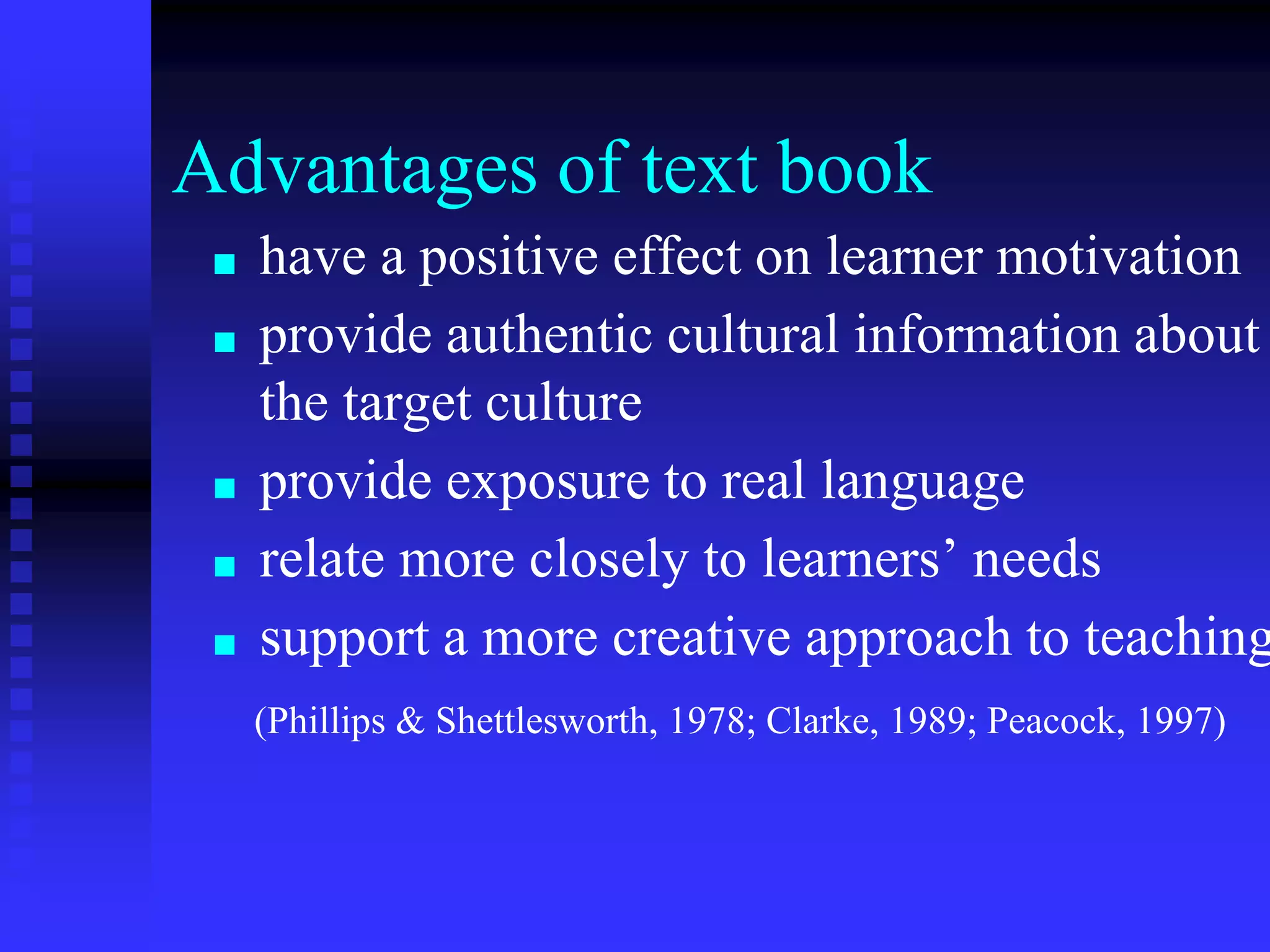
Advantages of text book
■ have a positive effect on learner motivation
■ provide authentic cultural information about
the target culture
■ provide exposure to real language
■ relate more closely to learners’ needs
■ support a more creative approach to teaching
(Phillips & Shettlesworth, 1978; Clarke, 1989; Peacock, 1997)
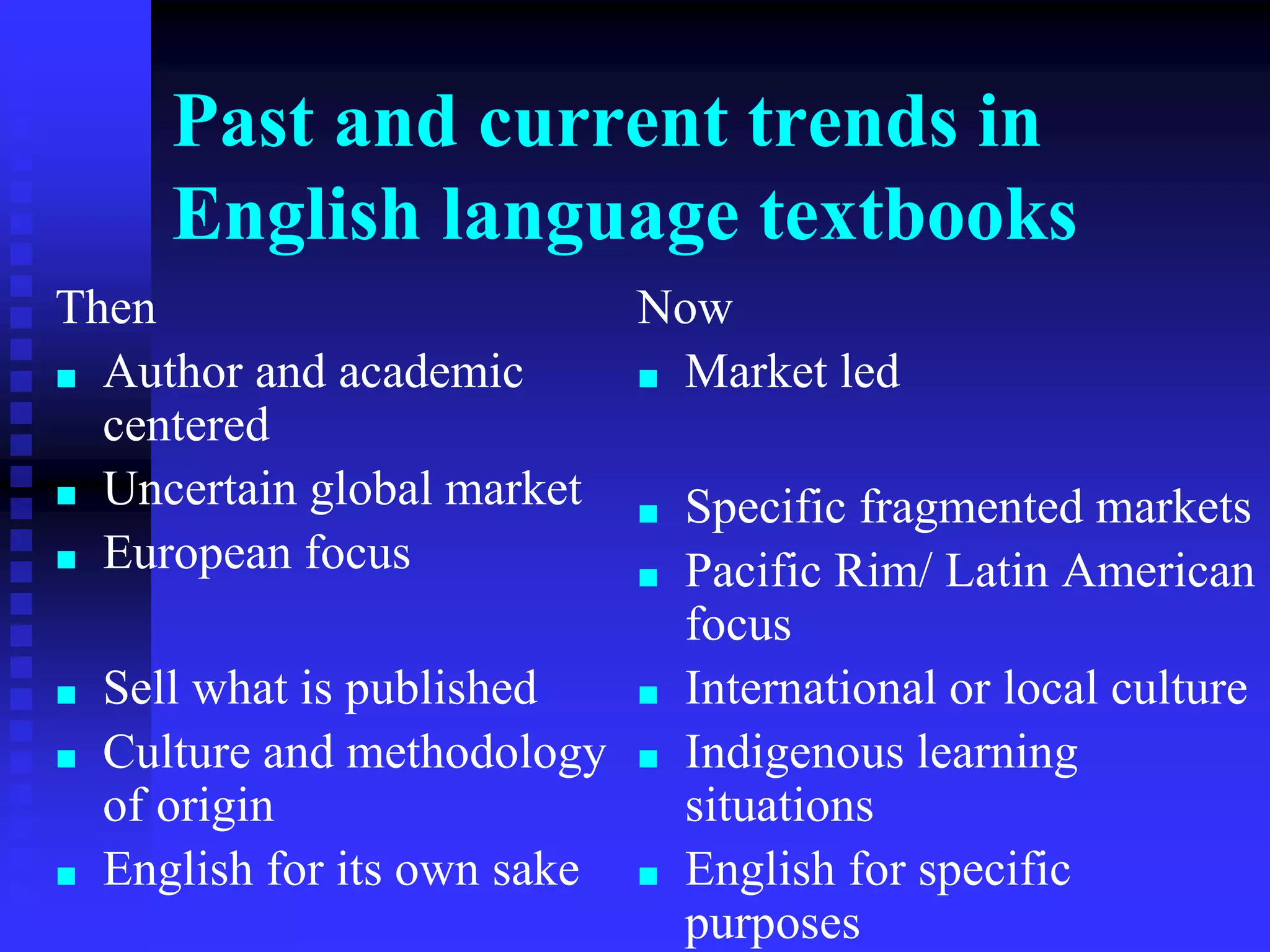
Past and current trends in
English language textbooks
Then
■ Author and academic
centered
■ Uncertain global market
■ European focus
■ Sell what is published
■ Culture and methodology
of origin
■ English for its own sake
Now
■ Market led
■ Specific fragmented markets
■ Pacific Rim/ Latin American
focus
■ International or local culture
■ Indigenous learning
situations
■ English for specific
purposes
Past and current trends in
English language textbooks
Then
■ UK/ US publisher
dominance
■ Native speaker expertise
■ Culturally insensitive
■ Low risk / competition
■ Little design
■ Artificial texts and tasks
■ Single-volume titles
Now
■ Rise in local publishing
■ Nonnative speaker
competence
■ Culturally sensitive
■ High risk / competition
■ Design rich
■ Authenticity
■ Multicomponent/multimedia
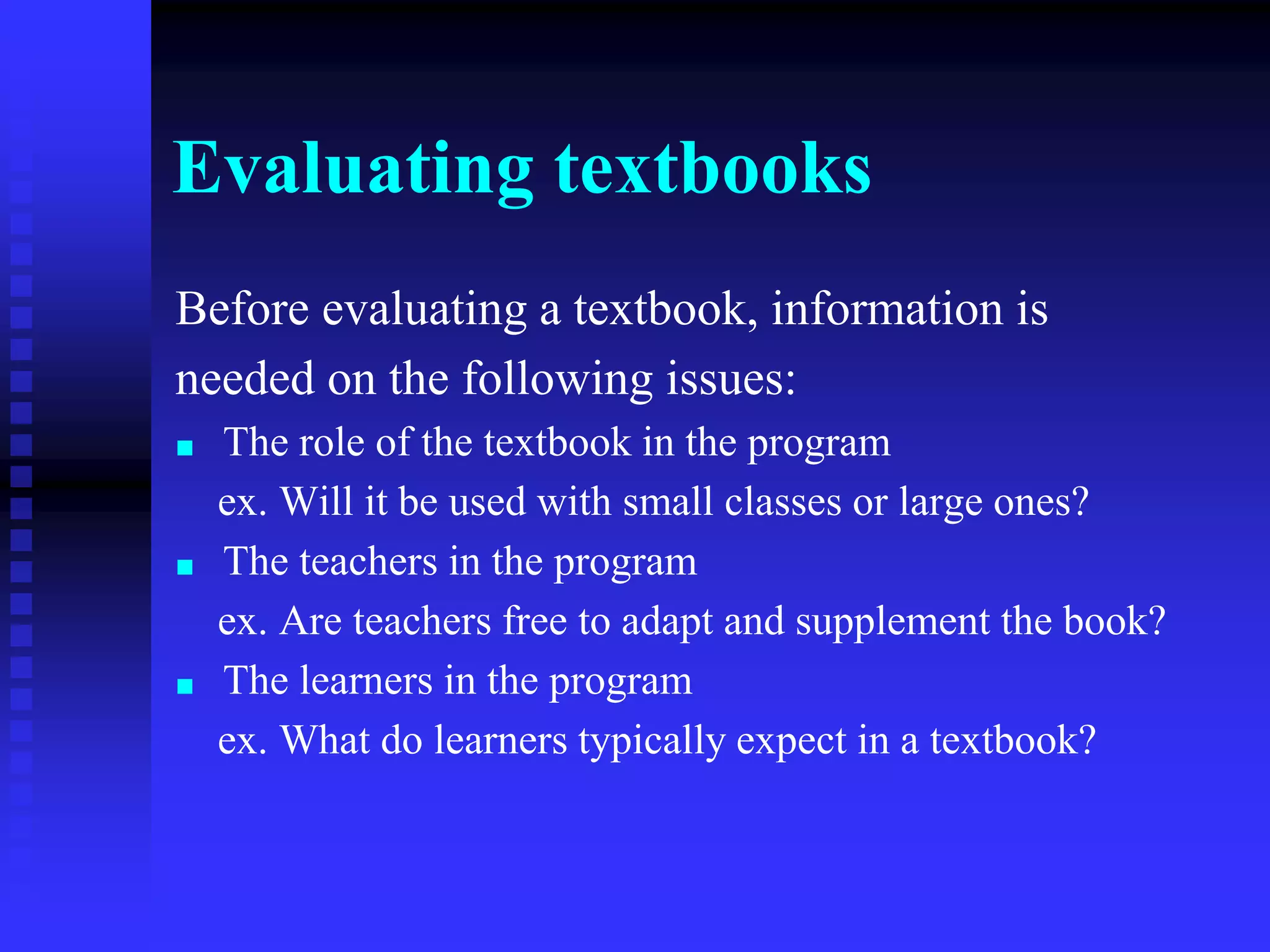
Evaluating textbooks
Before evaluating a textbook, information is
needed on the following issues:
■ The role of the textbook in the program
ex. Will it be used with small classes or large ones?
■ The teachers in the program
ex. Are teachers free to adapt and supplement the book?
■ The learners in the program
ex. What do learners typically expect in a textbook?
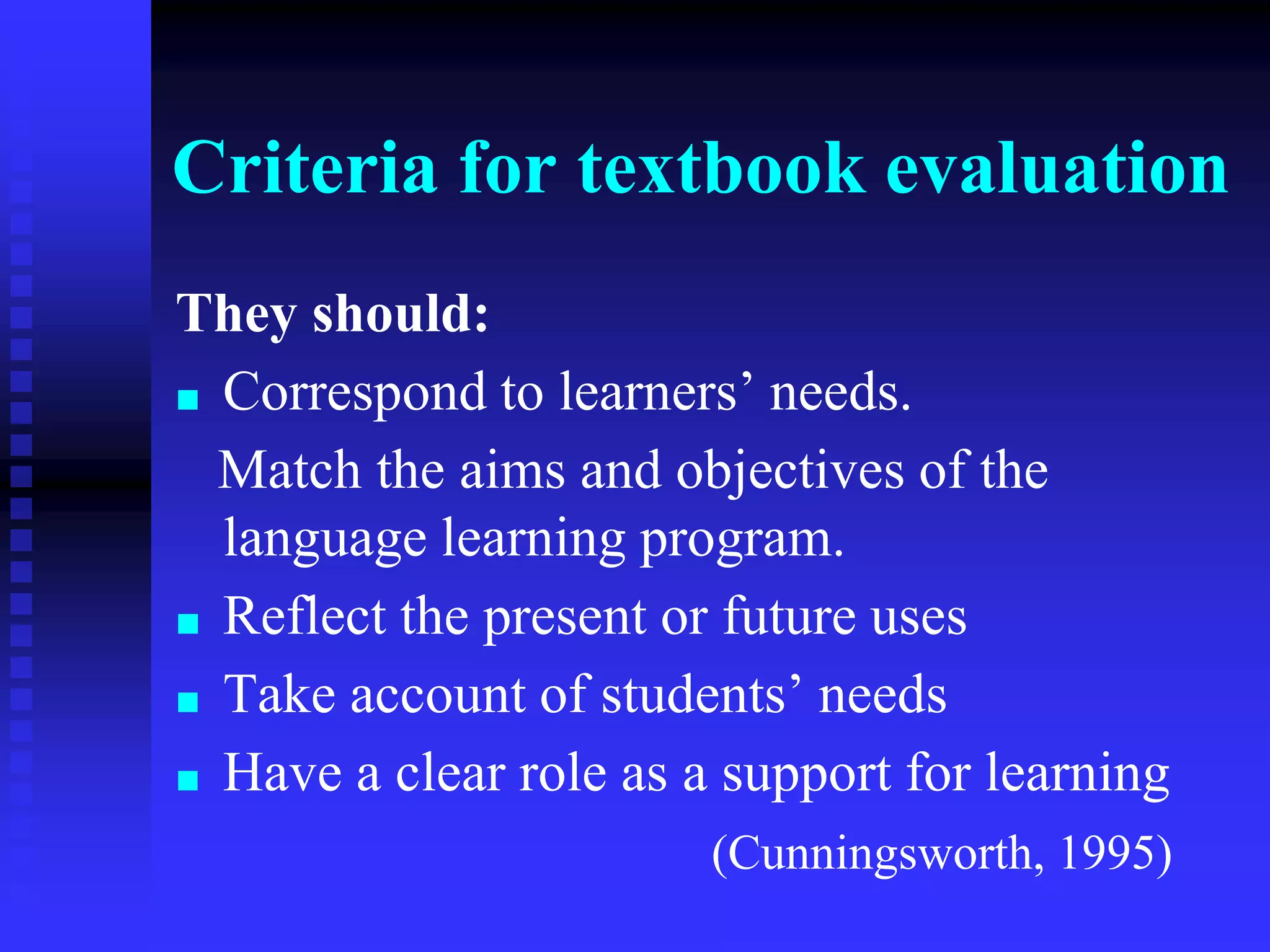
Criteria for textbook evaluation
They should:
■ Correspond to learners’ needs.
Match the aims and objectives of the
language learning program.
■ Reflect the present or future uses
■ Take account of students’ needs
■ Have a clear role as a support for learning
(Cunningsworth, 1995)
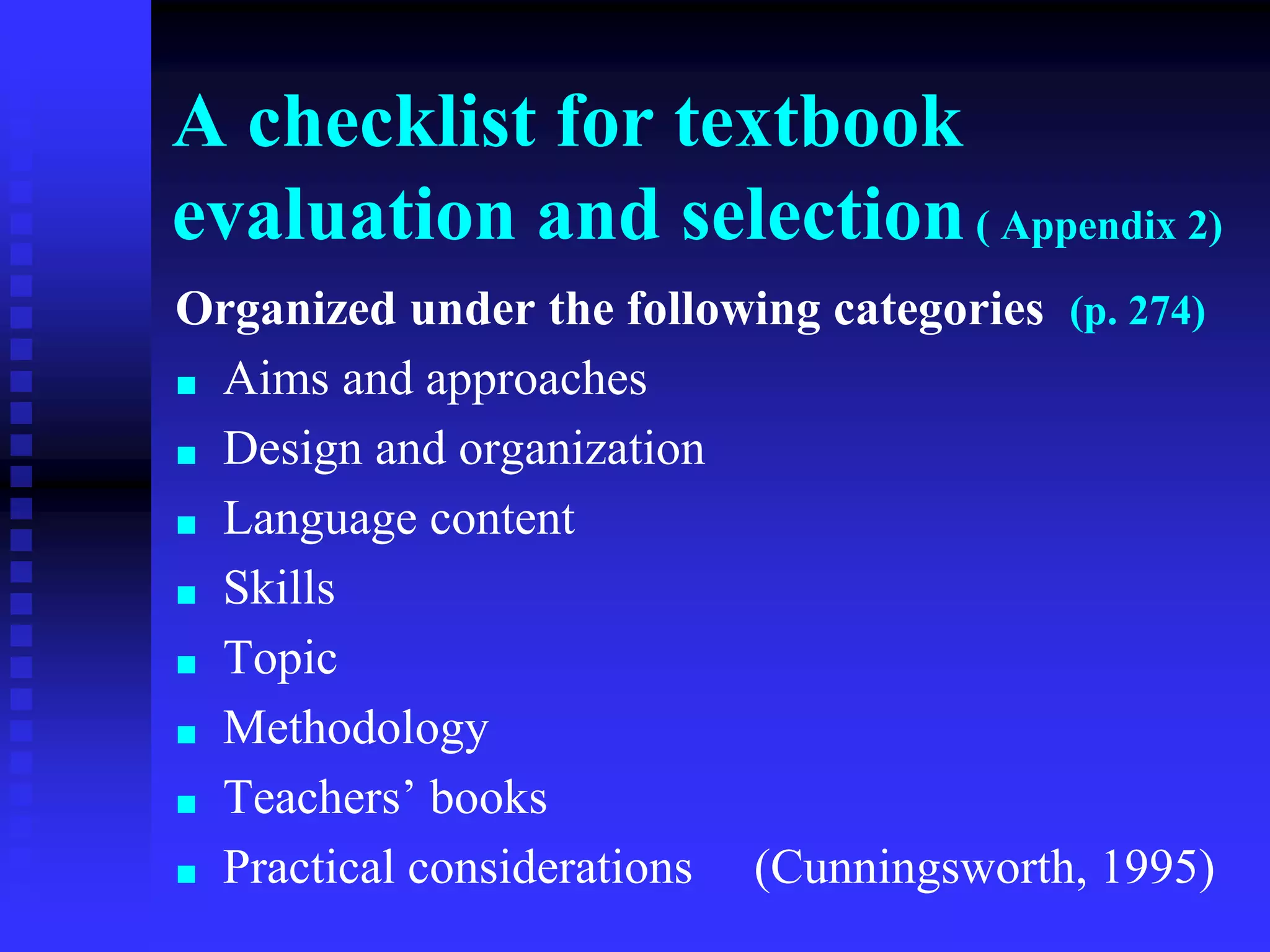
A checklist for textbook
evaluation and selection( Appendix 2)
Organized under the following categories (p. 274)
■ Aims and approaches
■ Design and organization
■ Language content
■ Skills
■ Topic
■ Methodology
■ Teachers’ books
■ Practical considerations (Cunningsworth, 1995)
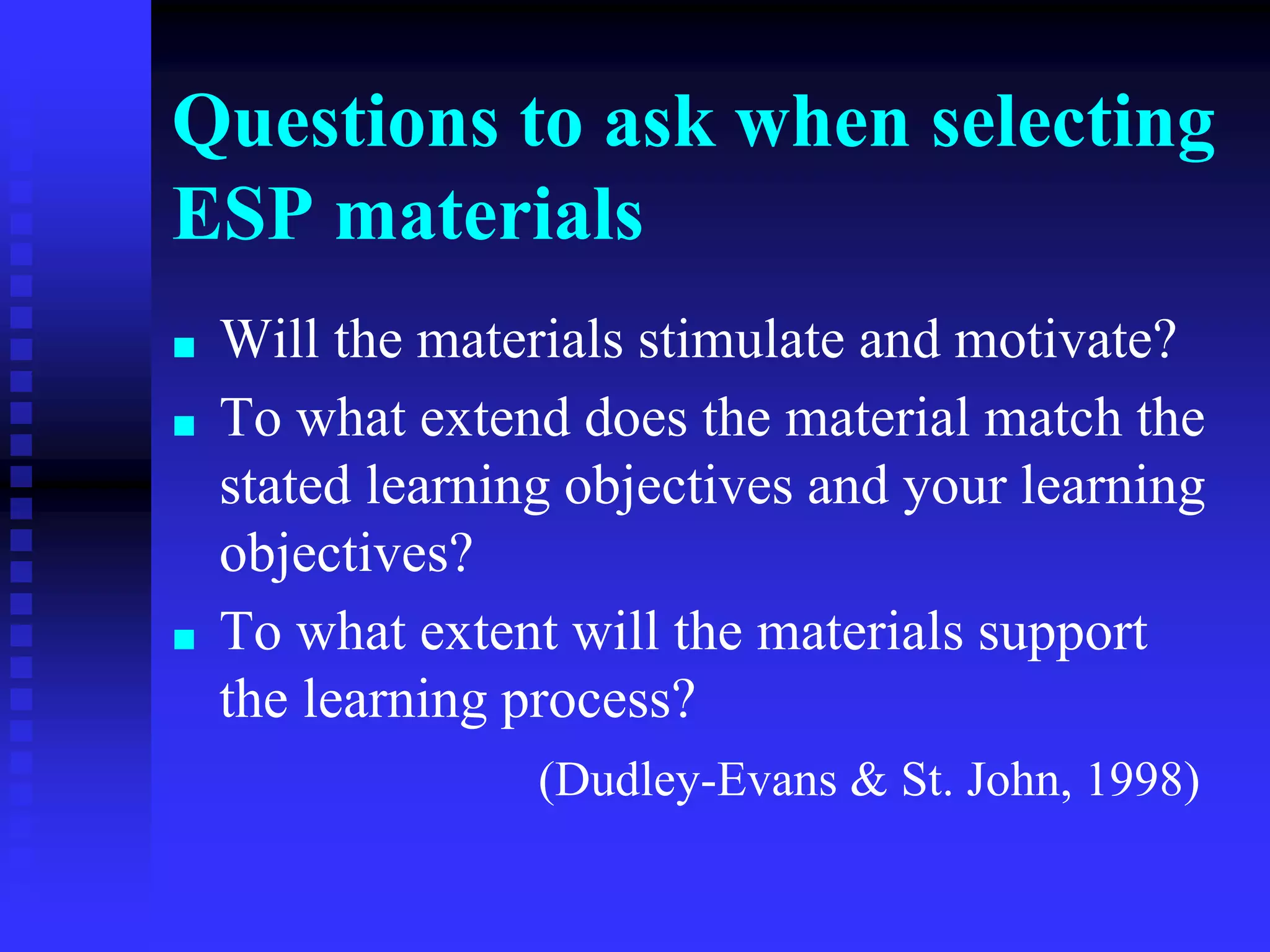
Questions to ask when selecting
ESP materials
■ Will the materials stimulate and motivate?
■ To what extend does the material match the
stated learning objectives and your learning
objectives?
■ To what extent will the materials support
the learning process?
(Dudley-Evans & St. John, 1998)
A good provider of materials will be able
to:
■ Select appropriately from what is available
■ Be creative with what is available
■ Modify activities to suit learners’ needs
■ Supplement by providing extra activities
(Dudley-Evans & St. John,
1998)
Preparing materials for a program
Advantages:
‧Relevance
‧Develop expertise
‧Reputation
‧Flexibility
Disadvantages
‧Cost
‧Quality
‧Training
The nature of materials
development
The process of materials development:
■ Preparation: ex. critical analysis of texts
■ Representation: ex. examples, demonstrations
■ Selection: ex. choice from modes of teaching,
organizing, managing, and arranging
■ Adapting and tailoring to student characteristics:
ex. consideration of social class, gender, age
(Shulman, 1987)
Characteristics for good language
teaching materials (Tomlinson, 1998)
Materials should:
■ achieve impact
■ help learners feel at ease
■ help learners to develop confidence
■ be relevant and useful to students
■ require and facilitate learner self-investment
■ expose the learners to language in authentic use
■ provide the learners with opportunities to achieve
communicative purpose
■ take into account that positive effects of
instruction are usually delayed
Characteristics for good language
teaching materials
Materials should:
■ take into account that the learners have different learning
styles
■ take into account that learners differ in affective attitudes
■ permit a silent period at the beginning of instruction
■ maximize learning potential
■ not rely too much on controlled practice
■ provide opportunities for outcome feedback
■ Learners must be ready to acquire the points being
taught
■ The learners’ attention should be drawn to linguistic
features of the input
Decisions in creating textbook
Processes of program design and materials design:
■ Developing aims
■ Developing objectives
■ Developing a syllabus
■ Organizing the course into units
■ Developing a structure for units
■ Sequencing units
■ Choosing input and sources
■ Selecting exercise types
Choosing input and sources
■ Grammar materials
■ Listening materials
■ Reading materials
■ Writing materials
■ Speaking materials
** copyright permission
Selecting exercise types (Appendix 1,
p.272)
An example of exercises that involve a
nonlinguistic response to the text:
■ Ordering a sequence of pictures
■ Comparing texts and pictures
■ Matching
■ Using illustrations
■ Completing a document
■ Mapping it out
■ Using the information in a text
■ Jigsaw reading (Grellet, 1981)
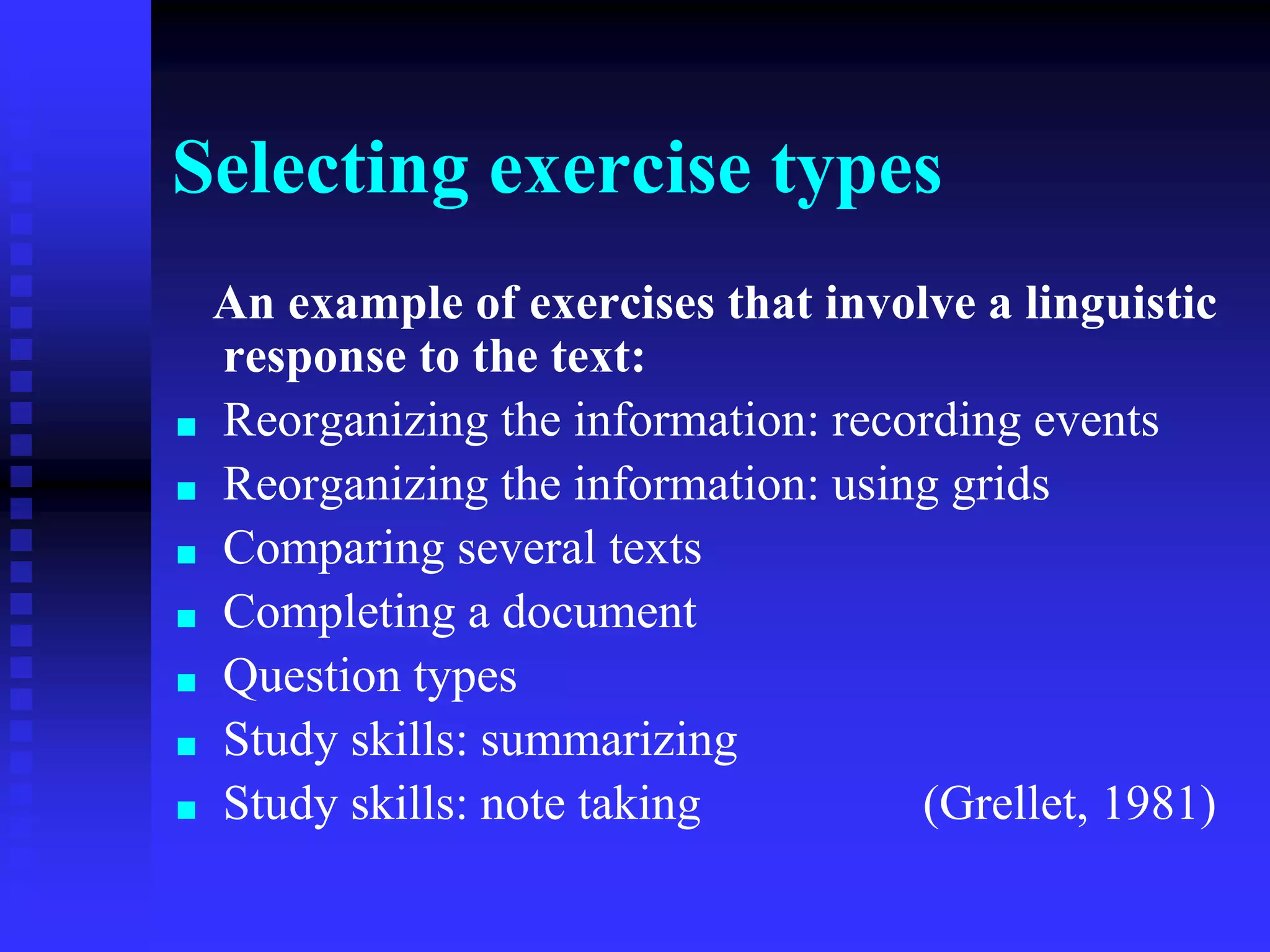
Selecting exercise types
An example of exercises that involve a linguistic
response to the text:
■ Reorganizing the information: recording events
■ Reorganizing the information: using grids
■ Comparing several texts
■ Completing a document
■ Question types
■ Study skills: summarizing
■ Study skills: note taking (Grellet, 1981)
Managing a materials writing
project ( Appendix 3, p. 277)
A team-based writing project involves:
■ Selecting the project team
■ Planning the number of stages involved
■ Identifying reviewers
■ Planning the writing schedule
■ Piloting the materials
■ Design and production
Monitoring the use of materials
Forms of Monitoring:
■ Observation
■ Feedback sessions
■ Written reports
■ Review
■ Students’ reviews
Thank you!

Creating english textbook

  • 2.
  • 3.
    ● Abid Rashid30 ● Syed Adeed 53 ● Muhammad Arif 09 ● Syed Jawad 44 ● Syed Hassan 49 ● Naseer ud Din 06 Conducted by;
  • 4.
  • 5.
    english text book Atextbook or course book (UK English) is a manual of instruction in any branch of study. Textbooks are produced according to the demands of educational institutions. Schoolbooks are textbooks and other books used in schools.
  • 6.
    ● "textbook" means.something perfectly done, or done following specific instructions. Example Sentences: The driving student performed a textbook parallel park while doing his driving test. our presentation was textbook.
  • 7.
    The functions oftextbook ■ As a source of language ■ As a learning support ■ For motivation and stimulation ■ For reference (Dudley-Evans & St. John, 1998)
  • 8.
    ● A textbookis a book used for the study of a subject. People use a textbook to learn facts and methods about a certain subject. Textbooks sometimes have questions to test the knowledge and understanding of the learner. A workbook is a type of textbook that has only practice questions and exercises purpose
  • 9.
    Advantages of textbook ■ have a positive effect on learner motivation ■ provide authentic cultural information about the target culture ■ provide exposure to real language ■ relate more closely to learners’ needs ■ support a more creative approach to teaching (Phillips & Shettlesworth, 1978; Clarke, 1989; Peacock, 1997)
  • 10.
    Past and currenttrends in English language textbooks Then ■ Author and academic centered ■ Uncertain global market ■ European focus ■ Sell what is published ■ Culture and methodology of origin ■ English for its own sake Now ■ Market led ■ Specific fragmented markets ■ Pacific Rim/ Latin American focus ■ International or local culture ■ Indigenous learning situations ■ English for specific purposes
  • 11.
    Past and currenttrends in English language textbooks Then ■ UK/ US publisher dominance ■ Native speaker expertise ■ Culturally insensitive ■ Low risk / competition ■ Little design ■ Artificial texts and tasks ■ Single-volume titles Now ■ Rise in local publishing ■ Nonnative speaker competence ■ Culturally sensitive ■ High risk / competition ■ Design rich ■ Authenticity ■ Multicomponent/multimedia
  • 12.
    Evaluating textbooks Before evaluatinga textbook, information is needed on the following issues: ■ The role of the textbook in the program ex. Will it be used with small classes or large ones? ■ The teachers in the program ex. Are teachers free to adapt and supplement the book? ■ The learners in the program ex. What do learners typically expect in a textbook?
  • 13.
    Criteria for textbookevaluation They should: ■ Correspond to learners’ needs. Match the aims and objectives of the language learning program. ■ Reflect the present or future uses ■ Take account of students’ needs ■ Have a clear role as a support for learning (Cunningsworth, 1995)
  • 14.
    A checklist fortextbook evaluation and selection( Appendix 2) Organized under the following categories (p. 274) ■ Aims and approaches ■ Design and organization ■ Language content ■ Skills ■ Topic ■ Methodology ■ Teachers’ books ■ Practical considerations (Cunningsworth, 1995)
  • 15.
    Questions to askwhen selecting ESP materials ■ Will the materials stimulate and motivate? ■ To what extend does the material match the stated learning objectives and your learning objectives? ■ To what extent will the materials support the learning process? (Dudley-Evans & St. John, 1998)
  • 16.
    A good providerof materials will be able to: ■ Select appropriately from what is available ■ Be creative with what is available ■ Modify activities to suit learners’ needs ■ Supplement by providing extra activities (Dudley-Evans & St. John, 1998)
  • 17.
    Preparing materials fora program Advantages: ‧Relevance ‧Develop expertise ‧Reputation ‧Flexibility Disadvantages ‧Cost ‧Quality ‧Training
  • 18.
    The nature ofmaterials development The process of materials development: ■ Preparation: ex. critical analysis of texts ■ Representation: ex. examples, demonstrations ■ Selection: ex. choice from modes of teaching, organizing, managing, and arranging ■ Adapting and tailoring to student characteristics: ex. consideration of social class, gender, age (Shulman, 1987)
  • 19.
    Characteristics for goodlanguage teaching materials (Tomlinson, 1998) Materials should: ■ achieve impact ■ help learners feel at ease ■ help learners to develop confidence ■ be relevant and useful to students ■ require and facilitate learner self-investment ■ expose the learners to language in authentic use ■ provide the learners with opportunities to achieve communicative purpose ■ take into account that positive effects of instruction are usually delayed
  • 20.
    Characteristics for goodlanguage teaching materials Materials should: ■ take into account that the learners have different learning styles ■ take into account that learners differ in affective attitudes ■ permit a silent period at the beginning of instruction ■ maximize learning potential ■ not rely too much on controlled practice ■ provide opportunities for outcome feedback ■ Learners must be ready to acquire the points being taught ■ The learners’ attention should be drawn to linguistic features of the input
  • 21.
    Decisions in creatingtextbook Processes of program design and materials design: ■ Developing aims ■ Developing objectives ■ Developing a syllabus ■ Organizing the course into units ■ Developing a structure for units ■ Sequencing units ■ Choosing input and sources ■ Selecting exercise types
  • 22.
    Choosing input andsources ■ Grammar materials ■ Listening materials ■ Reading materials ■ Writing materials ■ Speaking materials ** copyright permission
  • 23.
    Selecting exercise types(Appendix 1, p.272) An example of exercises that involve a nonlinguistic response to the text: ■ Ordering a sequence of pictures ■ Comparing texts and pictures ■ Matching ■ Using illustrations ■ Completing a document ■ Mapping it out ■ Using the information in a text ■ Jigsaw reading (Grellet, 1981)
  • 24.
    Selecting exercise types Anexample of exercises that involve a linguistic response to the text: ■ Reorganizing the information: recording events ■ Reorganizing the information: using grids ■ Comparing several texts ■ Completing a document ■ Question types ■ Study skills: summarizing ■ Study skills: note taking (Grellet, 1981)
  • 25.
    Managing a materialswriting project ( Appendix 3, p. 277) A team-based writing project involves: ■ Selecting the project team ■ Planning the number of stages involved ■ Identifying reviewers ■ Planning the writing schedule ■ Piloting the materials ■ Design and production
  • 26.
    Monitoring the useof materials Forms of Monitoring: ■ Observation ■ Feedback sessions ■ Written reports ■ Review ■ Students’ reviews
  • 27.