The document evaluates the role of textbooks in English language teaching, highlighting their advantages such as measurable student progress, credibility compared to teacher-generated materials, and cost-effectiveness. However, it also discusses significant disadvantages, including inflexibility, biases, and potential misalignment with authentic language use. Textbook evaluation is presented as essential for effective teaching, helping educators select appropriate resources and foster professional growth.
Defines textbooks as core materials for language classes, highlighting their universal role in EFL/ESL teaching.
Covers several advantages of using textbooks including psychological benefits, credibility, adaptability, and cost-effectiveness for both students and teachers.
Explores criticism of textbooks related to inflexibility, cultural biases, inauthenticity, and profit-driven motives leading to quality issues.
Details the importance of evaluating textbooks for improving instruction, understanding strengths and weaknesses, and supporting teacher development.
Outlines the criteria and checklist for evaluating textbooks across areas such as practical considerations, layout, activities, skills, language type, content relevance, and overall effectiveness.
Textbook Evaluation
The Roleof Textbooks in the EFL/ESL
Classroom:
A course book could be defined as:
1/ “…a textbook which is meant to provide the
core materials for a course. It aims to provide
as much as possible in one book and is
designed so that it could serve as the only
book learners necessarily use during a
course”
3.
2/ "The textbookis an almost universal
element of [English language] teaching.
Millions of copies are sold every year, and
numerous aid projects have been set up to
produce them in [various] countries…No
teaching-learning situation, it seems, is
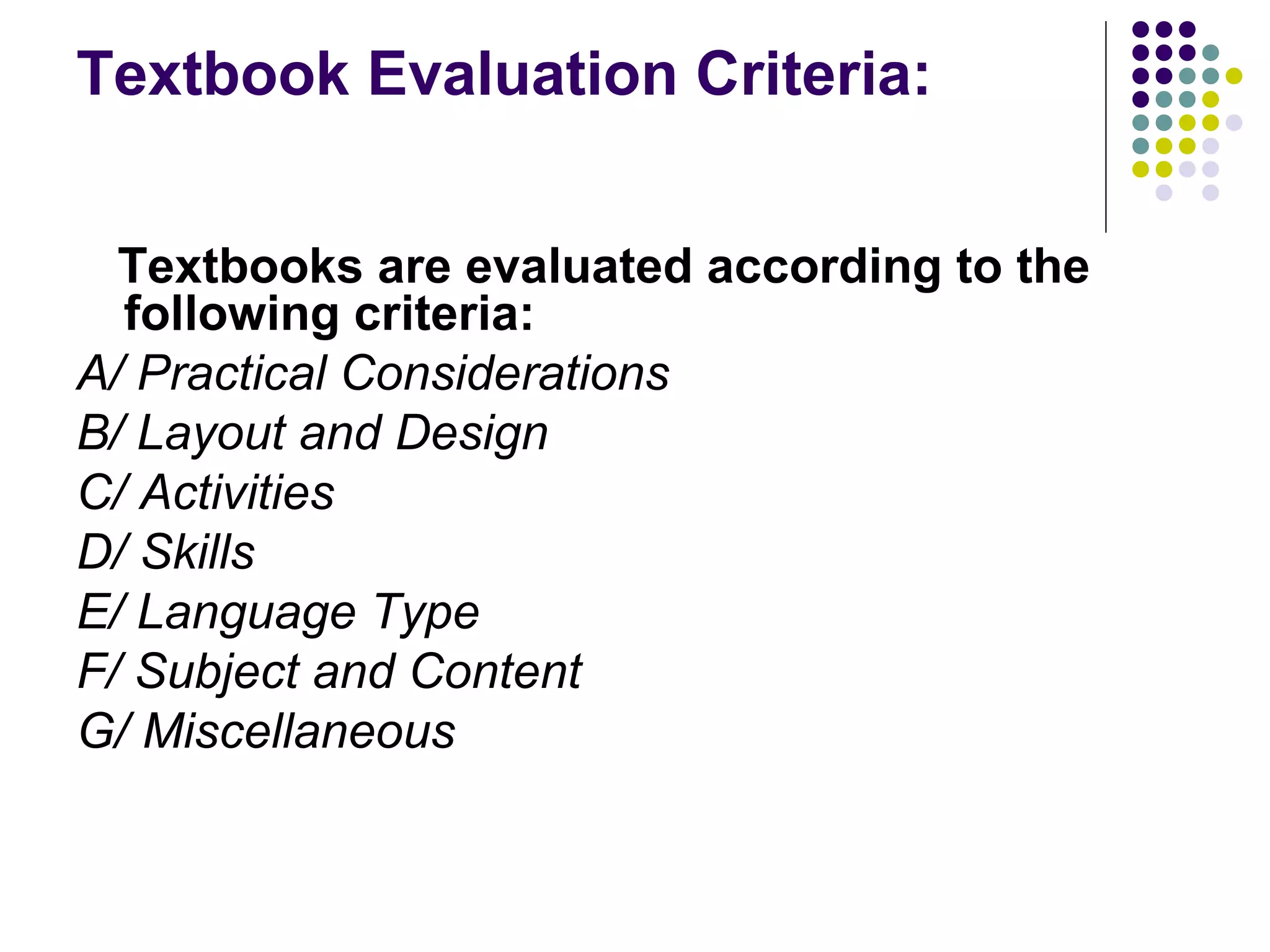
complete until it has its relevant textbook. "
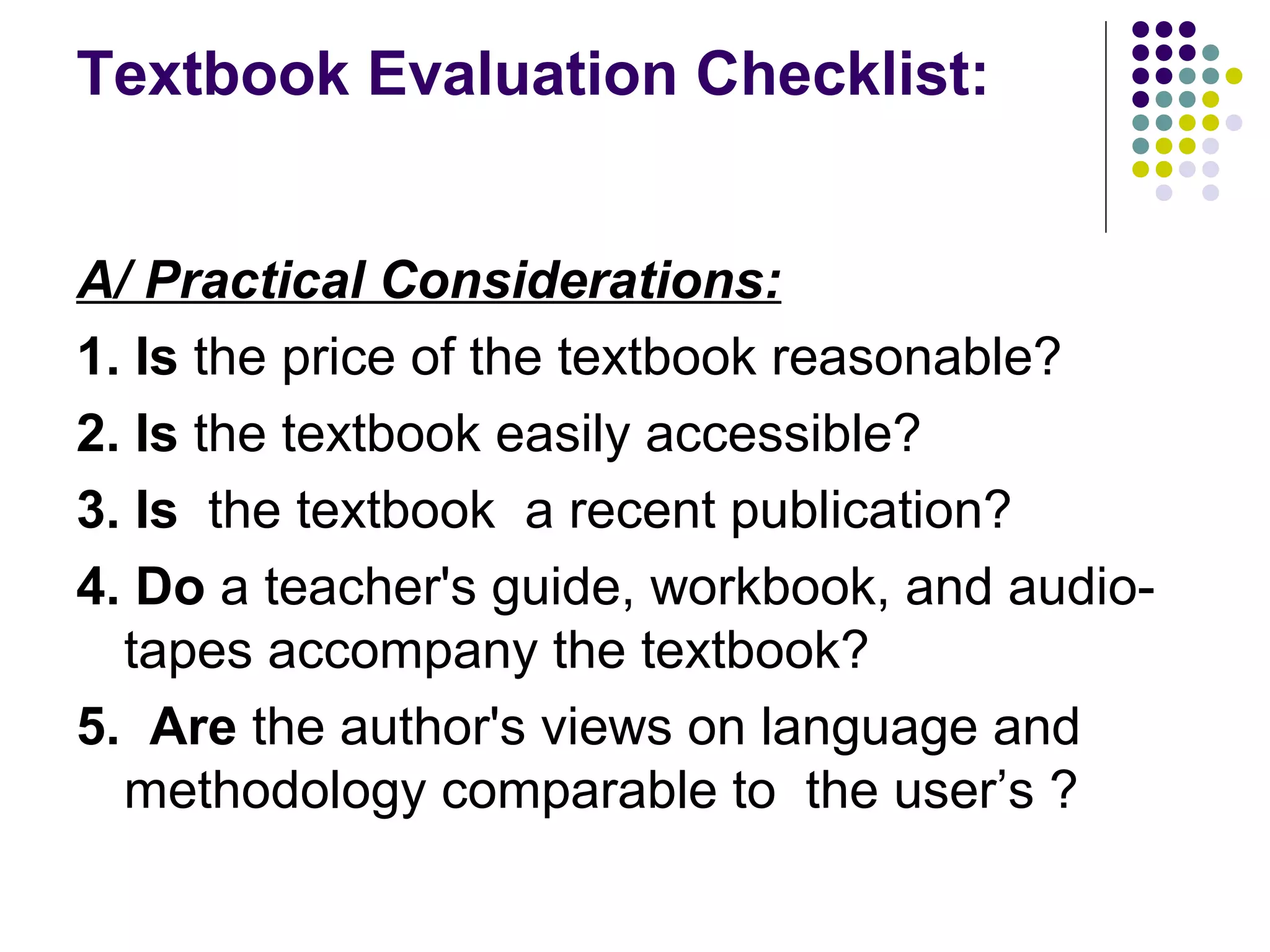
4.
Advantages of textbooks:
Textbooksdo not only represent the visible
heart of any ELT program, but also offer
considerable advantages - for both the
student and the teacher - when they are
being used in the ESL/EFL classroom.
They have the following advantages:
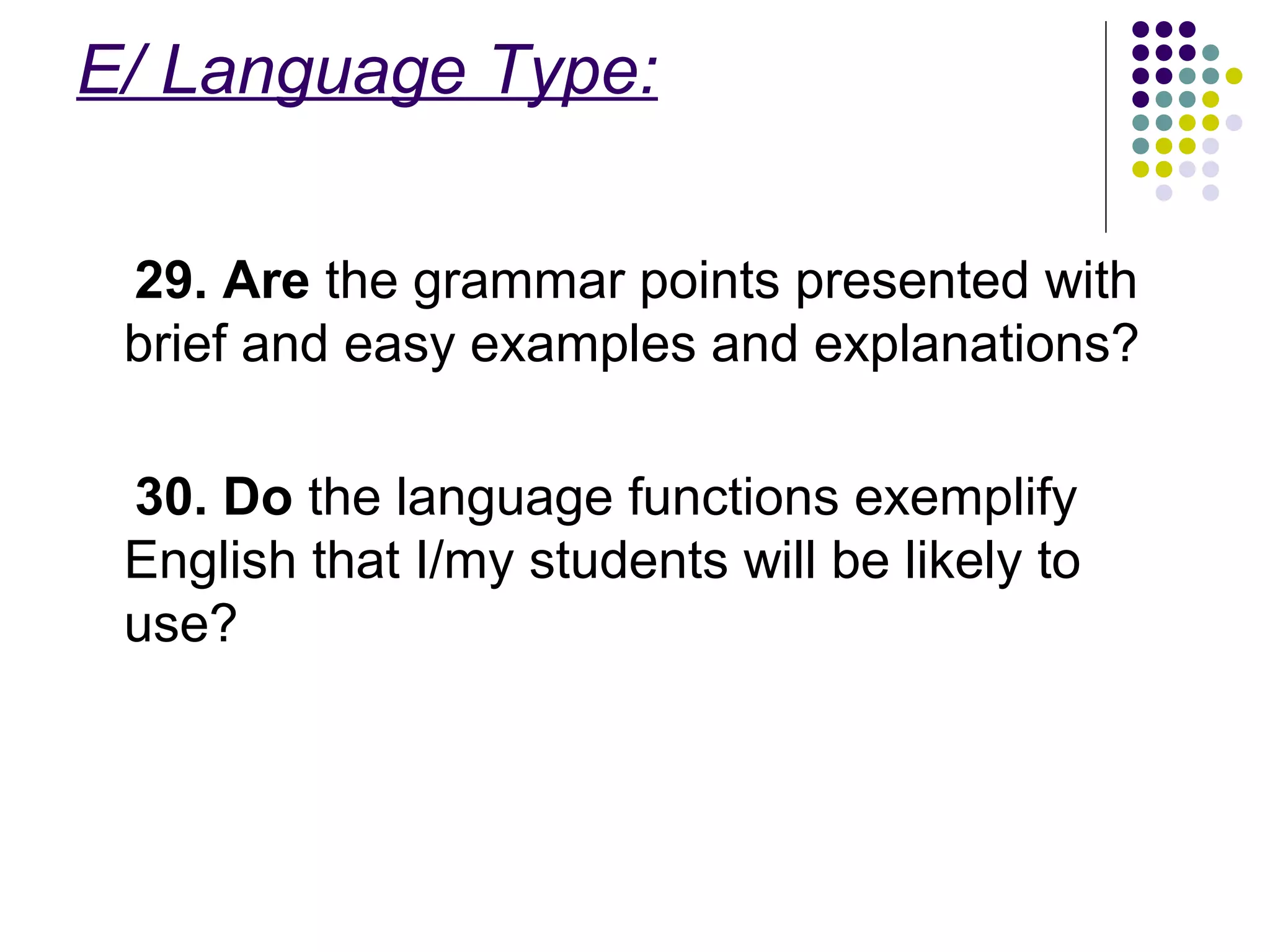
5.
Advantages of textbooks:
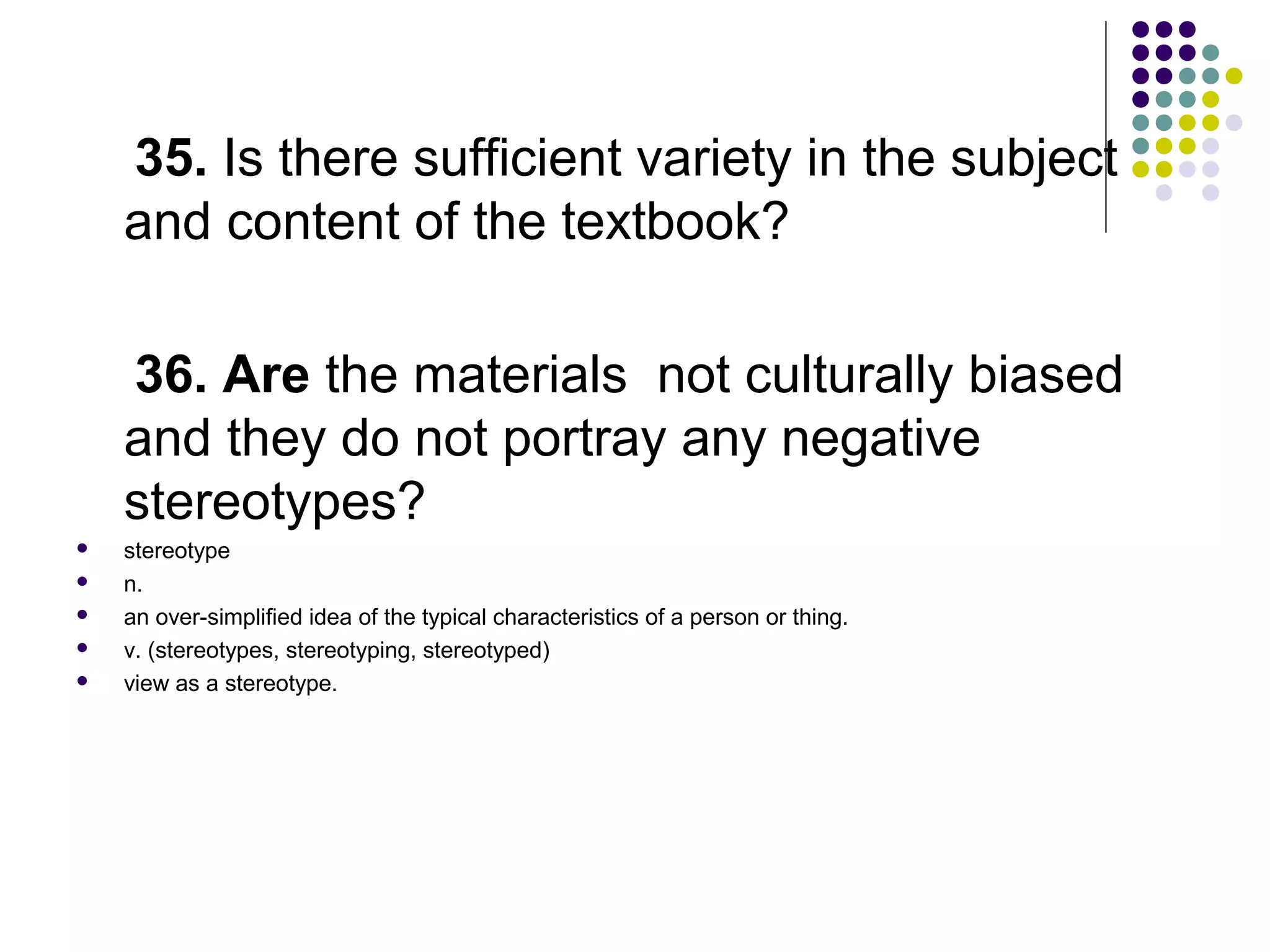
1/One of the primary advantages of using
textbooks is that they are psychologically
essential for students since their progress
and
achievement can be measured concretely
when we use them.
6.
Advantages of textbooks:
2/Students often keep in mind expectations
about using a textbook in their particular
language classroom and program and
believe that published materials have more
credibility than teacher-generated or "in-
house" materials.
7.
Advantages of textbooks:
3/Textbooks are generally sensitive to
students' needs, even if they are not
designed specifically for them, they are
efficient in terms of time and money, and they
can and should allow for adaptation and
improvisation.
improvise
v. (improvises, improvising, improvised)
1. invent and perform (music, drama, or poetry) on the spur of the moment.
2. make from whatever is available.
8.
Advantages of textbooks:
4/Textbooks are economical- relatively
inexpensive and involve low lesson
preparation time, whereas teacher-generated
materials can be time consuming and quality
defective.
9.
Advantages of textbooks:
5/They are potential for serving several
additional roles in the ELT curriculum:
(a) They are an effective resource for self-
directed learning;
(b) an effective resource for presentation
material;
(c) a source of ideas and activities;
10.
Advantages of textbooks:
(d)a reference source for students;
(e) a syllabus where they reflect pre-
determined learning objectives,
(f) and support for less experienced teachers
who have yet to gain in confidence.
11.
Disadvantages of Textbooks
Thereare many researchers and practitioners
who are not in favor of textbooks, and
propose the following disadvantages:
12.
1/ Textbooks aretoo inflexible and generally
reflect the pedagogic, psychological, and
linguistic preferences and biases of their
authors. Textbooks essentially determine and
control the methods, processes and
procedures of language teaching and
learning.
Disadvantages of Textbooks
13.
2/ More recentauthors have criticized
textbooks for their inherent social and cultural
biases. Researchers have demonstrated that
many EFL/ESL textbooks still contain
rampant examples of gender bias, sexism,
and stereotyping.
Disadvantages of Textbooks
14.
3/ Other theoristshave focused on the use of
the target language culture as a vehicle for
teaching the language in textbooks and
suggest that it is not really possible to teach a
language without embedding it in its cultural
base.
Disadvantages of Textbooks
15.
4/ They areactually too contrived and
artificial in their presentation of the target
language. They argue that it is crucial to
introduce learners to the fundamental
characteristics of authentic real life examples
of both spoken and written discourse.
Disadvantages of Textbooks
16.
5/ A finalreason for disappointment with
many ELT textbooks is the fact that they are
often regarded as the "…tainted end-product
of an author's or a publisher's desire for quick
profit").
taint
n.
a trace of an undesirable quality or substance.
v.
1. make impure.
2. affect with an undesirable quality:
Disadvantages of Textbooks
17.
Too many textbooksare often marketed with
grand artificial claims by their authors and
publishers yet these same books tend to
contain serious theoretical problems, design
flaws, and practical shortcomings.
flaw
n.
1. a mark or fault that spoils something.
2. a weakness or mistake.
v.
spoil or weaken.
Disadvantages of Textbooks
18.
Reasons for TextbookEvaluation
1/ A thorough evaluation would enable the
administrative and teaching staff of a specific
institution or organization to discriminate
between all of the available textbooks on the
market .
19.
Reasons for TextbookEvaluation
2/ Textbook evaluation would provide a sense
of familiarity with a book's content thus
assisting educators in identifying the
particular strengths and weaknesses in
textbooks already in use.
20.
Reasons for TextbookEvaluation
This would go a long way in ultimately
assisting teachers with making optimum use
of a book's strong points and recognizing the
shortcomings of certain exercises, tasks, and
entire texts.
optimum
adj.
most likely to lead to a favourable outcome:
21.
Reasons for TextbookEvaluation
3/ One additional reason for textbook
evaluation is the fact that it can be very useful
in teacher development and professional
growth.
22.
Reasons for TextbookEvaluation
Textbook evaluation helps teachers move
beyond impressionistic assessments and it
helps them to acquire useful, accurate,
systematic, and contextual insights into the
overall nature of textbook material
23.
Textbook Evaluation Criteria:
Textbooksare evaluated according to the
following criteria:
A/ Practical Considerations
B/ Layout and Design
C/ Activities
D/ Skills
E/ Language Type
F/ Subject and Content
G/ Miscellaneous
24.
Textbook Evaluation Checklist:
A/Practical Considerations:
1. Is the price of the textbook reasonable?
2. Is the textbook easily accessible?
3. Is the textbook a recent publication?
4. Do a teacher's guide, workbook, and audio-
tapes accompany the textbook?
5. Are the author's views on language and
methodology comparable to the user’s ?
25.
B/ Layout andDesign:
6. Does the textbook include a detailed
overview of the functions, structures and
vocabulary that will be taught in each unit?
7. Is the layout and design appropriate and
clear?
8. Is the textbook organized effectively?
9.Is an adequate vocabulary list or glossary
included?
10. Are adequate review sections and exercises
included?
26.
B/ Layout andDesign:
11. Is an adequate set of evaluation quizzes
or testing suggestions included?
12. Does the teacher's manual contain
guidance about how the textbook can be
used to the utmost advantage?
13. Are the materials objectives apparent to
both the teacher and student?
utmost
adj.
most extreme; greatest.
27.
C/ Activities:
14. Doesthe textbook provide a balance of
activities (e.g. is there an even distribution of
free vs. controlled exercises and tasks that
focus on both fluency and accuracy)?
15. Do the activities encourage sufficient
communicative and meaningful practice?
16. Do the activities incorporate individual,
pair and group work?
28.
C/ Activities:
17. Arethe grammar points and vocabulary
items introduced in motivating and realistic
contexts?
18. Do the activities promote creative, original
and independent responses?
19. Are the tasks conducive to the
internalization of newly introduced language?
20. Can the textbook's activities be modified or
supplemented easily?
internalize
make (a belief or attitude) part of one's behaviour or thinking.
29.
D/ Skills:
21. Dothe materials include and focus on the
skills that I/my students need to practice?
22. Do the materials provide an appropriate
balance of the four language skills?
23. Does the textbook pay attention to sub-
skills - i.e. listening for gist, note-taking,
skimming for information, etc?
30.
D/ Skills:
24. Doesthe textbook highlight and practice
natural pronunciation (i.e.- stress and
intonation).
25. Is the practice of individual skills
integrated into the practice of other skills?
31.
E/ Language Type:
26.Is the language used in the textbook
authentic - i.e. like real-life English?
27. Is the language used at the right level
for my (students') current English ability?
28. Is the progression of grammar points and
vocabulary items appropriate?
32.
E/ Language Type:
29.Are the grammar points presented with
brief and easy examples and explanations?
30. Do the language functions exemplify
English that I/my students will be likely to
use?
33.
F/ Subject andContent:
32. Is the subject and content of the textbook
relevant to my students' needs as English
language learners?
33. Is the subject and content of the textbook
generally realistic?
34. Is the subject and content of the textbook
interesting, challenging and motivating?
34.
35. Is theresufficient variety in the subject
and content of the textbook?
36. Are the materials not culturally biased
and they do not portray any negative
stereotypes?
stereotype
n.
an over-simplified idea of the typical characteristics of a person or thing.
v. (stereotypes, stereotyping, stereotyped)
view as a stereotype.
35.
G/ Miscellaneous:
37. Isthe textbook appropriate for the language-learning
aims of my institution?
39. Does the textbook raise my (students') interest in
further English language study?