MULTILINGUALISM
ITS ADVANTAGES AND DISADVANTAGES
USING MULTILINGUALISM AS A RESOURCE IN THE CLASS
Presented by
Sharmistha gur
INTRODUCTION
• Language across curriculum is a modern approach
that language learning should be occurred
throughout the school hours in language classrooms
as well as other subject classrooms.
• The goals of LAC are – simply speaking – to support
language development in each and every child, in all
domains of language use, in each learning activity in
school. This implies to reflect about the
strongly language-mediated evaluation criteria for
success in academic learning, in passing tests and in
getting good marks.
• So the overall goal is not just developing Cognitive
Academic Language Proficiency, but “Conceptual
Literacy”
• LAC has been embraced by a number of academic
institutions nationwide and is a readily identifiable
means to indicate a student’s ability to engage in
multilingual learning in preparation for the
workplace.
MULTILINGUALISM
 Multilingualism is a powerful linguistic
phenomenon, which evolves from the need to
communicate across speech communities.
Multilingualism is the ability to speak in more than
one language either by an individual speaker
or by a
community of speakers.
Multi-lingual Person :
 A multilingual person is one who can
communicate in more than one language, be
it actively (through speaking, writing, or
signing) or passively (through listening,
reading, or perceiving).
 A multilingual person also known as a
“polyglot” [Poly means "many“ and glot
means "language“].
EXAMPLE:
Diagram:
• A student belongs to a Bengali
family but living in Delhi .
• In school , his first language is
English, second language is Hindi.
• In family, he talks in Bengali .
• So the student deals with three
languages ( which is known as
trilingual's) with almost equal
efficiency,
• In that way, the student becomes
a multi-lingual person .
School
L-1 : English
L-2 : Hindi
Family
Bengali
Student
Knows:
1.English
2.Hindi
3.Bengali
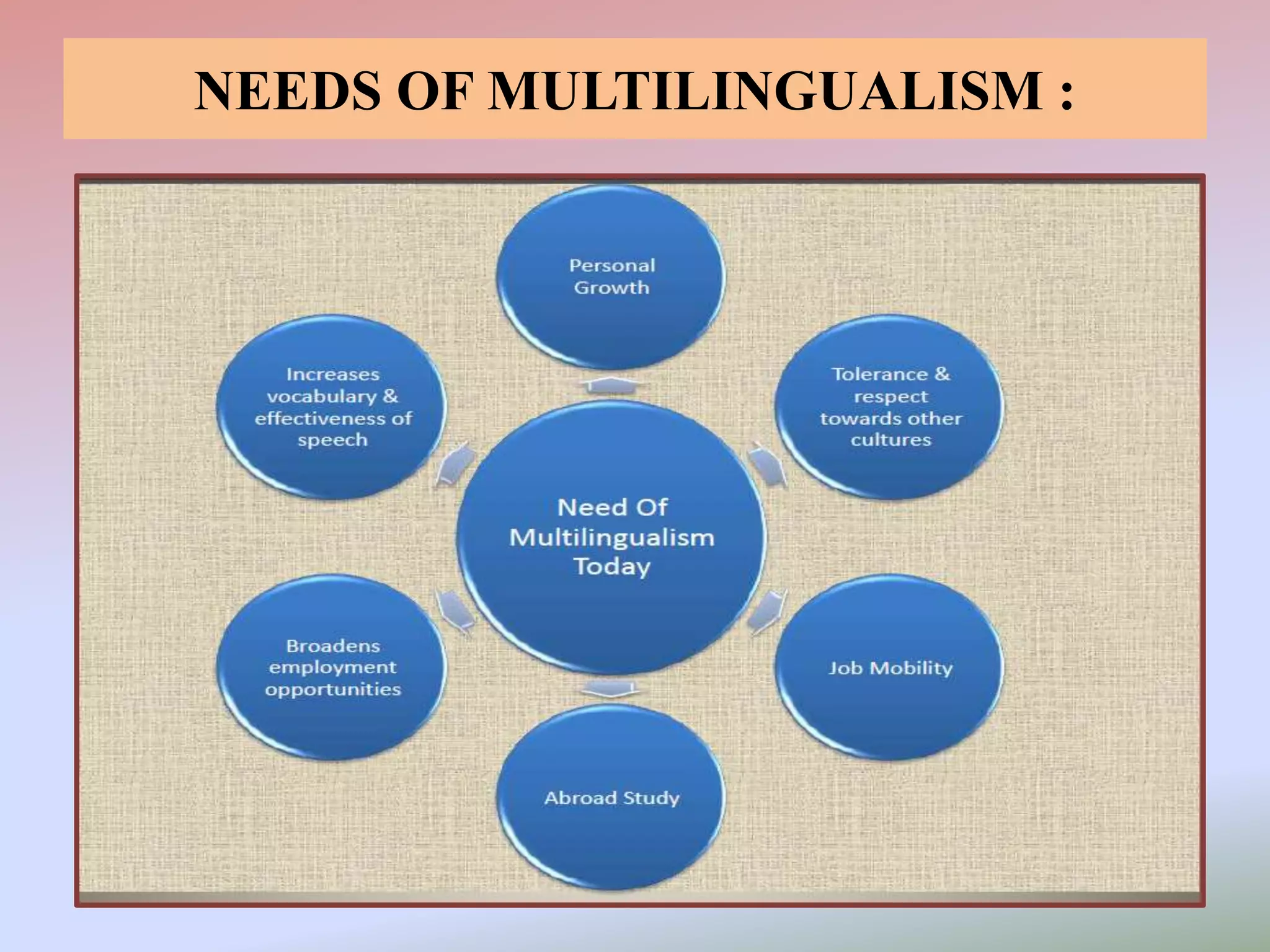
NEEDS OF MULTILINGUALISM :
ADVANTAGES OF MULTILINGUALISM :
I. Personal and social benefit : It helps to gain recognition and status in eyes of
society . Also in a multilingual country like India , characterized by tantalizing
cultural diversity multilingualism helps to access the social network among
different linguistic communities. It also helps to connect the social sites and
keep us in touch with people of all parts of the world.
II. Cognitive and academic benefits : It helps to understand the reading
process through multilingual interpretation in a better way. Multilingual
proficiency increases one’s prospect of higher education. Also multilingual
person have enhanced executive function and better at some aspects of
language learning compared to monolinguals.
III. Economic benefits: It enhances one’s competitive skill in global
perspective. those people who are engaging in the tourist or BPO ,they have
to deal with people belonging to so many linguistic background so here
multilingualism plays a vital role . It is also important for those people who
give essential services like free legal or medical help , rights of the
consumers etc.
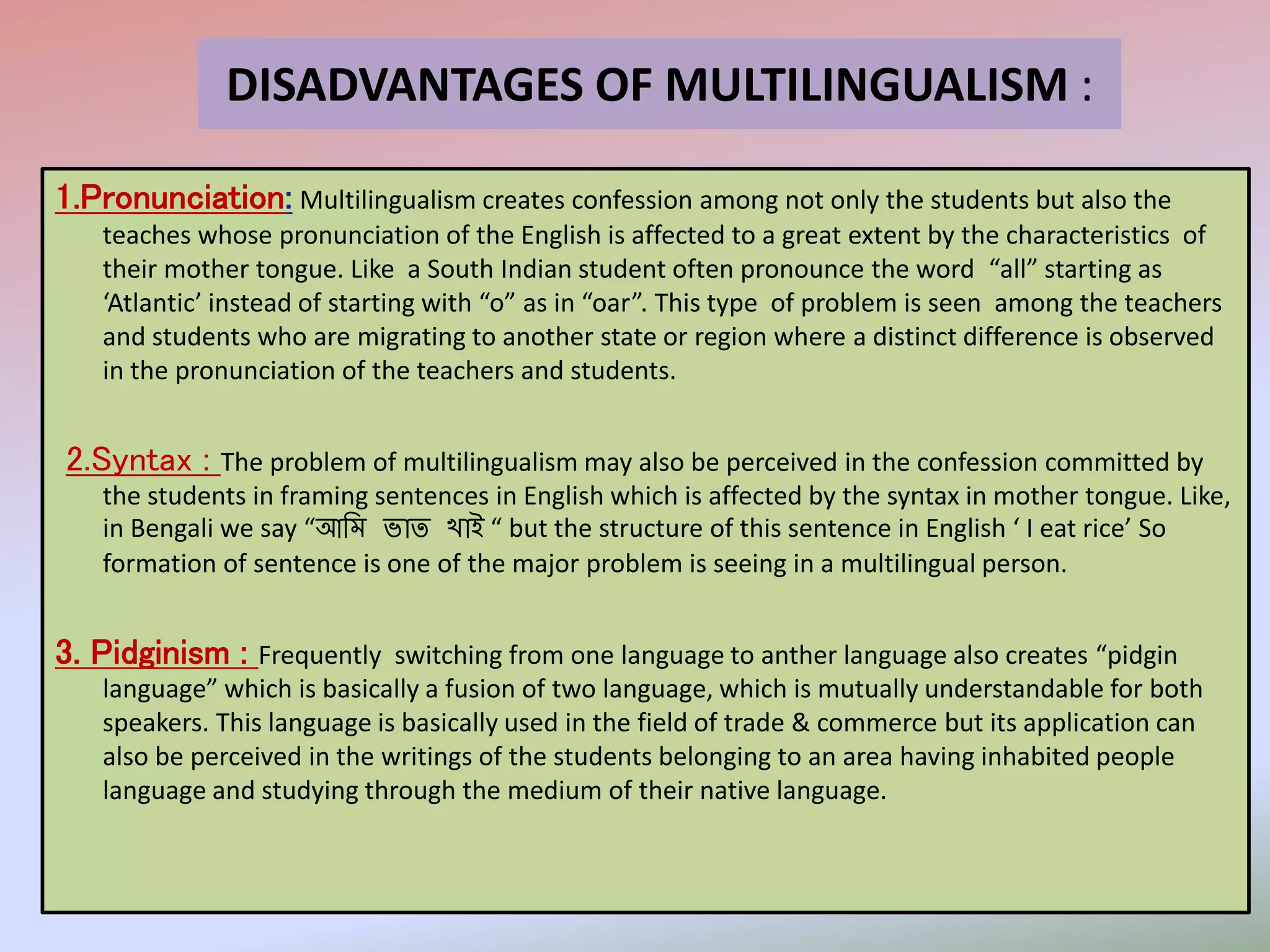
DISADVANTAGES OF MULTILINGUALISM :
1.Pronunciation: Multilingualism creates confession among not only the students but also the
teaches whose pronunciation of the English is affected to a great extent by the characteristics of
their mother tongue. Like a South Indian student often pronounce the word “all” starting as
‘Atlantic’ instead of starting with “o” as in “oar”. This type of problem is seen among the teachers
and students who are migrating to another state or region where a distinct difference is observed
in the pronunciation of the teachers and students.
2.Syntax : The problem of multilingualism may also be perceived in the confession committed by
the students in framing sentences in English which is affected by the syntax in mother tongue. Like,
in Bengali we say “আমি ভাত খাই “ but the structure of this sentence in English ‘ I eat rice’ So
formation of sentence is one of the major problem is seeing in a multilingual person.
3. Pidginism : Frequently switching from one language to anther language also creates “pidgin
language” which is basically a fusion of two language, which is mutually understandable for both
speakers. This language is basically used in the field of trade & commerce but its application can
also be perceived in the writings of the students belonging to an area having inhabited people
language and studying through the medium of their native language.
According to National curriculum Framework (NCF) 2005, ‘ the multilingual characteristics of
Indian
society should be seen as a resource to promote multilingual proficiency in every child,
which
includes proficiency
in English..Reading and writing , listening and speech, contribute to the child’s progress in all
curricular
areas and must be the basis for curriculum planning “
 Different language of different students will be used creativity in classroom. Students
will have exposure to different languages and their sound system , phonological pattern
at the same time.
 Student will learn about rules of different languages that will help to sharpen their skills
of observing , deducing and reasoning and also enhancing their linguistic and cognitive
faculty.
 The multilingual environment itself will act as a motivation to learn English as the
common means of communication. So the ESL ( English as second language) that will
ultimately turn the ESL classroom into a socialized community.
 The ESL teacher may use first language of the pupils that may appear to be a benefactor
in fostering a positive affective environment to restore student’s feeling of security and
creates cognitive atmosphere in a large classroom .
USING MULTILINGUALISM AS A RESOURCE IN THE CLASS :
USING MULTILINGUALISM AS A RESOURCE IN THE CLASS:
 The level of involvement and participation will increase if the students are
asked to contribute by sharing language data of their mother tongue.
 The amount of data which will be generated from within the classroom
could turn out to be better than any standardized text.
 By giving space and scope to our students to participate and contribute ,
we will help them to boost up their confidence.
 Teacher becomes a learner and reflective teacher who will continuously
reflect on students experiences and evolve classroom practices that will
help their linguistic competence .
 Teaching – learning process will revolve around functional proficiency in
target language rather than developing only academic skills.
 Student will understand that all languages unique and all of them are rule
governed and patterned. Their mother tongue is neither superior nor
inferior compared to any other language. They will realize that every
language is equal and they can have legitimate pride on their mother
tongue.
CONCLUSION :
Language is the most important medium of communication and education , its
development occupies an important place in the National Policy on Education
and Programme of Action.
The one and only way to introduce multilingualism through a formal system of
education , is to make provision for the study of several languages in the school
curriculum.
So we know of the positive relationship between multilingualism ,
cognitive growth , and educational achievement, there is every need to promote
multilingual education in schools.
Curricular achievement is increased through such education. It helps students to
achieve their self esteem, confidence, their own ability and potentiality and curricular
success.
Be a multilingual person has a huge scope in the aspects of Job. It also helps to
understand of history and heritage , of traditions and cultures and territory.
REFERENCES
 LANGUAGE ACROSS THE CURRICULUM , BY DR. PIKU CHOWDHURY,
OCTOBER,2016 EDITION
 LANGUAGE ACROSS THE CURRICULUM , BY DR. MALAYENDU
DINDA,JANUARY 2016-17 EDITION
 https://en.wikipedia.org/wiki/Multilingualism ( 23RD . SEP.2018)
 https://www.tandfonline.com/doi/abs/10.1080/09500782.2013.788020,(2
3RD .SEP.2018)
Multilingual

Multilingual

  • 1.
    MULTILINGUALISM ITS ADVANTAGES ANDDISADVANTAGES USING MULTILINGUALISM AS A RESOURCE IN THE CLASS Presented by Sharmistha gur
  • 2.
    INTRODUCTION • Language acrosscurriculum is a modern approach that language learning should be occurred throughout the school hours in language classrooms as well as other subject classrooms. • The goals of LAC are – simply speaking – to support language development in each and every child, in all domains of language use, in each learning activity in school. This implies to reflect about the strongly language-mediated evaluation criteria for success in academic learning, in passing tests and in getting good marks. • So the overall goal is not just developing Cognitive Academic Language Proficiency, but “Conceptual Literacy” • LAC has been embraced by a number of academic institutions nationwide and is a readily identifiable means to indicate a student’s ability to engage in multilingual learning in preparation for the workplace.
  • 3.
    MULTILINGUALISM  Multilingualism isa powerful linguistic phenomenon, which evolves from the need to communicate across speech communities. Multilingualism is the ability to speak in more than one language either by an individual speaker or by a community of speakers. Multi-lingual Person :  A multilingual person is one who can communicate in more than one language, be it actively (through speaking, writing, or signing) or passively (through listening, reading, or perceiving).  A multilingual person also known as a “polyglot” [Poly means "many“ and glot means "language“].
  • 4.
    EXAMPLE: Diagram: • A studentbelongs to a Bengali family but living in Delhi . • In school , his first language is English, second language is Hindi. • In family, he talks in Bengali . • So the student deals with three languages ( which is known as trilingual's) with almost equal efficiency, • In that way, the student becomes a multi-lingual person . School L-1 : English L-2 : Hindi Family Bengali Student Knows: 1.English 2.Hindi 3.Bengali
  • 5.
  • 6.
    ADVANTAGES OF MULTILINGUALISM: I. Personal and social benefit : It helps to gain recognition and status in eyes of society . Also in a multilingual country like India , characterized by tantalizing cultural diversity multilingualism helps to access the social network among different linguistic communities. It also helps to connect the social sites and keep us in touch with people of all parts of the world. II. Cognitive and academic benefits : It helps to understand the reading process through multilingual interpretation in a better way. Multilingual proficiency increases one’s prospect of higher education. Also multilingual person have enhanced executive function and better at some aspects of language learning compared to monolinguals. III. Economic benefits: It enhances one’s competitive skill in global perspective. those people who are engaging in the tourist or BPO ,they have to deal with people belonging to so many linguistic background so here multilingualism plays a vital role . It is also important for those people who give essential services like free legal or medical help , rights of the consumers etc.
  • 7.
    DISADVANTAGES OF MULTILINGUALISM: 1.Pronunciation: Multilingualism creates confession among not only the students but also the teaches whose pronunciation of the English is affected to a great extent by the characteristics of their mother tongue. Like a South Indian student often pronounce the word “all” starting as ‘Atlantic’ instead of starting with “o” as in “oar”. This type of problem is seen among the teachers and students who are migrating to another state or region where a distinct difference is observed in the pronunciation of the teachers and students. 2.Syntax : The problem of multilingualism may also be perceived in the confession committed by the students in framing sentences in English which is affected by the syntax in mother tongue. Like, in Bengali we say “আমি ভাত খাই “ but the structure of this sentence in English ‘ I eat rice’ So formation of sentence is one of the major problem is seeing in a multilingual person. 3. Pidginism : Frequently switching from one language to anther language also creates “pidgin language” which is basically a fusion of two language, which is mutually understandable for both speakers. This language is basically used in the field of trade & commerce but its application can also be perceived in the writings of the students belonging to an area having inhabited people language and studying through the medium of their native language.
  • 8.
    According to Nationalcurriculum Framework (NCF) 2005, ‘ the multilingual characteristics of Indian society should be seen as a resource to promote multilingual proficiency in every child, which includes proficiency in English..Reading and writing , listening and speech, contribute to the child’s progress in all curricular areas and must be the basis for curriculum planning “  Different language of different students will be used creativity in classroom. Students will have exposure to different languages and their sound system , phonological pattern at the same time.  Student will learn about rules of different languages that will help to sharpen their skills of observing , deducing and reasoning and also enhancing their linguistic and cognitive faculty.  The multilingual environment itself will act as a motivation to learn English as the common means of communication. So the ESL ( English as second language) that will ultimately turn the ESL classroom into a socialized community.  The ESL teacher may use first language of the pupils that may appear to be a benefactor in fostering a positive affective environment to restore student’s feeling of security and creates cognitive atmosphere in a large classroom . USING MULTILINGUALISM AS A RESOURCE IN THE CLASS :
  • 9.
    USING MULTILINGUALISM ASA RESOURCE IN THE CLASS:  The level of involvement and participation will increase if the students are asked to contribute by sharing language data of their mother tongue.  The amount of data which will be generated from within the classroom could turn out to be better than any standardized text.  By giving space and scope to our students to participate and contribute , we will help them to boost up their confidence.  Teacher becomes a learner and reflective teacher who will continuously reflect on students experiences and evolve classroom practices that will help their linguistic competence .  Teaching – learning process will revolve around functional proficiency in target language rather than developing only academic skills.  Student will understand that all languages unique and all of them are rule governed and patterned. Their mother tongue is neither superior nor inferior compared to any other language. They will realize that every language is equal and they can have legitimate pride on their mother tongue.
  • 10.
    CONCLUSION : Language isthe most important medium of communication and education , its development occupies an important place in the National Policy on Education and Programme of Action. The one and only way to introduce multilingualism through a formal system of education , is to make provision for the study of several languages in the school curriculum. So we know of the positive relationship between multilingualism , cognitive growth , and educational achievement, there is every need to promote multilingual education in schools. Curricular achievement is increased through such education. It helps students to achieve their self esteem, confidence, their own ability and potentiality and curricular success. Be a multilingual person has a huge scope in the aspects of Job. It also helps to understand of history and heritage , of traditions and cultures and territory.
  • 11.
    REFERENCES  LANGUAGE ACROSSTHE CURRICULUM , BY DR. PIKU CHOWDHURY, OCTOBER,2016 EDITION  LANGUAGE ACROSS THE CURRICULUM , BY DR. MALAYENDU DINDA,JANUARY 2016-17 EDITION  https://en.wikipedia.org/wiki/Multilingualism ( 23RD . SEP.2018)  https://www.tandfonline.com/doi/abs/10.1080/09500782.2013.788020,(2 3RD .SEP.2018)