TEXTBOOK
ANALYSIS
X GRADE SENIOR
HIGH SCHOOL /
SEMESTER 2
BY GROUP 7
 A.A. Istri Sasmari Putra ()
 Norma Nila Sari ()
 Komang Gede Agus Pranata ()
 Gede Andy Wirawan ()
 I G A A Widiyani Eka Putri (3854)
TEXTBOOK IDENTITY
Book title : Bahasa Inggris (Buku Kerja Siswa
Model Paikem)
Author : Drs. H. Suparmin, M.Pd
Putri Maryani, S.Pd
Frisca Sofiani, S.Pd
Publisher : Mediatama
Date (year)
of Publication : -
Intended for grade : X (Senior High School/ Semester 1)
Chapter/Unit : 3 unit
THE CRITERIONS OF
TEXTBOOK
1. GENERAL
2. LISTENING
3. SPEAKING
4. READING
5. WRITING
6. GRAMMAR
7. TECHNICAL
GENERAL
In unit 3, there are introductory
guidance for 4 language skills, but for
language item, there are no introductory
guidance for it.
 Chapter 5
 Chapter 6
 Chapter 7
 Chapter 8
SPEAKING
Unit 3 (I prefer tea to milk)
 Complete dialogues and practice speaking
them out
 Take turn to ask and answer the students’
partner about their preference
 Learn some expressions used in talking
about capabilities
 Practice speaking the dialogues with the
students’ partner
 Answer the question based on the dialogue
 Learn some expressions used for finding
places in the building
GRAMMAR
Unit 3 (I prefer tea to milk)
 Learn about Conditional sentence type
I
a. Responding the questions using
conditional sentence type I
b. Fill in the blanks
c. Matching sentences
d. Make conditional sentences
READING
Unit 3 (I prefer tea to milk)
 Descriptive text about “Ivan Mirsky” :
- Read the passage and do the
comprehension questions
- Answer the questions based on the
passage
 Display panel :
- Answer the questions about the
location of certain places
WRITING
Unit 3 (I prefer tea to milk)
 Fill in the blanks
 Matching sentences on the box
 Write conditional sentences using
verb given
TECHNICAL
Unit 3 (I prefer tea to milk)
 This chapter is supported by paikem in
every language skills. So, there are 4
paikem in this unit. Moreover, there
are also dialogues for interesting
learning.
Evaluation of the Textbook
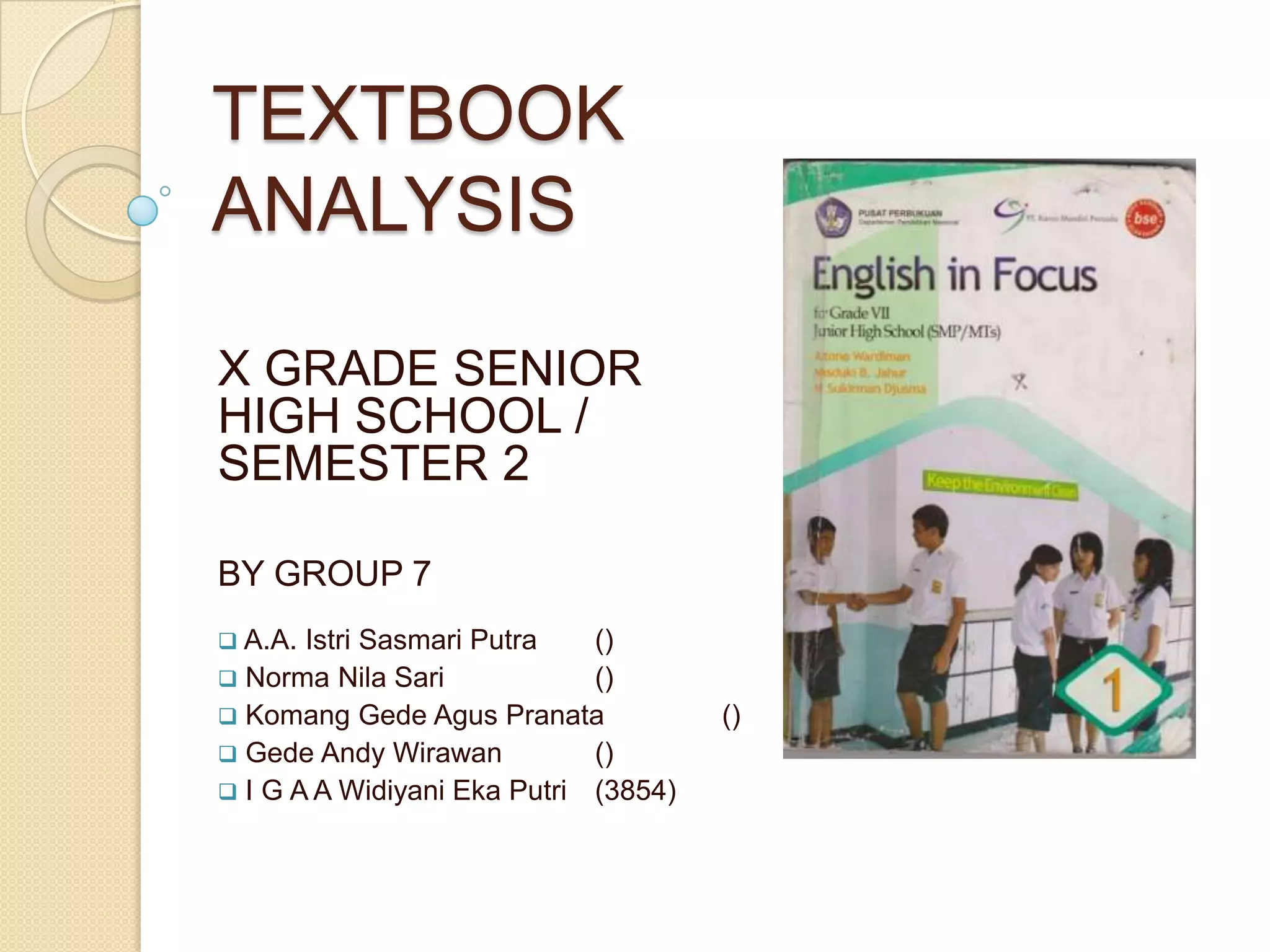
 The book of English in Focus 1 for VII grade
doesn’t have introductory guidance to
language items for every chapter.
Therefore, this book is less complete. Every
chapter has title, but what is discussed in this
book is not in accordance with title given. For
example: Chapter 6, the title is “What do you
do”; however, it also discusses how someone
looks like.
 The activities suggested for practicing the
items selected are good enough because it
has variation of practice such as fill in the
blank, matching sentence, etc.
 The sequencing of
vocabulary, grammar and genre are
not in order, especially for grammar; it
should start from easier to more
difficult material of learning. In
addition, every chapter should have
difference genre to learn. So, it
doesn’t have repetition which can
create flatness.
 There is a relevance of the contexts
and the situations in real life. It will
motivate the students to learn it and
use it in their daily life.
The strengths of the book:
 Provide some expressions about
preferances
 Provide some expression about
capabilities
 Provide some examples of Conditional
sentence type I
 Provide 4 Paikem in 4 language skills
The weaknesses of the book:
 There are no pictures, to make this book
interest.

Analysis Text Book

  • 1.
    TEXTBOOK ANALYSIS X GRADE SENIOR HIGHSCHOOL / SEMESTER 2 BY GROUP 7  A.A. Istri Sasmari Putra ()  Norma Nila Sari ()  Komang Gede Agus Pranata ()  Gede Andy Wirawan ()  I G A A Widiyani Eka Putri (3854)
  • 2.
    TEXTBOOK IDENTITY Book title: Bahasa Inggris (Buku Kerja Siswa Model Paikem) Author : Drs. H. Suparmin, M.Pd Putri Maryani, S.Pd Frisca Sofiani, S.Pd Publisher : Mediatama Date (year) of Publication : - Intended for grade : X (Senior High School/ Semester 1) Chapter/Unit : 3 unit
  • 3.
    THE CRITERIONS OF TEXTBOOK 1.GENERAL 2. LISTENING 3. SPEAKING 4. READING 5. WRITING 6. GRAMMAR 7. TECHNICAL
  • 4.
    GENERAL In unit 3,there are introductory guidance for 4 language skills, but for language item, there are no introductory guidance for it.  Chapter 5  Chapter 6  Chapter 7  Chapter 8
  • 5.
    SPEAKING Unit 3 (Iprefer tea to milk)  Complete dialogues and practice speaking them out  Take turn to ask and answer the students’ partner about their preference  Learn some expressions used in talking about capabilities  Practice speaking the dialogues with the students’ partner  Answer the question based on the dialogue  Learn some expressions used for finding places in the building
  • 6.
    GRAMMAR Unit 3 (Iprefer tea to milk)  Learn about Conditional sentence type I a. Responding the questions using conditional sentence type I b. Fill in the blanks c. Matching sentences d. Make conditional sentences
  • 7.
    READING Unit 3 (Iprefer tea to milk)  Descriptive text about “Ivan Mirsky” : - Read the passage and do the comprehension questions - Answer the questions based on the passage  Display panel : - Answer the questions about the location of certain places
  • 8.
    WRITING Unit 3 (Iprefer tea to milk)  Fill in the blanks  Matching sentences on the box  Write conditional sentences using verb given
  • 9.
    TECHNICAL Unit 3 (Iprefer tea to milk)  This chapter is supported by paikem in every language skills. So, there are 4 paikem in this unit. Moreover, there are also dialogues for interesting learning.
  • 10.
    Evaluation of theTextbook  The book of English in Focus 1 for VII grade doesn’t have introductory guidance to language items for every chapter. Therefore, this book is less complete. Every chapter has title, but what is discussed in this book is not in accordance with title given. For example: Chapter 6, the title is “What do you do”; however, it also discusses how someone looks like.  The activities suggested for practicing the items selected are good enough because it has variation of practice such as fill in the blank, matching sentence, etc.
  • 11.
     The sequencingof vocabulary, grammar and genre are not in order, especially for grammar; it should start from easier to more difficult material of learning. In addition, every chapter should have difference genre to learn. So, it doesn’t have repetition which can create flatness.  There is a relevance of the contexts and the situations in real life. It will motivate the students to learn it and use it in their daily life.
  • 12.
    The strengths ofthe book:  Provide some expressions about preferances  Provide some expression about capabilities  Provide some examples of Conditional sentence type I  Provide 4 Paikem in 4 language skills The weaknesses of the book:  There are no pictures, to make this book interest.