PREPARED BY
NIHAL SHIROYA
Why "Testing of Circuit Breaker" is Necessary?
A Circuit Breaker should be capable of carrying, making, and
breaking under normal and abnormal conditions. In any power
system circuit breaker has to withstand power frequency over
voltages and transient over voltages due to switching and
lightning.
The performance of a circuit breaker under normal and abnormal
conditions can be verified by performing different type of tests
on circuit breakers. The main purpose of testing of circuit
breakers is to confirm if circuit breaker is able to work on
particular voltage and current ratings or not.
There are mainly two tests classified:
1) Type test
2) Routine Test
1) Type Tests:
The purpose of type tests is to prove design
features and the quality of circuit breaker. Type tests
are not conducted on each circuit breaker. This is
done to prove the capabilities and to confirm the
rated characteristics of the circuit breakers.
2)Routine Tests:
Routine test is performed before circuit
breaker dispatch to ensure the product.
This gives result about defects in
materials and construction of circuit
breaker. We can check quality of material
of circuit breaker by performing Routine
Test.
 Mechanical endurance tests
 Thermal tests
 Dielectric tests
 Measurement of resistance of the main circuits
 Short Circuit tests
In this test, the C.B.. is open and closed 500 times or
other value as agreed to between the purchaser and the
supplier.the test are carried out without current through
the main circuit of the C.B.Out of the total number of
tests, 10% should be closed-open operation,that is with
the tripping,mechanism energized by the closing of
main contacts.During the tests,occasional
lubrication,but no mechanical adjustments are
permissible.after the tests,all parts including contacts
should be in good condition and there should be no
permanent distortion and undue wear of the parts.
This test determines the maximum normal current that the
circuit breaker can carry without exceeding the maximum
allowable temperature rise.In this test the rated normal
current of normal frequency is passed through the current
carrying parts of circuit breaker.
Method are recognized by Indian standards for measuring
temperature rise of parts:-
1) Thermometer method
2) Thermocouple method
3) Self resistance method
1) Breaking capacity Test:-
• Sequence of performing this tests is as follows:-
 First of all,the master circuit breaker (MB)and the breaker under test
(TB)are closed.
 The s.c.current is passed by closing the make switch.
 The circuit breaker under test(TB) is opened to interrupt the s.c.current at
desired moment.
• The following measurements related to the breaking capacity
performance are taken from the oscillogram during the test:-
 Symmetrical breaking current
 Asymmetrical breaking current
 Amplitude factor
 Natural frequency of oscillations and RRRV(RATE OF RISE OF
RISTRIKING VOLTAGE)
Sequence of Performing this test :-
First of all,the master circuit breaker (MB)and the
make switch(MS) are closed.
Then,the short circuit current is initiated by closing
the test breaker (TB).
The rated short circuit making current i.e.the peak
value of the first major loop of the short circuit current
envelope is measured from the oscillorgram.
3(Short Time Withstand Current Capacity
In this test,the rated short-time withstand current is
applied to the circuit breaker
under test for the specified duration of the time.
The rated short time withstand current is equal to be
rated short circuit breaking current and standarad
value of rated duration of short circuit current is 1
second or 3 seconds.
The current is measured by taking an oscillograph of
the short circuit current wave.
After the test,there should be no mechanical or
insulation damage and any contact welding.
Routine Test Listed Below:-
1(Mechanical Operational test
2(One-Minute power frequency
voltage dry withstand test
3(Measurement of resistance of main
circuits
 This test should be made before temperature rise
test.The measurement of resistance is made by
measuring dc voltage drop or resistance across the
terminals of each pole of circuit breaker.The current
during the test shall have any convenient value
between 100 A and the rated current of the circuit
breaker.The d.c. resistance of main contact of each
pole of a circuit breaker is of the order of a few tens
of micro-ohms.
 Operational tests are made to ensure that the circuit breakers
comply with prescribed operating conditions within the specified
voltage and supply pressure limits of their opening and closing
devices.
 During routine test five opening and five closing operations should
carry out at
a. Minimum supply voltage and pressure
b. Maximum supply voltage and pressure
After the test,all parts should be in good condition and should not
undue wear.
 
The preliminary preparations of circuit breaker testing include
the following:
 Connect the equipment.
 Adjust the correct values of resistance and reactors to set
the required magnitude of short circuit.
 Connect and set the transformer to get desired test voltage.
 The contacts on sequence switch are adjusted to get
desired timings.
 Oscillographs are adjusted and calibrated.
• 1) Short Circuit generator:-
It is a specially designed generator having very low
leakage reactance to provide short power for testing c.b.
It is driven by 3-phse induction motor.A flywheel is
provided on shaft of generator to supply kinetic energy
during short circuit and helps in spped regulation.
• 2)Short Circuit Transformer:-
 It is connected between TB and power source.It is used
to allow for flexibility to test at different voltage levels and
also provide isolation between the power source and test
breaker.
It is designed to have low leakage reactance and to
withstand repeated short circuit.
It is used as a back up c.b. to interrupt the short circuit
current in event of c.b.under test(TB) fails to operate.It
has higher capacity than the circuit breaker under
test.After every test,it is also isolates the test circuit
breaker(TB) from the supply source.It is set to operate at
a predetermined time after the initiation of short circuit
4) Make Switch(MS):-
It is very high speed switch used for initiation of short
circuit test current at desired moment.Recently,SF6 gas
make switch are used in short circuit testing station.
5) Reactors(L):-
It is connected in series.It is used to limit or control the
magnitude of the short circuit or test current to its
required value.
6) Resistors and Capacitors (R and C):-
TRV shaping circuit(R and C) is connected across the
circuit breaker under test(TB).This circuit is used to control
transient recovery voltage(TRV).Capacitors are also used
for voltage measurement.
7) Measuring Equipments:-
 For the measurements of voltage,voltage
dividers are used and for cureent measurements
shunts or CTs are used in the short circuit testing
stations.
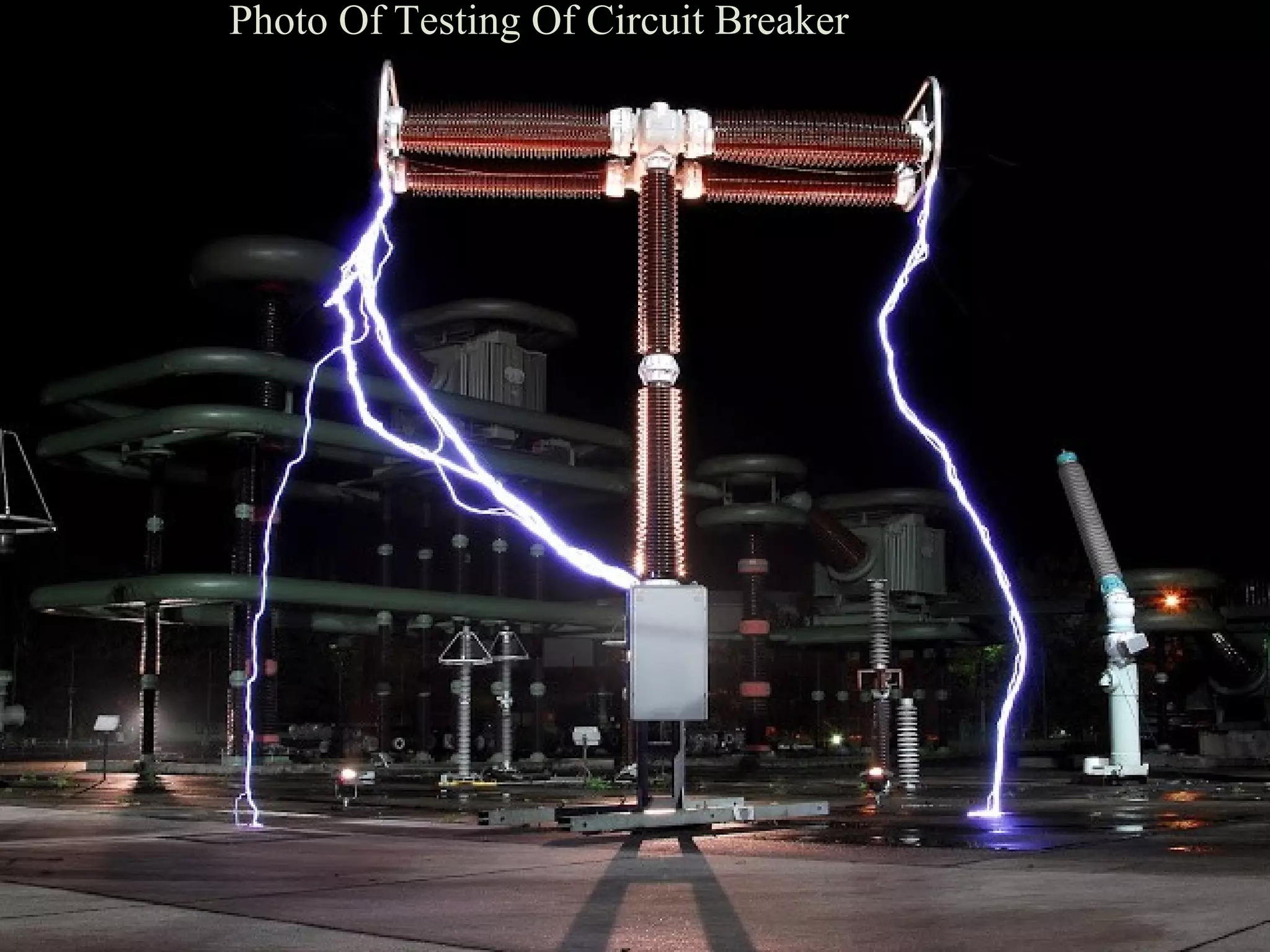
Photo Of Testing Of Circuit Breaker
Testing of c.b.(hk & hr) nihal

Testing of c.b.(hk & hr) nihal

  • 1.
  • 2.
    Why "Testing ofCircuit Breaker" is Necessary? A Circuit Breaker should be capable of carrying, making, and breaking under normal and abnormal conditions. In any power system circuit breaker has to withstand power frequency over voltages and transient over voltages due to switching and lightning. The performance of a circuit breaker under normal and abnormal conditions can be verified by performing different type of tests on circuit breakers. The main purpose of testing of circuit breakers is to confirm if circuit breaker is able to work on particular voltage and current ratings or not.
  • 3.
    There are mainlytwo tests classified: 1) Type test 2) Routine Test 1) Type Tests: The purpose of type tests is to prove design features and the quality of circuit breaker. Type tests are not conducted on each circuit breaker. This is done to prove the capabilities and to confirm the rated characteristics of the circuit breakers.
  • 4.
    2)Routine Tests: Routine testis performed before circuit breaker dispatch to ensure the product. This gives result about defects in materials and construction of circuit breaker. We can check quality of material of circuit breaker by performing Routine Test.
  • 5.
     Mechanical endurancetests  Thermal tests  Dielectric tests  Measurement of resistance of the main circuits  Short Circuit tests
  • 6.
    In this test,the C.B.. is open and closed 500 times or other value as agreed to between the purchaser and the supplier.the test are carried out without current through the main circuit of the C.B.Out of the total number of tests, 10% should be closed-open operation,that is with the tripping,mechanism energized by the closing of main contacts.During the tests,occasional lubrication,but no mechanical adjustments are permissible.after the tests,all parts including contacts should be in good condition and there should be no permanent distortion and undue wear of the parts.
  • 7.
    This test determinesthe maximum normal current that the circuit breaker can carry without exceeding the maximum allowable temperature rise.In this test the rated normal current of normal frequency is passed through the current carrying parts of circuit breaker. Method are recognized by Indian standards for measuring temperature rise of parts:- 1) Thermometer method 2) Thermocouple method 3) Self resistance method
  • 8.
    1) Breaking capacityTest:- • Sequence of performing this tests is as follows:-  First of all,the master circuit breaker (MB)and the breaker under test (TB)are closed.  The s.c.current is passed by closing the make switch.  The circuit breaker under test(TB) is opened to interrupt the s.c.current at desired moment. • The following measurements related to the breaking capacity performance are taken from the oscillogram during the test:-  Symmetrical breaking current  Asymmetrical breaking current  Amplitude factor  Natural frequency of oscillations and RRRV(RATE OF RISE OF RISTRIKING VOLTAGE)
  • 9.
    Sequence of Performingthis test :- First of all,the master circuit breaker (MB)and the make switch(MS) are closed. Then,the short circuit current is initiated by closing the test breaker (TB). The rated short circuit making current i.e.the peak value of the first major loop of the short circuit current envelope is measured from the oscillorgram.
  • 10.
    3(Short Time WithstandCurrent Capacity In this test,the rated short-time withstand current is applied to the circuit breaker under test for the specified duration of the time. The rated short time withstand current is equal to be rated short circuit breaking current and standarad value of rated duration of short circuit current is 1 second or 3 seconds. The current is measured by taking an oscillograph of the short circuit current wave. After the test,there should be no mechanical or insulation damage and any contact welding.
  • 11.
    Routine Test ListedBelow:- 1(Mechanical Operational test 2(One-Minute power frequency voltage dry withstand test 3(Measurement of resistance of main circuits
  • 12.
     This testshould be made before temperature rise test.The measurement of resistance is made by measuring dc voltage drop or resistance across the terminals of each pole of circuit breaker.The current during the test shall have any convenient value between 100 A and the rated current of the circuit breaker.The d.c. resistance of main contact of each pole of a circuit breaker is of the order of a few tens of micro-ohms.
  • 13.
     Operational testsare made to ensure that the circuit breakers comply with prescribed operating conditions within the specified voltage and supply pressure limits of their opening and closing devices.  During routine test five opening and five closing operations should carry out at a. Minimum supply voltage and pressure b. Maximum supply voltage and pressure After the test,all parts should be in good condition and should not undue wear.
  • 14.
      The preliminary preparationsof circuit breaker testing include the following:  Connect the equipment.  Adjust the correct values of resistance and reactors to set the required magnitude of short circuit.  Connect and set the transformer to get desired test voltage.  The contacts on sequence switch are adjusted to get desired timings.  Oscillographs are adjusted and calibrated.
  • 15.
    • 1) ShortCircuit generator:- It is a specially designed generator having very low leakage reactance to provide short power for testing c.b. It is driven by 3-phse induction motor.A flywheel is provided on shaft of generator to supply kinetic energy during short circuit and helps in spped regulation. • 2)Short Circuit Transformer:-  It is connected between TB and power source.It is used to allow for flexibility to test at different voltage levels and also provide isolation between the power source and test breaker. It is designed to have low leakage reactance and to withstand repeated short circuit.
  • 16.
    It is usedas a back up c.b. to interrupt the short circuit current in event of c.b.under test(TB) fails to operate.It has higher capacity than the circuit breaker under test.After every test,it is also isolates the test circuit breaker(TB) from the supply source.It is set to operate at a predetermined time after the initiation of short circuit 4) Make Switch(MS):- It is very high speed switch used for initiation of short circuit test current at desired moment.Recently,SF6 gas make switch are used in short circuit testing station. 5) Reactors(L):- It is connected in series.It is used to limit or control the magnitude of the short circuit or test current to its required value.
  • 17.
    6) Resistors andCapacitors (R and C):- TRV shaping circuit(R and C) is connected across the circuit breaker under test(TB).This circuit is used to control transient recovery voltage(TRV).Capacitors are also used for voltage measurement. 7) Measuring Equipments:-  For the measurements of voltage,voltage dividers are used and for cureent measurements shunts or CTs are used in the short circuit testing stations.
  • 18.
    Photo Of TestingOf Circuit Breaker