

Back to the Future: The Power of Traditional Teaching with Modern Communication Brian Mulligan Open Learning Coordinator Institute of Technology Sligo m-ICTE2009 Conference 22 nd  – 24 th  April, 2009, Lisbon, Portugal.
Why is online-distance learning developing so slowly ?
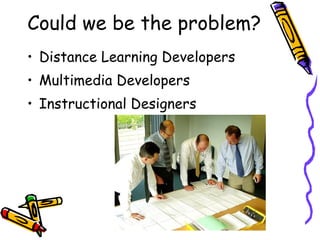
Could we be the problem? Distance Learning Developers Multimedia Developers Instructional Designers
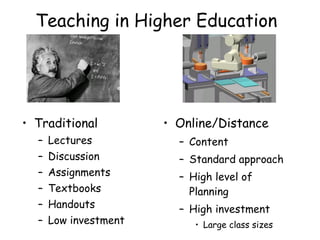
Teaching in Higher Education Traditional Lectures Discussion Assignments Textbooks Handouts Low investment Online/Distance Content Standard approach High level of Planning High investment Large class sizes
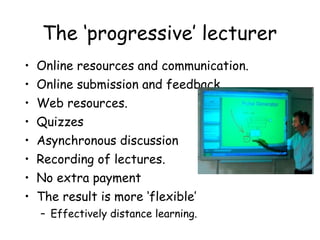
The ‘progressive’ lecturer  Online resources and communication. Online submission and feedback. Web resources. Quizzes Asynchronous discussion Recording of lectures. No extra payment The result is more ‘flexible’ Effectively distance learning.
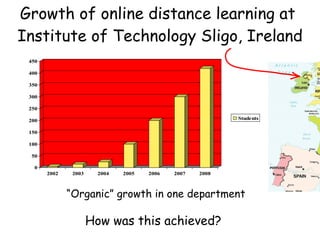
Growth of online distance learning at  Institute of Technology Sligo, Ireland “ Organic” growth in one department How was this achieved?
‘ Evening Classes’ online
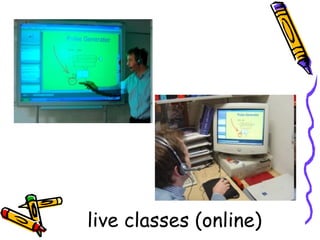
live classes (online)
textbook
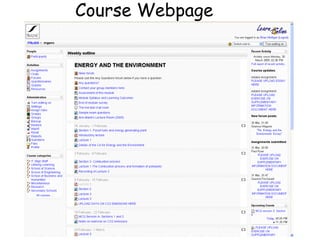
Course Webpage
handouts
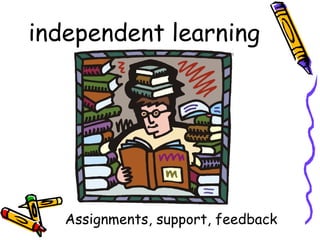
independent learning Assignments, support, feedback
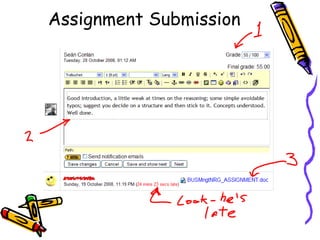
Assignment Submission
Good online communication
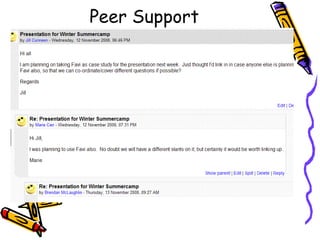
Peer Support
Bring ‘em in if you have to!
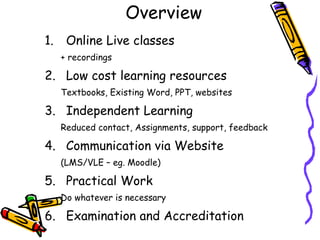
Overview Online Live classes + recordings  Low cost learning resources Textbooks, Existing Word, PPT, websites Independent Learning Reduced contact, Assignments, support, feedback Communication via Website (LMS/VLE – eg. Moodle) Practical Work Do whatever is necessary Examination and Accreditation
Why it works. Familiarity Simplicity
Why is this approach not more common ?
Influencers and ‘traditions’ Content Text - > Multimedia High Standards Planning and Design Sophistication Resulting in: High start-up costs Reduced agility
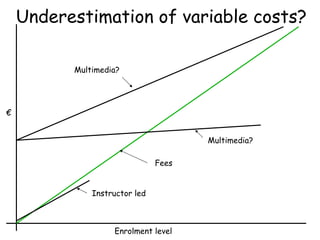
Underestimation of variable costs? Enrolment level € Fees Instructor led Multimedia? Multimedia?
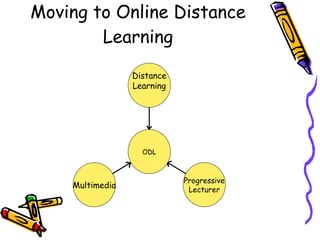
Moving to Online Distance Learning Multimedia Progressive Lecturer Distance Learning ODL
Any Questions?

Back to the Future: The Power of Traditional Teaching with Modern Communication

Editor's Notes

  • #4 I want to make the following points: online distance learning can be quite simple – perhaps it is the preference of certain professionals to make it more complicated that is holding development back.
  • #7 Most of this growth was in one dept. Mech and Elec which now has more online than full-time students. Organic growth – outwards as well as upwards. – about 10 programmes. So, How did we achieve this.
  • #8 Click for “Evening Classes” Click again for ‘online’ Just imagine you could come in and teach evening classes and that people could join in without driving in. So what was involved (in putting these evening classes online)
  • #9 You might argue that this would be enough (well not as good as real face to face classes) However, it easy to make it better.
  • #10 So you don’t have to cover everything in class Sounds obvious – but lots of people think that if you have a distance learning programme you have to type everything up – this is expensive – would never do that for a night course.
  • #12 Handouts can be uploaded into a VLE (Blackboard, WebCT, Moodle) – even easier than using the photocopier. Even better – use many free resources on the web – give them the link.
  • #13 Get them to do some work – learn by doing – help them with it (VLE queries) – let them know how they are getting on.
  • #15 Send out notices, answer queries, let them talk to each other using ‘bulletin boards’ or forums. How do we know this whole thing works? – students say they like it – it is very convenient – they tell their friends and they sign up. Next slide – bit by bit.
  • #18 People are very busy nowadays. Time is more of a problem than distance. Imagine you were giving evening classes where some of the students had difficulty making classes. You want to make it as convenient as possible for them. You might add online resources to help them. You might redesign your approach to make it a little less dependant on attendance. The result would probably be useful to distance learners. In the end how do you think they would stack up in exams?
  • #19 Lecturers have enough to do dealing with their own domain without becoming computer experts. So what Lessons could we draw from this experience? Next slide.
  • #21 Instructional Designers, Distance Learning designers, Multimedia designers
  • #22 Instructor led has low economies of scale and limited in how low you can cut fees irrespective of your enrollment level. Perceived multi-media costs – if you can get high enrollment levels you can cut fees. (can further generate higher enrollments) However, variable costs of multi-media may be underestimated (updating, tutor-support, marketing/sales, technical support, risk of over-estimating market) and you still have the problem of high entry barriers. Conclusions – instructor led has low entry barriers and is less risky – leads to agility
  • #23 We tend to forget the third way!