page
From Workshop to the Web: Reflections on the Journey in Producing  Vidcasts to Enhance Student Learning Angela Shapiro,  Effective Learning Service Aidan Johnston,  Caledonian Academy TECHEDUCA, 19 th  May 2010
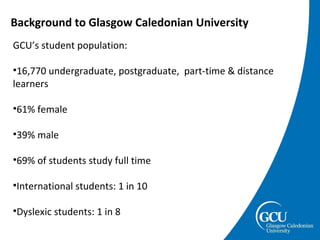
Background to Glasgow Caledonian University GCU’s student population:  16,770 undergraduate, postgraduate,  part-time & distance learners 61% female  39% male 69% of students study full time International students: 1 in 10 Dyslexic students: 1 in 8
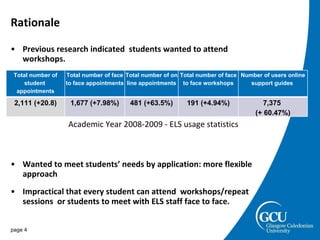
Rationale Previous research indicated  students wanted to attend workshops. Wanted to meet students’ needs by application: more flexible approach Impractical that every student can attend  workshops/repeat sessions  or students to meet with ELS staff face to face.  page  Academic Year 2008-2009 - ELS usage statistics Total number of student  appointments Total number of face to face appointments  Total number of on line appointments Total number of face to face workshops Number of users online support guides  2,111 (+20.8) 1,677 (+7.98%) 481 (+63.5%) 191 (+4.94%) 7,375  (+ 60.47%)
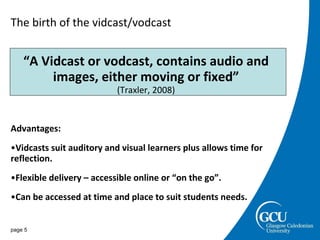
The birth of the vidcast/vodcast “ A Vidcast or vodcast, contains audio and images, either moving or fixed” (Traxler, 2008) Advantages: Vidcasts suit auditory and visual learners plus allows time for reflection. Flexible delivery – accessible online or “on the go”. Can be accessed at time and place to suit students needs. page
Project Aims page  To incorporate academic literacies approach through the use of vidcasts. To focus on the deconstruction and demystification of the language & discourse. To facilitate students’ learning in accessible and empowering ways.  To select an auditory approach supported by visual content. To bring workshop into the learner’s individual learning space. To accommodate students’ self directed learning approaches.
Project Outcomes page  Applied  action based research  to replicate in complementary and engaging ways, workshop learning experiences online via a browser based website, and offline, as a vidcast, downloaded to personal mobile device.  Aiming to evaluate the extent of the contribution of e-learning technology to enhance learning and teaching practices, and for  students to develop generic academic writing skills.
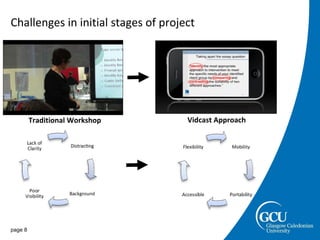
Challenges in initial stages of project page  Vidcast Approach Traditional Workshop
Second stage Design and production of 20 minute vidcast blending PowerPoint and audio narration linked to Effective Learning Services website. Links were added to specific areas of the ELS website to give additional information and reinforce the vidcast subject areas. Two formats were used: one for on line access embedded within a webpage using a flash based video player, and one for students to download for use with their iPod/mobile video device.  page
Adaptations Response to feedback – students & academics. Findings: 20 minutes too long. Students wanted to self select the pertinent sections. Students liked links to ELS website. Wanted more vidcasts to be produced! page
The journey continues… 3 vidcasts on website To date, over 2,500 hits on website for viewing & download. From feedback, 85% of users accessed via the web Flash based  video version over mobile version! Context based vidcasts for different levels of study in process. Ongoing feedback through questionnaire online – evaluating! page
ευχαριστώ Any Questions? www.gcu.ac.uk/els page

TECHEDUCA 2010 Presentation

  • 1.
  • 2.
    From Workshop tothe Web: Reflections on the Journey in Producing Vidcasts to Enhance Student Learning Angela Shapiro, Effective Learning Service Aidan Johnston, Caledonian Academy TECHEDUCA, 19 th May 2010
  • 3.
    Background to GlasgowCaledonian University GCU’s student population: 16,770 undergraduate, postgraduate, part-time & distance learners 61% female 39% male 69% of students study full time International students: 1 in 10 Dyslexic students: 1 in 8
  • 4.
    Rationale Previous researchindicated students wanted to attend workshops. Wanted to meet students’ needs by application: more flexible approach Impractical that every student can attend workshops/repeat sessions or students to meet with ELS staff face to face. page Academic Year 2008-2009 - ELS usage statistics Total number of student appointments Total number of face to face appointments Total number of on line appointments Total number of face to face workshops Number of users online support guides 2,111 (+20.8) 1,677 (+7.98%) 481 (+63.5%) 191 (+4.94%) 7,375 (+ 60.47%)
  • 5.
    The birth ofthe vidcast/vodcast “ A Vidcast or vodcast, contains audio and images, either moving or fixed” (Traxler, 2008) Advantages: Vidcasts suit auditory and visual learners plus allows time for reflection. Flexible delivery – accessible online or “on the go”. Can be accessed at time and place to suit students needs. page
  • 6.
    Project Aims page To incorporate academic literacies approach through the use of vidcasts. To focus on the deconstruction and demystification of the language & discourse. To facilitate students’ learning in accessible and empowering ways. To select an auditory approach supported by visual content. To bring workshop into the learner’s individual learning space. To accommodate students’ self directed learning approaches.
  • 7.
    Project Outcomes page Applied action based research to replicate in complementary and engaging ways, workshop learning experiences online via a browser based website, and offline, as a vidcast, downloaded to personal mobile device. Aiming to evaluate the extent of the contribution of e-learning technology to enhance learning and teaching practices, and for students to develop generic academic writing skills.
  • 8.
    Challenges in initialstages of project page Vidcast Approach Traditional Workshop
  • 9.
    Second stage Designand production of 20 minute vidcast blending PowerPoint and audio narration linked to Effective Learning Services website. Links were added to specific areas of the ELS website to give additional information and reinforce the vidcast subject areas. Two formats were used: one for on line access embedded within a webpage using a flash based video player, and one for students to download for use with their iPod/mobile video device. page
  • 10.
    Adaptations Response tofeedback – students & academics. Findings: 20 minutes too long. Students wanted to self select the pertinent sections. Students liked links to ELS website. Wanted more vidcasts to be produced! page
  • 11.
    The journey continues…3 vidcasts on website To date, over 2,500 hits on website for viewing & download. From feedback, 85% of users accessed via the web Flash based video version over mobile version! Context based vidcasts for different levels of study in process. Ongoing feedback through questionnaire online – evaluating! page
  • 12.
    ευχαριστώ Any Questions?www.gcu.ac.uk/els page