TEST CONSTRUCTION
AND PREPARATION
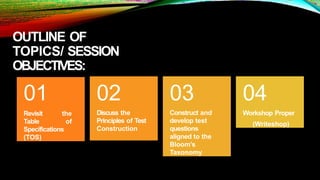
OUTLINE OF
TOPICS/ SESSION
OBJECTIVES:
01
Revisit the
Table of
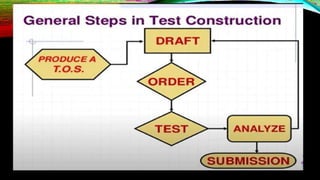
Specifications
(TOS)
02
Discuss the
Principles of Test
Construction
03
Construct and
develop test
questions
aligned to the
Bloom’s
Taxonomy
04
Workshop Proper
(Writeshop)
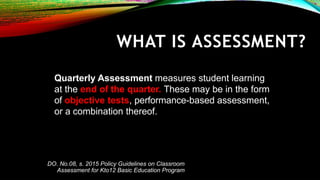
Quarterly Assessment measures student learning
at the end of the quarter. These may be in the form
of objective tests, performance-based assessment,
or a combination thereof.
WHAT IS ASSESSMENT?
DO. No.08, s. 2015 Policy Guidelines on Classroom
Assessment for Kto12 Basic Education Program
PRESENTATION TITLE
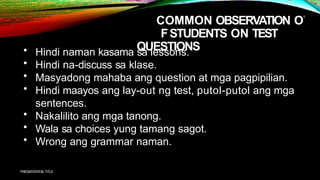
COMMON OBSERVATION O
5
FSTUDENTS ON TEST
QUESTIONS
• Hindi naman kasama sa lessons.
• Hindi na-discuss sa klase.
• Masyadong mahaba ang question at mga pagpipilian.
• Hindi maayos ang lay-out ng test, putol-putol ang mga
sentences.
• Nakalilito ang mga tanong.
• Wala sa choices yung tamang sagot.
• Wrong ang grammar naman.
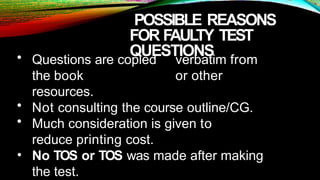
POSSIBLE REASONS
FOR FAULTY TEST
QUESTIONS
• Questions are copied verbatim from
the book or other
resources.
• Not consulting the course outline/CG.
• Much consideration is given to
reduce printing cost.
• No TOS or TOS was made after making
the test.
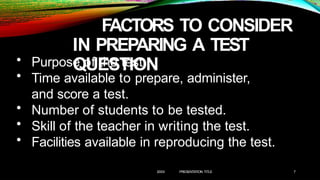
FACTORS TO CONSIDER
IN PREPARING A TEST
QUESTION
20XX PRESENTATION TITLE 7
• Purpose of the test
• Time available to prepare, administer,
and score a test.
• Number of students to be tested.
• Skill of the teacher in writing the test.
• Facilities available in reproducing the test.
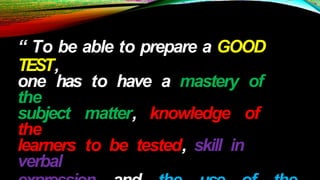
“ To be able to prepare a GOOD
TEST,
one has to have a mastery of
the
subject matter, knowledge of
the
learners to be tested, skill in
verbal
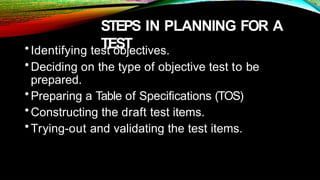
STEPS IN PLANNING FOR A
TEST
•Identifying test objectives.
•Deciding on the type of objective test to be
prepared.
•Preparing a Table of Specifications (TOS)
•Constructing the draft test items.
•Trying-out and validating the test items.
T
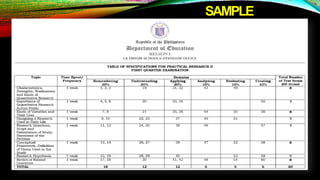
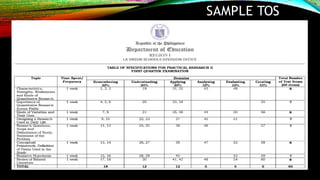
ABLE OF SPECIFICATIONS
(TOS)
• Atwo-way chart that relates the learning outcomes to the
course content.
• It is a test map that guides the teacher in constructing a test.
• It ensures that there is a balance between items that test lower-
level thinking skills and those which test higher-order thinking
skills.
• It ensures balance between easy and difficult items
• It enables the teacher to prepare a test containing a
representative sample of student knowledge in each of the areas
tested.
T
ABLE OF SPECIFICATIONS
•A TOS consists of the following:
• Level of objectives to be tested.
• Statement of objective.
• Item numbers where such an objective is
being tested.
• Number of items and percentage out of the total for
that particular objective.
THINGS THAT YOU NEED TO
KNOW BEFORE
CONSTRUCTING A TOS
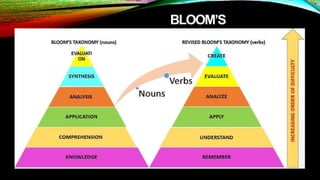
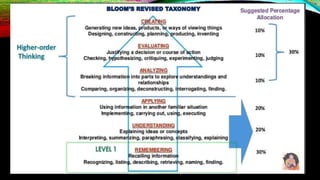
•The TOS requires a thorough knowledge of
Bloom’s Revised Taxonomy /BRT
• Create a TOS following the standard format
used by DepED.
computation that will result to
• The TOS requires some simple
mathematical
proportional
allocation of test items per topic/LC.
SAMPLE
TOS
BLOOM’S
TAXONOMY
SAMPLE TOS
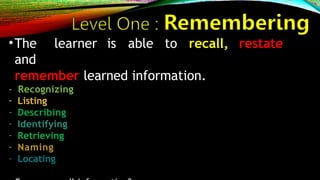
•The learner is able to recall, restate
and
remember learned information.
- Recognizing
- Listing
- Describing
- Identifying
- Retrieving
- Naming
- Locating
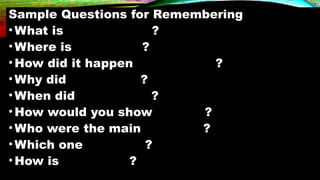
Sample Questions for Remembering
•What is ?
•Where is ?
•How did it happen ?
•Why did ?
•When did ?
•How would you show ?
•Who were the main ?
•Which one ?
•How is ?
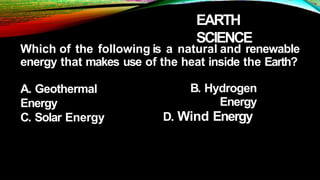
EARTH
SCIENCE
Which of the following is a natural and renewable
energy that makes use of the heat inside the Earth?
A. Geothermal
Energy
C. Solar Energy
B. Hydrogen
Energy
D. Wind Energy
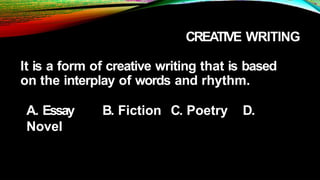
CREATIVE WRITING
It is a form of creative writing that is based
on the interplay of words and rhythm.
A. Essay B. Fiction C. Poetry D.
Novel
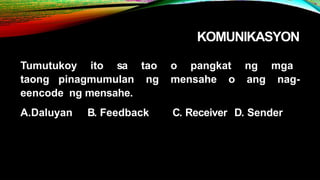
KOMUNIKASYON
Tumutukoy ito sa tao o pangkat ng mga
taong pinagmumulan ng mensahe o ang nag-
eencode ng mensahe.
A.Daluyan B. Feedback C. Receiver D. Sender
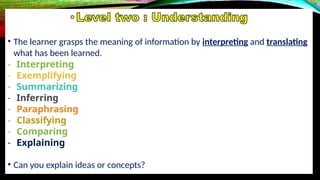
• The learner grasps the meaning of information by interpreting and translating
what has been learned.
- Interpreting
- Exemplifying
- Summarizing
- Inferring
- Paraphrasing
- Classifying
- Comparing
- Explaining
• Can you explain ideas or concepts?
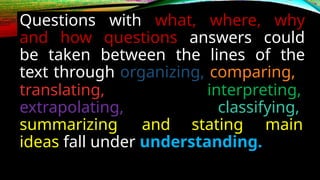
Questions with what, where, why
and how questions answers could
be taken between the lines of the
text through organizing, comparing,
translating,
extrapolating,
interpreting,
classifying,
summarizing and stating main
ideas fall under understanding.
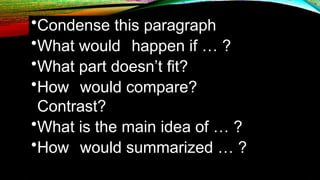
•Condense this paragraph
•What would happen if … ?
•What part doesn’t fit?
•How would compare?
Contrast?
•What is the main idea of … ?
•How would summarized … ?
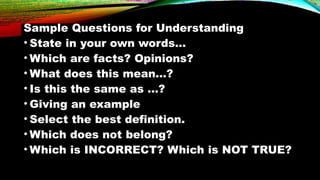
Sample Questions for Understanding
• State in your own words…
• Which are facts? Opinions?
• What does this mean…?
• Is this the same as …?
• Giving an example
• Select the best definition.
• Which does not belong?
• Which is INCORRECT? Which is NOT TRUE?
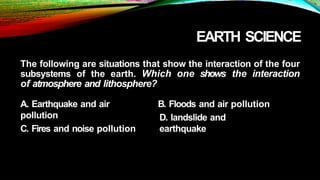
EARTH SCIENCE
The following are situations that show the interaction of the four
subsystems of the earth. Which one shows the interaction
of atmosphere and lithosphere?
A. Earthquake and air
pollution
C. Fires and noise pollution
B. Floods and air pollution
D. landslide and
earthquake
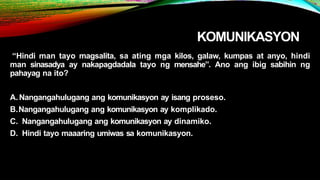
KOMUNIKASYON
“Hindi man tayo magsalita, sa ating mga kilos, galaw, kumpas at anyo, hindi
man sinasadya ay nakapagdadala tayo ng mensahe”. Ano ang ibig sabihin ng
pahayag na ito?
A.Nangangahulugang ang komunikasyon ay isang proseso.
B.Nangangahulugang ang komunikasyon ay komplikado.
C. Nangangahulugang ang komunikasyon ay dinamiko.
D. Hindi tayo maaaring umiwas sa komunikasyon.
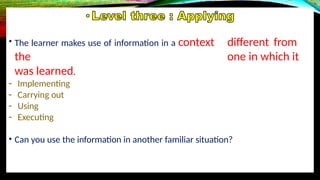
• The learner makes use of information in a context different from
the one in which it
was learned.
- Implementing
- Carrying out
- Using
- Executing
• Can you use the information in another familiar situation?
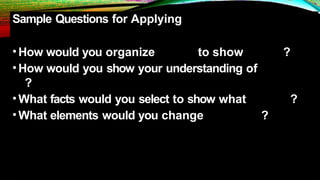
Sample Questions for Applying
•How would you organize to show ?
•How would you show your understanding of
?
•What facts would you select to show what ?
•What elements would you change ?
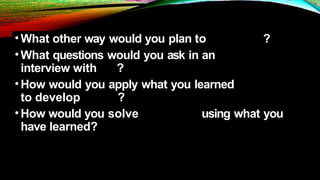
•What other way would you plan to ?
•What questions would you ask in an
interview with ?
•How would you apply what you learned
to develop ?
•How would you solve using what you
have learned?
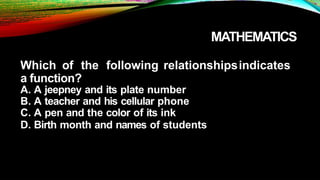
MATHEMATICS
Which of the following relationshipsindicates
a function?
A. A jeepney and its plate number
B. A teacher and his cellular phone
C. A pen and the color of its ink
D. Birth month and names of students
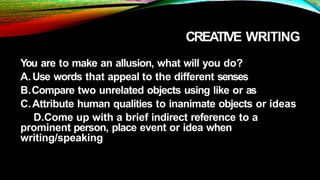
CREATIVE WRITING
You are to make an allusion, what will you do?
A.Use words that appeal to the different senses
B.Compare two unrelated objects using like or as
C.Attribute human qualities to inanimate objects or ideas
D.Come up with a brief indirect reference to a
prominent person, place event or idea when
writing/speaking
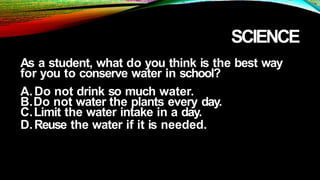
SCIENCE
As a student, what do you think is the best way
for you to conserve water in school?
A.Do not drink so much water.
B.Do not water the plants every day.
C.Limit the water intake in a day.
D.Reuse the water if it is needed.
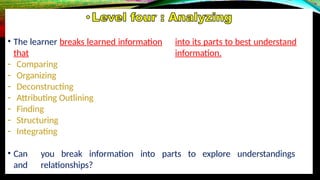
• The learner breaks learned information into its parts to best understand
that information.
- Comparing
- Organizing
- Deconstructing
- Attributing Outlining
- Finding
- Structuring
- Integrating
• Can you break information into parts to explore understandings
and relationships?
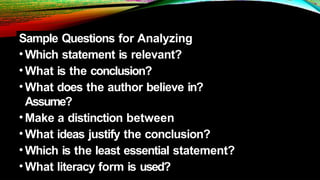
Sample Questions for Analyzing
•Which statement is relevant?
•What is the conclusion?
•What does the author believe in?
Assume?
•Make a distinction between
•What ideas justify the conclusion?
•Which is the least essential statement?
•What literacy form is used?
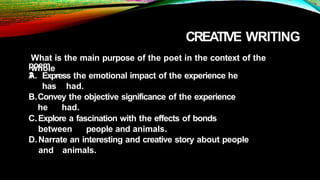
CREATIVE WRITING
What is the main purpose of the poet in the context of the
whole
poem
?
A. Express the emotional impact of the experience he
has had.
B.Convey the objective significance of the experience
he had.
C.Explore a fascination with the effects of bonds
between people and animals.
D.Narrate an interesting and creative story about people
and animals.
SCIENC
E
What is the correct order of Earth’s atmospheric layers from
bottom to top?
A. Exosphere,
Troposphere
B. Stratosphere,
Exosphere
Thermosphere,
Mesosphere,
Stratosphere,
Mesosphere,
Troposphere,
Mesosphere,
Stratosphere,
Thermosphere,
Thermosphere,
C. Troposphere,
Exosphere
D. Thermosphere, Stratosphere, Mesosphere, Exosphere,
Troposphere
MATHEMATICS
Which of the following relations is a one-to-one
function?
A. {(-6, 2), (-5, 1), (-4, 2), (-3,
3)}
C. {(-2, -6), (-1, -3), (0, 0), (1, -
3)}
B. {(0, -2), (1, -1), (1, 0), (3,
1)}
D. {(6, 8), (7, 9), (8, 10), (9, 11)}
• The learner makes decisions based on in-depth reflection, criticism
and
assessment.
- Checking
- Hypothesizing
- Critiquing
- Experimenting
- Judging
- Testing
- Detecting
- Monitoring
• Can you justify a decision or course of action?
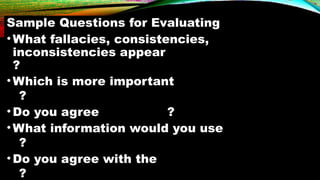
Sample Questions for Evaluating
• What fallacies, consistencies,
inconsistencies appear
?
•Which is more important
?
•Do you agree ?
•What information would you use
?
•Do you agree with the
?
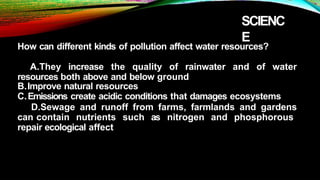
SCIENC
E
How can different kinds of pollution affect water resources?
A.They increase the quality of rainwater and of water
resources both above and below ground
B.Improve natural resources
C.Emissions create acidic conditions that damages ecosystems
D.Sewage and runoff from farms, farmlands and gardens
can contain nutrients such as nitrogen and phosphorous
repair ecological affect
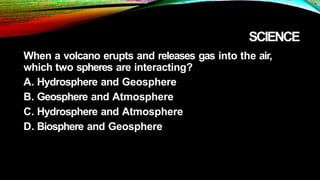
SCIENCE
When a volcano erupts and releases gas into the air,
which two spheres are interacting?
A. Hydrosphere and Geosphere
B. Geosphere and Atmosphere
C. Hydrosphere and Atmosphere
D. Biosphere and Geosphere
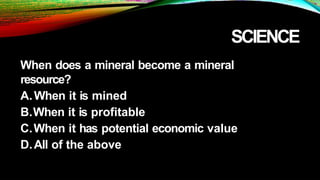
SCIENCE
When does a mineral become a mineral
resource?
A.When it is mined
B.When it is profitable
C.When it has potential economic value
D.All of the above
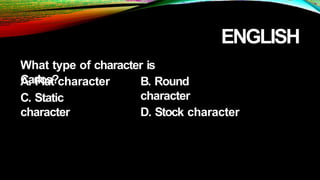
ENGLISH
What type of character is
Carlos?
A. Flat character
C. Static
character
B. Round
character
D. Stock character
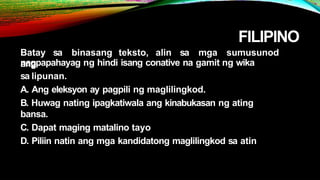
FILIPINO
Batay sa binasang teksto, alin sa mga sumusunod
ang
nagpapahayag ng hindi isang conative na gamit ng wika
sa lipunan.
A. Ang eleksyon ay pagpili ng maglilingkod.
B. Huwag nating ipagkatiwala ang kinabukasan ng ating
bansa.
C. Dapat maging matalino tayo
D. Piliin natin ang mga kandidatong maglilingkod sa atin
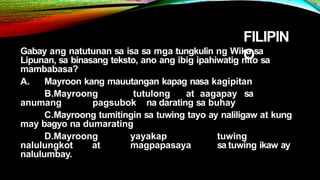
FILIPIN
O
Gabay ang natutunan sa isa sa mga tungkulin ng Wika sa
Lipunan, sa binasang teksto, ano ang ibig ipahiwatig nito sa
mambabasa?
A. Mayroon kang mauutangan kapag nasa kagipitan
B.Mayroong tutulong at aagapay sa
anumang pagsubok na darating sa buhay
C.Mayroong tumitingin sa tuwing tayo ay naliligaw at kung
may bagyo na dumarating
D.Mayroong yayakap tuwing
nalulungkot at magpapasaya sa tuwing ikaw ay
nalulumbay.
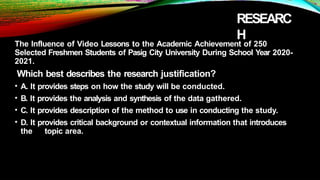
RESEARC
H
The Influence of Video Lessons to the Academic Achievement of 250
Selected Freshmen Students of Pasig City University During School Year 2020-
2021.
Which best describes the research justification?
• A. It provides steps on how the study will be conducted.
• B. It provides the analysis and synthesis of the data gathered.
• C. It provides description of the method to use in conducting the study.
• D. It provides critical background or contextual information that introduces
the topic area.
FILIPIN
O
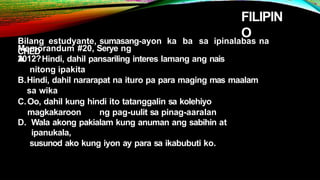
Bilang estudyante, sumasang-ayon ka ba sa ipinalabas na
CHED
Memorandum #20, Serye ng
2012?
A. Hindi, dahil pansariling interes lamang ang nais
nitong ipakita
B.Hindi, dahil nararapat na ituro pa para maging mas maalam
sa wika
C.Oo, dahil kung hindi ito tatanggalin sa kolehiyo
magkakaroon ng pag-uulit sa pinag-aaralan
D. Wala akong pakialam kung anuman ang sabihin at
ipanukala,
susunod ako kung iyon ay para sa ikabubuti ko.
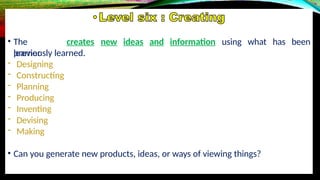
• The
learner
creates new ideas and information using what has been
previously learned.
- Designing
- Constructing
- Planning
- Producing
- Inventing
- Devising
- Making
• Can you generate new products, ideas, or ways of viewing things?
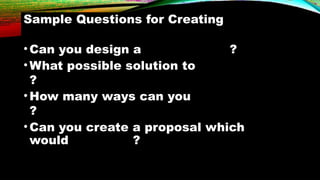
Sample Questions for Creating
•Can you design a ?
•What possible solution to
?
•How many ways can you
?
•Can you create a proposal which
would ?
SCIENC
E
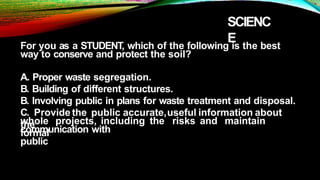
For you as a STUDENT, which of the following is the best
way to conserve and protect the soil?
A. Proper waste segregation.
B. Building of different structures.
B. Involving public in plans for waste treatment and disposal.
C. Provide the public accurate,useful information about
the
whole projects, including the risks and maintain
formal
communication with
public
ENGLIS
H
If you are to compliment your mother in a formal diction and a
hyperbole, how will it be?
A.“You are the world’s number one mudrang”.
B.“Mommy, you are one in a million, you’re the best!”.
C.“Well, of course, you are always number one to me mother”.
D.“Mother, thou art the loveliest and most temperate in the
whole galaxy!”
BREAD & PASTRY
PRODUCTION
If you wereRen, how would you make the
remedies not to compromise the quality of the product?
A.Postpone the plan in baking pan de coco.
B. Be resourceful, used the available ones at home.
C.Continue to bake pan de coco ensuring the
unavailable ingredients has its own equal substitution at
home
D.Continue to bake pan de coco as long as the
main ingredient which is the bread/all-purpose flour is
available, it will be done successfully
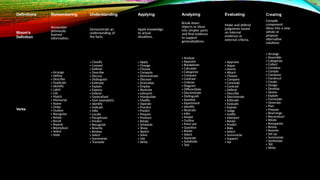
Definitions Remembering Understanding Applying Analyzing Evaluating Creating
Bloom’s
Definition
Remember
previously
learned
information.
Demonstrate an
understanding of
the facts.
Apply knowledge
to actual
situations.
Break down
objects or ideas
into simpler parts
and find evidence
to support
generalizations.
Make and defend
judgments based
on internal
evidence or
external criteria.
Compile
component
ideas into a new
whole or
propose
alternative
solutions
Verbs
• Arrange
• Define
• Describe
• Duplicate
• Identify
• Label
• List
• Match
• Memorize
• Name
• Order
• Outline
• Recognize
• Relate
• Recall
• Repeat
• Reproduce
• Select
• State
• Classify
• Convert
• Defend
• Describe
• Discuss
• Distinguish
• Estimate
• Explain
• Express
• Extend
• Generalized
• Give example(s)
• Identify
• Indicate
• Infer
• Locate
• Paraphrase
• Predict
• Recognize
• Rewrite
• Review
• Select
• Summarize
• Translate
• Apply
• Change
• Choose
• Compute
• Demonstrate
• Discover
• Dramatize
• Employ
• Illustrate
• Interpret
• Manipulate
• Modify
• Operate
• Practice
• Predict
• Prepare
• Produce
• Relate
• Schedule
• Show
• Sketch
• Solve
• Use
• Write
• Analyze
• Appraise
• Breakdown
• Calculate
• Categorize
• Compare
• Contrast
• Criticize
• Diagram
• Differentiate
• Discriminate
• Distinguish
• Examine
• Experiment
• Identify
• Illustrate
• Infer
• Model
• Outline
• Point out
• Question
• Relate
• Select
• Separate
• Subdivide
• Test
• Appraise
• Argue
• Assess
• Attach
• Choose
• Compare
• Conclude
• Contrast
• Defend
• Describe
• Discriminate
• Estimate
• Evaluate
• Explain
• Judge
• Justify
• Interpret
• Relate
• Predict
• Rate
• Select
• Summarize
• Support
• Val
• Arrange
• Assemble
• Categorize
• Collect
• Combine
• Comply
• Compose
• Construct
• Create
• Design
• Develop
• Devise
• Explain
• Formulate
• Generate
• Plan
• Prepare
• Rearrange
• Reconstruct
• Relate
• Reorganize
• Revise
• Rewrite
• Set up
• Summarize
• Synthesize
• Tell
• Write
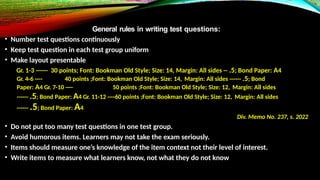
General rules in writing test questions:
• Number test questions continuously
• Keep test question in each test group uniform
• Make layout presentable
Gr. 1-3 ------ 30 points; Font: Bookman Old Style; Size: 14, Margin: All sides -- .5; Bond Paper: A4
Gr. 4-6 ---- 40 points ;Font: Bookman Old Style; Size: 14, Margin: All sides ------ .5; Bond
Paper: A4 Gr. 7-10 ---- 50 points ;Font: Bookman Old Style; Size: 12, Margin: All sides
------ .5; Bond Paper: A4 Gr. 11-12 ----60 points ;Font: Bookman Old Style; Size: 12, Margin: All sides
------ .5; Bond Paper: A4
Div. Memo No. 237, s. 2022
• Do not put too many test questions in one test group.
• Avoid humorous items. Learners may not take the exam seriously.
• Items should measure one’s knowledge of the item context not their level of interest.
• Write items to measure what learners know, not what they do not know
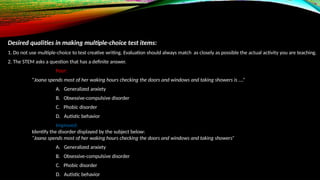
Desired qualities in making multiple-choice test items:
1. Do not use multiple-choice to test creative writing. Evaluation should always match as closely as possible the actual activity you are teaching.
2. The STEM asks a question that has a definite answer.
Poor:
“Joana spends most of her waking hours checking the doors and windows and taking showers is ….”
A. Generalized anxiety
B. Obsessive-compulsive disorder
C. Phobic disorder
D. Autistic behavior
Improved:
Identify the disorder displayed by the subject below:
“Joana spends most of her waking hours checking the doors and windows and taking showers”
A. Generalized anxiety
B. Obsessive-compulsive disorder
C. Phobic disorder
D. Autistic behavior
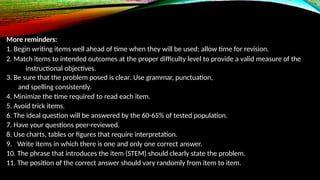
More reminders:
1. Begin writing items well ahead of time when they will be used; allow time for revision.
2. Match items to intended outcomes at the proper difficulty level to provide a valid measure of the
instructional objectives.
3. Be sure that the problem posed is clear. Use grammar, punctuation,
and spelling consistently.
4. Minimize the time required to read each item.
5. Avoid trick items.
6. The ideal question will be answered by the 60-65% of tested population.
7. Have your questions peer-reviewed.
8. Use charts, tables or figures that require interpretation.
9. Write items in which there is one and only one correct answer.
10. The phrase that introduces the item (STEM) should clearly state the problem.
11. The position of the correct answer should vary randomly from item to item.
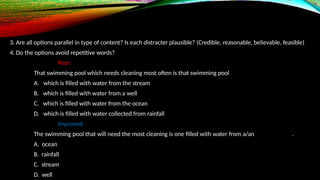
3. Are all options parallel in type of content? Is each distracter plausible? (Credible, reasonable, believable, feasible)
4. Do the options avoid repetitive words?
Poor:
That swimming pool which needs cleaning most often is that swimming pool
A. which is filled with water from the stream
B. which is filled with water from a well
C. which is filled with water from the ocean
D. which is filled with water collected from rainfall
Improved:
The swimming pool that will need the most cleaning is one filled with water from a/an .
A. ocean
B. rainfall
C. stream
D. well
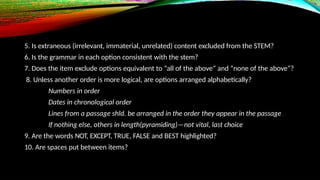
5. Is extraneous (irrelevant, immaterial, unrelated) content excluded from the STEM?
6. Is the grammar in each option consistent with the stem?
7. Does the item exclude options equivalent to “all of the above” and “none of the above”?
8. Unless another order is more logical, are options arranged alphabetically?
Numbers in order
Dates in chronological order
Lines from a passage shld. be arranged in the order they appear in the passage
If nothing else, others in length(pyramiding)—not vital, last choice
9. Are the words NOT, EXCEPT, TRUE, FALSE and BEST highlighted?
10. Are spaces put between items?
Points to
ponder: A good lesson makes a good question
A good question makes a good
content A good content makes a good
test
A good test makes a good grade
A good grade makes a good student
A good student makes a good
community.
- Jesus Ochave, Ph. D.
VP
, Research and

TEST CONSTRUCTION, mechanics and guidelines.pptx

  • 1.
  • 2.
    OUTLINE OF TOPICS/ SESSION OBJECTIVES: 01 Revisitthe Table of Specifications (TOS) 02 Discuss the Principles of Test Construction 03 Construct and develop test questions aligned to the Bloom’s Taxonomy 04 Workshop Proper (Writeshop)
  • 3.
    Quarterly Assessment measuresstudent learning at the end of the quarter. These may be in the form of objective tests, performance-based assessment, or a combination thereof. WHAT IS ASSESSMENT? DO. No.08, s. 2015 Policy Guidelines on Classroom Assessment for Kto12 Basic Education Program
  • 4.
    PRESENTATION TITLE COMMON OBSERVATIONO 5 FSTUDENTS ON TEST QUESTIONS • Hindi naman kasama sa lessons. • Hindi na-discuss sa klase. • Masyadong mahaba ang question at mga pagpipilian. • Hindi maayos ang lay-out ng test, putol-putol ang mga sentences. • Nakalilito ang mga tanong. • Wala sa choices yung tamang sagot. • Wrong ang grammar naman.
  • 5.
    POSSIBLE REASONS FOR FAULTYTEST QUESTIONS • Questions are copied verbatim from the book or other resources. • Not consulting the course outline/CG. • Much consideration is given to reduce printing cost. • No TOS or TOS was made after making the test.
  • 6.
    FACTORS TO CONSIDER INPREPARING A TEST QUESTION 20XX PRESENTATION TITLE 7 • Purpose of the test • Time available to prepare, administer, and score a test. • Number of students to be tested. • Skill of the teacher in writing the test. • Facilities available in reproducing the test.
  • 7.
    “ To beable to prepare a GOOD TEST, one has to have a mastery of the subject matter, knowledge of the learners to be tested, skill in verbal
  • 8.
    STEPS IN PLANNINGFOR A TEST •Identifying test objectives. •Deciding on the type of objective test to be prepared. •Preparing a Table of Specifications (TOS) •Constructing the draft test items. •Trying-out and validating the test items.
  • 10.
    T ABLE OF SPECIFICATIONS (TOS) •Atwo-way chart that relates the learning outcomes to the course content. • It is a test map that guides the teacher in constructing a test. • It ensures that there is a balance between items that test lower- level thinking skills and those which test higher-order thinking skills. • It ensures balance between easy and difficult items • It enables the teacher to prepare a test containing a representative sample of student knowledge in each of the areas tested.
  • 11.
    T ABLE OF SPECIFICATIONS •ATOS consists of the following: • Level of objectives to be tested. • Statement of objective. • Item numbers where such an objective is being tested. • Number of items and percentage out of the total for that particular objective.
  • 12.
    THINGS THAT YOUNEED TO KNOW BEFORE CONSTRUCTING A TOS •The TOS requires a thorough knowledge of Bloom’s Revised Taxonomy /BRT • Create a TOS following the standard format used by DepED. computation that will result to • The TOS requires some simple mathematical proportional allocation of test items per topic/LC.
  • 13.
  • 14.
  • 16.
  • 17.
    •The learner isable to recall, restate and remember learned information. - Recognizing - Listing - Describing - Identifying - Retrieving - Naming - Locating
  • 18.
    Sample Questions forRemembering •What is ? •Where is ? •How did it happen ? •Why did ? •When did ? •How would you show ? •Who were the main ? •Which one ? •How is ?
  • 19.
    EARTH SCIENCE Which of thefollowing is a natural and renewable energy that makes use of the heat inside the Earth? A. Geothermal Energy C. Solar Energy B. Hydrogen Energy D. Wind Energy
  • 20.
    CREATIVE WRITING It isa form of creative writing that is based on the interplay of words and rhythm. A. Essay B. Fiction C. Poetry D. Novel
  • 21.
    KOMUNIKASYON Tumutukoy ito satao o pangkat ng mga taong pinagmumulan ng mensahe o ang nag- eencode ng mensahe. A.Daluyan B. Feedback C. Receiver D. Sender
  • 22.
    • The learnergrasps the meaning of information by interpreting and translating what has been learned. - Interpreting - Exemplifying - Summarizing - Inferring - Paraphrasing - Classifying - Comparing - Explaining • Can you explain ideas or concepts?
  • 23.
    Questions with what,where, why and how questions answers could be taken between the lines of the text through organizing, comparing, translating, extrapolating, interpreting, classifying, summarizing and stating main ideas fall under understanding.
  • 24.
    •Condense this paragraph •Whatwould happen if … ? •What part doesn’t fit? •How would compare? Contrast? •What is the main idea of … ? •How would summarized … ?
  • 25.
    Sample Questions forUnderstanding • State in your own words… • Which are facts? Opinions? • What does this mean…? • Is this the same as …? • Giving an example • Select the best definition. • Which does not belong? • Which is INCORRECT? Which is NOT TRUE?
  • 26.
    EARTH SCIENCE The followingare situations that show the interaction of the four subsystems of the earth. Which one shows the interaction of atmosphere and lithosphere? A. Earthquake and air pollution C. Fires and noise pollution B. Floods and air pollution D. landslide and earthquake
  • 27.
    KOMUNIKASYON “Hindi man tayomagsalita, sa ating mga kilos, galaw, kumpas at anyo, hindi man sinasadya ay nakapagdadala tayo ng mensahe”. Ano ang ibig sabihin ng pahayag na ito? A.Nangangahulugang ang komunikasyon ay isang proseso. B.Nangangahulugang ang komunikasyon ay komplikado. C. Nangangahulugang ang komunikasyon ay dinamiko. D. Hindi tayo maaaring umiwas sa komunikasyon.
  • 28.
    • The learnermakes use of information in a context different from the one in which it was learned. - Implementing - Carrying out - Using - Executing • Can you use the information in another familiar situation?
  • 29.
    Sample Questions forApplying •How would you organize to show ? •How would you show your understanding of ? •What facts would you select to show what ? •What elements would you change ?
  • 30.
    •What other waywould you plan to ? •What questions would you ask in an interview with ? •How would you apply what you learned to develop ? •How would you solve using what you have learned?
  • 31.
    MATHEMATICS Which of thefollowing relationshipsindicates a function? A. A jeepney and its plate number B. A teacher and his cellular phone C. A pen and the color of its ink D. Birth month and names of students
  • 32.
    CREATIVE WRITING You areto make an allusion, what will you do? A.Use words that appeal to the different senses B.Compare two unrelated objects using like or as C.Attribute human qualities to inanimate objects or ideas D.Come up with a brief indirect reference to a prominent person, place event or idea when writing/speaking
  • 33.
    SCIENCE As a student,what do you think is the best way for you to conserve water in school? A.Do not drink so much water. B.Do not water the plants every day. C.Limit the water intake in a day. D.Reuse the water if it is needed.
  • 34.
    • The learnerbreaks learned information into its parts to best understand that information. - Comparing - Organizing - Deconstructing - Attributing Outlining - Finding - Structuring - Integrating • Can you break information into parts to explore understandings and relationships?
  • 35.
    Sample Questions forAnalyzing •Which statement is relevant? •What is the conclusion? •What does the author believe in? Assume? •Make a distinction between •What ideas justify the conclusion? •Which is the least essential statement? •What literacy form is used?
  • 36.
    CREATIVE WRITING What isthe main purpose of the poet in the context of the whole poem ? A. Express the emotional impact of the experience he has had. B.Convey the objective significance of the experience he had. C.Explore a fascination with the effects of bonds between people and animals. D.Narrate an interesting and creative story about people and animals.
  • 37.
    SCIENC E What is thecorrect order of Earth’s atmospheric layers from bottom to top? A. Exosphere, Troposphere B. Stratosphere, Exosphere Thermosphere, Mesosphere, Stratosphere, Mesosphere, Troposphere, Mesosphere, Stratosphere, Thermosphere, Thermosphere, C. Troposphere, Exosphere D. Thermosphere, Stratosphere, Mesosphere, Exosphere, Troposphere
  • 38.
    MATHEMATICS Which of thefollowing relations is a one-to-one function? A. {(-6, 2), (-5, 1), (-4, 2), (-3, 3)} C. {(-2, -6), (-1, -3), (0, 0), (1, - 3)} B. {(0, -2), (1, -1), (1, 0), (3, 1)} D. {(6, 8), (7, 9), (8, 10), (9, 11)}
  • 39.
    • The learnermakes decisions based on in-depth reflection, criticism and assessment. - Checking - Hypothesizing - Critiquing - Experimenting - Judging - Testing - Detecting - Monitoring • Can you justify a decision or course of action?
  • 40.
    Sample Questions forEvaluating • What fallacies, consistencies, inconsistencies appear ? •Which is more important ? •Do you agree ? •What information would you use ? •Do you agree with the ?
  • 41.
    SCIENC E How can differentkinds of pollution affect water resources? A.They increase the quality of rainwater and of water resources both above and below ground B.Improve natural resources C.Emissions create acidic conditions that damages ecosystems D.Sewage and runoff from farms, farmlands and gardens can contain nutrients such as nitrogen and phosphorous repair ecological affect
  • 42.
    SCIENCE When a volcanoerupts and releases gas into the air, which two spheres are interacting? A. Hydrosphere and Geosphere B. Geosphere and Atmosphere C. Hydrosphere and Atmosphere D. Biosphere and Geosphere
  • 43.
    SCIENCE When does amineral become a mineral resource? A.When it is mined B.When it is profitable C.When it has potential economic value D.All of the above
  • 44.
    ENGLISH What type ofcharacter is Carlos? A. Flat character C. Static character B. Round character D. Stock character
  • 45.
    FILIPINO Batay sa binasangteksto, alin sa mga sumusunod ang nagpapahayag ng hindi isang conative na gamit ng wika sa lipunan. A. Ang eleksyon ay pagpili ng maglilingkod. B. Huwag nating ipagkatiwala ang kinabukasan ng ating bansa. C. Dapat maging matalino tayo D. Piliin natin ang mga kandidatong maglilingkod sa atin
  • 46.
    FILIPIN O Gabay ang natutunansa isa sa mga tungkulin ng Wika sa Lipunan, sa binasang teksto, ano ang ibig ipahiwatig nito sa mambabasa? A. Mayroon kang mauutangan kapag nasa kagipitan B.Mayroong tutulong at aagapay sa anumang pagsubok na darating sa buhay C.Mayroong tumitingin sa tuwing tayo ay naliligaw at kung may bagyo na dumarating D.Mayroong yayakap tuwing nalulungkot at magpapasaya sa tuwing ikaw ay nalulumbay.
  • 47.
    RESEARC H The Influence ofVideo Lessons to the Academic Achievement of 250 Selected Freshmen Students of Pasig City University During School Year 2020- 2021. Which best describes the research justification? • A. It provides steps on how the study will be conducted. • B. It provides the analysis and synthesis of the data gathered. • C. It provides description of the method to use in conducting the study. • D. It provides critical background or contextual information that introduces the topic area.
  • 48.
    FILIPIN O Bilang estudyante, sumasang-ayonka ba sa ipinalabas na CHED Memorandum #20, Serye ng 2012? A. Hindi, dahil pansariling interes lamang ang nais nitong ipakita B.Hindi, dahil nararapat na ituro pa para maging mas maalam sa wika C.Oo, dahil kung hindi ito tatanggalin sa kolehiyo magkakaroon ng pag-uulit sa pinag-aaralan D. Wala akong pakialam kung anuman ang sabihin at ipanukala, susunod ako kung iyon ay para sa ikabubuti ko.
  • 49.
    • The learner creates newideas and information using what has been previously learned. - Designing - Constructing - Planning - Producing - Inventing - Devising - Making • Can you generate new products, ideas, or ways of viewing things?
  • 50.
    Sample Questions forCreating •Can you design a ? •What possible solution to ? •How many ways can you ? •Can you create a proposal which would ?
  • 51.
    SCIENC E For you asa STUDENT, which of the following is the best way to conserve and protect the soil? A. Proper waste segregation. B. Building of different structures. B. Involving public in plans for waste treatment and disposal. C. Provide the public accurate,useful information about the whole projects, including the risks and maintain formal communication with public
  • 52.
    ENGLIS H If you areto compliment your mother in a formal diction and a hyperbole, how will it be? A.“You are the world’s number one mudrang”. B.“Mommy, you are one in a million, you’re the best!”. C.“Well, of course, you are always number one to me mother”. D.“Mother, thou art the loveliest and most temperate in the whole galaxy!”
  • 53.
    BREAD & PASTRY PRODUCTION Ifyou wereRen, how would you make the remedies not to compromise the quality of the product? A.Postpone the plan in baking pan de coco. B. Be resourceful, used the available ones at home. C.Continue to bake pan de coco ensuring the unavailable ingredients has its own equal substitution at home D.Continue to bake pan de coco as long as the main ingredient which is the bread/all-purpose flour is available, it will be done successfully
  • 54.
    Definitions Remembering UnderstandingApplying Analyzing Evaluating Creating Bloom’s Definition Remember previously learned information. Demonstrate an understanding of the facts. Apply knowledge to actual situations. Break down objects or ideas into simpler parts and find evidence to support generalizations. Make and defend judgments based on internal evidence or external criteria. Compile component ideas into a new whole or propose alternative solutions Verbs • Arrange • Define • Describe • Duplicate • Identify • Label • List • Match • Memorize • Name • Order • Outline • Recognize • Relate • Recall • Repeat • Reproduce • Select • State • Classify • Convert • Defend • Describe • Discuss • Distinguish • Estimate • Explain • Express • Extend • Generalized • Give example(s) • Identify • Indicate • Infer • Locate • Paraphrase • Predict • Recognize • Rewrite • Review • Select • Summarize • Translate • Apply • Change • Choose • Compute • Demonstrate • Discover • Dramatize • Employ • Illustrate • Interpret • Manipulate • Modify • Operate • Practice • Predict • Prepare • Produce • Relate • Schedule • Show • Sketch • Solve • Use • Write • Analyze • Appraise • Breakdown • Calculate • Categorize • Compare • Contrast • Criticize • Diagram • Differentiate • Discriminate • Distinguish • Examine • Experiment • Identify • Illustrate • Infer • Model • Outline • Point out • Question • Relate • Select • Separate • Subdivide • Test • Appraise • Argue • Assess • Attach • Choose • Compare • Conclude • Contrast • Defend • Describe • Discriminate • Estimate • Evaluate • Explain • Judge • Justify • Interpret • Relate • Predict • Rate • Select • Summarize • Support • Val • Arrange • Assemble • Categorize • Collect • Combine • Comply • Compose • Construct • Create • Design • Develop • Devise • Explain • Formulate • Generate • Plan • Prepare • Rearrange • Reconstruct • Relate • Reorganize • Revise • Rewrite • Set up • Summarize • Synthesize • Tell • Write
  • 55.
    General rules inwriting test questions: • Number test questions continuously • Keep test question in each test group uniform • Make layout presentable Gr. 1-3 ------ 30 points; Font: Bookman Old Style; Size: 14, Margin: All sides -- .5; Bond Paper: A4 Gr. 4-6 ---- 40 points ;Font: Bookman Old Style; Size: 14, Margin: All sides ------ .5; Bond Paper: A4 Gr. 7-10 ---- 50 points ;Font: Bookman Old Style; Size: 12, Margin: All sides ------ .5; Bond Paper: A4 Gr. 11-12 ----60 points ;Font: Bookman Old Style; Size: 12, Margin: All sides ------ .5; Bond Paper: A4 Div. Memo No. 237, s. 2022 • Do not put too many test questions in one test group. • Avoid humorous items. Learners may not take the exam seriously. • Items should measure one’s knowledge of the item context not their level of interest. • Write items to measure what learners know, not what they do not know
  • 56.
    Desired qualities inmaking multiple-choice test items: 1. Do not use multiple-choice to test creative writing. Evaluation should always match as closely as possible the actual activity you are teaching. 2. The STEM asks a question that has a definite answer. Poor: “Joana spends most of her waking hours checking the doors and windows and taking showers is ….” A. Generalized anxiety B. Obsessive-compulsive disorder C. Phobic disorder D. Autistic behavior Improved: Identify the disorder displayed by the subject below: “Joana spends most of her waking hours checking the doors and windows and taking showers” A. Generalized anxiety B. Obsessive-compulsive disorder C. Phobic disorder D. Autistic behavior
  • 57.
    More reminders: 1. Beginwriting items well ahead of time when they will be used; allow time for revision. 2. Match items to intended outcomes at the proper difficulty level to provide a valid measure of the instructional objectives. 3. Be sure that the problem posed is clear. Use grammar, punctuation, and spelling consistently. 4. Minimize the time required to read each item. 5. Avoid trick items. 6. The ideal question will be answered by the 60-65% of tested population. 7. Have your questions peer-reviewed. 8. Use charts, tables or figures that require interpretation. 9. Write items in which there is one and only one correct answer. 10. The phrase that introduces the item (STEM) should clearly state the problem. 11. The position of the correct answer should vary randomly from item to item.
  • 58.
    3. Are alloptions parallel in type of content? Is each distracter plausible? (Credible, reasonable, believable, feasible) 4. Do the options avoid repetitive words? Poor: That swimming pool which needs cleaning most often is that swimming pool A. which is filled with water from the stream B. which is filled with water from a well C. which is filled with water from the ocean D. which is filled with water collected from rainfall Improved: The swimming pool that will need the most cleaning is one filled with water from a/an . A. ocean B. rainfall C. stream D. well
  • 59.
    5. Is extraneous(irrelevant, immaterial, unrelated) content excluded from the STEM? 6. Is the grammar in each option consistent with the stem? 7. Does the item exclude options equivalent to “all of the above” and “none of the above”? 8. Unless another order is more logical, are options arranged alphabetically? Numbers in order Dates in chronological order Lines from a passage shld. be arranged in the order they appear in the passage If nothing else, others in length(pyramiding)—not vital, last choice 9. Are the words NOT, EXCEPT, TRUE, FALSE and BEST highlighted? 10. Are spaces put between items?
  • 60.
    Points to ponder: Agood lesson makes a good question A good question makes a good content A good content makes a good test A good test makes a good grade A good grade makes a good student A good student makes a good community. - Jesus Ochave, Ph. D. VP , Research and