THE BASIC EDUCATION
MONITORING AND EVALUATION
FRAMEWORK (BEMEF)
Policy Research and Development Division
Planning Service
BASIC EDUCATION
MONITORING AND
EVALUATION
FRAMEWORK
(BEMEF)
DO 29, s.
2022
2
SCOPE OF BEMEF
The Basic Education Monitoring and
Evaluation Framework (BEMEF) along
with the structures and mechanisms,
shall be adopted and implemented by
all DepEd operating units in all
governance levels. It identifies
DepEd operating units with
oversight M&E functions and
articulates the M&E processes that
shall be performed at each
governance level.
OBJECTIVE(S)
The Department establishes the BEMEF to ensure that the
agency’s plans, policies, systems and processes are geared
towards the achievement of organizational outcomes.
This Framework sets the performance measures for the
agency where all operating units are expected to contribute.
This framework shall also guide DepEd bureaus, services,
regional and schools division offices, schools, and learning
centers in developing their respective M&E plan. Lastly, it
shall define the roles and responsibilities of DepEd
operating units in the M&E system and processes.
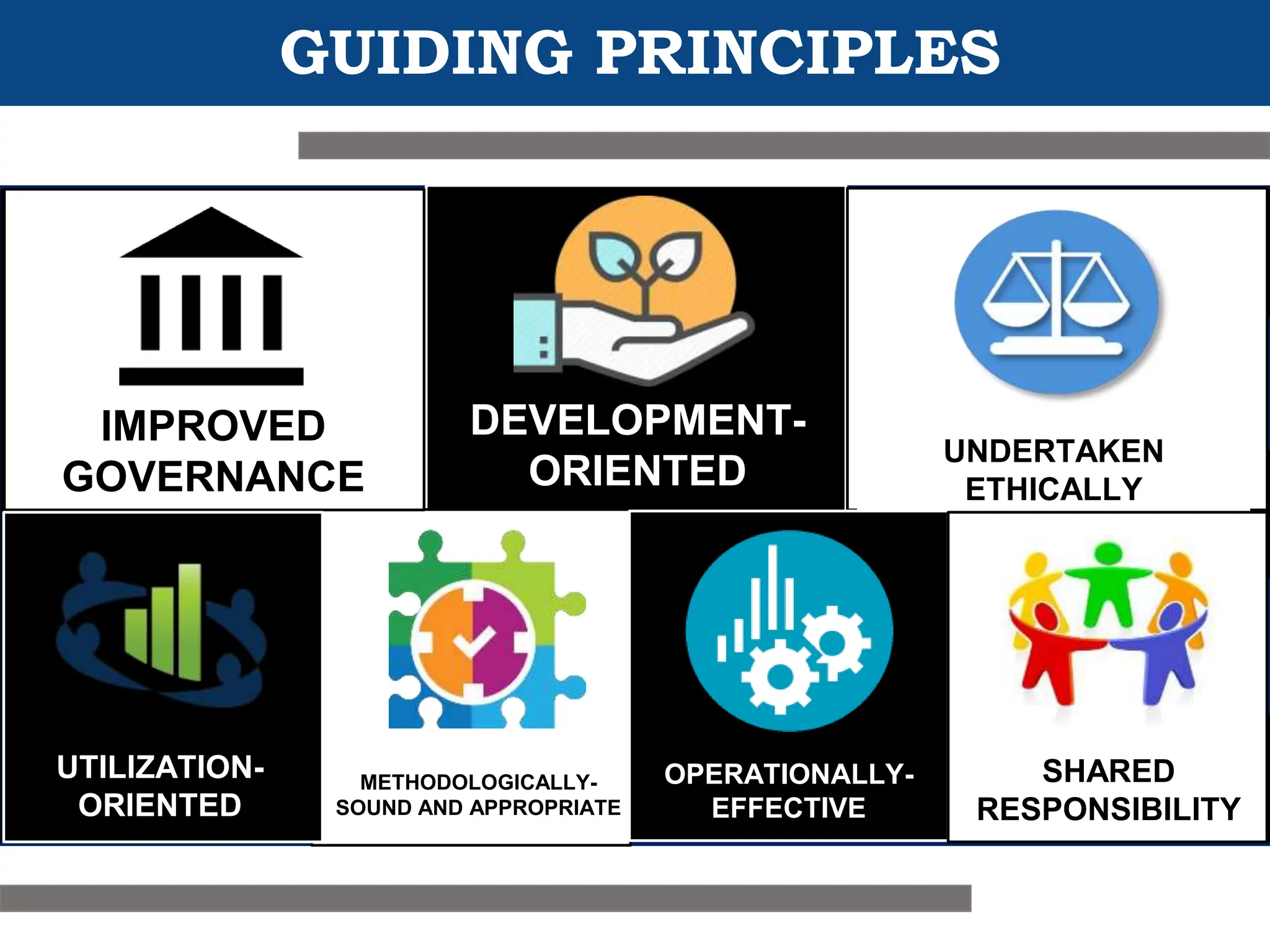
GUIDING PRINCIPLES
DEVELOPMENT-
ORIENTED
UNDERTAKEN
ETHICALLY
METHODOLOGICALLY-
SOUND AND APPROPRIATE
IMPROVED
GOVERNANCE
UTILIZATION-
ORIENTED
OPERATIONALLY-
EFFECTIVE
SHARED
RESPONSIBILITY
DEPARTMENT OF EDUCATION
Check for understanding
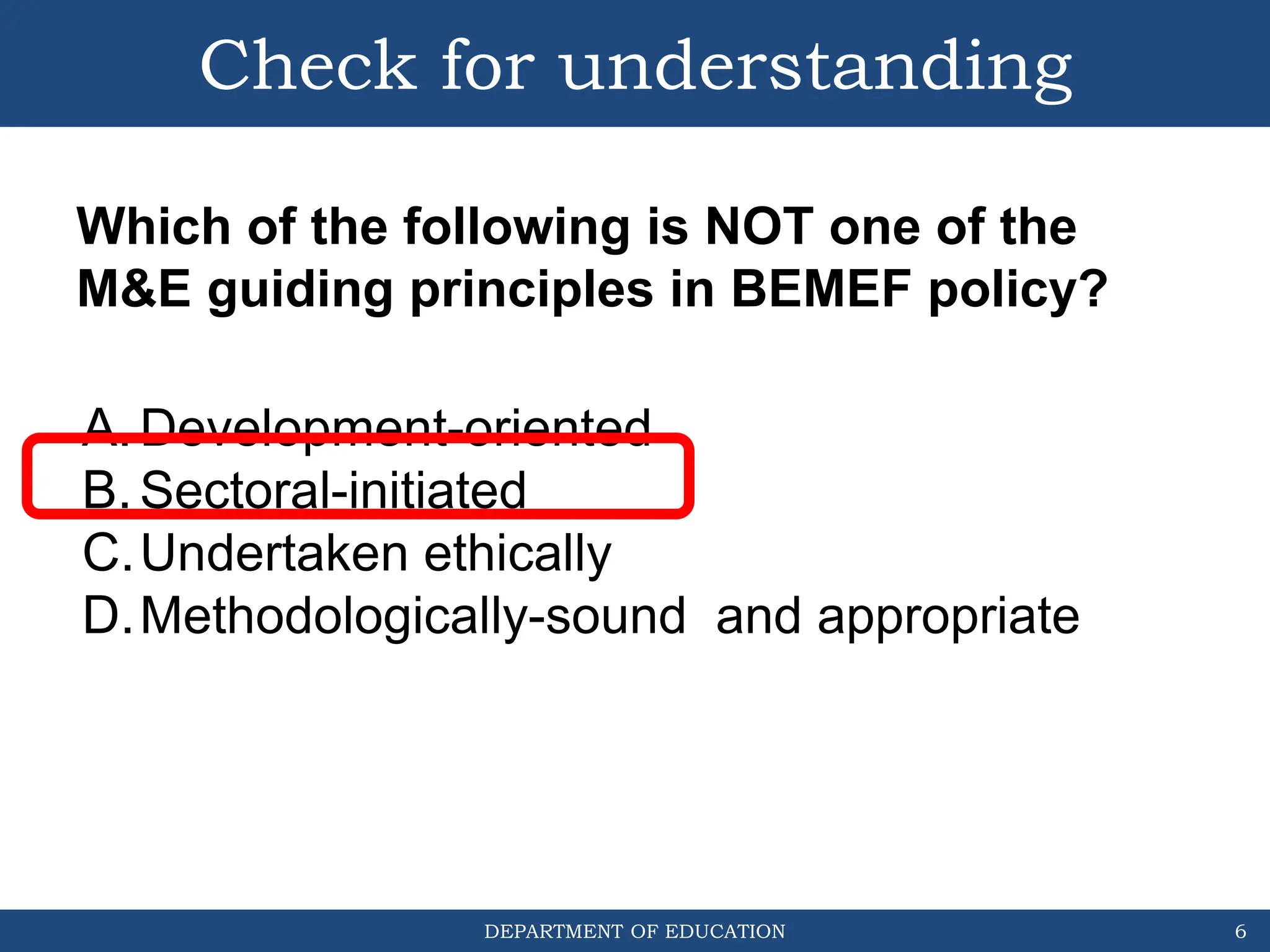
Which of the following is NOT one of the
M&E guiding principles in BEMEF policy?
A.Development-oriented
B.Sectoral-initiated
C.Undertaken ethically
D.Methodologically-sound and appropriate
6
DEPARTMENT OF EDUCATION 7
Theory of Change (ToC)
DEPARTMENT OF EDUCATION
Theory of Change (ToC)
• An ongoing process of reflection to
explore change and how it happens -
and what it means in a particular context,
sector, and/or group of people.
• A theory of change is a road map of
where we are going (results) and how we
are getting there (process).
DEPARTMENT OF EDUCATION
Theory of Change (ToC)
Causal Hypothesis
Question: How do I expect results to be
achieved?
Answer: If (inputs) produce (outputs), this
should lead to (outcomes) which will ultimately
contribute to the (goal).
DEPARTMENT OF EDUCATION
Theory of Change (ToC)
Source: Innovations for Poverty Action Theory of Change lecture slides
DEPARTMENT OF EDUCATION
Theory of Change (ToC)
Source: Innovations for Poverty Action Theory of Change lecture slides
DEPARTMENT OF EDUCATION
Theory of Change (ToC)
Source: Innovations for Poverty Action Theory of Change lecture slides
DEPARTMENT OF EDUCATION
Theory of Change (ToC)
Source: Innovations for Poverty Action Theory of Change lecture slides
DEPARTMENT OF EDUCATION
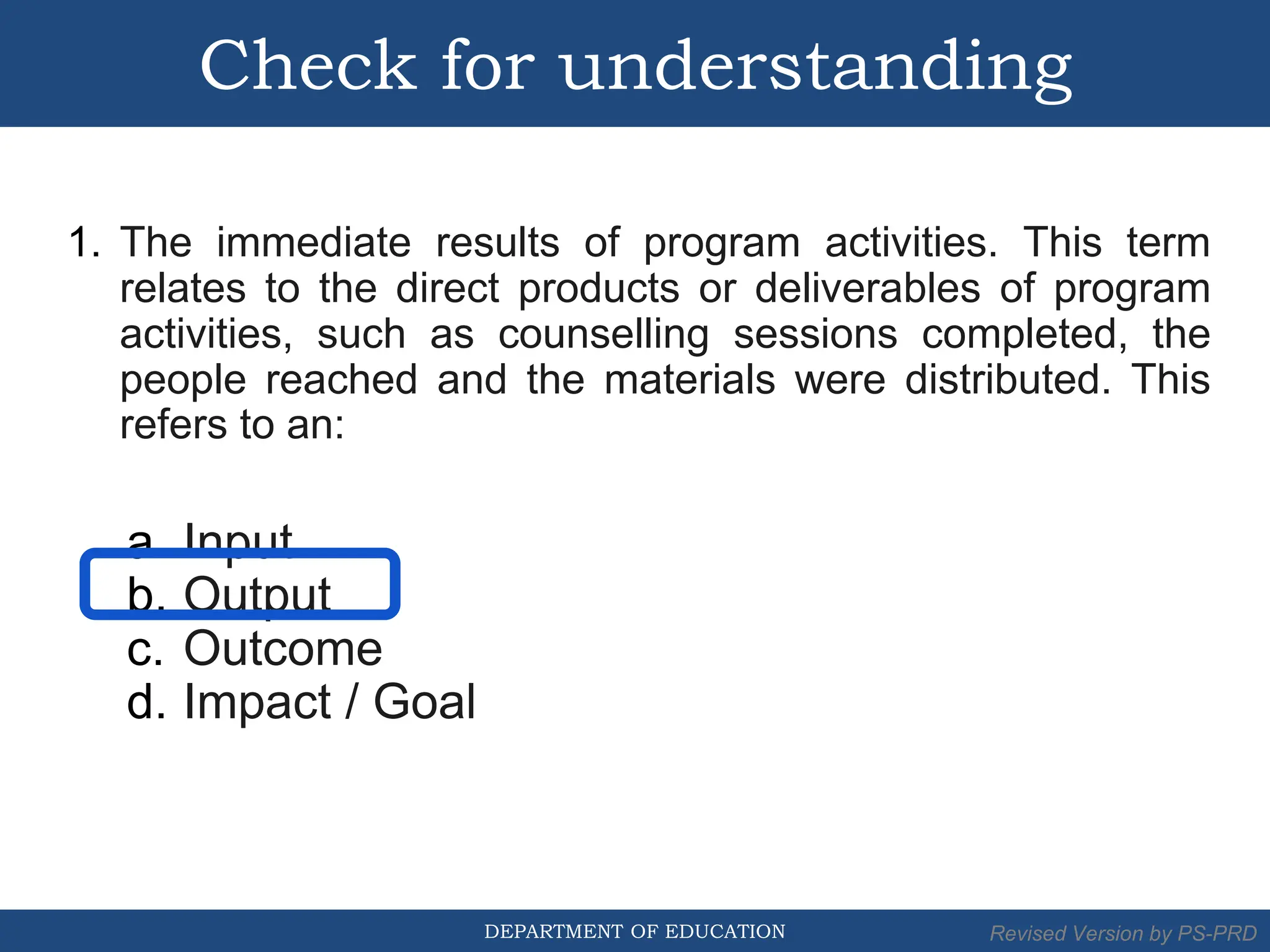
a. Input
b. Output
c. Outcome
d. Impact / Goal
1. The immediate results of program activities. This term
relates to the direct products or deliverables of program
activities, such as counselling sessions completed, the
people reached and the materials were distributed. This
refers to an:
Revised Version by PS-PRD
Check for understanding
DEPARTMENT OF EDUCATION
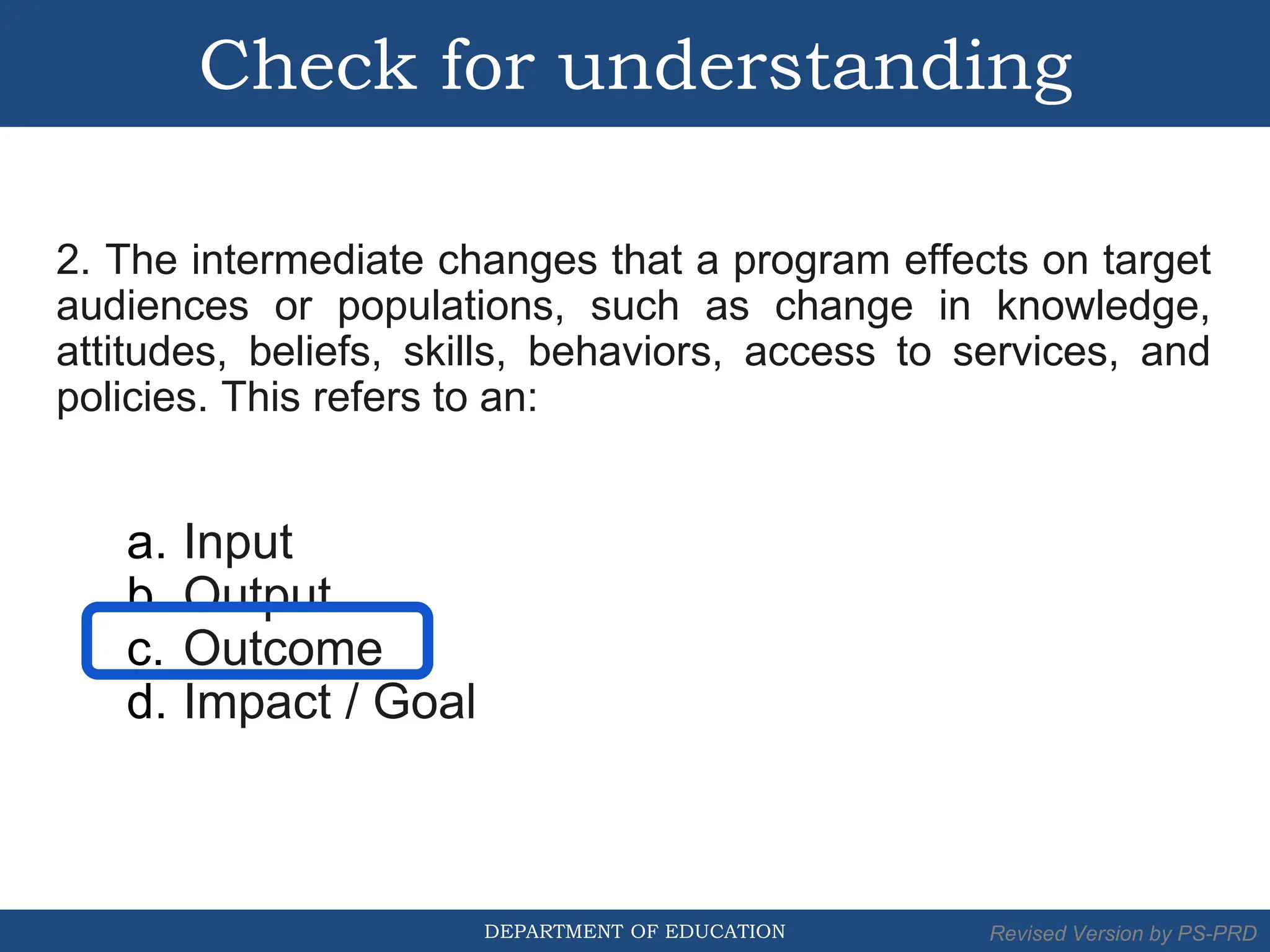
a. Input
b. Output
c. Outcome
d. Impact / Goal
2. The intermediate changes that a program effects on target
audiences or populations, such as change in knowledge,
attitudes, beliefs, skills, behaviors, access to services, and
policies. This refers to an:
Revised Version by PS-PRD
Check for understanding
DEPARTMENT OF EDUCATION
a. Input
b. Output
c. Outcome
d. Impact / Goal
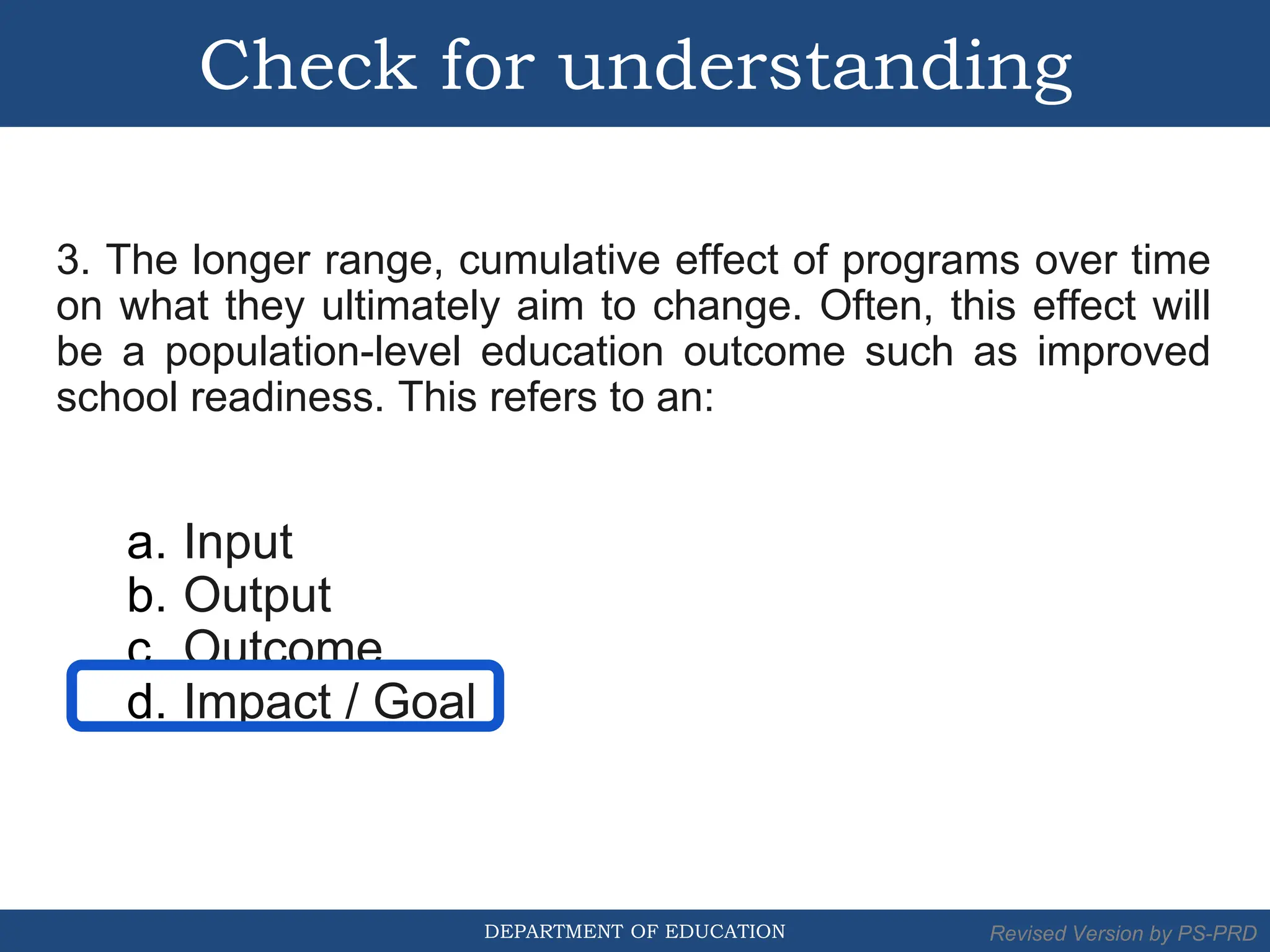
3. The longer range, cumulative effect of programs over time
on what they ultimately aim to change. Often, this effect will
be a population-level education outcome such as improved
school readiness. This refers to an:
Revised Version by PS-PRD
Check for understanding
DEPARTMENT OF EDUCATION
a. Input
b. Output
c. Outcome
d. Impact / Goal
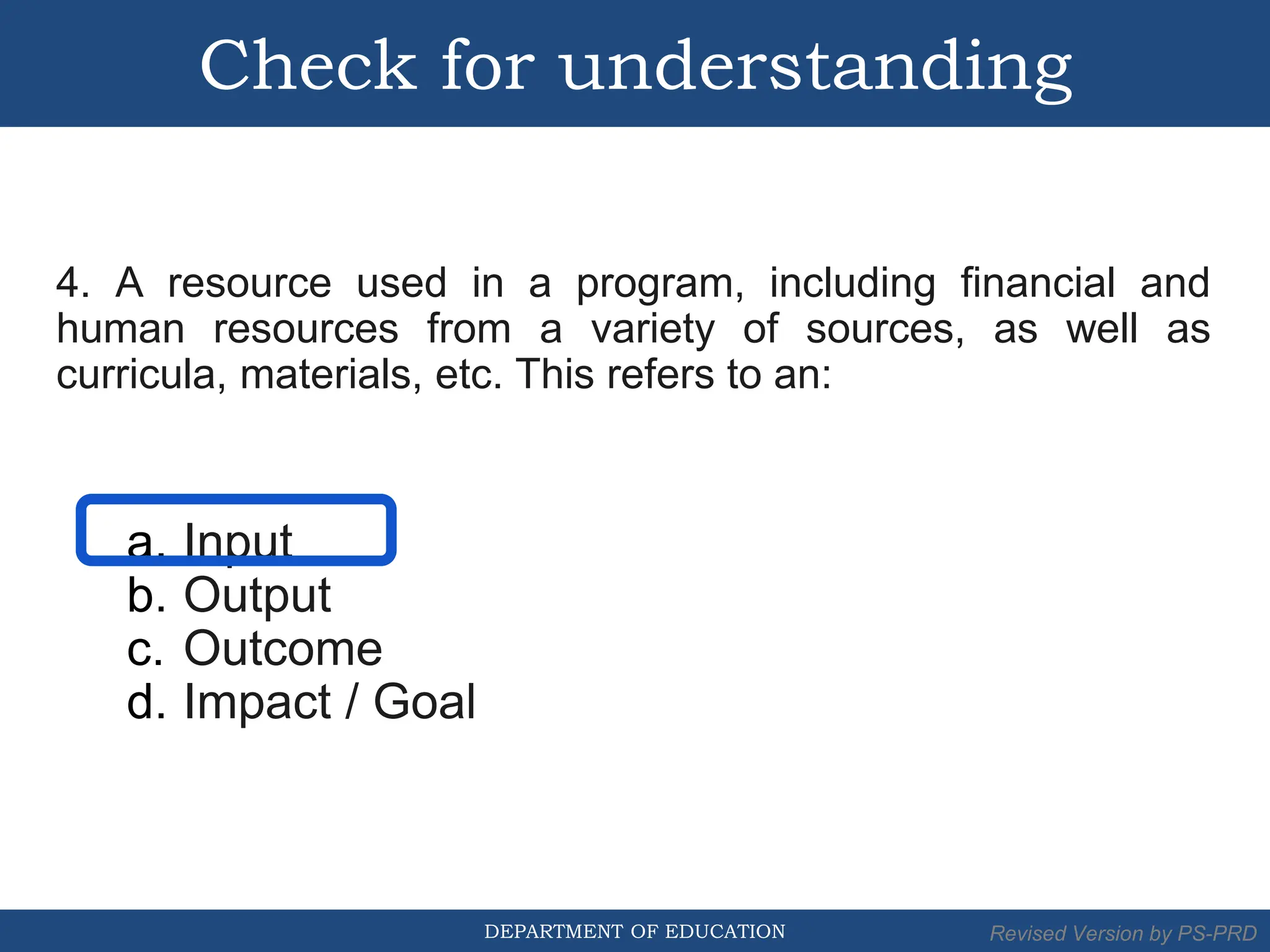
4. A resource used in a program, including financial and
human resources from a variety of sources, as well as
curricula, materials, etc. This refers to an:
Revised Version by PS-PRD
Check for understanding
DEPARTMENT OF EDUCATION
Check for understanding
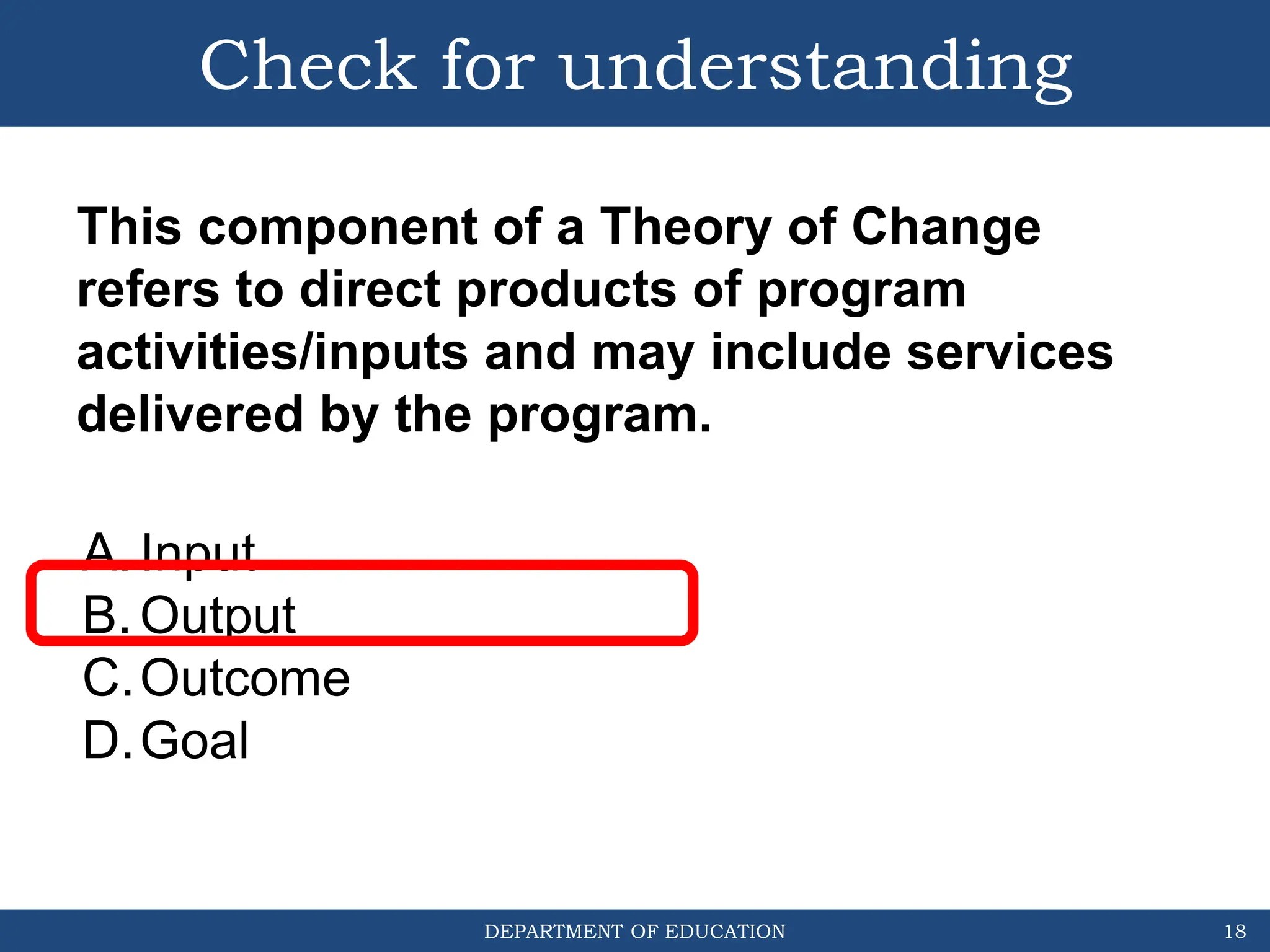
This component of a Theory of Change
refers to direct products of program
activities/inputs and may include services
delivered by the program.
A.Input
B.Output
C.Outcome
D.Goal
18
DEPARTMENT OF EDUCATION
EXERCISE/PRACTICE
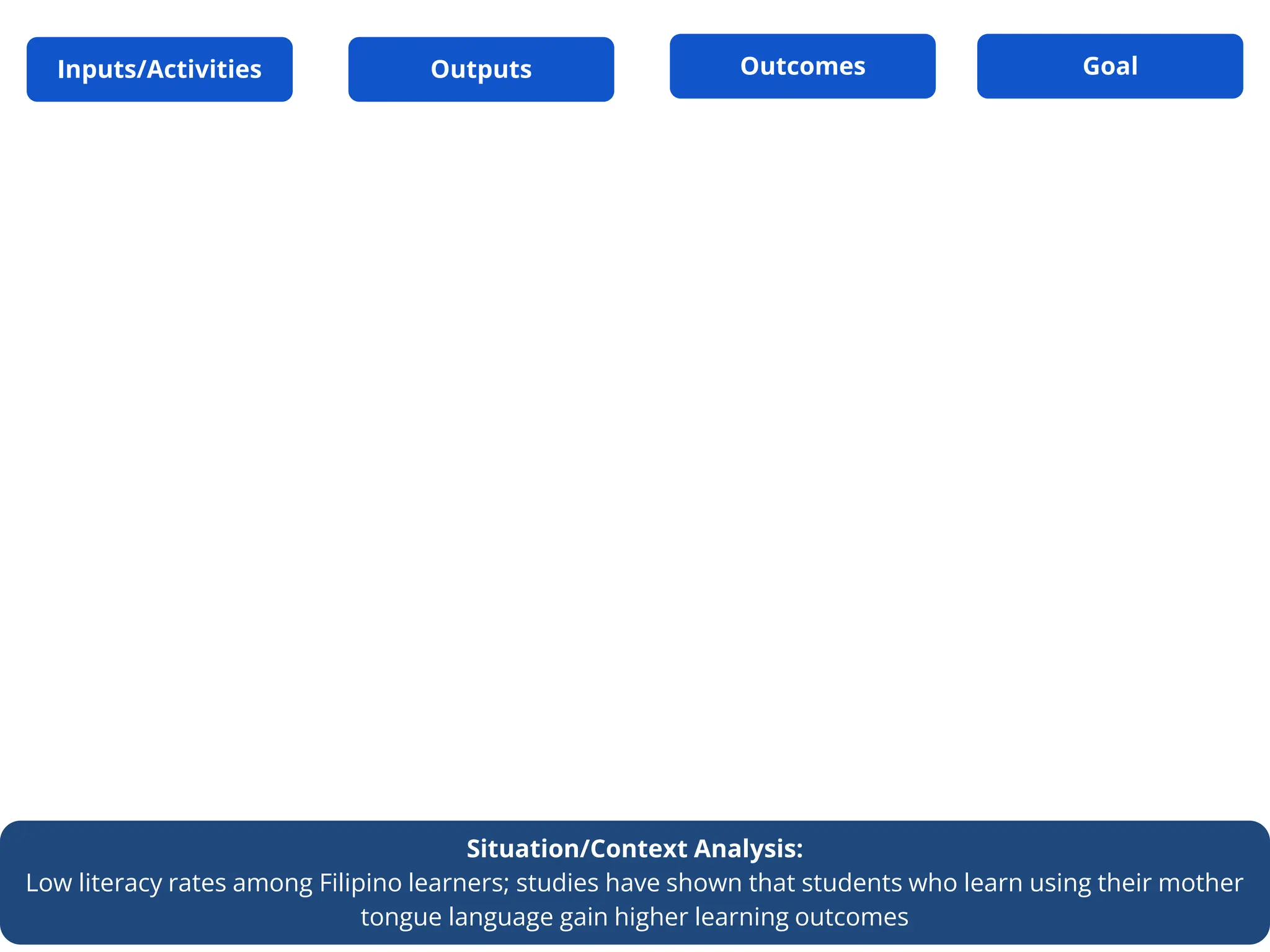
Activity Instructions
● Complete the Theory of Change of Mother Tongue-
Based Multilingual Education (MTB-MLE) by filling out
the boxes of appropriate objective statements.
● You can select the objective statements from the box
below. Write the full objective statement in each box to
build a Theory of Change for the implementation of the
MTB-MLE Program.
● Take note: the arrows help you establish the causal
relationship/s of the objectives under the components!
● You can accomplish this activity together with your
teammates.
DEPARTMENT OF EDUCATION
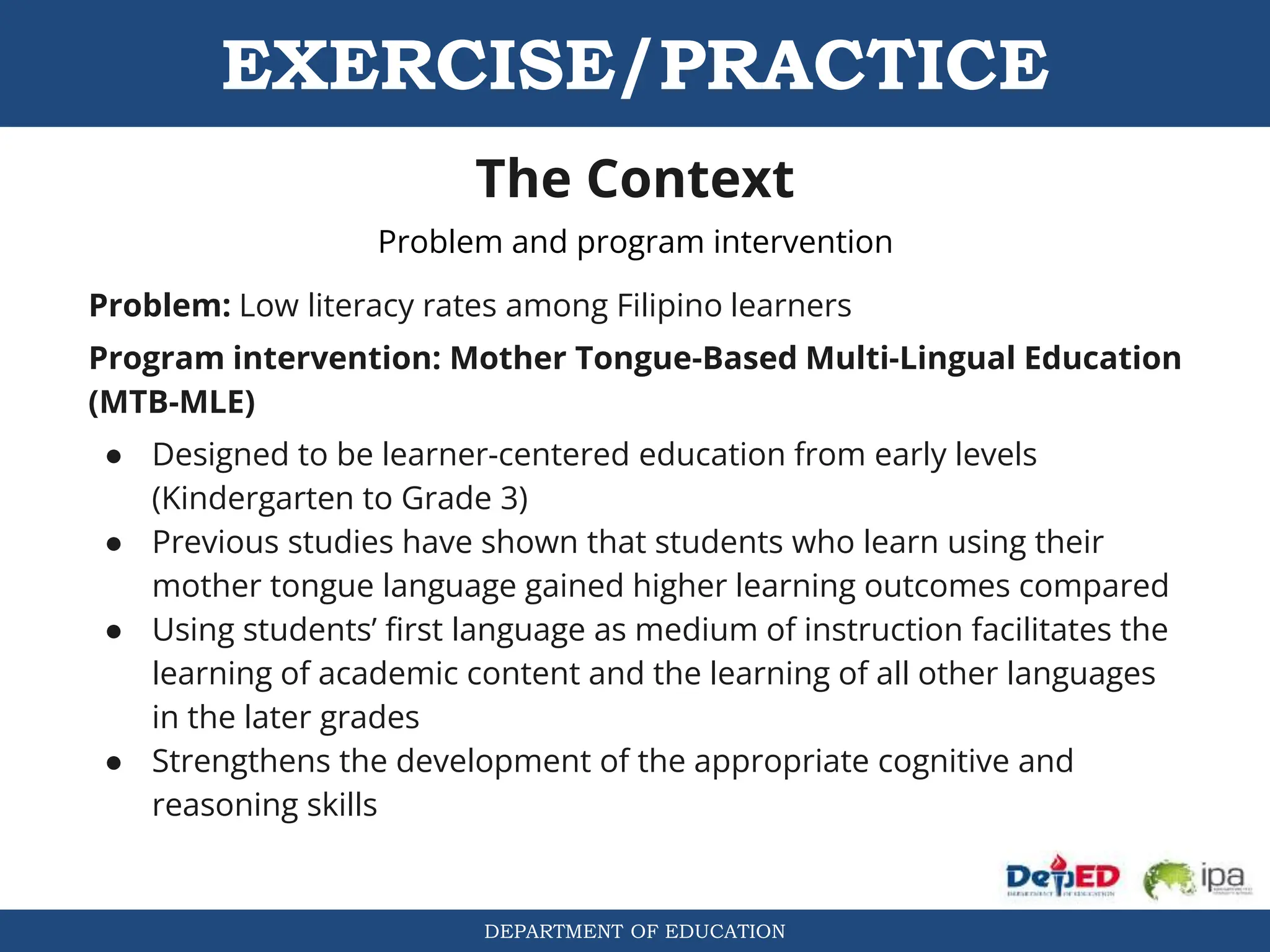
The Context
Problem and program intervention
Problem: Low literacy rates among Filipino learners
Program intervention: Mother Tongue-Based Multi-Lingual Education
(MTB-MLE)
● Designed to be learner-centered education from early levels
(Kindergarten to Grade 3)
● Previous studies have shown that students who learn using their
mother tongue language gained higher learning outcomes compared
● Using students’ first language as medium of instruction facilitates the
learning of academic content and the learning of all other languages
in the later grades
● Strengthens the development of the appropriate cognitive and
reasoning skills
EXERCISE/PRACTICE
DEPARTMENT OF EDUCATION
MTB-MLE
a. Translated curriculum guide and teaching guide
b. K-3 students can read in and comprehend in the MT
c. Development of mother tongue (MT) textbooks and localized resources
d. Reduced absenteeism
e. Teachers trained in the MT
f. Improved LAPG, ELLNA, NAT scores
g. Greater class participation
h. Reduced dropout
i. Training of teachers to teach in the MT
j. K-3 classes taught in the MT
k. K-3 students can write in the MT
l. Translation of curriculum guide and teaching guide to MT
m. MT textbooks and localized resources produced
n. Improved reading scores; higher comprehension scores
o. K-3 students can compute in MT
Objectives
Inputs/Activities Outputs Outcomes Goal
Situation/Context Analysis:
Low literacy rates among Filipino learners; studies have shown that students who learn using their mother
tongue language gain higher learning outcomes
Inputs/Activities Outputs Outcomes Goal
Situation/Context Analysis:
Low literacy rates among Filipino learners; studies have shown that students who learn using their mother
tongue language gain higher learning outcomes
DEPARTMENT OF EDUCATION
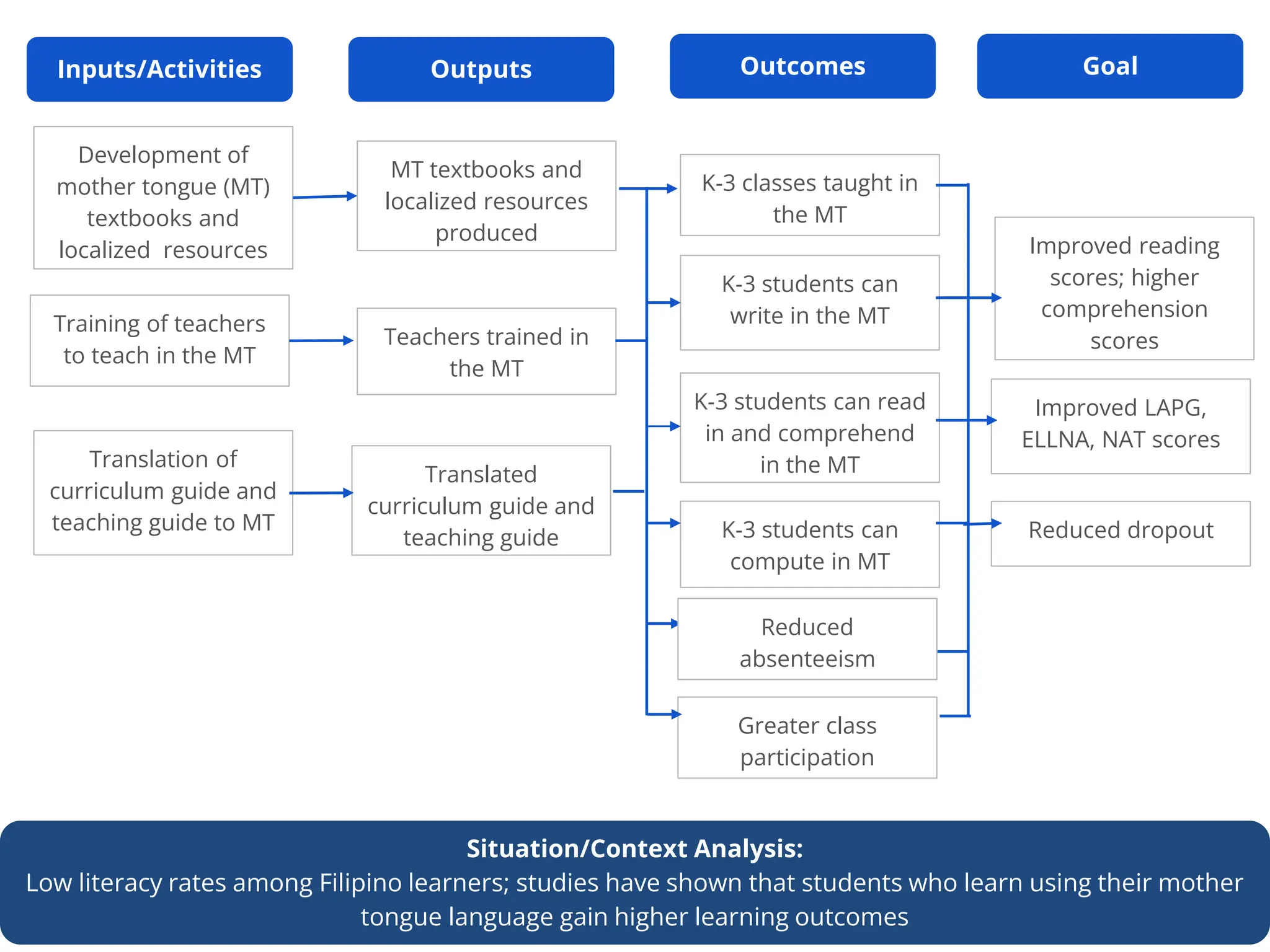
Suggested Answer
Inputs/Activities Outputs Outcomes Goal
Development of
mother tongue (MT)
textbooks and
localized resources
Translation of
curriculum guide and
teaching guide to MT
Training of teachers
to teach in the MT
MT textbooks and
localized resources
produced
Teachers trained in
the MT
Translated
curriculum guide and
teaching guide
K-3 classes taught in
the MT
K-3 students can
write in the MT
K-3 students can read
in and comprehend
in the MT
K-3 students can
compute in MT
Improved reading
scores; higher
comprehension
scores
Improved LAPG,
ELLNA, NAT scores
Greater class
participation
Reduced
absenteeism
Situation/Context Analysis:
Low literacy rates among Filipino learners; studies have shown that students who learn using their mother
tongue language gain higher learning outcomes
Reduced dropout
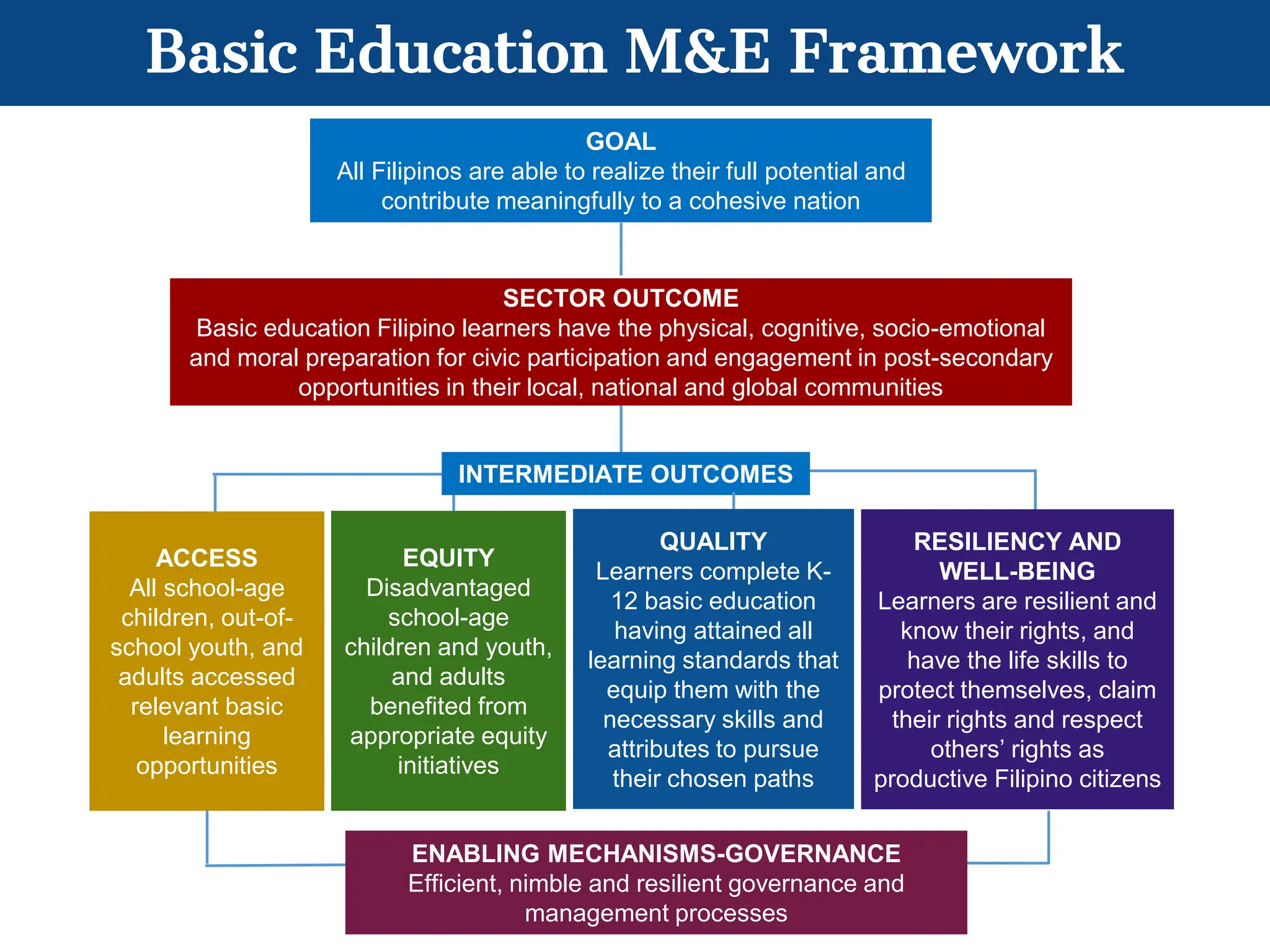
GOAL
All Filipinos are able to realize their full potential and
contribute meaningfully to a cohesive nation
SECTOR OUTCOME
Basic education Filipino learners have the physical, cognitive, socio-emotional
and moral preparation for civic participation and engagement in post-secondary
opportunities in their local, national and global communities
INTERMEDIATE OUTCOMES
EQUITY
Disadvantaged
school-age
children and youth,
and adults
benefited from
appropriate equity
initiatives
QUALITY
Learners complete K-
12 basic education
having attained all
learning standards that
equip them with the
necessary skills and
attributes to pursue
their chosen paths
RESILIENCY AND
WELL-BEING
Learners are resilient and
know their rights, and
have the life skills to
protect themselves, claim
their rights and respect
others’ rights as
productive Filipino citizens
ENABLING MECHANISMS-GOVERNANCE
Efficient, nimble and resilient governance and
management processes
Basic Education M&E Framework
ACCESS
All school-age
children, out-of-
school youth, and
adults accessed
relevant basic
learning
opportunities
DEPARTMENT OF EDUCATION
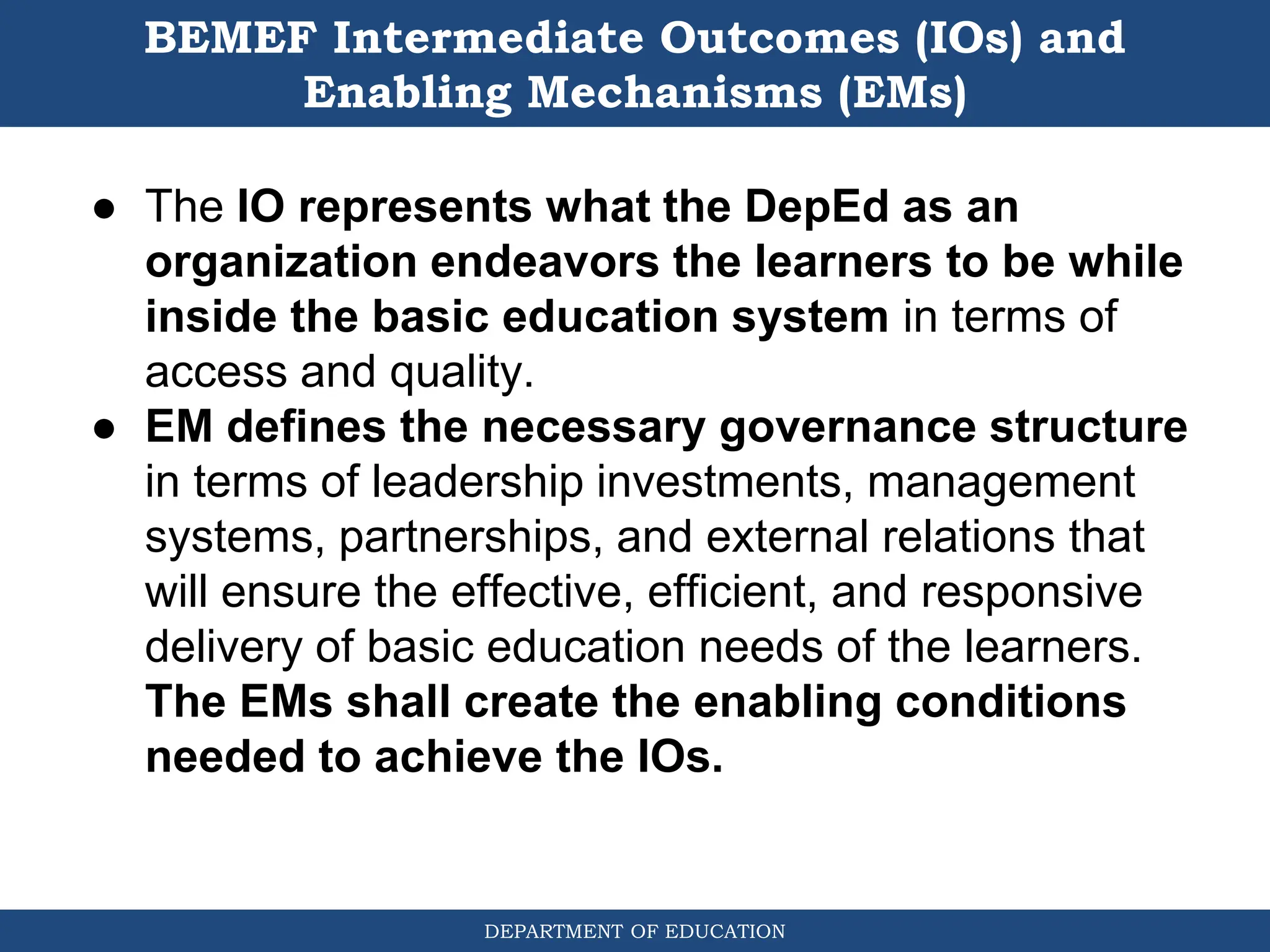
BEMEF Intermediate Outcomes (IOs) and
Enabling Mechanisms (EMs)
● The IO represents what the DepEd as an
organization endeavors the learners to be while
inside the basic education system in terms of
access and quality.
● EM defines the necessary governance structure
in terms of leadership investments, management
systems, partnerships, and external relations that
will ensure the effective, efficient, and responsive
delivery of basic education needs of the learners.
The EMs shall create the enabling conditions
needed to achieve the IOs.
DEPARTMENT OF EDUCATION
Intermediate Outcomes
IO#1: All school-age
children, out-of-
school youth, and
adults accessed
relevant basic
learning
opportunities
Ensured that all learners, regardless of sex,
religion, geography, financial disposition,
have access to and are encouraged to
attend schools and learning centers. This
ensures that schools and learning facilities are
made accessible to all types of learners.
28
DEPARTMENT OF EDUCATION
Intermediate Outcomes
29
IO#2: School-
age children
and youth, and
adults in
situations of
disadvantaged
benefited from
appropriate
equity initiatives
Ensured that School age children and youth, and
adults who are most vulnerable and disadvantaged in
terms of access to learning as indicated in the
eligibility of learners: indigent children, out-of-school
youth, distressed individuals and families, including
internally displaced personas (IDPs), low resourced
students, abandoned and neglected children,
street children, children of former rebels, children
living in conflict-affected areas and vulnerable
communities (CVAS), children with disabilities,
children from Geographically Isolated and
Disadvantaged Areas (GIDA) have access to schools,
learning centers, and all education resources and
facilities. This ensures that no child and youth is
left behind in the education system and reach
their full potential as active members of their
communities and the Philippine society.
DEPARTMENT OF EDUCATION
Intermediate Outcomes
IO#3: Learners
complete K-12
basic education
having attained all
learning standards
that equip them
with the
necessary skills
and attributes to
pursue their
chosen paths
Programs and initiatives aimed at ensuring
learners benefit from their completion of the
basic education cycle and from any other
educational interventions, and are learning/
gaining knowledge are implemented. It
recognizes that attendance to school and
learning centers is not sufficient to deliver
quality basic education.
30
DEPARTMENT OF EDUCATION
Intermediate Outcomes
31
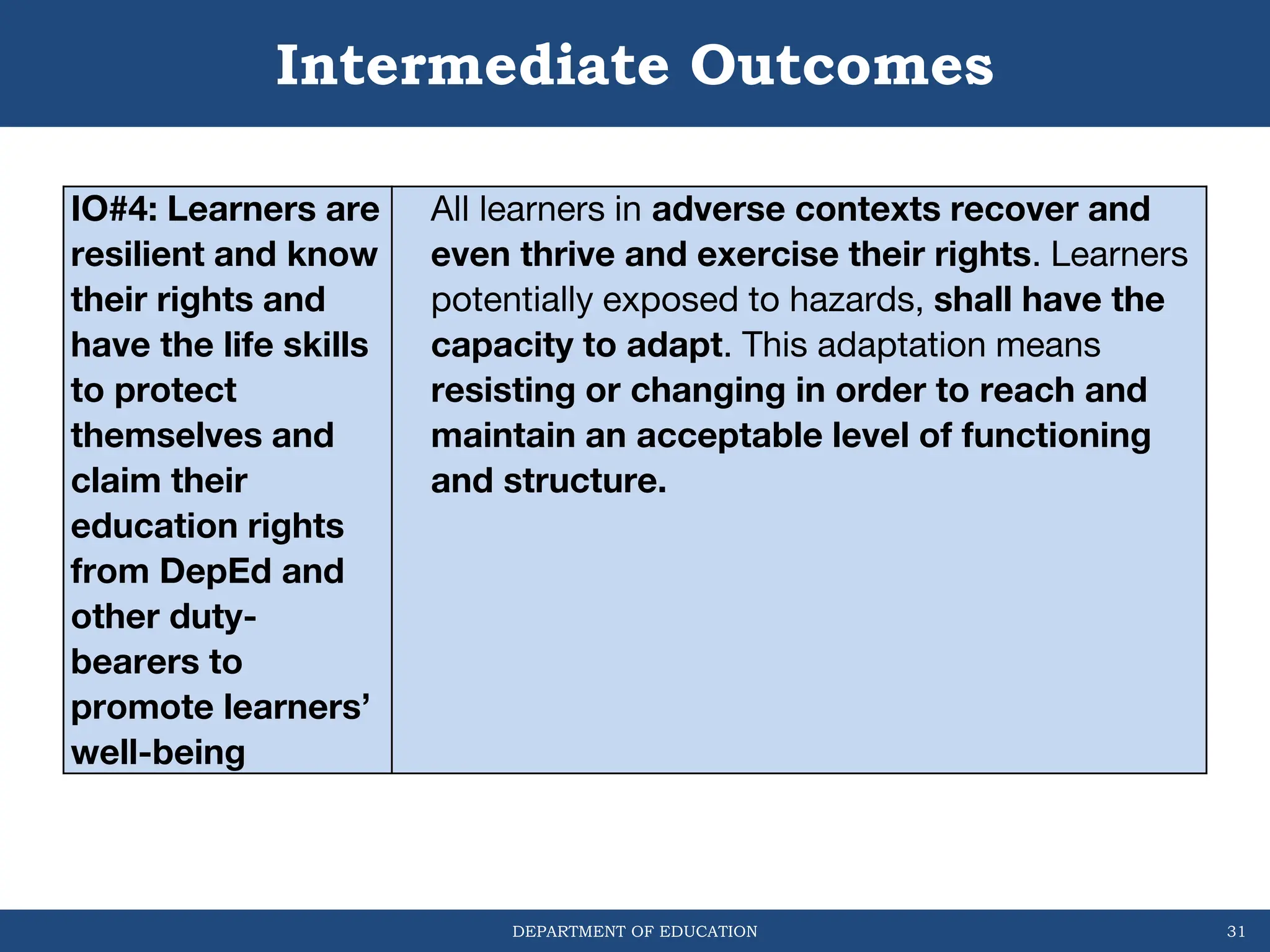
IO#4: Learners are
resilient and know
their rights and
have the life skills
to protect
themselves and
claim their
education rights
from DepEd and
other duty-
bearers to
promote learners’
well-being
All learners in adverse contexts recover and
even thrive and exercise their rights. Learners
potentially exposed to hazards, shall have the
capacity to adapt. This adaptation means
resisting or changing in order to reach and
maintain an acceptable level of functioning
and structure.
DEPARTMENT OF EDUCATION
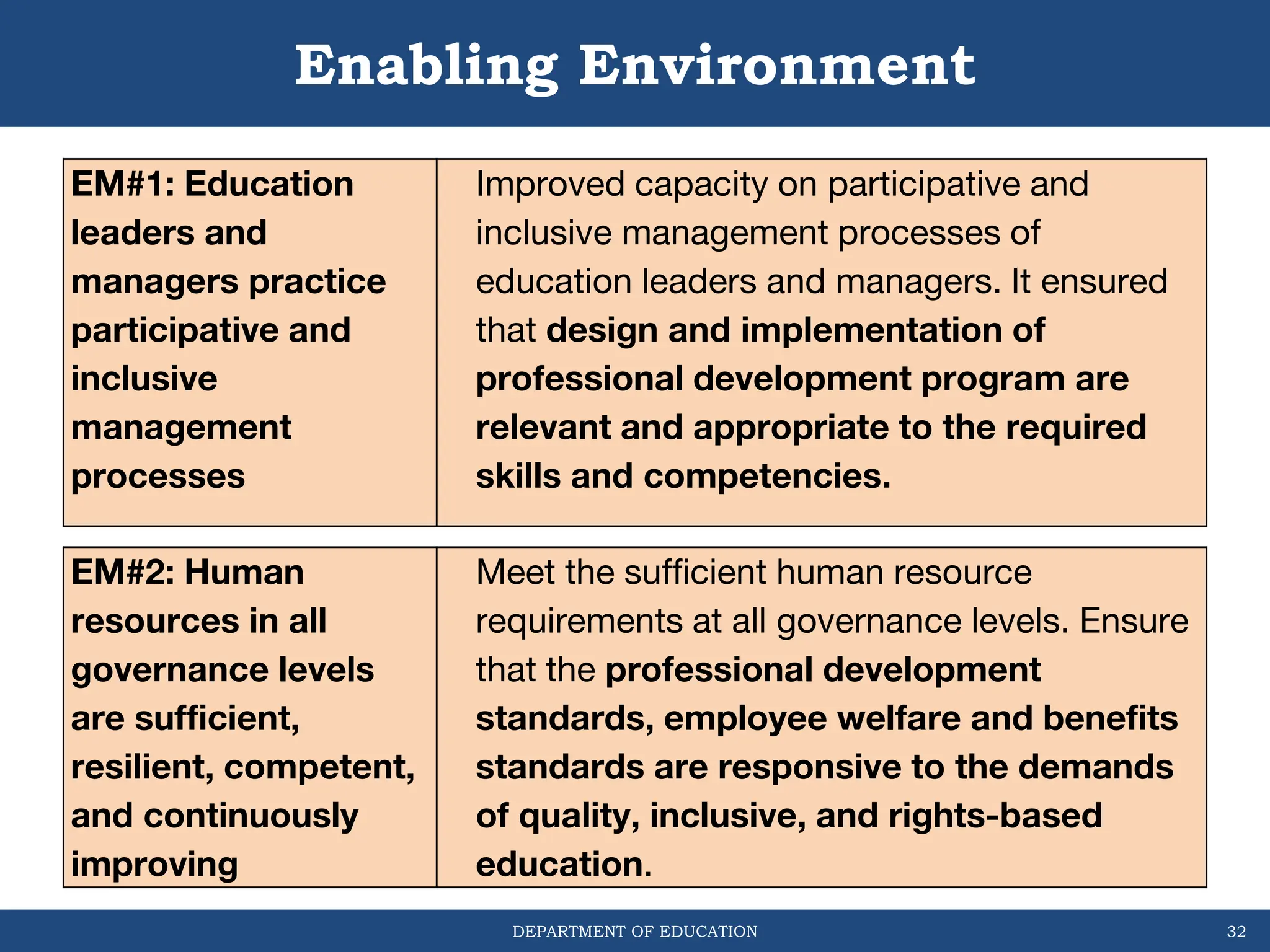
Enabling Environment
EM#1: Education
leaders and
managers practice
participative and
inclusive
management
processes
Improved capacity on participative and
inclusive management processes of
education leaders and managers. It ensured
that design and implementation of
professional development program are
relevant and appropriate to the required
skills and competencies.
32
EM#2: Human
resources in all
governance levels
are sufficient,
resilient, competent,
and continuously
improving
Meet the sufficient human resource
requirements at all governance levels. Ensure
that the professional development
standards, employee welfare and benefits
standards are responsive to the demands
of quality, inclusive, and rights-based
education.
DEPARTMENT OF EDUCATION
Enabling Environment
EM#3: Investments
in basic education
provide learners
with the ideal
learning
environment
Sufficient provision and equitable distribution
of education resources. It also recognizes the
gaps and immediate measures that need to
be considered in prioritizing resources in the
midst of competing education priorities to
achieve equity and impact.
12
EM#4: Improve and
modernize internal
systems and
processes for a
responsive and
efficient financial
resource
management
Enhance people's capacity, functional and
leadership competencies, internal systems
and processes to efficiently and effectively
deliver basic education services.
DEPARTMENT OF EDUCATION
Enabling Environment
EM#5: Key
stakeholders
actively collaborate
to serve learners
better
Ensure the collaborative engagement with
key stakeholders to achieve basic
education goals. This will be delivered
through functional mechanisms to make
partnership building and linkages more
strategic and aligned to DepEd priorities.
12
EM#6: Public and
private education
operate under a
dynamic and
responsive
complementarity
framework
Reinforce the role of private education to
complement the implementation of the basic
education curriculum.
DEPARTMENT OF EDUCATION
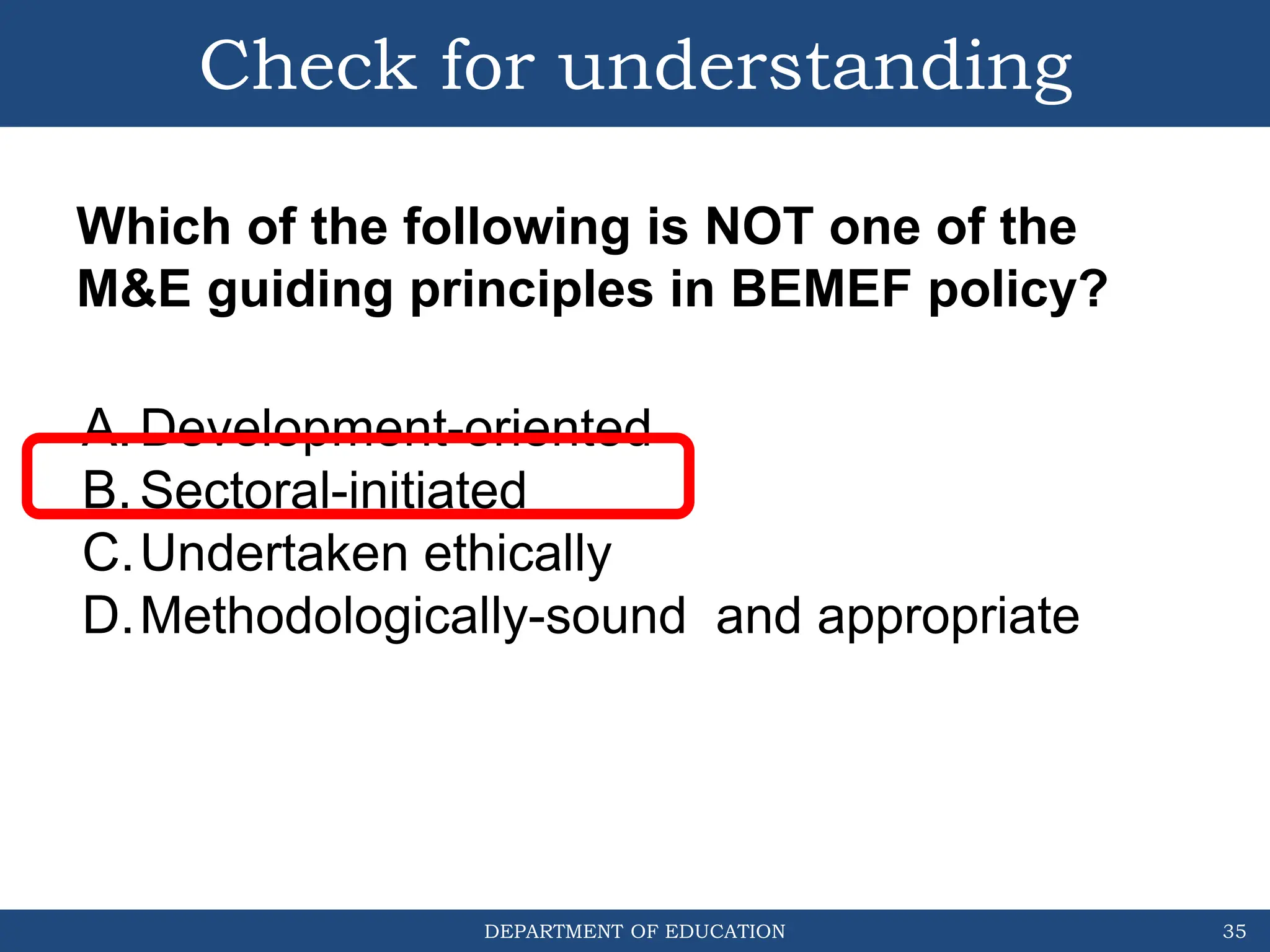
Check for understanding
Which of the following is NOT one of the
M&E guiding principles in BEMEF policy?
A.Development-oriented
B.Sectoral-initiated
C.Undertaken ethically
D.Methodologically-sound and appropriate
35
DEPARTMENT OF EDUCATION
Check for understanding
Which intermediate outcome (IO) ensures that no child
and youth is left behind in the education system and
reach their full potential as active members of their
communities and the Philippine society?
A. Access
B. Quality
C. Resiliency and Well-being
D. Equity
E. All of the above
36
DEPARTMENT OF EDUCATION
Developing BEMEF Performance
Indicators
37
DEPARTMENT OF EDUCATION
Performance Indicators
38
DEPARTMENT OF EDUCATION
What comes to your mind
when you hear indicators?
DEPARTMENT OF EDUCATION
How do you determine the
indicators of the program
you implement?
DEPARTMENT OF EDUCATION
What is an indicator?
• Indicators are signposts of change along
the path to development. They describe
the way to track intended results and are
critical for monitoring and evaluation.
DEPARTMENT OF EDUCATION
1. % of beneficiaries who think intimate partner violence is bad
2. % of beneficiaries who disagree with at least 3 of 5
statements about intimate partner violence
1. % of trainings conducted that were rated high quality by
trainees
2. # of trainings conducted
1. # of farmers using improved seed varieties for the first time
2. # of farmers using improved seed varieties
Which of these indicators is better? Why?
DEPARTMENT OF EDUCATION
1. % of beneficiaries who think intimate partner violence is bad
2. % of beneficiaries who disagree with at least 3 of 5
statements about intimate partner violence
1. % of trainings conducted that were rated high quality by
trainees
2. # of trainings conducted
1. # of farmers using improved seed varieties for the first
time
2. # of farmers using improved seed varieties
Which of these indicators is better? Why?
DEPARTMENT OF EDUCATION
Indicators
• The process of formulating indicators should
begin with the following questions:
• How can we measure that the expected
results are being achieved?
• What type of information can demonstrate a
positive change?
• What can be feasibly monitored with given
resource and capacity constraints?
UNDP M&E Handbook 2009
DEPARTMENT OF EDUCATION
Indicators
• (Continuation) The process of formulating
indicators should begin with the following
questions:
• Will timely information be available for the
different monitoring exercises?
• What will the system of data collection be
and who will be responsible?
• Can national systems be used or
augmented?
• Can government indicators be used?
UNDP M&E Handbook 2009
DEPARTMENT OF EDUCATION
Indicators
Criteria in establishing indicators
DEPARTMENT OF EDUCATION
Indicators
Source: Kusek & Rist, Ten Steps, 2004, 109
DEPARTMENT OF EDUCATION
Indicators
Quantitative
Indicators
▪ statistical measures that
measure results in terms
of:
• Number
• Percentage
• Rate
• Ratio
Source: UNDP PME Handbook, 2009
DEPARTMENT OF EDUCATION
Indicators
Qualitative
Indicators
▪ reflect people’s judgements,
opinions, perceptions and attitudes
towards a given situation or subject
▪ include changes in sensitivity,
satisfaction, influence, awareness,
understanding, attitudes, quality,
perception, dialogue or sense of
well-being
▪ measure results in terms of:
• Compliance with…
• Quality of…
• Extent of…
• Level of…
Source: UNDP PME Handbook, 2009
DEPARTMENT OF EDUCATION
Agency Performance Matrix
(refer to DO 29, s. 2022)
50
DEPARTMENT OF EDUCATION
DepEd Performance Indicators
51
● The Agency Performance matrix enumerates
and articulates the agency performance
indicators that shall measure DepEd’s
organizational performance.
● This includes the description, frequency of
data reporting, data disaggregation, and
data source for each IO performance
indicator, and includes the description,
frequency of data reporting, data
disaggregation, and accountable offices for
each EM performance indicator
DEPARTMENT OF EDUCATION
DepEd Performance Indicators
52
● The implementation of these indicators will be
divided into three tiers which are as follows:
○ Tier 1 indicators are those that are readily
available in our current information systems
and administrative data.
○ Tier 2 indicators are those currently under
development and/or with ongoing policy
initiatives.
○ Tier 3 indicators are those that are yet to be
developed.
DEPARTMENT OF EDUCATION
Access:
IO#1: All school-age children, out-of-
school youth, and adults accessed
relevant basic learning opportunities
53
DEPARTMENT OF EDUCATION
IO#1: All school-age children, out-of-school youth, and
adults accessed relevant basic learning opportunities
54
Performance
Indicators
Description Frequency
of Data
Reporting
Disaggregated by Data Source Tier
Net Enrollment
Rate (NER)
NER refers to the
ratio of the
enrolment for the
age group
corresponding to
the official school
age in the
elementary/
secondary level to
the population of
the same age
group in a given
year. Also known
as Participation
Rate.
Annual -Governance level
(national, region,
division)
-Level of education:
Elementary,
Secondary,
Kindergarten; Grade
1-6; Grade 7-10;
Grade 11-12
-Sex (male, female)
-Gender parity index
for NER
-Sector (Public and
Private Schools)
CO: PS
RO: PPRD
SDO: SGOD
1
DEPARTMENT OF EDUCATION
IO#1: All school-age children, out-of-school youth, and
adults accessed relevant basic learning opportunities
55
Performance
Indicators
Description Frequency
of Data
Reporting
Disaggregated by Data Source Tier
Gross
Enrollment
Rate (GER)
GER refers to the
total enrollment in
a given level of
education,
regardless of age,
as a percentage of
the population
who according to
the national
regulations should
be enrolled at this
level (i.e., age 6-
11 for elementary
and 12-15 for
secondary)
Annual -Governance level
(national, region,
division)
-Level of education:
Elementary,
Secondary,
Kindergarten; Grade
1-6; Grade 7-10;
Grade 11-12
-Sex (male, female)
-Gender parity index
for GER
-Sector (Public and
Private Schools)
CO: PS
RO: PPRD
SDO: SGOD
1
DEPARTMENT OF EDUCATION
IO 1.1. All five-year-old children in school
56
Performance
Indicators
Description Frequency
of Data
Reporting
Disaggregated by Data Source Tier
Net Intake
Rate (NIR)
NIR refers to the
percentage of the
population at the
official elementary
school-entrance
age who are new
entrants in the first
grade of
elementary
education, and
who are of the
same age. Also
known as the
Percentage of
five-year old in
school
Annual -Governance level
(national, region,
division)
-Sex (male, female)
-Sector (Public and
Private Schools
-Gender parity index
for NIR
CO: PS
RO: PPRD
SDO: SGOD
1
DEPARTMENT OF EDUCATION
IO 1.2: All learners will stay in school and finish
key stages
57
Performance
Indicators
Description Frequency
of Data
Reporting
Disaggregated by Data Source Tier
Retention Rate
(RR)
RR refers to the
percentage of
enrollees in the
elementary/secon
dary level in a
given school year
who continue to
be in school the
following year
Annual -Governance level
(national, region,
division)
-Level of education:
Elementary,
Secondary,
Kindergarten; Grade
1-6; Grade 7-10;
Grade 11-12
-Sex (male, female)
-Sector (Public and
Private Schools
-Gender parity index
for RR
CO: PS
RO: PPRD
SDO: SGOD
School: School Head
1
DEPARTMENT OF EDUCATION
IO 1.2: All learners will stay in school and finish
key stages
58
Performance
Indicators
Description Frequency
of Data
Reporting
Disaggregated by Data Source Tier
Dropout Rate
(DR)
DR refers to the
percentage of
pupils/students who
leave school during
the year for any
reason as well as
those who complete
the previous
grade/year level but
fail to enroll in the
next grade/year
level the following
school year to the
total number of
pupils/students
enrolled during the
previous school
year
Annual -Governance level
(national, region,
division)
-Level of education
(Elementary, Junior
High School, Senior
High School)
-Sex (male, female)
-Sector (Public and
Private Schools
-Gender parity index
for DR
CO: PS
RO: PPRD
SDO: SGOD
School: School Head
1
DEPARTMENT OF EDUCATION
IO 1.3: All learners transition to the next key
stage
59
Performance
Indicators
Description Frequency
of Data
Reporting
Disaggregated by Data Source Tier
Transition Rate
(TR)
TR refers to the
percentage of
learners who
graduate from one
level of education
and move on to
the next higher
level
Annual -Governance level
(national, region,
division)
-Level of education
(Primary to
intermediate;
elementary to
secondary)
-Kinder to Grade 1;
Grade 3 to 4; Grade
6 to 7; Grade 10 to
11
-Sex (male, female)
-Sector (Public and
Private Schools)
-Gender parity index
for TR
CO: PS
RO: PPRD
SDO: SGOD
1
DEPARTMENT OF EDUCATION
IO 1.4: All out-of-school children & youth participate in and
complete formal or non-formal basic education learning
opportunities
60
Performance
Indicators
Description Frequency
of Data
Reporting
Disaggregated by Data Source Tier
Participation
Rate of Out-of-
school children
(OSC) and Out-
of-school youth
(OSY)
Out of school
children (OSC) is
defined as persons
aged 6-14 years
who are not
attending school
while out-of-school
youth refers to
persons aged 15-30
years who are not
attending school,
have not finished
any college or post-
secondary course,
and are not working
Description of
computation: To be
developed
To be
developed
To be developed CO: PS
RO: PPRD
SDO: SGOD
3
DEPARTMENT OF EDUCATION
IO 1.4: All out-of-school children & youth participate in and
complete formal or non-formal basic education learning
opportunities
61
Performance
Indicators
Description Frequency
of Data
Reporting
Disaggregated by Data Source Tier
ALS
Completion
Rate
Percentage of
Alternative
Learning System
(ALS) learners
who completed
either elementary
or secondary level
in accordance with
the requirements
Annual - Governance level
(national, region,
division,
school/learning
center)
- Sex (male, female)
- Level of education
(Basic Literacy, A&E
elementary, A&E
secondary)
- Program provider
(DepEd delivered,
DepEd procured,
DepEd partners)
CO: BAE
RO: CLMD
SDO: CID
1
DEPARTMENT OF EDUCATION
Equity:
IO #2: School-age children and youth,
and adults in situation of disadvantage
benefited from appropriate equity
initiatives
ves
62
DEPARTMENT OF EDUCATION
IO #2: School-age children and youth, and adults in
situation of disadvantage benefited from appropriate equity
initiatives
63
Performance
Indicators
Description Frequency of
Data Reporting
Disaggregated
by
Data Source Tier
Proportion of
learners in
situation of
disadvantage
transition to next
key stage
-
ELEMENTARY:
% Disparity in
transition rate
- SECONDARY:
% Disparity in
transition rate
Transition rate refers
to the percentage of
learners who
graduate from one
level of education
and move on to the
next higher level
Description of
computation: To be
developed
To be developed To be developed CO: PS
RO: PPRD
SDO: SGOD
School: School
Head
3
*Learners in situation of disadvantage refers to the who are most vulnerable and disadvantaged in terms of access to
learning as indicated in the eligibility of learners: indigent children, out-of-school youth, distressed individuals and
families, including internally displaced personas (IDPs), low resourced students, abandoned and neglected children,
street children, children of former rebels, children living in conflict-affected areas and vulnerable communities (CVAS),
children with disabilities, Children from Geographically Isolated and Disadvantaged Areas (GIDA)
DEPARTMENT OF EDUCATION
IO 2.1: All school-age children and youth and adults in situations
of disadvantage are participating in basic learning opportunities
and receiving appropriate quality education
64
Performance
Indicators
Description Frequency
of Data
Reporting
Disaggregated by Data Source Tier
Retention rate
of learners in
situation of
disadvantage
To be developed To be
developed
To be developed CO: PS
RO: PPRD
SDO: SGOD
School: School Head
3
DEPARTMENT OF EDUCATION
IO 2.1: All school-age children and youth and adults in situations
of disadvantage are participating in basic learning opportunities
and receiving appropriate quality education
65
Performance Indicators Description Frequency of
Data Reporting
Disaggregated by Data
Source
Tier
Percentage of learners in
situations of disadvantage
(disaggregated by group)
achieved at least the
minimum level of
proficiency in (a) functional
literacy, (b) numeracy, and
(c) 21st century skills
Reading literacy: % of
learners with at least the
minimum level of
proficiency
Numeracy: % of learners
with at least the minimum
level of proficiency
21st century skills: % of
learners with at least the
minimum level of
proficiency
To be
developed
To be developed To be developed CO: BEA
RO: CLMD
SDO: CID
3
DEPARTMENT OF EDUCATION
Quality:
IO #3: Learners complete K-12 basic
education having attained all learning
standards that equip them with the
necessary skills and attributes to
pursue their chosen paths
66
DEPARTMENT OF EDUCATION
IO #3: Learners complete K-12 basic education having attained
all learning standards that equip them with the necessary skills
and attributes to pursue their chosen paths
67
Performance
Indicators
Description Frequency of
Data Reporting
Disaggregated by Data
Source
Tier
Completion Rate (CR) CR refers to
the percentage
of first grade
level entrants
in a level of
education who
graduate the
level
(elementary or
secondary) in
accordance
with the
required
number of
years of study
Annual - Governance level
(national, region,
division)
- Level of education:
Elementary,
Secondary,
Kindergarten; Grade
1-6; Grade 7-10;
Grade 11-12
- Sex (male, female)
- Sector (Public and
Private Schools)
- Per program
(IPEd, SPED,
Madrasah, Special
Interest Programs)
-Gender parity index
for CR
CO: PS
RO: PPRD
SDO: SGOD
1
DEPARTMENT OF EDUCATION
IO 3.1: Learners attained Stage 1 learning standards of
fundamental reading and numeracy skills
68
Performance
Indicators
Description Frequency of
Data Reporting
Disaggregated by Data
Source
Tier
Percentage of learners
attaining at least the
minimum level of
proficiency in Reading
and Listening
comprehension increased
Percentage of learners
achieving at least the
minimum level of
proficiency in
-English
-Filipino
-Mother Tongue (except
Tagalog)
-Numeracy
Refers to the
number of
learners attaining
at least the
minimum level of
proficiency in
Reading and
listening
comprehensions
over the total
number of
learners.
Annual - Governance level
(national, region,
division, school)
- Level of education:
Elementary,
Secondary,
Kindergarten; Grade
1-6; Grade 7-10;
Grade 11-12
- Sex (male, female)
- Learning area:
English, Filipino,
Mother Tongue
(except Tagalog),
Numeracy/Math
- Sector: Public and
Private Schools
CO: BEA
RO: CLMD
SDO: CID
1
Proficiency in reading and listening comprehensions include the proficiency in English, Filipino, Mother Tongue (excluding
Tagalog) and numeracy
DEPARTMENT OF EDUCATION
IO 3.2: Learners attain Stage 2 (Grade 6) learning standards of
literacy & numeracy skills and apply 21st century skills to
various situations
69
Performance
Indicators
Description Frequency of
Data Reporting
Disaggregated by Data
Source
Tier
Percentage of learners
attaining at least the
minimum level of
proficiency in Stage 2
literacy and numeracy
standards
Refers to the
number of Grade
6 learners
attaining at least
the minimum
level of
proficiency in
Stage 2 literacy
and numeracy
standards over
the total number
of Grade 6
learners
Annual - Governance level
(national, region,
division)
- Sex (male, female)
- Sector (Public and
Private Schools
CO: BEA
RO: CLMD
SDO: CID
1
DEPARTMENT OF EDUCATION
IO 3.3: Learners attain Stage 3 (Grades 7-10) learning standards
of literacy & numeracy skills and apply 21st century skills to
various situations
70
Performance
Indicators
Description Frequency of
Data Reporting
Disaggregated by Data
Source
Tier
Percentage of G10
learners attaining at least
the minimum level of
proficiency in Stage 3
literacy and numeracy
standards
Refers to the
number of Grade
10 learners
attaining at least
the minimum
level of
proficiency in
Stage 3 literacy
and numeracy
standards over
the total number
of Grade 10
learners
Annual - Governance level
(national, region,
division)
- Sex (male, female)
- Sector (Public and
Private Schools
CO: BEA
RO: CLMD
SDO: CID
1
DEPARTMENT OF EDUCATION
IO 3.4: Learners attain Stage 4 (Grades 11-12) learning standards
equipped with knowledge and 21st century competencies
developed in their chosen core, applied, and specialized SHS
tracks
71
Performance
Indicators
Description Frequency of
Data Reporting
Disaggregated by Data
Source
Tier
Percentage of Grade 12
learners attaining at least
the minimum level of
proficiency in Stage 4
SHS core areas
Refers to the
number of Grade
12 learners
attaining at least
the minimum
level of
proficiency in
Stage 4 SHS
core areas over
the total number
of Grade 12
learners
Annual - Governance level
(national, region,
division)
- Sex (male, female)
- Sector (Public and
Private Schools
CO: BEA
RO: CLMD
SDO: CID
1
DEPARTMENT OF EDUCATION
IO 3.5: Learners in the Alternative Learning System attain
certification as Elementary or Junior High School completers
72
Performance
Indicators
Description Frequency of
Data Reporting
Disaggregated by Data
Source
Tier
ALS A&E passing rate Refers to the
percentage of ALS
learners who
passed the
Accreditation &
Equivalency (A&E)
test
Annual - Governance level
(national, region,
division,
school/learning center)
- Level of Education
(A&E elementary, A&E
Junior High School,
A&E Senior High
School)
- Sex (male, female)
- Program provider
(DepEd delivered,
DepEd procured,
DepEd partners)
- ALS Delivery Mode
(Modular, Home
Tutorial, 1-2 Meetings
per week)
CO: BAE
RO: CLMD
SDO: CID
1
DEPARTMENT OF EDUCATION
Resiliency and Well-being:
IO #4: Learners are resilient and know
their rights, and have the life skills to
protect themselves, claim their rights
and respect others’ rights as
productive Filipino citizens
73
DEPARTMENT OF EDUCATION
IO #4: Learners are resilient and know their rights, and have the
life skills to protect themselves, claim their rights and respect
others’ rights as productive Filipino citizens
74
Performance
Indicators
Description Frequency of
Data Reporting
Disaggregated by Data
Source
Tier
Learners satisfaction
rating on
Rights-based
Education (RbE)
To be developed To be developed To be developed CO: Child
Rights in
Education
Desk –
Legal Affairs;
Child
Protection
Unit;
DRRMS;
BLSS
3
DEPARTMENT OF EDUCATION
Check for understanding
Your office at the Central Office wants to explore the
transition rate in Region 11 to understand its
relationship to the access programs in DepEd. Which
functional office should you reach out to to request for
the data?
A. Policy, Planning, and Research Division of Region 11
B. Bureau of Education Assessment
C. Planning Service
D. Office of the Secretary
75
DEPARTMENT OF EDUCATION
Check for understanding
In your regional office, if you want to explore the
transition rate in your region to understand its
relationship to the access programs in DepEd. Which
functional office should you reach out to to request for
the data?
A. Policy, Planning, and Research Division
B. Curriculum Learning and Management Division
C. Planning Service-EMISD
D. SGOD
76
DEPARTMENT OF EDUCATION
Enabling Mechanisms (EM)-
Governance
Efficient, nimble and resilient
governance and management
processes
77
DEPARTMENT OF EDUCATION
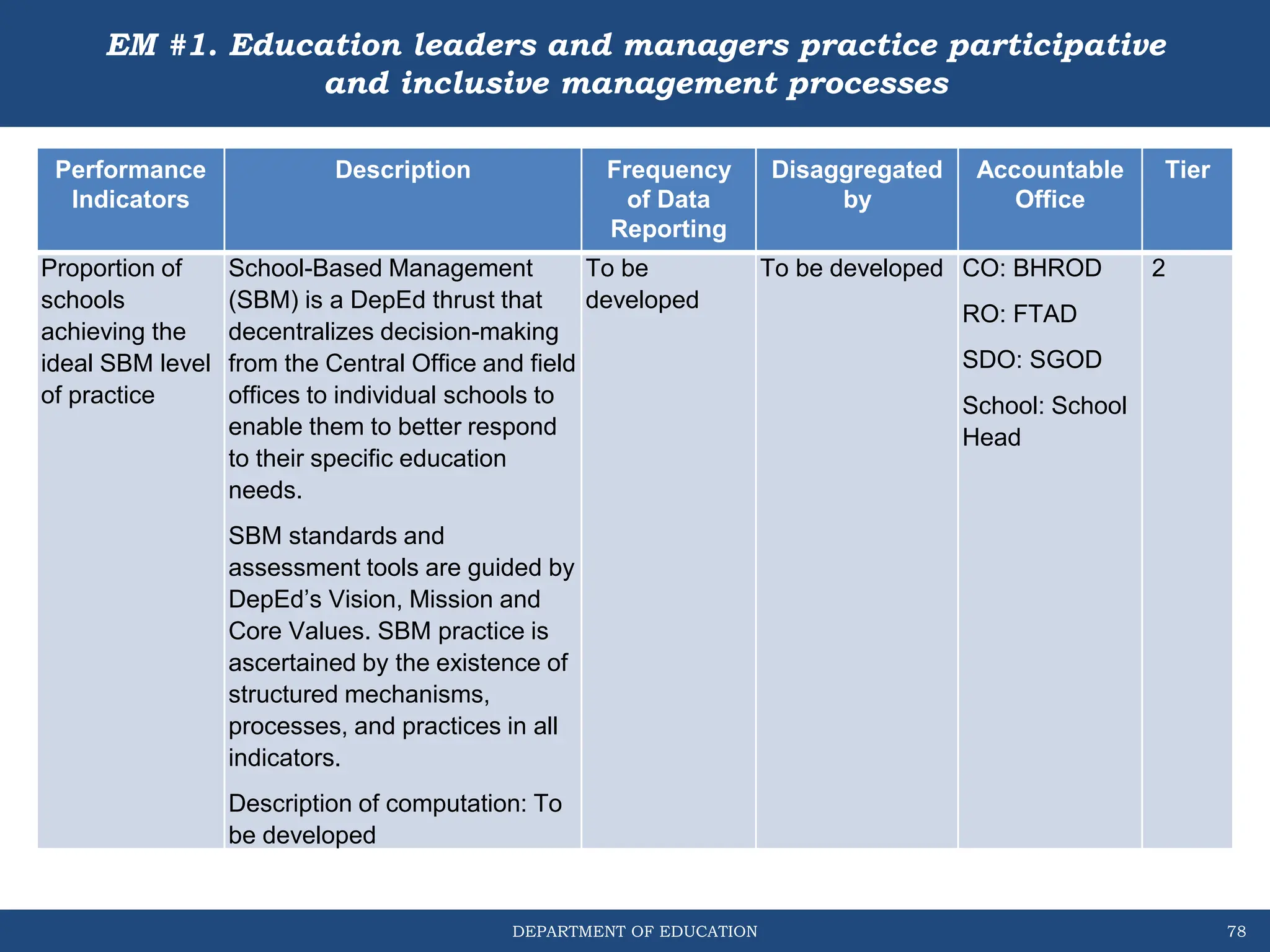
EM #1. Education leaders and managers practice participative
and inclusive management processes
78
Performance
Indicators
Description Frequency
of Data
Reporting
Disaggregated
by
Accountable
Office
Tier
Proportion of
schools
achieving the
ideal SBM level
of practice
School-Based Management
(SBM) is a DepEd thrust that
decentralizes decision-making
from the Central Office and field
offices to individual schools to
enable them to better respond
to their specific education
needs.
SBM standards and
assessment tools are guided by
DepEd’s Vision, Mission and
Core Values. SBM practice is
ascertained by the existence of
structured mechanisms,
processes, and practices in all
indicators.
Description of computation: To
be developed
To be
developed
To be developed CO: BHROD
RO: FTAD
SDO: SGOD
School: School
Head
2
DEPARTMENT OF EDUCATION
EM #2. Human resources in all governance levels are sufficient,
resilient, competent, and continuously improving
79
Performance
Indicators
Description Frequency of
Data Reporting
Disaggregated
by
Accountable
Office
Tier
Proportion of
offices across
governance levels
with at least
satisfactory in the
Office
Performance
Commitment and
Review Form
(OPCRF)
The OPCRF is
accomplished by the
head of office and
reflects office
commitments and
performance.
Description of
computation: To be
developed
To be developed To be developed CO: BHROD 2
DEPARTMENT OF EDUCATION
EM #3. Investments in basic education provide learners with the
ideal learning environment
80
Performance
Indicators
Description Frequency
of Data
Reporting
Disaggregated
by
Accountable
Office
Tier
Proportion of
schools and
community
learning centers
(CLCs) achieving
ideal ratio on:
-Classroom
-Teachers
-Learning
resources and
learning materials
(LRs and LMs)
-Seats
-Science and Math
equipment
-Multimedia
package
Proportion of schools with
ideal ratio refers to the
number of schools with ideal
ratio on the requirements for
classroom, teachers,
LRs/LMs, seats, Science
and Math equipment,
multimedia package over the
total number of DepEd
schools.
Ideal ratio for classroom,
teachers, LRs/LMs, seats,
Science and Math
Equipment, multimedia
package shall be based on
the planning standards set
by the Department.
Annual - Governance level
(national, region,
division, school)
- Level of
education:
Elementary,
Secondary,
Kindergarten;
Grade 1-6; Grade
7-10; Grade11-12
- Sector (Public
and Private
Schools)
CO: Physical
facilities
Division
(classroom);
Planning
Service
(teachers); BLR
(textbooks);
Procurement
Office
(Seats, Science
and
Math
Equipment);
ICTS (ICT
package/eclass
room)
1
DEPARTMENT OF EDUCATION
EM #3. Investments in basic education provide learners with the
ideal learning environment
81
Performance
Indicators
Description Frequency
of Data
Reporting
Disaggregated
by
Accountable
Office
Tier
Proportion of
schools with:
-Connection to
electricity
-Connection to
internet
-Water and
Sanitation
(WatSan) facility
- Water source
Percentage of schools
(elementary and secondary)
with
-connection to electricity
-connection to internet
-WatSan facility
-Water source
over the total number of
schools in that level
Annual - Governance level
(national, region,
division, school)
- Level of
education:
Elementary,
Secondary,
Kindergarten;
Grade 1-6; Grade
7-10; Grade 11-12
CO: ICTS
(internet);
Physical
facilities
(electricity)
1
DEPARTMENT OF EDUCATION
EM #3. Investments in basic education provide learners with the
ideal learning environment
82
Performance
Indicators
Description Frequency
of Data
Reporting
Disaggregated
by
Accountable
Office
Tier
Proportion of
schools with:
-functional library
-faculty’s/teachers
room
To be developed To be
developed
To be developed To be
determined
3
DEPARTMENT OF EDUCATION
EM #3. Investments in basic education provide learners with the
ideal learning environment
83
Performance
Indicators
Description Frequency
of Data
Reporting
Disaggregated
by
Accountable
Office
Tier
Proportion of
SDOs achieving
ideal interquartile
ratio (IQR)
*on teacher
deployment
IQR is a measure of
inequality in the distribution
of teachers. It compares
pupils/students with the most
favorable teacher-student
ratios with groups of
students whose schools
have the most unfavorable
teacher-student ratios.
A national IQR in both
elementary and secondary
education greater than 2
indicates that the most
favored pupils/students have
teacher ratios twice better
than the least favored.
Annual - Governance level
(national, region,
division, school)
- Level of
education (Kinder;
G1-G6, G7-G10,
G11-G12)
CO: PS 1
DEPARTMENT OF EDUCATION
EM #4. Improve and modernize internal systems and processes for
a responsive and efficient financial resource management
84
Performance
Indicators
Description Frequency
of Data
Reporting
Disaggregated
by
Accountable
Office
Tier
Client
satisfactory rating
of DepEd offices’
respective
stakeholders
(internal &
external)
To be developed To be
developed
To be developed CO: PS
RO: QAD
SDO: SGOD
3
DEPARTMENT OF EDUCATION
EM #5. Key stakeholders actively collaborate to serve learners
better
85
Performance
Indicators
Description Frequency
of Data
Reporting
Disaggregated
by
Accountable
Office
Tier
Percentage
increase of
financial
contribution of
development
partners (i.e.,
international and
local partners)
To be developed To be
developed
To be developed CO: Finance
Service, PMS,
and EPS
3
Proportion of
schools with
functional School
Governing
Council (SGC)
To be developed To be
developed
To be developed CO: BHROD 2
DEPARTMENT OF EDUCATION
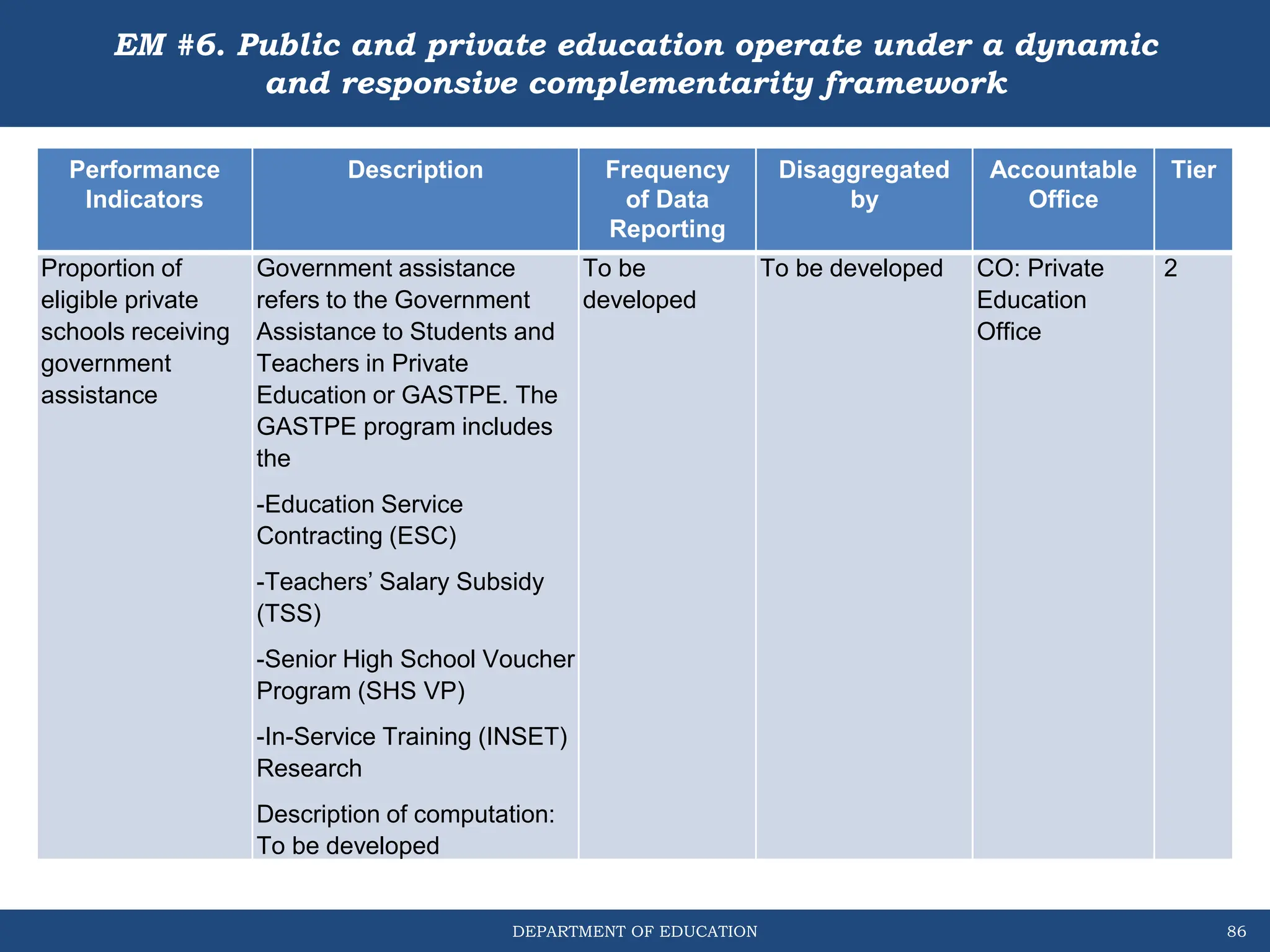
EM #6. Public and private education operate under a dynamic
and responsive complementarity framework
86
Performance
Indicators
Description Frequency
of Data
Reporting
Disaggregated
by
Accountable
Office
Tier
Proportion of
eligible private
schools receiving
government
assistance
Government assistance
refers to the Government
Assistance to Students and
Teachers in Private
Education or GASTPE. The
GASTPE program includes
the
-Education Service
Contracting (ESC)
-Teachers’ Salary Subsidy
(TSS)
-Senior High School Voucher
Program (SHS VP)
-In-Service Training (INSET)
Research
Description of computation:
To be developed
To be
developed
To be developed CO: Private
Education
Office
2
DEPARTMENT OF EDUCATION
EM #6. Public and private education operate under a dynamic
and responsive complementarity framework
87
Performance
Indicators
Description Frequency
of Data
Reporting
Disaggregated
by
Accountable
Office
Tier
Proportion of
teachers in private
schools receiving
teacher subsidy
Teachers’ Salary Subsidy
(TSS) is a
GASTPE program wherein
an annual salary subsidy is
given to licensed teachers in
ESC-participating JHSs.
These teachers are called
TSS recipients.
Description of computation:
To be developed
To be
developed
To be developed CO: Private
Education
Office
2
DEPARTMENT OF EDUCATION
EM #6. Public and private education operate under a dynamic
and responsive complementarity framework
88
Performance
Indicators
Description Frequency
of Data
Reporting
Disaggregated
by
Accountable
Office
Tier
Percentage of
recognized
schools or schools
with recognition
Recognition comes after the
establishment of a private
educational institution.
Recognition presumes an
existing school and refers to the
authorization granted by the
Department for the school to
conduct educational programs
or operations. The grant of
recognition for schools shall be
based on its satisfactory
operation during the school
year, without any deficiencies in
instruction, administration
and/or management and on full
compliance with the prescribed
requirements of the course15
Description of computation: To
be developed
To be
developed
To be developed CO: Private
Education
Office
2
DEPARTMENT OF EDUCATION
Agency Performance Matrix
(refer to DO 29, s. 2022)
89
DEPARTMENT OF EDUCATION
Monitoring and Evaluation (M&E)
Mechanism
90
DEPARTMENT OF EDUCATION
• How do you
collect data
in your M&E
initiatives?
• What are the
challenges in
collecting the
data?
Think-Pair-Share
91
Look for a
partner to talk
about your
answer.
Share with the
whole group you
and your
partner’s
practices
DEPARTMENT OF EDUCATION
● How do you collect data in your
M&E initiatives?
● What are the challenges in collecting
the data?
Think and
Share
92
DEPARTMENT OF EDUCATION
Monitoring and Evaluation
• Monitoring explains the efficiency and effectiveness of
operations while evaluation provides information on the
benefits achieved
• Monitoring results provide bases for critical
management decisions such as resource allocation or
realignment, target setting, remedial/corrective actions
or strategy development.
• Evaluation results provide valuable lessons and
insights that can be used by managers in crafting
strategic decisions for the future such as in designing
organizational changes or future programs and/or
projects.
DEPARTMENT OF EDUCATION
Theory of Change (ToC)
Source: Innovations for Poverty Action Theory of Change lecture slides
DEPARTMENT OF EDUCATION
Theory of Change (ToC)
Source: Innovations for Poverty Action Theory of Change lecture slides
DEPARTMENT OF EDUCATION
Types of M&E
• Monitoring
• Results Evaluation
• Process Evaluation
DEPARTMENT OF EDUCATION
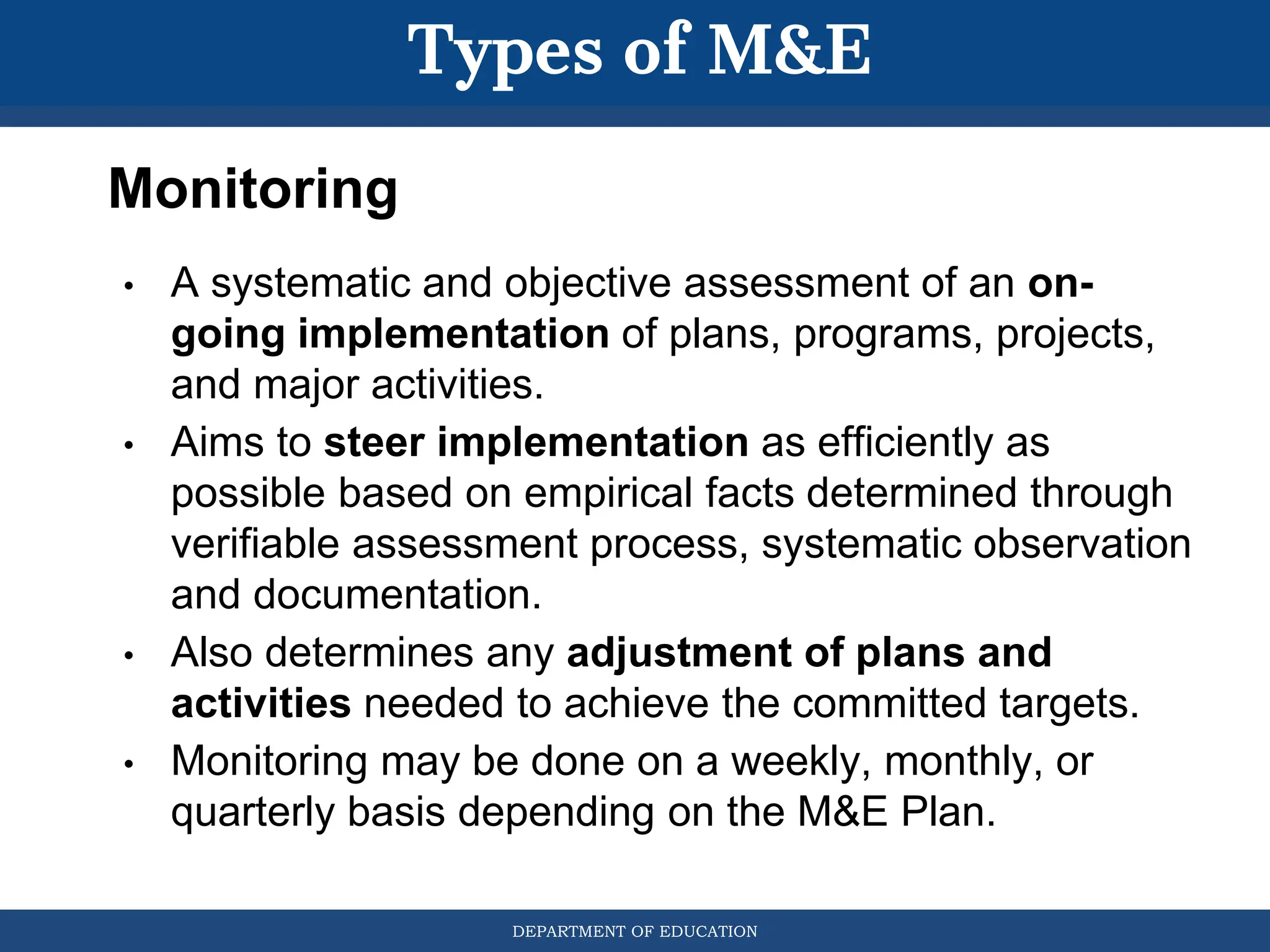
Types of M&E
• A systematic and objective assessment of an on-
going implementation of plans, programs, projects,
and major activities.
• Aims to steer implementation as efficiently as
possible based on empirical facts determined through
verifiable assessment process, systematic observation
and documentation.
• Also determines any adjustment of plans and
activities needed to achieve the committed targets.
• Monitoring may be done on a weekly, monthly, or
quarterly basis depending on the M&E Plan.
Monitoring
DEPARTMENT OF EDUCATION
Types of M&E
• The Program Management Information System
(PMIS) is one of the mechanisms in doing monitoring
and currently the official source of data on
programs, projects and activities (PPAs) from planning
to implementation.
• In support of monitoring and evaluation, Program
Implementation Review (PIR) is established as the
reporting platform. The PIR is conducted on a
quarterly basis to report the accomplishments of
outputs in terms of efficiency, and corresponding
utilization of the budget.
DepEd Monitoring
DEPARTMENT OF EDUCATION 99
DEPARTMENT OF EDUCATION 100
DEPARTMENT OF EDUCATION
Types of M&E
• This is an evaluation approach that focuses on
measuring the realization of results.
• It seeks to assess the outcomes and changes
brought about by program or project interventions.
• Findings from this type of evaluation are used as the
baseline situation for the next planning cycle.
Results Evaluation
DEPARTMENT OF EDUCATION
Types of M&E
• Did the program succeed in helping teachers to use
ICT in teaching and learning process?
• Was the program more successful with certain groups
of people than with others?
• What aspects of the program did participants find
gave the greatest benefit?
Results Evaluation
Sample questions to ask…
DEPARTMENT OF EDUCATION 103
DEPARTMENT OF EDUCATION
Types of M&E
• Determines the effectiveness and efficiency of the
implementation processes and systems.
• This could be conducted at any phase of the plan
implementation and could be combined with other
types of monitoring.
• Through this evaluation, issues and challenges in
program, project, and activity deliveries can be
addressed.
Process Evaluation
DEPARTMENT OF EDUCATION
Types of M&E
• What were specific interventions put into place by the
program to fight the problem being tackled? Did the
interventions work or not — and how and why?
• What were the kinds of problems encountered in
delivering the program — were there enough
resources from the beginning to do it well? Was it well
managed? Were staff trained or educated to the right
level of the program design? Is there skill at facilitating
the program processes from beginning to end? Was
there adequate support to the program?
Process Evaluation
Sample questions to ask…
DEPARTMENT OF EDUCATION 107
DEPARTMENT OF EDUCATION 108
DEPARTMENT OF EDUCATION
Check for understanding
CLMD of Region V aims to determine the extent of
implementation of limited F2F class to identify best
practices, issues and areas for improvement. What
types of M&E will they use?
A. Monitoring of outputs
B. Process Evaluation
C. Results Evaluation
D. All of the above
109
DEPARTMENT OF EDUCATION
Operationalizing the Conduct of
M&E
110
111
DEPARTMENT OF EDUCATION
How do you prepare for the
conduct of M&E?
112
DEPARTMENT OF EDUCATION
Operationalizing the M&E
• In operationalizing the conduct of M&E, all operating
units are required to develop M&E Plans for their
respective education plans, programs, and policies.
• The M&E Plan is a document that provides guidance
on the purpose and process of conducting monitoring
and evaluation of any programs, policies, projects,
office mandates, and activities.
• The M&E plan contains four (4) core M&E processes.
M&E CORE PROCESSES
I. Establishment
of Purpose and
Scope
II. Data
Collection and
Management
III. Data
Analysis
IV. Information
Dissemination,
Reporting, and
Utilization
I. Establishment of
Purpose and Scope
Guide Questions
• What should you be
monitoring and
evaluating?
• What are the
corresponding
indicators?
M&E CORE PROCESSES
Reference point for the
M&E system, guiding key
decisions such as
informational needs,
methodological approaches,
capacity building and
allocation of resources.
M&E CORE PROCESSES
Sample: Core Process 1 of BEMEF
II. Data Collection and
Management
Guide Questions
• What are the possible
sources of data?
• Who (office/personnel) is
responsible in data
collection?
• How frequent will you
collect this data?
• How will you organize and
store the collected data?
• Who are the possible users
of the data (internal and
external) and what are the
possible uses of these
data?
M&E CORE PROCESSES
Collection or gathering of
relevant data to be
managed for analysis. It
involves processes and
systems for how a
project/program will
systematically and reliably
store, manage and access
M&E data.
M&E CORE PROCESSES
Sample: Core Process 2 of BEMEF
III. Data Analysis
Process of converting collected
(raw) data into usable
information. It Involves looking
for trends, clusters or other
relationships between different
types of data, assessing
performance against plans and
targets, forming conclusions,
anticipating problems and
identifying solutions and best
practices.
M&E CORE PROCESSES
Guide Questions
• How will you process and
analyze the data that you
have collected?
• Who are responsible in data
analysis?
• How often do you conduct
data analysis?
M&E CORE PROCESSES
Sample: Core Process 3 of BEMEF
IV. Information
Dissemination,
Reporting, and
Utilization
The most visible part of
the M&E system.
Collected and analyzed
data is presented as
information for use of key
stakeholders.
M&E CORE PROCESSES
Guide Questions
• To whom will you
communicate the M&E
results? (identifying
type of
stakeholder/audience
• How will you
communicate the
results? What are
communication /
reporting strategies will
you employ?
• When do you report
M&E results?
M&E CORE PROCESSES
Sample: Core Process 4 of BEMEF
DEPARTMENT OF EDUCATION
M&E Core Processes
• The development of tools for data
collection/requirements shall be guided by the
M&E Plan to be established per program, policy, and
plan.
DEPARTMENT OF EDUCATION
M&E SYSTEM PER GOVERNANCE
LEVEL
124
DEPARTMENT OF EDUCATION
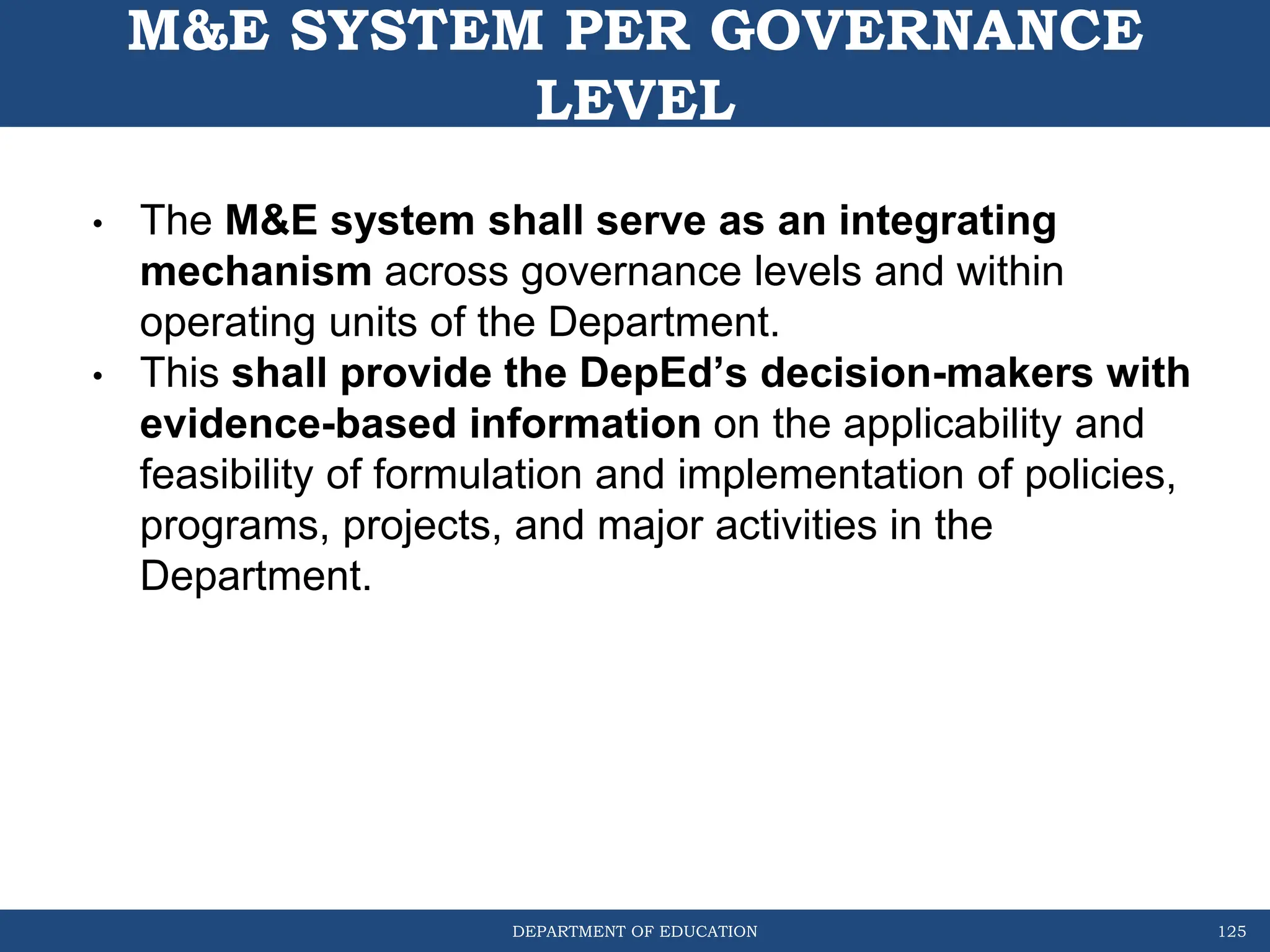
M&E SYSTEM PER GOVERNANCE
LEVEL
125
• The M&E system shall serve as an integrating
mechanism across governance levels and within
operating units of the Department.
• This shall provide the DepEd’s decision-makers with
evidence-based information on the applicability and
feasibility of formulation and implementation of policies,
programs, projects, and major activities in the
Department.
DEPARTMENT OF EDUCATION
M&E SYSTEM PER GOVERNANCE
LEVEL
126
• The vertical integration
of the M&E system
across governance
levels is the systematic
alignment of development
and implementation of
basic education plans,
policies, programs,
projects, major activities,
and M&E processes from
national to region, region
to school division, and
school division to school
level and vice versa.
National (Central Office)
Regional Office
Schools Division Office
School Level
DEPARTMENT OF EDUCATION
M&E SYSTEM PER GOVERNANCE
LEVEL
127
• The horizontal integration of the M&E system within
governance levels shall align the development and
implementation processes of basic education plans,
policies, programs, projects, major activities, and M&E
processes among operating units in a particular
governance level.
National (Central Office)/
Regional/SDO/School
Office/ Unit Office/ Unit Office/ Unit Office/ Unit
M&E SYSTEM PER GOVERNANCE LEVEL
M&E System
National
M&E system
❑ defines the scope of DepEd M&E system
❑ includes continuous review and enhancements
of performance indicators that shall ensure that
needs of all learners are addressed
Regional
M&E system
❑ensures the effective, efficient, and inclusive
implementation of all education policies &
programs and achievement of desired outcomes
❑provides the policy makers and implementers
with timely and appropriate feedback on the
implementation of DepEd policies, programs, and
delivery systems
M&E SYSTEM PER GOVERNANCE
LEVEL
M&E System
School
Division M&E
system
❑ focuses on determining effectiveness and
inclusiveness of schools in providing basic education
services
❑ serves as a mechanism for reflection on the SDO’s
capacity to provide timely and needs-based basic
education support services to schools
School M&E
system
❑ makes teaching and learning process more learner-
centered and school-based management more effective
and inclusive
❑ provides the platform for shared governance in
developing, implementing, and sustaining effective
inclusive schools
❑ provides school heads, teachers, non-teaching staff,
and communities with critical insights, lessons, and
timely information on the performance of all learners
M&E SYSTEM PER GOVERNANCE LEVEL
M&E SYSTEM PER GOVERNANCE
LEVEL
National M&E System shall:
• Establish a results-based M&E at all levels;
• Provide the mechanism for the horizontal integration of
bureaus, services and other operating units at the
national level;
• Ensure vertical integration of the M&E systems in the
region, school division, and school;
• Define the processes for validating outcomes and
accomplishments. This includes design of M&E work
processes, identification of the information needs of
internal and external stakeholders, report requirements,
and process for collecting and capturing data and
information;
131
M&E SYSTEM PER GOVERNANCE
LEVEL
National M&E System shall:
• Ensure the integration of M&E results in development
policies, programs and plans, preparation of the agency’s
financial requirements and distribution of resources;
• Facilitate exchange of information, practices, insights,
lessons and issues between and among operating units
and external stakeholders;
• Facilitate the implementation of third party evaluation of
DepEd programs and projects;
• Link M&E results to the organizational and individual
performance; and
• Ensure that BEMEF is supportive of the achievement of
DepEd goals and outcomes.
132
M&E SYSTEM PER GOVERNANCE
LEVEL
Regional M&E System shall:
• Establish a results-based M&E at the regional level;
• Ensure the horizontal integration of M&E activities of the
different operating units in the region;
• Strengthen vertical integration to link M&E systems
between region, school division and school;
• Ensure that M&E standards and processes are
implemented at the regional level;
• Evaluate the impact, effectiveness, and efficiency of
education policies and programs in the region;
133
M&E SYSTEM PER GOVERNANCE
LEVEL
Regional M&E System shall:
• Facilitate exchange of information, practices, insights,
lessons and issues between and among operating units
and external stakeholders;
• Provide feedback to CO on the regional M&E results
particularly on issues with implications for national policies
and programs;
• Ensure the integration of M&E results in developing local
programs and plans, and customizing national education
strategies and policies; and
• Link M&E results to the organizational and individual
performance.
134
M&E SYSTEM PER GOVERNANCE
LEVEL
SDO M&E System shall:
• Establish a results-based M&E at the school division level;
• Strengthen the link of M&E systems between SDO and
schools;
• Ensure the integration of M&E initiatives of SDO operating
units;
• Monitor the effective and efficient implementation of
education policies and programs;
• Ensure that M&E standards and processes are
implemented at the SDO and school levels;
135
M&E SYSTEM PER GOVERNANCE
LEVEL
SDO M&E System shall:
• Facilitate exchange of information, practices, insights,
lessons and issues between and among operating units
and external stakeholders;
• Provide feedback to RO on the SDO M&E results;
• Ensure the integration of M&E results in developing local
education plans and programs, and in implementing
national education policies and systems both at the SDO
and school levels;
• Provide M&E technical support and capacity building
intervention to schools; and
• Link M&E results to the organizational and individual
performance.
136
M&E SYSTEM PER GOVERNANCE
LEVEL
School M&E System shall:
• Ensure the periodic conduct of M&E in all school
operations and processes in accordance with existing
standards;
• Track operational bottlenecks and issues to update,
calibrate, and differentiate response every school year
and regularly examine and customize teaching strategies;
• Formalize interface between and among school head,
teachers, and non-teaching staff to discuss operational
issues and challenges;
137
M&E SYSTEM PER GOVERNANCE
LEVEL
School M&E System shall:
• Facilitate participation of learners, communities, and other
key stakeholders in the exchange of information,
practices, insights, lessons and issues;
• Maintain records of M&E results and integrate such in the
preparation of SIP, OPCRF, and other school projects and
programs;
• Report to the SDO the M&E results for appropriate
technical support; and
• Link M&E results to the organizational and individual
performance.
138
DEPARTMENT OF EDUCATION
Roles and Responsibilities of
Offices
140
ROLES AND RESPONSIBILITIES OF
OFFICES
M&E
System
Overall Lead Process Owner Responsible Offices
National Secretary Planning Service All operating units
Regional
Regional
Director
Quality Assurance
Division
All operating units
School
Division
School Division
Superintendent
Schools Governance
and Operations
Division
All operating units
School School Head School Head
All personnel and
stakeholders in the
school
OVERALL LEAD
SECRETARY
REGIONAL
DIRECTOR
SCHOOLS
DIVISION
SUPERINTENDENT
SCHOOL HEAD
● formulate
national
educational
policies, plans,
standards,
programs,
projects, and
major
activities;
● assess
national
learning
outcomes
● develop regional
basic education
plans, standards,
programs,
projects, and
major activities
● customize
national
education
strategies and
policies
● assess regional
learning
outcomes
● develop and
implement
division
education
development
plans and
programs;
● implement
national
education
policies and
systems at the
SDO and school
● the authority,
accountable, and
responsible for
ensuring that
information
generated from
the school M&E
system is used in
the development
and
implementation of
plans, programs,
projects, and
major activities to
make the school
more effective
and inclusive
OVERALL LEAD
SECRETARY
REGIONAL
DIRECTOR
SCHOOLS
DIVISION
SUPERINTENDENT
● Lead the institutionalization of the basic education national/regional and
SD M&E system;
● Provide decisions and directions on national/regional/SD education
issues and matters arising from various M&E activities such as national
PIRs, stakeholders’ forum, inter-agency meetings, among others;
● Communicate education concerns to other national/regional/SD offices
and other development partners during meetings, fora, or conferences;
● Approve educational policies (for national M&E system) and program
recommendations (for national and regional M&E systems) from internal
and external stakeholders based on evidences presented such as
completed researches, national statistics, among others; and
● Determine additional performance indicators and other adjustments
in the national M&E plan as necessary.
OVERALL LEAD
● Lead the institutionalization of the school M&E system;
● Provide decisions and directions on school issues and matters
arising from various M&E activities such as school PIRs, stakeholders’
forum, inter-agency meetings, among others;
● Communicate school concerns to the school division office during
meetings, fora, or conferences;
● Oversee the conduct of M&E activities in the school and ensure that
these are according to established standards;
● Engage different stakeholders in the conduct of school M&E
activities such as the members of the School Planning Team (SPT),
School Governance Council (SGC), among others;
SCHOOL
HEAD
OVERALL LEAD
● Conduct quarterly Program Implementation Review (PIR) in the
school to track physical and financial accomplishments and assess the
progress of implementation of plans, programs, projects, and major
activities;
● Maintain records of M&E results and integrate such in the preparation
of SIP/AIP, OPCRF, and other school programs, projects, and major
activities;
● Develop M&E plan for their respective School improvement plan;
● Prepare school M&E reports for dissemination to internal and external
stakeholders such as the School Report Card (SRC), Transparency
Board, Learning Action Cells (LAC), among others;
● Determine additional performance indicators and other adjustments
in the school M&E plan as necessary.
SCHOOL
HEAD
PROCESS OWNER
● Oversee and manage the conduct of M&E of all operating units within
their governance level and ensure that they are adhering to established
standards;
● Review and provide input to the M&E plan of DepEd offices
● Maintain a national/regional/SD database facility to ensure that data
and information gathered from M&E activities are properly managed;
● Consolidate and analyze M&E reports from central and
regional/regional and SD/ SD operating units and school for the
preparation of national/regional/SD reports to be disseminated to internal
and external stakeholders;
● Lead the conduct of quarterly Program Implementation Review (PIR)
among central and regional operating units/ regional and SD operating
units/ SD operating units and schools to track physical and financial
accomplishments and assess the progress implementation of plans,
programs, projects, and major activities
PLANNING
SERVICE
Quality Assurance
Division
School Governance and
Operations Divisions
SCHOOL
HEAD
PROCESS OWNER
● Oversee and provide assistance in the conduct of evaluations on
DepEd’s programs, projects, and major activities; and,
● Provide technical assistance and capacity building support to
central and regional operating units/ regional and SD operating units/ SD
operating units and schools on the management and conduct of M&E
within their respective M&E systems.
PLANNING
SERVICE
Quality Assurance
Division
School Governance and
Operations Divisions
RESPONSIBLE OFFICE
▪ All operating units of the Department from the national, regional,
school division, and school levels responsible to conduct M&E
▪ Establishes results-oriented and evidence-based M&E within
their respective offices
▪ Adheres to the established M&E standards in performing M&E
activities and processes
▪ Partakes in strengthening the horizontal and vertical
integration of M&E system by engaging other operating units
during development of local education plans and programs,
implementation of national education policies and systems, and
M&E
ALL CENTRAL
OFFICE UNITS
ALL REGIONAL
OFFICE UNITS
ALL SCHOOLS DIVISION
OFFICE UNITS
ALL PERSONNEL
AND
STAKEHOLDERS IN
THE SCHOOL
RESPONSIBLE OFFICE
▪ Develop M&E plan for their respective education plans, programs, and
policies
▪ Provides feedback, insights, lessons, and other issues gathered from
their respective M&E activities to relevant operating units
▪ Participates in M&E initiatives such as PIRs, periodic reporting of
accomplishments of plans and PAPs, submission of O/IPCRF, among
others
▪ Applies M&E results in improving office and individual performance
ALL CENTRAL
OFFICE UNITS
ALL REGIONAL
OFFICE UNITS
ALL SCHOOLS DIVISION
OFFICE UNITS
ALL PERSONNEL
AND
STAKEHOLDERS IN
THE SCHOOL
REFERENCES
● Amerasinghe, Nihal. (2015). “Design, Appraisal, and Management of
Sustainable Development Projects”. Manila: Asian Institute of
Management
● DepEd Order No. 88, s. 2010. 2010 Revised Manual of Regulations for
Private Schools in Basic Education
● DepEd Order No. 02, s. 2015. Guidelines on the Establishment and
Implementation of the Results-Based Performance Management System
(RPMS) in the Department of Education
● DepEd Order No. 44, s. 2015. Guidelines on the Enhanced School
Improvement Planning (SIP) Process and the School Report Card (SRC)
● DepEd Order No. 52, s. 2015. New Organizational Structures of the
Central, Regional, and SDOs of the Department of Education
● DepEd Order No. 52, s. 2016. Data Collection of Basic Education
Statistics in the Learner Information System and Enhanced Basic
Education Information System for Beginning of School Year 2016-2017
● DepEd Order No. 11, s. 2021. Guidelines on the operationalization of
Program Management Information System (PMIS)
REFERENCES
● DepEd Order No. 50, s. 2021. Creation of the Education Program
Management Office
● Department of Education-Department of Health (DepEd-DOH) Joint
Memorandum Circular (JMC) No. 01, s. 2021. Operational Guidelines on
the Implementation of Limited Face-to-Face Learning Modality
● International Federation of Red Cross and Red Crescent Societies.
2011. Project/programme monitoring and evaluation (M&E) guide.
Accessible at https://www.ifrc.org/document/projectprogramme-
monitoring-and-evaluation-guide
● National Economic and Development Authority and Department of
Budget and Management (NEDA-DBM) Joint Memorandum Circular
(JMC) No. 2015-01. National Evaluation Policy Framework of the
Philippines
● National Budget Circular (NBC) No. 565, s. 2016. Adoption of a Results-
Based Monitoring, Evaluation and Reporting Policy
REFERENCES
● Philippine Statistics Authority (PSA). Demographic and Social Statistics.
Accessible at psa.gov.ph
● Republic Act (RA) No. 8044. The Youth in Nation-Building Act. An act
creating the National Youth Commission, Establishing a National
Comprehensive and Coordinated Program on Youth Development,
Appropriating Funds Therefore, and for Other Purposes
● Republic Act (RA) No. 9155. “An Act Instituting a Framework of
Governance for Basic Education, Establishing Authority and
Accountability, Renaming the Department of Education, Culture and
Sports as the Department of Education, and for Other Purposes”
● United Nations Development Programme (UNDP). (2009). “Handbook on
Planning, Monitoring and Evaluating for Development Results”. USA:
UNDP
questions?
If you do not measure results, you cannot tell
success from failure.
If you cannot see success, you cannot reward it.
If you cannot reward success, you are probably
rewarding failure.
If you cannot see success, you cannot learn from it.
If you cannot recognize failure, you cannot correct
it.
If you can demonstrate results, you can win public
support.
(Osborne & Gaebler)
154
Thank you!
Policy Research and Development Division, Planning Service
ps.prd@deped.gov.ph
(02) 8 635 3976

the basic education monitoring and evaluation framework (bemef).pptx

  • 1.
    THE BASIC EDUCATION MONITORINGAND EVALUATION FRAMEWORK (BEMEF) Policy Research and Development Division Planning Service
  • 2.
  • 3.
    SCOPE OF BEMEF TheBasic Education Monitoring and Evaluation Framework (BEMEF) along with the structures and mechanisms, shall be adopted and implemented by all DepEd operating units in all governance levels. It identifies DepEd operating units with oversight M&E functions and articulates the M&E processes that shall be performed at each governance level.
  • 4.
    OBJECTIVE(S) The Department establishesthe BEMEF to ensure that the agency’s plans, policies, systems and processes are geared towards the achievement of organizational outcomes. This Framework sets the performance measures for the agency where all operating units are expected to contribute. This framework shall also guide DepEd bureaus, services, regional and schools division offices, schools, and learning centers in developing their respective M&E plan. Lastly, it shall define the roles and responsibilities of DepEd operating units in the M&E system and processes.
  • 5.
    GUIDING PRINCIPLES DEVELOPMENT- ORIENTED UNDERTAKEN ETHICALLY METHODOLOGICALLY- SOUND ANDAPPROPRIATE IMPROVED GOVERNANCE UTILIZATION- ORIENTED OPERATIONALLY- EFFECTIVE SHARED RESPONSIBILITY
  • 6.
    DEPARTMENT OF EDUCATION Checkfor understanding Which of the following is NOT one of the M&E guiding principles in BEMEF policy? A.Development-oriented B.Sectoral-initiated C.Undertaken ethically D.Methodologically-sound and appropriate 6
  • 7.
    DEPARTMENT OF EDUCATION7 Theory of Change (ToC)
  • 8.
    DEPARTMENT OF EDUCATION Theoryof Change (ToC) • An ongoing process of reflection to explore change and how it happens - and what it means in a particular context, sector, and/or group of people. • A theory of change is a road map of where we are going (results) and how we are getting there (process).
  • 9.
    DEPARTMENT OF EDUCATION Theoryof Change (ToC) Causal Hypothesis Question: How do I expect results to be achieved? Answer: If (inputs) produce (outputs), this should lead to (outcomes) which will ultimately contribute to the (goal).
  • 10.
    DEPARTMENT OF EDUCATION Theoryof Change (ToC) Source: Innovations for Poverty Action Theory of Change lecture slides
  • 11.
    DEPARTMENT OF EDUCATION Theoryof Change (ToC) Source: Innovations for Poverty Action Theory of Change lecture slides
  • 12.
    DEPARTMENT OF EDUCATION Theoryof Change (ToC) Source: Innovations for Poverty Action Theory of Change lecture slides
  • 13.
    DEPARTMENT OF EDUCATION Theoryof Change (ToC) Source: Innovations for Poverty Action Theory of Change lecture slides
  • 14.
    DEPARTMENT OF EDUCATION a.Input b. Output c. Outcome d. Impact / Goal 1. The immediate results of program activities. This term relates to the direct products or deliverables of program activities, such as counselling sessions completed, the people reached and the materials were distributed. This refers to an: Revised Version by PS-PRD Check for understanding
  • 15.
    DEPARTMENT OF EDUCATION a.Input b. Output c. Outcome d. Impact / Goal 2. The intermediate changes that a program effects on target audiences or populations, such as change in knowledge, attitudes, beliefs, skills, behaviors, access to services, and policies. This refers to an: Revised Version by PS-PRD Check for understanding
  • 16.
    DEPARTMENT OF EDUCATION a.Input b. Output c. Outcome d. Impact / Goal 3. The longer range, cumulative effect of programs over time on what they ultimately aim to change. Often, this effect will be a population-level education outcome such as improved school readiness. This refers to an: Revised Version by PS-PRD Check for understanding
  • 17.
    DEPARTMENT OF EDUCATION a.Input b. Output c. Outcome d. Impact / Goal 4. A resource used in a program, including financial and human resources from a variety of sources, as well as curricula, materials, etc. This refers to an: Revised Version by PS-PRD Check for understanding
  • 18.
    DEPARTMENT OF EDUCATION Checkfor understanding This component of a Theory of Change refers to direct products of program activities/inputs and may include services delivered by the program. A.Input B.Output C.Outcome D.Goal 18
  • 19.
    DEPARTMENT OF EDUCATION EXERCISE/PRACTICE ActivityInstructions ● Complete the Theory of Change of Mother Tongue- Based Multilingual Education (MTB-MLE) by filling out the boxes of appropriate objective statements. ● You can select the objective statements from the box below. Write the full objective statement in each box to build a Theory of Change for the implementation of the MTB-MLE Program. ● Take note: the arrows help you establish the causal relationship/s of the objectives under the components! ● You can accomplish this activity together with your teammates.
  • 20.
    DEPARTMENT OF EDUCATION TheContext Problem and program intervention Problem: Low literacy rates among Filipino learners Program intervention: Mother Tongue-Based Multi-Lingual Education (MTB-MLE) ● Designed to be learner-centered education from early levels (Kindergarten to Grade 3) ● Previous studies have shown that students who learn using their mother tongue language gained higher learning outcomes compared ● Using students’ first language as medium of instruction facilitates the learning of academic content and the learning of all other languages in the later grades ● Strengthens the development of the appropriate cognitive and reasoning skills EXERCISE/PRACTICE
  • 21.
    DEPARTMENT OF EDUCATION MTB-MLE a.Translated curriculum guide and teaching guide b. K-3 students can read in and comprehend in the MT c. Development of mother tongue (MT) textbooks and localized resources d. Reduced absenteeism e. Teachers trained in the MT f. Improved LAPG, ELLNA, NAT scores g. Greater class participation h. Reduced dropout i. Training of teachers to teach in the MT j. K-3 classes taught in the MT k. K-3 students can write in the MT l. Translation of curriculum guide and teaching guide to MT m. MT textbooks and localized resources produced n. Improved reading scores; higher comprehension scores o. K-3 students can compute in MT Objectives
  • 22.
    Inputs/Activities Outputs OutcomesGoal Situation/Context Analysis: Low literacy rates among Filipino learners; studies have shown that students who learn using their mother tongue language gain higher learning outcomes
  • 23.
    Inputs/Activities Outputs OutcomesGoal Situation/Context Analysis: Low literacy rates among Filipino learners; studies have shown that students who learn using their mother tongue language gain higher learning outcomes
  • 24.
  • 25.
    Inputs/Activities Outputs OutcomesGoal Development of mother tongue (MT) textbooks and localized resources Translation of curriculum guide and teaching guide to MT Training of teachers to teach in the MT MT textbooks and localized resources produced Teachers trained in the MT Translated curriculum guide and teaching guide K-3 classes taught in the MT K-3 students can write in the MT K-3 students can read in and comprehend in the MT K-3 students can compute in MT Improved reading scores; higher comprehension scores Improved LAPG, ELLNA, NAT scores Greater class participation Reduced absenteeism Situation/Context Analysis: Low literacy rates among Filipino learners; studies have shown that students who learn using their mother tongue language gain higher learning outcomes Reduced dropout
  • 26.
    GOAL All Filipinos areable to realize their full potential and contribute meaningfully to a cohesive nation SECTOR OUTCOME Basic education Filipino learners have the physical, cognitive, socio-emotional and moral preparation for civic participation and engagement in post-secondary opportunities in their local, national and global communities INTERMEDIATE OUTCOMES EQUITY Disadvantaged school-age children and youth, and adults benefited from appropriate equity initiatives QUALITY Learners complete K- 12 basic education having attained all learning standards that equip them with the necessary skills and attributes to pursue their chosen paths RESILIENCY AND WELL-BEING Learners are resilient and know their rights, and have the life skills to protect themselves, claim their rights and respect others’ rights as productive Filipino citizens ENABLING MECHANISMS-GOVERNANCE Efficient, nimble and resilient governance and management processes Basic Education M&E Framework ACCESS All school-age children, out-of- school youth, and adults accessed relevant basic learning opportunities
  • 27.
    DEPARTMENT OF EDUCATION BEMEFIntermediate Outcomes (IOs) and Enabling Mechanisms (EMs) ● The IO represents what the DepEd as an organization endeavors the learners to be while inside the basic education system in terms of access and quality. ● EM defines the necessary governance structure in terms of leadership investments, management systems, partnerships, and external relations that will ensure the effective, efficient, and responsive delivery of basic education needs of the learners. The EMs shall create the enabling conditions needed to achieve the IOs.
  • 28.
    DEPARTMENT OF EDUCATION IntermediateOutcomes IO#1: All school-age children, out-of- school youth, and adults accessed relevant basic learning opportunities Ensured that all learners, regardless of sex, religion, geography, financial disposition, have access to and are encouraged to attend schools and learning centers. This ensures that schools and learning facilities are made accessible to all types of learners. 28
  • 29.
    DEPARTMENT OF EDUCATION IntermediateOutcomes 29 IO#2: School- age children and youth, and adults in situations of disadvantaged benefited from appropriate equity initiatives Ensured that School age children and youth, and adults who are most vulnerable and disadvantaged in terms of access to learning as indicated in the eligibility of learners: indigent children, out-of-school youth, distressed individuals and families, including internally displaced personas (IDPs), low resourced students, abandoned and neglected children, street children, children of former rebels, children living in conflict-affected areas and vulnerable communities (CVAS), children with disabilities, children from Geographically Isolated and Disadvantaged Areas (GIDA) have access to schools, learning centers, and all education resources and facilities. This ensures that no child and youth is left behind in the education system and reach their full potential as active members of their communities and the Philippine society.
  • 30.
    DEPARTMENT OF EDUCATION IntermediateOutcomes IO#3: Learners complete K-12 basic education having attained all learning standards that equip them with the necessary skills and attributes to pursue their chosen paths Programs and initiatives aimed at ensuring learners benefit from their completion of the basic education cycle and from any other educational interventions, and are learning/ gaining knowledge are implemented. It recognizes that attendance to school and learning centers is not sufficient to deliver quality basic education. 30
  • 31.
    DEPARTMENT OF EDUCATION IntermediateOutcomes 31 IO#4: Learners are resilient and know their rights and have the life skills to protect themselves and claim their education rights from DepEd and other duty- bearers to promote learners’ well-being All learners in adverse contexts recover and even thrive and exercise their rights. Learners potentially exposed to hazards, shall have the capacity to adapt. This adaptation means resisting or changing in order to reach and maintain an acceptable level of functioning and structure.
  • 32.
    DEPARTMENT OF EDUCATION EnablingEnvironment EM#1: Education leaders and managers practice participative and inclusive management processes Improved capacity on participative and inclusive management processes of education leaders and managers. It ensured that design and implementation of professional development program are relevant and appropriate to the required skills and competencies. 32 EM#2: Human resources in all governance levels are sufficient, resilient, competent, and continuously improving Meet the sufficient human resource requirements at all governance levels. Ensure that the professional development standards, employee welfare and benefits standards are responsive to the demands of quality, inclusive, and rights-based education.
  • 33.
    DEPARTMENT OF EDUCATION EnablingEnvironment EM#3: Investments in basic education provide learners with the ideal learning environment Sufficient provision and equitable distribution of education resources. It also recognizes the gaps and immediate measures that need to be considered in prioritizing resources in the midst of competing education priorities to achieve equity and impact. 12 EM#4: Improve and modernize internal systems and processes for a responsive and efficient financial resource management Enhance people's capacity, functional and leadership competencies, internal systems and processes to efficiently and effectively deliver basic education services.
  • 34.
    DEPARTMENT OF EDUCATION EnablingEnvironment EM#5: Key stakeholders actively collaborate to serve learners better Ensure the collaborative engagement with key stakeholders to achieve basic education goals. This will be delivered through functional mechanisms to make partnership building and linkages more strategic and aligned to DepEd priorities. 12 EM#6: Public and private education operate under a dynamic and responsive complementarity framework Reinforce the role of private education to complement the implementation of the basic education curriculum.
  • 35.
    DEPARTMENT OF EDUCATION Checkfor understanding Which of the following is NOT one of the M&E guiding principles in BEMEF policy? A.Development-oriented B.Sectoral-initiated C.Undertaken ethically D.Methodologically-sound and appropriate 35
  • 36.
    DEPARTMENT OF EDUCATION Checkfor understanding Which intermediate outcome (IO) ensures that no child and youth is left behind in the education system and reach their full potential as active members of their communities and the Philippine society? A. Access B. Quality C. Resiliency and Well-being D. Equity E. All of the above 36
  • 37.
    DEPARTMENT OF EDUCATION DevelopingBEMEF Performance Indicators 37
  • 38.
  • 39.
    DEPARTMENT OF EDUCATION Whatcomes to your mind when you hear indicators?
  • 40.
    DEPARTMENT OF EDUCATION Howdo you determine the indicators of the program you implement?
  • 41.
    DEPARTMENT OF EDUCATION Whatis an indicator? • Indicators are signposts of change along the path to development. They describe the way to track intended results and are critical for monitoring and evaluation.
  • 42.
    DEPARTMENT OF EDUCATION 1.% of beneficiaries who think intimate partner violence is bad 2. % of beneficiaries who disagree with at least 3 of 5 statements about intimate partner violence 1. % of trainings conducted that were rated high quality by trainees 2. # of trainings conducted 1. # of farmers using improved seed varieties for the first time 2. # of farmers using improved seed varieties Which of these indicators is better? Why?
  • 43.
    DEPARTMENT OF EDUCATION 1.% of beneficiaries who think intimate partner violence is bad 2. % of beneficiaries who disagree with at least 3 of 5 statements about intimate partner violence 1. % of trainings conducted that were rated high quality by trainees 2. # of trainings conducted 1. # of farmers using improved seed varieties for the first time 2. # of farmers using improved seed varieties Which of these indicators is better? Why?
  • 44.
    DEPARTMENT OF EDUCATION Indicators •The process of formulating indicators should begin with the following questions: • How can we measure that the expected results are being achieved? • What type of information can demonstrate a positive change? • What can be feasibly monitored with given resource and capacity constraints? UNDP M&E Handbook 2009
  • 45.
    DEPARTMENT OF EDUCATION Indicators •(Continuation) The process of formulating indicators should begin with the following questions: • Will timely information be available for the different monitoring exercises? • What will the system of data collection be and who will be responsible? • Can national systems be used or augmented? • Can government indicators be used? UNDP M&E Handbook 2009
  • 46.
  • 47.
    DEPARTMENT OF EDUCATION Indicators Source:Kusek & Rist, Ten Steps, 2004, 109
  • 48.
    DEPARTMENT OF EDUCATION Indicators Quantitative Indicators ▪statistical measures that measure results in terms of: • Number • Percentage • Rate • Ratio Source: UNDP PME Handbook, 2009
  • 49.
    DEPARTMENT OF EDUCATION Indicators Qualitative Indicators ▪reflect people’s judgements, opinions, perceptions and attitudes towards a given situation or subject ▪ include changes in sensitivity, satisfaction, influence, awareness, understanding, attitudes, quality, perception, dialogue or sense of well-being ▪ measure results in terms of: • Compliance with… • Quality of… • Extent of… • Level of… Source: UNDP PME Handbook, 2009
  • 50.
    DEPARTMENT OF EDUCATION AgencyPerformance Matrix (refer to DO 29, s. 2022) 50
  • 51.
    DEPARTMENT OF EDUCATION DepEdPerformance Indicators 51 ● The Agency Performance matrix enumerates and articulates the agency performance indicators that shall measure DepEd’s organizational performance. ● This includes the description, frequency of data reporting, data disaggregation, and data source for each IO performance indicator, and includes the description, frequency of data reporting, data disaggregation, and accountable offices for each EM performance indicator
  • 52.
    DEPARTMENT OF EDUCATION DepEdPerformance Indicators 52 ● The implementation of these indicators will be divided into three tiers which are as follows: ○ Tier 1 indicators are those that are readily available in our current information systems and administrative data. ○ Tier 2 indicators are those currently under development and/or with ongoing policy initiatives. ○ Tier 3 indicators are those that are yet to be developed.
  • 53.
    DEPARTMENT OF EDUCATION Access: IO#1:All school-age children, out-of- school youth, and adults accessed relevant basic learning opportunities 53
  • 54.
    DEPARTMENT OF EDUCATION IO#1:All school-age children, out-of-school youth, and adults accessed relevant basic learning opportunities 54 Performance Indicators Description Frequency of Data Reporting Disaggregated by Data Source Tier Net Enrollment Rate (NER) NER refers to the ratio of the enrolment for the age group corresponding to the official school age in the elementary/ secondary level to the population of the same age group in a given year. Also known as Participation Rate. Annual -Governance level (national, region, division) -Level of education: Elementary, Secondary, Kindergarten; Grade 1-6; Grade 7-10; Grade 11-12 -Sex (male, female) -Gender parity index for NER -Sector (Public and Private Schools) CO: PS RO: PPRD SDO: SGOD 1
  • 55.
    DEPARTMENT OF EDUCATION IO#1:All school-age children, out-of-school youth, and adults accessed relevant basic learning opportunities 55 Performance Indicators Description Frequency of Data Reporting Disaggregated by Data Source Tier Gross Enrollment Rate (GER) GER refers to the total enrollment in a given level of education, regardless of age, as a percentage of the population who according to the national regulations should be enrolled at this level (i.e., age 6- 11 for elementary and 12-15 for secondary) Annual -Governance level (national, region, division) -Level of education: Elementary, Secondary, Kindergarten; Grade 1-6; Grade 7-10; Grade 11-12 -Sex (male, female) -Gender parity index for GER -Sector (Public and Private Schools) CO: PS RO: PPRD SDO: SGOD 1
  • 56.
    DEPARTMENT OF EDUCATION IO1.1. All five-year-old children in school 56 Performance Indicators Description Frequency of Data Reporting Disaggregated by Data Source Tier Net Intake Rate (NIR) NIR refers to the percentage of the population at the official elementary school-entrance age who are new entrants in the first grade of elementary education, and who are of the same age. Also known as the Percentage of five-year old in school Annual -Governance level (national, region, division) -Sex (male, female) -Sector (Public and Private Schools -Gender parity index for NIR CO: PS RO: PPRD SDO: SGOD 1
  • 57.
    DEPARTMENT OF EDUCATION IO1.2: All learners will stay in school and finish key stages 57 Performance Indicators Description Frequency of Data Reporting Disaggregated by Data Source Tier Retention Rate (RR) RR refers to the percentage of enrollees in the elementary/secon dary level in a given school year who continue to be in school the following year Annual -Governance level (national, region, division) -Level of education: Elementary, Secondary, Kindergarten; Grade 1-6; Grade 7-10; Grade 11-12 -Sex (male, female) -Sector (Public and Private Schools -Gender parity index for RR CO: PS RO: PPRD SDO: SGOD School: School Head 1
  • 58.
    DEPARTMENT OF EDUCATION IO1.2: All learners will stay in school and finish key stages 58 Performance Indicators Description Frequency of Data Reporting Disaggregated by Data Source Tier Dropout Rate (DR) DR refers to the percentage of pupils/students who leave school during the year for any reason as well as those who complete the previous grade/year level but fail to enroll in the next grade/year level the following school year to the total number of pupils/students enrolled during the previous school year Annual -Governance level (national, region, division) -Level of education (Elementary, Junior High School, Senior High School) -Sex (male, female) -Sector (Public and Private Schools -Gender parity index for DR CO: PS RO: PPRD SDO: SGOD School: School Head 1
  • 59.
    DEPARTMENT OF EDUCATION IO1.3: All learners transition to the next key stage 59 Performance Indicators Description Frequency of Data Reporting Disaggregated by Data Source Tier Transition Rate (TR) TR refers to the percentage of learners who graduate from one level of education and move on to the next higher level Annual -Governance level (national, region, division) -Level of education (Primary to intermediate; elementary to secondary) -Kinder to Grade 1; Grade 3 to 4; Grade 6 to 7; Grade 10 to 11 -Sex (male, female) -Sector (Public and Private Schools) -Gender parity index for TR CO: PS RO: PPRD SDO: SGOD 1
  • 60.
    DEPARTMENT OF EDUCATION IO1.4: All out-of-school children & youth participate in and complete formal or non-formal basic education learning opportunities 60 Performance Indicators Description Frequency of Data Reporting Disaggregated by Data Source Tier Participation Rate of Out-of- school children (OSC) and Out- of-school youth (OSY) Out of school children (OSC) is defined as persons aged 6-14 years who are not attending school while out-of-school youth refers to persons aged 15-30 years who are not attending school, have not finished any college or post- secondary course, and are not working Description of computation: To be developed To be developed To be developed CO: PS RO: PPRD SDO: SGOD 3
  • 61.
    DEPARTMENT OF EDUCATION IO1.4: All out-of-school children & youth participate in and complete formal or non-formal basic education learning opportunities 61 Performance Indicators Description Frequency of Data Reporting Disaggregated by Data Source Tier ALS Completion Rate Percentage of Alternative Learning System (ALS) learners who completed either elementary or secondary level in accordance with the requirements Annual - Governance level (national, region, division, school/learning center) - Sex (male, female) - Level of education (Basic Literacy, A&E elementary, A&E secondary) - Program provider (DepEd delivered, DepEd procured, DepEd partners) CO: BAE RO: CLMD SDO: CID 1
  • 62.
    DEPARTMENT OF EDUCATION Equity: IO#2: School-age children and youth, and adults in situation of disadvantage benefited from appropriate equity initiatives ves 62
  • 63.
    DEPARTMENT OF EDUCATION IO#2: School-age children and youth, and adults in situation of disadvantage benefited from appropriate equity initiatives 63 Performance Indicators Description Frequency of Data Reporting Disaggregated by Data Source Tier Proportion of learners in situation of disadvantage transition to next key stage - ELEMENTARY: % Disparity in transition rate - SECONDARY: % Disparity in transition rate Transition rate refers to the percentage of learners who graduate from one level of education and move on to the next higher level Description of computation: To be developed To be developed To be developed CO: PS RO: PPRD SDO: SGOD School: School Head 3 *Learners in situation of disadvantage refers to the who are most vulnerable and disadvantaged in terms of access to learning as indicated in the eligibility of learners: indigent children, out-of-school youth, distressed individuals and families, including internally displaced personas (IDPs), low resourced students, abandoned and neglected children, street children, children of former rebels, children living in conflict-affected areas and vulnerable communities (CVAS), children with disabilities, Children from Geographically Isolated and Disadvantaged Areas (GIDA)
  • 64.
    DEPARTMENT OF EDUCATION IO2.1: All school-age children and youth and adults in situations of disadvantage are participating in basic learning opportunities and receiving appropriate quality education 64 Performance Indicators Description Frequency of Data Reporting Disaggregated by Data Source Tier Retention rate of learners in situation of disadvantage To be developed To be developed To be developed CO: PS RO: PPRD SDO: SGOD School: School Head 3
  • 65.
    DEPARTMENT OF EDUCATION IO2.1: All school-age children and youth and adults in situations of disadvantage are participating in basic learning opportunities and receiving appropriate quality education 65 Performance Indicators Description Frequency of Data Reporting Disaggregated by Data Source Tier Percentage of learners in situations of disadvantage (disaggregated by group) achieved at least the minimum level of proficiency in (a) functional literacy, (b) numeracy, and (c) 21st century skills Reading literacy: % of learners with at least the minimum level of proficiency Numeracy: % of learners with at least the minimum level of proficiency 21st century skills: % of learners with at least the minimum level of proficiency To be developed To be developed To be developed CO: BEA RO: CLMD SDO: CID 3
  • 66.
    DEPARTMENT OF EDUCATION Quality: IO#3: Learners complete K-12 basic education having attained all learning standards that equip them with the necessary skills and attributes to pursue their chosen paths 66
  • 67.
    DEPARTMENT OF EDUCATION IO#3: Learners complete K-12 basic education having attained all learning standards that equip them with the necessary skills and attributes to pursue their chosen paths 67 Performance Indicators Description Frequency of Data Reporting Disaggregated by Data Source Tier Completion Rate (CR) CR refers to the percentage of first grade level entrants in a level of education who graduate the level (elementary or secondary) in accordance with the required number of years of study Annual - Governance level (national, region, division) - Level of education: Elementary, Secondary, Kindergarten; Grade 1-6; Grade 7-10; Grade 11-12 - Sex (male, female) - Sector (Public and Private Schools) - Per program (IPEd, SPED, Madrasah, Special Interest Programs) -Gender parity index for CR CO: PS RO: PPRD SDO: SGOD 1
  • 68.
    DEPARTMENT OF EDUCATION IO3.1: Learners attained Stage 1 learning standards of fundamental reading and numeracy skills 68 Performance Indicators Description Frequency of Data Reporting Disaggregated by Data Source Tier Percentage of learners attaining at least the minimum level of proficiency in Reading and Listening comprehension increased Percentage of learners achieving at least the minimum level of proficiency in -English -Filipino -Mother Tongue (except Tagalog) -Numeracy Refers to the number of learners attaining at least the minimum level of proficiency in Reading and listening comprehensions over the total number of learners. Annual - Governance level (national, region, division, school) - Level of education: Elementary, Secondary, Kindergarten; Grade 1-6; Grade 7-10; Grade 11-12 - Sex (male, female) - Learning area: English, Filipino, Mother Tongue (except Tagalog), Numeracy/Math - Sector: Public and Private Schools CO: BEA RO: CLMD SDO: CID 1 Proficiency in reading and listening comprehensions include the proficiency in English, Filipino, Mother Tongue (excluding Tagalog) and numeracy
  • 69.
    DEPARTMENT OF EDUCATION IO3.2: Learners attain Stage 2 (Grade 6) learning standards of literacy & numeracy skills and apply 21st century skills to various situations 69 Performance Indicators Description Frequency of Data Reporting Disaggregated by Data Source Tier Percentage of learners attaining at least the minimum level of proficiency in Stage 2 literacy and numeracy standards Refers to the number of Grade 6 learners attaining at least the minimum level of proficiency in Stage 2 literacy and numeracy standards over the total number of Grade 6 learners Annual - Governance level (national, region, division) - Sex (male, female) - Sector (Public and Private Schools CO: BEA RO: CLMD SDO: CID 1
  • 70.
    DEPARTMENT OF EDUCATION IO3.3: Learners attain Stage 3 (Grades 7-10) learning standards of literacy & numeracy skills and apply 21st century skills to various situations 70 Performance Indicators Description Frequency of Data Reporting Disaggregated by Data Source Tier Percentage of G10 learners attaining at least the minimum level of proficiency in Stage 3 literacy and numeracy standards Refers to the number of Grade 10 learners attaining at least the minimum level of proficiency in Stage 3 literacy and numeracy standards over the total number of Grade 10 learners Annual - Governance level (national, region, division) - Sex (male, female) - Sector (Public and Private Schools CO: BEA RO: CLMD SDO: CID 1
  • 71.
    DEPARTMENT OF EDUCATION IO3.4: Learners attain Stage 4 (Grades 11-12) learning standards equipped with knowledge and 21st century competencies developed in their chosen core, applied, and specialized SHS tracks 71 Performance Indicators Description Frequency of Data Reporting Disaggregated by Data Source Tier Percentage of Grade 12 learners attaining at least the minimum level of proficiency in Stage 4 SHS core areas Refers to the number of Grade 12 learners attaining at least the minimum level of proficiency in Stage 4 SHS core areas over the total number of Grade 12 learners Annual - Governance level (national, region, division) - Sex (male, female) - Sector (Public and Private Schools CO: BEA RO: CLMD SDO: CID 1
  • 72.
    DEPARTMENT OF EDUCATION IO3.5: Learners in the Alternative Learning System attain certification as Elementary or Junior High School completers 72 Performance Indicators Description Frequency of Data Reporting Disaggregated by Data Source Tier ALS A&E passing rate Refers to the percentage of ALS learners who passed the Accreditation & Equivalency (A&E) test Annual - Governance level (national, region, division, school/learning center) - Level of Education (A&E elementary, A&E Junior High School, A&E Senior High School) - Sex (male, female) - Program provider (DepEd delivered, DepEd procured, DepEd partners) - ALS Delivery Mode (Modular, Home Tutorial, 1-2 Meetings per week) CO: BAE RO: CLMD SDO: CID 1
  • 73.
    DEPARTMENT OF EDUCATION Resiliencyand Well-being: IO #4: Learners are resilient and know their rights, and have the life skills to protect themselves, claim their rights and respect others’ rights as productive Filipino citizens 73
  • 74.
    DEPARTMENT OF EDUCATION IO#4: Learners are resilient and know their rights, and have the life skills to protect themselves, claim their rights and respect others’ rights as productive Filipino citizens 74 Performance Indicators Description Frequency of Data Reporting Disaggregated by Data Source Tier Learners satisfaction rating on Rights-based Education (RbE) To be developed To be developed To be developed CO: Child Rights in Education Desk – Legal Affairs; Child Protection Unit; DRRMS; BLSS 3
  • 75.
    DEPARTMENT OF EDUCATION Checkfor understanding Your office at the Central Office wants to explore the transition rate in Region 11 to understand its relationship to the access programs in DepEd. Which functional office should you reach out to to request for the data? A. Policy, Planning, and Research Division of Region 11 B. Bureau of Education Assessment C. Planning Service D. Office of the Secretary 75
  • 76.
    DEPARTMENT OF EDUCATION Checkfor understanding In your regional office, if you want to explore the transition rate in your region to understand its relationship to the access programs in DepEd. Which functional office should you reach out to to request for the data? A. Policy, Planning, and Research Division B. Curriculum Learning and Management Division C. Planning Service-EMISD D. SGOD 76
  • 77.
    DEPARTMENT OF EDUCATION EnablingMechanisms (EM)- Governance Efficient, nimble and resilient governance and management processes 77
  • 78.
    DEPARTMENT OF EDUCATION EM#1. Education leaders and managers practice participative and inclusive management processes 78 Performance Indicators Description Frequency of Data Reporting Disaggregated by Accountable Office Tier Proportion of schools achieving the ideal SBM level of practice School-Based Management (SBM) is a DepEd thrust that decentralizes decision-making from the Central Office and field offices to individual schools to enable them to better respond to their specific education needs. SBM standards and assessment tools are guided by DepEd’s Vision, Mission and Core Values. SBM practice is ascertained by the existence of structured mechanisms, processes, and practices in all indicators. Description of computation: To be developed To be developed To be developed CO: BHROD RO: FTAD SDO: SGOD School: School Head 2
  • 79.
    DEPARTMENT OF EDUCATION EM#2. Human resources in all governance levels are sufficient, resilient, competent, and continuously improving 79 Performance Indicators Description Frequency of Data Reporting Disaggregated by Accountable Office Tier Proportion of offices across governance levels with at least satisfactory in the Office Performance Commitment and Review Form (OPCRF) The OPCRF is accomplished by the head of office and reflects office commitments and performance. Description of computation: To be developed To be developed To be developed CO: BHROD 2
  • 80.
    DEPARTMENT OF EDUCATION EM#3. Investments in basic education provide learners with the ideal learning environment 80 Performance Indicators Description Frequency of Data Reporting Disaggregated by Accountable Office Tier Proportion of schools and community learning centers (CLCs) achieving ideal ratio on: -Classroom -Teachers -Learning resources and learning materials (LRs and LMs) -Seats -Science and Math equipment -Multimedia package Proportion of schools with ideal ratio refers to the number of schools with ideal ratio on the requirements for classroom, teachers, LRs/LMs, seats, Science and Math equipment, multimedia package over the total number of DepEd schools. Ideal ratio for classroom, teachers, LRs/LMs, seats, Science and Math Equipment, multimedia package shall be based on the planning standards set by the Department. Annual - Governance level (national, region, division, school) - Level of education: Elementary, Secondary, Kindergarten; Grade 1-6; Grade 7-10; Grade11-12 - Sector (Public and Private Schools) CO: Physical facilities Division (classroom); Planning Service (teachers); BLR (textbooks); Procurement Office (Seats, Science and Math Equipment); ICTS (ICT package/eclass room) 1
  • 81.
    DEPARTMENT OF EDUCATION EM#3. Investments in basic education provide learners with the ideal learning environment 81 Performance Indicators Description Frequency of Data Reporting Disaggregated by Accountable Office Tier Proportion of schools with: -Connection to electricity -Connection to internet -Water and Sanitation (WatSan) facility - Water source Percentage of schools (elementary and secondary) with -connection to electricity -connection to internet -WatSan facility -Water source over the total number of schools in that level Annual - Governance level (national, region, division, school) - Level of education: Elementary, Secondary, Kindergarten; Grade 1-6; Grade 7-10; Grade 11-12 CO: ICTS (internet); Physical facilities (electricity) 1
  • 82.
    DEPARTMENT OF EDUCATION EM#3. Investments in basic education provide learners with the ideal learning environment 82 Performance Indicators Description Frequency of Data Reporting Disaggregated by Accountable Office Tier Proportion of schools with: -functional library -faculty’s/teachers room To be developed To be developed To be developed To be determined 3
  • 83.
    DEPARTMENT OF EDUCATION EM#3. Investments in basic education provide learners with the ideal learning environment 83 Performance Indicators Description Frequency of Data Reporting Disaggregated by Accountable Office Tier Proportion of SDOs achieving ideal interquartile ratio (IQR) *on teacher deployment IQR is a measure of inequality in the distribution of teachers. It compares pupils/students with the most favorable teacher-student ratios with groups of students whose schools have the most unfavorable teacher-student ratios. A national IQR in both elementary and secondary education greater than 2 indicates that the most favored pupils/students have teacher ratios twice better than the least favored. Annual - Governance level (national, region, division, school) - Level of education (Kinder; G1-G6, G7-G10, G11-G12) CO: PS 1
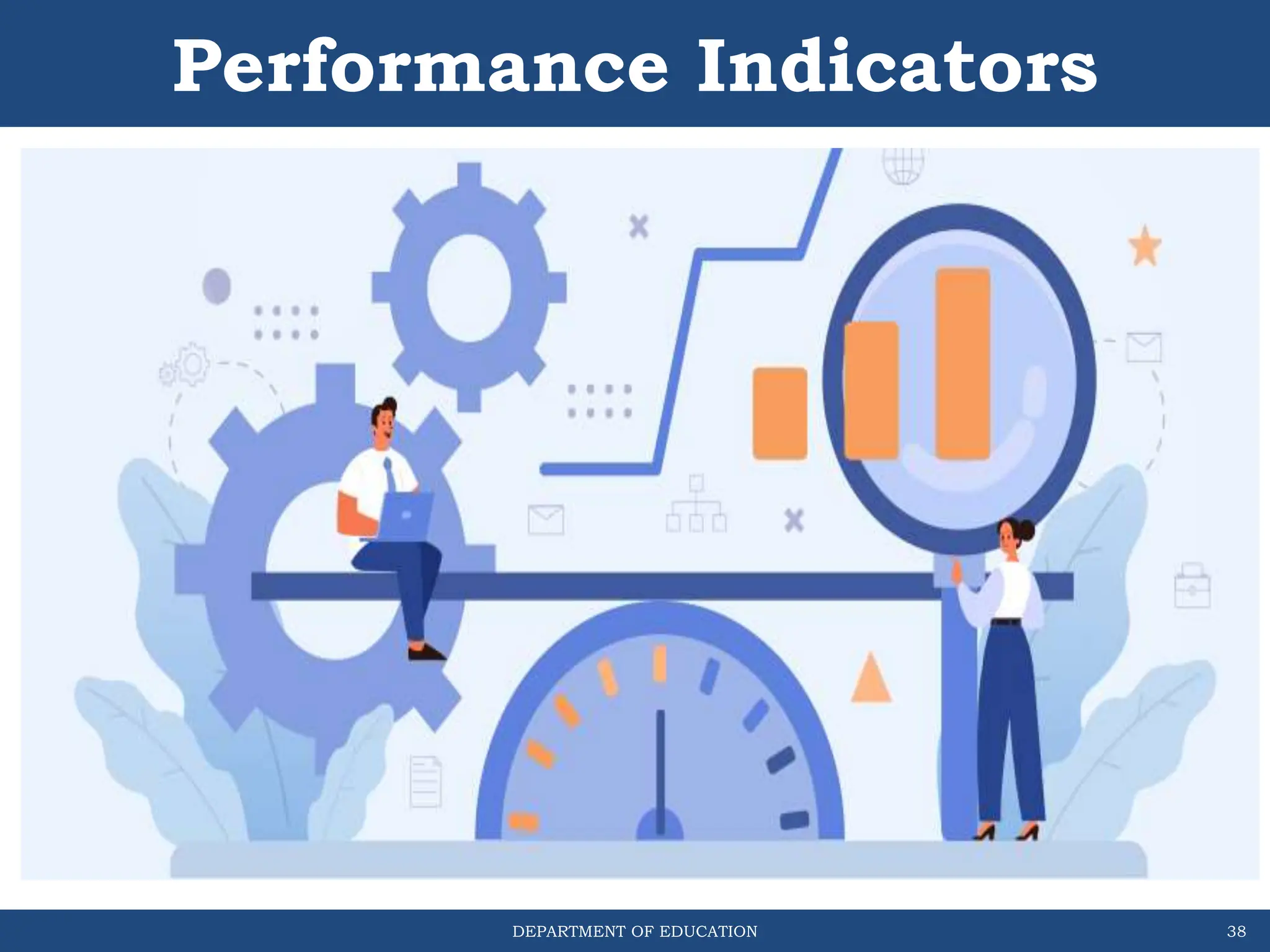
  • 84.
    DEPARTMENT OF EDUCATION EM#4. Improve and modernize internal systems and processes for a responsive and efficient financial resource management 84 Performance Indicators Description Frequency of Data Reporting Disaggregated by Accountable Office Tier Client satisfactory rating of DepEd offices’ respective stakeholders (internal & external) To be developed To be developed To be developed CO: PS RO: QAD SDO: SGOD 3
  • 85.
    DEPARTMENT OF EDUCATION EM#5. Key stakeholders actively collaborate to serve learners better 85 Performance Indicators Description Frequency of Data Reporting Disaggregated by Accountable Office Tier Percentage increase of financial contribution of development partners (i.e., international and local partners) To be developed To be developed To be developed CO: Finance Service, PMS, and EPS 3 Proportion of schools with functional School Governing Council (SGC) To be developed To be developed To be developed CO: BHROD 2
  • 86.
    DEPARTMENT OF EDUCATION EM#6. Public and private education operate under a dynamic and responsive complementarity framework 86 Performance Indicators Description Frequency of Data Reporting Disaggregated by Accountable Office Tier Proportion of eligible private schools receiving government assistance Government assistance refers to the Government Assistance to Students and Teachers in Private Education or GASTPE. The GASTPE program includes the -Education Service Contracting (ESC) -Teachers’ Salary Subsidy (TSS) -Senior High School Voucher Program (SHS VP) -In-Service Training (INSET) Research Description of computation: To be developed To be developed To be developed CO: Private Education Office 2
  • 87.
    DEPARTMENT OF EDUCATION EM#6. Public and private education operate under a dynamic and responsive complementarity framework 87 Performance Indicators Description Frequency of Data Reporting Disaggregated by Accountable Office Tier Proportion of teachers in private schools receiving teacher subsidy Teachers’ Salary Subsidy (TSS) is a GASTPE program wherein an annual salary subsidy is given to licensed teachers in ESC-participating JHSs. These teachers are called TSS recipients. Description of computation: To be developed To be developed To be developed CO: Private Education Office 2
  • 88.
    DEPARTMENT OF EDUCATION EM#6. Public and private education operate under a dynamic and responsive complementarity framework 88 Performance Indicators Description Frequency of Data Reporting Disaggregated by Accountable Office Tier Percentage of recognized schools or schools with recognition Recognition comes after the establishment of a private educational institution. Recognition presumes an existing school and refers to the authorization granted by the Department for the school to conduct educational programs or operations. The grant of recognition for schools shall be based on its satisfactory operation during the school year, without any deficiencies in instruction, administration and/or management and on full compliance with the prescribed requirements of the course15 Description of computation: To be developed To be developed To be developed CO: Private Education Office 2
  • 89.
    DEPARTMENT OF EDUCATION AgencyPerformance Matrix (refer to DO 29, s. 2022) 89
  • 90.
    DEPARTMENT OF EDUCATION Monitoringand Evaluation (M&E) Mechanism 90
  • 91.
    DEPARTMENT OF EDUCATION •How do you collect data in your M&E initiatives? • What are the challenges in collecting the data? Think-Pair-Share 91 Look for a partner to talk about your answer. Share with the whole group you and your partner’s practices
  • 92.
    DEPARTMENT OF EDUCATION ●How do you collect data in your M&E initiatives? ● What are the challenges in collecting the data? Think and Share 92
  • 93.
    DEPARTMENT OF EDUCATION Monitoringand Evaluation • Monitoring explains the efficiency and effectiveness of operations while evaluation provides information on the benefits achieved • Monitoring results provide bases for critical management decisions such as resource allocation or realignment, target setting, remedial/corrective actions or strategy development. • Evaluation results provide valuable lessons and insights that can be used by managers in crafting strategic decisions for the future such as in designing organizational changes or future programs and/or projects.
  • 94.
    DEPARTMENT OF EDUCATION Theoryof Change (ToC) Source: Innovations for Poverty Action Theory of Change lecture slides
  • 95.
    DEPARTMENT OF EDUCATION Theoryof Change (ToC) Source: Innovations for Poverty Action Theory of Change lecture slides
  • 96.
    DEPARTMENT OF EDUCATION Typesof M&E • Monitoring • Results Evaluation • Process Evaluation
  • 97.
    DEPARTMENT OF EDUCATION Typesof M&E • A systematic and objective assessment of an on- going implementation of plans, programs, projects, and major activities. • Aims to steer implementation as efficiently as possible based on empirical facts determined through verifiable assessment process, systematic observation and documentation. • Also determines any adjustment of plans and activities needed to achieve the committed targets. • Monitoring may be done on a weekly, monthly, or quarterly basis depending on the M&E Plan. Monitoring
  • 98.
    DEPARTMENT OF EDUCATION Typesof M&E • The Program Management Information System (PMIS) is one of the mechanisms in doing monitoring and currently the official source of data on programs, projects and activities (PPAs) from planning to implementation. • In support of monitoring and evaluation, Program Implementation Review (PIR) is established as the reporting platform. The PIR is conducted on a quarterly basis to report the accomplishments of outputs in terms of efficiency, and corresponding utilization of the budget. DepEd Monitoring
  • 99.
  • 100.
  • 101.
    DEPARTMENT OF EDUCATION Typesof M&E • This is an evaluation approach that focuses on measuring the realization of results. • It seeks to assess the outcomes and changes brought about by program or project interventions. • Findings from this type of evaluation are used as the baseline situation for the next planning cycle. Results Evaluation
  • 102.
    DEPARTMENT OF EDUCATION Typesof M&E • Did the program succeed in helping teachers to use ICT in teaching and learning process? • Was the program more successful with certain groups of people than with others? • What aspects of the program did participants find gave the greatest benefit? Results Evaluation Sample questions to ask…
  • 103.
  • 104.
    DEPARTMENT OF EDUCATION Typesof M&E • Determines the effectiveness and efficiency of the implementation processes and systems. • This could be conducted at any phase of the plan implementation and could be combined with other types of monitoring. • Through this evaluation, issues and challenges in program, project, and activity deliveries can be addressed. Process Evaluation
  • 105.
    DEPARTMENT OF EDUCATION Typesof M&E • What were specific interventions put into place by the program to fight the problem being tackled? Did the interventions work or not — and how and why? • What were the kinds of problems encountered in delivering the program — were there enough resources from the beginning to do it well? Was it well managed? Were staff trained or educated to the right level of the program design? Is there skill at facilitating the program processes from beginning to end? Was there adequate support to the program? Process Evaluation Sample questions to ask…
  • 106.
  • 107.
  • 108.
    DEPARTMENT OF EDUCATION Checkfor understanding CLMD of Region V aims to determine the extent of implementation of limited F2F class to identify best practices, issues and areas for improvement. What types of M&E will they use? A. Monitoring of outputs B. Process Evaluation C. Results Evaluation D. All of the above 109
  • 109.
  • 110.
  • 111.
    DEPARTMENT OF EDUCATION Howdo you prepare for the conduct of M&E? 112
  • 112.
    DEPARTMENT OF EDUCATION Operationalizingthe M&E • In operationalizing the conduct of M&E, all operating units are required to develop M&E Plans for their respective education plans, programs, and policies. • The M&E Plan is a document that provides guidance on the purpose and process of conducting monitoring and evaluation of any programs, policies, projects, office mandates, and activities. • The M&E plan contains four (4) core M&E processes.
  • 113.
    M&E CORE PROCESSES I.Establishment of Purpose and Scope II. Data Collection and Management III. Data Analysis IV. Information Dissemination, Reporting, and Utilization
  • 114.
    I. Establishment of Purposeand Scope Guide Questions • What should you be monitoring and evaluating? • What are the corresponding indicators? M&E CORE PROCESSES Reference point for the M&E system, guiding key decisions such as informational needs, methodological approaches, capacity building and allocation of resources.
  • 115.
    M&E CORE PROCESSES Sample:Core Process 1 of BEMEF
  • 116.
    II. Data Collectionand Management Guide Questions • What are the possible sources of data? • Who (office/personnel) is responsible in data collection? • How frequent will you collect this data? • How will you organize and store the collected data? • Who are the possible users of the data (internal and external) and what are the possible uses of these data? M&E CORE PROCESSES Collection or gathering of relevant data to be managed for analysis. It involves processes and systems for how a project/program will systematically and reliably store, manage and access M&E data.
  • 117.
    M&E CORE PROCESSES Sample:Core Process 2 of BEMEF
  • 118.
    III. Data Analysis Processof converting collected (raw) data into usable information. It Involves looking for trends, clusters or other relationships between different types of data, assessing performance against plans and targets, forming conclusions, anticipating problems and identifying solutions and best practices. M&E CORE PROCESSES Guide Questions • How will you process and analyze the data that you have collected? • Who are responsible in data analysis? • How often do you conduct data analysis?
  • 119.
    M&E CORE PROCESSES Sample:Core Process 3 of BEMEF
  • 120.
    IV. Information Dissemination, Reporting, and Utilization Themost visible part of the M&E system. Collected and analyzed data is presented as information for use of key stakeholders. M&E CORE PROCESSES Guide Questions • To whom will you communicate the M&E results? (identifying type of stakeholder/audience • How will you communicate the results? What are communication / reporting strategies will you employ? • When do you report M&E results?
  • 121.
    M&E CORE PROCESSES Sample:Core Process 4 of BEMEF
  • 122.
    DEPARTMENT OF EDUCATION M&ECore Processes • The development of tools for data collection/requirements shall be guided by the M&E Plan to be established per program, policy, and plan.
  • 123.
    DEPARTMENT OF EDUCATION M&ESYSTEM PER GOVERNANCE LEVEL 124
  • 124.
    DEPARTMENT OF EDUCATION M&ESYSTEM PER GOVERNANCE LEVEL 125 • The M&E system shall serve as an integrating mechanism across governance levels and within operating units of the Department. • This shall provide the DepEd’s decision-makers with evidence-based information on the applicability and feasibility of formulation and implementation of policies, programs, projects, and major activities in the Department.
  • 125.
    DEPARTMENT OF EDUCATION M&ESYSTEM PER GOVERNANCE LEVEL 126 • The vertical integration of the M&E system across governance levels is the systematic alignment of development and implementation of basic education plans, policies, programs, projects, major activities, and M&E processes from national to region, region to school division, and school division to school level and vice versa. National (Central Office) Regional Office Schools Division Office School Level
  • 126.
    DEPARTMENT OF EDUCATION M&ESYSTEM PER GOVERNANCE LEVEL 127 • The horizontal integration of the M&E system within governance levels shall align the development and implementation processes of basic education plans, policies, programs, projects, major activities, and M&E processes among operating units in a particular governance level. National (Central Office)/ Regional/SDO/School Office/ Unit Office/ Unit Office/ Unit Office/ Unit
  • 127.
    M&E SYSTEM PERGOVERNANCE LEVEL M&E System National M&E system ❑ defines the scope of DepEd M&E system ❑ includes continuous review and enhancements of performance indicators that shall ensure that needs of all learners are addressed Regional M&E system ❑ensures the effective, efficient, and inclusive implementation of all education policies & programs and achievement of desired outcomes ❑provides the policy makers and implementers with timely and appropriate feedback on the implementation of DepEd policies, programs, and delivery systems
  • 128.
    M&E SYSTEM PERGOVERNANCE LEVEL M&E System School Division M&E system ❑ focuses on determining effectiveness and inclusiveness of schools in providing basic education services ❑ serves as a mechanism for reflection on the SDO’s capacity to provide timely and needs-based basic education support services to schools School M&E system ❑ makes teaching and learning process more learner- centered and school-based management more effective and inclusive ❑ provides the platform for shared governance in developing, implementing, and sustaining effective inclusive schools ❑ provides school heads, teachers, non-teaching staff, and communities with critical insights, lessons, and timely information on the performance of all learners M&E SYSTEM PER GOVERNANCE LEVEL
  • 129.
    M&E SYSTEM PERGOVERNANCE LEVEL National M&E System shall: • Establish a results-based M&E at all levels; • Provide the mechanism for the horizontal integration of bureaus, services and other operating units at the national level; • Ensure vertical integration of the M&E systems in the region, school division, and school; • Define the processes for validating outcomes and accomplishments. This includes design of M&E work processes, identification of the information needs of internal and external stakeholders, report requirements, and process for collecting and capturing data and information; 131
  • 130.
    M&E SYSTEM PERGOVERNANCE LEVEL National M&E System shall: • Ensure the integration of M&E results in development policies, programs and plans, preparation of the agency’s financial requirements and distribution of resources; • Facilitate exchange of information, practices, insights, lessons and issues between and among operating units and external stakeholders; • Facilitate the implementation of third party evaluation of DepEd programs and projects; • Link M&E results to the organizational and individual performance; and • Ensure that BEMEF is supportive of the achievement of DepEd goals and outcomes. 132
  • 131.
    M&E SYSTEM PERGOVERNANCE LEVEL Regional M&E System shall: • Establish a results-based M&E at the regional level; • Ensure the horizontal integration of M&E activities of the different operating units in the region; • Strengthen vertical integration to link M&E systems between region, school division and school; • Ensure that M&E standards and processes are implemented at the regional level; • Evaluate the impact, effectiveness, and efficiency of education policies and programs in the region; 133
  • 132.
    M&E SYSTEM PERGOVERNANCE LEVEL Regional M&E System shall: • Facilitate exchange of information, practices, insights, lessons and issues between and among operating units and external stakeholders; • Provide feedback to CO on the regional M&E results particularly on issues with implications for national policies and programs; • Ensure the integration of M&E results in developing local programs and plans, and customizing national education strategies and policies; and • Link M&E results to the organizational and individual performance. 134
  • 133.
    M&E SYSTEM PERGOVERNANCE LEVEL SDO M&E System shall: • Establish a results-based M&E at the school division level; • Strengthen the link of M&E systems between SDO and schools; • Ensure the integration of M&E initiatives of SDO operating units; • Monitor the effective and efficient implementation of education policies and programs; • Ensure that M&E standards and processes are implemented at the SDO and school levels; 135
  • 134.
    M&E SYSTEM PERGOVERNANCE LEVEL SDO M&E System shall: • Facilitate exchange of information, practices, insights, lessons and issues between and among operating units and external stakeholders; • Provide feedback to RO on the SDO M&E results; • Ensure the integration of M&E results in developing local education plans and programs, and in implementing national education policies and systems both at the SDO and school levels; • Provide M&E technical support and capacity building intervention to schools; and • Link M&E results to the organizational and individual performance. 136
  • 135.
    M&E SYSTEM PERGOVERNANCE LEVEL School M&E System shall: • Ensure the periodic conduct of M&E in all school operations and processes in accordance with existing standards; • Track operational bottlenecks and issues to update, calibrate, and differentiate response every school year and regularly examine and customize teaching strategies; • Formalize interface between and among school head, teachers, and non-teaching staff to discuss operational issues and challenges; 137
  • 136.
    M&E SYSTEM PERGOVERNANCE LEVEL School M&E System shall: • Facilitate participation of learners, communities, and other key stakeholders in the exchange of information, practices, insights, lessons and issues; • Maintain records of M&E results and integrate such in the preparation of SIP, OPCRF, and other school projects and programs; • Report to the SDO the M&E results for appropriate technical support; and • Link M&E results to the organizational and individual performance. 138
  • 137.
    DEPARTMENT OF EDUCATION Rolesand Responsibilities of Offices 140
  • 138.
    ROLES AND RESPONSIBILITIESOF OFFICES M&E System Overall Lead Process Owner Responsible Offices National Secretary Planning Service All operating units Regional Regional Director Quality Assurance Division All operating units School Division School Division Superintendent Schools Governance and Operations Division All operating units School School Head School Head All personnel and stakeholders in the school
  • 139.
    OVERALL LEAD SECRETARY REGIONAL DIRECTOR SCHOOLS DIVISION SUPERINTENDENT SCHOOL HEAD ●formulate national educational policies, plans, standards, programs, projects, and major activities; ● assess national learning outcomes ● develop regional basic education plans, standards, programs, projects, and major activities ● customize national education strategies and policies ● assess regional learning outcomes ● develop and implement division education development plans and programs; ● implement national education policies and systems at the SDO and school ● the authority, accountable, and responsible for ensuring that information generated from the school M&E system is used in the development and implementation of plans, programs, projects, and major activities to make the school more effective and inclusive
  • 140.
    OVERALL LEAD SECRETARY REGIONAL DIRECTOR SCHOOLS DIVISION SUPERINTENDENT ● Leadthe institutionalization of the basic education national/regional and SD M&E system; ● Provide decisions and directions on national/regional/SD education issues and matters arising from various M&E activities such as national PIRs, stakeholders’ forum, inter-agency meetings, among others; ● Communicate education concerns to other national/regional/SD offices and other development partners during meetings, fora, or conferences; ● Approve educational policies (for national M&E system) and program recommendations (for national and regional M&E systems) from internal and external stakeholders based on evidences presented such as completed researches, national statistics, among others; and ● Determine additional performance indicators and other adjustments in the national M&E plan as necessary.
  • 141.
    OVERALL LEAD ● Leadthe institutionalization of the school M&E system; ● Provide decisions and directions on school issues and matters arising from various M&E activities such as school PIRs, stakeholders’ forum, inter-agency meetings, among others; ● Communicate school concerns to the school division office during meetings, fora, or conferences; ● Oversee the conduct of M&E activities in the school and ensure that these are according to established standards; ● Engage different stakeholders in the conduct of school M&E activities such as the members of the School Planning Team (SPT), School Governance Council (SGC), among others; SCHOOL HEAD
  • 142.
    OVERALL LEAD ● Conductquarterly Program Implementation Review (PIR) in the school to track physical and financial accomplishments and assess the progress of implementation of plans, programs, projects, and major activities; ● Maintain records of M&E results and integrate such in the preparation of SIP/AIP, OPCRF, and other school programs, projects, and major activities; ● Develop M&E plan for their respective School improvement plan; ● Prepare school M&E reports for dissemination to internal and external stakeholders such as the School Report Card (SRC), Transparency Board, Learning Action Cells (LAC), among others; ● Determine additional performance indicators and other adjustments in the school M&E plan as necessary. SCHOOL HEAD
  • 143.
    PROCESS OWNER ● Overseeand manage the conduct of M&E of all operating units within their governance level and ensure that they are adhering to established standards; ● Review and provide input to the M&E plan of DepEd offices ● Maintain a national/regional/SD database facility to ensure that data and information gathered from M&E activities are properly managed; ● Consolidate and analyze M&E reports from central and regional/regional and SD/ SD operating units and school for the preparation of national/regional/SD reports to be disseminated to internal and external stakeholders; ● Lead the conduct of quarterly Program Implementation Review (PIR) among central and regional operating units/ regional and SD operating units/ SD operating units and schools to track physical and financial accomplishments and assess the progress implementation of plans, programs, projects, and major activities PLANNING SERVICE Quality Assurance Division School Governance and Operations Divisions SCHOOL HEAD
  • 144.
    PROCESS OWNER ● Overseeand provide assistance in the conduct of evaluations on DepEd’s programs, projects, and major activities; and, ● Provide technical assistance and capacity building support to central and regional operating units/ regional and SD operating units/ SD operating units and schools on the management and conduct of M&E within their respective M&E systems. PLANNING SERVICE Quality Assurance Division School Governance and Operations Divisions
  • 145.
    RESPONSIBLE OFFICE ▪ Alloperating units of the Department from the national, regional, school division, and school levels responsible to conduct M&E ▪ Establishes results-oriented and evidence-based M&E within their respective offices ▪ Adheres to the established M&E standards in performing M&E activities and processes ▪ Partakes in strengthening the horizontal and vertical integration of M&E system by engaging other operating units during development of local education plans and programs, implementation of national education policies and systems, and M&E ALL CENTRAL OFFICE UNITS ALL REGIONAL OFFICE UNITS ALL SCHOOLS DIVISION OFFICE UNITS ALL PERSONNEL AND STAKEHOLDERS IN THE SCHOOL
  • 146.
    RESPONSIBLE OFFICE ▪ DevelopM&E plan for their respective education plans, programs, and policies ▪ Provides feedback, insights, lessons, and other issues gathered from their respective M&E activities to relevant operating units ▪ Participates in M&E initiatives such as PIRs, periodic reporting of accomplishments of plans and PAPs, submission of O/IPCRF, among others ▪ Applies M&E results in improving office and individual performance ALL CENTRAL OFFICE UNITS ALL REGIONAL OFFICE UNITS ALL SCHOOLS DIVISION OFFICE UNITS ALL PERSONNEL AND STAKEHOLDERS IN THE SCHOOL
  • 147.
    REFERENCES ● Amerasinghe, Nihal.(2015). “Design, Appraisal, and Management of Sustainable Development Projects”. Manila: Asian Institute of Management ● DepEd Order No. 88, s. 2010. 2010 Revised Manual of Regulations for Private Schools in Basic Education ● DepEd Order No. 02, s. 2015. Guidelines on the Establishment and Implementation of the Results-Based Performance Management System (RPMS) in the Department of Education ● DepEd Order No. 44, s. 2015. Guidelines on the Enhanced School Improvement Planning (SIP) Process and the School Report Card (SRC) ● DepEd Order No. 52, s. 2015. New Organizational Structures of the Central, Regional, and SDOs of the Department of Education ● DepEd Order No. 52, s. 2016. Data Collection of Basic Education Statistics in the Learner Information System and Enhanced Basic Education Information System for Beginning of School Year 2016-2017 ● DepEd Order No. 11, s. 2021. Guidelines on the operationalization of Program Management Information System (PMIS)
  • 148.
    REFERENCES ● DepEd OrderNo. 50, s. 2021. Creation of the Education Program Management Office ● Department of Education-Department of Health (DepEd-DOH) Joint Memorandum Circular (JMC) No. 01, s. 2021. Operational Guidelines on the Implementation of Limited Face-to-Face Learning Modality ● International Federation of Red Cross and Red Crescent Societies. 2011. Project/programme monitoring and evaluation (M&E) guide. Accessible at https://www.ifrc.org/document/projectprogramme- monitoring-and-evaluation-guide ● National Economic and Development Authority and Department of Budget and Management (NEDA-DBM) Joint Memorandum Circular (JMC) No. 2015-01. National Evaluation Policy Framework of the Philippines ● National Budget Circular (NBC) No. 565, s. 2016. Adoption of a Results- Based Monitoring, Evaluation and Reporting Policy
  • 149.
    REFERENCES ● Philippine StatisticsAuthority (PSA). Demographic and Social Statistics. Accessible at psa.gov.ph ● Republic Act (RA) No. 8044. The Youth in Nation-Building Act. An act creating the National Youth Commission, Establishing a National Comprehensive and Coordinated Program on Youth Development, Appropriating Funds Therefore, and for Other Purposes ● Republic Act (RA) No. 9155. “An Act Instituting a Framework of Governance for Basic Education, Establishing Authority and Accountability, Renaming the Department of Education, Culture and Sports as the Department of Education, and for Other Purposes” ● United Nations Development Programme (UNDP). (2009). “Handbook on Planning, Monitoring and Evaluating for Development Results”. USA: UNDP
  • 150.
  • 151.
    If you donot measure results, you cannot tell success from failure. If you cannot see success, you cannot reward it. If you cannot reward success, you are probably rewarding failure. If you cannot see success, you cannot learn from it. If you cannot recognize failure, you cannot correct it. If you can demonstrate results, you can win public support. (Osborne & Gaebler) 154
  • 152.
    Thank you! Policy Researchand Development Division, Planning Service ps.prd@deped.gov.ph (02) 8 635 3976