Software Testing ppt which explain about the overview, applications, approaches in detail.
Goal of a software tester:
… to find bugs
… as early in the software development processes as possible
… and make sure they get fixed.
Advice: Be careful not to get get caught in the dangerous spiral of unattainable perfection.
Testing Axioms:
Rules or facts
Impossible to test a program complexity
Software testing is a risk based exercise
Test can’t show that bugs don’t exist
The more bugs you find, the more bugs there are
The pesticide paradox
Not all the bugs that you find will be fixed
Too Many Possible Inputs:
Programs take input in a variety of ways: mouse, keyboard, and other devices.
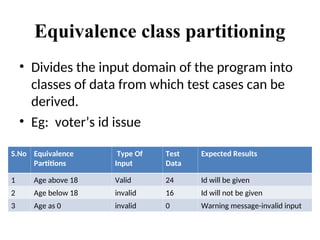
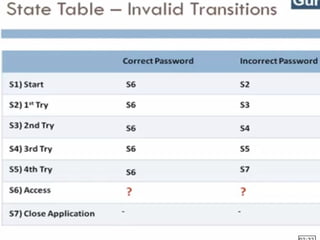
Must test Valid and Invalid inputs.
Most importantly, there are an infinite amount of sequences of inputs to be tested.
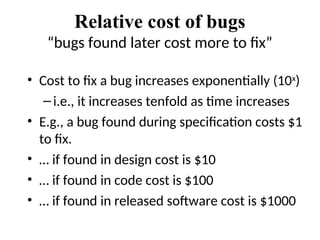
Relative cost of bugs�“bugs found later cost more to fix”
Cost to fix a bug increases exponentially (10x)
i.e., it increases tenfold as time increases
E.g., a bug found during specification costs $1 to fix.
… if found in design cost is $10
… if found in code cost is $100
… if found in released software cost is $1000
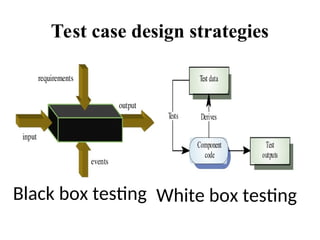
Black Box Testing
The technique of testing without having any knowledge of the interior workings of the application is called black-box testing.
The tester is oblivious to the system architecture and does not have access to the source code.
a tester will interact with the system's user interface by providing inputs and examining outputs without knowing how and where the inputs are worked upon.
white-box testing
White-box testing is the detailed investigation of internal logic and structure of the code. White-box testing is also called glass testing or open-box testing.
to perform white-box testing on an application, a tester needs to know the internal workings of the code.
The tester needs to have a look inside the source code and find out which unit/chunk of the code is behaving inappropriately.