.lusoftware verification & validation
VVS
Mining Assumptions for Software
Components using Machine Learning
Khouloud Gaaloul
Claudio Menghi
Shiva Nejati
Lionel C. Briand
QRA Corp, Canada
David Wolfe
University of Luxembourg,
Luxembourg
University of Ottawa,
Canada
University of Luxembourg,
Luxembourg
University of Ottawa,
Canada
University of Luxembourg,
Luxembourg
University of Luxembourg,
Luxembourg
Assumption Generation
Problem
2
Cyber-Physical Systems (CPS)
Systems in which
the physical and software components
are deeply intertwined
!3
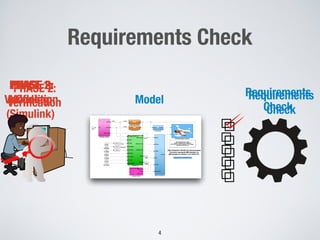
Requirements Check
Model
Requirements
Check
!4
PHASE 1:
Modeling
(Simulink)
PHASE 2:
Verification
PHASE 3:
Coding
PHASE 2:
Verification
Requirements
Check
Problem
• Usually, exhaustive verification can not analyse complex
industrial models
• However, model checking can verify models’ components
• When a sub-component is analysed, assumptions are usually
not explicitly documented.
!5
• A software component to guide small aircrafts
• Controls the aircraft orientation (Pitch, Roll, and Yaw)
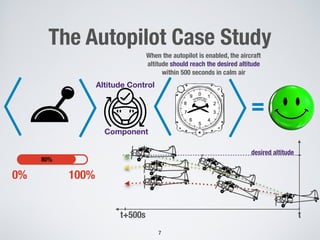
The Autopilot Case Study
!6
Yaw
Roll Pitch
Yaw
Roll Pitch
Yaw
Yaw
Autopilot
Indicators
Actuators
The Autopilot Case Study
!7
Altitude Control
Component
When the autopilot is enabled, the aircraft
altitude should reach the desired altitude
within 500 seconds in calm air
= ?
0% 100%
tt+500s
desired altitude
20%40%60%80%
Goal
!8
To provide the aircraft with enough boost so that it can reach the desired
altitude, the pilot should manually adjust the power given to the engines
of the aircraft to ensure that the aircraft does not enter a stall condition
Advanced Avionics Handbook
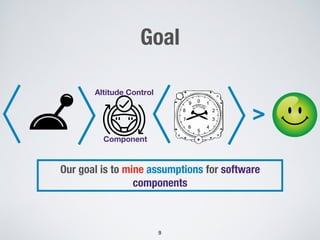
Goal
Our goal is to mine assumptions for software
components
!9
Altitude Control
Component
>
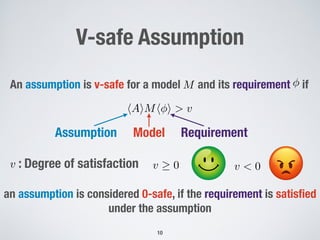
An assumption is v-safe for a model ! and its requirement ! if
!
M
hAiMh i > v
!10
V-safe Assumption
RequirementModelAssumption
! : Degree of satisfactionv
an assumption is considered 0-safe, if the requirement is satisfied
under the assumption
v 0 v < 0
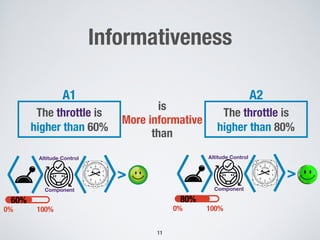
!11
The throttle is
higher than 60%
The throttle is
higher than 80%
is
More informative
than
Informativeness
0% 100%
60%
Altitude Control
Component
>
0% 100%
80%
Altitude Control
Component
>
A1 A2
Goal
!12
The goal is to generate the most informative v-safe
assumptions for software components
Preriquisites
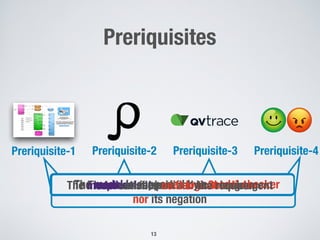
The model is specified in Simulink
Preriquisite-1 Preriquisite-2
The requirement is in a logical languageThe model is supported by a model checker
Preriquisite-3
The model satisfies neither the requirement
nor its negation
!13
Preriquisite-4
Our Solution
(EPIcuRus)
14
EPIcuRus (assumPtIon
geneRation approach for CPS)
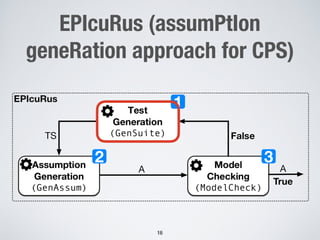
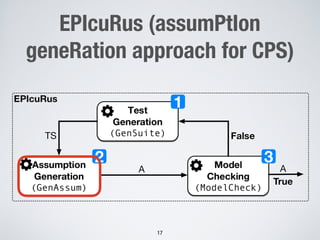
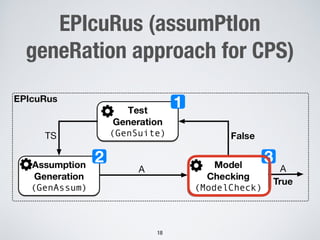
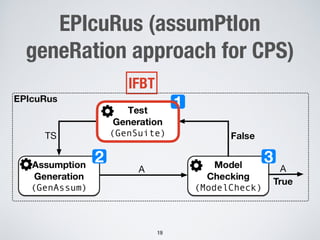
We propose EPIcuRus, an automated approach to infer
environment assumptions for system components
!15
EPIcuRus (assumPtIon
geneRation approach for CPS)
!16
EPIcuRus (assumPtIon
geneRation approach for CPS)
!17
EPIcuRus (assumPtIon
geneRation approach for CPS)
!18
EPIcuRus (assumPtIon
geneRation approach for CPS)
!19
IFBT
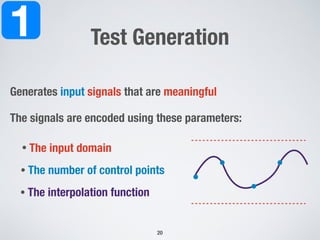
Generates input signals that are meaningful
The signals are encoded using these parameters:
Test Generation
!20
1
• The input domain
• The number of control points
• The interpolation function
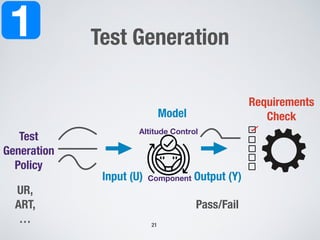
Model
Requirements
Check
Input (U) Output (Y)
Test Generation1
Test
Generation
Policy
UR,
ART,
… !21
Pass/Fail
Altitude Control
Component
Assumption Generation
!22
2
Node 1
Total data: 1000
Node 2
Total data: 494
98%
Label: fail
Node 3
Total data: 532
Node 4
Total data: 200
100%
Label: pass
Throttle1 < 60Throttle1 < 60Throttle1 < 60 Throttle1 ≥ 60Throttle1 ≥ 60Throttle1 ≥ 60
Throttle1 < 90Throttle1 < 90Throttle1 < 90 Throttle1 ≥ 90Throttle1 ≥ 90Throttle1 ≥ 90
Node 5
Total data: 332
Node 6
Total data: 145
32%
Label: pass
Node 7
Total data: 187
85%
Label: fail
Pwheel < 2Pwheel < 2Pwheel < 2 Pwheel ≥ 2Pwheel ≥ 2Pwheel ≥ 2
Node 1
Total data: 1000
Node 2
Total data: 494
98%
Label: fail
Node 3
Total data: 532
Node 4
Total data: 200
100%
Label: pass
Throttle1 < 60Throttle1 < 60Throttle1 < 60 Throttle1 ≥ 60Throttle1 ≥ 60Throttle1 ≥ 60
Throttle1 < 90Throttle1 < 90Throttle1 < 90 Throttle1 ≥ 90Throttle1 ≥ 90Throttle1 ≥ 90
Node 5
Total data: 332
Node 6
Total data: 145
32%
Label: pass
Node 7
Total data: 187
85%
Label: fail
Pwheel < 2Pwheel < 2Pwheel < 2 Pwheel ≥ 2Pwheel ≥ 2Pwheel ≥ 2
8t 2 [0, t1] : 60  Throttle(t) < 908t 2 [0, t1] : 60  Throttle(t) < 908t 2 [0, t1] : 60  Throttle(t) < 90
60  Throttle1 < 9060  Throttle1 < 9060  Throttle1 < 90
Model Checking
!23
3
Exhaustively checks if the obtained assumption is accurate
• QVTrace from QRA Corp, Canada
• SMT-based model checker for Simulink
• Z3, Mathematica
2.4.Accessing QVtrace:
Once the QVtrace server is running, QVtrace will be accessed through a web browser with
the address: http://localhost:2999
If accessing the QVtrace server on a networked computer then use the address:
http://[server_name]:2999.
QVtrace has been fully tested to be accessed with the Google Chrome web browser.
Although other browsers may render QVtrace appropriately, these have not been fully
tested and their performance is not well known. We recommend you use the Google
Chrome browser for QVtrace.
3. Using QVtrace
3.1.Understanding the QVtrace user interface
QVtrace has been designed to optimize the workflow for model-based design analysis. The
interface has three main sections as shown in the image below and described in detail on
the next page.
QVtrace User Manual v0.11.7 qracorp.com of4 21
1
2
3
IFBT-Important Feature Boundary
Test
[ ]][ ][
0% 100%
boundary areas
Conjecture-1Conjecture-2
Identifying control points with high
impact on the fitness value and
focusing the search on them
!24
Generating test cases in boundary
areas of the input domain
Two conjectures enable more effective learning of v-safe
assumptions.
!25
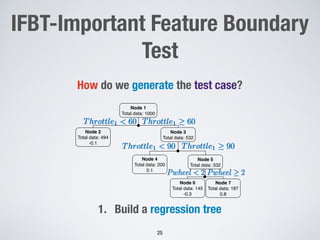
IFBT-Important Feature Boundary
Test
1. Build a regression tree
How do we generate the test case?
Node 1
Total data: 1000
Node 2
Total data: 494
-0.1
Node 3
Total data: 532
Node 4
Total data: 200
0.1
Throttle1 < 60Throttle1 < 60Throttle1 < 60 Throttle1 ≥ 60Throttle1 ≥ 60Throttle1 ≥ 60
Throttle1 < 90Throttle1 < 90Throttle1 < 90 Throttle1 ≥ 90Throttle1 ≥ 90Throttle1 ≥ 90
Node 5
Total data: 332
Node 6
Total data: 145
-0.3
Node 7
Total data: 187
0.8
Pwheel < 2Pwheel < 2Pwheel < 2 Pwheel ≥ 2Pwheel ≥ 2Pwheel ≥ 2
!26
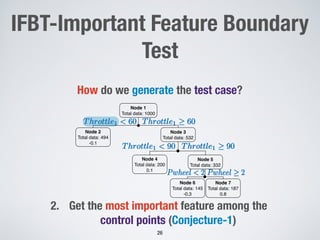
IFBT-Important Feature Boundary
Test
2. Get the most important feature among the
control points (Conjecture-1)
How do we generate the test case?
Node 1
Total data: 1000
Node 2
Total data: 494
-0.1
Node 3
Total data: 532
Node 4
Total data: 200
0.1
Throttle1 < 60Throttle1 < 60Throttle1 < 60 Throttle1 ≥ 60Throttle1 ≥ 60Throttle1 ≥ 60
Throttle1 < 90Throttle1 < 90Throttle1 < 90 Throttle1 ≥ 90Throttle1 ≥ 90Throttle1 ≥ 90
Node 5
Total data: 332
Node 6
Total data: 145
-0.3
Node 7
Total data: 187
0.8
Pwheel < 2Pwheel < 2Pwheel < 2 Pwheel ≥ 2Pwheel ≥ 2Pwheel ≥ 2
Node 1
Total data: 1000
Node 2
Total data: 494
-0.1
Node 3
Total data: 532
Node 4
Total data: 200
0.1
Throttle1 < 60Throttle1 < 60Throttle1 < 60 Throttle1 ≥ 60Throttle1 ≥ 60Throttle1 ≥ 60
Throttle1 < 90Throttle1 < 90Throttle1 < 90 Throttle1 ≥ 90Throttle1 ≥ 90Throttle1 ≥ 90
Node 5
Total data: 332
Node 6
Total data: 145
-0.3
Node 7
Total data: 187
0.8
Pwheel < 2Pwheel < 2Pwheel < 2 Pwheel ≥ 2Pwheel ≥ 2Pwheel ≥ 2
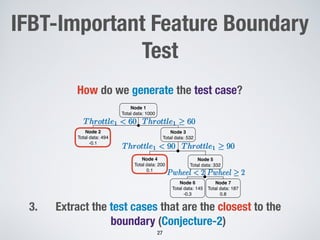
3. Extract the test cases that are the closest to the
boundary (Conjecture-2)
!27
IFBT-Important Feature Boundary
Test
How do we generate the test case?
Node 1
Total data: 1000
Node 2
Total data: 494
-0.1
Node 3
Total data: 532
Node 4
Total data: 200
0.1
Throttle1 < 60Throttle1 < 60Throttle1 < 60 Throttle1 ≥ 60Throttle1 ≥ 60Throttle1 ≥ 60
Throttle1 < 90Throttle1 < 90Throttle1 < 90 Throttle1 ≥ 90Throttle1 ≥ 90Throttle1 ≥ 90
Node 5
Total data: 332
Node 6
Total data: 145
-0.3
Node 7
Total data: 187
0.8
Pwheel < 2Pwheel < 2Pwheel < 2 Pwheel ≥ 2Pwheel ≥ 2Pwheel ≥ 2
!28
IFBT-Important Feature Boundary
Test
4. Get the ranges associated with the most
important feature
[54 , 66]
[81 , 99]
How do we generate the test case?
!29
IFBT-Important Feature Boundary
Test
5. For each test case, get the ranges associated
with the most important feature
How do we generate the test case?
Node 1
Total data: 1000
Node 2
Total data: 494
-0.1
Node 3
Total data: 532
Node 4
Total data: 200
0.1
Throttle1 < 60Throttle1 < 60Throttle1 < 60 Throttle1 ≥ 60Throttle1 ≥ 60Throttle1 ≥ 60
Throttle1 < 90Throttle1 < 90Throttle1 < 90 Throttle1 ≥ 90Throttle1 ≥ 90Throttle1 ≥ 90
Node 5
Total data: 332
Node 6
Total data: 145
-0.3
Node 7
Total data: 187
0.8
Pwheel < 2Pwheel < 2Pwheel < 2 Pwheel ≥ 2Pwheel ≥ 2Pwheel ≥ 2
[54 , 66]
[81 , 99]
Implementation
30
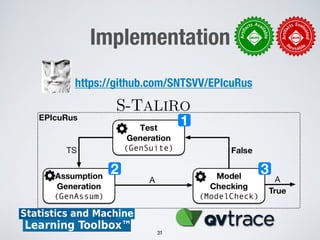
Implementation
!31
S-TALIRO
https://github.com/SNTSVV/EPIcuRus
Evaluation
32
Research Questions
• RQ1: Which test case generation policy learns assumptions
most effectively and efficiently?
• RQ2: Can EPIcuRus generate assumptions for real world
Simulink models within a practical time limit?
!33
RQ1: Effectiveness and Efficiency
• RQ1: Which test case generation policy learns assumptions
most effectively and efficiently?
!34
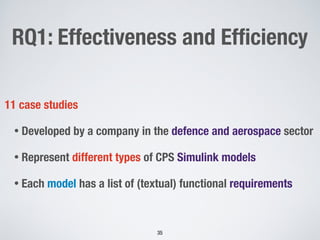
RQ1: Effectiveness and Efficiency
11 case studies
• Developed by a company in the defence and aerospace sector
• Represent different types of CPS Simulink models
• Each model has a list of (textual) functional requirements
!35
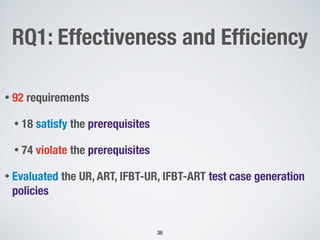
RQ1: Effectiveness and Efficiency
• 92 requirements
• 18 satisfy the prerequisites
• 74 violate the prerequisites
• Evaluated the UR, ART, IFBT-UR, IFBT-ART test case generation
policies
!36
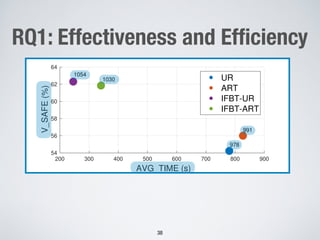
RQ1: Effectiveness and Efficiency
• For each policy, we run EPIcuRus
• We consider input signals with one (IP), two (IP’) and three (IP”) control points
• we measured among 50 experiment runs:
• V-SAFE: the percentage of runs, in which a v-safe assumption was computed
• AVG_TIME: the average execution time
• INF_IDX: the number of times an assumption was more informative than
another
!37
RQ1: Effectiveness and Efficiency
!38
200 300 400 500 600 700 800 900
AVG_TIME (s)
54
56
58
60
62
64
V_SAFE(%)
978
991
1054
1030 UR
ART
IFBT-UR
IFBT-ART
RQ1: Effectiveness and Efficiency
!39
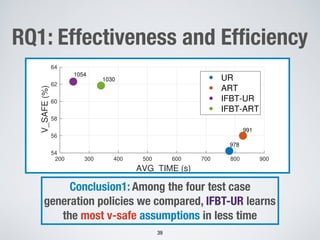
Conclusion1: Among the four test case
generation policies we compared, IFBT-UR learns
the most v-safe assumptions in less time
200 300 400 500 600 700 800 900
AVG_TIME (s)
54
56
58
60
62
64
V_SAFE(%)
978
991
1054
1030 UR
ART
IFBT-UR
IFBT-ART
RQ1: Effectiveness and Efficiency
!40
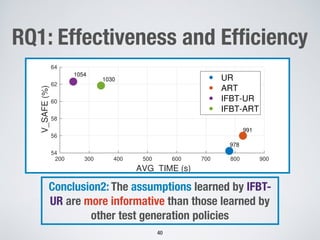
Conclusion2: The assumptions learned by IFBT-
UR are more informative than those learned by
other test generation policies
200 300 400 500 600 700 800 900
AVG_TIME (s)
54
56
58
60
62
64
V_SAFE(%)
978
991
1054
1030 UR
ART
IFBT-UR
IFBT-ART
RQ2: Usefulness
RQ2: Can EPIcuRus generate assumptions for real world
Simulink models within a practical time limit?
!41
• We select the best performing test case generation policy: IFBT-UR
• We considered four models and 18 requirements.
• Among 50 experiment runs:
• We compute the percentage of requirements for which a v-safe
assumption is computed
• We examine the usefulness, the structure and the length of all
the computed assumptions
!42
RQ2: Usefulness
RQ2: Usefulness
!43
• EPIcuRus computed a v-safe assumption, within one
hour, for ≈78% of the requirements
• Across all 50 runs, which take around four hours per
requirement, EPIcuRus computed a v-safe assumption
for all the 18 requirements
• EPIcuRus learnt non-vacuous and short assumptions
Conclusions
44
Conclusions
• EPIcuRus: infer assumptions for software components
• It is applicable to complex signal-based modelling notations
• Combines search-based software testing, Machine Learning
and model checking
• IFBT: A test case generation technique to guide the search
through the most informative features and areas in the
search space
!45
Conclusion
• We were able to compute v-safe assumptions
• The computed assumptions are short and non-vacuous
• Assumptions are computed based on a large set of
requirements
!46
.lusoftware verification & validation
VVS
Mining Assumptions for Software
Components using Machine Learning
Khouloud Gaaloul
Claudio Menghi
Shiva Nejati
Lionel C. Briand
QRA Corp, Canada
David Wolfe
University of Luxembourg,
Luxembourg
University of Ottawa,
Canada
University of Luxembourg,
Luxembourg
University of Ottawa,
Canada
University of Luxembourg,
Luxembourg
University of Luxembourg,
Luxembourg

Mining Assumptions for Software Components using Machine Learning

  • 1.
    .lusoftware verification &validation VVS Mining Assumptions for Software Components using Machine Learning Khouloud Gaaloul Claudio Menghi Shiva Nejati Lionel C. Briand QRA Corp, Canada David Wolfe University of Luxembourg, Luxembourg University of Ottawa, Canada University of Luxembourg, Luxembourg University of Ottawa, Canada University of Luxembourg, Luxembourg University of Luxembourg, Luxembourg
  • 2.
  • 3.
    Cyber-Physical Systems (CPS) Systemsin which the physical and software components are deeply intertwined !3
  • 4.
    Requirements Check Model Requirements Check !4 PHASE 1: Modeling (Simulink) PHASE2: Verification PHASE 3: Coding PHASE 2: Verification Requirements Check
  • 5.
    Problem • Usually, exhaustiveverification can not analyse complex industrial models • However, model checking can verify models’ components • When a sub-component is analysed, assumptions are usually not explicitly documented. !5
  • 6.
    • A softwarecomponent to guide small aircrafts • Controls the aircraft orientation (Pitch, Roll, and Yaw) The Autopilot Case Study !6 Yaw Roll Pitch Yaw Roll Pitch Yaw Yaw Autopilot Indicators Actuators
  • 7.
    The Autopilot CaseStudy !7 Altitude Control Component When the autopilot is enabled, the aircraft altitude should reach the desired altitude within 500 seconds in calm air = ? 0% 100% tt+500s desired altitude 20%40%60%80%
  • 8.
    Goal !8 To provide theaircraft with enough boost so that it can reach the desired altitude, the pilot should manually adjust the power given to the engines of the aircraft to ensure that the aircraft does not enter a stall condition Advanced Avionics Handbook
  • 9.
    Goal Our goal isto mine assumptions for software components !9 Altitude Control Component >
  • 10.
    An assumption isv-safe for a model ! and its requirement ! if ! M hAiMh i > v !10 V-safe Assumption RequirementModelAssumption ! : Degree of satisfactionv an assumption is considered 0-safe, if the requirement is satisfied under the assumption v 0 v < 0
  • 11.
    !11 The throttle is higherthan 60% The throttle is higher than 80% is More informative than Informativeness 0% 100% 60% Altitude Control Component > 0% 100% 80% Altitude Control Component > A1 A2
  • 12.
    Goal !12 The goal isto generate the most informative v-safe assumptions for software components
  • 13.
    Preriquisites The model isspecified in Simulink Preriquisite-1 Preriquisite-2 The requirement is in a logical languageThe model is supported by a model checker Preriquisite-3 The model satisfies neither the requirement nor its negation !13 Preriquisite-4
  • 14.
  • 15.
    EPIcuRus (assumPtIon geneRation approachfor CPS) We propose EPIcuRus, an automated approach to infer environment assumptions for system components !15
  • 16.
  • 17.
  • 18.
  • 19.
  • 20.
    Generates input signalsthat are meaningful The signals are encoded using these parameters: Test Generation !20 1 • The input domain • The number of control points • The interpolation function
  • 21.
    Model Requirements Check Input (U) Output(Y) Test Generation1 Test Generation Policy UR, ART, … !21 Pass/Fail Altitude Control Component
  • 22.
    Assumption Generation !22 2 Node 1 Totaldata: 1000 Node 2 Total data: 494 98% Label: fail Node 3 Total data: 532 Node 4 Total data: 200 100% Label: pass Throttle1 < 60Throttle1 < 60Throttle1 < 60 Throttle1 ≥ 60Throttle1 ≥ 60Throttle1 ≥ 60 Throttle1 < 90Throttle1 < 90Throttle1 < 90 Throttle1 ≥ 90Throttle1 ≥ 90Throttle1 ≥ 90 Node 5 Total data: 332 Node 6 Total data: 145 32% Label: pass Node 7 Total data: 187 85% Label: fail Pwheel < 2Pwheel < 2Pwheel < 2 Pwheel ≥ 2Pwheel ≥ 2Pwheel ≥ 2 Node 1 Total data: 1000 Node 2 Total data: 494 98% Label: fail Node 3 Total data: 532 Node 4 Total data: 200 100% Label: pass Throttle1 < 60Throttle1 < 60Throttle1 < 60 Throttle1 ≥ 60Throttle1 ≥ 60Throttle1 ≥ 60 Throttle1 < 90Throttle1 < 90Throttle1 < 90 Throttle1 ≥ 90Throttle1 ≥ 90Throttle1 ≥ 90 Node 5 Total data: 332 Node 6 Total data: 145 32% Label: pass Node 7 Total data: 187 85% Label: fail Pwheel < 2Pwheel < 2Pwheel < 2 Pwheel ≥ 2Pwheel ≥ 2Pwheel ≥ 2 8t 2 [0, t1] : 60  Throttle(t) < 908t 2 [0, t1] : 60  Throttle(t) < 908t 2 [0, t1] : 60  Throttle(t) < 90 60  Throttle1 < 9060  Throttle1 < 9060  Throttle1 < 90
  • 23.
    Model Checking !23 3 Exhaustively checksif the obtained assumption is accurate • QVTrace from QRA Corp, Canada • SMT-based model checker for Simulink • Z3, Mathematica 2.4.Accessing QVtrace: Once the QVtrace server is running, QVtrace will be accessed through a web browser with the address: http://localhost:2999 If accessing the QVtrace server on a networked computer then use the address: http://[server_name]:2999. QVtrace has been fully tested to be accessed with the Google Chrome web browser. Although other browsers may render QVtrace appropriately, these have not been fully tested and their performance is not well known. We recommend you use the Google Chrome browser for QVtrace. 3. Using QVtrace 3.1.Understanding the QVtrace user interface QVtrace has been designed to optimize the workflow for model-based design analysis. The interface has three main sections as shown in the image below and described in detail on the next page. QVtrace User Manual v0.11.7 qracorp.com of4 21 1 2 3
  • 24.
    IFBT-Important Feature Boundary Test []][ ][ 0% 100% boundary areas Conjecture-1Conjecture-2 Identifying control points with high impact on the fitness value and focusing the search on them !24 Generating test cases in boundary areas of the input domain Two conjectures enable more effective learning of v-safe assumptions.
  • 25.
    !25 IFBT-Important Feature Boundary Test 1.Build a regression tree How do we generate the test case? Node 1 Total data: 1000 Node 2 Total data: 494 -0.1 Node 3 Total data: 532 Node 4 Total data: 200 0.1 Throttle1 < 60Throttle1 < 60Throttle1 < 60 Throttle1 ≥ 60Throttle1 ≥ 60Throttle1 ≥ 60 Throttle1 < 90Throttle1 < 90Throttle1 < 90 Throttle1 ≥ 90Throttle1 ≥ 90Throttle1 ≥ 90 Node 5 Total data: 332 Node 6 Total data: 145 -0.3 Node 7 Total data: 187 0.8 Pwheel < 2Pwheel < 2Pwheel < 2 Pwheel ≥ 2Pwheel ≥ 2Pwheel ≥ 2
  • 26.
    !26 IFBT-Important Feature Boundary Test 2.Get the most important feature among the control points (Conjecture-1) How do we generate the test case? Node 1 Total data: 1000 Node 2 Total data: 494 -0.1 Node 3 Total data: 532 Node 4 Total data: 200 0.1 Throttle1 < 60Throttle1 < 60Throttle1 < 60 Throttle1 ≥ 60Throttle1 ≥ 60Throttle1 ≥ 60 Throttle1 < 90Throttle1 < 90Throttle1 < 90 Throttle1 ≥ 90Throttle1 ≥ 90Throttle1 ≥ 90 Node 5 Total data: 332 Node 6 Total data: 145 -0.3 Node 7 Total data: 187 0.8 Pwheel < 2Pwheel < 2Pwheel < 2 Pwheel ≥ 2Pwheel ≥ 2Pwheel ≥ 2
  • 27.
    Node 1 Total data:1000 Node 2 Total data: 494 -0.1 Node 3 Total data: 532 Node 4 Total data: 200 0.1 Throttle1 < 60Throttle1 < 60Throttle1 < 60 Throttle1 ≥ 60Throttle1 ≥ 60Throttle1 ≥ 60 Throttle1 < 90Throttle1 < 90Throttle1 < 90 Throttle1 ≥ 90Throttle1 ≥ 90Throttle1 ≥ 90 Node 5 Total data: 332 Node 6 Total data: 145 -0.3 Node 7 Total data: 187 0.8 Pwheel < 2Pwheel < 2Pwheel < 2 Pwheel ≥ 2Pwheel ≥ 2Pwheel ≥ 2 3. Extract the test cases that are the closest to the boundary (Conjecture-2) !27 IFBT-Important Feature Boundary Test How do we generate the test case?
  • 28.
    Node 1 Total data:1000 Node 2 Total data: 494 -0.1 Node 3 Total data: 532 Node 4 Total data: 200 0.1 Throttle1 < 60Throttle1 < 60Throttle1 < 60 Throttle1 ≥ 60Throttle1 ≥ 60Throttle1 ≥ 60 Throttle1 < 90Throttle1 < 90Throttle1 < 90 Throttle1 ≥ 90Throttle1 ≥ 90Throttle1 ≥ 90 Node 5 Total data: 332 Node 6 Total data: 145 -0.3 Node 7 Total data: 187 0.8 Pwheel < 2Pwheel < 2Pwheel < 2 Pwheel ≥ 2Pwheel ≥ 2Pwheel ≥ 2 !28 IFBT-Important Feature Boundary Test 4. Get the ranges associated with the most important feature [54 , 66] [81 , 99] How do we generate the test case?
  • 29.
    !29 IFBT-Important Feature Boundary Test 5.For each test case, get the ranges associated with the most important feature How do we generate the test case? Node 1 Total data: 1000 Node 2 Total data: 494 -0.1 Node 3 Total data: 532 Node 4 Total data: 200 0.1 Throttle1 < 60Throttle1 < 60Throttle1 < 60 Throttle1 ≥ 60Throttle1 ≥ 60Throttle1 ≥ 60 Throttle1 < 90Throttle1 < 90Throttle1 < 90 Throttle1 ≥ 90Throttle1 ≥ 90Throttle1 ≥ 90 Node 5 Total data: 332 Node 6 Total data: 145 -0.3 Node 7 Total data: 187 0.8 Pwheel < 2Pwheel < 2Pwheel < 2 Pwheel ≥ 2Pwheel ≥ 2Pwheel ≥ 2 [54 , 66] [81 , 99]
  • 30.
  • 31.
  • 32.
  • 33.
    Research Questions • RQ1:Which test case generation policy learns assumptions most effectively and efficiently? • RQ2: Can EPIcuRus generate assumptions for real world Simulink models within a practical time limit? !33
  • 34.
    RQ1: Effectiveness andEfficiency • RQ1: Which test case generation policy learns assumptions most effectively and efficiently? !34
  • 35.
    RQ1: Effectiveness andEfficiency 11 case studies • Developed by a company in the defence and aerospace sector • Represent different types of CPS Simulink models • Each model has a list of (textual) functional requirements !35
  • 36.
    RQ1: Effectiveness andEfficiency • 92 requirements • 18 satisfy the prerequisites • 74 violate the prerequisites • Evaluated the UR, ART, IFBT-UR, IFBT-ART test case generation policies !36
  • 37.
    RQ1: Effectiveness andEfficiency • For each policy, we run EPIcuRus • We consider input signals with one (IP), two (IP’) and three (IP”) control points • we measured among 50 experiment runs: • V-SAFE: the percentage of runs, in which a v-safe assumption was computed • AVG_TIME: the average execution time • INF_IDX: the number of times an assumption was more informative than another !37
  • 38.
    RQ1: Effectiveness andEfficiency !38 200 300 400 500 600 700 800 900 AVG_TIME (s) 54 56 58 60 62 64 V_SAFE(%) 978 991 1054 1030 UR ART IFBT-UR IFBT-ART
  • 39.
    RQ1: Effectiveness andEfficiency !39 Conclusion1: Among the four test case generation policies we compared, IFBT-UR learns the most v-safe assumptions in less time 200 300 400 500 600 700 800 900 AVG_TIME (s) 54 56 58 60 62 64 V_SAFE(%) 978 991 1054 1030 UR ART IFBT-UR IFBT-ART
  • 40.
    RQ1: Effectiveness andEfficiency !40 Conclusion2: The assumptions learned by IFBT- UR are more informative than those learned by other test generation policies 200 300 400 500 600 700 800 900 AVG_TIME (s) 54 56 58 60 62 64 V_SAFE(%) 978 991 1054 1030 UR ART IFBT-UR IFBT-ART
  • 41.
    RQ2: Usefulness RQ2: CanEPIcuRus generate assumptions for real world Simulink models within a practical time limit? !41
  • 42.
    • We selectthe best performing test case generation policy: IFBT-UR • We considered four models and 18 requirements. • Among 50 experiment runs: • We compute the percentage of requirements for which a v-safe assumption is computed • We examine the usefulness, the structure and the length of all the computed assumptions !42 RQ2: Usefulness
  • 43.
    RQ2: Usefulness !43 • EPIcuRuscomputed a v-safe assumption, within one hour, for ≈78% of the requirements • Across all 50 runs, which take around four hours per requirement, EPIcuRus computed a v-safe assumption for all the 18 requirements • EPIcuRus learnt non-vacuous and short assumptions
  • 44.
  • 45.
    Conclusions • EPIcuRus: inferassumptions for software components • It is applicable to complex signal-based modelling notations • Combines search-based software testing, Machine Learning and model checking • IFBT: A test case generation technique to guide the search through the most informative features and areas in the search space !45
  • 46.
    Conclusion • We wereable to compute v-safe assumptions • The computed assumptions are short and non-vacuous • Assumptions are computed based on a large set of requirements !46
  • 47.
    .lusoftware verification &validation VVS Mining Assumptions for Software Components using Machine Learning Khouloud Gaaloul Claudio Menghi Shiva Nejati Lionel C. Briand QRA Corp, Canada David Wolfe University of Luxembourg, Luxembourg University of Ottawa, Canada University of Luxembourg, Luxembourg University of Ottawa, Canada University of Luxembourg, Luxembourg University of Luxembourg, Luxembourg