http://www.iaeme.com/IJCIET/index.asp 685 editor@iaeme.com
International Journal of Civil Engineering and Technology (IJCIET)
Volume 8, Issue 1, January 2017, pp. 685–694 Article ID: IJCIET_08_01_080
Available online at http://www.iaeme.com/IJCIET/issues.asp?JType=IJCIET&VType=8&IType=1
ISSN Print: 0976-6308 and ISSN Online: 0976-6316
© IAEME Publication Scopus Indexed
TERRAIN CHARACTERISTICS EVALUATION
USING GEO SPATIAL TECHNOLOGY: A MODEL
STUDY FROM TELANGANA STATE, INDIA
Ravali.Koppula
B-Tech Student, Department of Civil Engineering,
K L University, Vaddeswaram, Andhra Pradesh, India
Varikunta.Bhargavi Sai
B-Tech Student, Department of Civil Engineering,
K L University, Vaddeswaram, Andhra Pradesh, India
SS. Asadi
Associate Dean of Academics, Department of. Civil Engineering,
K L University, Vaddeswaram, Andhra Pradesh, India
M.V. Raju
Assistant Professor, Department of Civil Engineering,
Vignan University, Vadllamudi, Andhra Pradesh, India
ABSTRACT
Physical characteristics such as Base map, Drainage, watershed, Ground water,
Physiography, Geomorphology, slope etc; for a study area are Required for many development
activities for Human needs, Creation of these Physical characteristics information system with
the help of Remote Sensing and Geographic Information System (GIS) Could be helpful in
getting the precise and valuable spatial information in understanding the present Scenario
contemplating with the past data and predicting the future trends. The main objective of this
study is to evaluate and map the Physical characteristics of Kothagudem , Khammam Dist;
area using Remote sensing and Geographic Information System(GIS). The thematic layers are
derived from Survey of india(SOI) topomaps using visual interpretation technique. These maps
are converted to digital format and further integrated in ARCGIS software for the generation
of final outputs.
Key words: Terrain characteristics, Geo Spatial Technology, GIS
Cite this Article: Ravali.Koppula, Varikunta.Bhargavi Sai, SS. Asadi and M.V. Raju, Terrain
Characteristics Evaluation Using Geo Spatial Technology: A Model Study from Telangana
State, India. International Journal of Civil Engineering and Technology, 8(1), 2017, pp. 685–
694.
http://www.iaeme.com/IJCIET/issues.asp?JType=IJCIET&VType=8&IType=1
Ravali.Koppula, Varikunta.Bhargavi Sai, SS. Asadi and M.V. Raju
http://www.iaeme.com/IJCIET/index.asp 686 editor@iaeme.com
1. INTRODUCTION
Status of water resources, land evaluation, Drainage pattern and land use/ land cover are the important
factors that effect on efficiency of soil and water use. Periodic mapping and monitoring of Natural
resources and their utilization status is therefore important for formulation of appropriate strategies for
planning and implementation of ameliorative and development measures. This periodic mapping is
done by using Remote sensing and Geographic Information System(GIS) . Remote sensing is the
science and art of obtaining information about an object, area or phenomenon through the analysis of
data acquired by a device that is not in contact with object area, or phenomena under investigation.
Remote sensing of earth’s environment comprises of measuring and recording of electro magnetic
energy reflected from or emitted by the planet’s surface and atmosphere from a vantage point above
the surface and relating of such measurements to the nature end distribution of surface materials and
atmospheric conditions. Electromagnetic energy sensors are currently being operated from airborne
and space borne platforms to assist in inventorying, mapping and monitoring earth resources and GIS
are decision support computer based system for collecting, storing presenting and analyzing spatial
information. An information system a set of processes executed on raw data, to produce information,
which will be useful in decision making. GIS is a general-purpose technology for handling geographic
data in digital form. GIS is a convergence of technological fields and traditional disciplines. GIS has
been called an “Enabling Technology” because of the potential it offense for the wide variety of
disciplines which must deal with spatial. Many related fields of study provide techniques, which make
up GIC them together by emphasizing integrations, medalling and analysis. This GIS often claims to
be the science of spatial information. Remote sensing data can be readily merged with other sources of
geocoded information in GIS. One of the most important benefits of a GIS is the ability to spatially
interrelate multiple types of information stemming from a range of sources. This permits the
overlapping of several layers of information with the remotely sensed data, and the application of a
virtually unlimited number of forces of data analysis. On the other hand, the data in a GIS might be
used to aid in image classification. In the other hand, the land cover data generated by a classification
might be used in subsequent guesses and manipulation of the GIS database. Remotely sensed data is
almost always proceed and stored in master data structures. When working simultaneously with an
image processing system and raster geographic information system, it usually easy to move data
between them .the most common application of this is the land cover mapping. In addition to aerial
photographs, it also provides a synoptic view of the surface features.
1.1. Objectives
 To create the physical characteristics information of the study area.
 To create spatial digital database consisting of land use/ land cover, Drainage, watershed, slope,
physiography, structures and soil maps using SOI toposheets and ground data on ARCGIS platform.
 To generate attribute data base consisting of statistical details of each of the above thematic layers.
2. DESCRIPTION OF STUDY AREA
The study area is a part of Khammam District of Telangana state in India. Khammam city is the
Headquarters of Khammam District and Khammam mandal as well. It is located about 193 kilometres
(120 mi) east of the state capital, Hyderabad, and also it is located about 100 kilometres (62 mi) North
of the Andhra Pradesh state capital, Amaravathi. The river Munneru flows on the western side of the
town. As of 2011 census of India, it had a population of 2,84,268, with an area of 94.37 km2
. On 19
October 2012, the civic body of Khammam was upgraded to Municipal corporation, which includes 14
surrounding villages. However the study area kothagudem mandal is located at latitude of 17.55°N
and longitude of 80.618°E.
Terrain Characteristics Evaluation Using Geo Spatial Technology: A Model Study from Telangana State, India
http://www.iaeme.com/IJCIET/index.asp 687 editor@iaeme.com
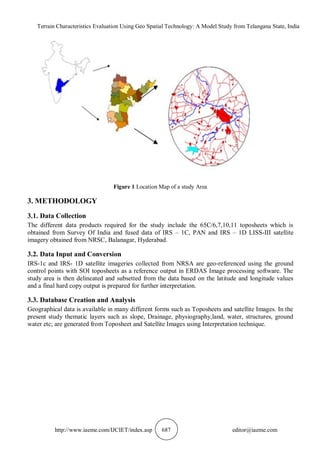
Figure 1 Location Map of a study Area
3. METHODOLOGY
3.1. Data Collection
The different data products required for the study include the 65C/6,7,10,11 toposheets which is
obtained from Survey Of India and fused data of IRS – 1C, PAN and IRS – 1D LISS-III satellite
imagery obtained from NRSC, Balanagar, Hyderabad.
3.2. Data Input and Conversion
IRS-1c and IRS- 1D satellite imageries collected from NRSA are geo-referenced using the ground
control points with SOI toposheets as a reference output in ERDAS Image processing software. The
study area is then delineated and subsetted from the data based on the latitude and longitude values
and a final hard copy output is prepared for further interpretation.
3.3. Database Creation and Analysis
Geographical data is available in many different forms such as Toposheets and satellite Images. In the
present study thematic layers such as slope, Drainage, physiography,land, water, structures, ground
water etc; are generated from Toposheet and Satellite Images using Interpretation technique.
Ravali.Koppula, Varikunta.Bhargavi Sai, SS. Asadi and M.V. Raju
http://www.iaeme.com/IJCIET/index.asp 688 editor@iaeme.com
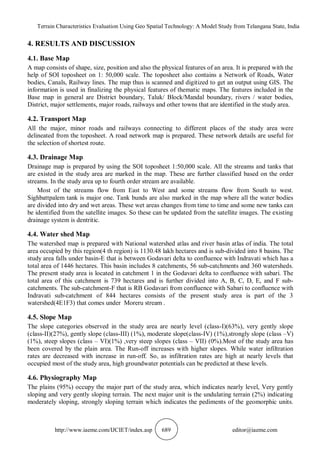
Figure 2 Flow Chart Showing the Methodology Adopted for the Present Study
DATA COLLECTION
DATA INPUT
DATABASE CREATION
DATA CONVERSION
SPATIAL DATABASE
Raw Satellite Digital Data
Loading
Pre-Processing
Enhancement
Georeferencing (transfer of GCP on image)
Data Merging
IRSP6, LISS -IV, MX output
(Hard copy Preparation)
SOI Toposheet
Georeferencing (extraction of GCPs)
Mosaicking
Final rectified toposheet
Visual Image Interpretation
Generation of thematic maps from Imagery/ toposheet
Base,Drainage,landuse/land cocover,Geomorphology,soil ,Ground water
potential
Scanning, Digitization using AUTOCAD, Export to Arc/Info for analysis,
editing, Cleaning, Creation of thematic and topographical digital output maps in
ArcView
Field work for confirmation of
doubtful areas
DATA ANALYSIS
RECOMMENDATIONS
Terrain Characteristics Evaluation Using Geo Spatial Technology: A Model Study from Telangana State, India
http://www.iaeme.com/IJCIET/index.asp 689 editor@iaeme.com
4. RESULTS AND DISCUSSION
4.1. Base Map
A map consists of shape, size, position and also the physical features of an area. It is prepared with the
help of SOI toposheet on 1: 50,000 scale. The toposheet also contains a Network of Roads, Water
bodies, Canals, Railway lines. The map thus is scanned and digitized to get an output using GIS. The
information is used in finalizing the physical features of thematic maps. The features included in the
Base map in general are District boundary, Taluk/ Block/Mandal boundary, rivers / water bodies,
District, major settlements, major roads, railways and other towns that are identified in the study area.
4.2. Transport Map
All the major, minor roads and railways connecting to different places of the study area were
delineated from the toposheet. A road network map is prepared. These network details are useful for
the selection of shortest route.
4.3. Drainage Map
Drainage map is prepared by using the SOI toposheet 1:50,000 scale. All the streams and tanks that
are existed in the study area are marked in the map. These are further classified based on the order
streams. In the study area up to fourth order stream are available.
Most of the streams flow from East to West and some streams flow from South to west.
Sighbattpalem tank is major one. Tank bunds are also marked in the map where all the water bodies
are divided into dry and wet areas. These wet areas changes from time to time and some new tanks can
be identified from the satellite images. So these can be updated from the satellite images. The existing
drainage system is dentritic.
4.4. Water shed Map
The watershed map is prepared with National watershed atlas and river basin atlas of india. The total
area occupied by this region(4 th region) is 1130.48 lakh hectares and is sub-divided into 8 basins. The
study area falls under basin-E that is between Godavari delta to confluence with Indravati which has a
total area of 1446 hectares. This basin includes 8 catchments, 56 sub-catchments and 360 watersheds.
The present study area is located in catchment 1 in the Godavari delta to confluence with sabari. The
total area of this catchment is 739 hectares and is further divided into A, B, C, D, E, and F sub-
catchments. The sub-catchment-F that is RB Godavari from confluence with Sabari to confluence with
Indravati sub-catchment of 844 hectares consists of the present study area is part of the 3
watershed(4E1F3) that comes under Moreru stream .
4.5. Slope Map
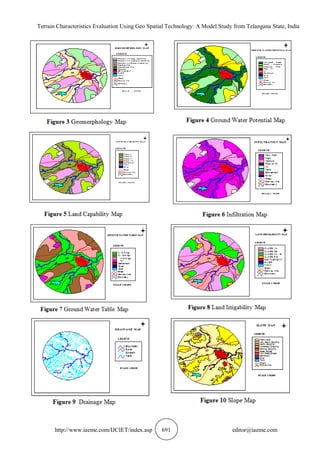
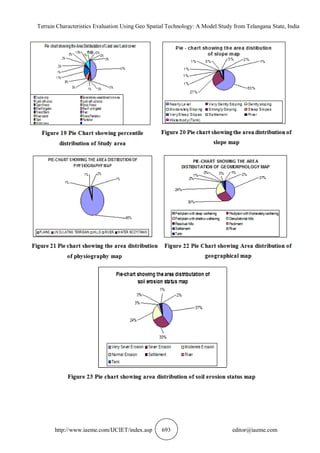
The slope categories observed in the study area are nearly level (class-I)(63%), very gently slope
(class-II)(27%), gently slope (class-III) (1%), moderate slope(class-IV) (1%),strongly slope (class –V)
(1%), steep slopes (class – VI)(1%) ,very steep slopes (class – VII) (0%).Most of the study area has
been covered by the plain area. The Run-off increases with higher slopes. While water infiltration
rates are decreased with increase in run-off. So, as infiltration rates are high at nearly levels that
occupied most of the study area, high groundwater potentials can be predicted at these levels.
4.6. Physiography Map
The plains (95%) occupy the major part of the study area, which indicates nearly level, Very gently
sloping and very gently sloping terrain. The next major unit is the undulating terrain (2%) indicating
moderately sloping, strongly sloping terrain which indicates the pediments of the geomorphic units.
Ravali.Koppula, Varikunta.Bhargavi Sai, SS. Asadi and M.V. Raju
http://www.iaeme.com/IJCIET/index.asp 690 editor@iaeme.com
The next unit is Hills (1%) this is indicating steepto very steep slopes and denudation hills, Residual
hills of the geomorphic units.
4.7. Land use/Land Cover Map
The land use/land cover categories such as built-up land, agriculture, forest, water body and
wastelands have been identified and mapped from the study area. Major part of the study area is
covered with double crop (47%), kharif irrigated (17%), kharif un irrigated (1%). About 3%of the
study area is under built-up land and Mining area is 2%. From the satellite data the agriculture area
could be clearly delineated as four categories, double crop, kharif irrigated, kharif unirrigated, and
plantations. Though single crop and double crop has been observed at various parts of the study area
and plantations are observed at some places of the study area. In forest category forest plantation
(10%), forest blank (2%),scrub forest (4%),open forest (2%) has beeen observed. In the waste lands
category Land with scrub (3%),Land with out scrub (1%),Mining area(2%) has been observed. Under
Water bodies category Rivers (2%),Tanks occupied (1%) and barren sheet rock area (1%) are
observed.
4.8. Geomorphology Map
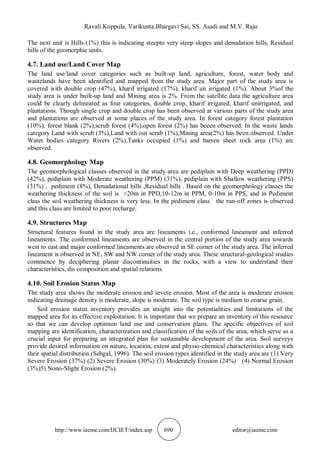
The geomorphological classes observed in the study area are pediplain with Deep weathering (PPD)
(42%), pediplain with Moderate weathering (PPM) (31%), pediplain with Shallow weathering (PPS)
(31%) , pediment (8%), Denudational hills ,Residual hills . Based on the geomorphology classes the
weathering thickness of the soil is >20m in PPD,10-12m in PPM, 0-10m in PPS, and in Pediment
class the soil weathering thickness is very less. In the pediment class the run-off zones is observed
and this class are limited to poor recharge.
4.9. Structures Map
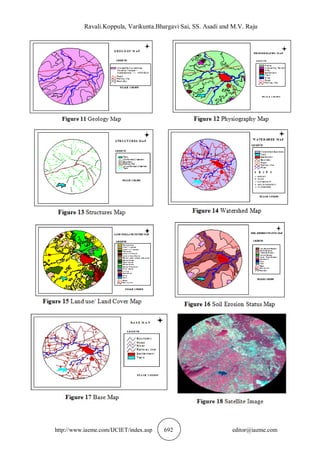
Structural features found in the study area are lineaments i.e., conformed lineament and inferred
lineaments. The conformed lineaments are observed in the central portion of the study area towards
west to east and major conformed lineaments are observed in SE corner of the study area. The inferred
lineament is observed in NE, SW and NW corner of the study area. These structural-geological studies
commence by deciphering planar discontinuities in the rocks, with a view to understand their
characteristics, dis composition and spatial relations.
4.10. Soil Erosion Status Map
The study area shows the moderate erosion and severe erosion. Most of the area is moderate erosion
indicating drainage density is moderate, slope is moderate. The soil type is medium to coarse grain.
Soil erosion status inventory provides an insight into the potentialities and limitations of the
mapped area for its effective exploitation. It is important that we prepare an inventory of this resource
so that we can develop optimum land use and conservation plans. The specific objectives of soil
mapping are identification, characterization and classification of the soils of the area, which serve as a
crucial input for preparing an integrated plan for sustainable development of the area. Soil surveys
provide desired information on nature, location, extent and physio-chemical characteristics along with
their spatial distribution (Sehgal, 1996). The soil erosion types identified in the study area are (1) Very
Severe Erosion (37%) (2) Severe Erosion (30%) (3) Moderately Erosion (24%) (4) Normal Erosion
(3%)5) Nono-Slight Erosion (2%).
Terrain Characteristics Evaluation Using Geo Spatial Technology: A Model Study from Telangana State, India
http://www.iaeme.com/IJCIET/index.asp 691 editor@iaeme.com
Ravali.Koppula, Varikunta.Bhargavi Sai, SS. Asadi and M.V. Raju
http://www.iaeme.com/IJCIET/index.asp 692 editor@iaeme.com
Terrain Characteristics Evaluation Using Geo Spatial Technology: A Model Study from Telangana State, India
http://www.iaeme.com/IJCIET/index.asp 693 editor@iaeme.com
Ravali.Koppula, Varikunta.Bhargavi Sai, SS. Asadi and M.V. Raju
http://www.iaeme.com/IJCIET/index.asp 694 editor@iaeme.com
5. CONCLUSION AND RECOMMENDATION
By studying the existing Scenario of study area and changes in physical characteristics of study area
due to mining activities going on in study area and its impact on the Land and Water Resources
through special analysis using Remote Sensing and GIS tools. From the Analysis of physical
characteristics data, It is identified that more area in the site has been very severely affected by soil
erosion. In future this may lead to consequential problem to major water bodies. Thus, It is necessary
to control soil erosion and Ground water potential is very good in the selected site and Ground water
table is 0-5 m bgl. Thus, there is a need to save water from undergoing pollution.
REFERENCES
[1] Griffth, Daniel A. and Larry J.Layne. A casebook for spatial Statistical Data Analysis: A
compilation of Analyses of Different Thematic Data Sets, New York : Oxford Presss,1999.
[2] Harder, Christian. Serving Maps on the internet: Geographic Information on the World Wide Web,
Redlands, CA: ESRI Press,1998.
[3] Hay, S.I, S.E. Randolph and D.J.Rogers, eds. Remote Sensing and Geographical Information
Systems in Epidemiology, San Diego: Academic Press,2000.
[4] Huxhold, Willian E, Eric M.Fowler and Brian Parr. ArcGis and the Digital City: A Hands- on
Approach for Local Governments, Redlands, CA: ESRI Press,2004.
[5] Kennedy, Heather, ed. Dictionary of GIS Terminology, Redlands, CA:ESRI Press,2001.
[6] Agarwal, C.S. and Garg, P.K. Text book of Remote Sensing in Natural Resources Management.
[7] Arakeri, H.R. and Roy Donahue, 1984. Principles of soil Conservation and Water
Management. Oxford and IBH Publishing CO. Ltd.
[8] Bikram Prasad and H.L Tiwari, GIS Based Soil Erosio n Modelling. International Journal
of Civil Engineering and Technology, 7(6), 2016, pp.166 – 171.
[9] Cracknell, A.P. and Hayes, L.W.B. 1996. Introduction to Remote Sensing. Chapman and
Hall Publications, New York.
[10] Handbook of Statistics, Rangareddy district 2001. Chief Planning Officer, Director of
Census Operation, Andhra Pradesh.
[11] G.S. Sarma, SS. Asadi and S. Lakshmi Narayana, Creation of Web Based Decision Support
Information System for Evaluation of Topographic Characteristics Using Remote Sensing
& GIS and Visual Basic Programe. International Journal of Civil Engineering and
Technology, 7(6), 2016, pp. 621–634.
[12] Isobel W. Heathcote, 1998. Integrated Watershed management – Principles and practice.
John Wiley and Sons Inc, New York.

TERRAIN CHARACTERISTICS EVALUATION USING GEO SPATIAL TECHNOLOGY: A MODEL STUDY FROM TELANGANA STATE, INDIA

  • 1.
    http://www.iaeme.com/IJCIET/index.asp 685 editor@iaeme.com InternationalJournal of Civil Engineering and Technology (IJCIET) Volume 8, Issue 1, January 2017, pp. 685–694 Article ID: IJCIET_08_01_080 Available online at http://www.iaeme.com/IJCIET/issues.asp?JType=IJCIET&VType=8&IType=1 ISSN Print: 0976-6308 and ISSN Online: 0976-6316 © IAEME Publication Scopus Indexed TERRAIN CHARACTERISTICS EVALUATION USING GEO SPATIAL TECHNOLOGY: A MODEL STUDY FROM TELANGANA STATE, INDIA Ravali.Koppula B-Tech Student, Department of Civil Engineering, K L University, Vaddeswaram, Andhra Pradesh, India Varikunta.Bhargavi Sai B-Tech Student, Department of Civil Engineering, K L University, Vaddeswaram, Andhra Pradesh, India SS. Asadi Associate Dean of Academics, Department of. Civil Engineering, K L University, Vaddeswaram, Andhra Pradesh, India M.V. Raju Assistant Professor, Department of Civil Engineering, Vignan University, Vadllamudi, Andhra Pradesh, India ABSTRACT Physical characteristics such as Base map, Drainage, watershed, Ground water, Physiography, Geomorphology, slope etc; for a study area are Required for many development activities for Human needs, Creation of these Physical characteristics information system with the help of Remote Sensing and Geographic Information System (GIS) Could be helpful in getting the precise and valuable spatial information in understanding the present Scenario contemplating with the past data and predicting the future trends. The main objective of this study is to evaluate and map the Physical characteristics of Kothagudem , Khammam Dist; area using Remote sensing and Geographic Information System(GIS). The thematic layers are derived from Survey of india(SOI) topomaps using visual interpretation technique. These maps are converted to digital format and further integrated in ARCGIS software for the generation of final outputs. Key words: Terrain characteristics, Geo Spatial Technology, GIS Cite this Article: Ravali.Koppula, Varikunta.Bhargavi Sai, SS. Asadi and M.V. Raju, Terrain Characteristics Evaluation Using Geo Spatial Technology: A Model Study from Telangana State, India. International Journal of Civil Engineering and Technology, 8(1), 2017, pp. 685– 694. http://www.iaeme.com/IJCIET/issues.asp?JType=IJCIET&VType=8&IType=1
  • 2.
    Ravali.Koppula, Varikunta.Bhargavi Sai,SS. Asadi and M.V. Raju http://www.iaeme.com/IJCIET/index.asp 686 editor@iaeme.com 1. INTRODUCTION Status of water resources, land evaluation, Drainage pattern and land use/ land cover are the important factors that effect on efficiency of soil and water use. Periodic mapping and monitoring of Natural resources and their utilization status is therefore important for formulation of appropriate strategies for planning and implementation of ameliorative and development measures. This periodic mapping is done by using Remote sensing and Geographic Information System(GIS) . Remote sensing is the science and art of obtaining information about an object, area or phenomenon through the analysis of data acquired by a device that is not in contact with object area, or phenomena under investigation. Remote sensing of earth’s environment comprises of measuring and recording of electro magnetic energy reflected from or emitted by the planet’s surface and atmosphere from a vantage point above the surface and relating of such measurements to the nature end distribution of surface materials and atmospheric conditions. Electromagnetic energy sensors are currently being operated from airborne and space borne platforms to assist in inventorying, mapping and monitoring earth resources and GIS are decision support computer based system for collecting, storing presenting and analyzing spatial information. An information system a set of processes executed on raw data, to produce information, which will be useful in decision making. GIS is a general-purpose technology for handling geographic data in digital form. GIS is a convergence of technological fields and traditional disciplines. GIS has been called an “Enabling Technology” because of the potential it offense for the wide variety of disciplines which must deal with spatial. Many related fields of study provide techniques, which make up GIC them together by emphasizing integrations, medalling and analysis. This GIS often claims to be the science of spatial information. Remote sensing data can be readily merged with other sources of geocoded information in GIS. One of the most important benefits of a GIS is the ability to spatially interrelate multiple types of information stemming from a range of sources. This permits the overlapping of several layers of information with the remotely sensed data, and the application of a virtually unlimited number of forces of data analysis. On the other hand, the data in a GIS might be used to aid in image classification. In the other hand, the land cover data generated by a classification might be used in subsequent guesses and manipulation of the GIS database. Remotely sensed data is almost always proceed and stored in master data structures. When working simultaneously with an image processing system and raster geographic information system, it usually easy to move data between them .the most common application of this is the land cover mapping. In addition to aerial photographs, it also provides a synoptic view of the surface features. 1.1. Objectives  To create the physical characteristics information of the study area.  To create spatial digital database consisting of land use/ land cover, Drainage, watershed, slope, physiography, structures and soil maps using SOI toposheets and ground data on ARCGIS platform.  To generate attribute data base consisting of statistical details of each of the above thematic layers. 2. DESCRIPTION OF STUDY AREA The study area is a part of Khammam District of Telangana state in India. Khammam city is the Headquarters of Khammam District and Khammam mandal as well. It is located about 193 kilometres (120 mi) east of the state capital, Hyderabad, and also it is located about 100 kilometres (62 mi) North of the Andhra Pradesh state capital, Amaravathi. The river Munneru flows on the western side of the town. As of 2011 census of India, it had a population of 2,84,268, with an area of 94.37 km2 . On 19 October 2012, the civic body of Khammam was upgraded to Municipal corporation, which includes 14 surrounding villages. However the study area kothagudem mandal is located at latitude of 17.55°N and longitude of 80.618°E.
  • 3.
    Terrain Characteristics EvaluationUsing Geo Spatial Technology: A Model Study from Telangana State, India http://www.iaeme.com/IJCIET/index.asp 687 editor@iaeme.com Figure 1 Location Map of a study Area 3. METHODOLOGY 3.1. Data Collection The different data products required for the study include the 65C/6,7,10,11 toposheets which is obtained from Survey Of India and fused data of IRS – 1C, PAN and IRS – 1D LISS-III satellite imagery obtained from NRSC, Balanagar, Hyderabad. 3.2. Data Input and Conversion IRS-1c and IRS- 1D satellite imageries collected from NRSA are geo-referenced using the ground control points with SOI toposheets as a reference output in ERDAS Image processing software. The study area is then delineated and subsetted from the data based on the latitude and longitude values and a final hard copy output is prepared for further interpretation. 3.3. Database Creation and Analysis Geographical data is available in many different forms such as Toposheets and satellite Images. In the present study thematic layers such as slope, Drainage, physiography,land, water, structures, ground water etc; are generated from Toposheet and Satellite Images using Interpretation technique.
  • 4.
    Ravali.Koppula, Varikunta.Bhargavi Sai,SS. Asadi and M.V. Raju http://www.iaeme.com/IJCIET/index.asp 688 editor@iaeme.com Figure 2 Flow Chart Showing the Methodology Adopted for the Present Study DATA COLLECTION DATA INPUT DATABASE CREATION DATA CONVERSION SPATIAL DATABASE Raw Satellite Digital Data Loading Pre-Processing Enhancement Georeferencing (transfer of GCP on image) Data Merging IRSP6, LISS -IV, MX output (Hard copy Preparation) SOI Toposheet Georeferencing (extraction of GCPs) Mosaicking Final rectified toposheet Visual Image Interpretation Generation of thematic maps from Imagery/ toposheet Base,Drainage,landuse/land cocover,Geomorphology,soil ,Ground water potential Scanning, Digitization using AUTOCAD, Export to Arc/Info for analysis, editing, Cleaning, Creation of thematic and topographical digital output maps in ArcView Field work for confirmation of doubtful areas DATA ANALYSIS RECOMMENDATIONS
  • 5.
    Terrain Characteristics EvaluationUsing Geo Spatial Technology: A Model Study from Telangana State, India http://www.iaeme.com/IJCIET/index.asp 689 editor@iaeme.com 4. RESULTS AND DISCUSSION 4.1. Base Map A map consists of shape, size, position and also the physical features of an area. It is prepared with the help of SOI toposheet on 1: 50,000 scale. The toposheet also contains a Network of Roads, Water bodies, Canals, Railway lines. The map thus is scanned and digitized to get an output using GIS. The information is used in finalizing the physical features of thematic maps. The features included in the Base map in general are District boundary, Taluk/ Block/Mandal boundary, rivers / water bodies, District, major settlements, major roads, railways and other towns that are identified in the study area. 4.2. Transport Map All the major, minor roads and railways connecting to different places of the study area were delineated from the toposheet. A road network map is prepared. These network details are useful for the selection of shortest route. 4.3. Drainage Map Drainage map is prepared by using the SOI toposheet 1:50,000 scale. All the streams and tanks that are existed in the study area are marked in the map. These are further classified based on the order streams. In the study area up to fourth order stream are available. Most of the streams flow from East to West and some streams flow from South to west. Sighbattpalem tank is major one. Tank bunds are also marked in the map where all the water bodies are divided into dry and wet areas. These wet areas changes from time to time and some new tanks can be identified from the satellite images. So these can be updated from the satellite images. The existing drainage system is dentritic. 4.4. Water shed Map The watershed map is prepared with National watershed atlas and river basin atlas of india. The total area occupied by this region(4 th region) is 1130.48 lakh hectares and is sub-divided into 8 basins. The study area falls under basin-E that is between Godavari delta to confluence with Indravati which has a total area of 1446 hectares. This basin includes 8 catchments, 56 sub-catchments and 360 watersheds. The present study area is located in catchment 1 in the Godavari delta to confluence with sabari. The total area of this catchment is 739 hectares and is further divided into A, B, C, D, E, and F sub- catchments. The sub-catchment-F that is RB Godavari from confluence with Sabari to confluence with Indravati sub-catchment of 844 hectares consists of the present study area is part of the 3 watershed(4E1F3) that comes under Moreru stream . 4.5. Slope Map The slope categories observed in the study area are nearly level (class-I)(63%), very gently slope (class-II)(27%), gently slope (class-III) (1%), moderate slope(class-IV) (1%),strongly slope (class –V) (1%), steep slopes (class – VI)(1%) ,very steep slopes (class – VII) (0%).Most of the study area has been covered by the plain area. The Run-off increases with higher slopes. While water infiltration rates are decreased with increase in run-off. So, as infiltration rates are high at nearly levels that occupied most of the study area, high groundwater potentials can be predicted at these levels. 4.6. Physiography Map The plains (95%) occupy the major part of the study area, which indicates nearly level, Very gently sloping and very gently sloping terrain. The next major unit is the undulating terrain (2%) indicating moderately sloping, strongly sloping terrain which indicates the pediments of the geomorphic units.
  • 6.
    Ravali.Koppula, Varikunta.Bhargavi Sai,SS. Asadi and M.V. Raju http://www.iaeme.com/IJCIET/index.asp 690 editor@iaeme.com The next unit is Hills (1%) this is indicating steepto very steep slopes and denudation hills, Residual hills of the geomorphic units. 4.7. Land use/Land Cover Map The land use/land cover categories such as built-up land, agriculture, forest, water body and wastelands have been identified and mapped from the study area. Major part of the study area is covered with double crop (47%), kharif irrigated (17%), kharif un irrigated (1%). About 3%of the study area is under built-up land and Mining area is 2%. From the satellite data the agriculture area could be clearly delineated as four categories, double crop, kharif irrigated, kharif unirrigated, and plantations. Though single crop and double crop has been observed at various parts of the study area and plantations are observed at some places of the study area. In forest category forest plantation (10%), forest blank (2%),scrub forest (4%),open forest (2%) has beeen observed. In the waste lands category Land with scrub (3%),Land with out scrub (1%),Mining area(2%) has been observed. Under Water bodies category Rivers (2%),Tanks occupied (1%) and barren sheet rock area (1%) are observed. 4.8. Geomorphology Map The geomorphological classes observed in the study area are pediplain with Deep weathering (PPD) (42%), pediplain with Moderate weathering (PPM) (31%), pediplain with Shallow weathering (PPS) (31%) , pediment (8%), Denudational hills ,Residual hills . Based on the geomorphology classes the weathering thickness of the soil is >20m in PPD,10-12m in PPM, 0-10m in PPS, and in Pediment class the soil weathering thickness is very less. In the pediment class the run-off zones is observed and this class are limited to poor recharge. 4.9. Structures Map Structural features found in the study area are lineaments i.e., conformed lineament and inferred lineaments. The conformed lineaments are observed in the central portion of the study area towards west to east and major conformed lineaments are observed in SE corner of the study area. The inferred lineament is observed in NE, SW and NW corner of the study area. These structural-geological studies commence by deciphering planar discontinuities in the rocks, with a view to understand their characteristics, dis composition and spatial relations. 4.10. Soil Erosion Status Map The study area shows the moderate erosion and severe erosion. Most of the area is moderate erosion indicating drainage density is moderate, slope is moderate. The soil type is medium to coarse grain. Soil erosion status inventory provides an insight into the potentialities and limitations of the mapped area for its effective exploitation. It is important that we prepare an inventory of this resource so that we can develop optimum land use and conservation plans. The specific objectives of soil mapping are identification, characterization and classification of the soils of the area, which serve as a crucial input for preparing an integrated plan for sustainable development of the area. Soil surveys provide desired information on nature, location, extent and physio-chemical characteristics along with their spatial distribution (Sehgal, 1996). The soil erosion types identified in the study area are (1) Very Severe Erosion (37%) (2) Severe Erosion (30%) (3) Moderately Erosion (24%) (4) Normal Erosion (3%)5) Nono-Slight Erosion (2%).
  • 7.
    Terrain Characteristics EvaluationUsing Geo Spatial Technology: A Model Study from Telangana State, India http://www.iaeme.com/IJCIET/index.asp 691 editor@iaeme.com
  • 8.
    Ravali.Koppula, Varikunta.Bhargavi Sai,SS. Asadi and M.V. Raju http://www.iaeme.com/IJCIET/index.asp 692 editor@iaeme.com
  • 9.
    Terrain Characteristics EvaluationUsing Geo Spatial Technology: A Model Study from Telangana State, India http://www.iaeme.com/IJCIET/index.asp 693 editor@iaeme.com
  • 10.
    Ravali.Koppula, Varikunta.Bhargavi Sai,SS. Asadi and M.V. Raju http://www.iaeme.com/IJCIET/index.asp 694 editor@iaeme.com 5. CONCLUSION AND RECOMMENDATION By studying the existing Scenario of study area and changes in physical characteristics of study area due to mining activities going on in study area and its impact on the Land and Water Resources through special analysis using Remote Sensing and GIS tools. From the Analysis of physical characteristics data, It is identified that more area in the site has been very severely affected by soil erosion. In future this may lead to consequential problem to major water bodies. Thus, It is necessary to control soil erosion and Ground water potential is very good in the selected site and Ground water table is 0-5 m bgl. Thus, there is a need to save water from undergoing pollution. REFERENCES [1] Griffth, Daniel A. and Larry J.Layne. A casebook for spatial Statistical Data Analysis: A compilation of Analyses of Different Thematic Data Sets, New York : Oxford Presss,1999. [2] Harder, Christian. Serving Maps on the internet: Geographic Information on the World Wide Web, Redlands, CA: ESRI Press,1998. [3] Hay, S.I, S.E. Randolph and D.J.Rogers, eds. Remote Sensing and Geographical Information Systems in Epidemiology, San Diego: Academic Press,2000. [4] Huxhold, Willian E, Eric M.Fowler and Brian Parr. ArcGis and the Digital City: A Hands- on Approach for Local Governments, Redlands, CA: ESRI Press,2004. [5] Kennedy, Heather, ed. Dictionary of GIS Terminology, Redlands, CA:ESRI Press,2001. [6] Agarwal, C.S. and Garg, P.K. Text book of Remote Sensing in Natural Resources Management. [7] Arakeri, H.R. and Roy Donahue, 1984. Principles of soil Conservation and Water Management. Oxford and IBH Publishing CO. Ltd. [8] Bikram Prasad and H.L Tiwari, GIS Based Soil Erosio n Modelling. International Journal of Civil Engineering and Technology, 7(6), 2016, pp.166 – 171. [9] Cracknell, A.P. and Hayes, L.W.B. 1996. Introduction to Remote Sensing. Chapman and Hall Publications, New York. [10] Handbook of Statistics, Rangareddy district 2001. Chief Planning Officer, Director of Census Operation, Andhra Pradesh. [11] G.S. Sarma, SS. Asadi and S. Lakshmi Narayana, Creation of Web Based Decision Support Information System for Evaluation of Topographic Characteristics Using Remote Sensing & GIS and Visual Basic Programe. International Journal of Civil Engineering and Technology, 7(6), 2016, pp. 621–634. [12] Isobel W. Heathcote, 1998. Integrated Watershed management – Principles and practice. John Wiley and Sons Inc, New York.