ā€œImplementation of artificial intelligence
(AI) for sustainable agricultureā€
Pavan K. J and Prakash K. K
Department of Biotechnology
GM Institute of Technology, Davanagere, Karnataka, India- 577006
IQAC Initiated UGC -STRIDE Sponsored Two Days International e-Conference on
BRIDGING THE GAP BETWEEN ACADEMIA, RESEARCH & INDUSTRY FOR
LOCAL & GLOBAL COMPETENCY
Organized by Dept.of Biotechnology by KLE Society’s S. Nijalingappa College.
27th and 28th October 2020
10/27/2020 1
Presentation By - Pavan K. J
Scope of AI in Agriculture
āž¢ According to UN Food and Agriculture Organization. The
population will increase to 10 billion by 2050.
āž¢ Double agricultural production in order to meet food
demands which is about 70% increase in food production.
āž¢ Only 4% additional land will come by 2050.
āž¢ Farm enterprises require new and innovative technologies to
face and overcome these challenges.
āž¢ By using AI we can resolve these challenges10/27/2020 2
āž¢ AI has a lot of direct application across sectors.
āž¢ AI can also bring a paradigm shift in farming.
āž¢ AI-powered solutions
Enable farmers to do more with less.
It will also improve quality and yield.
āž¢ Agriculture is seeing rapid adoption of AI both in
terms of
Agricultural products and
In-field farming techniques
10/27/2020 3
HOW AI IS USED IN AGRICULTURE:
āž¢ Automated farming activities.
āž¢ Identification of pest and disease outbreak before
occurrence.
āž¢ Managing crop quality.
āž¢ Monitoring biotic.
āž¢ Abiotic factors and stress.
āž¢ Machine vision systems and phenotype lead to
adjustments.
āž¢ AI enabled drone in insect and pesticides spray
10/27/2020 4
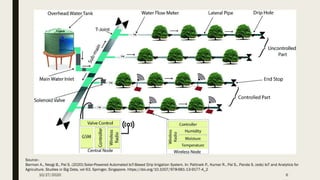
AUTOMATED IRRIGATION SYSTEM:
ļ‚¢ EFFECT OF USAGE:
ļ‚¢ Reducing production costs of vegetables, making the industry more
competitive and sustainable.
ļ‚¢ Maintaining (or increasing) average vegetable yields
ļ‚¢ Minimizing environmental impacts caused by excess
applied water and subsequent agrichemical leaching.
ļ‚¢ Maintaining a desired soil water range in the root zone that is optimal
for plant growth.
ļ‚¢ Low labor input for irrigation process maintenance
ļ‚¢ Substantial water saving compared to irrigation management based
on average historical weather conditions.
10/27/2020 5
Source:-
Barman A., Neogi B., Pal S. (2020) Solar-Powered Automated IoT-Based Drip Irrigation System. In: Pattnaik P., Kumar R., Pal S., Panda S. (eds) IoT and Analytics for
Agriculture. Studies in Big Data, vol 63. Springer, Singapore. https://doi.org/10.1007/978-981-13-9177-4_2
10/27/2020 6
EFFECT OF USAGE
i)Reducing production costs of vegetables, making the industry more
competitive and sustainable.
ii)Maintaining (or increasing) average vegetable yields
iii)Minimizing environmental impacts caused by excess applied water and
subsequent agrichemical leaching.
iv)Maintaining a desired soil water range in the root zone that is optimal for
plant growth.
v)Low labor input for irrigation process maintenance
vi)Substantial water saving compared to irrigation management based on
average historical weather conditions.10/27/2020 7
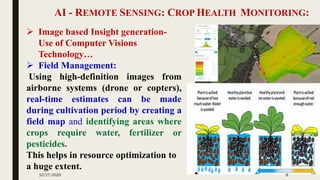
AI - REMOTE SENSING: CROP HEALTH MONITORING:
āž¢ Image based Insight generation-
Use of Computer Visions
Technology…
āž¢ Field Management:
Using high-definition images from
airborne systems (drone or copters),
real-time estimates can be made
during cultivation period by creating a
field map and identifying areas where
crops require water, fertilizer or
pesticides.
This helps in resource optimization to
a huge extent.
10/27/2020 8
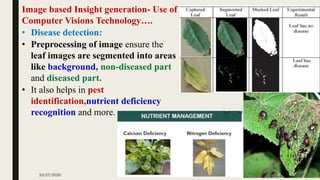
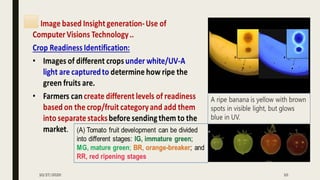
Image based Insight generation- Use of
Computer Visions Technology….
• Disease detection:
• Preprocessing of image ensure the
leaf images are segmented into areas
like background, non-diseased part
and diseased part.
• It also helps in pest
identification,nutrient deficiency
recognition and more.
10/27/2020 9
10/27/2020 10
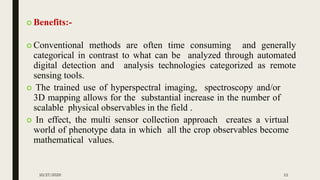
ļ‚¢ Benefits:-
ļ‚¢ Conventional methods are often time consuming and generally
categorical in contrast to what can be analyzed through automated
digital detection and analysis technologies categorized as remote
sensing tools.
ļ‚¢ The trained use of hyperspectral imaging, spectroscopy and/or
3D mapping allows for the substantial increase in the number of
scalable physical observables in the field .
ļ‚¢ In effect, the multi sensor collection approach creates a virtual
world of phenotype data in which all the crop observables become
mathematical values.
10/27/2020 11
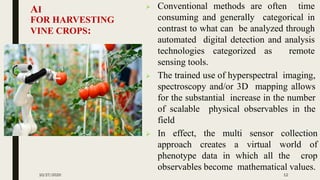
AI
FOR HARVESTING
VINE CROPS:
āž¢ Conventional methods are often time
consuming and generally categorical in
contrast to what can be analyzed through
automated digital detection and analysis
technologies categorized as remote
sensing tools.
āž¢ The trained use of hyperspectral imaging,
spectroscopy and/or 3D mapping allows
for the substantial increase in the number
of scalable physical observables in the
field
āž¢ In effect, the multi sensor collection
approach creates a virtual world of
phenotype data in which all the crop
observables become mathematical values.
10/27/2020 12
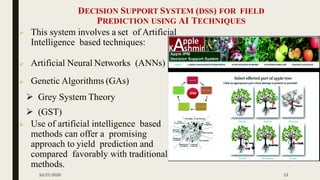
DECISION SUPPORT SYSTEM (DSS) FOR FIELD
PREDICTION USING AI TECHNIQUES
āž¢ This system involves a set of Artificial
Intelligence based techniques:
āž¢ Artificial Neural Networks (ANNs)
āž¢ Genetic Algorithms (GAs)
āž¢ Grey System Theory
āž¢ (GST)
āž¢ Use of artificial intelligence based
methods can offer a promising
approach to yield prediction and
compared favorably with traditional
methods.
10/27/2020 13
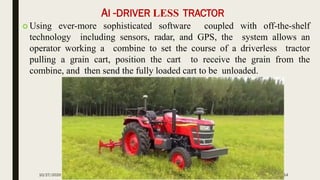
AI -DRIVER LESS TRACTOR
ļ‚¢ Using ever-more sophisticated software coupled with off-the-shelf
technology including sensors, radar, and GPS, the system allows an
operator working a combine to set the course of a driverless tractor
pulling a grain cart, position the cart to receive the grain from the
combine, and then send the fully loaded cart to be unloaded.
10/27/2020 14
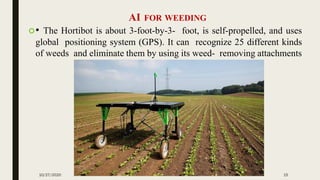
AI FOR WEEDING
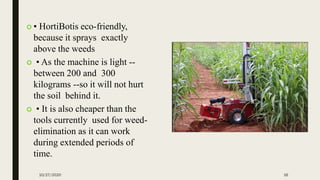
• The Hortibot is about 3-foot-by-3- foot, is self-propelled, and uses
global positioning system (GPS). It can recognize 25 different kinds
of weeds and eliminate them by using its weed- removing attachments
10/27/2020 15
ļ‚¢ • HortiBotis eco-friendly,
because it sprays exactly
above the weeds
ļ‚¢ • As the machine is light --
between 200 and 300
kilograms --so it will not hurt
the soil behind it.
ļ‚¢ • It is also cheaper than the
tools currently used for weed-
elimination as it can work
during extended periods of
time.
10/27/2020 16
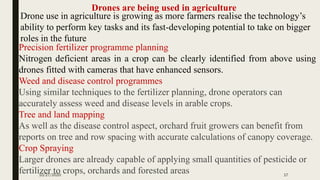
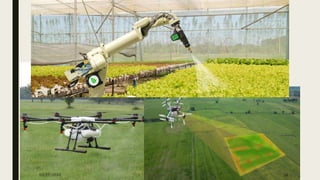
Drones are being used in agriculture
Precision fertilizer programme planning
Nitrogen deficient areas in a crop can be clearly identified from above using
drones fitted with cameras that have enhanced sensors.
Weed and disease control programmes
Using similar techniques to the fertilizer planning, drone operators can
accurately assess weed and disease levels in arable crops.
Tree and land mapping
As well as the disease control aspect, orchard fruit growers can benefit from
reports on tree and row spacing with accurate calculations of canopy coverage.
Crop Spraying
Larger drones are already capable of applying small quantities of pesticide or
fertilizer to crops, orchards and forested areas
Drone use in agriculture is growing as more farmers realise the technology’s
ability to perform key tasks and its fast-developing potential to take on bigger
roles in the future
10/27/2020 17
10/27/2020 18
CONCLUSION
ļ‚¢ AI can be appropriate and efficacious in agriculture sector as it
optimises the resource use and efficiency.
ļ‚¢ It solves the scarcity of resources and labour to a large extent.
Adoption of AI is quite useful in agriculture.
ļ‚¢ Artificial intelligence can be technological revolution and boom in
agriculture to feed the increasing human population of world.
ļ‚¢ Artificial intelligence will complement and challenge to make right
decision by farmers.
10/27/2020 19
Thank You
10/27/2020 20

Artificial Intelligence in Agriculture

  • 1.
    ā€œImplementation of artificialintelligence (AI) for sustainable agricultureā€ Pavan K. J and Prakash K. K Department of Biotechnology GM Institute of Technology, Davanagere, Karnataka, India- 577006 IQAC Initiated UGC -STRIDE Sponsored Two Days International e-Conference on BRIDGING THE GAP BETWEEN ACADEMIA, RESEARCH & INDUSTRY FOR LOCAL & GLOBAL COMPETENCY Organized by Dept.of Biotechnology by KLE Society’s S. Nijalingappa College. 27th and 28th October 2020 10/27/2020 1 Presentation By - Pavan K. J
  • 2.
    Scope of AIin Agriculture āž¢ According to UN Food and Agriculture Organization. The population will increase to 10 billion by 2050. āž¢ Double agricultural production in order to meet food demands which is about 70% increase in food production. āž¢ Only 4% additional land will come by 2050. āž¢ Farm enterprises require new and innovative technologies to face and overcome these challenges. āž¢ By using AI we can resolve these challenges10/27/2020 2
  • 3.
    āž¢ AI hasa lot of direct application across sectors. āž¢ AI can also bring a paradigm shift in farming. āž¢ AI-powered solutions Enable farmers to do more with less. It will also improve quality and yield. āž¢ Agriculture is seeing rapid adoption of AI both in terms of Agricultural products and In-field farming techniques 10/27/2020 3
  • 4.
    HOW AI ISUSED IN AGRICULTURE: āž¢ Automated farming activities. āž¢ Identification of pest and disease outbreak before occurrence. āž¢ Managing crop quality. āž¢ Monitoring biotic. āž¢ Abiotic factors and stress. āž¢ Machine vision systems and phenotype lead to adjustments. āž¢ AI enabled drone in insect and pesticides spray 10/27/2020 4
  • 5.
    AUTOMATED IRRIGATION SYSTEM: ļ‚¢EFFECT OF USAGE: ļ‚¢ Reducing production costs of vegetables, making the industry more competitive and sustainable. ļ‚¢ Maintaining (or increasing) average vegetable yields ļ‚¢ Minimizing environmental impacts caused by excess applied water and subsequent agrichemical leaching. ļ‚¢ Maintaining a desired soil water range in the root zone that is optimal for plant growth. ļ‚¢ Low labor input for irrigation process maintenance ļ‚¢ Substantial water saving compared to irrigation management based on average historical weather conditions. 10/27/2020 5
  • 6.
    Source:- Barman A., NeogiB., Pal S. (2020) Solar-Powered Automated IoT-Based Drip Irrigation System. In: Pattnaik P., Kumar R., Pal S., Panda S. (eds) IoT and Analytics for Agriculture. Studies in Big Data, vol 63. Springer, Singapore. https://doi.org/10.1007/978-981-13-9177-4_2 10/27/2020 6
  • 7.
    EFFECT OF USAGE i)Reducingproduction costs of vegetables, making the industry more competitive and sustainable. ii)Maintaining (or increasing) average vegetable yields iii)Minimizing environmental impacts caused by excess applied water and subsequent agrichemical leaching. iv)Maintaining a desired soil water range in the root zone that is optimal for plant growth. v)Low labor input for irrigation process maintenance vi)Substantial water saving compared to irrigation management based on average historical weather conditions.10/27/2020 7
  • 8.
    AI - REMOTESENSING: CROP HEALTH MONITORING: āž¢ Image based Insight generation- Use of Computer Visions Technology… āž¢ Field Management: Using high-definition images from airborne systems (drone or copters), real-time estimates can be made during cultivation period by creating a field map and identifying areas where crops require water, fertilizer or pesticides. This helps in resource optimization to a huge extent. 10/27/2020 8
  • 9.
    Image based Insightgeneration- Use of Computer Visions Technology…. • Disease detection: • Preprocessing of image ensure the leaf images are segmented into areas like background, non-diseased part and diseased part. • It also helps in pest identification,nutrient deficiency recognition and more. 10/27/2020 9
  • 10.
  • 11.
    ļ‚¢ Benefits:- ļ‚¢ Conventionalmethods are often time consuming and generally categorical in contrast to what can be analyzed through automated digital detection and analysis technologies categorized as remote sensing tools. ļ‚¢ The trained use of hyperspectral imaging, spectroscopy and/or 3D mapping allows for the substantial increase in the number of scalable physical observables in the field . ļ‚¢ In effect, the multi sensor collection approach creates a virtual world of phenotype data in which all the crop observables become mathematical values. 10/27/2020 11
  • 12.
    AI FOR HARVESTING VINE CROPS: āž¢Conventional methods are often time consuming and generally categorical in contrast to what can be analyzed through automated digital detection and analysis technologies categorized as remote sensing tools. āž¢ The trained use of hyperspectral imaging, spectroscopy and/or 3D mapping allows for the substantial increase in the number of scalable physical observables in the field āž¢ In effect, the multi sensor collection approach creates a virtual world of phenotype data in which all the crop observables become mathematical values. 10/27/2020 12
  • 13.
    DECISION SUPPORT SYSTEM(DSS) FOR FIELD PREDICTION USING AI TECHNIQUES āž¢ This system involves a set of Artificial Intelligence based techniques: āž¢ Artificial Neural Networks (ANNs) āž¢ Genetic Algorithms (GAs) āž¢ Grey System Theory āž¢ (GST) āž¢ Use of artificial intelligence based methods can offer a promising approach to yield prediction and compared favorably with traditional methods. 10/27/2020 13
  • 14.
    AI -DRIVER LESSTRACTOR ļ‚¢ Using ever-more sophisticated software coupled with off-the-shelf technology including sensors, radar, and GPS, the system allows an operator working a combine to set the course of a driverless tractor pulling a grain cart, position the cart to receive the grain from the combine, and then send the fully loaded cart to be unloaded. 10/27/2020 14
  • 15.
    AI FOR WEEDING •The Hortibot is about 3-foot-by-3- foot, is self-propelled, and uses global positioning system (GPS). It can recognize 25 different kinds of weeds and eliminate them by using its weed- removing attachments 10/27/2020 15
  • 16.
    ļ‚¢ • HortiBotiseco-friendly, because it sprays exactly above the weeds ļ‚¢ • As the machine is light -- between 200 and 300 kilograms --so it will not hurt the soil behind it. ļ‚¢ • It is also cheaper than the tools currently used for weed- elimination as it can work during extended periods of time. 10/27/2020 16
  • 17.
    Drones are beingused in agriculture Precision fertilizer programme planning Nitrogen deficient areas in a crop can be clearly identified from above using drones fitted with cameras that have enhanced sensors. Weed and disease control programmes Using similar techniques to the fertilizer planning, drone operators can accurately assess weed and disease levels in arable crops. Tree and land mapping As well as the disease control aspect, orchard fruit growers can benefit from reports on tree and row spacing with accurate calculations of canopy coverage. Crop Spraying Larger drones are already capable of applying small quantities of pesticide or fertilizer to crops, orchards and forested areas Drone use in agriculture is growing as more farmers realise the technology’s ability to perform key tasks and its fast-developing potential to take on bigger roles in the future 10/27/2020 17
  • 18.
  • 19.
    CONCLUSION ļ‚¢ AI canbe appropriate and efficacious in agriculture sector as it optimises the resource use and efficiency. ļ‚¢ It solves the scarcity of resources and labour to a large extent. Adoption of AI is quite useful in agriculture. ļ‚¢ Artificial intelligence can be technological revolution and boom in agriculture to feed the increasing human population of world. ļ‚¢ Artificial intelligence will complement and challenge to make right decision by farmers. 10/27/2020 19
  • 20.