





Digital scholarship
10 lessons in 10 videos


    http://www.flickr.com/photos/lwr/
Book


       Bloomsburyacademic.com
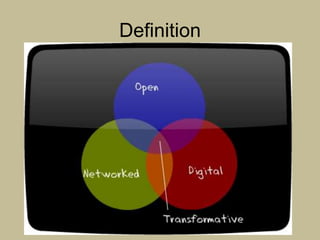
Definition
<Alternative title>


   10 things I’ve come to believe after
thinking about the impact of technology
   for a few years, accompanied by 10
 tenuously connected, and sometimes
             amusing, videos
Lesson 1: It‟s not just for geeks
• YouTube clip - http://youtu.be/fKXk1VhAuvE
But it‟s also about:
•   Knowledge sharing
•   Knowledge creation
•   Networking
•   Generating ideas
•   Communicating
•   Democratisation of learning
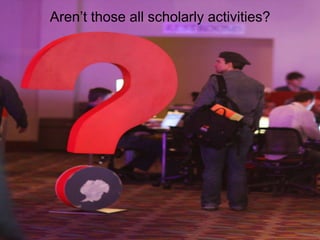
Aren‟t those all scholarly activities?
Sir Martin Rees:
“arXiv.org archive transformed the literature of
physics, establishing a new model for
communication over the whole of science. Far
fewer people today read traditional journals.
These have so far survived as guarantors of
quality. But even this role may soon be trumped
by a more informal system of quality control,
signaled by the approbation of discerning
readers”
So there‟s
something going on
 here, beyond just
       geeks
The Boyer view of scholarship
•   Discovery
•   Integration
•   Application
•   Teaching
Lesson 2: Researchers are caught
          in a dilemma
• YouTube clip http://youtu.be/LnQcCgS7aPQ
But researchers aren’t keen
“frequent or intensive use is
   rare, and some researchers
   regard blogs, wikis and other
   novel forms of
   communication as a waste of
   time or even dangerous”            Harley et al (2010)
                                        “We found no evidence to suggest
(Proctor, Williams and Stewart (2010)   that “tech-savvy” young graduate
                                                 students, postdoctoral scholars, or
                                                 assistant professors are bucking
                                                 traditional publishing practices”


  Carpenter et al describe researchers as
  „risk averse‟ and „behind the curve in using
  digital technology‟
Is it tenure?

“The advice given to pre-tenure scholars
  was consistent across all fields: focus on
  publishing in the right venues and avoid
  spending too much time on public
  engagement, committee work, writing op-
  ed pieces, developing websites, blogging,
  and other non-traditional forms of
  electronic dissemination”
Is it caution?
Waldrop 2008 (on blogging)
““It's so antithetical to the way scientists are trained," Duke
    University geneticist Huntington F. Willard said... The
    whole point of blogging is spontaneity--getting your ideas
    out there quickly, even at the risk of being wrong or
    incomplete. “But to a scientist, that's a tough jump to
    make,” says Willard. “When we publish things, by and
    large, we've gone through a very long process of drafting
    a paper and getting it peer reviewed.”
Is it habit?
Kroll & Forsman
“Almost all researchers have created a strong network of
   friends and colleagues and they draw together the same
   team repeatedly for new projects…
Everyone emphasizes the paramount importance of
   interpersonal contact as the vital basis for agreeing to
   enter into joint work. Personal introductions,
   conversations at meetings or hearing someone present a
   paper were cited as key in choosing collaborators.”
<A tension between potential and
            context>
Lesson 3: Interdisciplinary is the
                network
• YouTube clip - http://youtu.be/LJr8uAqQCBM
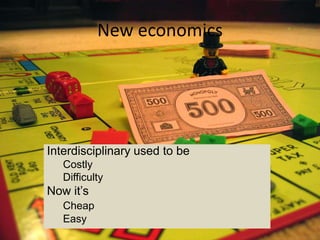
New economics


Interdisciplinary used to be
   Costly
   Difficulty
Now it‟s
   Cheap
   Easy
New cultural norms
What are the cultural norms of blogging?
• a willingness to share thoughts and experiences with others at an
    early stage;
• the importance of getting input from others on an idea or opinion;
• launching collaborative projects that would be very difficult or
    impossible to achieve alone;
• gathering information from a high number of sources every day;
• control over the sources and aggregation of their news;
• the existence of a „common code‟: a vocabulary, a way to write
    posts and behaviour codes such as quoting other sources when
    you use them, linking into them, commenting on other posts and
    so on;
• a culture of speed and currency, with a preference to post or
    react instantaneously; and
• a need for recognition – bloggers want to express themselves
    and get credit for it.
(Le Muir 2005)
How ‘sticky’ are these cultural norms?
Lesson 4: We’re all broadcasters now

Public engagement used to look like this:

YouTube clip - http://youtu.be/2un9rO2ZF4g
Now looks like this:

YouTube clip - http://youtu.be/5zVaFjSxAZs
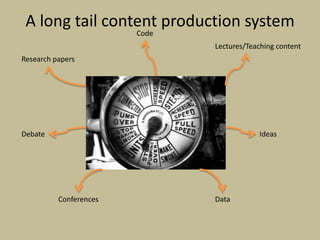
A long tail content production system
                        Code
                               Lectures/Teaching content
Research papers


Debate                                     Ideas


          Conferences          Data
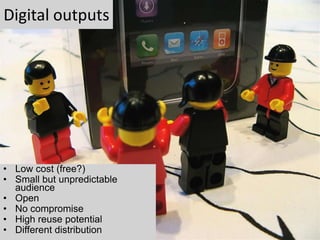
Digital outputs


• Low cost (free?)
• Small but unpredictable
  audience
• Open
• No compromise
• High reuse potential
• Different distribution
Lesson 5: Teaching in an attention
               economy
• YouTube clip - http://youtu.be/DRBW8eJGTVs
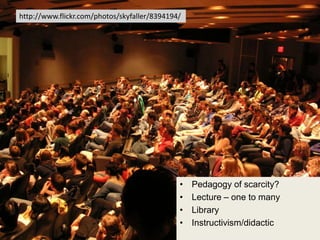
http://www.flickr.com/photos/skyfaller/8394194/


                                              •   Pedagogy of scarcity?
                                              •   Lecture – one to many
                                              •   Library
                                              •   Instructivism/didactic
http://www.flickr.com/photos/42903611@N00/387761039/


What would a pedagogy of abundance look like?
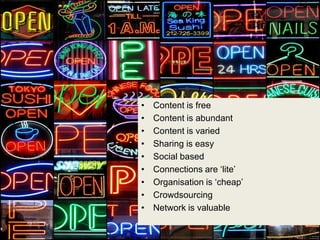
•   Content is free
•   Content is abundant
•   Content is varied
•   Sharing is easy
•   Social based
•   Connections are „lite‟
•   Organisation is „cheap‟
•   Crowdsourcing
•   Network is valuable
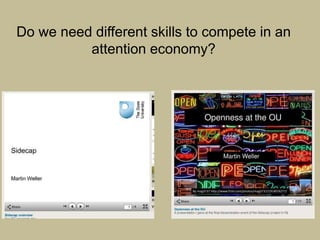
Do we need different skills to compete in an
          attention economy?
Lesson 6: Rethink research
• YouTube clip - http://youtu.be/7KLnXjqKL5g
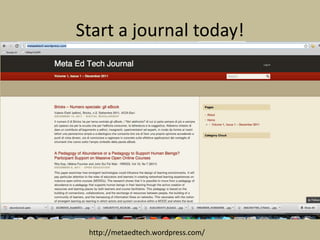
Start a journal today!


 http://metaedtech.wordpress.com/
Invent an app today!
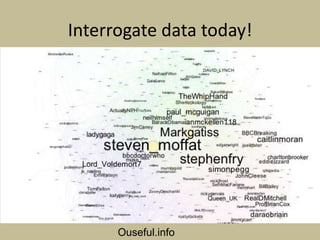
Interrogate data today!


      Ouseful.info
Heppell (2001)
 “we continually make the error of
 subjugating technology to our present
 practice rather than allowing it to free us
 from the tyranny of past mistakes”
Lesson 7: New skills will be required
• YouTube clip - http://youtu.be/7KLnXjqKL5g
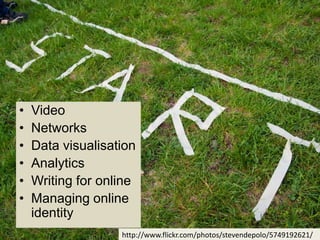
•   Video
•   Networks
•   Data visualisation
•   Analytics
•   Writing for online
•   Managing online
    identity
                   http://www.flickr.com/photos/stevendepolo/5749192621/
<Do we need to be taught these
          skills?>
Lesson 8: It’ll impact even if you ignore
                    it
• YouTube clip - http://youtu.be/rIABo0d9MVE
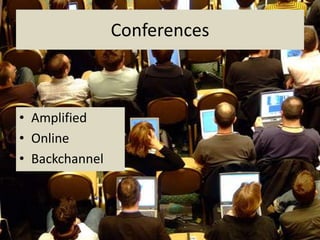
Conferences


• Amplified
• Online
• Backchannel
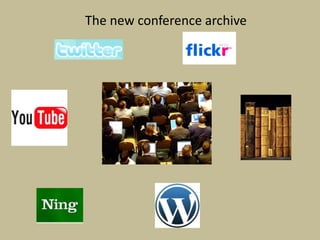
The new conference archive
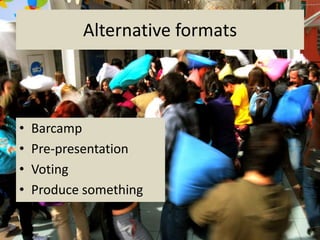
Alternative formats


•   Barcamp
•   Pre-presentation
•   Voting
•   Produce something
Lesson 9: It’s about alternatives
• YouTube clip - http://youtu.be/SKVcQnyEIT8
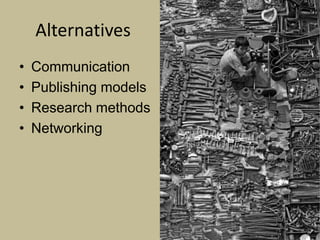
Alternatives
•   Communication
•   Publishing models
•   Research methods
•   Networking
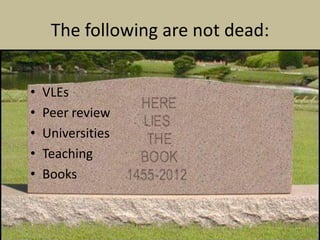
The following are not dead:


•   VLEs
•   Peer review
•   Universities
•   Teaching
•   Books
But they are operating in a different
            ecosystem


       http://www.flickr.com/photos/luc/393887467/
Lesson 10: Don’t focus just on risk
• YouTube clip - http://youtu.be/w7RIgs3eygo
• Doomed - we're all destined to become
  stupid, dysfunctional & lessened by the
  technology eg Carr
• Marooned - we are placing technology in
  too powerful a position and dehumanising
  ourselves in the process eg Lanier
• Entombed - the more we communicate,
  the more alone and isolated we are
  becoming eg Turkle
Tversky and Kahneman: We give risk/loss more
                  weight


        http://www.flickr.com/photos/markusram/1361719776/
James Boyle:
“We are very good at seeing the downsides
and the dangers of open systems, open
production systems, networks of openness.
.. Those dangers are real… we are not so
good at seeing the benefits and the
converse holds true for the closed system.”
To recap
1. It‟s not just for geeks
2. Resolve the researcher‟s dilemma
3. Interdisciplinarity is in the network
4. We‟re all broadcasters now
5. Teaching in an attention economy
6. Opportunity to rethink research
7. New skills will be required
8. It‟ll impact even if you ignore it
9. It‟s about alternatives
10. Don‟t focus just on risk
<polite applause>


<and now – disagree>
Links ‘n’ stuff
•   Videos: www.youtube.com/edtechie
•   Twitter: @mweller
•   Blog: Edtechie.net
•   Book: bit.ly/w80vcq

Ten lessons in digital scholarship

  • 1.
    Digital scholarship 10 lessonsin 10 videos http://www.flickr.com/photos/lwr/
  • 2.
    Book Bloomsburyacademic.com
  • 3.
  • 5.
    <Alternative title> 10 things I’ve come to believe after thinking about the impact of technology for a few years, accompanied by 10 tenuously connected, and sometimes amusing, videos
  • 6.
    Lesson 1: It‟snot just for geeks • YouTube clip - http://youtu.be/fKXk1VhAuvE
  • 7.
    But it‟s alsoabout: • Knowledge sharing • Knowledge creation • Networking • Generating ideas • Communicating • Democratisation of learning
  • 8.
    Aren‟t those allscholarly activities?
  • 9.
    Sir Martin Rees: “arXiv.orgarchive transformed the literature of physics, establishing a new model for communication over the whole of science. Far fewer people today read traditional journals. These have so far survived as guarantors of quality. But even this role may soon be trumped by a more informal system of quality control, signaled by the approbation of discerning readers”
  • 10.
    So there‟s something goingon here, beyond just geeks
  • 11.
    The Boyer viewof scholarship • Discovery • Integration • Application • Teaching
  • 12.
    Lesson 2: Researchersare caught in a dilemma • YouTube clip http://youtu.be/LnQcCgS7aPQ
  • 13.
    But researchers aren’tkeen “frequent or intensive use is rare, and some researchers regard blogs, wikis and other novel forms of communication as a waste of time or even dangerous” Harley et al (2010) “We found no evidence to suggest (Proctor, Williams and Stewart (2010) that “tech-savvy” young graduate students, postdoctoral scholars, or assistant professors are bucking traditional publishing practices” Carpenter et al describe researchers as „risk averse‟ and „behind the curve in using digital technology‟
  • 14.
    Is it tenure? “Theadvice given to pre-tenure scholars was consistent across all fields: focus on publishing in the right venues and avoid spending too much time on public engagement, committee work, writing op- ed pieces, developing websites, blogging, and other non-traditional forms of electronic dissemination”
  • 15.
    Is it caution? Waldrop2008 (on blogging) ““It's so antithetical to the way scientists are trained," Duke University geneticist Huntington F. Willard said... The whole point of blogging is spontaneity--getting your ideas out there quickly, even at the risk of being wrong or incomplete. “But to a scientist, that's a tough jump to make,” says Willard. “When we publish things, by and large, we've gone through a very long process of drafting a paper and getting it peer reviewed.”
  • 16.
    Is it habit? Kroll& Forsman “Almost all researchers have created a strong network of friends and colleagues and they draw together the same team repeatedly for new projects… Everyone emphasizes the paramount importance of interpersonal contact as the vital basis for agreeing to enter into joint work. Personal introductions, conversations at meetings or hearing someone present a paper were cited as key in choosing collaborators.”
  • 17.
    <A tension betweenpotential and context>
  • 18.
    Lesson 3: Interdisciplinaryis the network • YouTube clip - http://youtu.be/LJr8uAqQCBM
  • 19.
    New economics Interdisciplinary usedto be Costly Difficulty Now it‟s Cheap Easy
  • 20.
    New cultural norms Whatare the cultural norms of blogging? • a willingness to share thoughts and experiences with others at an early stage; • the importance of getting input from others on an idea or opinion; • launching collaborative projects that would be very difficult or impossible to achieve alone; • gathering information from a high number of sources every day; • control over the sources and aggregation of their news; • the existence of a „common code‟: a vocabulary, a way to write posts and behaviour codes such as quoting other sources when you use them, linking into them, commenting on other posts and so on; • a culture of speed and currency, with a preference to post or react instantaneously; and • a need for recognition – bloggers want to express themselves and get credit for it. (Le Muir 2005)
  • 21.
    How ‘sticky’ arethese cultural norms?
  • 22.
    Lesson 4: We’reall broadcasters now Public engagement used to look like this: YouTube clip - http://youtu.be/2un9rO2ZF4g
  • 23.
    Now looks likethis: YouTube clip - http://youtu.be/5zVaFjSxAZs
  • 24.
    A long tailcontent production system Code Lectures/Teaching content Research papers Debate Ideas Conferences Data
  • 25.
    Digital outputs • Lowcost (free?) • Small but unpredictable audience • Open • No compromise • High reuse potential • Different distribution
  • 26.
    Lesson 5: Teachingin an attention economy • YouTube clip - http://youtu.be/DRBW8eJGTVs
  • 27.
    http://www.flickr.com/photos/skyfaller/8394194/ • Pedagogy of scarcity? • Lecture – one to many • Library • Instructivism/didactic
  • 28.
  • 29.
    Content is free • Content is abundant • Content is varied • Sharing is easy • Social based • Connections are „lite‟ • Organisation is „cheap‟ • Crowdsourcing • Network is valuable
  • 30.
    Do we needdifferent skills to compete in an attention economy?
  • 31.
    Lesson 6: Rethinkresearch • YouTube clip - http://youtu.be/7KLnXjqKL5g
  • 32.
    Start a journaltoday! http://metaedtech.wordpress.com/
  • 33.
  • 34.
  • 35.
    Heppell (2001) “wecontinually make the error of subjugating technology to our present practice rather than allowing it to free us from the tyranny of past mistakes”
  • 36.
    Lesson 7: Newskills will be required • YouTube clip - http://youtu.be/7KLnXjqKL5g
  • 37.
    Video • Networks • Data visualisation • Analytics • Writing for online • Managing online identity http://www.flickr.com/photos/stevendepolo/5749192621/
  • 38.
    <Do we needto be taught these skills?>
  • 39.
    Lesson 8: It’llimpact even if you ignore it • YouTube clip - http://youtu.be/rIABo0d9MVE
  • 40.
  • 41.
  • 42.
    Alternative formats • Barcamp • Pre-presentation • Voting • Produce something
  • 43.
    Lesson 9: It’sabout alternatives • YouTube clip - http://youtu.be/SKVcQnyEIT8
  • 44.
    Alternatives • Communication • Publishing models • Research methods • Networking
  • 45.
    The following arenot dead: • VLEs • Peer review • Universities • Teaching • Books
  • 46.
    But they areoperating in a different ecosystem http://www.flickr.com/photos/luc/393887467/
  • 47.
    Lesson 10: Don’tfocus just on risk • YouTube clip - http://youtu.be/w7RIgs3eygo
  • 48.
    • Doomed -we're all destined to become stupid, dysfunctional & lessened by the technology eg Carr • Marooned - we are placing technology in too powerful a position and dehumanising ourselves in the process eg Lanier • Entombed - the more we communicate, the more alone and isolated we are becoming eg Turkle
  • 49.
    Tversky and Kahneman:We give risk/loss more weight http://www.flickr.com/photos/markusram/1361719776/
  • 50.
    James Boyle: “We arevery good at seeing the downsides and the dangers of open systems, open production systems, networks of openness. .. Those dangers are real… we are not so good at seeing the benefits and the converse holds true for the closed system.”
  • 51.
    To recap 1. It‟snot just for geeks 2. Resolve the researcher‟s dilemma 3. Interdisciplinarity is in the network 4. We‟re all broadcasters now 5. Teaching in an attention economy 6. Opportunity to rethink research 7. New skills will be required 8. It‟ll impact even if you ignore it 9. It‟s about alternatives 10. Don‟t focus just on risk
  • 52.
  • 53.
    Links ‘n’ stuff • Videos: www.youtube.com/edtechie • Twitter: @mweller • Blog: Edtechie.net • Book: bit.ly/w80vcq

Editor's Notes

  • #3 Written a book recently, so more detail in that if you’re interested.Book was example – published by BloomsburyAcademic – buy hardcopy of read free online under a CC licence
  • #4 People get hung up on definitions – when I use digital scholarship it’s really a shorthand for these 3 factors:Digital content, distributed via global and social network, and mediated through open technologies and practices
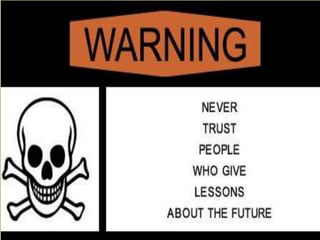
  • #5 As John Naughton notes we are in the middle of a revolution and it’s difficult to know what the outcome will beTherefore you should always be suspicious of people who pretend to know the answers as they’re usually selling somethingSo, I used the term ‘lessons’ just because it made a better title, a more accurate one would have been:
  • #6 But I think we all agree that’s not as snappy.So onto the lessons
  • #7 I spend a lot of time wit geeks and developers. And they’re great, but it sometimes feels like another language and divorced from what you do.
  • #10 When the astronomer royal says this, you know it isn’t a hobbyist thing.
  • #11 It’s dangerous to dismiss it as being about a particular technology or for more techy people. It’s about very fundamental scholarly activity and practice
  • #12 Discovery = ResearchIntegration = Working between disciplinesApplication = taking research and applying it, eg in industry, or public engagementTeachingAll four have equal weighting, and I’ll take an example of each one for my next four lessons
  • #13 So, is there an equivalent happening in research? Could we speed up the innovation cycle?
  • #14 Lots of studies recently have reported a rather conservative approachWhy might this be so?
  • #15 Don’t waste time on all this non-traditional output stuffIs this what happens in other industries?
  • #16 It goes against our training and instincts
  • #17 Successful networks have been developed and researchers return to these, thus not valuing online ones as much
  • #19 The online network forms a new route into interdisciplinary work
  • #20 Consider creating an interdisciplinary print journal with setting up your own blog now
  • #21 Are there consistent cultural norms across these new tools? Same could be said of twitter.Do people who use these tools successfully adopt these cultural norms?
  • #22 How do these new norms then sit with existing disciplinary ones? Are they ‘more sticky’? Have two bloggers in different disciplines got more in common than a blogger and non-blogger in the same discipline?
  • #23 At the OU we used to do TV programmes for our courses, and here’s a parody of them
  • #24 We still make TV but are also developing web native content.But more interesting I think is the material produced by individual academics, which wasn’t possible before
  • #25 As part of their normal function, scholars produce the following:It doesn’t take much effort to turn all of these into shareable digital outputs.
  • #26 These outputs have different characteristics to the type of public engagement we used to do
  • #27 I’m talking about teaching here, but the same applies to disseminating research.Many of you will have seen this clip, but I think it makes a good point
  • #28 We can think of many existing practices as embodying these principles of scarcity
  • #29 If we have abundant content as our assumption, would our approach change?
  • #30 Here are some assumptions which might underlie such a pedagogy.Maybe our existing pedagogies can be adapted, but I think few of them start with these assumptions
  • #31 Competing in an attention economy, you want stuff to be noticed.Development of a slideshare style
  • #32 Talking about business here, but I think the same applies to research. We have become enculturated into a certain approach to research
  • #36 We’ve been trained to think of research as funded, and published, but it needn’t be.
  • #37 Trailer for a course, but could also do trailers or promotions for research projects, publications, etc
  • #38 We’re only at the beginning of this – all of these might be skills the new researcher will need, and which funders will increasingly want evidence for
  • #39 I am suspicious of digital literacy programmes as they tend to end up as tick boxes, and are out of date by the time they’re formalised. It seems to me more about an approach and a mindset
  • #41 This conference is being amplified so others can join inRan the OU conference as all onlineThe backchannel can affect the mood.So even if you’re not involved in any of these media, it will impact upon the conference, which is at the heart of scholarly practice
  • #43 Network weather
  • #44 Books and libraries are a good example of things we hold dear. And what better location.
  • #45 It’s simplistic to think of it as either/or – previously we often only had one approach open to us, eg publish a journal article. Now we have a much richer toolbox to choose from.
  • #46 Simplistically people like to declare that certain things are dead. But they rarely are.This misses the more interesting picture of how those functions or artefacts are changed subtly by the new technology