Open, Online and Connectivist:
Lessons from our cMOOCs

Betty Hurley-Dasgupta
October 29, 2013
Open Learning- UNESCO Definition
OPEN LEARNING - instructional systems in
which many facets of the learning process
are under the control of the learner. It
attempts to deliver learning opportunities
where, when, and how the learner needs
them.
http://www.unesco.org/education/lwf/doc/portfolio/definitions.htm

2
“Open” Defined by David Wiley

“By „open‟ it is generally meant that the
resource is available at no cost to others for
adaptation and reuse in different contexts.”
http://scholar.google.com/citations?view_op=view_citation&hl=en&user=M47HR7IAAAAJ&
citation_for_view=M47HR7IAAAAJ:mVmsd5A6BfQC

3
What is Connectivism?
• Principles of connectivism:
• Learning and knowledge rests in diversity of opinions.
• Learning is a process of connecting specialized nodes or
information sources.
• Capacity to know more is more critical than what is
currently known
• Nurturing and maintaining connections is needed to
facilitate continual learning.
What is Connectivism? (con’d)
• Ability to see connections between fields, ideas, and
concepts is a core skill.
• Currency (accurate, up-to-date knowledge) is the intent
of all connectivist learning activities.
• Decision-making is itself a learning process. Choosing
what to learn and the meaning of incoming information is
seen through the lens of a shifting reality. While there is
a right answer now, it may be wrong tomorrow due to
alterations in the information climate affecting the
decision.
What is a cMOOC?
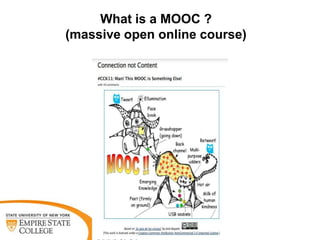
What is a MOOC ?
(massive open online course)
gRSShopper
open source by Stephen Downes
(grsshopper.downes.ca/about.htm )
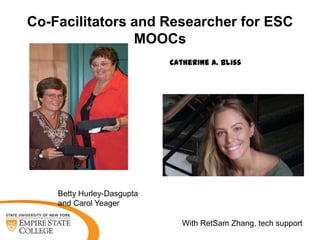
Co-Facilitators and Researcher for ESC
MOOCs
Catherine A. Bliss

Betty Hurley-Dasgupta
and Carol Yeager
With RetSam Zhang, tech support
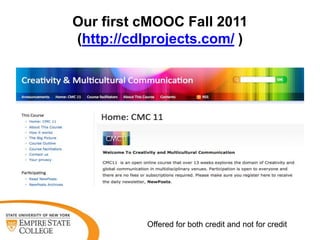
Our first cMOOC Fall 2011
(http://cdlprojects.com/ )

Offered for both credit and not for credit
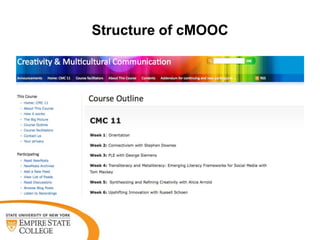
Structure of cMOOC
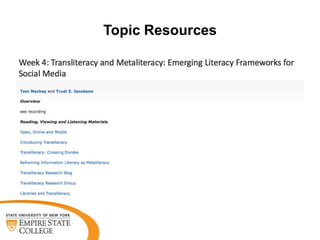
Topic Resources
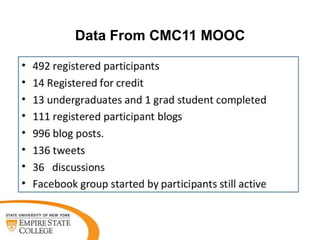
Data From CMC11 MOOC
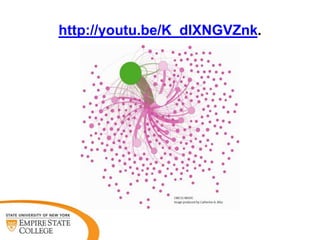
http://youtu.be/K_dIXNGVZnk.
(http://math.cdlprojects.com/ )
our second MOOC Fall 2012

Not offered for credit
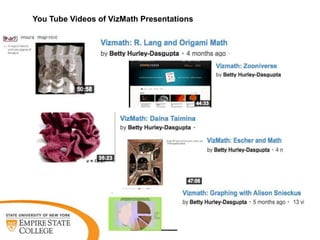
You Tube Videos of VizMath Presentations
Lessons Learned
 Need critical mass for blogs and connections to occur
 Webinar space is not ideal
 Assessment- challenge!
 Connect with ePortfolios
 What is learning?

18
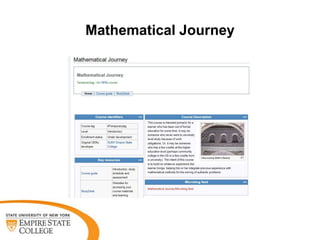
Mathematical Journey
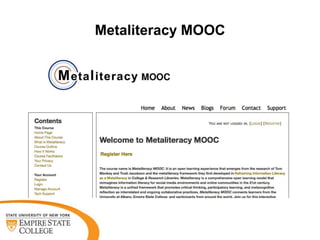
Metaliteracy MOOC
As these online universities gain traction, and start
counting for actual college course credit, they‟ll most
likely have enormous real-world impact. They‟ll help in
getting jobs and creating business ideas. They might
just live up to their hype. For millions of people around
the globe with few resources, MOOCs may even be
life-changing.
A.J. Jacobs

http://www.nytimes.com/2013/04/21/opinion/sunday/grading-themooc-university.html?hp
Some References
•
•
•
•
•
•

•
•
•

Research article on MOOCs:
http://www.irrodl.org/index.php/irrodl/article/view/1041/2025
Dave Cormier on MOOCs:
http://davecormier.com/edblog/2012/07/31/20-questions-and-answersabout-moocs/
George Siemens on MOOCs (video):
http://blog.p2pfoundation.net/george-siemens-on-massive-open-onlinecourses/2011/05/14
Stephen Downes on MOOCs (video):
http://www.slideshare.net/Downes/xmooc-the-massive-open-onlinecourse-in-theory-and-in-practice
Article by Yeager, Hurley-Dasgupta and Bliss on MOOCs:
http://jaln.sloanconsortium.org/index.php/jaln/article/view/347
References
https://groups.diigo.com/group/mooc
-research

CDETG Presentation on MOOCs

  • 1.
    Open, Online andConnectivist: Lessons from our cMOOCs Betty Hurley-Dasgupta October 29, 2013
  • 2.
    Open Learning- UNESCODefinition OPEN LEARNING - instructional systems in which many facets of the learning process are under the control of the learner. It attempts to deliver learning opportunities where, when, and how the learner needs them. http://www.unesco.org/education/lwf/doc/portfolio/definitions.htm 2
  • 3.
    “Open” Defined byDavid Wiley “By „open‟ it is generally meant that the resource is available at no cost to others for adaptation and reuse in different contexts.” http://scholar.google.com/citations?view_op=view_citation&hl=en&user=M47HR7IAAAAJ& citation_for_view=M47HR7IAAAAJ:mVmsd5A6BfQC 3
  • 4.
    What is Connectivism? •Principles of connectivism: • Learning and knowledge rests in diversity of opinions. • Learning is a process of connecting specialized nodes or information sources. • Capacity to know more is more critical than what is currently known • Nurturing and maintaining connections is needed to facilitate continual learning.
  • 5.
    What is Connectivism?(con’d) • Ability to see connections between fields, ideas, and concepts is a core skill. • Currency (accurate, up-to-date knowledge) is the intent of all connectivist learning activities. • Decision-making is itself a learning process. Choosing what to learn and the meaning of incoming information is seen through the lens of a shifting reality. While there is a right answer now, it may be wrong tomorrow due to alterations in the information climate affecting the decision.
  • 7.
    What is acMOOC?
  • 8.
    What is aMOOC ? (massive open online course)
  • 9.
    gRSShopper open source byStephen Downes (grsshopper.downes.ca/about.htm )
  • 10.
    Co-Facilitators and Researcherfor ESC MOOCs Catherine A. Bliss Betty Hurley-Dasgupta and Carol Yeager With RetSam Zhang, tech support
  • 11.
    Our first cMOOCFall 2011 (http://cdlprojects.com/ ) Offered for both credit and not for credit
  • 12.
  • 13.
  • 14.
  • 15.
  • 16.
    (http://math.cdlprojects.com/ ) our secondMOOC Fall 2012 Not offered for credit
  • 17.
    You Tube Videosof VizMath Presentations
  • 18.
    Lessons Learned  Needcritical mass for blogs and connections to occur  Webinar space is not ideal  Assessment- challenge!  Connect with ePortfolios  What is learning? 18
  • 19.
  • 20.
  • 21.
    As these onlineuniversities gain traction, and start counting for actual college course credit, they‟ll most likely have enormous real-world impact. They‟ll help in getting jobs and creating business ideas. They might just live up to their hype. For millions of people around the globe with few resources, MOOCs may even be life-changing. A.J. Jacobs http://www.nytimes.com/2013/04/21/opinion/sunday/grading-themooc-university.html?hp
  • 22.
    Some References • • • • • • • • • Research articleon MOOCs: http://www.irrodl.org/index.php/irrodl/article/view/1041/2025 Dave Cormier on MOOCs: http://davecormier.com/edblog/2012/07/31/20-questions-and-answersabout-moocs/ George Siemens on MOOCs (video): http://blog.p2pfoundation.net/george-siemens-on-massive-open-onlinecourses/2011/05/14 Stephen Downes on MOOCs (video): http://www.slideshare.net/Downes/xmooc-the-massive-open-onlinecourse-in-theory-and-in-practice Article by Yeager, Hurley-Dasgupta and Bliss on MOOCs: http://jaln.sloanconsortium.org/index.php/jaln/article/view/347
  • 23.

Editor's Notes

  • #5 Thirteen credit seeking participants, one of whom was a grad student; 350+ total registrations in first offering Fall 2011. Approx 15% active, all registered participants completed; a number of not for credit completed and some are still active today.Learning contract of expectations for credit seekers; constantly updating, adding new presentations .. One 3 weeks from Mexico also using cMOOC theory in her teaching … all sessions are recorded and available now in the “course”
  • #6 Thirteen credit seeking participants, one of whom was a grad student; 350+ total registrations in first offering Fall 2011. Approx 15% active, all registered participants completed; a number of not for credit completed and some are still active today.Learning contract of expectations for credit seekers; constantly updating, adding new presentations .. One 3 weeks from Mexico also using cMOOC theory in her teaching … all sessions are recorded and available now in the “course”
  • #9 Mention Siemens, Downes, Cormier PLENK 2010, CCK 11 and 12, Change 11/12 …
  • #11 Building on our work together in International Program development and delivery as well as my work in Creativity and Change Leadership at SUNY/Buffalo State, started designing our first MOOC in Spring of 2011. We had both experienced several of the CMOOCswDownes, Cormier and Siemens. Worked with Retsam for tech learning and support and at end of 1st offering, Catherine Bliss analyzed the interaction within the course …
  • #12 Thirteen credit seeking participants, one of whom was a grad student; 350+ total registrations in first offering Fall 2011. Approx 15% active, all registered participants completed; a number of not for credit completed and some are still active today.Learning contract of expectations for credit seekers; constantly updating, adding new presentations .. One 3 weeks from Mexico also using cMOOC theory in her teaching … all sessions are recorded and available now in the “course”
  • #16 Animation of interactions and activity over 13 weeks of Fall 2011 … Catherine Bliss using Gephi software
  • #17 Spring of 2012 started work on second MOOC … not for credit and as an adjunct to another open resource course, A Mathemtical Journey that also uses Khan Academy videos. Wanted to attract non math lovers as well as math afficionados
  • #22 Read this 4 weeks ago in the NYTimes … part of a larger discussion you might wish to read. Interesting approach to the disruptive world of MOOCs in HE and related OER opportunities.