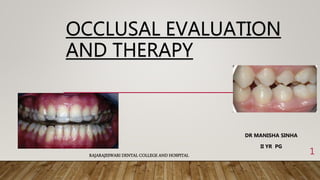
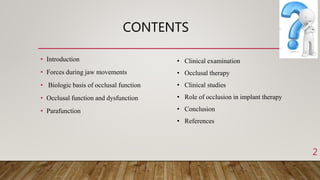
DR MANISHA SINHA
II YR PG
1RAJARAJESWARI DENTAL COLLEGE AND HOSPITAL
CONTENTS
• Introduction
• Forces during jaw movements
• Biologic basis of occlusal function
• Occlusal function and dysfunction
• Parafunction
• Clinical examination
• Occlusal therapy
• Clinical studies
• Role of occlusion in implant therapy
• Conclusion
• References
2
3
 Occlusion is "the static relationship between the incising or occlusal surfaces of the maxillary
or mandibular teeth or tooth analogues. The occlusion should be balanced and as stress free as
possible".
 Among the numerous local and systemic factors with the potential to influence the progression
of periodontitis, the patient’s occlusion remains a variable that requires an exact diagnosis.
INTRODUCTION:
4
 Occlusion becomes a factor for consideration when the occlusal forces acting on a tooth produce
displacement of the root in the socket which results in an injury to the supporting periodontal
ligament.
 This periodontal tissue injury from occlusal forces has been defined as the lesion of trauma from
occlusion.
5
At low levels, the microscopic changes include
increased vascularization, increased vascular
permeability, vascular thrombosis, and disruption of
fibroblasts and collagen fiber bundles.
If the force is maintained,
osteoclasts appear on the surface of the
alveolus, leading to net bone resorption.
6
At higher levels, occlusal forces may cause necrosis
of periodontal ligament tissue, including lysis of
cells, disruption of blood vessels and hyalinization
of collagen fibers.
In addition, resorption of the root surface
may be a feature of the occlusal trauma lesion.
7
The teeth and their periodontium are subjected to functional dynamic loading during
chewing, swallowing, and the performance of parafunctional habits, including bruxism and
clenching.
Tooth contact is minimal during speech. (Gibbs CH et al., 1972).
Forces during jaw movements
8
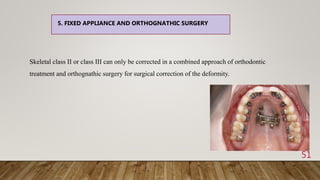
The forces generated by these contacts are of relatively low magnitude, averaging 81 N, and short
acting, with a duration of about 20-50 ms.
In contrast, forces at final closure in the intercuspal position are not only much greater, averaging
262 N, but are also longer acting with an average duration of about 115 ms.
Swallowing during chewing occurs in the intercuspal position with an average force of 296 N and a
duration of about 700 ms.
9
Harmonious occlusal force on a tooth stimulates the physiologic arrangement of its periodontal
attachment fibres and its osseous architecture and encourages its stability.
Forces that exceed the tolerance of the periodontium result in resorption of the bone and disruption
of the attachment.
(Kaku M et a., 2005; Motohira H et al., 2007; Newman MG et al., 2006)
10
• A physiologic occlusion is present when no signs of
dysfunction or disease are present and no treatment is
indicated.
• A nonphysiologic (or traumatic) occlusion is associated
with dysfunction or disease caused by tissue injury, and
treatment may be indicated. In this text the term trauma horn
occlusion is applied to periodontal tissue injury resulting
from occlusal forces.
• A therapeutic occlusion is the result of specific
interventions designed to treat dysfunction or disease.
BIOLOGIC BASIS OF OCCLUSAL FUNCTION
A widely accepted physiologic classification of occlusion is as follows:
11
 Maintenance of a physiologic occlusion requires favourable structure-function relationships
and optimal tissue adaptation throughout the masticatory system.
 When occlusal forces are distributed optimally, the occlusion will be stable by objective
criteria and is likely to be subjectively comfortable for the patient.
OCCLUSAL FUNCTION & DYSFUNCTION:
The identification of masticatory system disharmonies allows the clinician to recognize
dysfunctional relationships, which may influence the accuracy of the diagnosis.
Stability is enhanced by the simultaneous bilateral contact of multiple posterior teeth with occlusal
forces in the long axis of most posterior teeth.
12
PARAFUNCTION:
13
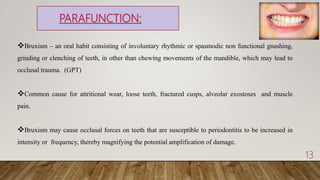
Bruxism – an oral habit consisting of involuntary rhythmic or spasmodic non functional gnashing,
grinding or clenching of teeth, in other than chewing movements of the mandible, which may lead to
occlusal trauma. (GPT)
Common cause for attritional wear, loose teeth, fractured cusps, alveolar exostoses and muscle
pain.
Bruxism may cause occlusal forces on teeth that are susceptible to periodontitis to be increased in
intensity or frequency, thereby magnifying the potential amplification of damage.
14
 In the case of a sustained, low-level force, the amount of deformation of the periodontal
membrane increases with the passage of time, due to viscous drag, and capillary vessels in
the periodontal membrane is compressed, causing ischemia.
 Repetition of this ischemic condition may affect the resistance of the periodontal issue.
15
BRUXISM AND PERIODONTAL DISEASE
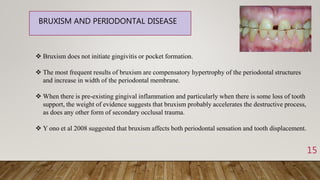
 Bruxism does not initiate gingivitis or pocket formation.
 The most frequent results of bruxism are compensatory hypertrophy of the periodontal structures
and increase in width of the periodontal membrane.
 When there is pre-existing gingival inflammation and particularly when there is some loss of tooth
support, the weight of evidence suggests that bruxism probably accelerates the destructive process,
as does any other form of secondary occlusal trauma.
 Y ono et al 2008 suggested that bruxism affects both periodontal sensation and tooth displacement.
CLINICAL EXAMINATION:
16
A comprehensive evaluation of masticatory system and muscles and occlusal
anatomy is a pre requisite to identify any occlusal disharmony.
Clinical assesments to be done are –
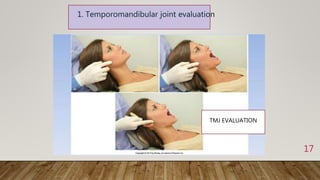
TMJ evaluation
Testing for mobility of teeth
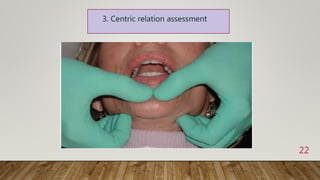
Centric relation assessment
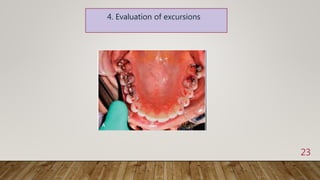
Evaluation of excursions
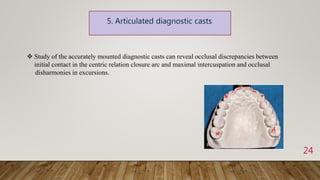
Articulated diagnostic casts
17
TMJ EVALUATION
18
Temporomandibular disorder screening
evaluation
1. Maximal interincisal opening (range = 40-
50mm)
2. Opening / closing pathway
3. Range of lateral and protrusive excursions (≥
7mm to 9mm)
4. Auscultation for TMJ sounds
5. Palpation for TMJ tenderness or tissue
displacement
6. Palpation for muscle tenderness
7. Load testing of the patient’s TMJs
19
Manual evaluation
Manual evaluation of mobility is best carried out clinically using the handles of two instruments to
move the teeth buccally and lingually.
Fremitus
Fremitus is the movement of a tooth or teeth subjected to functional occlusal forces, this can be
assessed by palpating the buccal aspect of several teeth as the patient taps up and down.
2. Testing of mobility of teeth
20
Periodontometers
to standardise the measurement of even minor tooth displacement. To date, this
instrument has been used in a few clinical studies and has limited practical use.
Periotest
was produced in Germany in the late 1980s to provide a more reliable method for
determining tooth mobility.
It is designed to measure the reaction of the periodontium to a defined percussion,
delivered by a tapping instrument.
21
22
23
24
 Study of the accurately mounted diagnostic casts can reveal occlusal discrepancies between
initial contact in the centric relation closure arc and maximal intercuspation and occlusal
disharmonies in excursions.
25
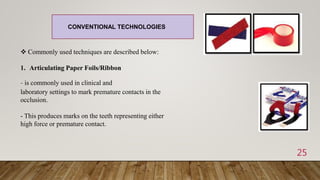
 Commonly used techniques are described below:
1. Articulating Paper Foils/Ribbon
- is commonly used in clinical and
laboratory settings to mark premature contacts in the
occlusion.
- This produces marks on the teeth representing either
high force or premature contact.
CONVENTIONAL TECHNOLOGIES
26
2. Silk strips
They are available in average thickness of 80μ and
are soft flexible indicator materials, which are reliable because
of their texture and do not produce pseudo contact markings
by adapting perfectly to cusps and fossae.
3. Foils
Foils are the thinnest indicator materials which give more
accurate readings than paper and silk
27
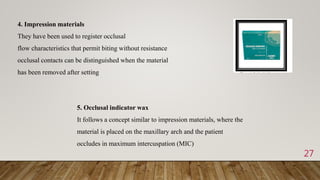
4. Impression materials
They have been used to register occlusal
flow characteristics that permit biting without resistance
occlusal contacts can be distinguished when the material
has been removed after setting
5. Occlusal indicator wax
It follows a concept similar to impression materials, where the
material is placed on the maxillary arch and the patient
occludes in maximum intercuspation (MIC)
28
QUANTITATIVE OCCLUSAL REGISTRATION
TECHNOLOGIES
1. Photo-occlusion system
It consists of a thin photoplastic film layer which is positioned
on the occlusal surface of the teeth in which the patient would
bite for ten to twenty seconds. Then the film layer is inspected
under a polariscope light to obtain the relative tooth contact
intensity was measured. It has been proven that the
photoelastic wafer enhances posterior contact intensity while
diminishes the anterior ones.
29
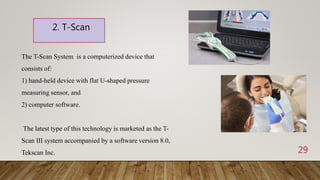
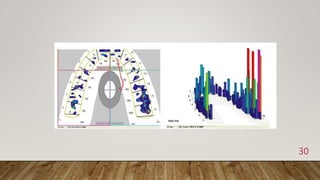
2. T-Scan
The T-Scan System is a computerized device that
consists of:
1) hand-held device with flat U-shaped pressure
measuring sensor, and
2) computer software.
The latest type of this technology is marketed as the T-
Scan III system accompanied by a software version 8.0,
Tekscan Inc.
30
OCCLUSAL THERAPY:
31
The purpose of occlusal therapy is to establish stable functional relationships favorable to
the oral health of the patient, including periodontium.
 Effective nonsurgical therapy usually reduces inflammation within the periodontium and
results in some healing of attachment, which often results in mobile teeth becoming more
stable.
 When there is sufficient evidence of excessive occlusal forces on the patient’s teeth or
when masticatory system disharmony exists and the patient desires a more stable
occlusion, an occlusal appliance is prescribed.
32
Requirements for Occlusal Stability
1 . Maximum intercuspation
• Light or absent anterior contacts
• Well-distributed posterior contacts
• Coupled contacts between opposing teeth
• Cross-tooth stabilization
• Forces directed along long axis of each tooth
2. Smooth excursive movements without interferences
3. No trauma from occlusion
4. Favorable subjective response to occlusal form
and function
33
Indications for occlusal therapy
Trauma from
occlusion
Bruxism, muscular
dysfunction
Some forms of TMJ
pathosis
Need to improve
functional relation,
increase masticatory
efficiency,
Food impaction
Increased tooth
mobility
Dental pain
associated with
occlusion
Uneven marginal
ridges
Occlusal soft tissue
injury
34
CONTRAINDICATIONS:
Presence of occlusal discrepancies without evidence of related pathologic changes
Severe extrusion, mobility that would not respond to occlusal treatment
35
OCCLUSAL EQUILIBRATION
According to World Workshop of the American Academy of Periodontology some guidelines
for situations when occlusal equilibration are indicated:
1. when there are occlusal contact relationships that cause trauma to the periodontium,
joints,muscles or soft tissues.
2. When there are interferences that aggravate parafunction
3. As an aid to splint therapy.
TREATMENT OPTIONS:
36
When there is sufficient evidence of excessive occlusal forces on the patient’s teeth or when
masticatory system disharmony exists and the patient desires a more stable occlusion, then an occlusal
appliance is prescribed.
Treatment options –
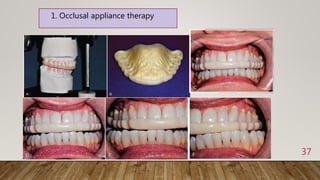
1. occlusal appliance therapy
2. occlusal adjustment
3. occlusal stability for restorative dentistry
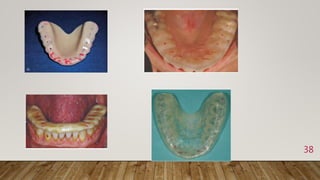
4. orthodontic tooth movement
5. orthognathic therapy
37
1. Occlusal appliance therapy
38
39
2. Occlusal adjustment
Occlusal adjustment or the selective reshaping of the occluding surfaces of the teeth can reduce
the magnitude of occlusal interferences or direct the forces to be more compatible with the long
axes of the affected teeth.
Accurately mounted duplicate models can be used to accomplish a trial occlusal adjustment to
determine safety and efficacy for a patient.
40
 The clinical goal of intercuspal position and retruded contact position adjustment are to
reduce the supracontacts as as to create unobstructed closure of cusps into fossae and
marginal ridges.
 The correction of occlusal supracontacts consists of grooving, spheroiding and pointing.
41
42
STEPS IN CORONOPLASTY
1. Retrusive prematurities are eliminated.
2. Adjust ICP to achieve stable, simultaneous contacts
3.Test for excessive occlusal contact on the incisors in ICP
4.Elimination of posterior protrusive contacts.
5.Reduce mediotrusive prematurities
6. Laterotrusive prematurities
7.Gross occlusal disharmonies
8.Recheck Contact relationships.
43
 Equilibrating mobile teeth
In a patient with mobile teeth, it may be necessary to temporarily stabilise those teeth before
equilibration is possible. If a tooth is mobile, it is very difficult if not impossible to effectively modify
its shape with the aim of reducing the occlusal forces acting upon it.
 When to equilibrate?
Whether occlusal equilibration is indicated will depend upon:
Whether the inflammatory periodontitis has been treated successfully.
The radiographic appearance of the periodontal support.
44
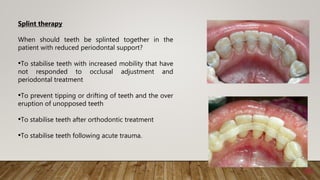
Splint therapy
When should teeth be splinted together in the
patient with reduced periodontal support?
•To stabilise teeth with increased mobility that have
not responded to occlusal adjustment and
periodontal treatment
•To prevent tipping or drifting of teeth and the over
eruption of unopposed teeth
•To stabilise teeth after orthodontic treatment
•To stabilise teeth following acute trauma.
45
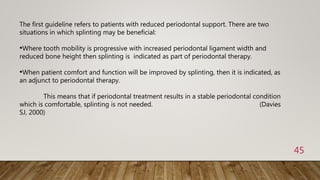
The first guideline refers to patients with reduced periodontal support. There are two
situations in which splinting may be beneficial:
•Where tooth mobility is progressive with increased periodontal ligament width and
reduced bone height then splinting is indicated as part of periodontal therapy.
•When patient comfort and function will be improved by splinting, then it is indicated, as
an adjunct to periodontal therapy.
This means that if periodontal treatment results in a stable periodontal condition
which is comfortable, splinting is not needed. (Davies
SJ, 2000)
46
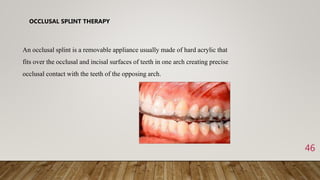
OCCLUSAL SPLINT THERAPY
An occlusal splint is a removable appliance usually made of hard acrylic that
fits over the occlusal and incisal surfaces of teeth in one arch creating precise
occlusal contact with the teeth of the opposing arch.
47
TYPES OF SPLINTS
PERMISSIVE OCCLUSAL SPLINT
have a smooth surface on one side that allow the muscles to move the
mandible without interference from deflective tooth inclines so the condyles
can slide back and up to complete seating in to the centric relation.
DIRECTIVE OCCLUSAL SPLINT
Direct the lower arch into a specific occlusal relationship that in turn directs the
condyles to a predetermined position.
48
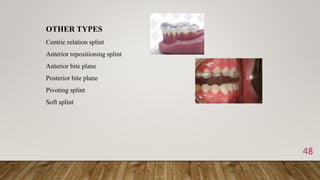
OTHER TYPES
Centric relation splint
Anterior repositioning splint
Anterior bite plane
Posterior bite plane
Pivoting splint
Soft splint
Requirements for occlusal stability
1. Forces on individual teeth that do not exceed the
and resistance of that tooth’s periodontium and that are
vertically oriented to the long axis of each tooth as
as possible.
2. Even, simultaneous contact of all posterior teeth in the
centric relation closure arc or in maximum
with minimal difference between the two
3. Little or no contact of the anterior teeth in centric
occlusion, although such contact readily available to
provide guidance in any excursion and to produce
posterior disclusion
4. Harmonious excursive movement of the mandible within
the patient’s envelope of function with complete
of occlusal Interference
49
3. Occlusal stability for restorative dentistry
50
4. ORTHODONTIC TREATMENT
Orthodontic correction is usually restricted to cases where tooth malpositions are the
primary cause of trauma.
There are certain additional factors such as morphology, prognosis of the teeth involved,
direction and magnitude of movement required that will influence the decision of whether or
not orthodontic tooth movement is indicated.
51
5. FIXED APPLIANCE AND ORTHOGNATHIC SURGERY
Skeletal class II or class III can only be corrected in a combined approach of orthodontic
treatment and orthognathic surgery for surgical correction of the deformity.
CLINICAL STUDIES CONDUCTED
52
53
Association of Occlusal Contacts with
Pocket Depths –
•In a study done by Nunn and Harrel,
2009 - Multiple types of Occlusal
prematurities were shown to be
associated with deeper probing pocket
depths and an increased assignment of
a less than “Good” prognosis and
suggested that treatment of Occlusal
Discrepancies as a routine part of
periodontal treatment may be
indicated
Effects of Occlusal Discrepancies on the
Progression of Periodontal Disease –
•In a study done by Nunn and Harrel in a
series of studies published in 2001 and 2004
reported that these occlusal discrepancies are
an independent risk factor for the progression
of periodontal disease with periodontal
treatment resulting in improved outcomes
when compared with patients with untreated
discrepancies.
54
Relationship between Occlusal Force and progression of Periodontal Disease –
•Takeuchi 2010 - Prognosis of teeth in maintenance phase was significantly affected by
Low Occlusal Forces and he suggested that Low Occlusal Forces might be possible Risk
Factor for Periodontal Disease Progression
55
Some contradictory studies were also there –
•Rosling et al (1976) – Infrabony pockets associated
with hypermobile teeth exhibited the same degree of
healing as adjacent firm teeth
•Jin and Cao (1992) – Concluded that there were no
significant differences in probing depth, clinical
attachment levels or alveolar bone height, when
comparing teeth with and without abnormal occlusal
contacts
HOW TO DECIDE WHAT MODE OF
TREATMENT IS REQUIRED :
56
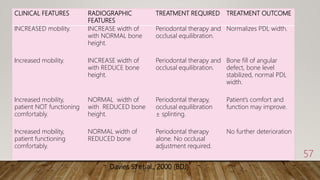
CLINICAL FEATURES RADIOGRAPHIC
FEATURES
TREATMENT REQUIRED TREATMENT OUTCOME
INCREASED mobility. INCREASE width of
with NORMAL bone
height.
Periodontal therapy and
occlusal equilibration.
Normalizes PDL width.
Increased mobility. INCREASE width of
with REDUCE bone
height.
Periodontal therapy and
occlusal equilibration.
Bone fill of angular
defect, bone level
stabilized, normal PDL
width.
Increased mobility,
patient NOT functioning
comfortably.
NORMAL width of
with REDUCED bone
height.
Periodontal therapy,
occlusal equilibration
± splinting.
Patient’s comfort and
function may improve.
Increased mobility,
patient functioning
comfortably.
NORMAL width of
REDUCED bone
Periodontal therapy
alone. No occlusal
adjustment required.
No further deterioration
57
ROLE OF OCCLUSION IN IMPLANT THERAPY:
58
Due to lack of the periodontal ligament, osseointegrated implants, unlike
natural teeth, react biomechanically in a different fashion to occlusal force.
It is therefore believed that dental implants may be more prone to
occlusal overloading, which is often regarded as one of the potential causes
for peri-implant bone loss and failure of the implant/implant prosthesis.
Overloading factors that may negatively influence on implant longevity
include large cantilevers, parafunctions, improper occlusal designs, and
premature contacts.
59
It is important to control implant occlusion within physiologic limit and thus
provide optimal implant load to ensure a long-term implant success.
Implant overloading attributes clinical complications such as
•screw loosening
•screw fractures
•fractures of veneering materials
•prosthesis fractures
•continuing marginal bone loss
•implant fractures
•implant loss
(Zarb & Schmitt 1990; Jemt & Lekholm 1993; Wennerberg & Jemt 1999; Schwarz 2000).
CONCLUSION
60
REFERENCES:
61
Newman MG, Takei HH, Klokkevold PR, Carranza FA. Carranza’s clinical
periodontology. 13th ed. New Delhi (India): Elsevier; 2012. p.872. vol II.
Lindhe J, Lang NP, Karring T. Clinical periodontology and implant dentistry. 5th ed.
Oxford (UK): Blackwell publishing ltd; 2008. p.551-3. vol 2.
Dawson PE. Functional occlusion from TMJ to smile design. Mosby elsevier.
Svanberg GK, King GJ, Gibbs CH. Occlusal considerations in periodontology.
Periodontology 2000. 1995 Oct;9(1):106-17.
Andrea mombelli. Critical issues in periodontal diagnosis. Perio 2000, vol. 39, 2005,
9–12.
62
Gunnar K. Svanberg, Gregory J King & Charles H Gibbs. Occlusal considerations in Periodontology.
Periodontology 2000, vol. 9, 1995, 106-11.
Davies SJ et al. Occlusal considerations in periodontics British dental journal, volume 191, no. 11,
December 8 2000.
Yongsik Kim et al. Occlusal considerations in implant therapy: clinical guidelines with
biomechanical rationale. Clin. Oral Impl. Res. 16, 2005; 26–35.
63

Occlusal evaluation and therapy

  • 1.
    DR MANISHA SINHA IIYR PG 1RAJARAJESWARI DENTAL COLLEGE AND HOSPITAL
  • 2.
    CONTENTS • Introduction • Forcesduring jaw movements • Biologic basis of occlusal function • Occlusal function and dysfunction • Parafunction • Clinical examination • Occlusal therapy • Clinical studies • Role of occlusion in implant therapy • Conclusion • References 2
  • 3.
    3  Occlusion is"the static relationship between the incising or occlusal surfaces of the maxillary or mandibular teeth or tooth analogues. The occlusion should be balanced and as stress free as possible".  Among the numerous local and systemic factors with the potential to influence the progression of periodontitis, the patient’s occlusion remains a variable that requires an exact diagnosis. INTRODUCTION:
  • 4.
    4  Occlusion becomesa factor for consideration when the occlusal forces acting on a tooth produce displacement of the root in the socket which results in an injury to the supporting periodontal ligament.  This periodontal tissue injury from occlusal forces has been defined as the lesion of trauma from occlusion.
  • 5.
    5 At low levels,the microscopic changes include increased vascularization, increased vascular permeability, vascular thrombosis, and disruption of fibroblasts and collagen fiber bundles. If the force is maintained, osteoclasts appear on the surface of the alveolus, leading to net bone resorption.
  • 6.
    6 At higher levels,occlusal forces may cause necrosis of periodontal ligament tissue, including lysis of cells, disruption of blood vessels and hyalinization of collagen fibers. In addition, resorption of the root surface may be a feature of the occlusal trauma lesion.
  • 7.
    7 The teeth andtheir periodontium are subjected to functional dynamic loading during chewing, swallowing, and the performance of parafunctional habits, including bruxism and clenching. Tooth contact is minimal during speech. (Gibbs CH et al., 1972). Forces during jaw movements
  • 8.
    8 The forces generatedby these contacts are of relatively low magnitude, averaging 81 N, and short acting, with a duration of about 20-50 ms. In contrast, forces at final closure in the intercuspal position are not only much greater, averaging 262 N, but are also longer acting with an average duration of about 115 ms. Swallowing during chewing occurs in the intercuspal position with an average force of 296 N and a duration of about 700 ms.
  • 9.
    9 Harmonious occlusal forceon a tooth stimulates the physiologic arrangement of its periodontal attachment fibres and its osseous architecture and encourages its stability. Forces that exceed the tolerance of the periodontium result in resorption of the bone and disruption of the attachment. (Kaku M et a., 2005; Motohira H et al., 2007; Newman MG et al., 2006)
  • 10.
    10 • A physiologicocclusion is present when no signs of dysfunction or disease are present and no treatment is indicated. • A nonphysiologic (or traumatic) occlusion is associated with dysfunction or disease caused by tissue injury, and treatment may be indicated. In this text the term trauma horn occlusion is applied to periodontal tissue injury resulting from occlusal forces. • A therapeutic occlusion is the result of specific interventions designed to treat dysfunction or disease. BIOLOGIC BASIS OF OCCLUSAL FUNCTION A widely accepted physiologic classification of occlusion is as follows:
  • 11.
    11  Maintenance ofa physiologic occlusion requires favourable structure-function relationships and optimal tissue adaptation throughout the masticatory system.  When occlusal forces are distributed optimally, the occlusion will be stable by objective criteria and is likely to be subjectively comfortable for the patient.
  • 12.
    OCCLUSAL FUNCTION &DYSFUNCTION: The identification of masticatory system disharmonies allows the clinician to recognize dysfunctional relationships, which may influence the accuracy of the diagnosis. Stability is enhanced by the simultaneous bilateral contact of multiple posterior teeth with occlusal forces in the long axis of most posterior teeth. 12
  • 13.
    PARAFUNCTION: 13 Bruxism – anoral habit consisting of involuntary rhythmic or spasmodic non functional gnashing, grinding or clenching of teeth, in other than chewing movements of the mandible, which may lead to occlusal trauma. (GPT) Common cause for attritional wear, loose teeth, fractured cusps, alveolar exostoses and muscle pain. Bruxism may cause occlusal forces on teeth that are susceptible to periodontitis to be increased in intensity or frequency, thereby magnifying the potential amplification of damage.
  • 14.
    14  In thecase of a sustained, low-level force, the amount of deformation of the periodontal membrane increases with the passage of time, due to viscous drag, and capillary vessels in the periodontal membrane is compressed, causing ischemia.  Repetition of this ischemic condition may affect the resistance of the periodontal issue.
  • 15.
    15 BRUXISM AND PERIODONTALDISEASE  Bruxism does not initiate gingivitis or pocket formation.  The most frequent results of bruxism are compensatory hypertrophy of the periodontal structures and increase in width of the periodontal membrane.  When there is pre-existing gingival inflammation and particularly when there is some loss of tooth support, the weight of evidence suggests that bruxism probably accelerates the destructive process, as does any other form of secondary occlusal trauma.  Y ono et al 2008 suggested that bruxism affects both periodontal sensation and tooth displacement.
  • 16.
    CLINICAL EXAMINATION: 16 A comprehensiveevaluation of masticatory system and muscles and occlusal anatomy is a pre requisite to identify any occlusal disharmony. Clinical assesments to be done are – TMJ evaluation Testing for mobility of teeth Centric relation assessment Evaluation of excursions Articulated diagnostic casts
  • 17.
  • 18.
    18 Temporomandibular disorder screening evaluation 1.Maximal interincisal opening (range = 40- 50mm) 2. Opening / closing pathway 3. Range of lateral and protrusive excursions (≥ 7mm to 9mm) 4. Auscultation for TMJ sounds 5. Palpation for TMJ tenderness or tissue displacement 6. Palpation for muscle tenderness 7. Load testing of the patient’s TMJs
  • 19.
    19 Manual evaluation Manual evaluationof mobility is best carried out clinically using the handles of two instruments to move the teeth buccally and lingually. Fremitus Fremitus is the movement of a tooth or teeth subjected to functional occlusal forces, this can be assessed by palpating the buccal aspect of several teeth as the patient taps up and down. 2. Testing of mobility of teeth
  • 20.
    20 Periodontometers to standardise themeasurement of even minor tooth displacement. To date, this instrument has been used in a few clinical studies and has limited practical use. Periotest was produced in Germany in the late 1980s to provide a more reliable method for determining tooth mobility. It is designed to measure the reaction of the periodontium to a defined percussion, delivered by a tapping instrument.
  • 21.
  • 22.
  • 23.
  • 24.
    24  Study ofthe accurately mounted diagnostic casts can reveal occlusal discrepancies between initial contact in the centric relation closure arc and maximal intercuspation and occlusal disharmonies in excursions.
  • 25.
    25  Commonly usedtechniques are described below: 1. Articulating Paper Foils/Ribbon - is commonly used in clinical and laboratory settings to mark premature contacts in the occlusion. - This produces marks on the teeth representing either high force or premature contact. CONVENTIONAL TECHNOLOGIES
  • 26.
    26 2. Silk strips Theyare available in average thickness of 80μ and are soft flexible indicator materials, which are reliable because of their texture and do not produce pseudo contact markings by adapting perfectly to cusps and fossae. 3. Foils Foils are the thinnest indicator materials which give more accurate readings than paper and silk
  • 27.
    27 4. Impression materials Theyhave been used to register occlusal flow characteristics that permit biting without resistance occlusal contacts can be distinguished when the material has been removed after setting 5. Occlusal indicator wax It follows a concept similar to impression materials, where the material is placed on the maxillary arch and the patient occludes in maximum intercuspation (MIC)
  • 28.
    28 QUANTITATIVE OCCLUSAL REGISTRATION TECHNOLOGIES 1.Photo-occlusion system It consists of a thin photoplastic film layer which is positioned on the occlusal surface of the teeth in which the patient would bite for ten to twenty seconds. Then the film layer is inspected under a polariscope light to obtain the relative tooth contact intensity was measured. It has been proven that the photoelastic wafer enhances posterior contact intensity while diminishes the anterior ones.
  • 29.
    29 2. T-Scan The T-ScanSystem is a computerized device that consists of: 1) hand-held device with flat U-shaped pressure measuring sensor, and 2) computer software. The latest type of this technology is marketed as the T- Scan III system accompanied by a software version 8.0, Tekscan Inc.
  • 30.
  • 31.
    OCCLUSAL THERAPY: 31 The purposeof occlusal therapy is to establish stable functional relationships favorable to the oral health of the patient, including periodontium.  Effective nonsurgical therapy usually reduces inflammation within the periodontium and results in some healing of attachment, which often results in mobile teeth becoming more stable.  When there is sufficient evidence of excessive occlusal forces on the patient’s teeth or when masticatory system disharmony exists and the patient desires a more stable occlusion, an occlusal appliance is prescribed.
  • 32.
    32 Requirements for OcclusalStability 1 . Maximum intercuspation • Light or absent anterior contacts • Well-distributed posterior contacts • Coupled contacts between opposing teeth • Cross-tooth stabilization • Forces directed along long axis of each tooth 2. Smooth excursive movements without interferences 3. No trauma from occlusion 4. Favorable subjective response to occlusal form and function
  • 33.
    33 Indications for occlusaltherapy Trauma from occlusion Bruxism, muscular dysfunction Some forms of TMJ pathosis Need to improve functional relation, increase masticatory efficiency, Food impaction Increased tooth mobility Dental pain associated with occlusion Uneven marginal ridges Occlusal soft tissue injury
  • 34.
    34 CONTRAINDICATIONS: Presence of occlusaldiscrepancies without evidence of related pathologic changes Severe extrusion, mobility that would not respond to occlusal treatment
  • 35.
    35 OCCLUSAL EQUILIBRATION According toWorld Workshop of the American Academy of Periodontology some guidelines for situations when occlusal equilibration are indicated: 1. when there are occlusal contact relationships that cause trauma to the periodontium, joints,muscles or soft tissues. 2. When there are interferences that aggravate parafunction 3. As an aid to splint therapy.
  • 36.
    TREATMENT OPTIONS: 36 When thereis sufficient evidence of excessive occlusal forces on the patient’s teeth or when masticatory system disharmony exists and the patient desires a more stable occlusion, then an occlusal appliance is prescribed. Treatment options – 1. occlusal appliance therapy 2. occlusal adjustment 3. occlusal stability for restorative dentistry 4. orthodontic tooth movement 5. orthognathic therapy
  • 37.
  • 38.
  • 39.
    39 2. Occlusal adjustment Occlusaladjustment or the selective reshaping of the occluding surfaces of the teeth can reduce the magnitude of occlusal interferences or direct the forces to be more compatible with the long axes of the affected teeth. Accurately mounted duplicate models can be used to accomplish a trial occlusal adjustment to determine safety and efficacy for a patient.
  • 40.
    40  The clinicalgoal of intercuspal position and retruded contact position adjustment are to reduce the supracontacts as as to create unobstructed closure of cusps into fossae and marginal ridges.  The correction of occlusal supracontacts consists of grooving, spheroiding and pointing.
  • 41.
  • 42.
    42 STEPS IN CORONOPLASTY 1.Retrusive prematurities are eliminated. 2. Adjust ICP to achieve stable, simultaneous contacts 3.Test for excessive occlusal contact on the incisors in ICP 4.Elimination of posterior protrusive contacts. 5.Reduce mediotrusive prematurities 6. Laterotrusive prematurities 7.Gross occlusal disharmonies 8.Recheck Contact relationships.
  • 43.
    43  Equilibrating mobileteeth In a patient with mobile teeth, it may be necessary to temporarily stabilise those teeth before equilibration is possible. If a tooth is mobile, it is very difficult if not impossible to effectively modify its shape with the aim of reducing the occlusal forces acting upon it.  When to equilibrate? Whether occlusal equilibration is indicated will depend upon: Whether the inflammatory periodontitis has been treated successfully. The radiographic appearance of the periodontal support.
  • 44.
    44 Splint therapy When shouldteeth be splinted together in the patient with reduced periodontal support? •To stabilise teeth with increased mobility that have not responded to occlusal adjustment and periodontal treatment •To prevent tipping or drifting of teeth and the over eruption of unopposed teeth •To stabilise teeth after orthodontic treatment •To stabilise teeth following acute trauma.
  • 45.
    45 The first guidelinerefers to patients with reduced periodontal support. There are two situations in which splinting may be beneficial: •Where tooth mobility is progressive with increased periodontal ligament width and reduced bone height then splinting is indicated as part of periodontal therapy. •When patient comfort and function will be improved by splinting, then it is indicated, as an adjunct to periodontal therapy. This means that if periodontal treatment results in a stable periodontal condition which is comfortable, splinting is not needed. (Davies SJ, 2000)
  • 46.
    46 OCCLUSAL SPLINT THERAPY Anocclusal splint is a removable appliance usually made of hard acrylic that fits over the occlusal and incisal surfaces of teeth in one arch creating precise occlusal contact with the teeth of the opposing arch.
  • 47.
    47 TYPES OF SPLINTS PERMISSIVEOCCLUSAL SPLINT have a smooth surface on one side that allow the muscles to move the mandible without interference from deflective tooth inclines so the condyles can slide back and up to complete seating in to the centric relation. DIRECTIVE OCCLUSAL SPLINT Direct the lower arch into a specific occlusal relationship that in turn directs the condyles to a predetermined position.
  • 48.
    48 OTHER TYPES Centric relationsplint Anterior repositioning splint Anterior bite plane Posterior bite plane Pivoting splint Soft splint
  • 49.
    Requirements for occlusalstability 1. Forces on individual teeth that do not exceed the and resistance of that tooth’s periodontium and that are vertically oriented to the long axis of each tooth as as possible. 2. Even, simultaneous contact of all posterior teeth in the centric relation closure arc or in maximum with minimal difference between the two 3. Little or no contact of the anterior teeth in centric occlusion, although such contact readily available to provide guidance in any excursion and to produce posterior disclusion 4. Harmonious excursive movement of the mandible within the patient’s envelope of function with complete of occlusal Interference 49 3. Occlusal stability for restorative dentistry
  • 50.
    50 4. ORTHODONTIC TREATMENT Orthodonticcorrection is usually restricted to cases where tooth malpositions are the primary cause of trauma. There are certain additional factors such as morphology, prognosis of the teeth involved, direction and magnitude of movement required that will influence the decision of whether or not orthodontic tooth movement is indicated.
  • 51.
    51 5. FIXED APPLIANCEAND ORTHOGNATHIC SURGERY Skeletal class II or class III can only be corrected in a combined approach of orthodontic treatment and orthognathic surgery for surgical correction of the deformity.
  • 52.
  • 53.
    53 Association of OcclusalContacts with Pocket Depths – •In a study done by Nunn and Harrel, 2009 - Multiple types of Occlusal prematurities were shown to be associated with deeper probing pocket depths and an increased assignment of a less than “Good” prognosis and suggested that treatment of Occlusal Discrepancies as a routine part of periodontal treatment may be indicated Effects of Occlusal Discrepancies on the Progression of Periodontal Disease – •In a study done by Nunn and Harrel in a series of studies published in 2001 and 2004 reported that these occlusal discrepancies are an independent risk factor for the progression of periodontal disease with periodontal treatment resulting in improved outcomes when compared with patients with untreated discrepancies.
  • 54.
    54 Relationship between OcclusalForce and progression of Periodontal Disease – •Takeuchi 2010 - Prognosis of teeth in maintenance phase was significantly affected by Low Occlusal Forces and he suggested that Low Occlusal Forces might be possible Risk Factor for Periodontal Disease Progression
  • 55.
    55 Some contradictory studieswere also there – •Rosling et al (1976) – Infrabony pockets associated with hypermobile teeth exhibited the same degree of healing as adjacent firm teeth •Jin and Cao (1992) – Concluded that there were no significant differences in probing depth, clinical attachment levels or alveolar bone height, when comparing teeth with and without abnormal occlusal contacts
  • 56.
    HOW TO DECIDEWHAT MODE OF TREATMENT IS REQUIRED : 56
  • 57.
    CLINICAL FEATURES RADIOGRAPHIC FEATURES TREATMENTREQUIRED TREATMENT OUTCOME INCREASED mobility. INCREASE width of with NORMAL bone height. Periodontal therapy and occlusal equilibration. Normalizes PDL width. Increased mobility. INCREASE width of with REDUCE bone height. Periodontal therapy and occlusal equilibration. Bone fill of angular defect, bone level stabilized, normal PDL width. Increased mobility, patient NOT functioning comfortably. NORMAL width of with REDUCED bone height. Periodontal therapy, occlusal equilibration ± splinting. Patient’s comfort and function may improve. Increased mobility, patient functioning comfortably. NORMAL width of REDUCED bone Periodontal therapy alone. No occlusal adjustment required. No further deterioration 57
  • 58.
    ROLE OF OCCLUSIONIN IMPLANT THERAPY: 58 Due to lack of the periodontal ligament, osseointegrated implants, unlike natural teeth, react biomechanically in a different fashion to occlusal force. It is therefore believed that dental implants may be more prone to occlusal overloading, which is often regarded as one of the potential causes for peri-implant bone loss and failure of the implant/implant prosthesis. Overloading factors that may negatively influence on implant longevity include large cantilevers, parafunctions, improper occlusal designs, and premature contacts.
  • 59.
    59 It is importantto control implant occlusion within physiologic limit and thus provide optimal implant load to ensure a long-term implant success. Implant overloading attributes clinical complications such as •screw loosening •screw fractures •fractures of veneering materials •prosthesis fractures •continuing marginal bone loss •implant fractures •implant loss (Zarb & Schmitt 1990; Jemt & Lekholm 1993; Wennerberg & Jemt 1999; Schwarz 2000).
  • 60.
  • 61.
    REFERENCES: 61 Newman MG, TakeiHH, Klokkevold PR, Carranza FA. Carranza’s clinical periodontology. 13th ed. New Delhi (India): Elsevier; 2012. p.872. vol II. Lindhe J, Lang NP, Karring T. Clinical periodontology and implant dentistry. 5th ed. Oxford (UK): Blackwell publishing ltd; 2008. p.551-3. vol 2. Dawson PE. Functional occlusion from TMJ to smile design. Mosby elsevier. Svanberg GK, King GJ, Gibbs CH. Occlusal considerations in periodontology. Periodontology 2000. 1995 Oct;9(1):106-17. Andrea mombelli. Critical issues in periodontal diagnosis. Perio 2000, vol. 39, 2005, 9–12.
  • 62.
    62 Gunnar K. Svanberg,Gregory J King & Charles H Gibbs. Occlusal considerations in Periodontology. Periodontology 2000, vol. 9, 1995, 106-11. Davies SJ et al. Occlusal considerations in periodontics British dental journal, volume 191, no. 11, December 8 2000. Yongsik Kim et al. Occlusal considerations in implant therapy: clinical guidelines with biomechanical rationale. Clin. Oral Impl. Res. 16, 2005; 26–35.
  • 63.

Editor's Notes

  • #10 Interest in the occlusion within the discipline of periodontics appears to be increasing, especially with the rapid growth of the replacement of missing teeth with implants. Despite some conflicting evidence in the literature, common ground for consensus exists.
  • #23 Other methods like leaf gauges and anterior bite stops are also effective
  • #24 Marking of teeth in all excursions will reveal the pathways of opposing occlusal or incisal surfaces during func . It may also identify interferences to harmonious func
  • #25 Max cast - face bow transfer ; mand – CR record
  • #32 The most significant concern is whether the occlusion meets the requirements for occlusal stability (
  • #40 As teeth tighten, interferences become prominent. When greater loss of CAL is correlated with interferences then occlusal adjustment is done.
  • #44 There is no evidence at the present time to suggest that occlusal equilibration is an appropriate method for preventing the progression of periodontitis.
  • #45 There is no evidence at the present time to suggest that occlusal equilibration is an appropriate method for preventing the progression of periodontitis.
  • #46 There is no evidence at the present time to suggest that occlusal equilibration is an appropriate method for preventing the progression of periodontitis.
  • #60 Implant occlusion – inc support area, improve force direction and reduce force magnification. – support area – bone quality and bone quantity; force direc – occ morphology; force mag – occ contacts, types of prosthesis, implant position
  • #61 Evaluation and management of the periodontal patient must include a thorough examination of the masticatory system, including a TMD screening exam and functional evaluation of occlusion. Occlusal interventions should be considered an adjunct to periodontal therapy, reversible when possible and planned in the context of the restorative needs.