Page 110 Realidades 1 Nouns
NOUNS Nouns refer to people, animals, places, and things.
NOUNS In Spanish, nouns have gender.  They are either  masculine  or  feminine.
Masculine / Feminine Most nouns that end in  -o are masculine.
Masculine / Feminine Most nouns that end in -a are feminine.
Masculine / Feminine For example:  el libr o   la calculador a  An exception:  el dí a
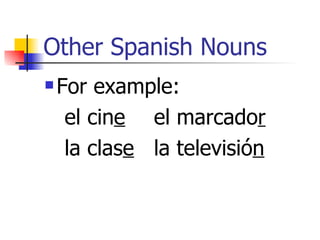
Other Spanish Nouns Other Spanish nouns end in  -e  or a  consonant .
Other Spanish Nouns For example: el cin e   el marcado r la clas e   la televisió n
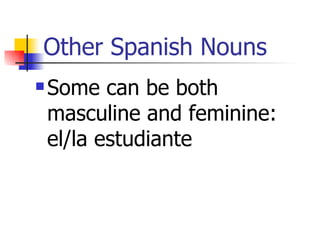
Other Spanish Nouns Some can be both masculine and feminine:  el/la estudiante
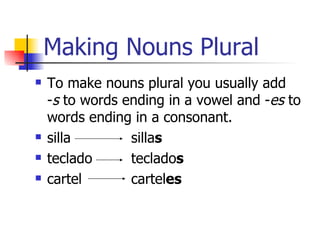
Making Nouns Plural To make nouns plural you usually add  - s  to words ending in a vowel and - es  to words ending in a consonant. silla silla s teclado teclado s cartel cartel es
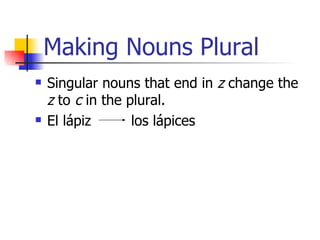
Making Nouns Plural Singular nouns that end in  z  change the  z  to  c  in the plural. El lápiz los lápices
Definite Articles El  ,  La  ,  Los  and  Las  are called definite articles.  In English they mean “the”
Definite Articles We use  El  and  Los  with masculine nouns and  La  and  Las  with feminine nouns.
Indefinite Articles Un ,  Una ,  Unos , and  Unas  are indefinite articles.
Indefinite Articles Un  and  Una  mean  “ a or an” in English.
Indefinite Articles Unos  and  Unas  mean “some” in English.
Indefinite Articles Un  and  Unos  are masculine and  Una  and  Unas  are feminine.
It’s a good idea to  learn a noun with its definite article,  el  or  la , because that will  usually tell you the  gender.

Nouns Gram