Nouns and articles
(Los sustantivos y los artículos)
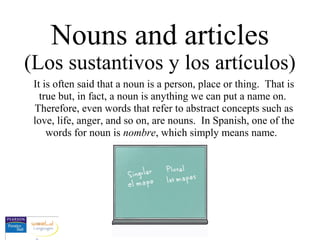
It is often said that a noun is a person, place or thing. That is
true but, in fact, a noun is anything we can put a name on.
Therefore, even words that refer to abstract concepts such as
love, life, anger, and so on, are nouns. In Spanish, one of the
words for noun is nombre, which simply means name.
In Spanish, nouns are classified into two
groups: masculine and feminine
Masculine nouns
To identify our masculine nouns, we will start with the
indefinite masculine article un, which in English is a or an
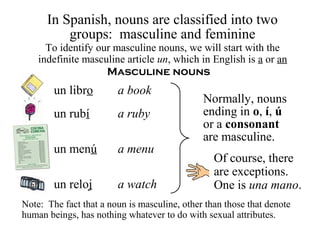
un libro
un reloj
a book
a watch
un menú a menu
un rubí a ruby
Normally, nouns
ending in o, í, ú
or a consonant
are masculine.
Of course, there
are exceptions.
One is una mano.
Note: The fact that a noun is masculine, other than those that denote
human beings, has nothing whatever to do with sexual attributes.
Words ending in í or ú (accented) are fairly rare in
Spanish and, as mentioned, are normally masculine.
un iglú an igloo
un colibrí a hummingbird
un menú a menu
un gurú a guru
un esquí a ski
un rubí a ruby
Words ending in i or u (unaccented) are even more
rare, and may be masculine or feminine.
una tribu a tribe
un/una cursi a pretentious person (male/female)
In Spanish, nouns are classified into two
groups: masculine and feminine
Masculine nouns
To identify our masculine nouns, we will start with the
indefinite masculine article un, which in English is a or an
un hombre
un doctor
a man
a doctor (m)
un profesor a professor (m)
un muchacho a boy
In addition, nouns
that denote male
persons are normally
masculine.
In Spanish, nouns are classified into two
groups: masculine and feminine
Feminine nouns
To identify our feminine nouns, we will start with the
indefinite feminine article una, which in English is a or an
una mesa a table
una nación a nation
una ciudad a city
Normally, nouns
ending in a, ad, ción,
or sión are feminine.
Two exceptions
are un mapa and
un día.
Note: Again, the fact that a noun is feminine, other than those that
denote human beings, has nothing to do with sexual attributes.
In Spanish, nouns are classified into two
groups: masculine and feminine
Feminine nouns
To identify our feminine nouns, we will start with the
indefinite feminine article una, which in English is a or an
una mujer
una doctora
a woman
a doctor (f)
una profesora a professor (f)
una muchacha a girl
In addition, nouns
that denote female
persons are normally
feminine or have a
feminine form that is
the counterpart of the
masculine.
In Spanish, nouns are classified into two
groups: masculine and feminine
Nouns ending in o, í, ú, or a consonant are normally masculine
nouns ending in e
Words that end with e are suspect, that is, they may be
masculine or they may be feminine
un coche a car
un bache a pothole
un bote a can
When in doubt about the gender of a noun ending in e, or any noun,
ask a native speaker or your teacher, or look it up in a dictionary.
una noche a night
una llave a key
una calle a street
un frente a front una frente a forehead
un bate a bat (baseball) una peste a plague
Masculine Feminine
Remember!
Nouns ending in a, ad, ción, or sión are normally feminine
Words that end with -ma are usually masculine
un problema un aroma
un tema un programa
un clima
un diagramaun sistema
un diploma
But there are a few exceptions:
una diademauna trama una estratagema
Definite and indefinite articles
Es un libro.
The indefinite article (un, una) refers to a non-specific item.
It’s a book, any old
book.
The definite article (el, la) refers to a specific item.
Es el libro que usamos en la clase de
español.
It’s the book we use in the
Spanish class.
Definite and indefinite articles
Es una silla.
The indefinite article (un, una) refers to a non-specific item.
It’s a chair, any old
chair.
The definite article (el, la) refers to a specific item.
Es la silla que usamos en la clase de
español.
It’s the chair we use in the
Spanish class.
Definite and indefinite articles
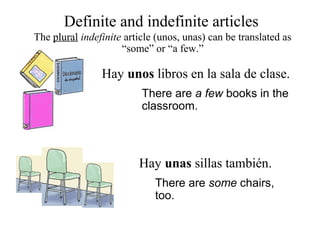
Hay unos libros en la sala de clase.
The plural indefinite article (unos, unas) can be translated as
“some” or “a few.”
There are a few books in the
classroom.
Hay unas sillas también.
There are some chairs,
too.
Definite and indefinite articles
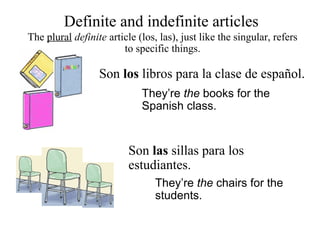
Son los libros para la clase de español.
The plural definite article (los, las), just like the singular, refers
to specific things.
They’re the books for the
Spanish class.
Son las sillas para los
estudiantes.
They’re the chairs for the
students.
Summary of definite and indefinite articles
un
The masculine indefinite articles are:
unos
a, an
some, a few
un libro = a book
unos libros = some
books
The masculine definite articles are:
el
los
the
the (English
has no plural
form for the)
el libro = the book
los libros = the books
Summary of definite and indefinite articles
una
The feminine indefinite articles are:
unas
a, an
some, a few
una silla = a chair
unas sillas = some
chairs
The feminine definite articles are:
la
las
the
the
la silla = the chair
las sillas = the chairs
Pluralization
(La pluralización)
Nouns are pluralized differently in Spanish than in English.
If a noun ends in a, á, e, é, o, ó, i or u, we simply add s.
libro
Singular Plural
libros
casa casas
llave llaves
tribu tribus
mamá mamás
café cafés
dominó dominós
cursi cursis
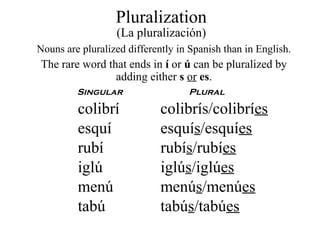
Pluralization
(La pluralización)
Nouns are pluralized differently in Spanish than in English.
The rare word that ends in í or ú can be pluralized by
adding either s or es.
Singular Plural
esquí esquís/esquíes
rubí rubís/rubíes
menú menús/menúes
tabú tabús/tabúes
colibrí colibrís/colibríes
iglú iglús/iglúes
Pluralization
(La pluralización)
If a noun ends in a consonant, we add es.
papel
Singular Plural
papeles
borrador borradores
orden órdenes
Nouns are pluralized differently in Spanish than in English.
pared paredes
reloj relojes
señor señores
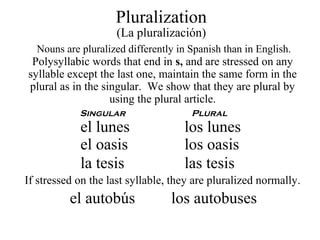
Pluralization
(La pluralización)
Singular Plural
Polysyllabic words that end in s, and are stressed on any
syllable except the last one, maintain the same form in the
plural as in the singular. We show that they are plural by
using the plural article.
el oasis los oasis
el lunes los lunes
Nouns are pluralized differently in Spanish than in English.
la tesis las tesis
If stressed on the last syllable, they are pluralized normally.
el autobús los autobuses
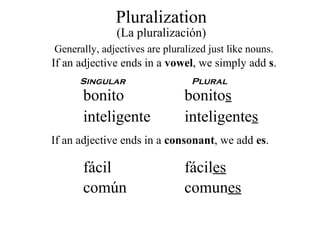
Pluralization
(La pluralización)
Generally, adjectives are pluralized just like nouns.
If an adjective ends in a vowel, we simply add s.
Singular Plural
bonito bonitos
inteligente inteligentes
If an adjective ends in a consonant, we add es.
fácil fáciles
común comunes
Pluralization
(La pluralización)
When a noun or an adjective ends in z, we must change
the z to c before adding es.
Singular Plural
lápiz lápices
luz luces
feliz felices
audaz audaces
nouns
adjectives
FIN

Nouns and articles

  • 1.
    Nouns and articles (Lossustantivos y los artículos) It is often said that a noun is a person, place or thing. That is true but, in fact, a noun is anything we can put a name on. Therefore, even words that refer to abstract concepts such as love, life, anger, and so on, are nouns. In Spanish, one of the words for noun is nombre, which simply means name.
  • 2.
    In Spanish, nounsare classified into two groups: masculine and feminine Masculine nouns To identify our masculine nouns, we will start with the indefinite masculine article un, which in English is a or an un libro un reloj a book a watch un menú a menu un rubí a ruby Normally, nouns ending in o, í, ú or a consonant are masculine. Of course, there are exceptions. One is una mano. Note: The fact that a noun is masculine, other than those that denote human beings, has nothing whatever to do with sexual attributes.
  • 3.
    Words ending iní or ú (accented) are fairly rare in Spanish and, as mentioned, are normally masculine. un iglú an igloo un colibrí a hummingbird un menú a menu un gurú a guru un esquí a ski un rubí a ruby Words ending in i or u (unaccented) are even more rare, and may be masculine or feminine. una tribu a tribe un/una cursi a pretentious person (male/female) In Spanish, nouns are classified into two groups: masculine and feminine
  • 4.
    Masculine nouns To identifyour masculine nouns, we will start with the indefinite masculine article un, which in English is a or an un hombre un doctor a man a doctor (m) un profesor a professor (m) un muchacho a boy In addition, nouns that denote male persons are normally masculine. In Spanish, nouns are classified into two groups: masculine and feminine
  • 5.
    Feminine nouns To identifyour feminine nouns, we will start with the indefinite feminine article una, which in English is a or an una mesa a table una nación a nation una ciudad a city Normally, nouns ending in a, ad, ción, or sión are feminine. Two exceptions are un mapa and un día. Note: Again, the fact that a noun is feminine, other than those that denote human beings, has nothing to do with sexual attributes. In Spanish, nouns are classified into two groups: masculine and feminine
  • 6.
    Feminine nouns To identifyour feminine nouns, we will start with the indefinite feminine article una, which in English is a or an una mujer una doctora a woman a doctor (f) una profesora a professor (f) una muchacha a girl In addition, nouns that denote female persons are normally feminine or have a feminine form that is the counterpart of the masculine. In Spanish, nouns are classified into two groups: masculine and feminine
  • 7.
    Nouns ending ino, í, ú, or a consonant are normally masculine nouns ending in e Words that end with e are suspect, that is, they may be masculine or they may be feminine un coche a car un bache a pothole un bote a can When in doubt about the gender of a noun ending in e, or any noun, ask a native speaker or your teacher, or look it up in a dictionary. una noche a night una llave a key una calle a street un frente a front una frente a forehead un bate a bat (baseball) una peste a plague Masculine Feminine Remember! Nouns ending in a, ad, ción, or sión are normally feminine
  • 8.
    Words that endwith -ma are usually masculine un problema un aroma un tema un programa un clima un diagramaun sistema un diploma But there are a few exceptions: una diademauna trama una estratagema
  • 9.
    Definite and indefinitearticles Es un libro. The indefinite article (un, una) refers to a non-specific item. It’s a book, any old book. The definite article (el, la) refers to a specific item. Es el libro que usamos en la clase de español. It’s the book we use in the Spanish class.
  • 10.
    Definite and indefinitearticles Es una silla. The indefinite article (un, una) refers to a non-specific item. It’s a chair, any old chair. The definite article (el, la) refers to a specific item. Es la silla que usamos en la clase de español. It’s the chair we use in the Spanish class.
  • 11.
    Definite and indefinitearticles Hay unos libros en la sala de clase. The plural indefinite article (unos, unas) can be translated as “some” or “a few.” There are a few books in the classroom. Hay unas sillas también. There are some chairs, too.
  • 12.
    Definite and indefinitearticles Son los libros para la clase de español. The plural definite article (los, las), just like the singular, refers to specific things. They’re the books for the Spanish class. Son las sillas para los estudiantes. They’re the chairs for the students.
  • 13.
    Summary of definiteand indefinite articles un The masculine indefinite articles are: unos a, an some, a few un libro = a book unos libros = some books The masculine definite articles are: el los the the (English has no plural form for the) el libro = the book los libros = the books
  • 14.
    Summary of definiteand indefinite articles una The feminine indefinite articles are: unas a, an some, a few una silla = a chair unas sillas = some chairs The feminine definite articles are: la las the the la silla = the chair las sillas = the chairs
  • 15.
    Pluralization (La pluralización) Nouns arepluralized differently in Spanish than in English. If a noun ends in a, á, e, é, o, ó, i or u, we simply add s. libro Singular Plural libros casa casas llave llaves tribu tribus mamá mamás café cafés dominó dominós cursi cursis
  • 16.
    Pluralization (La pluralización) Nouns arepluralized differently in Spanish than in English. The rare word that ends in í or ú can be pluralized by adding either s or es. Singular Plural esquí esquís/esquíes rubí rubís/rubíes menú menús/menúes tabú tabús/tabúes colibrí colibrís/colibríes iglú iglús/iglúes
  • 17.
    Pluralization (La pluralización) If anoun ends in a consonant, we add es. papel Singular Plural papeles borrador borradores orden órdenes Nouns are pluralized differently in Spanish than in English. pared paredes reloj relojes señor señores
  • 18.
    Pluralization (La pluralización) Singular Plural Polysyllabicwords that end in s, and are stressed on any syllable except the last one, maintain the same form in the plural as in the singular. We show that they are plural by using the plural article. el oasis los oasis el lunes los lunes Nouns are pluralized differently in Spanish than in English. la tesis las tesis If stressed on the last syllable, they are pluralized normally. el autobús los autobuses
  • 19.
    Pluralization (La pluralización) Generally, adjectivesare pluralized just like nouns. If an adjective ends in a vowel, we simply add s. Singular Plural bonito bonitos inteligente inteligentes If an adjective ends in a consonant, we add es. fácil fáciles común comunes
  • 20.
    Pluralization (La pluralización) When anoun or an adjective ends in z, we must change the z to c before adding es. Singular Plural lápiz lápices luz luces feliz felices audaz audaces nouns adjectives
  • 21.