Possessive Adjectives
Possessive Adjectives 
 Adjectives DESCRIBE nouns, 
correct? 
 Well, they can also show 
possession.
Possessive Adjectives 
 Here are the possessive 
adjectives in English: my, 
your, his, her, our, and 
their.
Posessive Adjectives 
 It ‘s like saying “my dog, 
your house, his notebook, 
etc.”
Here are the possessive 
adjectives in Spanish! 
Possessive adjectives show ownership or 
relationships between people. 
They are placed before the noun.
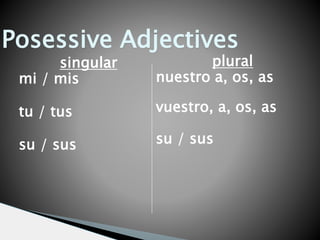
Posessive Adjectives 
singular 
mi / mis 
tu / tus 
su / sus 
plural 
nuestro a, os, as 
vuestro, a, os, as 
su / sus
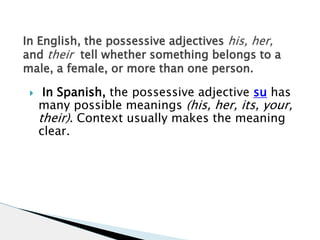
In English, the possessive adjectives his, her, 
and their tell whether something belongs to a 
male, a female, or more than one person. 
 In Spanish, the possessive adjective su has 
many possible meanings (his, her, its, your, 
their). Context usually makes the meaning 
clear.
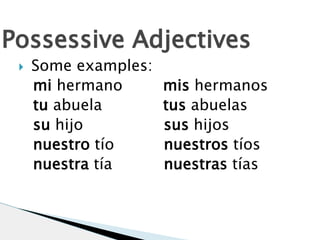
Possessive Adjectives 
 Some examples: 
mi hermano mis hermanos 
tu abuela tus abuelas 
su hijo sus hijos 
nuestro tío nuestros tíos 
nuestra tía nuestras tías
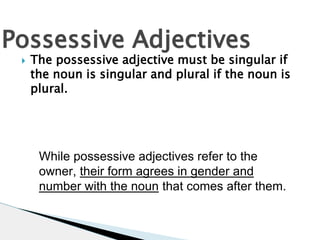
Possessive Adjectives 
 The possessive adjective must be singular if 
the noun is singular and plural if the noun is 
plural. 
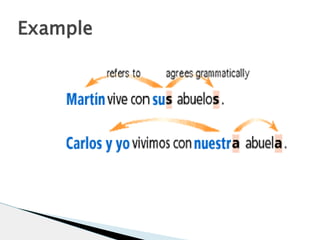
While possessive adjectives refer to the 
owner, their form agrees in gender and 
number with the noun that comes after them.
Example
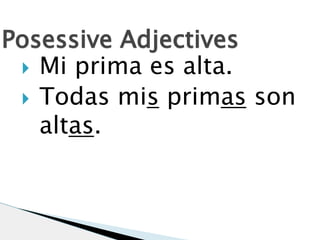
Posessive Adjectives 
 Mi prima es alta. 
 Todas mis primas son 
altas.
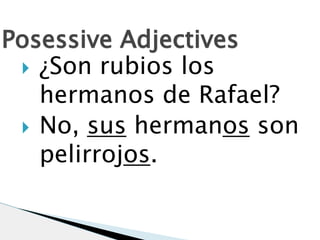
Posessive Adjectives 
 ¿Son rubios los 
hermanos de Rafael? 
 No, sus hermanos son 
pelirrojos.
Showing Possession 
 In Spanish there are NO 
apostrophes. 
 You cannot say, for 
example, 
Jorge’s dog, 
(using an apostrophe)
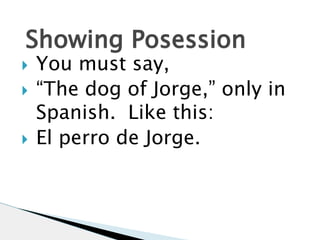
Showing Posession 
 You must say, 
 “The dog of Jorge,” only in 
Spanish. Like this: 
 El perro de Jorge.

Possessive adjectives

  • 1.
  • 2.
    Possessive Adjectives Adjectives DESCRIBE nouns, correct?  Well, they can also show possession.
  • 3.
    Possessive Adjectives Here are the possessive adjectives in English: my, your, his, her, our, and their.
  • 4.
    Posessive Adjectives It ‘s like saying “my dog, your house, his notebook, etc.”
  • 5.
    Here are thepossessive adjectives in Spanish! Possessive adjectives show ownership or relationships between people. They are placed before the noun.
  • 6.
    Posessive Adjectives singular mi / mis tu / tus su / sus plural nuestro a, os, as vuestro, a, os, as su / sus
  • 7.
    In English, thepossessive adjectives his, her, and their tell whether something belongs to a male, a female, or more than one person.  In Spanish, the possessive adjective su has many possible meanings (his, her, its, your, their). Context usually makes the meaning clear.
  • 8.
    Possessive Adjectives Some examples: mi hermano mis hermanos tu abuela tus abuelas su hijo sus hijos nuestro tío nuestros tíos nuestra tía nuestras tías
  • 9.
    Possessive Adjectives The possessive adjective must be singular if the noun is singular and plural if the noun is plural. While possessive adjectives refer to the owner, their form agrees in gender and number with the noun that comes after them.
  • 10.
  • 11.
    Posessive Adjectives Mi prima es alta.  Todas mis primas son altas.
  • 12.
    Posessive Adjectives ¿Son rubios los hermanos de Rafael?  No, sus hermanos son pelirrojos.
  • 13.
    Showing Possession In Spanish there are NO apostrophes.  You cannot say, for example, Jorge’s dog, (using an apostrophe)
  • 14.
    Showing Posession You must say,  “The dog of Jorge,” only in Spanish. Like this:  El perro de Jorge.