Unit 1
Introductory concepts and categories
(III)
The structure of words: Morphology
• Lexical words may be made of a single morpheme (stem) or
have a more complex structure by means of inflexion,
derivation & compounding
– Inflexion: lexical words take inflexional suffixes to signal
meanings & roles important to their word class (plural for
nouns or past tense for verbs)
• Other classes of words are generally invariable
(prepositions, conjunctions, & determiners)
The structure of words: morphology
– Derivation usually involves adding an affix (morpheme
attached to the beginning – prefix – or to the end – suffix –
of a word)
• Different from inflexion because it changes the identity
of a word and creates new nouns, adjectives, verbs and
adverbs
• It changes the meaning of a word or the class of a word
and can create a new base form for the word (e.g.
consider → reconsider → reconsideration )
The structure of words: Morphology
– Compounding is a form of derivation where a word
contains more than one stem (Noun+noun (chair+man);
Verb+noun (cook+book); Adjective+noun (blue+bird);
Noun+adjective (water+tight))
• Three tests to check if the word is a compound:
– The word will be spelt as a single word (no spaces)
– The word will be pronounced with the main stress
on first element
– The word will have a meaning not determined from
individual parts
The structure of words: Morphology
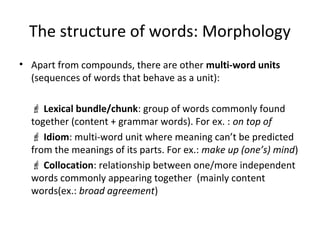
• Apart from compounds, there are other multi-word units
(sequences of words that behave as a unit):
 Lexical bundle/chunk: group of words commonly found
together (content + grammar words). For ex. : on top of
 Idiom: multi-word unit where meaning can’t be predicted
from the meanings of its parts. For ex.: make up (one’s) mind)
 Collocation: relationship between one/more independent
words commonly appearing together (mainly content
words(ex.: broad agreement)
Introduction to phrases
• Phrases are higher units into which words are organized
• A phrase may consist of one single word or a group of words
• Phrases can be embedded (i.e. be part of another structure)
– E.g. [They] [passed] [the table [with [the two men]]]
They passed the table with the two men
Classes of phrases
• For each type of lexical word there is a type of phrase,
where the lexical word is the head (function words are
also found):
– Noun phrase
– Verb phrase
– Adjective phrase
– Adverb phrase
– Prepositional phrase
Noun phrase
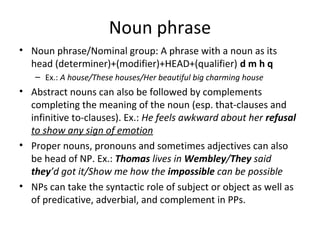
• Noun phrase/Nominal group: A phrase with a noun as its
head (determiner)+(modifier)+HEAD+(qualifier) d m h q
– Ex.: A house/These houses/Her beautiful big charming house
• Abstract nouns can also be followed by complements
completing the meaning of the noun (esp. that-clauses and
infinitive to-clauses). Ex.: He feels awkward about her refusal
to show any sign of emotion
• Proper nouns, pronouns and sometimes adjectives can also
be head of NP. Ex.: Thomas lives in Wembley/They said
they’d got it/Show me how the impossible can be possible
• NPs can take the syntactic role of subject or object as well as
of predicative, adverbial, and complement in PPs.
Verb phrases
• Verb phrase/Verbal group: a phrase with a primary/lexical
verb as its head: (operator)+(auxiliary)+VERB o x v (ex.: do
you go/has gone/go)
• Finite VPs show distinctions of tense (present/past) & include
modal auxiliaries (different from non-finite VPs)
• VPs are the essential part of a clause, referring to a type of
state/action (the main verb determines the other elements in
the clause)
• Sometimes VPs are split into two parts (e.g. in questions,
when adverbs and other adverbials are placed in the middle)
– What were you doing?
– This year has definitely started well

Tema 1 iii

  • 1.
    Unit 1 Introductory conceptsand categories (III)
  • 2.
    The structure ofwords: Morphology • Lexical words may be made of a single morpheme (stem) or have a more complex structure by means of inflexion, derivation & compounding – Inflexion: lexical words take inflexional suffixes to signal meanings & roles important to their word class (plural for nouns or past tense for verbs) • Other classes of words are generally invariable (prepositions, conjunctions, & determiners)
  • 3.
    The structure ofwords: morphology – Derivation usually involves adding an affix (morpheme attached to the beginning – prefix – or to the end – suffix – of a word) • Different from inflexion because it changes the identity of a word and creates new nouns, adjectives, verbs and adverbs • It changes the meaning of a word or the class of a word and can create a new base form for the word (e.g. consider → reconsider → reconsideration )
  • 4.
    The structure ofwords: Morphology – Compounding is a form of derivation where a word contains more than one stem (Noun+noun (chair+man); Verb+noun (cook+book); Adjective+noun (blue+bird); Noun+adjective (water+tight)) • Three tests to check if the word is a compound: – The word will be spelt as a single word (no spaces) – The word will be pronounced with the main stress on first element – The word will have a meaning not determined from individual parts
  • 5.
    The structure ofwords: Morphology • Apart from compounds, there are other multi-word units (sequences of words that behave as a unit):  Lexical bundle/chunk: group of words commonly found together (content + grammar words). For ex. : on top of  Idiom: multi-word unit where meaning can’t be predicted from the meanings of its parts. For ex.: make up (one’s) mind)  Collocation: relationship between one/more independent words commonly appearing together (mainly content words(ex.: broad agreement)
  • 6.
    Introduction to phrases •Phrases are higher units into which words are organized • A phrase may consist of one single word or a group of words • Phrases can be embedded (i.e. be part of another structure) – E.g. [They] [passed] [the table [with [the two men]]]
  • 7.
    They passed thetable with the two men
  • 8.
    Classes of phrases •For each type of lexical word there is a type of phrase, where the lexical word is the head (function words are also found): – Noun phrase – Verb phrase – Adjective phrase – Adverb phrase – Prepositional phrase
  • 9.
    Noun phrase • Nounphrase/Nominal group: A phrase with a noun as its head (determiner)+(modifier)+HEAD+(qualifier) d m h q – Ex.: A house/These houses/Her beautiful big charming house • Abstract nouns can also be followed by complements completing the meaning of the noun (esp. that-clauses and infinitive to-clauses). Ex.: He feels awkward about her refusal to show any sign of emotion • Proper nouns, pronouns and sometimes adjectives can also be head of NP. Ex.: Thomas lives in Wembley/They said they’d got it/Show me how the impossible can be possible • NPs can take the syntactic role of subject or object as well as of predicative, adverbial, and complement in PPs.
  • 10.
    Verb phrases • Verbphrase/Verbal group: a phrase with a primary/lexical verb as its head: (operator)+(auxiliary)+VERB o x v (ex.: do you go/has gone/go) • Finite VPs show distinctions of tense (present/past) & include modal auxiliaries (different from non-finite VPs) • VPs are the essential part of a clause, referring to a type of state/action (the main verb determines the other elements in the clause) • Sometimes VPs are split into two parts (e.g. in questions, when adverbs and other adverbials are placed in the middle) – What were you doing? – This year has definitely started well