The Morphology of
Hebrew
By: Hidaya Moulay Omar
derivation in Hebrew
Nouns,
adverbs,djectives and
prepositions can be
derived in any of the
following ways:
1. Root & Pattern
combination
• b.l.t ~v.l.t + -a-a- = balat (stood out)
• b.l.t~v.l.t + hi--i-= hivlit (stressed)
2. concatenation of morphological
components
1. Multi stem concatenation /
compounding
bet(house)+séfer(book)=(school)
basar(flesh)+va(and)+dam(blood)=human being
al(on)+yad(hand)=near
beyt + ha-yetomim=house the-orphans
`orphanage`
2. concatenation of morphological
components
2. Multi-stem blending
arafel(fog)+piah(smoke)=arpiah(smog)
midraxa(sidewalk)+rehov(street)= midrehov
(promenade)
2.concatenation of morphological
components
• Acronyms:
• Sakin(knife)+kaf(spoon)+u-mazleg(fork)
=sakum (utensils)
Verb formation in Hebrew
• The verb system in Hebrew is very
unique; a verb can take one of the verbal
patterns, which are well structured,
predictable and limitd in number.
• There are 09 verbal patterns in Hebrew.
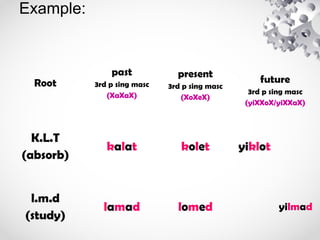
Example:
Root
past
3rd p sing masc
(XaXaX)
present
3rd p sing masc
(XoXeX)
future
3rd p sing masc
(yiXXoX/yiXXaX)
K.L.T
(absorb)
kalat kolet yiklot
l.m.d
(study)
lamad lomed yilmad
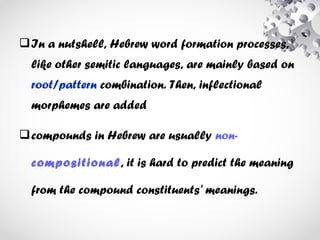
In a nutshell, Hebrew word formation processes,
like other semitic languages, are mainly based on
root/pattern combination. Then, inflectional
morphemes are added
compounds in Hebrew are usually non-
compositional, it is hard to predict the meaning
from the compound constituents' meanings.
Inflections
in
Hebrew
• Hebrew inflectional categories are gender,
number and possesion in nouns
• In addition to tense, mood and person in
verbs.
Examples
the plural of masculin nouns is usually
formed by adding the suffix "im"
mahshev ~ mahshevim (computers)
the plural of feminine nouns is usually
formed by adding the suffix "ot"
mita~mitot (beds)
yet, there are exceptions;
the plural of some feminine nouns is formed
by the suffix "im" and vice versa.
or, there is a suppletive stem for singular &
plural
• av (M) =avot (*avim)
• yom (f) =yamim (days)
• iŠa (f) = naŠim (women)
• for loan words, the suffixes are regular, yet
the stress pattern is irregular
 banána=banánot ~not bananót
The dual suffix
 Example: dual suffix (ay(i)m)
 The dual number is restricted to time units (weeks,
months, etc), symmetrical parts of the body (eyes,
hands, legs, etc), and garments and articles that come in
pairs (socks, trousers, glasses, etc)
• ‫אוזן‬   ózen ("ear") → ‫אוזניים‬   oznáyim ("ears")
• ‫נעל‬   ná al ("shoe") →ʿ ‫נעלים‬   na alʿ áyim ("shoes")
• ‫ום‬ֹ‫ם‬‫י‬   yom ("day") → ‫יים‬ִ‫םי‬‫מ‬ַ‫ִי‬ ‫ו‬ֹ‫ם‬‫י‬   yomáyim ("two days")
‫מים‬ִ‫םי‬ ‫י‬ָ‫מ‬ ‫והשה‬ֹ‫ם‬‫השל‬   shəlosha yamim ("three days")
`ayim` appears to be inflectional because:
It is obligatory for certain nouns like:
shamaym ('skies'), mitsraym ('Egypt'), maym
('waters').
There is an agreement relationship
between the noun and the adjective in
terms of number and definitness.
Clitics in Hebrew
• most prepositions and conjunctions are
clitics
• the letter bet /b-/ is a proclitic, which is
used as a proposition meaning in ,at or
with
Example:
Ani babinyan = I am in the building
Reference:
• Ora (Rodrigue) Schwarzwald
• Three Related Analyses in Modern
Hebrew Morphology
Thank you

New microsoft power point slide (2)

  • 1.
    The Morphology of Hebrew By:Hidaya Moulay Omar
  • 2.
  • 3.
    Nouns, adverbs,djectives and prepositions canbe derived in any of the following ways:
  • 4.
    1. Root &Pattern combination • b.l.t ~v.l.t + -a-a- = balat (stood out) • b.l.t~v.l.t + hi--i-= hivlit (stressed)
  • 5.
    2. concatenation ofmorphological components 1. Multi stem concatenation / compounding bet(house)+séfer(book)=(school) basar(flesh)+va(and)+dam(blood)=human being al(on)+yad(hand)=near beyt + ha-yetomim=house the-orphans `orphanage`
  • 6.
    2. concatenation ofmorphological components 2. Multi-stem blending arafel(fog)+piah(smoke)=arpiah(smog) midraxa(sidewalk)+rehov(street)= midrehov (promenade)
  • 7.
    2.concatenation of morphological components •Acronyms: • Sakin(knife)+kaf(spoon)+u-mazleg(fork) =sakum (utensils)
  • 8.
    Verb formation inHebrew • The verb system in Hebrew is very unique; a verb can take one of the verbal patterns, which are well structured, predictable and limitd in number. • There are 09 verbal patterns in Hebrew.
  • 9.
    Example: Root past 3rd p singmasc (XaXaX) present 3rd p sing masc (XoXeX) future 3rd p sing masc (yiXXoX/yiXXaX) K.L.T (absorb) kalat kolet yiklot l.m.d (study) lamad lomed yilmad
  • 10.
    In a nutshell,Hebrew word formation processes, like other semitic languages, are mainly based on root/pattern combination. Then, inflectional morphemes are added compounds in Hebrew are usually non- compositional, it is hard to predict the meaning from the compound constituents' meanings.
  • 11.
  • 12.
    • Hebrew inflectionalcategories are gender, number and possesion in nouns • In addition to tense, mood and person in verbs.
  • 13.
    Examples the plural ofmasculin nouns is usually formed by adding the suffix "im" mahshev ~ mahshevim (computers) the plural of feminine nouns is usually formed by adding the suffix "ot" mita~mitot (beds)
  • 14.
    yet, there areexceptions; the plural of some feminine nouns is formed by the suffix "im" and vice versa. or, there is a suppletive stem for singular & plural • av (M) =avot (*avim) • yom (f) =yamim (days) • iŠa (f) = naŠim (women) • for loan words, the suffixes are regular, yet the stress pattern is irregular  banána=banánot ~not bananót
  • 15.
    The dual suffix Example: dual suffix (ay(i)m)  The dual number is restricted to time units (weeks, months, etc), symmetrical parts of the body (eyes, hands, legs, etc), and garments and articles that come in pairs (socks, trousers, glasses, etc) • ‫אוזן‬   ózen ("ear") → ‫אוזניים‬   oznáyim ("ears") • ‫נעל‬   ná al ("shoe") →ʿ ‫נעלים‬   na alʿ áyim ("shoes") • ‫ום‬ֹ‫ם‬‫י‬   yom ("day") → ‫יים‬ִ‫םי‬‫מ‬ַ‫ִי‬ ‫ו‬ֹ‫ם‬‫י‬   yomáyim ("two days") ‫מים‬ִ‫םי‬ ‫י‬ָ‫מ‬ ‫והשה‬ֹ‫ם‬‫השל‬   shəlosha yamim ("three days")
  • 16.
    `ayim` appears tobe inflectional because: It is obligatory for certain nouns like: shamaym ('skies'), mitsraym ('Egypt'), maym ('waters'). There is an agreement relationship between the noun and the adjective in terms of number and definitness.
  • 17.
    Clitics in Hebrew •most prepositions and conjunctions are clitics • the letter bet /b-/ is a proclitic, which is used as a proposition meaning in ,at or with Example: Ani babinyan = I am in the building
  • 18.
    Reference: • Ora (Rodrigue)Schwarzwald • Three Related Analyses in Modern Hebrew Morphology
  • 19.