ERTMS is a new railway signalling and train control system being implemented across Europe to replace existing national systems and enable cross-border travel. It uses in-cab displays and train-to-ground communication via trackside balises (Level 1), or GSM-R radio (Level 2), or without trackside equipment (Level 3). The UK is currently implementing ERTMS on the Thameslink route, upgrading from 16 to 24 trains per hour, with the national implementation plan delayed until Thameslink is complete. ERTMS aims to increase capacity, interoperability and safety across Europe's rail networks.
In this document
Powered by AI
Overview of ERTMS focus, objectives, components, UK realization, and case study.
Definition, components, current and future signaling situations, strengths and weaknesses.
Details on ERTMS levels from 0 to 3, interoperability, cost-effectiveness, and capacity benefits.
Business case, costs involved in fitting trains and lineside equipment, Thameslink case study, future plans.
Contact details for Tracsis Plc and the contributors of the presentation.
Copyright Tracsis Plc.All rights reserved
ERTMS – European Rail Traffic Management System
From a Train Operators Perspective
Date: Thursday, 28 July 2016
2.
Introduction
• Aim: Toprovide a general awareness of ERTMS.
• What is ERTMS
• System Levels
• UK ERTMS Realisation
• Case Study: Thameslink Implementation
• Questions
What is ERTMS?(1)
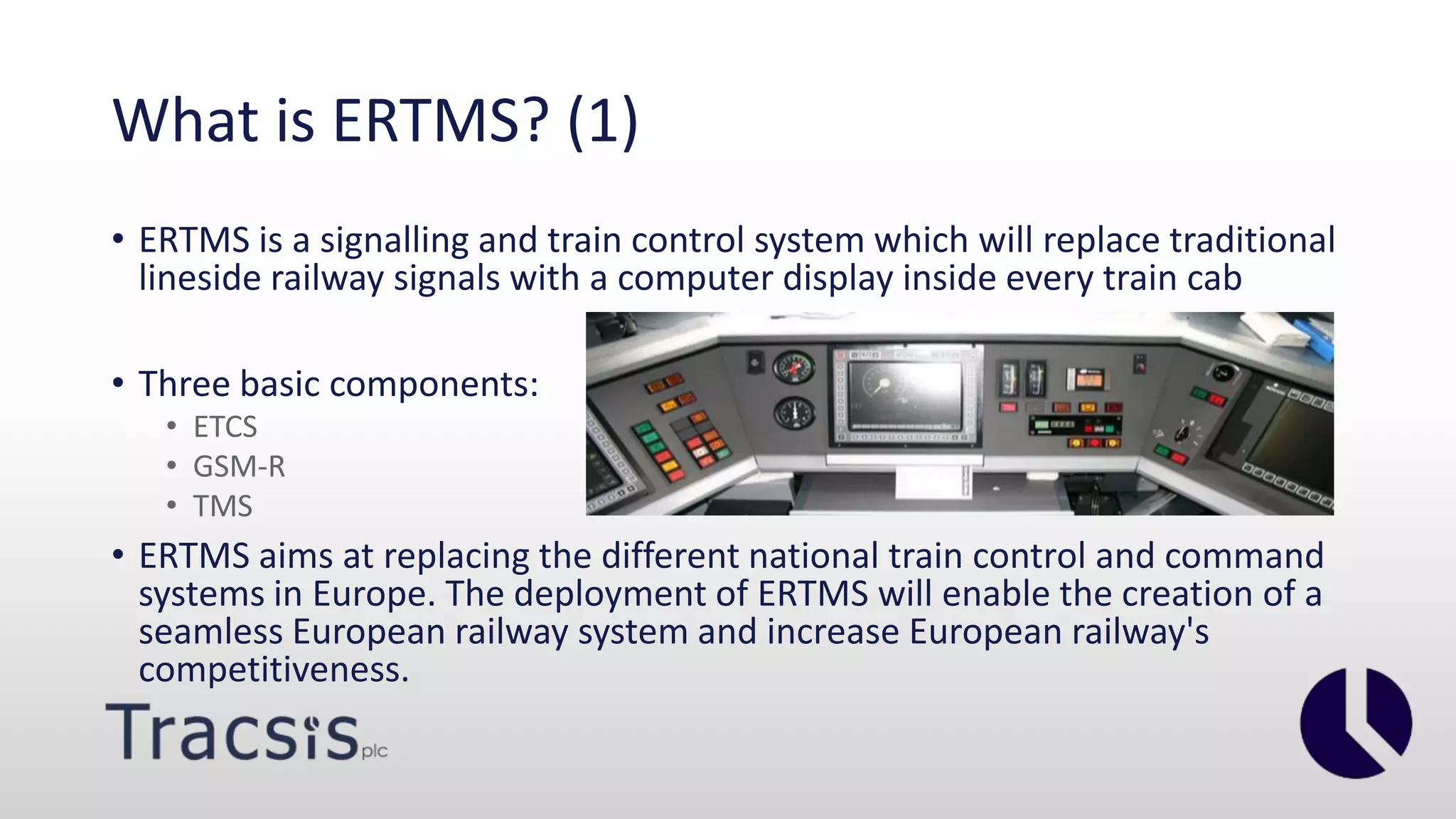
• ERTMS is a signalling and train control system which will replace traditional
lineside railway signals with a computer display inside every train cab
• Three basic components:
• ETCS
• GSM-R
• TMS
• ERTMS aims at replacing the different national train control and command
systems in Europe. The deployment of ERTMS will enable the creation of a
seamless European railway system and increase European railway's
competitiveness.
What is ERTMS?(5)
Strengths and Weaknesses
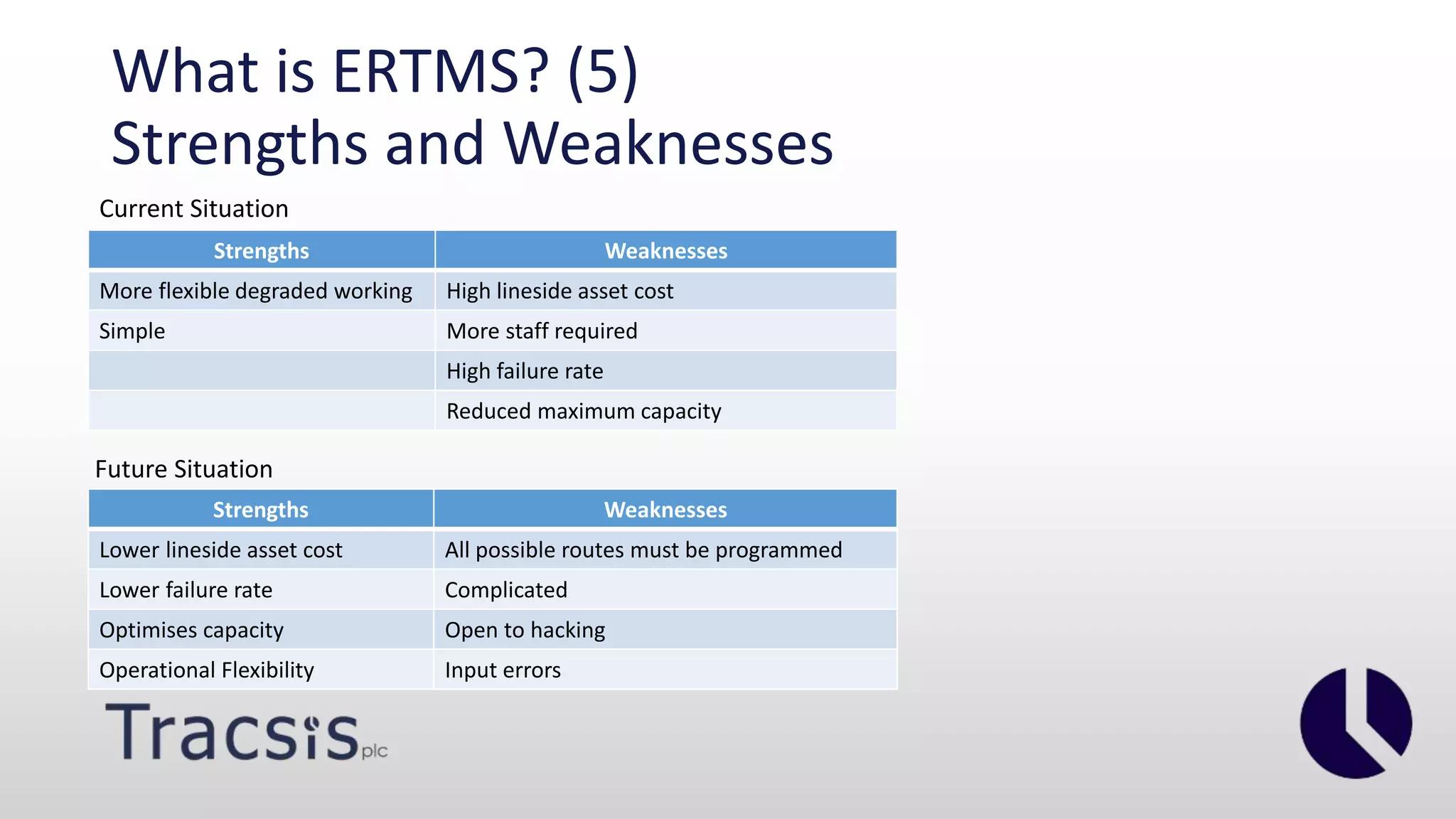
Strengths Weaknesses
Lower lineside asset cost All possible routes must be programmed
Lower failure rate Complicated
Optimises capacity Open to hacking
Operational Flexibility Input errors
Strengths Weaknesses
More flexible degraded working High lineside asset cost
Simple More staff required
High failure rate
Reduced maximum capacity
Current Situation
Future Situation
Systems levels (1)
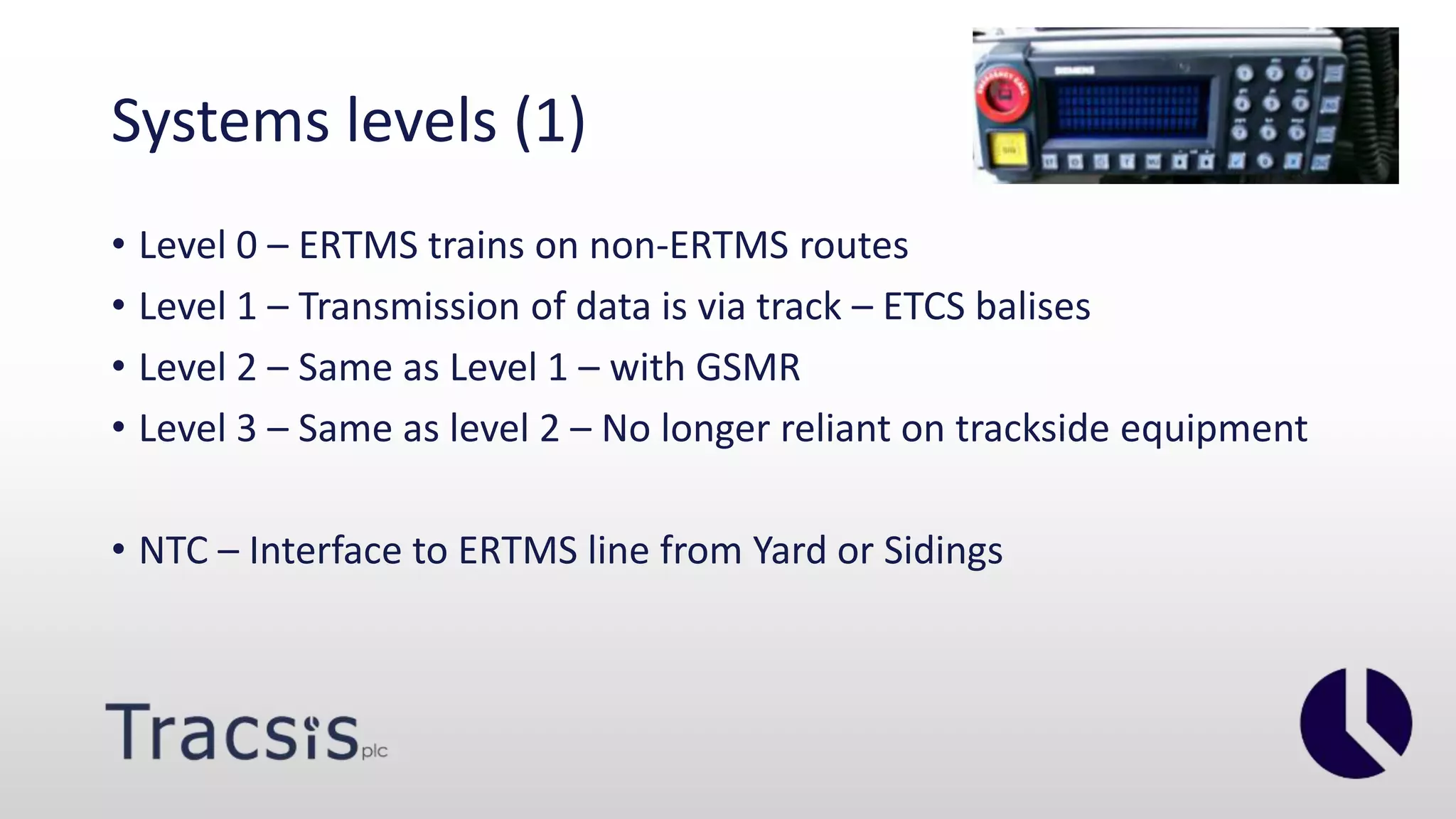
•Level 0 – ERTMS trains on non-ERTMS routes
• Level 1 – Transmission of data is via track – ETCS balises
• Level 2 – Same as Level 1 – with GSMR
• Level 3 – Same as level 2 – No longer reliant on trackside equipment
• NTC – Interface to ERTMS line from Yard or Sidings
11.
Systems levels (2)– Level NTC and Level 0
• Level NTC - Enables ETCS fitted trains to operate on infrastructure not
fitted with ETCS. Safe movement of the train is controlled by the
underlying national control systems; in case of UK this will be TPWS
and AWS.
• Level 0 - ETCS fitted trains operating on lines with no ETCS.
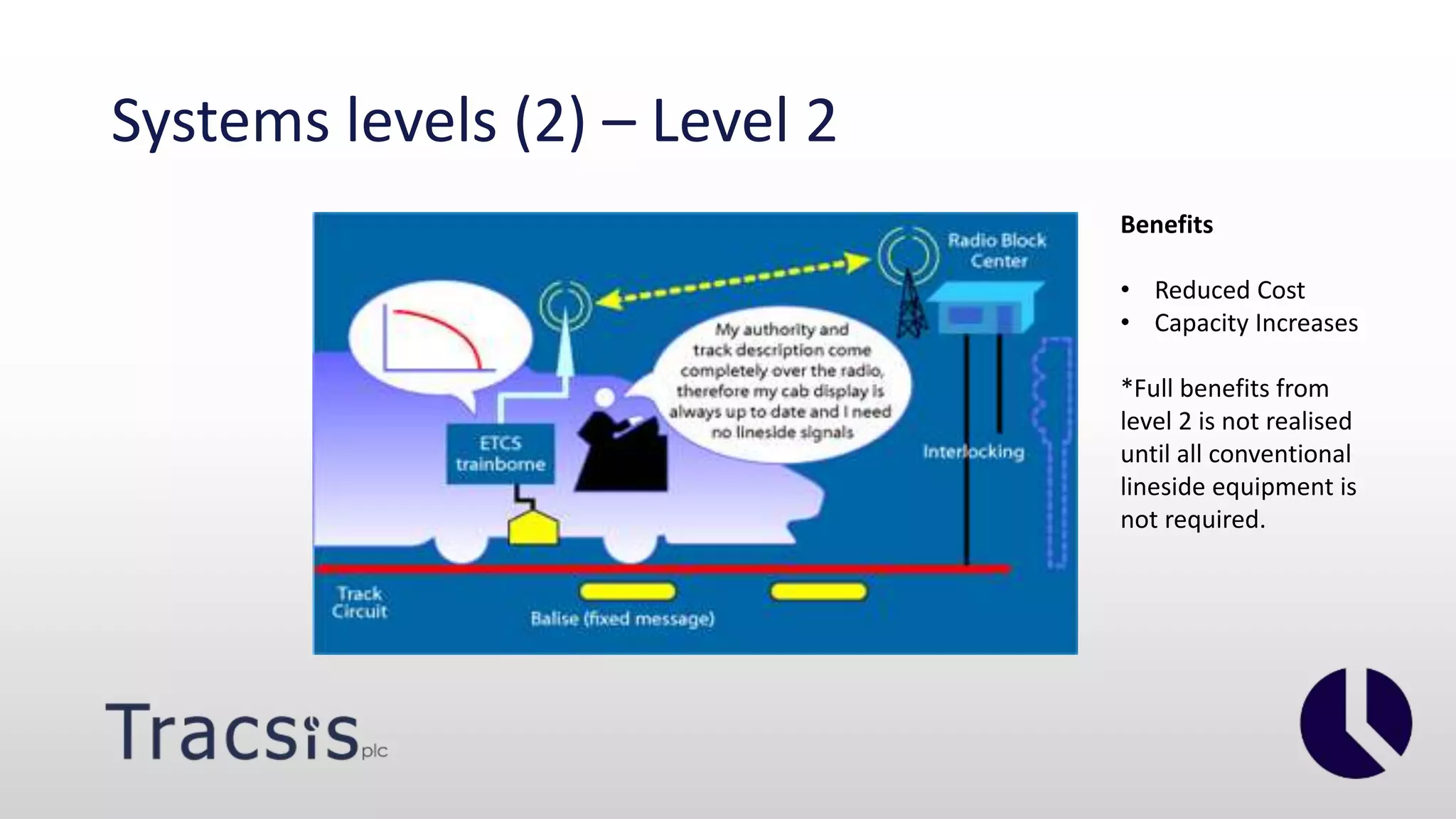
Systems levels (2)– Level 2
Benefits
• Reduced Cost
• Capacity Increases
*Full benefits from
level 2 is not realised
until all conventional
lineside equipment is
not required.
Level Comparison
• Level2 with Traditional Signalling vs Level 2 without Traditional
Signalling
• Level 2 without Traditional Signalling vs Level 3
17.
UK’s realisation ofERTMS
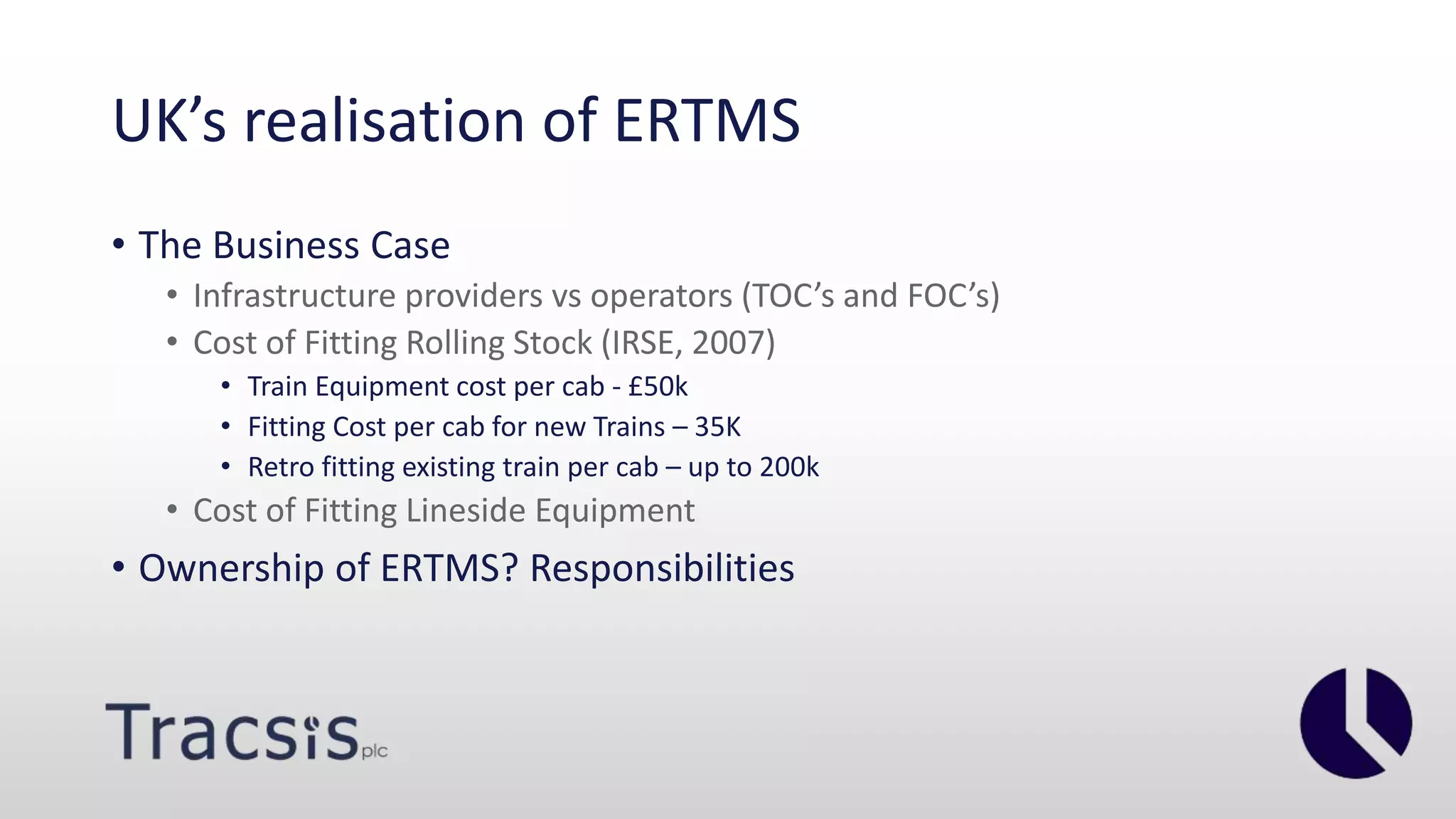
• The Business Case
• Infrastructure providers vs operators (TOC’s and FOC’s)
• Cost of Fitting Rolling Stock (IRSE, 2007)
• Train Equipment cost per cab - £50k
• Fitting Cost per cab for new Trains – 35K
• Retro fitting existing train per cab – up to 200k
• Cost of Fitting Lineside Equipment
• Ownership of ERTMS? Responsibilities
Case Study 1(1) - Thameslink
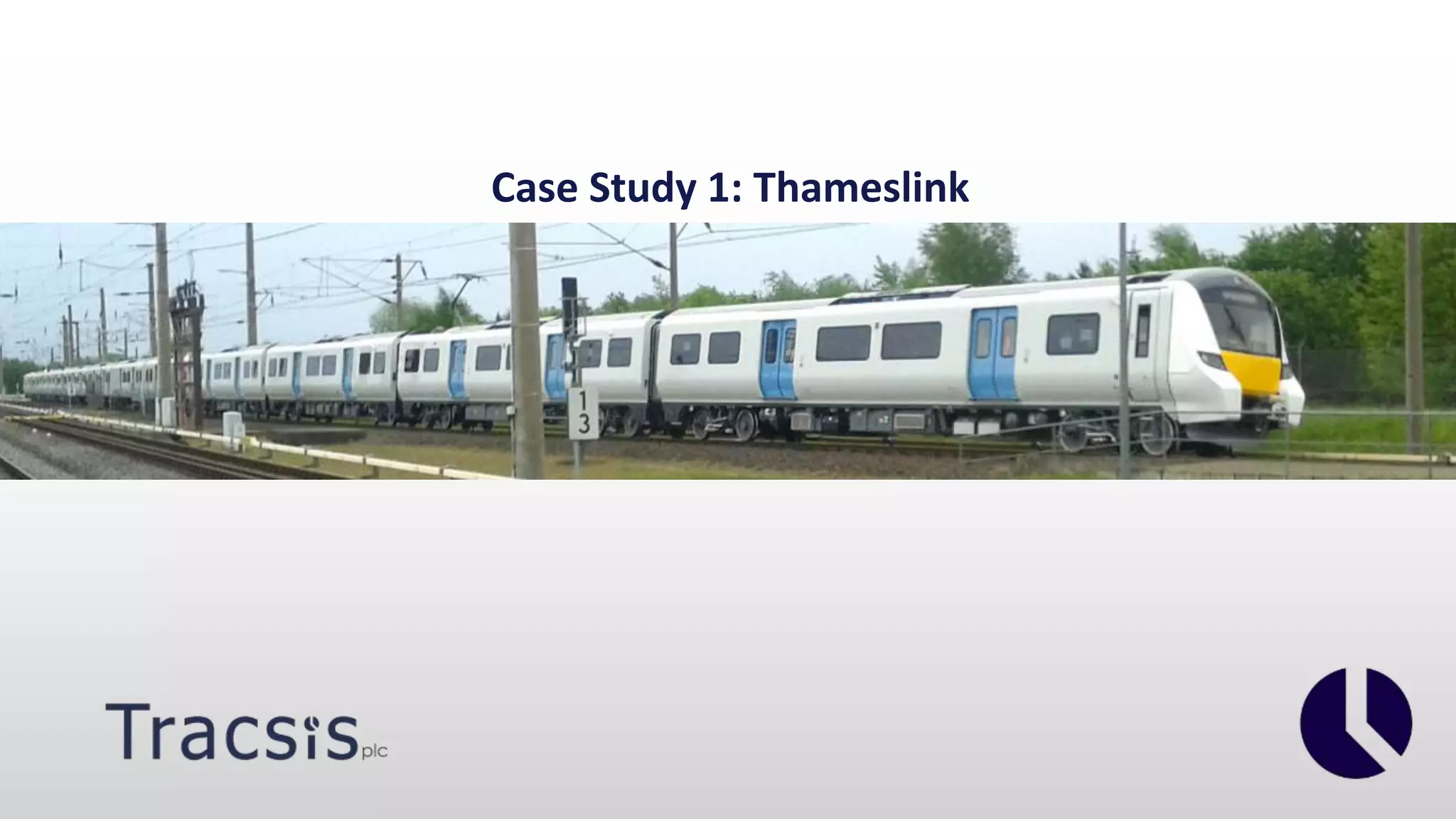
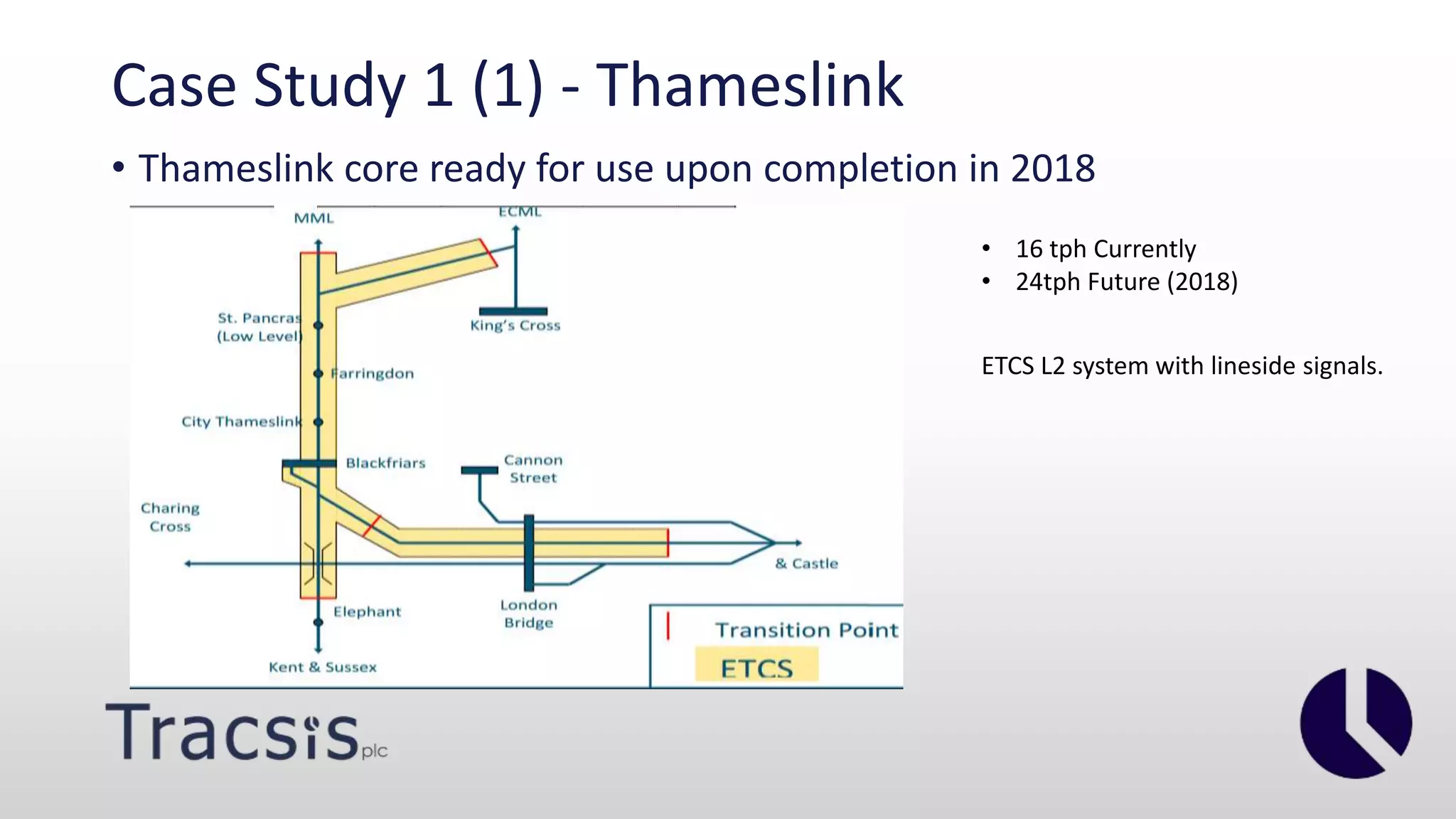
• Thameslink core ready for use upon completion in 2018
• 16 tph Currently
• 24tph Future (2018)
ETCS L2 system with lineside signals.
Future Plans
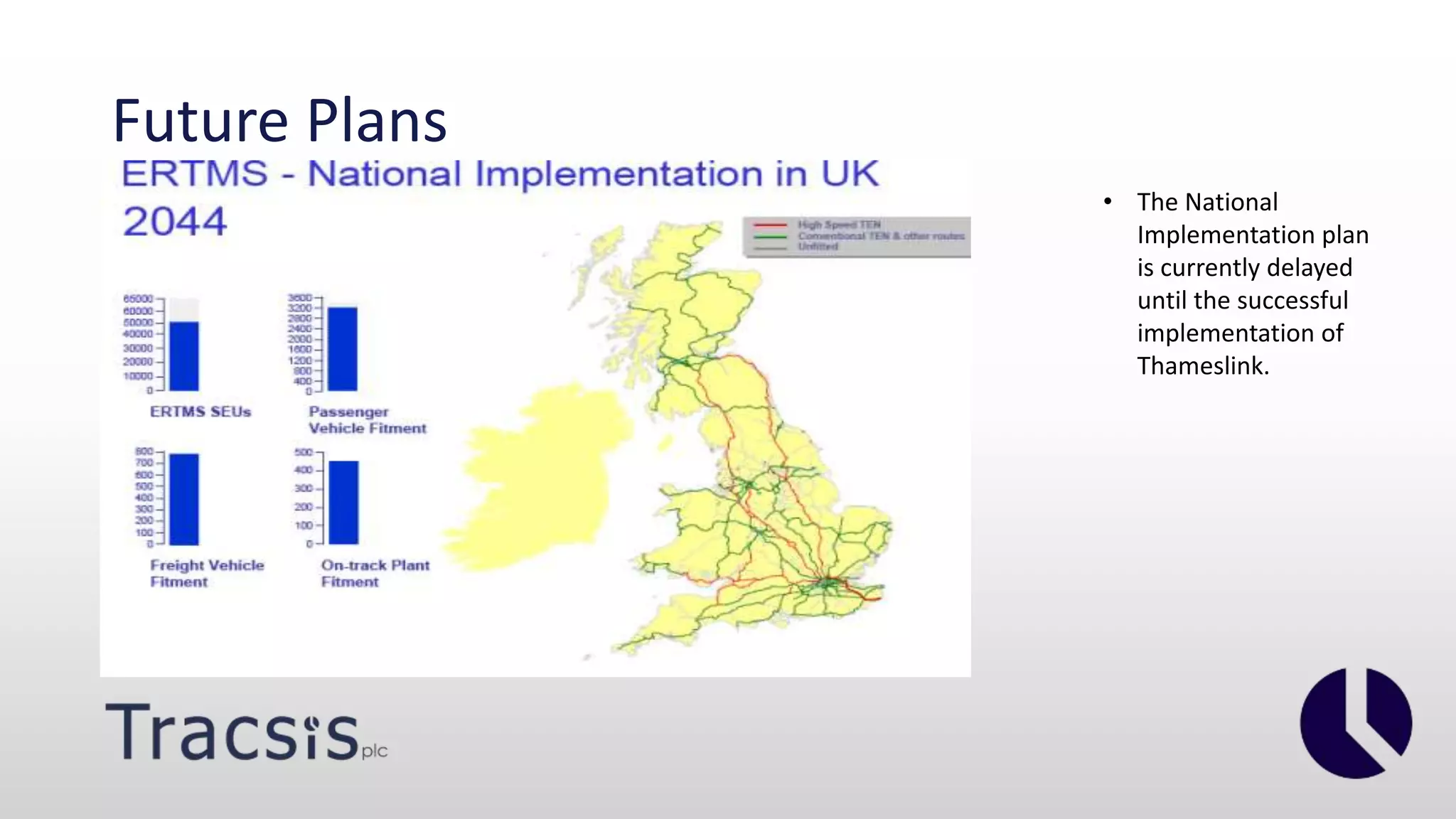
• TheNational
Implementation plan
is currently delayed
until the successful
implementation of
Thameslink.
22.
Copyright Tracsis Plc.All rights reserved
Martyn Tobin/Louis Rawlings/Gareth Harman/Ben Lander
Junior Consultant / Data Analysts
Office: +44 (0)1332 226 860
www.tracsis.com
6 The Point, Pinnacle Way
Pride Park
Derby DE24 8ZS
www.tracsis.com
@Tracsis
Editor's Notes
#3 The aim is to spread general awareness of the ERTMS; to provide a informed view to allow future discussions.
#5 European Train Control System (ETCS) - The train control element which provides ATP. ETCS is not in itself a signalling system, but is a component part of the signalling system.
Here is a video from Network Rail that quickly summarises ERTMS.
Currently there are more than 20 train control systems across European Union.
Each train must be equipped for the various control systems along its route; especially important for intercontinental train services.
Thalys train sets running between Paris-Brussels-Cologne and Amsterdam have to be equipped with 7 different types of train control systems, which brings considerable costs.
TCS (European Train Control System) – the ‘signalling’ element of the system and includes the control of movement authorities, automatic train protection and the interface to the interlockings
2. GSM-R (Global System for Mobiles – Railways) – the ‘communication’ element containing both a voice communication network between control rooms and trains, and a bearer path for the ETCS data
#6 Here is a video from Network Rail that quickly summarises ERTMS.
#7 Most of the UK (except Cabrian and HS1) uses route signalling and most of Continental Europe uses speed signals. - Route – We provide speed limits through route knowledge; location.
Speed – the signalling system advises the speed to use.
(there is cross over; however, not required for today)
ERTMS was designed as a standard product for Europe; it needs a retrofitting to our pre-existing network.
Why are we doing this?
- this is what we do today!
- Very complex
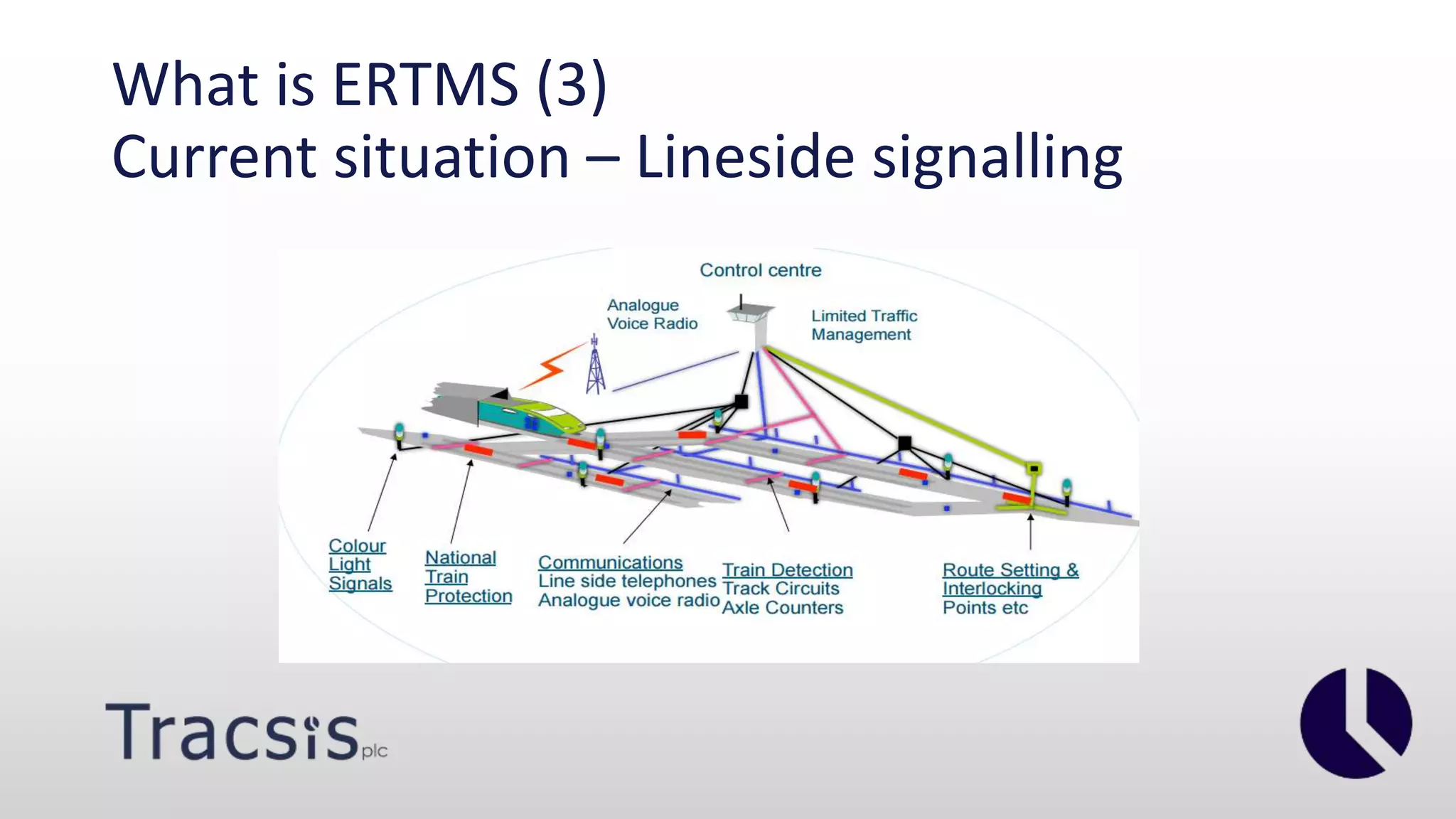
Little traffic management – (analogue radio)
- Very expensive to purchase, operate and all the maintenance cost incorporated
#8 Digital Railway which is seen as the future
Control system for 2030 +
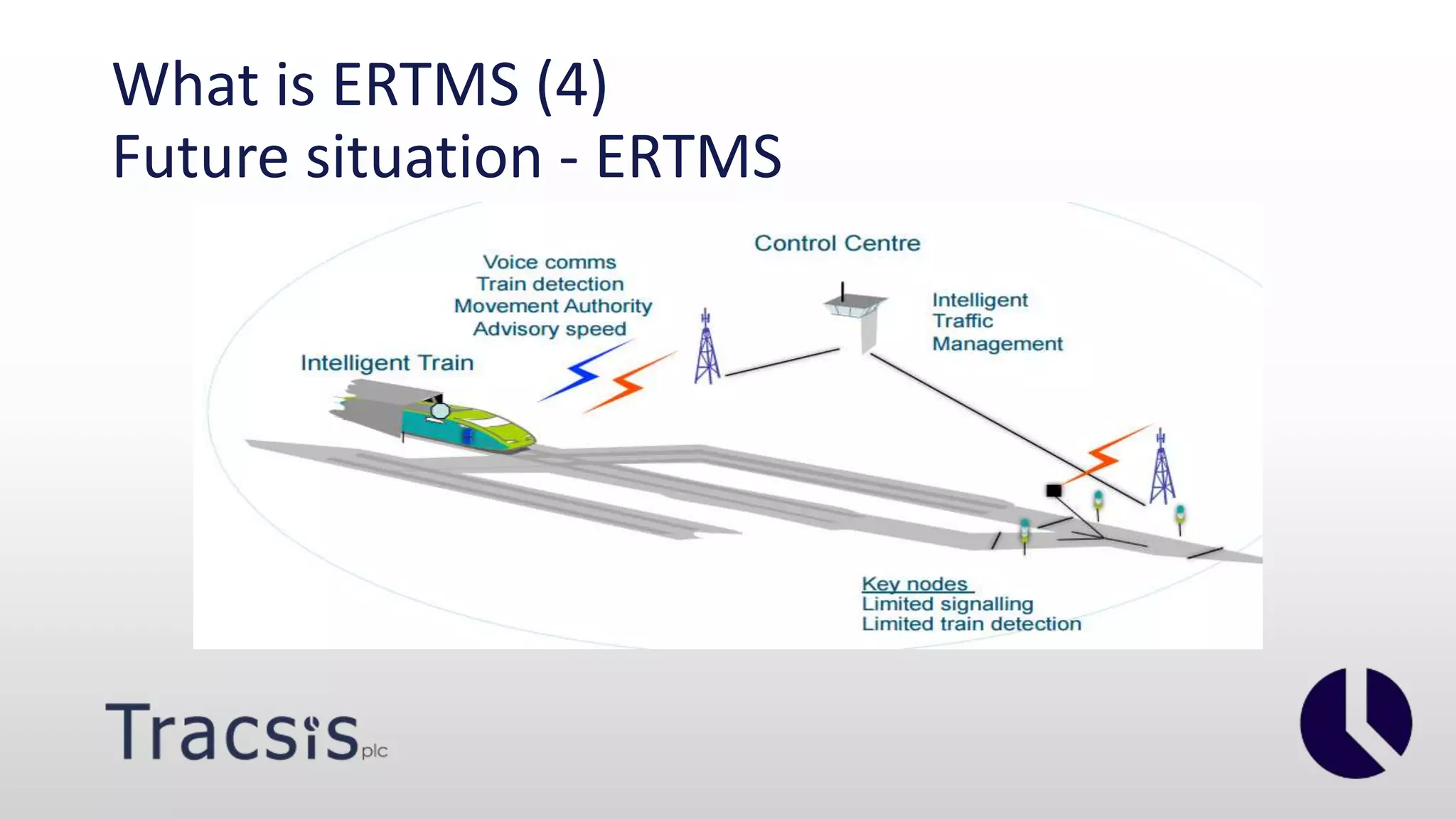
Got the control centre; but this time we have intelligent traffic management and we got the system controlling the movement of trains.
Provides the movement authority through data coming through the air gap rather than fixed signals.
Most operating cost have now been removed.
#11 The ERTMS/ETCS application “levels” define different uses of ERTMS as a train control system, ranging from track to train communications (Level 1) to continuous communications between the train and the radio block centre (Level 2). Level 3, which is in a conceptual phase, will further increase ERTMS’ potential by introducing a “moving block” technology
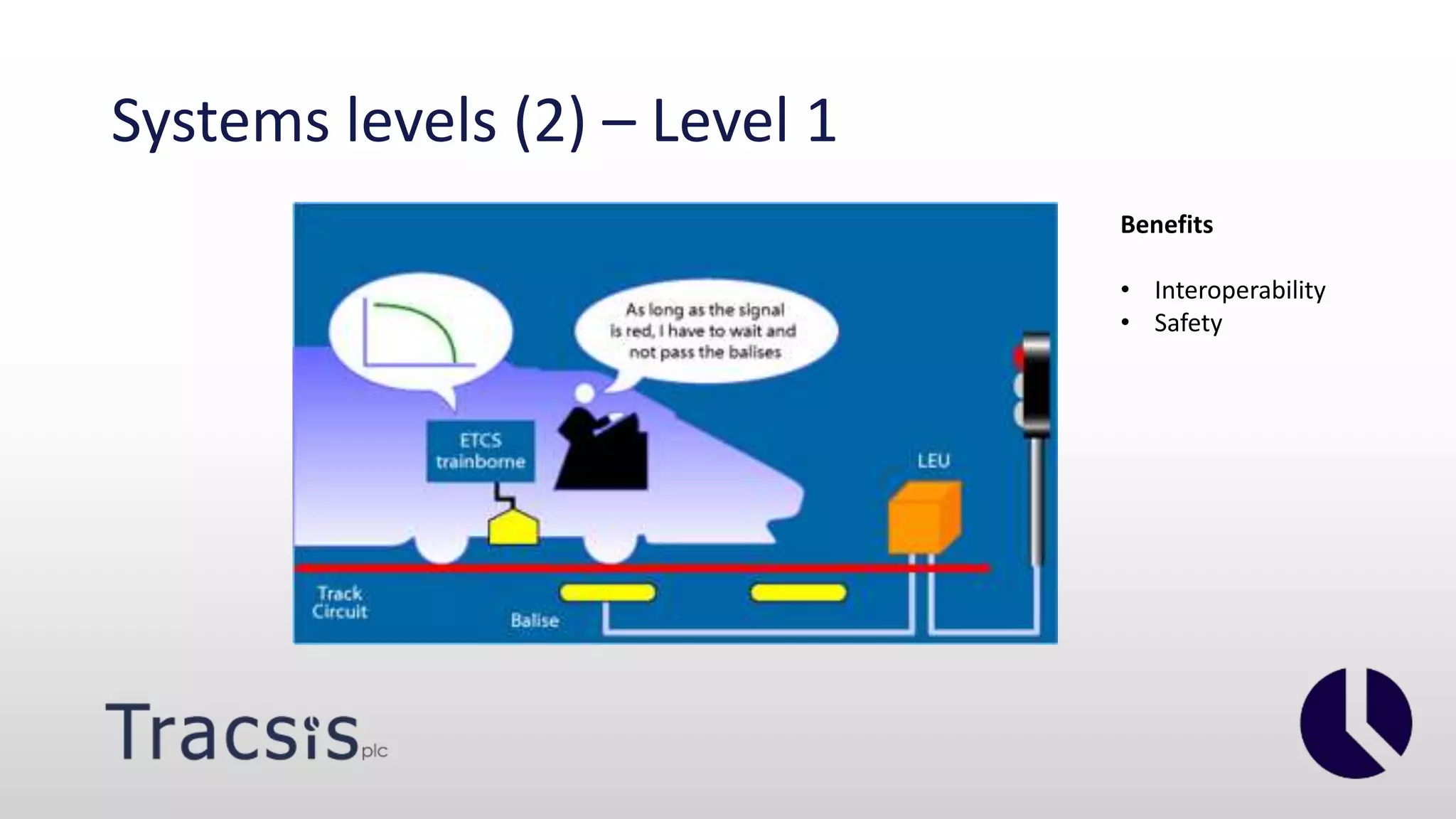
#13 ERTMS level 1 is designed as an add-on to or overlays a conventional line already equipped with lineside signals and train detectors. Communication between the tracks and the train are ensured by dedicated balises (known as “Eurobalises®”) located usually on the trackside adjacent to the lineside signals at required intervals, and connected to the train control centre.
Receiving the movement authority through Eurobalises, the ETCS onboard equipment automatically calculates the maximum speed of the train and the next braking point if needed, taking into account the train braking characteristics and the track description data. This information is displayed to the driver through a dedicated screen in the cabin. The speed of the train is continuously supervised by the ETCS onboard equipment.
#15 As opposed to level 1, ERTMS level 2 does not require lineside signals. The movement authority is communicated directly from a Radio Block Centre (RBC) to the onboard unit using GSM-R.
The balises are only used to transmit “fix messages” such as location, gradient, speed limit, etc. A continuous stream of data informs the driver of line-specific data and signals status on the route ahead, allowing the train to reach its maximum or optimal speed but still maintaining a safe braking distance factor.
Level 2 without lineside signals will reduce infrastructure costs by 40%
Elsewhere, plans exist for the deployment on the Great Western main line (GWML) to Bristol and South Wales – but only as a Level 2 overlay to the existing signalling system primarily because of problems in getting sufficient rolling stock (particularly freight) fitted. The project is still only at GRIP 1-3 stage, which makes it highly likely commissioning will be delayed beyond the 2019 target date. (http://www.railengineer.uk/2015/08/28/ertms-a-reality-check/)
Level 2, even without signals, still requires a considerable amount of trackside infrastructure to support the track circuits or axle counters required for train detection and this has always been seen as a shortcoming. http://www.railengineer.uk/2015/08/28/ertms-a-reality-check/
#16 ERTMS is a theoretical and is elusive.
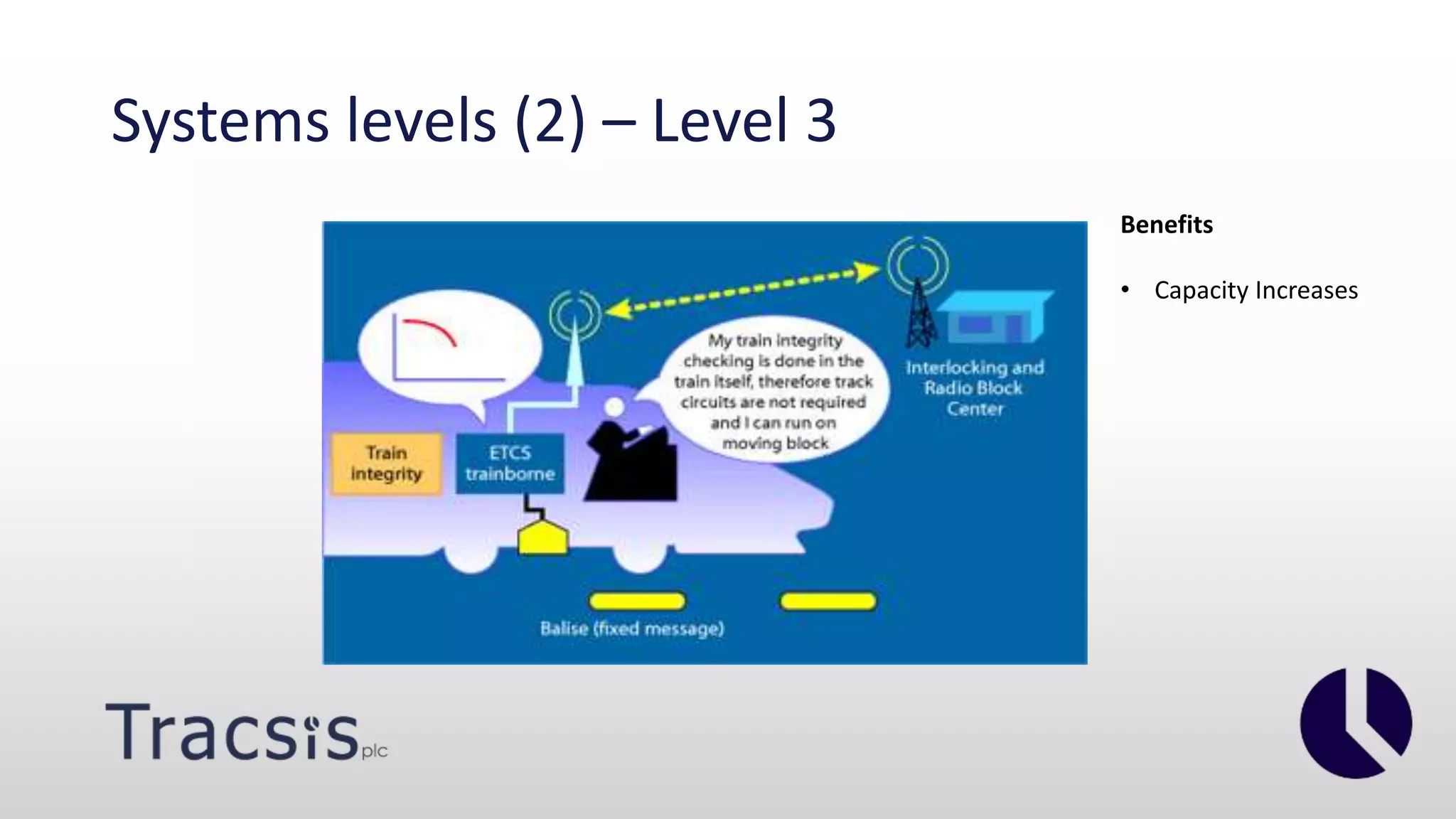
ERTMS Level 3, still in its conceptual phase, allows for the introduction of a “moving block” technology. Under ERTMS level 1 and 2, movement authorities are determined using “fixed blocks” - section of tracks between two fixed points which cannot be used by two trains at the same time.
ERTMS level 3, accurate and continuous position data is supplied to the control centre directly by the train, rather than by track based detection equipment. As the train continuously monitors its own position, there is no need for “fixed blocks” – rather the train itself will be considered as a moving block.
Level 3 – will reduce infrastructure costs by a further 25% (c.) in addition to the 40% reduction by level 2. However, some of this cost reduction will be offset to some extent by upgrading the current GSM-R rollout
One factor that has been a longstanding sticking point is the proving of train completeness. Without a track circuit or axle counter, how can it be proved that a train has not divided en route? This is not a problem for passenger trains with modern braking systems and on-board train data systems, but for freight trains, despite having a continuous brake, the driver may not realise the train has divided if the break is towards the rear of the consist. http://www.railengineer.uk/2015/08/28/ertms-a-reality-check/
More significantly, Level 3 will cause a shift in the functional responsibilities and cost between the organisations that make up a typical modern railway. The significant transfer of risk to the TOCs and adapting trains to be much more a part of the signalling control system is a heavy responsibility. Penalties for failure of equipment and delay to other trains will be a minefield and until the ‘rules of operation’ are sorted out, they are likely to be barriers that prevent Level 3 being progressed. http://www.railengineer.uk/2015/08/28/ertms-a-reality-check/
#18 Buisness Issue
The costs of the fitment itself.
• The costs of taking a train out of service to carry-out ETCS fitment.
• The costs of maintaining the equipment.
• The costs associated with any reduction in overall train reliability caused by having additional equipment onboard.
As more trains are fitted, so these benefits are enjoyed to an increasing extent. Finally, once all trains using a line are fitted, the further benefits can also be realised: • cost savings through removal of line side signalling equipment; • simplification of signalling principles
Ownership of ERTMS – trackside infrastructure will be the responsibility of Network Rail
- Equipment on the train will be the responsibility of the TOC,FOC?
Network Rail state: Although still operating under the umbrella term of ERTMS, we're creating our own traffic management system to optimise performance. (http://www.networkrail.co.uk/aspx/12275.aspx)
#20 Thameslink will be level 2 with lineside signals.
#22 (left to right) Great Western Mainline West Coast Mainline East Coast Mainline



![Omar Benjumea - Next Station: Cybersecurity [rooted2019]](https://cdn.slidesharecdn.com/ss_thumbnails/obenjumea-presorootedcon2019definitiva-190403185728-thumbnail.jpg?width=640&height=640&fit=bounds)


