Pros and Cons of TETRA vs. P25
and the
Benefits of a Multi-technology Platform
for TETRA, P25 Phase I / Phase II,
and Mobile WiMax
Keith Ammons
Vice President, Product Marketing
Pros and Cons of TETRA vs. P25
 TETRA
o What is TETRA?
 P25
o P25 Phase I / Phase II
 Comparison
o Similarities and differences
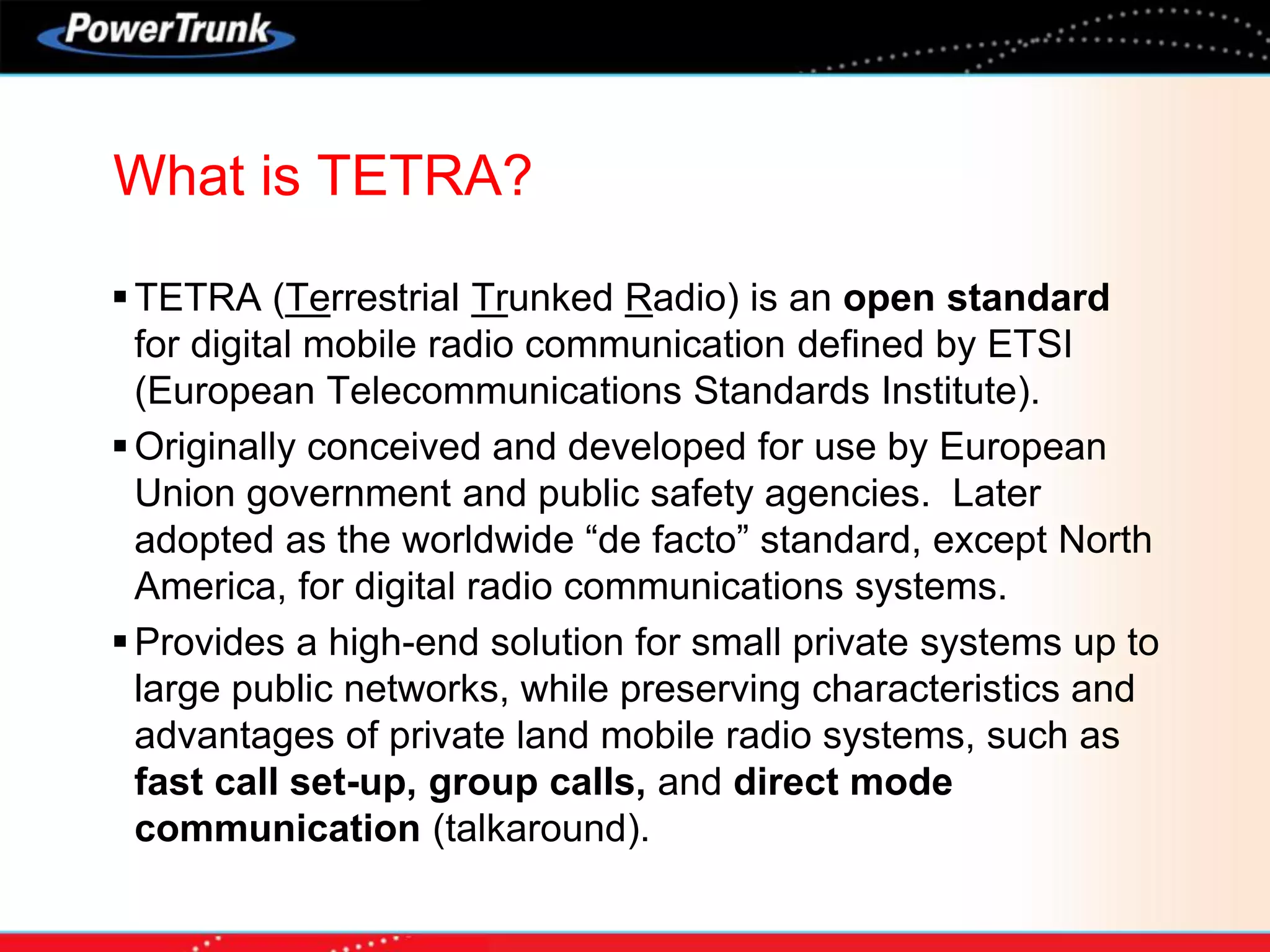
TETRA (Terrestrial Trunked Radio) is an open standard
for digital mobile radio communication defined by ETSI
(European Telecommunications Standards Institute).
Originally conceived and developed for use by European
Union government and public safety agencies. Later
adopted as the worldwide “de facto” standard, except North
America, for digital radio communications systems.
Provides a high-end solution for small private systems up to
large public networks, while preserving characteristics and
advantages of private land mobile radio systems, such as
fast call set-up, group calls, and direct mode
communication (talkaround).
What is TETRA?
AI - Air Interface (Trunked Mode)
DMO - Direct Mode Operation
ISI - Inter-System Interface
LS - Line Station (dispatcher)
LSC - Local Switching Controller
MMI - Man Machine Interface
MS - Mobile Station
NMS - Network Management System
PEI - Peripheral Equipment Interface
SBS - Site Base Station
SCN - Switching Control Node
SwMI - Switching and Management Infrastructure
TE - Terminal Equipment
REMOTE
DISPATCHER
ISI SwMI
SBS
SBS
SBS
TETRA Network
TETRA
Network
non-TETRA
Network
LSC
AI AI MS
DMOPEI MMI
GATEWAY
Link
MS
TE
SCN
LS
TETRA Standard Elements and Interfaces
 Each RF carrier (radio channel) is divided into
timeslots within a 25 KHz channel.
 The transmission rate is 7.2 Kbps per slot.
36 Kbps
28.8
Kbps7.2 Kbps
TETRA General Concepts
TDMA (Time Division Multiple Access)
MCCH TCH PDCH PDCH
TCH TCH TCH TCH
T1 T2 T3 T4
T1 T2 T3 T4
Carrier 1
(main)
Carrier 2
MCCH
TCH TCHPDCH
T1 T2 T3 T4
T1 T2 T3 T4
Carrier 1
(main)
Carrier 2
SCCHSCCHSCCH
SBS 1
SBS 3
MCCH TCHPDCH
T1 T2 T3 T4
Carrier 1
SBS 2
SCCH
PDCH
Example of channel distribution
TETRA General Concepts
 High Quality and High Security in communications.
 Double spectral efficiency.
 Higher data bandwidths (up to 28.8 kbps)
 Multiple real-time data services (status, short data,
circuit mode data, packet mode data).
 Half-duplex and full-duplex communications.
 Interoperable with other networks (TETRA, ISDN, IP, GSM).
 Continuous coverage.
 Emergency calls.
 Fast call setup.
 Simultaneous voice and data.
 Open standard technology: protects investment.
Total 2258 contracts across 105 countries
Data provided by the TETRA Association Members.
(October 2008 – latest data available )
TETRA Highlights
 Project 25 (P25) is a set of standards produced through
the joint efforts of the Association of Public Safety
Communications Officials International (APCO), the
National Association of State Telecommunications
Directors (NASTD), selected Federal Agencies and the
National Communications System (NCS), and
standardized under the Telecommunications Industry
Association (TIA).
 P25 is an open architecture, user-driven suite of system
standards that define digital radio communications
system architectures capable of serving the needs of
Public Safety and Government organizations.
 The P25 standard exists in the public domain, allowing
any manufacturer to produce a P25 compatible radio
product.
P25: Background
 P25 is defined for two different working modes:
o Conventional: provides a simple infrastructure system
that normally repeat radio calls from one frequency to
another.
o Trunked: a controller inside the infrastructure provides
intelligence to manage call set up, subscribers roaming
across the system, channel assignment,…
 Additionally, P25 conventional and trunked systems can be
deployed in three different ways according to frequency
usage:
o Multicast: All adjacent repeater sites use different
frequencies
o Voting system: All adjacent repeater sites use different
transmitting frequencies but the same reception
frequency
o Simulcast: All repeater sites use same Tx/Rx freqs.
P25: Background
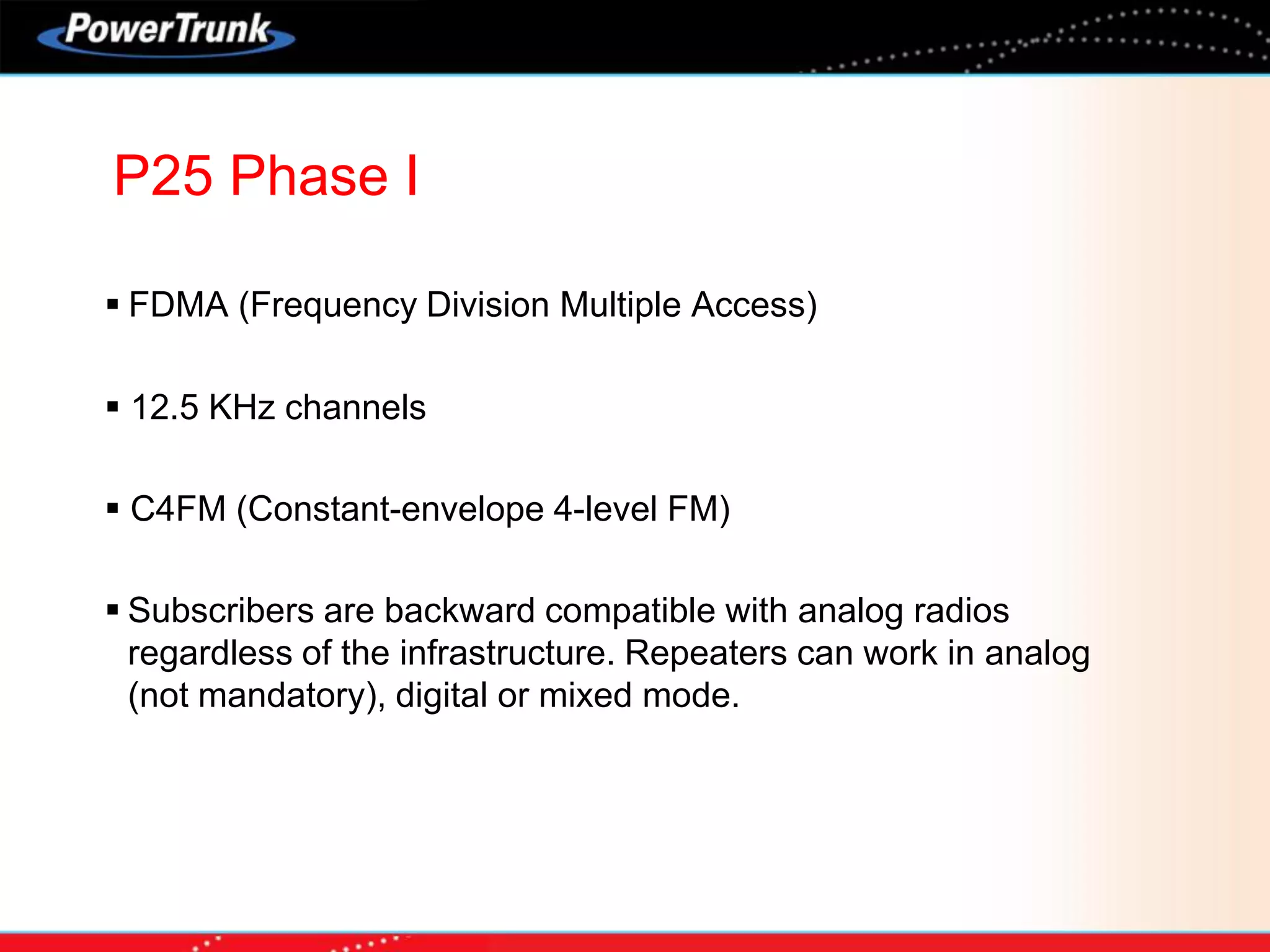
 FDMA (Frequency Division Multiple Access)
 12.5 KHz channels
 C4FM (Constant-envelope 4-level FM)
 Subscribers are backward compatible with analog radios
regardless of the infrastructure. Repeaters can work in analog
(not mandatory), digital or mixed mode.
P25 Phase I
 Phase II: Will be a 6.25 KHz equivalent system, meaning that 1
voice communication will fit within 6.25 KHz of channel bandwidth.
For the above, P25 Phase II will use a 2-timeslot TDMA structure
in 12.5 KHz channels.
 Control channels will support FDMA for backward compatibility
with Phase I.
P25 Phase II
TETRA / P25 Comparison
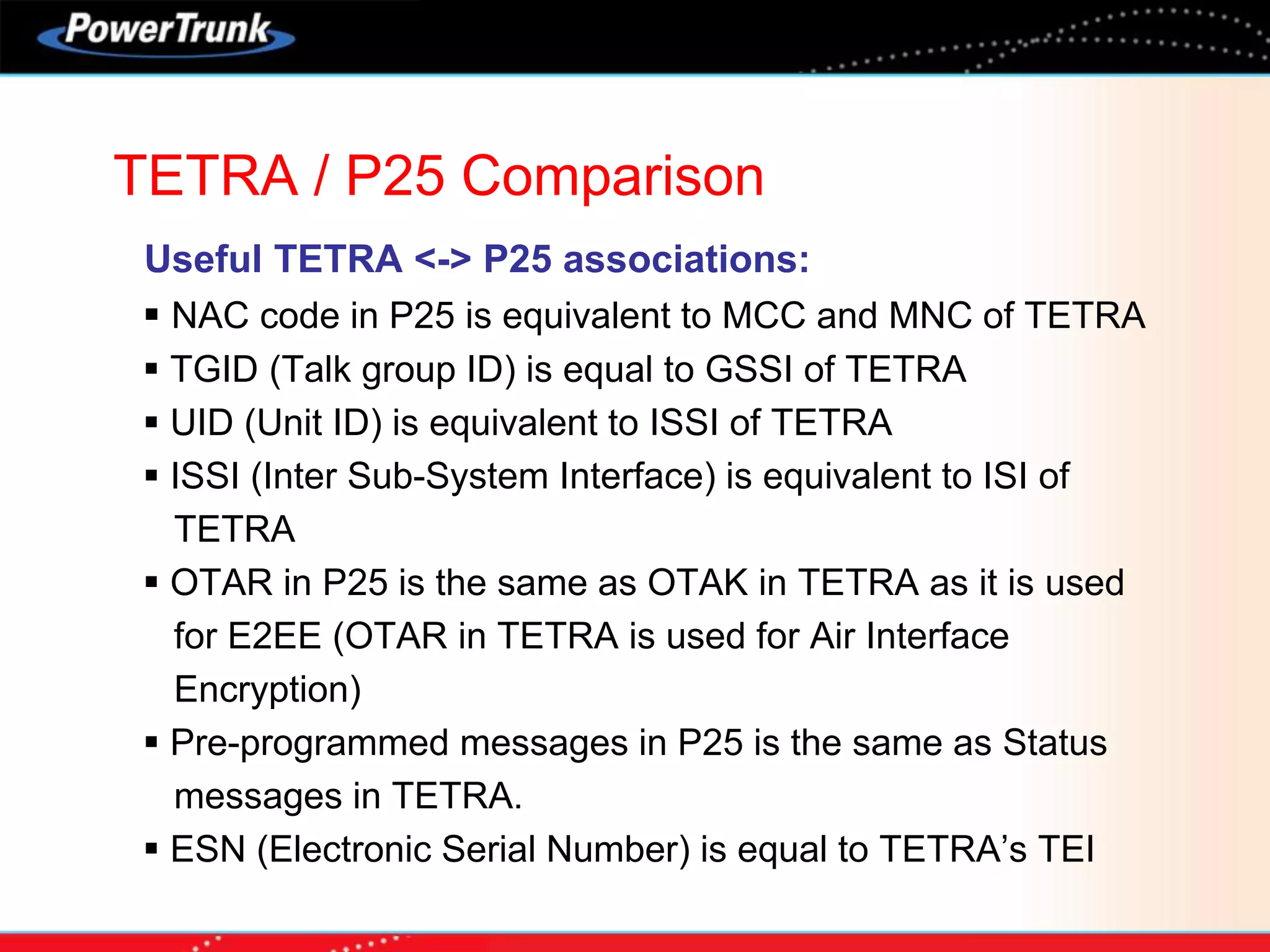
Useful TETRA <-> P25 associations:
 NAC code in P25 is equivalent to MCC and MNC of TETRA
 TGID (Talk group ID) is equal to GSSI of TETRA
 UID (Unit ID) is equivalent to ISSI of TETRA
 ISSI (Inter Sub-System Interface) is equivalent to ISI of
TETRA
 OTAR in P25 is the same as OTAK in TETRA as it is used
for E2EE (OTAR in TETRA is used for Air Interface
Encryption)
 Pre-programmed messages in P25 is the same as Status
messages in TETRA.
 ESN (Electronic Serial Number) is equal to TETRA’s TEI
TETRA Pros and Cons
 Pros:
o Optimized for high population density areas
o Spectral efficiency (4 time slots in 25 KHz)
o Data bandwidth on demand (up to 28.8 kbps)
o RX diversity
o Supports full duplex voice
o Short data / status messaging
o Packet data / circuit mode data
 Cons:
o Not presently available in VHF band
o No simulcast
P25 Pros and Cons
 Pros:
o Optimized for wider area coverage with low
population density
o Greater range than TETRA in Phase I (FDMA),
but nearly same in Phase II (TDMA)
o Support for simulcast
 Cons:
o Limited data support
o Delays in Phase II standard (projected 2011)
TETRA / P25 Comparison
 Both technologies are valid solutions for modern
professional-use digital radio communications systems
OFFERS BOTH SOLUTIONS !
Benefits of a Multi-technology Platform for
TETRA, P25 Phase I / Phase II,
and Mobile WiMax
 Common Architecture
o Support for TETRA, P25, and WiMax protocols
o Interconnectivity
o Common Computer Aided Dispatch (CAD) application
 Benefits / Applications by Sector
o For Transport
o For Utilities
o For PSS
Complete Ethernet / IP Architecture
Easy
& FriendlyFlexible
a) Distributed switching
b) Distributed intelligence
c) No need for GPS or external
synchronization
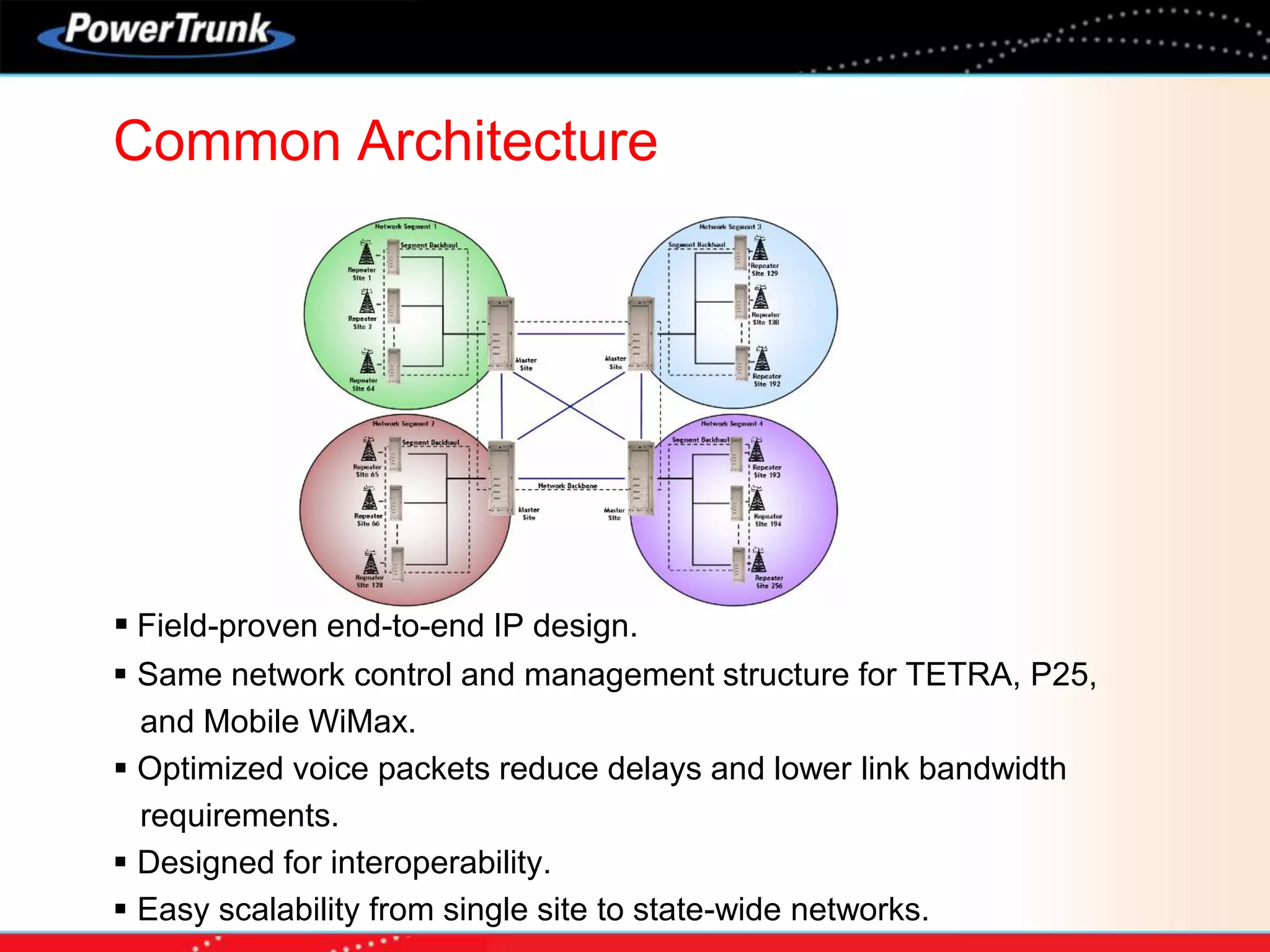
 Field-proven end-to-end IP design.
 Same network control and management structure for TETRA, P25,
and Mobile WiMax.
 Optimized voice packets reduce delays and lower link bandwidth
requirements.
 Designed for interoperability.
 Easy scalability from single site to state-wide networks.
Common Architecture
Common Hardware
Dispatching ConsoleNMS Client
Master Site
ControllerRF Base Station/Repeater
Local Site Controller (LSC)
NMS server
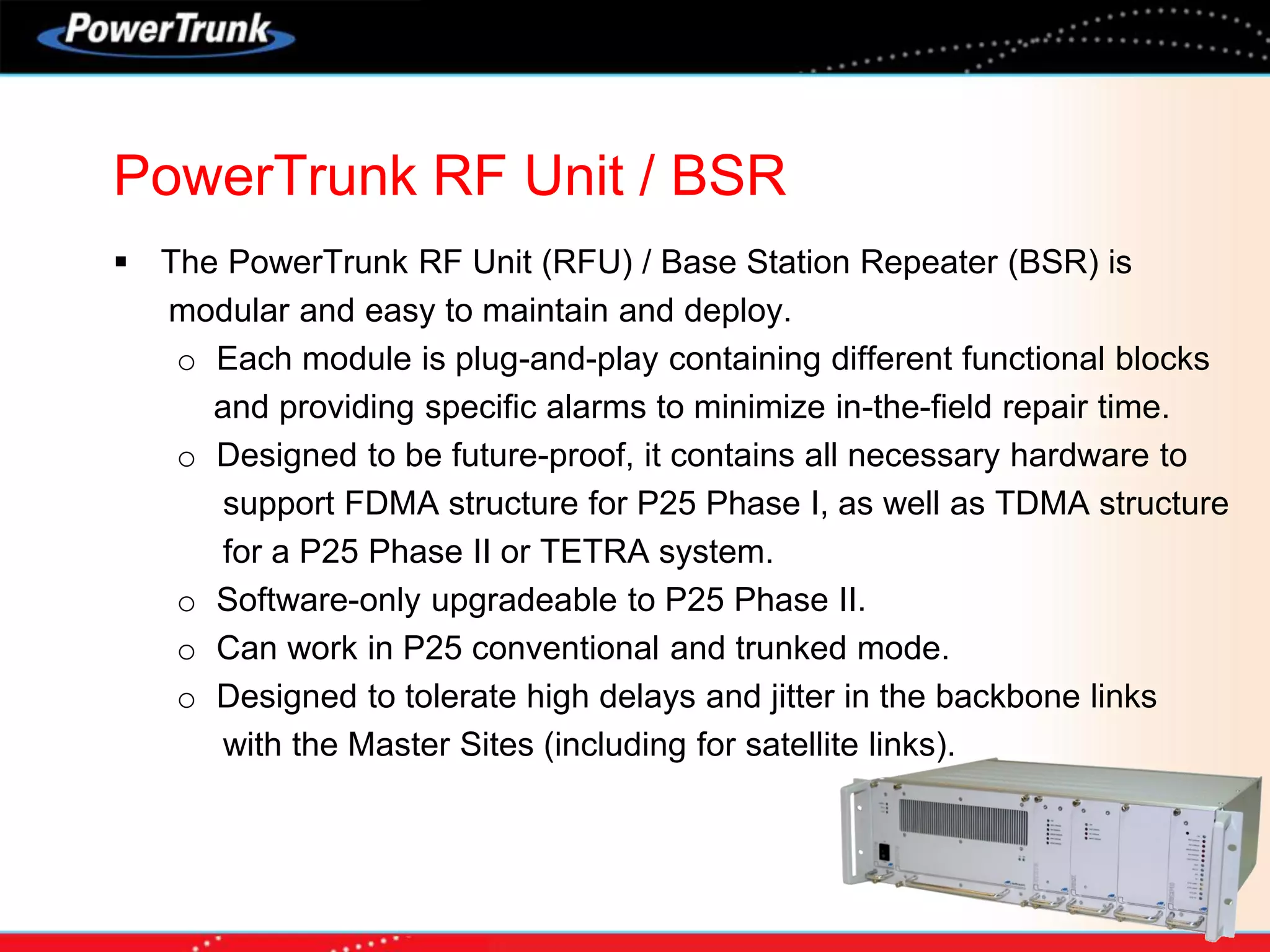
 The PowerTrunk RF Unit (RFU) / Base Station Repeater (BSR) is
modular and easy to maintain and deploy.
o Each module is plug-and-play containing different functional blocks
and providing specific alarms to minimize in-the-field repair time.
o Designed to be future-proof, it contains all necessary hardware to
support FDMA structure for P25 Phase I, as well as TDMA structure
for a P25 Phase II or TETRA system.
o Software-only upgradeable to P25 Phase II.
o Can work in P25 conventional and trunked mode.
o Designed to tolerate high delays and jitter in the backbone links
with the Master Sites (including for satellite links).
PowerTrunk RF Unit / BSR
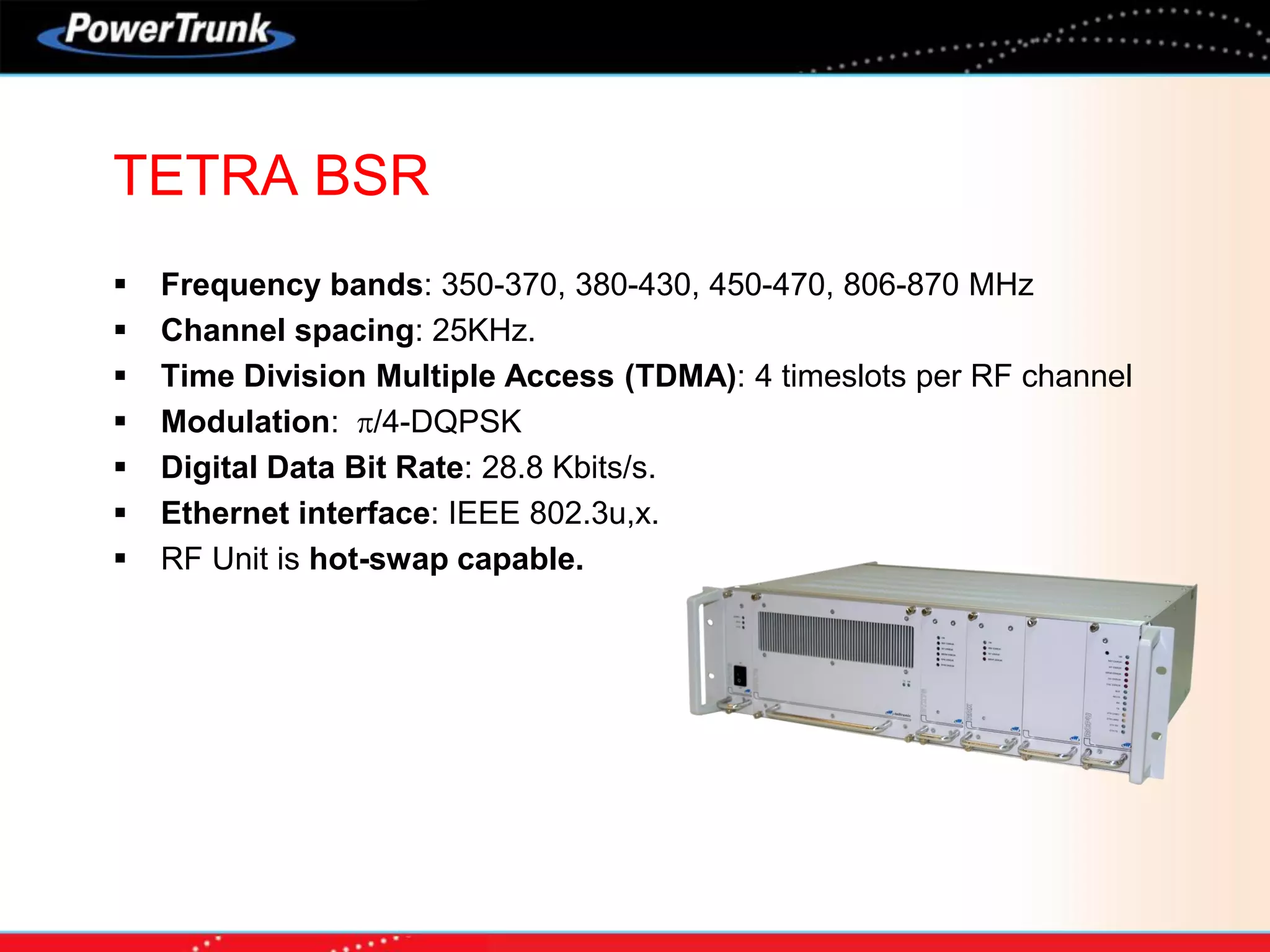
TETRA BSR
 Frequency bands: 350-370, 380-430, 450-470, 806-870 MHz
 Channel spacing: 25KHz.
 Time Division Multiple Access (TDMA): 4 timeslots per RF channel
 Modulation: p/4-DQPSK
 Digital Data Bit Rate: 28.8 Kbits/s.
 Ethernet interface: IEEE 802.3u,x.
 RF Unit is hot-swap capable.
 Frequency bands: VHF, 380-512 (*), 764-806, 806-870 MHz.
(* consult for specific sub-bands)
 Channel spacing: 6.25KHz, 12.5KHz or 25KHz.
 Frequency Division Multiple Access (FDMA): 1 channel per
RFU
 Modulation: Digital C4FM.
 Emissions Designator: 8K10F1W.
 Digital Data Bit Rate: 9.6 Kbits/s.
 Ethernet interface: IEEE 802.3u,x.
 RF Unit is hot-swap capable.
PowerTrunk25 RFU
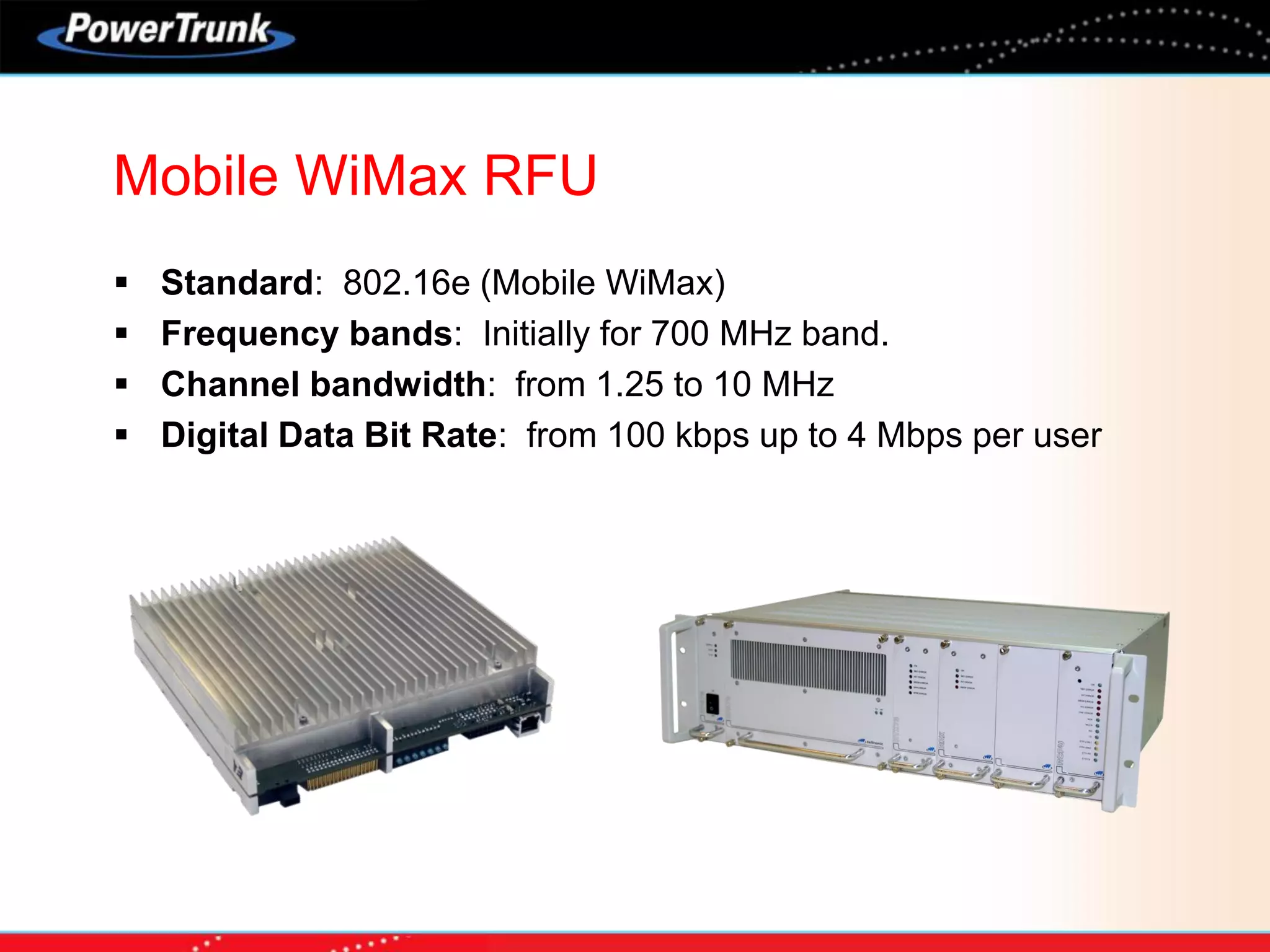
Mobile WiMax RFU
 Standard: 802.16e (Mobile WiMax)
 Frequency bands: Initially for 700 MHz band.
 Channel bandwidth: from 1.25 to 10 MHz
 Digital Data Bit Rate: from 100 kbps up to 4 Mbps per user
 This is not narrow or wide band, this is broadband:
o Mean typical data rate: 1Mbps / user
o Peak data rate: up to 4 Mbps / user
o Data rate can be managed dynamically
 Broadband provides the best capability to support the most
demanding applications:
o Video surveillance: remote monitoring for security and safety
o Video recording and streaming on demand
o Remote data base management
o Mobile office: staff working at remote locations or
on-board vehicles
o Remote maintenance of terminals and systems
o Web applications
o Telemedicine, E-health
o Biometrics, face recognition...
o Automation and control
o Smart metering
Broadband Performance
Vehicular PC
Broadband + TETRA / P25
radio terminal
VHF / UHF
radio antenna
Wireless broadband
antenna
Vehicular video
cameras
Audio
interfaces
MVC-6000: System Elements
BRI - PRI
[ISDN]
SBS
Synchronous Links
SBS
SBS
E1 Cross-Connect
ISDN Network
ISDN Connection
ISDN Connection
(dedicated BRI)
PDH or SDH SYSTEM
E1 / T1
Connection
V.35 Connection
E1 Drop-Insert
SCN
V.35 Link
G.703/G.704
[E1 / T1]
Synchronous Links: several types of links (V.35, E1 / T1, ISDN, …)
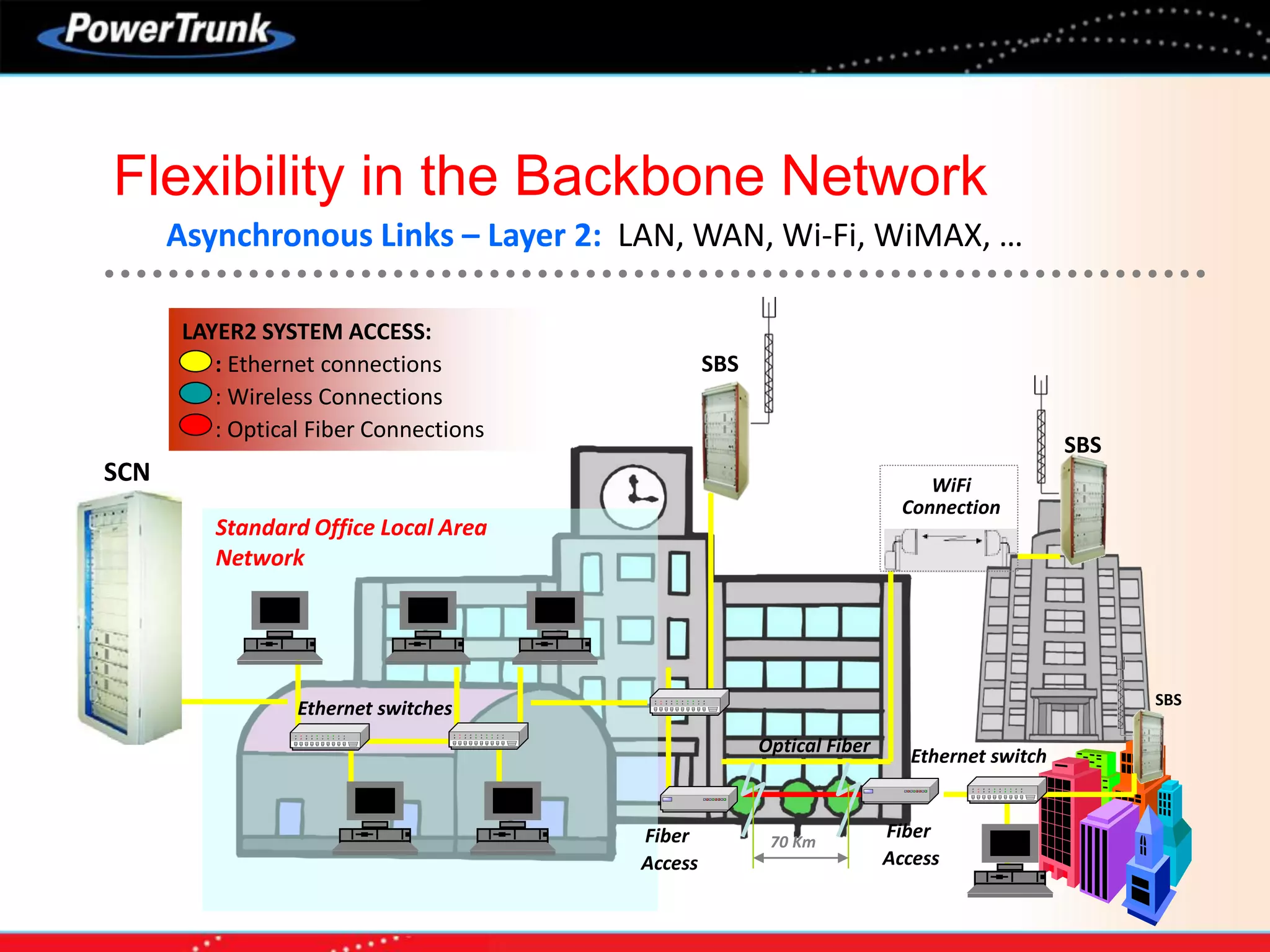
Flexibility in the Backbone Network
WiFi
Connection
SBS
Standard Office Local Area
Network
Ethernet switches SBS
Optical Fiber
Fiber
Access
Fiber
Access
Ethernet switch
70 Km
LAYER2 SYSTEM ACCESS:
: Ethernet connections
: Wireless Connections
: Optical Fiber Connections
SCN
SBS
Asynchronous Links – Layer 2: LAN, WAN, Wi-Fi, WiMAX, …
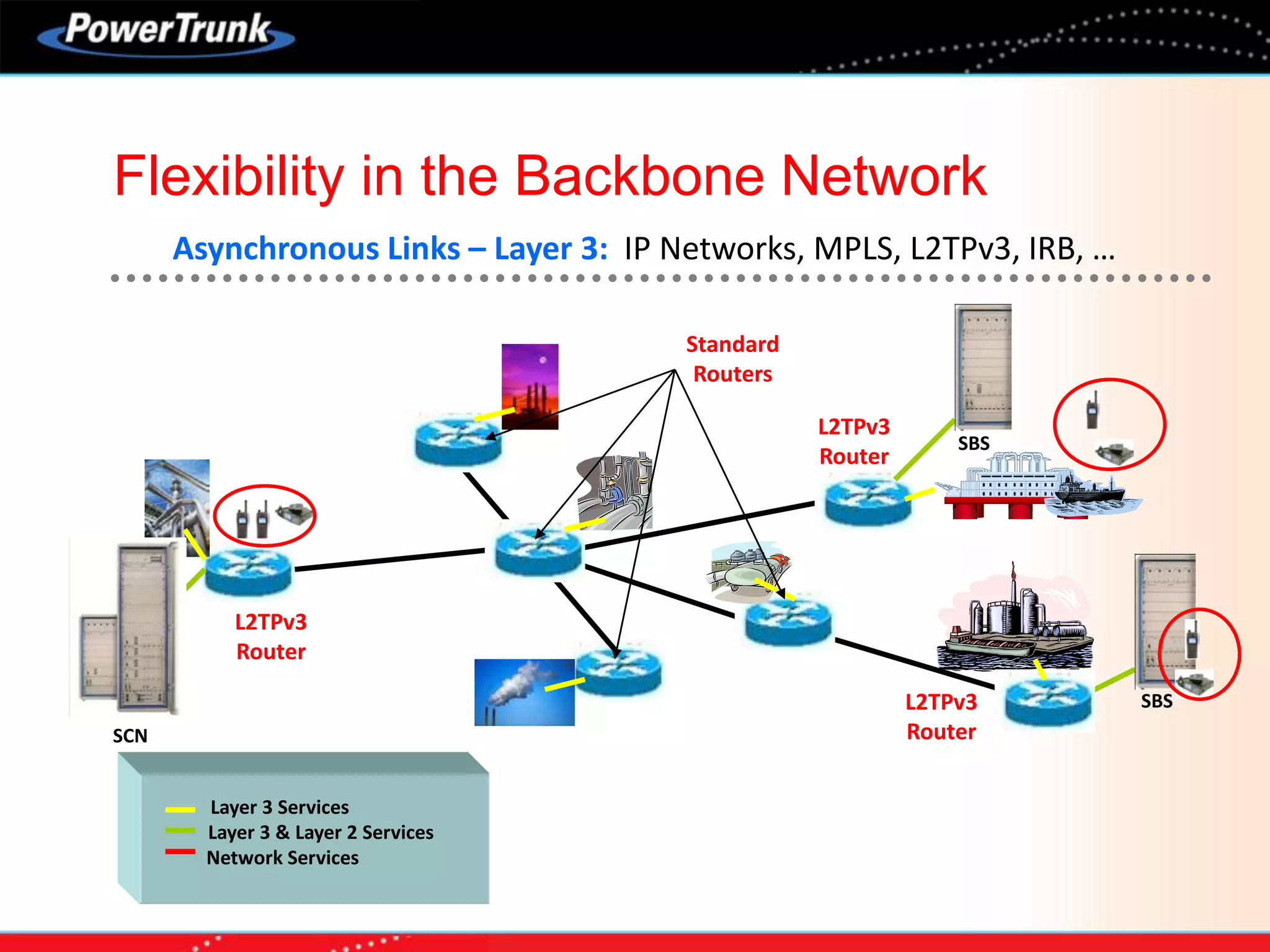
Flexibility in the Backbone Network
L2TPv3
Router
L2TPv3
Router
L2TPv3
Router
Layer 3 Services
Layer 3 & Layer 2 Services
SCN
SBS
SBS
Network Services
Standard
Routers
Asynchronous Links – Layer 3: IP Networks, MPLS, L2TPv3, IRB, …
Flexibility in the Backbone Network
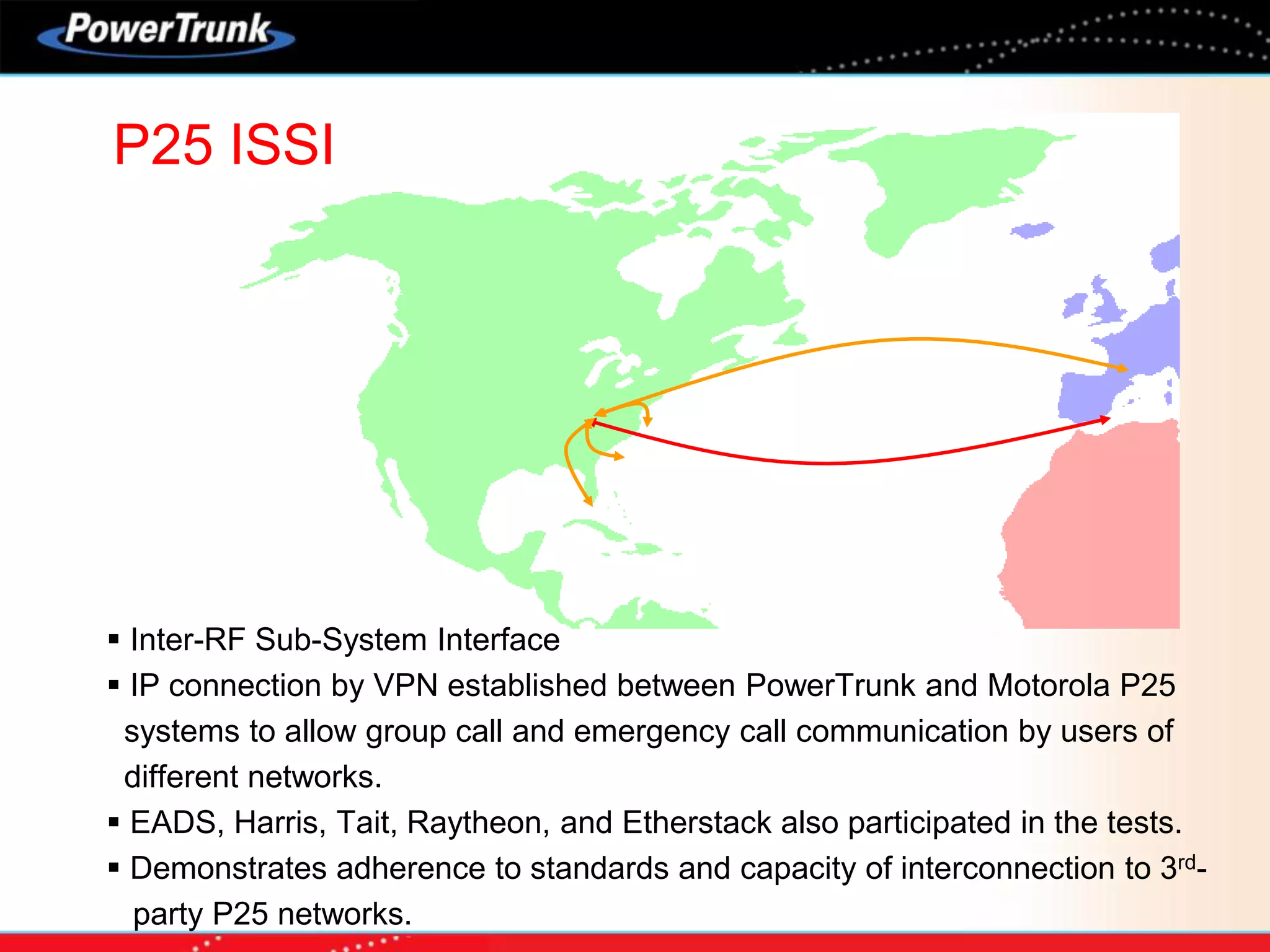
P25 ISSI
 Inter-RF Sub-System Interface
 IP connection by VPN established between PowerTrunk and Motorola P25
systems to allow group call and emergency call communication by users of
different networks.
 EADS, Harris, Tait, Raytheon, and Etherstack also participated in the tests.
 Demonstrates adherence to standards and capacity of interconnection to 3rd-
party P25 networks.
CeCoCo Series
Computer Aided Dispatch Solutions
 Includes modules for communication
management, location, and incident
management
 Ethernet-based connection with the
PowerTrunk range of TETRA and P25
infrastructure
 Additional services:
o Discreet Listening
o Ambience Listening
o Call inclusion / termination
o Fleet monitoring
o Priority calls
o Emergency calls
o Pre-emptive PTT
o Call Patching
CeCoCo
TETRA & P25
Radio Interfaces
Legacy
Conventional
System
Legacy Trunked
System
CeCoCo SERVER
PABX / PSTN
(E1/T1, ISDN,
VoIP, etc.)
Analog Telephony
PA system Recording SystemCall Taker /
Dispatcher
Workstation
Call Taker /
Dispatcher
Workstation
Line-Connected
TETRA/P25/WiMax
Infrastructure
TCP / IP
VoIP
Connect® -
Switching Matrix
CeCoCo Architecture
Metros / Subways
Entornos ferroviarios
Trams
Railroads
TETRA for Transport
Buses
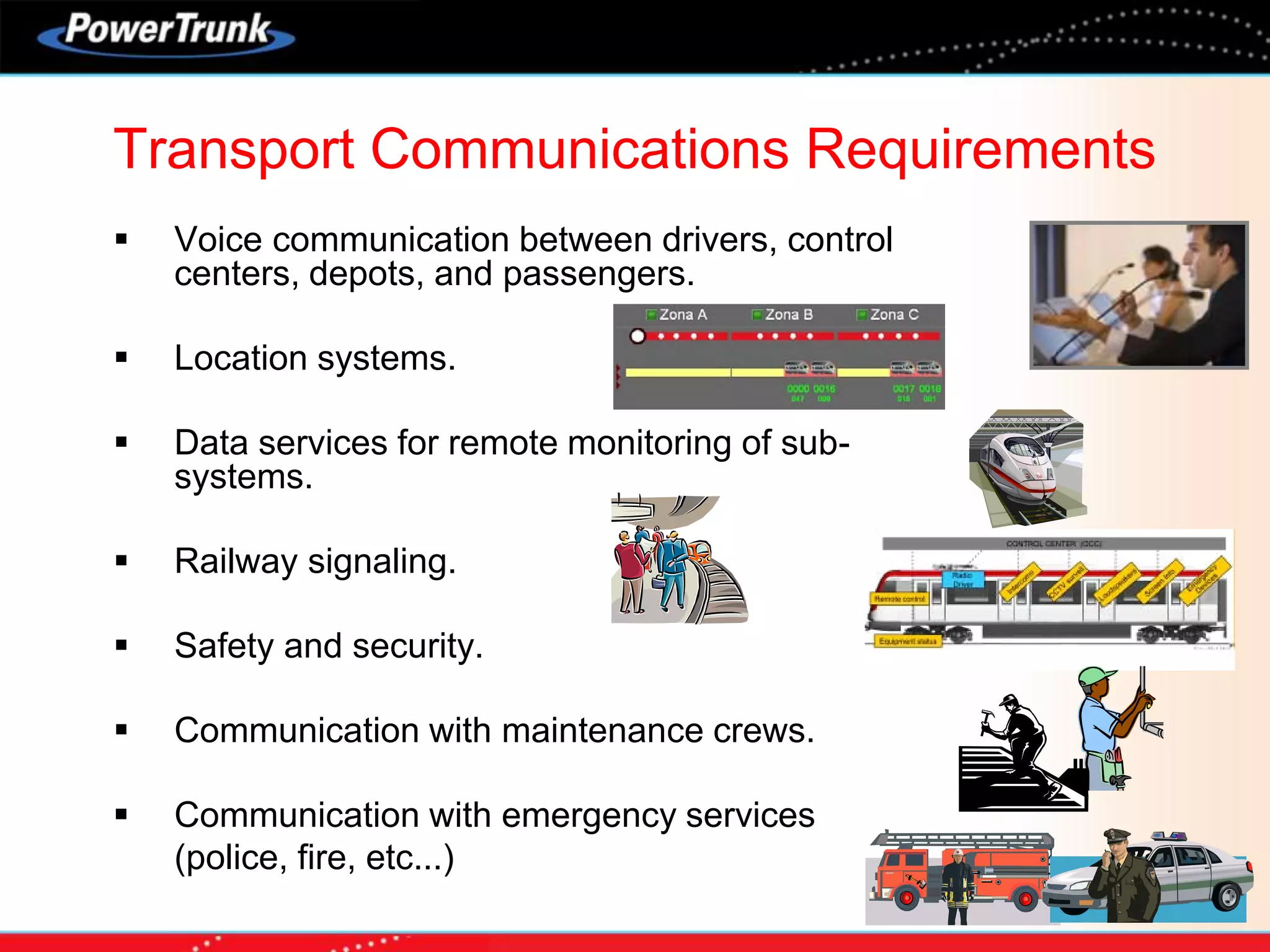
 Voice communication between drivers, control
centers, depots, and passengers.
 Location systems.
 Data services for remote monitoring of sub-
systems.
 Railway signaling.
 Safety and security.
 Communication with maintenance crews.
 Communication with emergency services
(police, fire, etc...)
Transport Communications Requirements
Voice
Communication
Remote
Command and
Control of
Rolling Stock Integration with
Passenger
Information
System
Integration with
Public Address
Systems
Interaction
with Intercom
System
Communication
Management
Sub-system
Telecommunications Sub-systems
Covered by TETRA
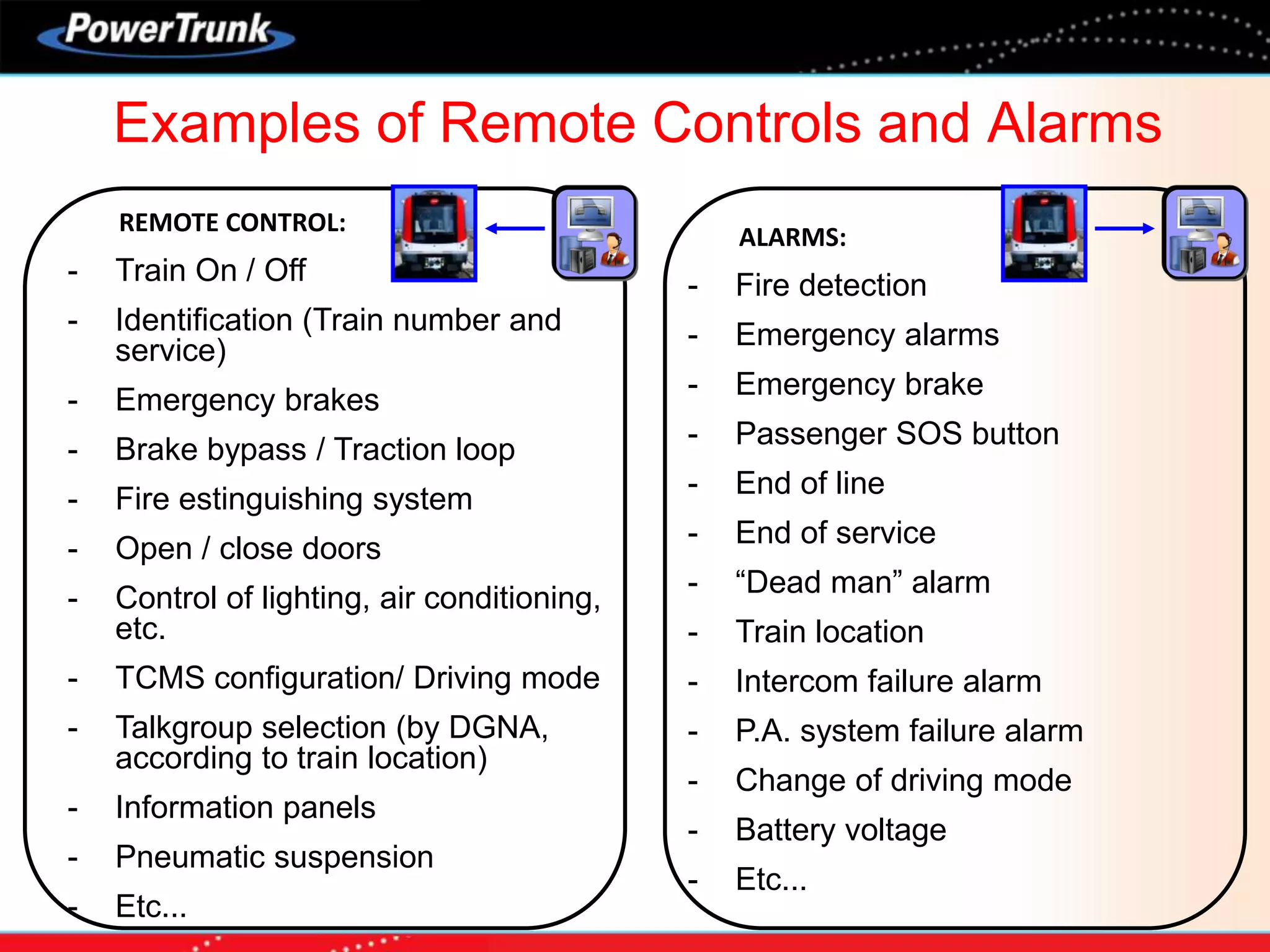
REMOTE CONTROL:
- Train On / Off
- Identification (Train number and
service)
- Emergency brakes
- Brake bypass / Traction loop
- Fire estinguishing system
- Open / close doors
- Control of lighting, air conditioning,
etc.
- TCMS configuration/ Driving mode
- Talkgroup selection (by DGNA,
according to train location)
- Information panels
- Pneumatic suspension
- Etc...
ALARMS:
- Fire detection
- Emergency alarms
- Emergency brake
- Passenger SOS button
- End of line
- End of service
- “Dead man” alarm
- Train location
- Intercom failure alarm
- P.A. system failure alarm
- Change of driving mode
- Battery voltage
- Etc...
Examples of Remote Controls and Alarms
Buses & Trams – Optimizing AVL
 Automatic regulation – Efficiency mostly depends
on the refresh period which can be achieved
 Old analog systems – Control of radio channels
(PTT-CD signals) by AVL Applications
 TETRA = TDMA. How to overcome the gap
between the AVL Application and TETRA
transport layers?
Based on:
 Basic TETRA Short Data Service (SDS) for polling
and transmitting GPS position in LIP format.
Speed of position polling / reply:
 The fastest rate is 1 position every 0.6 seconds.
Advantage:
 Supported by the majority of TETRA terminals in the
market.
Disadvantages:
 Care must be taken to poll terminals one by one, otherwise
degraded audio quality could result due to use of the
TETRA stealing mechanism.
 Not appropriate for large networks.
Basic SDS Solution
SDM (Synchronous Data Manager) is based on:
 Use of the SDS (LIP) service with reservation of air
resources, permitting reception of GPS positions at the base
station while avoiding collisions (synchronization concept).
 Special software in the infrastructure and the terminals.
Speed of polling / reply:
 The fastest rate is 5 positions per second for each CCH (control
channel) of the system, whether MCCH or SCCH.
Advantages:
 Acts in parallel for all zones simultaneously.
 Eliminates collisions in the uplink (synchronous).
 Efficiency increases with the number of zones.
 In traffic, GPS positions are sent between PTT change
PowerTrunk SDM Solution for AVL
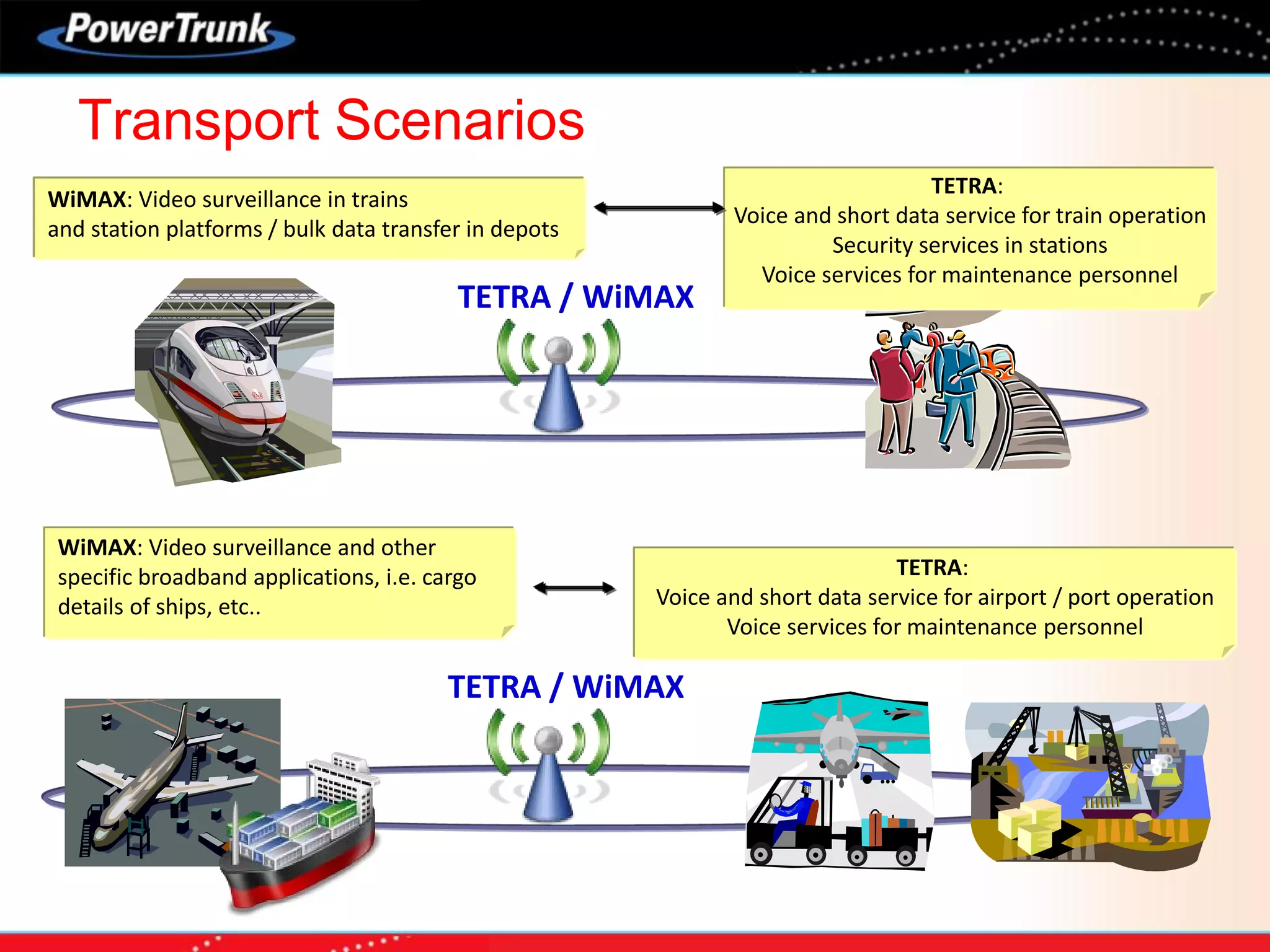
WiMAX: Video surveillance in trains
and station platforms / bulk data transfer in depots
Transport Scenarios
TETRA / WiMAX
TETRA:
Voice and short data service for train operation
Security services in stations
Voice services for maintenance personnel
TETRA / WiMAX
WiMAX: Video surveillance and other
specific broadband applications, i.e. cargo
details of ships, etc..
TETRA:
Voice and short data service for airport / port operation
Voice services for maintenance personnel
TETRA for Utilities
1. Specific data transmission requirements for:
 Permanent monitoring and control of the network elements
(Telemetry and Remote control)
 Data bandwith and reliability transmission. High availability.
 Integration with SCADA applications
2. Growth capacity:
 To solve saturation problems and overcome limited growth
capability of current communication networks.
3. Energy savings:
 Obtain detailed information about subscriber consumption to allow
customized tariffs and to avoid peaks of consumption during most
critical time slots (Smart Grid concept).
 Goal: Cost reduction.
 Goal: To support and improve the level of service to the users.
To reduce CAIDI index.
TETRA for Utilities
1. Private Network
 Total network control without depending on operators.
2. Digital trunking system (cellular)
 Robust communication. Several options for network coverage redundancy 
If a repeater fails, modems roam and the monitoring system is not interrupted.
 High spectral efficiency  Cost savings.
3. Avoids radio collisions in the air
 TETRA technology solves directly this problem.
4. Network Growth capacity / Possibility of additional services (voice,
etc..)
5. Data services
 Availability of different data services to be adapted to communication needs:
 Short Data Messages (SDS) and status messages
 Standard Packet Data service (PD)
 Circuit Mode Data (CMD)
What does TETRA offer?
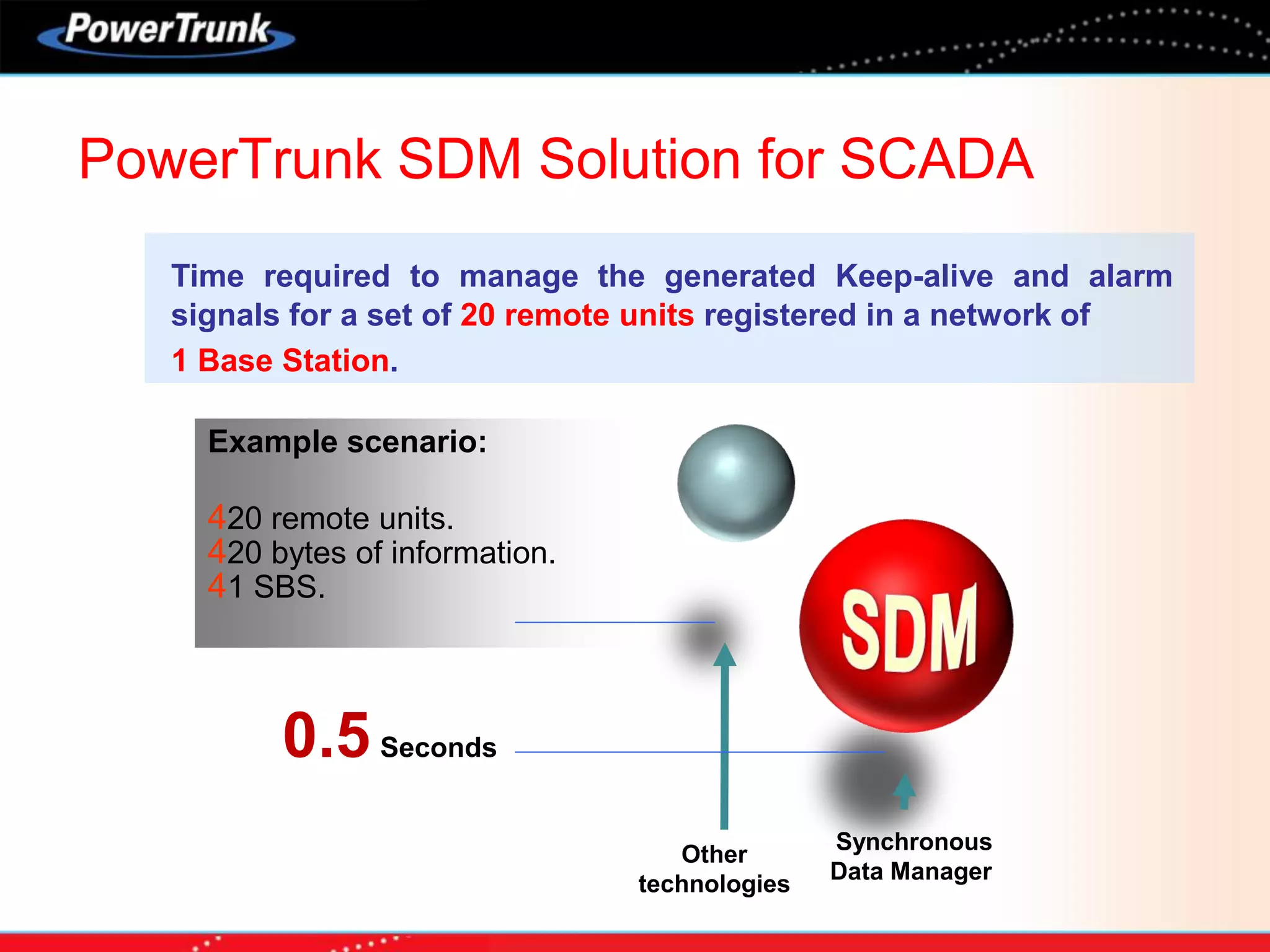
Time required to manage the generated Keep-alive and alarm
signals for a set of 20 remote units registered in a network of
1 Base Station.
300 Seconds
0.5 Seconds
Other
technologies
Synchronous
Data Manager
Example scenario:
420 remote units.
420 bytes of information.
41 SBS.
PowerTrunk SDM Solution for SCADA
Utilities: Smart Grid Scenario
TETRA / WiMAX
TETRA:
Short Data Services for telemetry
Security services
Voice services for maintenance personnel
AVL application for vehicles
WiMAX:
Video surveillance
Smart metering and bulk data transmission for
other specific applications
Integration
with SCADA
applications
Computer
Aided
Dispatchers
P25 for Public Safety
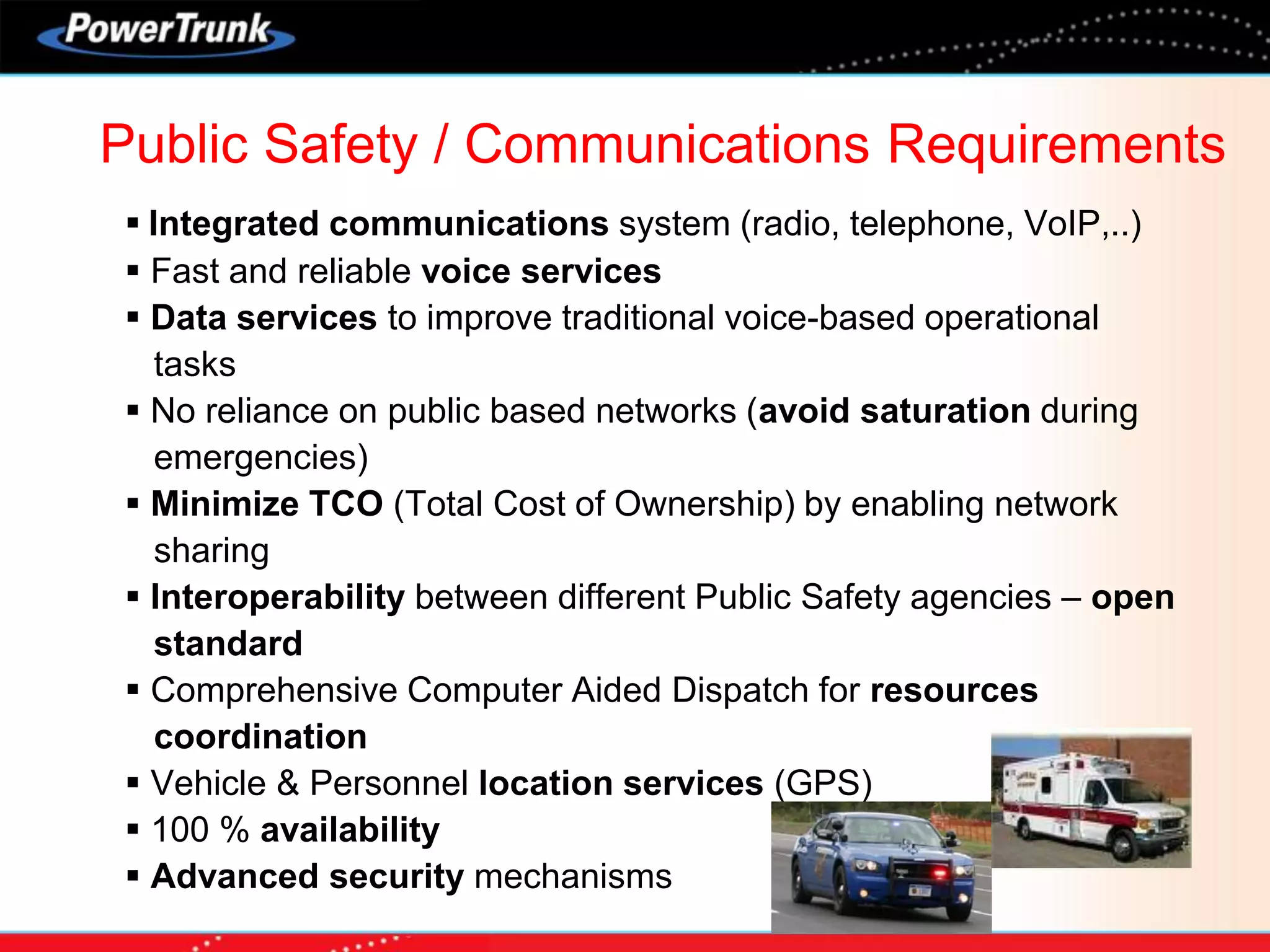
 Integrated communications system (radio, telephone, VoIP,..)
 Fast and reliable voice services
 Data services to improve traditional voice-based operational
tasks
 No reliance on public based networks (avoid saturation during
emergencies)
 Minimize TCO (Total Cost of Ownership) by enabling network
sharing
 Interoperability between different Public Safety agencies – open
standard
 Comprehensive Computer Aided Dispatch for resources
coordination
 Vehicle & Personnel location services (GPS)
 100 % availability
 Advanced security mechanisms
Public Safety / Communications Requirements
P25 Network Elements
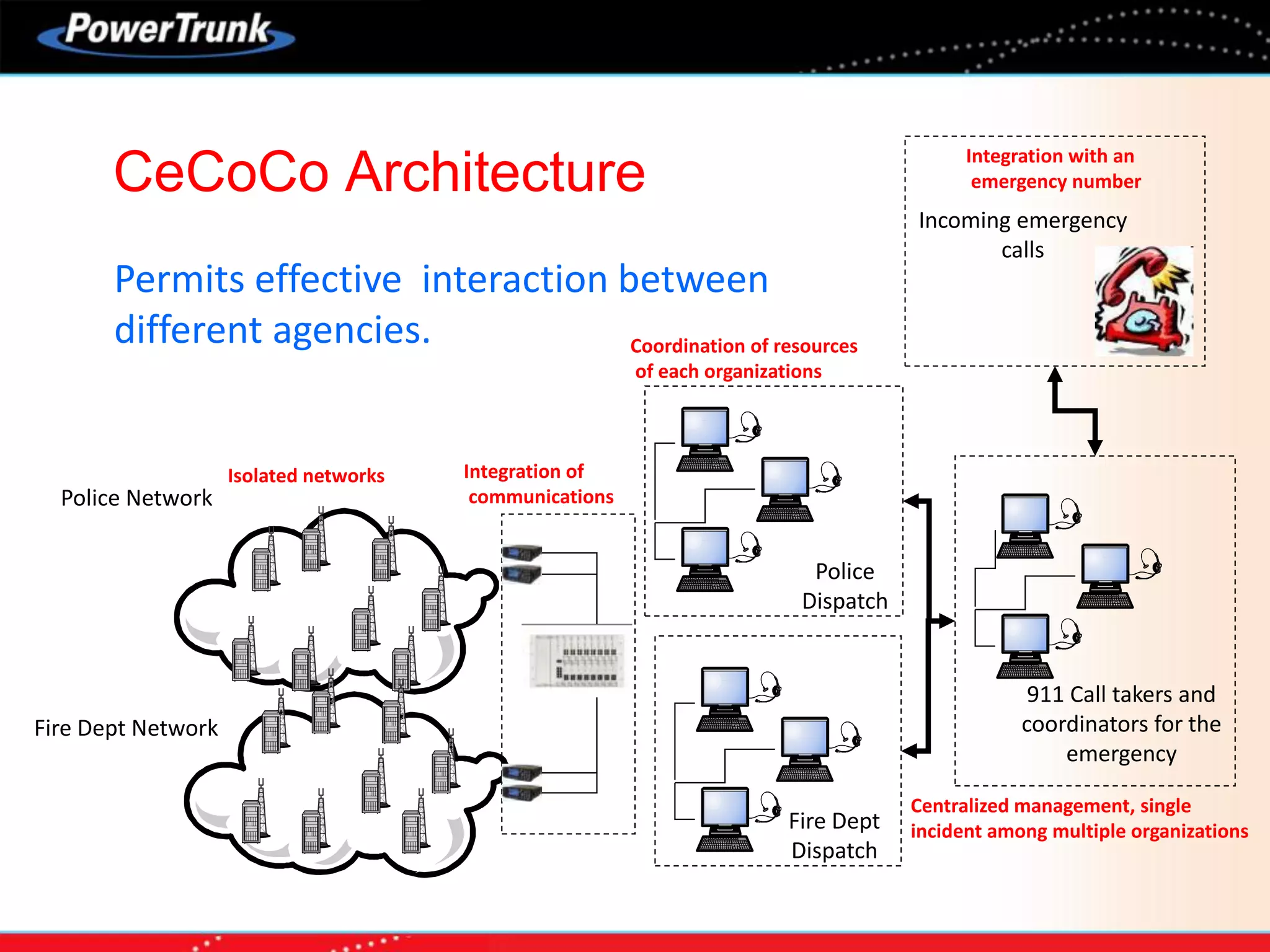
Permits effective interaction between
different agencies.
Police Network
Police
Dispatch
Fire Dept
Dispatch
Fire Dept Network
911 Call takers and
coordinators for the
emergency
Incoming emergency
calls
Isolated networks Integration of
communications
Coordination of resources
of each organizations
Centralized management, single
incident among multiple organizations
Integration with an
emergency numberCeCoCo Architecture
MVC-6000 Multi-Bearer Vehicular Console
Official building access:
Video surveillance
Public Safety Scenario
P25 / WiMAX
Integrated Computer
Aided Dispatchers
Traffic signal control:
Traffic lights, radars,
etc..
Traffic monitoring
Service assignment
Vehicle Location
Medical data
(photos, videos,
patient history,
remote diagnostics)
Service assignment (photos, video,
audio files, map location)
Vehicle Location, Navigation maps
Mobile office
Portal Web access
Incident video
Service assignment
Vehicle Location
Mobile office
Incident video
Building floor plans access
Main Customer References
Transport References
Spain
Alicante Light Train, FGV (ETRA, Vosslogh-
Bombardier
Palma de Mallorca Metro (Sampol, CAF)
Barcelona Metro Line 9 (Tradia)
Barcelona Buses (TMB)
Madrid Metro (CAF, Ansaldo)
Madrid Light Train T-2, T-3 (ETRA, ALSTOM)
Parla Light Train (ALSTOM)
Santa Cruz de Tenerife Light Train (Ikusi UTE,
ALSTOM)
Bilbao Airport
Mexico
Mexico D.F. Light Train (Alcatel, CAF)
Mexico D.F. Metro Line B (ALSTOM)
Mexico D.F. Metro Line 2 (ALSTOM)
Mexico D.F. Metro Line 12 (ALSTOM)
Germany
Nuremburg Metro (T-Systems)
KÖR Buses & Trams (T-Systems)
Brazil
Supervia, Rio de Janeiro Railway
Brazilia Tramway (ALSTOM)
Russia
Moscow – St. Petersburg Railway
Algeria
Algiers Underground (Siemens)
Constantine Tramway (EFACEC)
Oran Tramway
Chile
Santiago Metro (Siemens)
Transport References
Colombia
Emcali
Bogota Buses (Transmilenio)
Malaysia
Tanjung Pelepas Port (J&J – Comintel)
France / Switzerland
TETRA on-board systems for Marseille, Nice,
Grenoble, Bordeaux, Geneva, Lausanne,
and 10 other French / Swiss cities.
Public Safety References
Spain
Itelazpi, Basque Country
EXPO Zaragoza
Zaragoza City Local Police and Fire Brigades
Cordoba City Local Police
Canary Islands Regional Government
Ceuta Regional Government
Alcala de Guadaira City Local Police
Telefonica Security Engineering (Guadarrama
Tunnel)
Brazil
Bahia State Public Safety Secretariat (SSP)
Rio de Janeiro Public Safety Secretariat
(SSP) (Pan-American Games)
South Korea
Incheon Metropolitan Police Agency (KDN)
Mexico
Federal District Public Safety Secretariat
(Milpa Alta)
City of Puebla
Argentia
Neuquen Regional Government (Damovo)
Colombia
Cali Government & Public Safety
Gas & Oil:
Repsol YPF (Intepla/Intema), Argentina
Sports Stadiums:
Real Madrid Football Club, Spain
Operators:
Lig Mobile, Brazil
Airwaves, Auckland city TETRA
operator, New Zealand
Telefónica Móviles España, Spain
Mining:
Iron and Steel Company, CST Arcelor
Mittal Tubarao, Brazil
Rio Tinto, Australia
Others:
Música Funcional (sistema PAMR), Andorra
Telecomunicación Sistematizada, Mexico
Torre Picasso (Telvent), Spain
Degussa (T-Systems), Germany
Chemiepark Bitterfeld, Germany
KVB Köln (T-Systems), Germany
Bayerische Rieswasser (T-Systems),
Germany
Tetra Iceland (Niros), Iceland
Information Industry Company, Russia
Utilities:
COELCE, Brazil
Federal Comission of Electricity -CFE-, Mexico
Guadiana Hydrographic Authority (Adasa),
Spain
Other References
Summary / Conclusions
Pros and Cons of TETRA vs. P25
 TETRA
o What is TETRA?
 P25: Phase I / Phase II
 Comparison
o Similarities and differences
Benefits of a Multi-technology Platform
 Common Architecture for TETRA, P25, and WiMax
 Benefits / Applications by Sector
o For Transport
o For Utilities
o For PSS
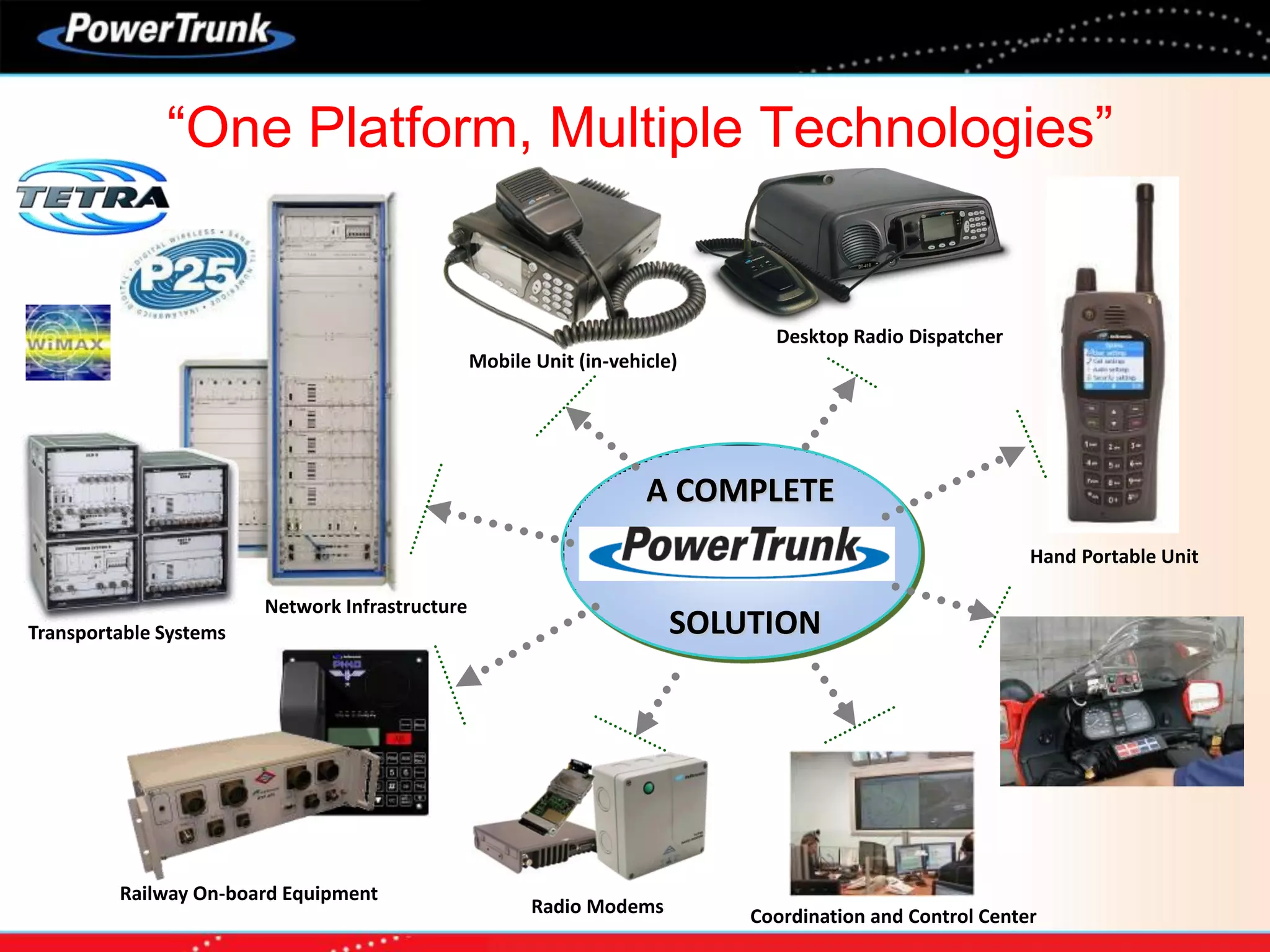
Network Infrastructure
Desktop Radio Dispatcher
Mobile Unit (in-vehicle)
Mobile Unit (Motorbike)
Hand Portable Unit
Transportable Systems
Coordination and Control Center
A COMPLETE
SOLUTION
Railway On-board Equipment
Radio Modems
“One Platform, Multiple Technologies”
Thank you for
your attention

Pros and cons_of_p25_vs_tetra

  • 1.
    Pros and Consof TETRA vs. P25 and the Benefits of a Multi-technology Platform for TETRA, P25 Phase I / Phase II, and Mobile WiMax Keith Ammons Vice President, Product Marketing
  • 2.
    Pros and Consof TETRA vs. P25  TETRA o What is TETRA?  P25 o P25 Phase I / Phase II  Comparison o Similarities and differences
  • 3.
    TETRA (Terrestrial TrunkedRadio) is an open standard for digital mobile radio communication defined by ETSI (European Telecommunications Standards Institute). Originally conceived and developed for use by European Union government and public safety agencies. Later adopted as the worldwide “de facto” standard, except North America, for digital radio communications systems. Provides a high-end solution for small private systems up to large public networks, while preserving characteristics and advantages of private land mobile radio systems, such as fast call set-up, group calls, and direct mode communication (talkaround). What is TETRA?
  • 4.
    AI - AirInterface (Trunked Mode) DMO - Direct Mode Operation ISI - Inter-System Interface LS - Line Station (dispatcher) LSC - Local Switching Controller MMI - Man Machine Interface MS - Mobile Station NMS - Network Management System PEI - Peripheral Equipment Interface SBS - Site Base Station SCN - Switching Control Node SwMI - Switching and Management Infrastructure TE - Terminal Equipment REMOTE DISPATCHER ISI SwMI SBS SBS SBS TETRA Network TETRA Network non-TETRA Network LSC AI AI MS DMOPEI MMI GATEWAY Link MS TE SCN LS TETRA Standard Elements and Interfaces
  • 5.
     Each RFcarrier (radio channel) is divided into timeslots within a 25 KHz channel.  The transmission rate is 7.2 Kbps per slot. 36 Kbps 28.8 Kbps7.2 Kbps TETRA General Concepts TDMA (Time Division Multiple Access)
  • 6.
    MCCH TCH PDCHPDCH TCH TCH TCH TCH T1 T2 T3 T4 T1 T2 T3 T4 Carrier 1 (main) Carrier 2 MCCH TCH TCHPDCH T1 T2 T3 T4 T1 T2 T3 T4 Carrier 1 (main) Carrier 2 SCCHSCCHSCCH SBS 1 SBS 3 MCCH TCHPDCH T1 T2 T3 T4 Carrier 1 SBS 2 SCCH PDCH Example of channel distribution TETRA General Concepts
  • 7.
     High Qualityand High Security in communications.  Double spectral efficiency.  Higher data bandwidths (up to 28.8 kbps)  Multiple real-time data services (status, short data, circuit mode data, packet mode data).  Half-duplex and full-duplex communications.  Interoperable with other networks (TETRA, ISDN, IP, GSM).  Continuous coverage.  Emergency calls.  Fast call setup.  Simultaneous voice and data.  Open standard technology: protects investment. Total 2258 contracts across 105 countries Data provided by the TETRA Association Members. (October 2008 – latest data available ) TETRA Highlights
  • 8.
     Project 25(P25) is a set of standards produced through the joint efforts of the Association of Public Safety Communications Officials International (APCO), the National Association of State Telecommunications Directors (NASTD), selected Federal Agencies and the National Communications System (NCS), and standardized under the Telecommunications Industry Association (TIA).  P25 is an open architecture, user-driven suite of system standards that define digital radio communications system architectures capable of serving the needs of Public Safety and Government organizations.  The P25 standard exists in the public domain, allowing any manufacturer to produce a P25 compatible radio product. P25: Background
  • 9.
     P25 isdefined for two different working modes: o Conventional: provides a simple infrastructure system that normally repeat radio calls from one frequency to another. o Trunked: a controller inside the infrastructure provides intelligence to manage call set up, subscribers roaming across the system, channel assignment,…  Additionally, P25 conventional and trunked systems can be deployed in three different ways according to frequency usage: o Multicast: All adjacent repeater sites use different frequencies o Voting system: All adjacent repeater sites use different transmitting frequencies but the same reception frequency o Simulcast: All repeater sites use same Tx/Rx freqs. P25: Background
  • 11.
     FDMA (FrequencyDivision Multiple Access)  12.5 KHz channels  C4FM (Constant-envelope 4-level FM)  Subscribers are backward compatible with analog radios regardless of the infrastructure. Repeaters can work in analog (not mandatory), digital or mixed mode. P25 Phase I
  • 12.
     Phase II:Will be a 6.25 KHz equivalent system, meaning that 1 voice communication will fit within 6.25 KHz of channel bandwidth. For the above, P25 Phase II will use a 2-timeslot TDMA structure in 12.5 KHz channels.  Control channels will support FDMA for backward compatibility with Phase I. P25 Phase II
  • 13.
    TETRA / P25Comparison Useful TETRA <-> P25 associations:  NAC code in P25 is equivalent to MCC and MNC of TETRA  TGID (Talk group ID) is equal to GSSI of TETRA  UID (Unit ID) is equivalent to ISSI of TETRA  ISSI (Inter Sub-System Interface) is equivalent to ISI of TETRA  OTAR in P25 is the same as OTAK in TETRA as it is used for E2EE (OTAR in TETRA is used for Air Interface Encryption)  Pre-programmed messages in P25 is the same as Status messages in TETRA.  ESN (Electronic Serial Number) is equal to TETRA’s TEI
  • 14.
    TETRA Pros andCons  Pros: o Optimized for high population density areas o Spectral efficiency (4 time slots in 25 KHz) o Data bandwidth on demand (up to 28.8 kbps) o RX diversity o Supports full duplex voice o Short data / status messaging o Packet data / circuit mode data  Cons: o Not presently available in VHF band o No simulcast
  • 15.
    P25 Pros andCons  Pros: o Optimized for wider area coverage with low population density o Greater range than TETRA in Phase I (FDMA), but nearly same in Phase II (TDMA) o Support for simulcast  Cons: o Limited data support o Delays in Phase II standard (projected 2011)
  • 16.
    TETRA / P25Comparison  Both technologies are valid solutions for modern professional-use digital radio communications systems OFFERS BOTH SOLUTIONS !
  • 17.
    Benefits of aMulti-technology Platform for TETRA, P25 Phase I / Phase II, and Mobile WiMax  Common Architecture o Support for TETRA, P25, and WiMax protocols o Interconnectivity o Common Computer Aided Dispatch (CAD) application  Benefits / Applications by Sector o For Transport o For Utilities o For PSS
  • 18.
    Complete Ethernet /IP Architecture Easy & FriendlyFlexible a) Distributed switching b) Distributed intelligence c) No need for GPS or external synchronization
  • 19.
     Field-proven end-to-endIP design.  Same network control and management structure for TETRA, P25, and Mobile WiMax.  Optimized voice packets reduce delays and lower link bandwidth requirements.  Designed for interoperability.  Easy scalability from single site to state-wide networks. Common Architecture
  • 20.
    Common Hardware Dispatching ConsoleNMSClient Master Site ControllerRF Base Station/Repeater Local Site Controller (LSC) NMS server
  • 21.
     The PowerTrunkRF Unit (RFU) / Base Station Repeater (BSR) is modular and easy to maintain and deploy. o Each module is plug-and-play containing different functional blocks and providing specific alarms to minimize in-the-field repair time. o Designed to be future-proof, it contains all necessary hardware to support FDMA structure for P25 Phase I, as well as TDMA structure for a P25 Phase II or TETRA system. o Software-only upgradeable to P25 Phase II. o Can work in P25 conventional and trunked mode. o Designed to tolerate high delays and jitter in the backbone links with the Master Sites (including for satellite links). PowerTrunk RF Unit / BSR
  • 22.
    TETRA BSR  Frequencybands: 350-370, 380-430, 450-470, 806-870 MHz  Channel spacing: 25KHz.  Time Division Multiple Access (TDMA): 4 timeslots per RF channel  Modulation: p/4-DQPSK  Digital Data Bit Rate: 28.8 Kbits/s.  Ethernet interface: IEEE 802.3u,x.  RF Unit is hot-swap capable.
  • 23.
     Frequency bands:VHF, 380-512 (*), 764-806, 806-870 MHz. (* consult for specific sub-bands)  Channel spacing: 6.25KHz, 12.5KHz or 25KHz.  Frequency Division Multiple Access (FDMA): 1 channel per RFU  Modulation: Digital C4FM.  Emissions Designator: 8K10F1W.  Digital Data Bit Rate: 9.6 Kbits/s.  Ethernet interface: IEEE 802.3u,x.  RF Unit is hot-swap capable. PowerTrunk25 RFU
  • 24.
    Mobile WiMax RFU Standard: 802.16e (Mobile WiMax)  Frequency bands: Initially for 700 MHz band.  Channel bandwidth: from 1.25 to 10 MHz  Digital Data Bit Rate: from 100 kbps up to 4 Mbps per user
  • 25.
     This isnot narrow or wide band, this is broadband: o Mean typical data rate: 1Mbps / user o Peak data rate: up to 4 Mbps / user o Data rate can be managed dynamically  Broadband provides the best capability to support the most demanding applications: o Video surveillance: remote monitoring for security and safety o Video recording and streaming on demand o Remote data base management o Mobile office: staff working at remote locations or on-board vehicles o Remote maintenance of terminals and systems o Web applications o Telemedicine, E-health o Biometrics, face recognition... o Automation and control o Smart metering Broadband Performance
  • 26.
    Vehicular PC Broadband +TETRA / P25 radio terminal VHF / UHF radio antenna Wireless broadband antenna Vehicular video cameras Audio interfaces MVC-6000: System Elements
  • 27.
    BRI - PRI [ISDN] SBS SynchronousLinks SBS SBS E1 Cross-Connect ISDN Network ISDN Connection ISDN Connection (dedicated BRI) PDH or SDH SYSTEM E1 / T1 Connection V.35 Connection E1 Drop-Insert SCN V.35 Link G.703/G.704 [E1 / T1] Synchronous Links: several types of links (V.35, E1 / T1, ISDN, …) Flexibility in the Backbone Network
  • 28.
    WiFi Connection SBS Standard Office LocalArea Network Ethernet switches SBS Optical Fiber Fiber Access Fiber Access Ethernet switch 70 Km LAYER2 SYSTEM ACCESS: : Ethernet connections : Wireless Connections : Optical Fiber Connections SCN SBS Asynchronous Links – Layer 2: LAN, WAN, Wi-Fi, WiMAX, … Flexibility in the Backbone Network
  • 29.
    L2TPv3 Router L2TPv3 Router L2TPv3 Router Layer 3 Services Layer3 & Layer 2 Services SCN SBS SBS Network Services Standard Routers Asynchronous Links – Layer 3: IP Networks, MPLS, L2TPv3, IRB, … Flexibility in the Backbone Network
  • 30.
    P25 ISSI  Inter-RFSub-System Interface  IP connection by VPN established between PowerTrunk and Motorola P25 systems to allow group call and emergency call communication by users of different networks.  EADS, Harris, Tait, Raytheon, and Etherstack also participated in the tests.  Demonstrates adherence to standards and capacity of interconnection to 3rd- party P25 networks.
  • 31.
    CeCoCo Series Computer AidedDispatch Solutions
  • 32.
     Includes modulesfor communication management, location, and incident management  Ethernet-based connection with the PowerTrunk range of TETRA and P25 infrastructure  Additional services: o Discreet Listening o Ambience Listening o Call inclusion / termination o Fleet monitoring o Priority calls o Emergency calls o Pre-emptive PTT o Call Patching CeCoCo
  • 33.
    TETRA & P25 RadioInterfaces Legacy Conventional System Legacy Trunked System CeCoCo SERVER PABX / PSTN (E1/T1, ISDN, VoIP, etc.) Analog Telephony PA system Recording SystemCall Taker / Dispatcher Workstation Call Taker / Dispatcher Workstation Line-Connected TETRA/P25/WiMax Infrastructure TCP / IP VoIP Connect® - Switching Matrix CeCoCo Architecture
  • 34.
    Metros / Subways Entornosferroviarios Trams Railroads TETRA for Transport Buses
  • 35.
     Voice communicationbetween drivers, control centers, depots, and passengers.  Location systems.  Data services for remote monitoring of sub- systems.  Railway signaling.  Safety and security.  Communication with maintenance crews.  Communication with emergency services (police, fire, etc...) Transport Communications Requirements
  • 36.
    Voice Communication Remote Command and Control of RollingStock Integration with Passenger Information System Integration with Public Address Systems Interaction with Intercom System Communication Management Sub-system Telecommunications Sub-systems Covered by TETRA
  • 37.
    REMOTE CONTROL: - TrainOn / Off - Identification (Train number and service) - Emergency brakes - Brake bypass / Traction loop - Fire estinguishing system - Open / close doors - Control of lighting, air conditioning, etc. - TCMS configuration/ Driving mode - Talkgroup selection (by DGNA, according to train location) - Information panels - Pneumatic suspension - Etc... ALARMS: - Fire detection - Emergency alarms - Emergency brake - Passenger SOS button - End of line - End of service - “Dead man” alarm - Train location - Intercom failure alarm - P.A. system failure alarm - Change of driving mode - Battery voltage - Etc... Examples of Remote Controls and Alarms
  • 38.
    Buses & Trams– Optimizing AVL  Automatic regulation – Efficiency mostly depends on the refresh period which can be achieved  Old analog systems – Control of radio channels (PTT-CD signals) by AVL Applications  TETRA = TDMA. How to overcome the gap between the AVL Application and TETRA transport layers?
  • 39.
    Based on:  BasicTETRA Short Data Service (SDS) for polling and transmitting GPS position in LIP format. Speed of position polling / reply:  The fastest rate is 1 position every 0.6 seconds. Advantage:  Supported by the majority of TETRA terminals in the market. Disadvantages:  Care must be taken to poll terminals one by one, otherwise degraded audio quality could result due to use of the TETRA stealing mechanism.  Not appropriate for large networks. Basic SDS Solution
  • 40.
    SDM (Synchronous DataManager) is based on:  Use of the SDS (LIP) service with reservation of air resources, permitting reception of GPS positions at the base station while avoiding collisions (synchronization concept).  Special software in the infrastructure and the terminals. Speed of polling / reply:  The fastest rate is 5 positions per second for each CCH (control channel) of the system, whether MCCH or SCCH. Advantages:  Acts in parallel for all zones simultaneously.  Eliminates collisions in the uplink (synchronous).  Efficiency increases with the number of zones.  In traffic, GPS positions are sent between PTT change PowerTrunk SDM Solution for AVL
  • 42.
    WiMAX: Video surveillancein trains and station platforms / bulk data transfer in depots Transport Scenarios TETRA / WiMAX TETRA: Voice and short data service for train operation Security services in stations Voice services for maintenance personnel TETRA / WiMAX WiMAX: Video surveillance and other specific broadband applications, i.e. cargo details of ships, etc.. TETRA: Voice and short data service for airport / port operation Voice services for maintenance personnel
  • 43.
  • 44.
    1. Specific datatransmission requirements for:  Permanent monitoring and control of the network elements (Telemetry and Remote control)  Data bandwith and reliability transmission. High availability.  Integration with SCADA applications 2. Growth capacity:  To solve saturation problems and overcome limited growth capability of current communication networks. 3. Energy savings:  Obtain detailed information about subscriber consumption to allow customized tariffs and to avoid peaks of consumption during most critical time slots (Smart Grid concept).  Goal: Cost reduction.  Goal: To support and improve the level of service to the users. To reduce CAIDI index. TETRA for Utilities
  • 45.
    1. Private Network Total network control without depending on operators. 2. Digital trunking system (cellular)  Robust communication. Several options for network coverage redundancy  If a repeater fails, modems roam and the monitoring system is not interrupted.  High spectral efficiency  Cost savings. 3. Avoids radio collisions in the air  TETRA technology solves directly this problem. 4. Network Growth capacity / Possibility of additional services (voice, etc..) 5. Data services  Availability of different data services to be adapted to communication needs:  Short Data Messages (SDS) and status messages  Standard Packet Data service (PD)  Circuit Mode Data (CMD) What does TETRA offer?
  • 46.
    Time required tomanage the generated Keep-alive and alarm signals for a set of 20 remote units registered in a network of 1 Base Station. 300 Seconds 0.5 Seconds Other technologies Synchronous Data Manager Example scenario: 420 remote units. 420 bytes of information. 41 SBS. PowerTrunk SDM Solution for SCADA
  • 47.
    Utilities: Smart GridScenario TETRA / WiMAX TETRA: Short Data Services for telemetry Security services Voice services for maintenance personnel AVL application for vehicles WiMAX: Video surveillance Smart metering and bulk data transmission for other specific applications Integration with SCADA applications Computer Aided Dispatchers
  • 48.
  • 49.
     Integrated communicationssystem (radio, telephone, VoIP,..)  Fast and reliable voice services  Data services to improve traditional voice-based operational tasks  No reliance on public based networks (avoid saturation during emergencies)  Minimize TCO (Total Cost of Ownership) by enabling network sharing  Interoperability between different Public Safety agencies – open standard  Comprehensive Computer Aided Dispatch for resources coordination  Vehicle & Personnel location services (GPS)  100 % availability  Advanced security mechanisms Public Safety / Communications Requirements
  • 50.
  • 51.
    Permits effective interactionbetween different agencies. Police Network Police Dispatch Fire Dept Dispatch Fire Dept Network 911 Call takers and coordinators for the emergency Incoming emergency calls Isolated networks Integration of communications Coordination of resources of each organizations Centralized management, single incident among multiple organizations Integration with an emergency numberCeCoCo Architecture
  • 52.
  • 53.
    Official building access: Videosurveillance Public Safety Scenario P25 / WiMAX Integrated Computer Aided Dispatchers Traffic signal control: Traffic lights, radars, etc.. Traffic monitoring Service assignment Vehicle Location Medical data (photos, videos, patient history, remote diagnostics) Service assignment (photos, video, audio files, map location) Vehicle Location, Navigation maps Mobile office Portal Web access Incident video Service assignment Vehicle Location Mobile office Incident video Building floor plans access
  • 54.
  • 55.
    Transport References Spain Alicante LightTrain, FGV (ETRA, Vosslogh- Bombardier Palma de Mallorca Metro (Sampol, CAF) Barcelona Metro Line 9 (Tradia) Barcelona Buses (TMB) Madrid Metro (CAF, Ansaldo) Madrid Light Train T-2, T-3 (ETRA, ALSTOM) Parla Light Train (ALSTOM) Santa Cruz de Tenerife Light Train (Ikusi UTE, ALSTOM) Bilbao Airport Mexico Mexico D.F. Light Train (Alcatel, CAF) Mexico D.F. Metro Line B (ALSTOM) Mexico D.F. Metro Line 2 (ALSTOM) Mexico D.F. Metro Line 12 (ALSTOM) Germany Nuremburg Metro (T-Systems) KÖR Buses & Trams (T-Systems) Brazil Supervia, Rio de Janeiro Railway Brazilia Tramway (ALSTOM) Russia Moscow – St. Petersburg Railway Algeria Algiers Underground (Siemens) Constantine Tramway (EFACEC) Oran Tramway Chile Santiago Metro (Siemens)
  • 56.
    Transport References Colombia Emcali Bogota Buses(Transmilenio) Malaysia Tanjung Pelepas Port (J&J – Comintel) France / Switzerland TETRA on-board systems for Marseille, Nice, Grenoble, Bordeaux, Geneva, Lausanne, and 10 other French / Swiss cities.
  • 57.
    Public Safety References Spain Itelazpi,Basque Country EXPO Zaragoza Zaragoza City Local Police and Fire Brigades Cordoba City Local Police Canary Islands Regional Government Ceuta Regional Government Alcala de Guadaira City Local Police Telefonica Security Engineering (Guadarrama Tunnel) Brazil Bahia State Public Safety Secretariat (SSP) Rio de Janeiro Public Safety Secretariat (SSP) (Pan-American Games) South Korea Incheon Metropolitan Police Agency (KDN) Mexico Federal District Public Safety Secretariat (Milpa Alta) City of Puebla Argentia Neuquen Regional Government (Damovo) Colombia Cali Government & Public Safety
  • 58.
    Gas & Oil: RepsolYPF (Intepla/Intema), Argentina Sports Stadiums: Real Madrid Football Club, Spain Operators: Lig Mobile, Brazil Airwaves, Auckland city TETRA operator, New Zealand Telefónica Móviles España, Spain Mining: Iron and Steel Company, CST Arcelor Mittal Tubarao, Brazil Rio Tinto, Australia Others: Música Funcional (sistema PAMR), Andorra Telecomunicación Sistematizada, Mexico Torre Picasso (Telvent), Spain Degussa (T-Systems), Germany Chemiepark Bitterfeld, Germany KVB Köln (T-Systems), Germany Bayerische Rieswasser (T-Systems), Germany Tetra Iceland (Niros), Iceland Information Industry Company, Russia Utilities: COELCE, Brazil Federal Comission of Electricity -CFE-, Mexico Guadiana Hydrographic Authority (Adasa), Spain Other References
  • 59.
  • 60.
    Pros and Consof TETRA vs. P25  TETRA o What is TETRA?  P25: Phase I / Phase II  Comparison o Similarities and differences Benefits of a Multi-technology Platform  Common Architecture for TETRA, P25, and WiMax  Benefits / Applications by Sector o For Transport o For Utilities o For PSS
  • 61.
    Network Infrastructure Desktop RadioDispatcher Mobile Unit (in-vehicle) Mobile Unit (Motorbike) Hand Portable Unit Transportable Systems Coordination and Control Center A COMPLETE SOLUTION Railway On-board Equipment Radio Modems “One Platform, Multiple Technologies”
  • 62.