Chapter 34 Solutions

34.1         Since the light from this star travels at 3.00 × 10⁸ m/s, the last bit of light will hit the Earth i n
               6.44 × 10¹⁸ m
                              = 2.15 × 10¹⁰ s = 680 years. Therefore, it will disappear from the sky in the year
             3.00 × 10⁸ m / s
             1999 + 680 = 2.68 × 10 3 A.D.


                    1         1
34.2         v=            =      c = 0.750c = 2.25 × 10⁸ m/s
                   kµ 0 e0   1.78


             E                              220
                                             B = 3.00 × 10 ;
34.3         B =c           or                            8
                                                                          so           B = 7.33 × 10⁻⁷ T = 733 nT


             Emax
34.4         Bmax = v is the generalized version of Equation 34.13.

                      Emax      7.60 × 10 −3 V / m  N ⋅ m   T ⋅ C ⋅ m 
             Bmax =        =                                               = 3.80 × 10⁻¹¹ T = 38.0 pT
                       v     (2 / 3)(3.00 × 10⁸ m / s)  V ⋅ C   N ⋅ s 


34.5   (a)   fλ = c         or              f (50.0 m) = 3.00 × 10⁸ m/s         so       f = 6.00 × 10⁶ Hz = 6.00 MHz

             E                              22.0
                                            Bmax = 3.00 × 10
                                                             8
       (b)
             B =c
                            or                                                  so       Bmax = (73.3 nT)(–k)

                2π    2π
       (c)   k=    = 50.0 = 0.126 m–1                       and           ω = 2π f = 2π (6.00 × 10⁶ s–1) = 3.77 × 10⁷
                 λ
             rad/s

             B = Bmax cos(kx – ω t) = (73.3 nT) cos (0.126x – 3.77 × 10⁷ t)(–k)


34.6         ω = 2π f = 6.00π × 109 s–1 = 1.88 × 10¹⁰ s-1

                  2π  ω   6.00π × 109 s–1                                        E      300 V/m
             k=      =c =                 = 20.0π = 62.8 m–1              Bmax = c =                = 1.00 µT
                   λ      3.00 × 10⁸ m/s                                             3.00 × 10⁸ m/s

                 
              E = 300
                 
                      V
                      m
                                 (
                         cos 62.8x − 1.88 × 10¹⁰ t   )                    B = (1.00 µT) cos (62.8x – 1.88 × 10¹⁰ t)


                                     © 2000 by Harcourt, Inc. All rights reserved.
Chapter 34 Solutions 299


                    E      100 V/m
34.7     (a)   B=     =                 = 3.33 × 10⁻⁷ T = 0.333 µT
                    c   3.00 × 10 8 m/s

                  2π        2π
         (b)   λ= k =                   = 0.628 µm
                      1.00 × 10 7 m – 1

                    c       3.00 × 10⁸ m/s
         (c)   f=       =                  = 4.77 × 10¹⁴ Hz
                    λ       6.28 × 10⁻⁷ m


34.8           E = Emax cos(kx – ω t)

               ∂E                                         ∂E
                  = –Emax sin(kx – ω t)(k)                   = –Emax sin(kx – ω t)(–ω)
               ∂x                                         ∂t
               ∂ 2E                                       ∂ 2E
                    = –Emax cos(kx – ω t)(k 2)                 = –Emax cos(kx – ω t)(–ω)2
               ∂x2                                        ∂t2
                                                              ∂E          ∂ 2E
               We must show:                                       = µ 0e0 2
                                                              ∂x 2
                                                                          ∂t
               That is,                                        ( )
                                                           − k 2 Emax cos( kx − ω t ) = − µ 0e0 ( −ω ) Emax cos( kx − ω t )
                                                                                                     2


                                                                         2
                                                              k2  1       1
               But this is true, because                          =   = 2 = µ 0 e0
                                                              ω 2
                                                                     fλ  c
               The proof for the wave of magnetic field is precisely similar.


*34.9          In the fundamental mode, there is a single loop in the standing wave between the plates.
               Therefore, the distance between the plates is equal to half a wavelength.

               λ = 2L = 2(2.00 m) = 4.00 m

                              c   3.00 × 10⁸ m/s
               Thus, f =        =                = 7.50 × 10 7 Hz = 75.0 MHz
                              λ       4.00 m


                                          λ
*34.10         dA to A = 6 cm ± 5% =
                                          2

               λ = 12 cm ± 5%


                                      © 2000 by Harcourt, Inc. All rights reserved.
300 Chapter 34 Solutions


                                     (              )
           v = λ f = (0.12 m ± 5%) 2.45 × 10 9 s −1 =      2.9 × 10⁸ m s ± 5%

                   U     Uc
           S=I=
                   A t = V = uc
34.11


             Energy       I   1000 W/m2
                       =u= =                = 3.33 µ J/m3
           Unit Volume    c  3.00 × 10⁸ m/s


                    P          4.00 × 10 3 W
34.12      Sav =          =                     = 7.68 µW/m 2
                   4π r 2   4π (4.00 × 1609 m)2

           Emax = 2µ 0 cSav = 0.0761 V / m

           ∆Vmax = Emax · L = (76.1 mV/m)(0.650 m) = 49.5 mV (amplitude)        or   35.0 mV (rms)


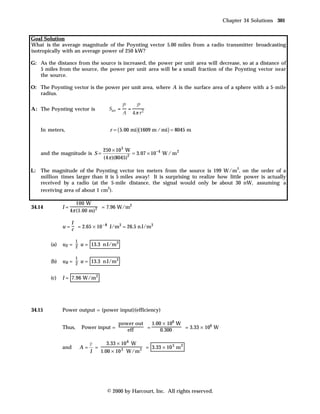
34.13      r = ( 5.00 mi )(1609 m / mi ) = 8.04 × 10 3 m

                 P          250 × 10 3 W
           S=          =                      = 307 µW/m 2
                4π r 2   4π (8.04 × 10 3 m) 2
Chapter 34 Solutions 301


Goal Solution
What is the average magnitude of the Poynting vector 5.00 miles from a radio transmitter broadcasting
isotropically with an average power of 250 kW?

G: As the distance from the source is increased, the power per unit area will decrease, so at a distance of
   5 miles from the source, the power per unit area will be a small fraction of the Poynting vector near
   the source.

O: The Poynting vector is the power per unit area, where A is the surface area of a sphere with a 5-mile
   radius.

A : The Poynting vector is


    In meters,                        r = ( 5.00 mi )(1609 m / mi ) = 8045 m


                                   250 × 10 3 W
    and the magnitude is S =                     = 3.07 × 10 −4 W / m 2
                                   (4 π )(8045)2

                                                                                          2
L : The magnitude of the Poynting vector ten meters from the source is 199 W/m , on the order of a
    million times larger than it is 5 miles away! It is surprising to realize how little power is actually
    received by a radio (at the 5-mile distance, the signal would only be about 30 nW, assuming a
                                2
    receiving area of about 1 cm ).

                      100 W
34.14         I=                = 7.96 W/m2
                   4π (1.00 m)2

                  I
              u = c = 2.65 × 10 – 8 J/m3 = 26.5 n J/m3

                     1
        (a)   uE = 2 u = 13.3 n J/m3

                     1
        (b)   uB = 2 u = 13.3 n J/m3


        (c)   I = 7.96 W/m2


34.15         Power output = (power input)(efficiency)

                                          power out   1.00 × 10⁶ W
              Thus,      Power input =              =              = 3.33 × 10⁶ W
                                             eff          0.300

                              P      3.33 × 10 6 W
              and        A=     =                   = 3.33 × 10 3 m 2
                              I   1.00 × 10 3 W/m 2


                                     © 2000 by Harcourt, Inc. All rights reserved.
302 Chapter 34 Solutions


                     2
                    Bmax c    P
*34.16         I=          =
                     2µ 0    4π r 2

                         P   2µ 0         (10.0 × 10 )(2)(4π × 10 ) =
                                                       3             −7
               Bmax =    4π r 2   c  =                                     5.16 × 10⁻¹⁰ T
                                           4 π ( 5.00 × 10 ) ( 3.00 × 10 )
                                                           3 2            8


               Since the magnetic field of the Earth is approximately 5 × 10 –5 T, the Earth's field is some
               100,000 times stronger.


34.17    (a)   P = I 2R = 150 W; A = 2π rL = 2π (0.900 × 10⁻³ m)(0.0800 m) = 4.52 × 10 –4 m2
                    P
               S=     = 332 kW/m2 (points radially inward)
                    A
                        I         µ0(1.00)
         (b)   B = µ 0 2π r =                    = 222 µT
                              2π (0.900 × 10 –3)

                    ∆V   IR    150 V
               E=      = L = 0.0800 m = 1.88 kV/m
                    ∆x
                         EB
               Note: S = µ = 332 kW/m2
                          0
Chapter 34 Solutions 303


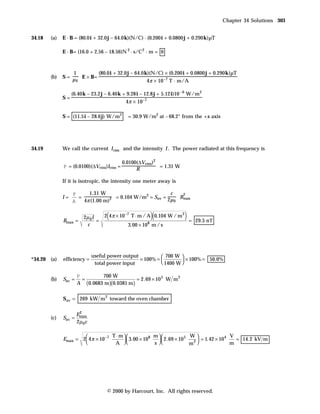
34.18   (a)   E · B = (80.0 i + 32.0 j – 64.0 k)(N/C) · (0.200 i + 0.0800 j + 0.290 k)µT

              E · B= (16.0 + 2.56 – 18.56)N 2 · s/C 2 · m = 0


                   1          (80.0 i + 32.0 j – 64.0 k)(N/C) × (0.200 i + 0.0800 j + 0.290 k)µT
                   µ 0 E × B=
        (b)   S=
                                                       4π × 10 –7 T · m/A

                   (6.40 k – 23.2 j – 6.40 k + 9.28 i – 12.8 j + 5.12 i)10 – 6 W/m 2
              S=
                                              4π × 10–7

              S = (11.5 i – 28.6 j) W/m 2      = 30.9 W/m2 at – 68.2° from the +x axis


34.19         We call the current I rms and the intensity I . The power radiated at this frequency is

                                             0.0100(∆Vrms)2
              P = (0.0100)(∆Vrms)Irms =                     = 1.31 W
                                                   R

              If it is isotropic, the intensity one meter away is

                   P     1.31 W                           c   2
              I=     =              = 0.104 W/m2 = Sav = 2µ Bmax
                   A   4π (1.00 m)2                         0


              Bmax =
                          2µ 0 I
                                 =
                                      (                      )(
                                     2 4 π × 10 −7 T ⋅ m / A 0.104 W / m 2   )=   29.5 nΤ
                           c                   3.00 × 10 m / s
                                                         8


                               useful power output           700 W 
*34.20 (a)    efficiency =                         × 100% =            × 100% = 50.0%
                                total power input            1400 W 

                      P        700 W
        (b)   Sav =     =                      = 2.69 × 10 5 W m 2
                      A (0.0683 m )(0.0381 m )

              Sav = 269 kW m 2 toward the oven chamber

                       2
                      Emax
        (c)   Sav =
                      2µ 0 c

                                  T ⋅ m            m              W                 V
              Emax = 2 4 π × 10 −7         3.00 × 10⁸      2.69 × 10 5      = 1.42 × 10 4   = 14.2 kV m
                                   A               s              m 2
                                                                                          m


                                      © 2000 by Harcourt, Inc. All rights reserved.
304 Chapter 34 Solutions


                         Emax   7.00 × 10⁵ N/C
34.21   (a)   Bmax =          =                = 2.33 mT
                          c     3.00 × 10⁸ m/s
                    2
                  Emax        (7.00 × 10 5)2
        (b)   I = 2µ c =                            = 650 MW/m 2
                    0    2(4π × 10 –7 )(3.00 × 10⁸)

                   P                               π
        (c)   I=     : P = I A = (6.50 × 10⁸ W/m2) 4 (1.00 × 10 – 3 m) 2 = 510 W
                   A


                                     2
                                    Emax                                       Pµ 0 c         (100 W)µ 0 c
34.22         Power = SA =                 (4 π r 2 ); solving for r ,   r=            =                     = 5.16 m
                                    2µ 0 c                                    Emax 2 π
                                                                               2
                                                                                           2 π (15.0 V / m)2


                      (10.0 × 10 − 3 )W
34.23   (a)   I=                         = 4.97 kW/m2
                   π (0.800 × 10 − 3 m)2

                        I 4.97 × 10 3 J / m 2 ⋅ s
        (b)   uav =       =                       = 16.6 µ J/m3
                        c   3.00 × 10⁸ m / s


34.24   (a)   E = cB = ( 3.00 × 10 8 m/s)(1.80 × 10 − 6 T) = 540 V/m

                        B2 (1.80 × 10 − 6 )2
        (b)   uav =        =                 = 2.58 µ J/m3
                        µ0   4 π × 10 − 7

        (c)   Sav = cuav = (3.00 × 10⁸ )(2.58 × 10 − 6 ) = 773 W/m2

        (d) This is 77.3% of the flux in Example 34.5 . It may be cloudy, or the Sun may be setting.


                                           S      25.0
34.25         For complete absorption, P = c =            = 83.3 nPa
                                               3.00 × 10⁸


*34.26 (a)                      (                 )(                 )
              P = (Sav )( A) = 6.00 W / m 2 40.0 × 10 −4 m 2 = 2.40 × 10 −2 J / s

              In one second, the total energy U impinging on the mirror is 2.40 × 10⁻² J. The momentum p
              transferred each second for total reflection is

                 2U  2(2.40 × 10⁻² J)                 kg · m
              p= c =                  = 1.60 × 10 –10        (each second)
                     3.00 × 10 m/s
                              8                         s

                  dp   1.60 × 10⁻¹⁰ kg · m/s
        (b)   F = dt =                       = 1.60 × 10⁻¹⁰ N
                                1s
Chapter 34 Solutions 305


                                                      (2)(1340 W / m 2 )
34.27   (a)   The radiation pressure is                                  = 8.93 × 10 −6 N / m 2
                                                      3.00 × 10⁸ m / s 2

              Multiplying by the total area,          A = 6.00 × 10⁵ m2 gives: F = 5.36 N

                                                          F   5.36 N
        (b)   The acceleration is:                    a = m = 6000 kg = 8.93 × 10– 4 m/s2

                                                           1
        (c)   It will take a time t where:            d = 2 at 2


                                                      t=
                                                           2d
                                                              =
                                                                      (
                                                                     2 3.84 × 10⁸ m    )           = 9.27 × 10 5 s = 10.7 days
                                                                   (8.93 × 10                  )
              or                                                                −4         2
                                                            a                        m/s


                                                                                                   2Sav
34.28         The pressure P upon the mirror is                                        P=
                                                                                                    c

                                                                                                    P
              where A is the cross-sectional area of the beam and                      Sav =
                                                                                                    A

                                                                                                           2P     2P
              The force on the mirror is then                                          F = PA =               A =
                                                                                                           c  A    c

                                                                                                   2(100 × 10 −3 )
              Therefore,                                                               F=                          = 6.67 × 10⁻¹⁰ N
                                                                                                     (3 × 10⁸ )


                    P    E2
34.29         I=        = max
                   π r 2 2µ 0 c

                        P ( 2µ 0 c )
        (a)   Emax =                   = 1.90 kN/C
                           π r2

               15 × 10–3 J/s
        (b)                       (1.00 m) = 50.0 pJ
              3.00 × 10⁸ m/s

                 U   5 × 10–11
        (c)   p= c =            = 1.67 × 10⁻¹⁹ kg · m/s
                     3.00 × 10⁸


                                        © 2000 by Harcourt, Inc. All rights reserved.
306 Chapter 34 Solutions


34.30   (a)   If P S is the total power radiated by the Sun, and rE and r M are the radii of the orbits of the
              planets Earth and Mars, then the intensities of the solar radiation at these planets are:

                                                   PS                                                     PS
                                         IE =                              and                    IM =
                                                  4 π rE
                                                       2
                                                                                                         4π rM
                                                                                                             2


                                                      2                                                  2
                                            r                 1.496 × 10¹¹ m 
              Thus,
                                             rM 
                                                              (
                                   I M = IE  E  = 1340 W m 2                )
                                                                2.28 × 10¹¹ m 
                                                                                 = 577 W/m
                                                                                            2


        (b)   Mars intercepts the power falling on its circular face:


                         (         ) (                        )(                   )
                                                                                       2
              P M = I M π RM = 577 W m 2 π 3.37 × 10⁶ m
                           2
                                                                                           = 2.06 × 10¹⁶ W

                                                                                                         SM I M
        (c)   If Mars behaves as a perfect absorber, it feels pressure P =                                  =
                                                                                                          c   c


              and force F = PA =
                                         IM
                                          c
                                              (2  P
                                            π RM = M =
                                                   c
                                                          )
                                                       2.06 × 10¹⁶ W
                                                       3.00 × 10⁸ m s
                                                                      = 6.87 × 10⁷ N


        (d) The attractive gravitational force exerted on Mars by the Sun is


              Fg =
                   GMS M M
                           =
                                     (                                    )(
                             6.67 × 10 −11 N ⋅ m 2 kg 2 1.991 × 10 30 kg 6.42 × 10 23 kg            )(
                                                                                         = 1.64 × 10 21 N
                                                                                                                      )
                                                                      (                       )
                      2                                            2
                     rM                            2.28 × 10 m
                                                            11


              which is ~1013 times stronger                        than the repulsive force of (c).


34.31   (a)   The total energy absorbed by the surface is

                  1
                   ( )     1 
                            
                                  W 
                                                      (
              U = 2 I At =  2 750 2  0.500 × 1.00 m 2 (60.0 s) = 11.3 kJ
                                  m 
                                                                               )
        (b)   The total energy incident on the surface in this time is 2U = 22.5 kJ, with U = 11.3 kJ being
              absorbed and U = 11.3 kJ being reflected. The total momentum transferred to the surface is

              p = (momentum from absorption ) + (momentum from reflection )


              p=
                    U   2U  3U 3 11.3 × 10 J
                        +      =   =
                                                3
                                                  (                   )
                                                    = 1.13 × 10 −4 kg ⋅ m s
                    c  c     c   3.00 × 10⁸ m s


                      µ 0 Jmax c
                           2
                                                                   (4 π × 10 −7 )Jmax (3.00 × 10⁸ )
                                                                                  2
34.32         Sav =                      or               570 =                                                  so       Jmax = 3.48 A/m2
                           8                                                       8
Chapter 34 Solutions 307


                            µ J 2 c
34.33    (a)   P = Sav A =  0 max  A
                               8   

                   4 π × 10 −7 (10.0)2 (3.00 × 10⁸ ) 
               P=                                     (1.20 × 0.400) = 2.26 kW
                                   8                 

                       µ 0 Jmax c (4 π × 10 −7 (10.0)2 (3.00 × 10⁸ )
                            2
         (b)   Sav =             =                                   = 4.71 kW/m2
                            8                      8


*34.34         P=
                    ( ∆V )2   or P ∝ ( ∆V )
                                               2
                       R                                                                                   eceiving
                                                                                             ∆y       l    ntenna
                                                                                                  θ
               ∆V = ( − )Ey ⋅ ∆y = Ey ⋅ l cos θ

               ∆V ∝ cos θ       so         P ∝ cos 2 θ

         (a)   θ = 15.0°:     P = P max cos 2 (15.0°) = 0.933P max = 93.3%

         (b)   θ = 45.0°:      P = P max cos 2 ( 45.0°) = 0.500P max = 50.0%

         (c)   θ = 90.0°:      P = P max cos 2 (90.0°) = 0


34.35    (a)   Constructive interference occurs when d cos θ = n λ for
               some integer n.

                           λ     λ 
               cos θ = n     = n       = 2n n = 0, ± 1, ± 2, . . .
                           d     λ / 2

               ∴ strong signal @ θ = cos–1 0 = 90°, 270°


         (b)   Destructive interference occurs when

                            2n + 1
               d cos θ =             λ:                  cos θ = 2n + 1
                            2 

               ∴ weak signal @ θ = cos–1 (±1) = 0°, 180°


                                          © 2000 by Harcourt, Inc. All rights reserved.
308 Chapter 34 Solutions


Goal Solution
Two radio-transmitting antennas are separated by half the broadcast wavelength and are driven in phase
with each other. In which directions are (a) the strongest and (b) the weakest signals radiated?
G: The strength of the radiated signal will be a function of the location around the two antennas and
   will depend on the interference of the waves.
O: A diagram helps to visualize this situation. The two antennas are driven in phase, which means
   that they both create maximum electric field strength at the same time, as shown in the diagram. The
   radio EM waves travel radially outwards from the antennas, and the received signal will be the vector
   sum of the two waves.
A : (a) Along the perpendicular bisector of the line joining the antennas, the distance is the same to
    both transmitting antennas. The transmitters oscillate in phase, so along this line the two signals will
    be received in phase, constructively interfering to produce a maximum signal strength that is twice
    the amplitude of one transmitter.
    (b) Along the extended line joining the sources, the wave from the more distant antenna must
    travel one-half wavelength farther, so the waves are received 180° out of phase. They interfere
    destructively to produce the weakest signal with zero amplitude.
L : Radio stations may use an antenna array to direct the radiated signal toward a highly-populated
    region and reduce the signal strength delivered to a sparsely-populated area.

                  c                                λ
34.36        λ=     = 536 m          so       h=     = 134 m
                  f                                4

                  c                                λ
             λ=     = 188 m          so       h=     = 46.9 m
                  f                                4


34.37        For the proton:         ΣF = ma ⇒ qvB sin 90.0° = mv 2 R

             The period and frequency of the proton’s circular motion are therefore:


             T=
                  2 πR 2 π m
                      =      =
                                          (
                                 2 π 1.67 × 10 −27 kg    )= 1.87 × 10 −7 s   f = 5.34 × 10⁶ Hz .
                    v   qB       (                  )
                               1.60 × 10 −19 C (0.350 T )

                                                                                  c   3.00 × 10⁸ m s
             The charge will radiate at this same frequency, with            λ=     =                = 56.2 m
                                                                                  f   5.34 × 10⁶ Hz


                                                                                                           mv 2
34.38        For the proton, ΣF = ma yields                                              qvB sin 90.0° =
                                                                                                            R
                                                                                              2 πR 2 π m
             The period of the proton’s circular motion is therefore:                    T=       =
                                                                                                v   qB
             The frequency of the proton's motion is                                     f = 1/ T

                                                                                              c        2 π mc
             The charge will radiate electromagnetic waves at this frequency, with       λ=     = cT =
                                                                                              f          qB
Chapter 34 Solutions 309


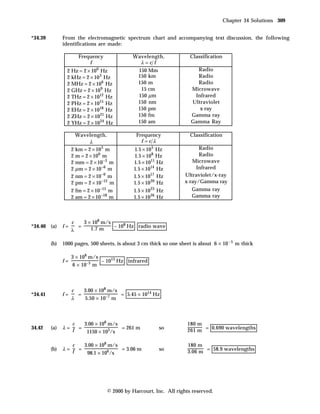
*34.39         From the electromagnetic spectrum chart and accompanying text discussion, the following
               identifications are made:

                        Frequency             Wavelength,              Classification
                            f                   λ=c f
                 2 Hz = 2 × 100 Hz               150 Mm                  Radio
                 2 kHz = 2 × 10 3 Hz             150 km                  Radio
                 2 MHz = 2 × 10⁶ Hz              150 m                   Radio
                 2 GHz = 2 × 10 9 Hz              15 cm                Microwave
                 2 THz = 2 × 10¹² Hz             150 µ m                Infrared
                 2 PHz = 2 × 10¹⁵ Hz             150 nm                Ultraviolet
                 2 EHz = 2 × 10¹⁸ Hz             150 pm                   x-ray
                 2 ZHz = 2 × 10 21 Hz            150 fm                Gamma ray
                 2 YHz = 2 × 10 24 Hz            150 am                Gamma Ray

                      Wavelength,               Frequency              Classification
                            λ                     f =c λ
                    2 km = 2 × 10 3 m          1.5 × 10 5 Hz               Radio
                    2 m = 2 × 100 m            1.5 × 10⁸ Hz                Radio
                    2 mm = 2 × 10 −3 m         1.5 × 10¹¹ Hz            Microwave
                    2 µ m = 2 × 10 −6 m        1.5 × 10¹⁴ Hz              Infrared
                    2 nm = 2 × 10 −9 m         1.5 × 10¹⁷ Hz         Ultraviolet/x-ray
                    2 pm = 2 × 10 −12 m        1.5 × 10 20 Hz        x-ray/Gamma ray
                    2 fm = 2 × 10 −15 m        1.5 × 10 23 Hz           Gamma ray
                    2 am = 2 × 10 −18 m        1.5 × 10 26 Hz           Gamma ray


                    c       3 × 10⁸ m/s
*34.40 (a)     f=       =               ~ 108 Hz radio wave
                    λ          1.7 m

         (b)   1000 pages, 500 sheets, is about 3 cm thick so one sheet is about 6 × 10 – 5 m thick

                    3 × 10⁸ m/s
               f=                 ~ 1013 Hz infrared
                    6 × 10⁻⁵ m


                    c   3.00 × 10⁸ m/s
*34.41         f=     =                = 5.45 × 10¹⁴ Hz
                    λ   5.50 × 10⁻⁷ m


                  c   3.00 × 10⁸ m/s                                  180 m
34.42    (a)   λ= f =                = 261 m               so
                                                                      261 m = 0.690 wavelengths
                       1150 × 103/s

                  c   3.00 × 10⁸ m/s                                  180 m
         (b)   λ= f =                = 3.06 m              so
                                                                      3.06 m = 58.9 wavelengths
                       98.1 × 10⁶/s


                                    © 2000 by Harcourt, Inc. All rights reserved.
310 Chapter 34 Solutions


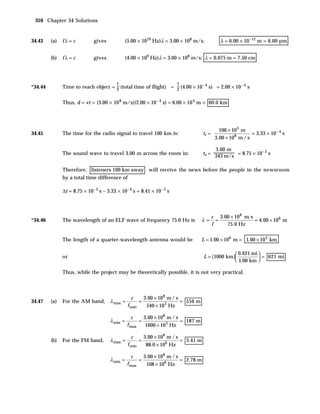
34.43    (a)   fλ = c         gives             (5.00 × 10¹⁹ Hz)λ = 3.00 × 10⁸ m/s:                λ = 6.00 × 10 –12 m = 6.00 pm


         (b)   fλ = c         gives             (4.00 × 10⁹ Hz)λ = 3.00 × 10⁸ m/s: λ = 0.075 m = 7.50 cm


                                         1                                 1
*34.44         Time to reach object = 2 (total time of flight) = 2 (4.00 × 10 – 4 s) = 2.00 × 10 – 4 s


               Thus, d = vt = (3.00 × 10 8 m/s)(2.00 × 10 – 4 s) = 6.00 × 10 4 m = 60.0 km


                                                                                                   100 × 10 3 m
34.45          The time for the radio signal to travel 100 km is:                        tr =                     = 3.33 × 10 – 4 s
                                                                                                 3.00 × 10⁸ m / s

                                                                                                 3.00 m
                                                                                                 343 m/s = 8.75 × 10
                                                                                                                     –3
               The sound wave to travel 3.00 m across the room in:                       ts =                           s


               Therefore, listeners 100 km away will receive the news before the people in the newsroom
               by a total time difference of

               ∆t = 8.75 × 10– 3 s – 3.33 × 10– 4 s = 8.41 × 10– 3 s


                                                                                                c 3.00 × 10⁸ m s
*34.46         The wavelength of an ELF wave of frequency 75.0 Hz is                    λ=        =              = 4.00 × 10⁶ m
                                                                                                f    75.0 Hz

               The length of a quarter-wavelength antenna would be                      L = 1.00 × 10⁶ m = 1.00 × 10 3 km

                                                                                                        0.621 mi 
               or                                                                        L = (1000 km )             = 621 mi
                                                                                                        1.00 km 

               Thus, while the project may be theoretically possible, it is not very practical.


                                                  c          3.00 × 10⁸ m / s
34.47    (a)   For the AM band, λ max =                  =                    = 556 m
                                                 f min        540 × 10 3 Hz

                                                  c          3.00 × 10⁸ m / s
                                      λ min =            =                    = 187 m
                                                f max         1600 × 10 3 Hz

                                                  c          3.00 × 10⁸ m / s
         (b)   For the FM band,       λ max =            =                    = 3.41 m
                                                 f min        88.0 × 10⁶ Hz

                                                  c          3.00 × 10⁸ m / s
                                      λ min =            =                    = 2.78 m
                                                f max         108 × 106 Hz
Chapter 34 Solutions 311


34.48           CH 4 : fmin = 66 MHz               λ max = 4.55 m

                                  fmax = 72 MHz             λ min = 4.17 m

                CH 6 : fmin = 82 MHz               λ max = 3.66 m

                                  fmax = 88 MHz             λ min = 3.41 m

                CH 8 : fmin = 180 MHz              λ max = 1.67 m

                                  fmax = 186 MHz            λ min = 1.61 m


34.49    (a)    P = SA = (1340 W/m2)4π (1.496 × 10¹¹ m)2 = 3.77 × 1026 W

                       2
                     cBmax                                    2 µ 0S     2(4 π × 10 −7 N / A 2 )(1340 W / m 2 )
         (b)    S=                     so          Bmax =            =                                          = 3.35 µT
                      2µ 0                                       c                  3.00 × 10⁸ m / s


                                                                          (         )(           )
                      2
                     Emax
                S=                     so          Emax = 2µ 0 cS = 2 4 π × 10 −7 3.00 × 10⁸ (1340) = 1.01 kV/m
                     2µ 0 c


*34.50          Suppose you cover a 1.7 m-by-0.3 m section of beach blanket. Suppose the elevation angle of
                the Sun is 60°. Then the target area you fill in the Sun's field of view is

                (1.7 m )( 0.3 m )( cos 30° ) = 0.4 m2

                              P   E                                 W
                Now I =         =   :              E = IAt = 1340      (0.6)(0.5)(0.4 m2) 3600 s ~ 106 J
                              A At                                  m2


34.51    (a)   ε = − dΦB = − d (BA cos θ ) = −A         d
                                                           (Bmax cos ω t cos θ ) = ABmax ω (sin ω t cos θ )
                        dt        dt                    dt

                ε (t) = 2π f Bmax A sin 2π f t cos θ = 2π 2r 2 f Bmax cos θ sin 2π f t

                Thus,        ε max = 2π 2r 2 f Bmax cos θ    , where θ is the angle between the magnetic field and the
                normal to the loop.

         (b)    If E is vertical, then B is horizontal, so the plane of the loop should be vertical and the
                plane should contain the line of sight to the transmitter .


                                            © 2000 by Harcourt, Inc. All rights reserved.
312 Chapter 34 Solutions


                           GMs m  GMs 
34.52   (a)   F grav =          =        ρ ( 4 / 3)π r 3
                            R2     R2 

              where M s = mass of Sun, r = radius of particle and R = distance from Sun to particle.

                                Sπ r 2            Frad  1  3SR 2  1
              Since Frad =             ,                =                 ∝
                                 c                F grav  r   4cGMsρ  r
                                                                       

                                                                                                      3SR 2
        (b)   From the result found in part (a), when Fgrav = Frad, we have                  r=
                                                                                                  4cGM s ρ


                                              (             )(                 )
                                                                                   2
                                             3 214 W / m 2 3.75 × 10¹¹ m
              r=                                                                                              = 3.78 × 10⁻⁷ m
                      (                            )(               )(                 )(
                   4 6.67 × 10 −11 N ⋅ m 2 kg 2 1.991 × 10 30 kg 1500 kg m 3 3.00 × 10⁸ m s               )


                          Emax
                           c = 6.67 × 10 T
                                        –16
34.53   (a)   Bmax =

                            2
                          Emax
        (b)   Sav =              = 5.31 × 10⁻¹⁷ W/m 2
                          2 µ0 c

        (c)   P = Sav A = 1.67 × 10⁻¹⁴ W

                              Sav 
        (d)   F = PA =               A = 5.56 × 10⁻²³ N (≈ weight of 3000 H atoms!)
                              c 


*34.54 (a)    The electric field between the plates is E = ∆V l, directed
                                                                                                                           i
              downward in the figure. The magnetic field between the plate's
              edges is B = µ 0 i 2 π r counterclockwise.                                                           + +
                                                                                                              + ++ +
                                                                                                                           + +
                                                                                                                            + ++
                                                                                                      B               +    + +
                                                                                                              E       -    - -
                                                                                                  S            - - - - -
                                                                 ( ∆V ) i                                          -        - - -
                                                     1                                                                --   - -
              The Poynting vector is:             S=    E×B=                (radially outward)
                                                     µ0          2 π rl                                                    i

        (b)   The lateral surface area surrounding the electric field volume is

                                                           ( ∆V ) i 
              A = 2 π rl, so the power output is P = SA =            ( 2 π rl) = (∆V)i
                                                           2 π rl 

        (c)   As the capacitor charges, the polarity of the plates and hence the direction of the electric field
              is unchanged.     Reversing the current reverses the direction of the magnetic field, and
              therefore the Poynting vector.

               The Poynting vector is now directed radially inward.
Chapter 34 Solutions 313


*34.55 (a)   The magnetic field in the enclosed volume is directed upward,
                                                                                                                                   B
                                                                   dB        di
             with magnitude B = µ 0 ni and increasing at the rate      = µ 0n .
                                                                    dt       dt
             The changing magnetic field induces an electric field around any
             circle of radius r , according to Faraday’s Law:
                                                                                                                    E

             E( 2 π r ) = − µ 0n     ( )
                                 di 
                                 dt 
                                       π r2
                                                                 µ nr  di 
                                                              E=− 0
                                                                  2  dt 
                                                                                                                S


                                                                   µ 0nr  di 
             or                                               E=                (clockwise)
                                                                     2  dt                                            i


                                                            1       1  µ 0nr  di  
             Then,                                    S=
                                                           µ0
                                                              E×B=
                                                                   µ 0  2  dt  
                                                                                       (µ 0ni) inward,
                                                                                    

                                                                     µ 0n2 r i  di 
             or the Poynting vector is                        S=                      (radially inward)
                                                                        2  dt 

       (b)   The power flowing into the volume is P = SAlat where Alat is the lateral area perpendicular to
             S . Therefore,
                                                µ n2 r i  di                     2 2  di 
                                            P= 0                ( 2 π rl) = µ 0 π n r li  
                                                  2  dt                                 dt

       (c)   Taking Across to be the cross-sectional area perpendicular to B, the induced voltage between
             the ends of the inductor, which has N = nl turns, is

                                                              ∆V =    ε   =N
                                                                                dB 
                                                                                      A
                                                                                dt  cross
                                                                                                
                                                                                            = nl µ 0n
                                                                                                
                                                                                                      di 
                                                                                                      dt   ( )
                                                                                                           π r 2 = µ 0 π n2 r 2l
                                                                                                                                  di 
                                                                                                                                  dt 

             and it is observed that                           P = ( ∆V ) i


*34.56 (a)   The power incident on the mirror is:
                                                                                              
                                                                                              
                                                                                                   W
                                                                                                   m 
                                                                                                            [   2
                                                                                                                            ]
                                                                                    P I = IA = 1340 2 π (100 m ) = 4.21 × 10⁷ W


                                                                                                (
             The power reflected through the atmosphere is P R = 0.746 4.21 × 10⁷ W = 3.14 × 10⁷ W                  )
                  PR     3.14 × 10⁷ W
       (b)   S=      =                                = 0.625 W/m2
                           (                  )
                                                  2
                  A    π 4.00 × 10 3 m

       (c)   Noon sunshine in Saint Petersburg produces this power-per-area on a horizontal surface:

                           (                  )
             P N = 0.746 1340 W / m 2 sin 7.00° = 122 W / m 2

             The radiation intensity received from the mirror is

              0.625 W m 2 
              122 W m 2  100% = 0.513%                     of that from the noon Sun in January.
                          


                                     © 2000 by Harcourt, Inc. All rights reserved.
314 Chapter 34 Solutions


                    1   2
34.57          u = 2 e0Emax                                                              (Equation 34.21)

                          2u
               Emax =        = 95.1 mV/m
                          e0


*34.58         The area over which we model the antenna as radiating is the lateral surface of a cylinder,


                                                            (              )
                                            A = 2 π r l = 2 π 4.00 × 10 −2 m (0.100 m ) = 2.51 × 10 −2 m 2

                                                 P    0.600 W
         (a)   The intensity is then:       S=     =                = 23.9 W m 2
                                                 A 2.51 × 10 −2 m 2

                                                                                   −3
                                                                  mW   1.00 × 10 W   1.00 × 10 cm 
                                                                                                   4  2
                                                    mW                                                          W
         (b)   The standard is:             0.570        = 0.570                                         = 5.70 2
                                                    cm 2          cm 2   1.00 mW  
                                                                                          1.00 m 2          m

                                                                                  23.9 W m 2
               While it is on, the telephone is over the standard by                         = 4.19 times
                                                                                  5.70 W m 2


                        Emax    175 V/m
                         c = 3.00 × 10⁸ m/s = 5.83 × 10 T
                                                       –7
34.59    (a)   Bmax =


                    2π       2π
               k=      = (0.0150 m) = 419 rad/m
                     λ


               ω = kc = 1.26 × 10¹¹ rad/s


               Since S is along x, and E is along y, B must be in the z direction .              (That is S ∝ E × B.)

                        EmaxBmax
         (b)   Sav =
                          2µ 0   = 40.6 W/m2

                   2S
         (c)   Pr = c = 2.71 × 10⁻⁷ N/m2


         (d)   a=
                    ΣF PA
                      =   =
                               (                    )(
                            2.71 × 10 −7 N / m 2 0.750 m 2      )
                                                           = 4.06 × 10 −7 m / s 2
                    m   m               0.500 kg
Chapter 34 Solutions 315


*34.60 (a)    At steady-state, P in = P out and the power radiated out is P out = eσAT 4 .


                                     W                          W 
              Thus,         0.900 1000 2 A = (0.700) 5.67 × 10 −8          AT 4
                                     m                         m ⋅ K4 
                                                                   2


                                                                         14
                                        900 W m 2                   
                            T=                                              = 388 K = 115°C
                                         (                       )
              or
                               0.700 5.67 × 10 −8 W m 2 ⋅ K 4       
                                                                    

        (b)   The box of horizontal area A , presents projected area A sin 50.0° perpendicular to the
              sunlight. Then by the same reasoning,


                                     W                                    W 
                            0.900 1000 2 A sin 50.0° = (0.700) 5.67 × 10 −8          AT 4
                                     m                                   m ⋅ K4 
                                                                             2


                                     (             )
                                                                         14
                                    900 W m 2 sin 50.0°             
                            T=                                              = 363 K = 90.0 °C
                                         (                       )
              or
                               0.700 5.67 × 10 −8 W m 2 ⋅ K 4       
                                                                    


                 F   I
34.61   (a)   P= A = c


                                          = 3.33 × 10 −7 N = (110 kg )a
                   IA P      100 J / s
              F=      = =
                    c  c 3.00 × 10⁸ m / s

                                                             1
              a = 3.03 × 10⁻⁹ m/s2           and        x = 2 at 2


                   2x
              t=      = 8.12 × 10 4 s = 22.6 h
                    a

        (b)   0 = (107 kg)v – (3.00 kg)(12.0 m/s – v) = (107 kg)v – 36.0 kg · m/s + (3.00 kg)v


                  36.0
              v = 110 = 0.327 m/s


              t = 30.6 s


                                  © 2000 by Harcourt, Inc. All rights reserved.
316 Chapter 34 Solutions


Goal Solution
An astronaut, stranded in space 10.0 m from his spacecraft and at rest relative to it, has a mass (including
equipment) of 110 kg. Since he has a 100-W light source that forms a directed beam, he decides to use the
beam as a photon rocket to propel himself continuously toward the spacecraft. (a) Calculate how long it
takes him to reach the spacecraft by this method. (b) Suppose, instead, he decides to throw the light
source away in a direction opposite the spacecraft. If the mass of the light source has a mass of 3.00 kg and,
after being thrown, moves at 12.0 m/s relative to the recoiling astronaut , how long does it take for the
astronaut to reach the spacecraft?

G: Based on our everyday experience, the force exerted by photons is too small to feel, so it may take a
   very long time (maybe days!) for the astronaut to travel 10 m with his “photon rocket.” Using the
   momentum of the thrown light seems like a better solution, but it will still take a while (maybe a few
   minutes) for the astronaut to reach the spacecraft because his mass is so much larger than the mass of
   the light source.

O: In part (a), the radiation pressure can be used to find the force that accelerates the astronaut toward
   the spacecraft. In part (b), the principle of conservation of momentum can be applied to find the time
   required to travel the 10 m.

A : (a) Light exerts on the astronaut a pressure       P = F A = S c , and a force of

                                                            SA               100 J / s
                                                       F=      =     =                    = 3.33 × 10 −7 N
                                                             c           3.00 × 10⁸ m / s

                                                            F 3.33 × 10 −7 N
    By Newton’s 2nd law,                               a=     =              = 3.03 × 10 −9 m / s 2
                                                            m    110 kg

    This acceleration is constant, so the distance traveled is x = 2 at 2 , and the amount of time it travels is
                                                                   1


                                                             2x         2(10.0 m )
                                                       t=       =                        = 8.12 × 10 4 s = 22.6 h
                                                              a     3.03 × 10 −9 m / s 2

    (b) Because there are no external forces, the momentum of the astronaut before throwing the light
    is the same as afterwards when the now 107-kg astronaut is moving at speed v towards the spacecraft
    and the light is moving away from the spacecraft at (12.0 m / s − v ) . Thus, pi = p f gives

                                                       0 = (107 kg )v − ( 3.00 kg )(12.0 m / s − v )

                                                       0 = (107 kg )v − ( 36.0 kg ⋅ m / s) + ( 3.00 kg )v

                                                            36.0
                                                       v=        = 0.327 m / s
                                                            110

                                                            x   10.0 m
                                                       t=     =           = 30.6 s
                                                            v 0.327 m / s

L : Throwing the light away is certainly a more expedient way to reach the spacecraft, but there is not
    much chance of retrieving the lamp unless it has a very long cord. How long would the cord need to
    be, and does its length depend on how hard the astronaut throws the lamp? (You should verify that
    the minimum cord length is 367 m, independent of the speed that the lamp is thrown.)
Chapter 34 Solutions 317


                                                           W                                          2S   2(0.380)S
34.62         The 38.0% of the intensity S = 1340             that is reflected exerts a pressure P1 = r =
                                                           m2                                          c       c

                                                                                                                              Sa (0.620)S
              The absorbed light exerts pressure                                                                       P2 =      =
                                                                                                                               c     c

              Altogether the pressure at the subsolar point on Earth is

                                   1.38S   1.38(1340 W/m2)
        (a)   Ptot = P1 + P2 =           =                 = 6.16 × 10– 6 Pa
                                     c      3.00 × 10⁸ m/s

              Pa    1.01 × 10 5 N / m 2
        (b)       =                     = 1.64 × 10¹⁰ times smaller than atmospheric pressure
              Ptot 6.16 × 10 −6 N / m 2


                                                                                                                                     2
34.63         Think of light going up and being absorbed by the bead which presents a face area π r b .

                                        S  I
              The light pressure is P = c = .
                                           c

                         2                                                                    1/3
                  Iπ r b          4     3                                      4ρ gc  3m 
        (a)   Fl = c     = mg = ρ 3 π r b g            and                I=                      = 8.32 × 10 7 W/m 2
                                                                                 3  4 πρ 

        (b)   P = IA = (8.32 × 10 7 W/m2)π (2.00 × 10⁻³ m)2 = 1.05 kW


                                                                                                                                 2
34.64         Think of light going up and being absorbed by the bead which presents face area π r b .

                                                                                                           Sav I Fl
              If we take the bead to be perfectly absorbing, the light pressure is P =                        = =
                                                                                                            c  c A

                                             Flc F g c m gc
        (a)   Fl = F g          so      I=      =     =
                                              A   A     π rb 2


                                                                                                    (              )
                                                             m       m                   1              4          1/3
              From the definition of density, ρ =              =   4
                                                                                 so         =             πρ   m
                                                             V       π rb 3              rb             3
                                                                   3


                                                                                                               1/3
                                             m gc  4 πρ  2/3            2/3
                                                                     4ρ   m 
                                                                                 1/3
                                                                                       4ρ gc  3m 
              Substituting for rb , I =                        = gc                  =
                                              π    3m              3  π           3  4π ρ 
                                                                                                 


                             π r 24ρgc  3m  1/3
        (b)   P = IA =                       
                                  3     4π ρ 


                                       © 2000 by Harcourt, Inc. All rights reserved.
318 Chapter 34 Solutions


34.65         The mirror intercepts power

              P = I1A1 = (1.00 × 10 3 W/m2)π (0.500 m)2 = 785 W

              In the image,

                     P      785 W
        (a)   I2 =     =               = 625 kW/m2
                     A2 π (0.0200 m )2

                       2
                    E max
        (b)   I 2 = 2µ c       so     Emax = (2µ0c I 2 )1/2 = [2(4π × 10–7)(3.00 × 10⁸)(6.25 × 10⁵)]1/2= 21.7 kN/C
                       0

                       Emax
              Bmax =
                        c = 72.4 µT

        (c)   0.400 P t = mc ∆T

                                                  J
              0.400(785 W)t = (1.00 kg)  4186 kg · C° (100°C – 20.0°C)
                                                     

                   3.35 × 10⁵ J
              t=     314 W      = 1.07 × 10³ s = 17.8 min


                     c 3.00 × 10⁸ m s
34.66   (a)   λ=       =                  = 1.50 cm
                     f   20.0 × 10 9 s −1


        (b)
                            
              U = P ( ∆t ) = 25.0 × 10 3
                            
                                         J
                                         s
                                            (               )
                                            1.00 × 10 −9 s = 25.0 × 10 −6 J = 25.0 µJ


                      U    U           U                        25.0 × 10 −6 J
              uav =     =        =             =
                            ( ) ( )                                  (            )(             )
        (c)
                      V   π r 2 l π r 2 c( ∆t ) π (0.0600 m )2 3.00 × 10⁸ m s 1.00 × 10 −9 s


              uav = 7.37 × 10 −3 J m 3 = 7.37 mJ m 3


        (d)   Emax =
                           2uav
                                =
                                      (
                                     2 7.37 × 10 −3 J m 3   )    = 4.08 × 10 4 V m = 40.8 kV/m
                                                −12
                            e0      8.85 × 10         C N ⋅ m2
                                                       2


                        Emax 4.08 × 10 4 V m
              Bmax =        =                = 1.36 × 10 −4 T = 136 µT
                         c    3.00 × 10⁸ m s

                            S     c uav                           J 
        (e)   F = PA =          A=           A = uav A = 7.37 × 10 −3      π (0.0600 m )2 = 8.33 × 10 −5 N = 83.3 µN
                            c     c                              m3 
Chapter 34 Solutions 319


                                                                                    (               )
                                                                                                        2
                                                                                  C2 m s2                               N ⋅ m 2 ⋅ C2 ⋅ m 2 ⋅ s3 N ⋅ m J
         (a)   On the right side of the equation,                                                                   =                          =     = =W
                                                                   (C N ⋅ m )(m s)
34.67
                                                                              2                 2               3
                                                                                                                            C2 ⋅ s 4 ⋅ m 3        s   s


                                                                qE (1.60 × 10 C)(100 N C)       −19
         (b)   F = ma = qE                 or                a=   =                       =                                         1.76 × 10¹³ m s 2
                                                                  m                 9.11 × 10 −31 kg


               The radiated power is then:                   P=
                                                                  q2 a2
                                                                           =
                                                                                    (
                                                                               1.60 × 10      1.76 × 10     −19 2
                                                                                                                    )(              13 2
                                                                                                                                        )        = 1.75 × 10 − 27 W
                                                                6 π e0 c
                                                                                            (                         )(                 )
                                                                         3                                                                   3
                                                                             6 π 8.85 × 10 −12 3.00 × 10⁸

                          v    2
                                                                  qBr
         (c)   F = mar = m  = qvB             so           v=
                           r                                     m

                                                                                            (                           )
                                                                                                                            2
                                                                              1.60 × 10 −19 (0.350) (0.500)
                                                                                                                                    2
                                                                v 2 q 2B2 r
               The proton accelerates at                     a=    =        =                               = 5.62 × 10¹⁴ m s 2
                                                                 r    m2              1.67 × 10 −27 2
                                                                                                            (                   )
               The proton then radiates                      P=
                                                                  q2 a2
                                                                          =
                                                                                    (
                                                                            1.60 × 10       5.62 × 10       −19 2
                                                                                                                    )(              14 2
                                                                                                                                        )        = 1.80 × 10
                                                                                                                                                             −24
                                                                                                                                                                 W
                                                                                            (
                                                                6 π e0 c 3 6 π 8.85 × 10 −12 3.00 × 10⁸
                                                                                                                      )(                 )
                                                                                                                                             3


                    S Power      P                     60.0 W
34.68          P=     =     =        =                                         = 6.37 × 10⁻⁷ Pa
                    c   Ac    2 π rlc 2 π (0.0500 m)(1.00 m)(3.00 × 10⁸ m  s)


                          SA ( P / A)A P
                                                            τ = F  =
                                                                   l   Pl
34.69          F = PA =      =        = ,                                 ,                 and             τ = κθ
                           c      c    c                          2  2c


                               θ=
                                     Pl
                                         =
                                                    (
                                             3.00 × 10 −3 (0.0600)    )
                                                                     = 3.00 × 10– 2 deg
                                                (                )(                     )
               Therefore,
                                     2c κ 2 3.00 × 10⁸ 1.00 × 10 −11


*34.70         We take R to be the planet’s distance from its star.                                                 The planet, of radius r , presents a
                projected area π r   2
                                           perpendicular to the starlight.                              It radiates over area 4 π r 2 .


                                                            ( )           (
               At steady-state, P in = P out : e I in π r 2 = eσ 4 π r 2 T 4        )
                 6.00 × 10 23 W 
               e
                     4π R2      
                                     ( )
                                  π r = eσ 4 π r T
                                      2          2  4
                                                        (    )            so that                       6.00 × 10 23 W = 16 π σ R 2 T 4


                      6.00 × 10 23 W               6.00 × 10 23 W
               R=                    =                                           = 4.77 × 10 9 m = 4.77 Gm
                         16 π σ T 4
                                                    (
                                       16 π 5.67 × 10 −8 W m 2 ⋅ K 4 ( 310 K )
                                                                               4
                                                                                                )


                                         © 2000 by Harcourt, Inc. All rights reserved.
320 Chapter 34 Solutions


                                                           E2
34.71         The light intensity is          I = Sav =
                                                          2 µ 0c

                                                   S   E2
              The light pressure is           P=     =       = 1 e0 E 2
                                                   c 2 µ 0c 2 2


                                                                                         e0E 2 A
              For the asteroid,              PA = m a               and            a=
                                                                                          2m


34.72         f = 90.0 MHz,       Emax = 2.00 × 10 − 3 V / m = 200 mV/m

                   c
        (a)   λ=     = 3.33 m
                   f

                   1
              T=     = 1.11 × 10 −8 s = 11.1 ns
                   f

                         Emax
              Bmax =          = 6.67 × 10 −12 T = 6.67 pT
                          c

                                          x         t                                          x         t 
               E = (2.00 mV / m) cos 2 π        −                    B = (6.67 pT )k cos 2 π           −
                                           3.33 m 11.1 ns 
        (b)                                                 j
                                                                                               3.33 m 11.1 ns 

                    2
                   Emax         (2.00 × 10 − 3 )2
        (c)   I=         =                              = 5.31 × 10 − 9 W / m 2
                   2µ 0 c 2(4 π × 10 − 7 )(3.00 × 10⁸ )

        (d)   I = cuav            so          uav = 1.77 × 10 −17 J / m 3


                   2I (2)(5.31 × 10 − 9 )
        (e)   P=     =                    = 3.54 × 10 −17 Pa
                   c     3.00 × 10⁸

Capítulo 34 (5th edition) con soluciones ondas electromagneticas serway

  • 8.
    Chapter 34 Solutions 34.1 Since the light from this star travels at 3.00 × 10⁸ m/s, the last bit of light will hit the Earth i n 6.44 × 10¹⁸ m = 2.15 × 10¹⁰ s = 680 years. Therefore, it will disappear from the sky in the year 3.00 × 10⁸ m / s 1999 + 680 = 2.68 × 10 3 A.D. 1 1 34.2 v= = c = 0.750c = 2.25 × 10⁸ m/s kµ 0 e0 1.78 E 220 B = 3.00 × 10 ; 34.3 B =c or 8 so B = 7.33 × 10⁻⁷ T = 733 nT Emax 34.4 Bmax = v is the generalized version of Equation 34.13. Emax 7.60 × 10 −3 V / m  N ⋅ m   T ⋅ C ⋅ m  Bmax = = = 3.80 × 10⁻¹¹ T = 38.0 pT v (2 / 3)(3.00 × 10⁸ m / s)  V ⋅ C   N ⋅ s  34.5 (a) fλ = c or f (50.0 m) = 3.00 × 10⁸ m/s so f = 6.00 × 10⁶ Hz = 6.00 MHz E 22.0 Bmax = 3.00 × 10 8 (b) B =c or so Bmax = (73.3 nT)(–k) 2π 2π (c) k= = 50.0 = 0.126 m–1 and ω = 2π f = 2π (6.00 × 10⁶ s–1) = 3.77 × 10⁷ λ rad/s B = Bmax cos(kx – ω t) = (73.3 nT) cos (0.126x – 3.77 × 10⁷ t)(–k) 34.6 ω = 2π f = 6.00π × 109 s–1 = 1.88 × 10¹⁰ s-1 2π ω 6.00π × 109 s–1 E 300 V/m k= =c = = 20.0π = 62.8 m–1 Bmax = c = = 1.00 µT λ 3.00 × 10⁸ m/s 3.00 × 10⁸ m/s  E = 300  V m ( cos 62.8x − 1.88 × 10¹⁰ t ) B = (1.00 µT) cos (62.8x – 1.88 × 10¹⁰ t) © 2000 by Harcourt, Inc. All rights reserved.
  • 9.
    Chapter 34 Solutions299 E 100 V/m 34.7 (a) B= = = 3.33 × 10⁻⁷ T = 0.333 µT c 3.00 × 10 8 m/s 2π 2π (b) λ= k = = 0.628 µm 1.00 × 10 7 m – 1 c 3.00 × 10⁸ m/s (c) f= = = 4.77 × 10¹⁴ Hz λ 6.28 × 10⁻⁷ m 34.8 E = Emax cos(kx – ω t) ∂E ∂E = –Emax sin(kx – ω t)(k) = –Emax sin(kx – ω t)(–ω) ∂x ∂t ∂ 2E ∂ 2E = –Emax cos(kx – ω t)(k 2) = –Emax cos(kx – ω t)(–ω)2 ∂x2 ∂t2 ∂E ∂ 2E We must show: = µ 0e0 2 ∂x 2 ∂t That is, ( ) − k 2 Emax cos( kx − ω t ) = − µ 0e0 ( −ω ) Emax cos( kx − ω t ) 2 2 k2  1  1 But this is true, because =   = 2 = µ 0 e0 ω 2  fλ  c The proof for the wave of magnetic field is precisely similar. *34.9 In the fundamental mode, there is a single loop in the standing wave between the plates. Therefore, the distance between the plates is equal to half a wavelength. λ = 2L = 2(2.00 m) = 4.00 m c 3.00 × 10⁸ m/s Thus, f = = = 7.50 × 10 7 Hz = 75.0 MHz λ 4.00 m λ *34.10 dA to A = 6 cm ± 5% = 2 λ = 12 cm ± 5% © 2000 by Harcourt, Inc. All rights reserved.
  • 10.
    300 Chapter 34Solutions ( ) v = λ f = (0.12 m ± 5%) 2.45 × 10 9 s −1 = 2.9 × 10⁸ m s ± 5% U Uc S=I= A t = V = uc 34.11 Energy I 1000 W/m2 =u= = = 3.33 µ J/m3 Unit Volume c 3.00 × 10⁸ m/s P 4.00 × 10 3 W 34.12 Sav = = = 7.68 µW/m 2 4π r 2 4π (4.00 × 1609 m)2 Emax = 2µ 0 cSav = 0.0761 V / m ∆Vmax = Emax · L = (76.1 mV/m)(0.650 m) = 49.5 mV (amplitude) or 35.0 mV (rms) 34.13 r = ( 5.00 mi )(1609 m / mi ) = 8.04 × 10 3 m P 250 × 10 3 W S= = = 307 µW/m 2 4π r 2 4π (8.04 × 10 3 m) 2
  • 11.
    Chapter 34 Solutions301 Goal Solution What is the average magnitude of the Poynting vector 5.00 miles from a radio transmitter broadcasting isotropically with an average power of 250 kW? G: As the distance from the source is increased, the power per unit area will decrease, so at a distance of 5 miles from the source, the power per unit area will be a small fraction of the Poynting vector near the source. O: The Poynting vector is the power per unit area, where A is the surface area of a sphere with a 5-mile radius. A : The Poynting vector is In meters, r = ( 5.00 mi )(1609 m / mi ) = 8045 m 250 × 10 3 W and the magnitude is S = = 3.07 × 10 −4 W / m 2 (4 π )(8045)2 2 L : The magnitude of the Poynting vector ten meters from the source is 199 W/m , on the order of a million times larger than it is 5 miles away! It is surprising to realize how little power is actually received by a radio (at the 5-mile distance, the signal would only be about 30 nW, assuming a 2 receiving area of about 1 cm ). 100 W 34.14 I= = 7.96 W/m2 4π (1.00 m)2 I u = c = 2.65 × 10 – 8 J/m3 = 26.5 n J/m3 1 (a) uE = 2 u = 13.3 n J/m3 1 (b) uB = 2 u = 13.3 n J/m3 (c) I = 7.96 W/m2 34.15 Power output = (power input)(efficiency) power out 1.00 × 10⁶ W Thus, Power input = = = 3.33 × 10⁶ W eff 0.300 P 3.33 × 10 6 W and A= = = 3.33 × 10 3 m 2 I 1.00 × 10 3 W/m 2 © 2000 by Harcourt, Inc. All rights reserved.
  • 12.
    302 Chapter 34Solutions 2 Bmax c P *34.16 I= = 2µ 0 4π r 2  P   2µ 0  (10.0 × 10 )(2)(4π × 10 ) = 3 −7 Bmax =  4π r 2   c  = 5.16 × 10⁻¹⁰ T   4 π ( 5.00 × 10 ) ( 3.00 × 10 ) 3 2 8 Since the magnetic field of the Earth is approximately 5 × 10 –5 T, the Earth's field is some 100,000 times stronger. 34.17 (a) P = I 2R = 150 W; A = 2π rL = 2π (0.900 × 10⁻³ m)(0.0800 m) = 4.52 × 10 –4 m2 P S= = 332 kW/m2 (points radially inward) A I µ0(1.00) (b) B = µ 0 2π r = = 222 µT 2π (0.900 × 10 –3) ∆V IR 150 V E= = L = 0.0800 m = 1.88 kV/m ∆x EB Note: S = µ = 332 kW/m2 0
  • 13.
    Chapter 34 Solutions303 34.18 (a) E · B = (80.0 i + 32.0 j – 64.0 k)(N/C) · (0.200 i + 0.0800 j + 0.290 k)µT E · B= (16.0 + 2.56 – 18.56)N 2 · s/C 2 · m = 0 1 (80.0 i + 32.0 j – 64.0 k)(N/C) × (0.200 i + 0.0800 j + 0.290 k)µT µ 0 E × B= (b) S= 4π × 10 –7 T · m/A (6.40 k – 23.2 j – 6.40 k + 9.28 i – 12.8 j + 5.12 i)10 – 6 W/m 2 S= 4π × 10–7 S = (11.5 i – 28.6 j) W/m 2 = 30.9 W/m2 at – 68.2° from the +x axis 34.19 We call the current I rms and the intensity I . The power radiated at this frequency is 0.0100(∆Vrms)2 P = (0.0100)(∆Vrms)Irms = = 1.31 W R If it is isotropic, the intensity one meter away is P 1.31 W c 2 I= = = 0.104 W/m2 = Sav = 2µ Bmax A 4π (1.00 m)2 0 Bmax = 2µ 0 I = ( )( 2 4 π × 10 −7 T ⋅ m / A 0.104 W / m 2 )= 29.5 nΤ c 3.00 × 10 m / s 8 useful power output  700 W  *34.20 (a) efficiency = × 100% = × 100% = 50.0% total power input  1400 W  P 700 W (b) Sav = = = 2.69 × 10 5 W m 2 A (0.0683 m )(0.0381 m ) Sav = 269 kW m 2 toward the oven chamber 2 Emax (c) Sav = 2µ 0 c  T ⋅ m m W V Emax = 2 4 π × 10 −7 3.00 × 10⁸ 2.69 × 10 5 = 1.42 × 10 4 = 14.2 kV m  A  s  m 2 m © 2000 by Harcourt, Inc. All rights reserved.
  • 14.
    304 Chapter 34Solutions Emax 7.00 × 10⁵ N/C 34.21 (a) Bmax = = = 2.33 mT c 3.00 × 10⁸ m/s 2 Emax (7.00 × 10 5)2 (b) I = 2µ c = = 650 MW/m 2 0 2(4π × 10 –7 )(3.00 × 10⁸) P π (c) I= : P = I A = (6.50 × 10⁸ W/m2) 4 (1.00 × 10 – 3 m) 2 = 510 W A 2 Emax Pµ 0 c (100 W)µ 0 c 34.22 Power = SA = (4 π r 2 ); solving for r , r= = = 5.16 m 2µ 0 c Emax 2 π 2 2 π (15.0 V / m)2 (10.0 × 10 − 3 )W 34.23 (a) I= = 4.97 kW/m2 π (0.800 × 10 − 3 m)2 I 4.97 × 10 3 J / m 2 ⋅ s (b) uav = = = 16.6 µ J/m3 c 3.00 × 10⁸ m / s 34.24 (a) E = cB = ( 3.00 × 10 8 m/s)(1.80 × 10 − 6 T) = 540 V/m B2 (1.80 × 10 − 6 )2 (b) uav = = = 2.58 µ J/m3 µ0 4 π × 10 − 7 (c) Sav = cuav = (3.00 × 10⁸ )(2.58 × 10 − 6 ) = 773 W/m2 (d) This is 77.3% of the flux in Example 34.5 . It may be cloudy, or the Sun may be setting. S 25.0 34.25 For complete absorption, P = c = = 83.3 nPa 3.00 × 108 *34.26 (a) ( )( ) P = (Sav )( A) = 6.00 W / m 2 40.0 × 10 −4 m 2 = 2.40 × 10 −2 J / s In one second, the total energy U impinging on the mirror is 2.40 × 10⁻² J. The momentum p transferred each second for total reflection is 2U 2(2.40 × 10⁻² J) kg · m p= c = = 1.60 × 10 –10 (each second) 3.00 × 10 m/s 8 s dp 1.60 × 10⁻¹⁰ kg · m/s (b) F = dt = = 1.60 × 10⁻¹⁰ N 1s
  • 15.
    Chapter 34 Solutions305 (2)(1340 W / m 2 ) 34.27 (a) The radiation pressure is = 8.93 × 10 −6 N / m 2 3.00 × 10⁸ m / s 2 Multiplying by the total area, A = 6.00 × 10⁵ m2 gives: F = 5.36 N F 5.36 N (b) The acceleration is: a = m = 6000 kg = 8.93 × 10– 4 m/s2 1 (c) It will take a time t where: d = 2 at 2 t= 2d = ( 2 3.84 × 10⁸ m ) = 9.27 × 10 5 s = 10.7 days (8.93 × 10 ) or −4 2 a m/s 2Sav 34.28 The pressure P upon the mirror is P= c P where A is the cross-sectional area of the beam and Sav = A 2P 2P The force on the mirror is then F = PA =  A = c  A c 2(100 × 10 −3 ) Therefore, F= = 6.67 × 10⁻¹⁰ N (3 × 10⁸ ) P E2 34.29 I= = max π r 2 2µ 0 c P ( 2µ 0 c ) (a) Emax = = 1.90 kN/C π r2 15 × 10–3 J/s (b) (1.00 m) = 50.0 pJ 3.00 × 10⁸ m/s U 5 × 10–11 (c) p= c = = 1.67 × 10⁻¹⁹ kg · m/s 3.00 × 10⁸ © 2000 by Harcourt, Inc. All rights reserved.
  • 16.
    306 Chapter 34Solutions 34.30 (a) If P S is the total power radiated by the Sun, and rE and r M are the radii of the orbits of the planets Earth and Mars, then the intensities of the solar radiation at these planets are: PS PS IE = and IM = 4 π rE 2 4π rM 2 2 2 r   1.496 × 10¹¹ m  Thus,  rM  ( I M = IE  E  = 1340 W m 2  )  2.28 × 10¹¹ m   = 577 W/m 2 (b) Mars intercepts the power falling on its circular face: ( ) ( )( ) 2 P M = I M π RM = 577 W m 2 π 3.37 × 10⁶ m 2 = 2.06 × 10¹⁶ W SM I M (c) If Mars behaves as a perfect absorber, it feels pressure P = = c c and force F = PA = IM c (2 P π RM = M = c ) 2.06 × 10¹⁶ W 3.00 × 10⁸ m s = 6.87 × 10⁷ N (d) The attractive gravitational force exerted on Mars by the Sun is Fg = GMS M M = ( )( 6.67 × 10 −11 N ⋅ m 2 kg 2 1.991 × 10 30 kg 6.42 × 10 23 kg )( = 1.64 × 10 21 N ) ( ) 2 2 rM 2.28 × 10 m 11 which is ~1013 times stronger than the repulsive force of (c). 34.31 (a) The total energy absorbed by the surface is 1 ( ) 1    W  ( U = 2 I At =  2 750 2  0.500 × 1.00 m 2 (60.0 s) = 11.3 kJ m  ) (b) The total energy incident on the surface in this time is 2U = 22.5 kJ, with U = 11.3 kJ being absorbed and U = 11.3 kJ being reflected. The total momentum transferred to the surface is p = (momentum from absorption ) + (momentum from reflection ) p=  U   2U  3U 3 11.3 × 10 J + = = 3 ( ) = 1.13 × 10 −4 kg ⋅ m s  c  c  c 3.00 × 10⁸ m s µ 0 Jmax c 2 (4 π × 10 −7 )Jmax (3.00 × 10⁸ ) 2 34.32 Sav = or 570 = so Jmax = 3.48 A/m2 8 8
  • 17.
    Chapter 34 Solutions307  µ J 2 c 34.33 (a) P = Sav A =  0 max  A  8   4 π × 10 −7 (10.0)2 (3.00 × 10⁸ )  P=   (1.20 × 0.400) = 2.26 kW  8  µ 0 Jmax c (4 π × 10 −7 (10.0)2 (3.00 × 10⁸ ) 2 (b) Sav = = = 4.71 kW/m2 8 8 *34.34 P= ( ∆V )2 or P ∝ ( ∆V ) 2 R eceiving ∆y l ntenna θ ∆V = ( − )Ey ⋅ ∆y = Ey ⋅ l cos θ ∆V ∝ cos θ so P ∝ cos 2 θ (a) θ = 15.0°: P = P max cos 2 (15.0°) = 0.933P max = 93.3% (b) θ = 45.0°: P = P max cos 2 ( 45.0°) = 0.500P max = 50.0% (c) θ = 90.0°: P = P max cos 2 (90.0°) = 0 34.35 (a) Constructive interference occurs when d cos θ = n λ for some integer n. λ  λ  cos θ = n = n  = 2n n = 0, ± 1, ± 2, . . . d  λ / 2 ∴ strong signal @ θ = cos–1 0 = 90°, 270° (b) Destructive interference occurs when  2n + 1 d cos θ = λ: cos θ = 2n + 1  2  ∴ weak signal @ θ = cos–1 (±1) = 0°, 180° © 2000 by Harcourt, Inc. All rights reserved.
  • 18.
    308 Chapter 34Solutions Goal Solution Two radio-transmitting antennas are separated by half the broadcast wavelength and are driven in phase with each other. In which directions are (a) the strongest and (b) the weakest signals radiated? G: The strength of the radiated signal will be a function of the location around the two antennas and will depend on the interference of the waves. O: A diagram helps to visualize this situation. The two antennas are driven in phase, which means that they both create maximum electric field strength at the same time, as shown in the diagram. The radio EM waves travel radially outwards from the antennas, and the received signal will be the vector sum of the two waves. A : (a) Along the perpendicular bisector of the line joining the antennas, the distance is the same to both transmitting antennas. The transmitters oscillate in phase, so along this line the two signals will be received in phase, constructively interfering to produce a maximum signal strength that is twice the amplitude of one transmitter. (b) Along the extended line joining the sources, the wave from the more distant antenna must travel one-half wavelength farther, so the waves are received 180° out of phase. They interfere destructively to produce the weakest signal with zero amplitude. L : Radio stations may use an antenna array to direct the radiated signal toward a highly-populated region and reduce the signal strength delivered to a sparsely-populated area. c λ 34.36 λ= = 536 m so h= = 134 m f 4 c λ λ= = 188 m so h= = 46.9 m f 4 34.37 For the proton: ΣF = ma ⇒ qvB sin 90.0° = mv 2 R The period and frequency of the proton’s circular motion are therefore: T= 2 πR 2 π m = = ( 2 π 1.67 × 10 −27 kg )= 1.87 × 10 −7 s f = 5.34 × 10⁶ Hz . v qB ( ) 1.60 × 10 −19 C (0.350 T ) c 3.00 × 10⁸ m s The charge will radiate at this same frequency, with λ= = = 56.2 m f 5.34 × 10⁶ Hz mv 2 34.38 For the proton, ΣF = ma yields qvB sin 90.0° = R 2 πR 2 π m The period of the proton’s circular motion is therefore: T= = v qB The frequency of the proton's motion is f = 1/ T c 2 π mc The charge will radiate electromagnetic waves at this frequency, with λ= = cT = f qB
  • 19.
    Chapter 34 Solutions309 *34.39 From the electromagnetic spectrum chart and accompanying text discussion, the following identifications are made: Frequency Wavelength, Classification f λ=c f 2 Hz = 2 × 100 Hz 150 Mm Radio 2 kHz = 2 × 10 3 Hz 150 km Radio 2 MHz = 2 × 10⁶ Hz 150 m Radio 2 GHz = 2 × 10 9 Hz 15 cm Microwave 2 THz = 2 × 10¹² Hz 150 µ m Infrared 2 PHz = 2 × 10¹⁵ Hz 150 nm Ultraviolet 2 EHz = 2 × 10¹⁸ Hz 150 pm x-ray 2 ZHz = 2 × 10 21 Hz 150 fm Gamma ray 2 YHz = 2 × 10 24 Hz 150 am Gamma Ray Wavelength, Frequency Classification λ f =c λ 2 km = 2 × 10 3 m 1.5 × 10 5 Hz Radio 2 m = 2 × 100 m 1.5 × 10⁸ Hz Radio 2 mm = 2 × 10 −3 m 1.5 × 10¹¹ Hz Microwave 2 µ m = 2 × 10 −6 m 1.5 × 10¹⁴ Hz Infrared 2 nm = 2 × 10 −9 m 1.5 × 10¹⁷ Hz Ultraviolet/x-ray 2 pm = 2 × 10 −12 m 1.5 × 10 20 Hz x-ray/Gamma ray 2 fm = 2 × 10 −15 m 1.5 × 10 23 Hz Gamma ray 2 am = 2 × 10 −18 m 1.5 × 10 26 Hz Gamma ray c 3 × 10⁸ m/s *34.40 (a) f= = ~ 108 Hz radio wave λ 1.7 m (b) 1000 pages, 500 sheets, is about 3 cm thick so one sheet is about 6 × 10 – 5 m thick 3 × 10⁸ m/s f= ~ 1013 Hz infrared 6 × 10⁻⁵ m c 3.00 × 10⁸ m/s *34.41 f= = = 5.45 × 10¹⁴ Hz λ 5.50 × 10⁻⁷ m c 3.00 × 10⁸ m/s 180 m 34.42 (a) λ= f = = 261 m so 261 m = 0.690 wavelengths 1150 × 103/s c 3.00 × 10⁸ m/s 180 m (b) λ= f = = 3.06 m so 3.06 m = 58.9 wavelengths 98.1 × 10⁶/s © 2000 by Harcourt, Inc. All rights reserved.
  • 20.
    310 Chapter 34Solutions 34.43 (a) fλ = c gives (5.00 × 10¹⁹ Hz)λ = 3.00 × 10⁸ m/s: λ = 6.00 × 10 –12 m = 6.00 pm (b) fλ = c gives (4.00 × 10⁹ Hz)λ = 3.00 × 10⁸ m/s: λ = 0.075 m = 7.50 cm 1 1 *34.44 Time to reach object = 2 (total time of flight) = 2 (4.00 × 10 – 4 s) = 2.00 × 10 – 4 s Thus, d = vt = (3.00 × 10 8 m/s)(2.00 × 10 – 4 s) = 6.00 × 10 4 m = 60.0 km 100 × 10 3 m 34.45 The time for the radio signal to travel 100 km is: tr = = 3.33 × 10 – 4 s 3.00 × 10⁸ m / s 3.00 m 343 m/s = 8.75 × 10 –3 The sound wave to travel 3.00 m across the room in: ts = s Therefore, listeners 100 km away will receive the news before the people in the newsroom by a total time difference of ∆t = 8.75 × 10– 3 s – 3.33 × 10– 4 s = 8.41 × 10– 3 s c 3.00 × 10⁸ m s *34.46 The wavelength of an ELF wave of frequency 75.0 Hz is λ= = = 4.00 × 10⁶ m f 75.0 Hz The length of a quarter-wavelength antenna would be L = 1.00 × 10⁶ m = 1.00 × 10 3 km  0.621 mi  or L = (1000 km ) = 621 mi  1.00 km  Thus, while the project may be theoretically possible, it is not very practical. c 3.00 × 10⁸ m / s 34.47 (a) For the AM band, λ max = = = 556 m f min 540 × 10 3 Hz c 3.00 × 10⁸ m / s λ min = = = 187 m f max 1600 × 10 3 Hz c 3.00 × 10⁸ m / s (b) For the FM band, λ max = = = 3.41 m f min 88.0 × 10⁶ Hz c 3.00 × 10⁸ m / s λ min = = = 2.78 m f max 108 × 106 Hz
  • 21.
    Chapter 34 Solutions311 34.48 CH 4 : fmin = 66 MHz λ max = 4.55 m fmax = 72 MHz λ min = 4.17 m CH 6 : fmin = 82 MHz λ max = 3.66 m fmax = 88 MHz λ min = 3.41 m CH 8 : fmin = 180 MHz λ max = 1.67 m fmax = 186 MHz λ min = 1.61 m 34.49 (a) P = SA = (1340 W/m2)4π (1.496 × 10¹¹ m)2 = 3.77 × 1026 W 2 cBmax 2 µ 0S 2(4 π × 10 −7 N / A 2 )(1340 W / m 2 ) (b) S= so Bmax = = = 3.35 µT 2µ 0 c 3.00 × 10⁸ m / s ( )( ) 2 Emax S= so Emax = 2µ 0 cS = 2 4 π × 10 −7 3.00 × 10⁸ (1340) = 1.01 kV/m 2µ 0 c *34.50 Suppose you cover a 1.7 m-by-0.3 m section of beach blanket. Suppose the elevation angle of the Sun is 60°. Then the target area you fill in the Sun's field of view is (1.7 m )( 0.3 m )( cos 30° ) = 0.4 m2 P E W Now I = = : E = IAt = 1340 (0.6)(0.5)(0.4 m2) 3600 s ~ 106 J A At m2 34.51 (a) ε = − dΦB = − d (BA cos θ ) = −A d (Bmax cos ω t cos θ ) = ABmax ω (sin ω t cos θ ) dt dt dt ε (t) = 2π f Bmax A sin 2π f t cos θ = 2π 2r 2 f Bmax cos θ sin 2π f t Thus, ε max = 2π 2r 2 f Bmax cos θ , where θ is the angle between the magnetic field and the normal to the loop. (b) If E is vertical, then B is horizontal, so the plane of the loop should be vertical and the plane should contain the line of sight to the transmitter . © 2000 by Harcourt, Inc. All rights reserved.
  • 22.
    312 Chapter 34Solutions GMs m  GMs  34.52 (a) F grav = = ρ ( 4 / 3)π r 3 R2  R2  where M s = mass of Sun, r = radius of particle and R = distance from Sun to particle. Sπ r 2 Frad  1  3SR 2  1 Since Frad = , = ∝ c F grav  r   4cGMsρ  r   3SR 2 (b) From the result found in part (a), when Fgrav = Frad, we have r= 4cGM s ρ ( )( ) 2 3 214 W / m 2 3.75 × 10¹¹ m r= = 3.78 × 10⁻⁷ m ( )( )( )( 4 6.67 × 10 −11 N ⋅ m 2 kg 2 1.991 × 10 30 kg 1500 kg m 3 3.00 × 10⁸ m s ) Emax c = 6.67 × 10 T –16 34.53 (a) Bmax = 2 Emax (b) Sav = = 5.31 × 10⁻¹⁷ W/m 2 2 µ0 c (c) P = Sav A = 1.67 × 10⁻¹⁴ W  Sav  (d) F = PA = A = 5.56 × 10⁻²³ N (≈ weight of 3000 H atoms!)  c  *34.54 (a) The electric field between the plates is E = ∆V l, directed i downward in the figure. The magnetic field between the plate's edges is B = µ 0 i 2 π r counterclockwise. + + + ++ + + + + ++ B + + + E - - - S - - - - - ( ∆V ) i - - - - 1 -- - - The Poynting vector is: S= E×B= (radially outward) µ0 2 π rl i (b) The lateral surface area surrounding the electric field volume is  ( ∆V ) i  A = 2 π rl, so the power output is P = SA =   ( 2 π rl) = (∆V)i  2 π rl  (c) As the capacitor charges, the polarity of the plates and hence the direction of the electric field is unchanged. Reversing the current reverses the direction of the magnetic field, and therefore the Poynting vector. The Poynting vector is now directed radially inward.
  • 23.
    Chapter 34 Solutions313 *34.55 (a) The magnetic field in the enclosed volume is directed upward, B dB di with magnitude B = µ 0 ni and increasing at the rate = µ 0n . dt dt The changing magnetic field induces an electric field around any circle of radius r , according to Faraday’s Law: E E( 2 π r ) = − µ 0n ( )  di   dt  π r2 µ nr  di  E=− 0 2  dt  S µ 0nr  di  or E= (clockwise) 2  dt  i 1 1  µ 0nr  di   Then, S= µ0 E×B= µ 0  2  dt   (µ 0ni) inward,   µ 0n2 r i  di  or the Poynting vector is S= (radially inward) 2  dt  (b) The power flowing into the volume is P = SAlat where Alat is the lateral area perpendicular to S . Therefore,  µ n2 r i  di   2 2  di  P= 0 ( 2 π rl) = µ 0 π n r li    2  dt   dt (c) Taking Across to be the cross-sectional area perpendicular to B, the induced voltage between the ends of the inductor, which has N = nl turns, is ∆V = ε =N  dB  A  dt  cross  = nl µ 0n  di  dt  ( ) π r 2 = µ 0 π n2 r 2l  di   dt  and it is observed that P = ( ∆V ) i *34.56 (a) The power incident on the mirror is:   W m  [ 2 ] P I = IA = 1340 2 π (100 m ) = 4.21 × 10⁷ W ( The power reflected through the atmosphere is P R = 0.746 4.21 × 10⁷ W = 3.14 × 10⁷ W ) PR 3.14 × 10⁷ W (b) S= = = 0.625 W/m2 ( ) 2 A π 4.00 × 10 3 m (c) Noon sunshine in Saint Petersburg produces this power-per-area on a horizontal surface: ( ) P N = 0.746 1340 W / m 2 sin 7.00° = 122 W / m 2 The radiation intensity received from the mirror is  0.625 W m 2   122 W m 2  100% = 0.513% of that from the noon Sun in January.   © 2000 by Harcourt, Inc. All rights reserved.
  • 24.
    314 Chapter 34Solutions 1 2 34.57 u = 2 e0Emax (Equation 34.21) 2u Emax = = 95.1 mV/m e0 *34.58 The area over which we model the antenna as radiating is the lateral surface of a cylinder, ( ) A = 2 π r l = 2 π 4.00 × 10 −2 m (0.100 m ) = 2.51 × 10 −2 m 2 P 0.600 W (a) The intensity is then: S= = = 23.9 W m 2 A 2.51 × 10 −2 m 2 −3  mW   1.00 × 10 W   1.00 × 10 cm  4 2 mW W (b) The standard is: 0.570 = 0.570  = 5.70 2 cm 2  cm 2   1.00 mW     1.00 m 2  m 23.9 W m 2 While it is on, the telephone is over the standard by = 4.19 times 5.70 W m 2 Emax 175 V/m c = 3.00 × 10⁸ m/s = 5.83 × 10 T –7 34.59 (a) Bmax = 2π 2π k= = (0.0150 m) = 419 rad/m λ ω = kc = 1.26 × 10¹¹ rad/s Since S is along x, and E is along y, B must be in the z direction . (That is S ∝ E × B.) EmaxBmax (b) Sav = 2µ 0 = 40.6 W/m2 2S (c) Pr = c = 2.71 × 10⁻⁷ N/m2 (d) a= ΣF PA = = ( )( 2.71 × 10 −7 N / m 2 0.750 m 2 ) = 4.06 × 10 −7 m / s 2 m m 0.500 kg
  • 25.
    Chapter 34 Solutions315 *34.60 (a) At steady-state, P in = P out and the power radiated out is P out = eσAT 4 .  W  W  Thus, 0.900 1000 2 A = (0.700) 5.67 × 10 −8 AT 4  m   m ⋅ K4  2 14  900 W m 2  T=  = 388 K = 115°C ( ) or  0.700 5.67 × 10 −8 W m 2 ⋅ K 4    (b) The box of horizontal area A , presents projected area A sin 50.0° perpendicular to the sunlight. Then by the same reasoning,  W  W  0.900 1000 2 A sin 50.0° = (0.700) 5.67 × 10 −8 AT 4  m   m ⋅ K4  2 ( ) 14  900 W m 2 sin 50.0°  T=  = 363 K = 90.0 °C ( ) or  0.700 5.67 × 10 −8 W m 2 ⋅ K 4    F I 34.61 (a) P= A = c = 3.33 × 10 −7 N = (110 kg )a IA P 100 J / s F= = = c c 3.00 × 10⁸ m / s 1 a = 3.03 × 10⁻⁹ m/s2 and x = 2 at 2 2x t= = 8.12 × 10 4 s = 22.6 h a (b) 0 = (107 kg)v – (3.00 kg)(12.0 m/s – v) = (107 kg)v – 36.0 kg · m/s + (3.00 kg)v 36.0 v = 110 = 0.327 m/s t = 30.6 s © 2000 by Harcourt, Inc. All rights reserved.
  • 26.
    316 Chapter 34Solutions Goal Solution An astronaut, stranded in space 10.0 m from his spacecraft and at rest relative to it, has a mass (including equipment) of 110 kg. Since he has a 100-W light source that forms a directed beam, he decides to use the beam as a photon rocket to propel himself continuously toward the spacecraft. (a) Calculate how long it takes him to reach the spacecraft by this method. (b) Suppose, instead, he decides to throw the light source away in a direction opposite the spacecraft. If the mass of the light source has a mass of 3.00 kg and, after being thrown, moves at 12.0 m/s relative to the recoiling astronaut , how long does it take for the astronaut to reach the spacecraft? G: Based on our everyday experience, the force exerted by photons is too small to feel, so it may take a very long time (maybe days!) for the astronaut to travel 10 m with his “photon rocket.” Using the momentum of the thrown light seems like a better solution, but it will still take a while (maybe a few minutes) for the astronaut to reach the spacecraft because his mass is so much larger than the mass of the light source. O: In part (a), the radiation pressure can be used to find the force that accelerates the astronaut toward the spacecraft. In part (b), the principle of conservation of momentum can be applied to find the time required to travel the 10 m. A : (a) Light exerts on the astronaut a pressure P = F A = S c , and a force of SA 100 J / s F= = = = 3.33 × 10 −7 N c 3.00 × 10⁸ m / s F 3.33 × 10 −7 N By Newton’s 2nd law, a= = = 3.03 × 10 −9 m / s 2 m 110 kg This acceleration is constant, so the distance traveled is x = 2 at 2 , and the amount of time it travels is 1 2x 2(10.0 m ) t= = = 8.12 × 10 4 s = 22.6 h a 3.03 × 10 −9 m / s 2 (b) Because there are no external forces, the momentum of the astronaut before throwing the light is the same as afterwards when the now 107-kg astronaut is moving at speed v towards the spacecraft and the light is moving away from the spacecraft at (12.0 m / s − v ) . Thus, pi = p f gives 0 = (107 kg )v − ( 3.00 kg )(12.0 m / s − v ) 0 = (107 kg )v − ( 36.0 kg ⋅ m / s) + ( 3.00 kg )v 36.0 v= = 0.327 m / s 110 x 10.0 m t= = = 30.6 s v 0.327 m / s L : Throwing the light away is certainly a more expedient way to reach the spacecraft, but there is not much chance of retrieving the lamp unless it has a very long cord. How long would the cord need to be, and does its length depend on how hard the astronaut throws the lamp? (You should verify that the minimum cord length is 367 m, independent of the speed that the lamp is thrown.)
  • 27.
    Chapter 34 Solutions317 W 2S 2(0.380)S 34.62 The 38.0% of the intensity S = 1340 that is reflected exerts a pressure P1 = r = m2 c c Sa (0.620)S The absorbed light exerts pressure P2 = = c c Altogether the pressure at the subsolar point on Earth is 1.38S 1.38(1340 W/m2) (a) Ptot = P1 + P2 = = = 6.16 × 10– 6 Pa c 3.00 × 10⁸ m/s Pa 1.01 × 10 5 N / m 2 (b) = = 1.64 × 10¹⁰ times smaller than atmospheric pressure Ptot 6.16 × 10 −6 N / m 2 2 34.63 Think of light going up and being absorbed by the bead which presents a face area π r b . S I The light pressure is P = c = . c 2 1/3 Iπ r b 4 3 4ρ gc  3m  (a) Fl = c = mg = ρ 3 π r b g and I=   = 8.32 × 10 7 W/m 2 3  4 πρ  (b) P = IA = (8.32 × 10 7 W/m2)π (2.00 × 10⁻³ m)2 = 1.05 kW 2 34.64 Think of light going up and being absorbed by the bead which presents face area π r b . Sav I Fl If we take the bead to be perfectly absorbing, the light pressure is P = = = c c A Flc F g c m gc (a) Fl = F g so I= = = A A π rb 2 ( ) m m 1 4 1/3 From the definition of density, ρ = = 4 so = πρ m V π rb 3 rb 3 3 1/3 m gc  4 πρ  2/3 2/3  4ρ   m  1/3 4ρ gc  3m  Substituting for rb , I = = gc = π  3m   3  π 3  4π ρ    π r 24ρgc  3m  1/3 (b) P = IA =   3  4π ρ  © 2000 by Harcourt, Inc. All rights reserved.
  • 28.
    318 Chapter 34Solutions 34.65 The mirror intercepts power P = I1A1 = (1.00 × 10 3 W/m2)π (0.500 m)2 = 785 W In the image, P 785 W (a) I2 = = = 625 kW/m2 A2 π (0.0200 m )2 2 E max (b) I 2 = 2µ c so Emax = (2µ0c I 2 )1/2 = [2(4π × 10–7)(3.00 × 10⁸)(6.25 × 10⁵)]1/2= 21.7 kN/C 0 Emax Bmax = c = 72.4 µT (c) 0.400 P t = mc ∆T J 0.400(785 W)t = (1.00 kg)  4186 kg · C° (100°C – 20.0°C)   3.35 × 10⁵ J t= 314 W = 1.07 × 10³ s = 17.8 min c 3.00 × 10⁸ m s 34.66 (a) λ= = = 1.50 cm f 20.0 × 10 9 s −1 (b)  U = P ( ∆t ) = 25.0 × 10 3  J s ( ) 1.00 × 10 −9 s = 25.0 × 10 −6 J = 25.0 µJ U U U 25.0 × 10 −6 J uav = = = = ( ) ( ) ( )( ) (c) V π r 2 l π r 2 c( ∆t ) π (0.0600 m )2 3.00 × 10⁸ m s 1.00 × 10 −9 s uav = 7.37 × 10 −3 J m 3 = 7.37 mJ m 3 (d) Emax = 2uav = ( 2 7.37 × 10 −3 J m 3 ) = 4.08 × 10 4 V m = 40.8 kV/m −12 e0 8.85 × 10 C N ⋅ m2 2 Emax 4.08 × 10 4 V m Bmax = = = 1.36 × 10 −4 T = 136 µT c 3.00 × 10⁸ m s  S  c uav   J  (e) F = PA = A= A = uav A = 7.37 × 10 −3 π (0.0600 m )2 = 8.33 × 10 −5 N = 83.3 µN  c  c   m3 
  • 29.
    Chapter 34 Solutions319 ( ) 2 C2 m s2 N ⋅ m 2 ⋅ C2 ⋅ m 2 ⋅ s3 N ⋅ m J (a) On the right side of the equation, = = = =W (C N ⋅ m )(m s) 34.67 2 2 3 C2 ⋅ s 4 ⋅ m 3 s s qE (1.60 × 10 C)(100 N C) −19 (b) F = ma = qE or a= = = 1.76 × 10¹³ m s 2 m 9.11 × 10 −31 kg The radiated power is then: P= q2 a2 = ( 1.60 × 10 1.76 × 10 −19 2 )( 13 2 ) = 1.75 × 10 − 27 W 6 π e0 c ( )( ) 3 3 6 π 8.85 × 10 −12 3.00 × 10⁸ v 2 qBr (c) F = mar = m  = qvB so v=  r  m ( ) 2 1.60 × 10 −19 (0.350) (0.500) 2 v 2 q 2B2 r The proton accelerates at a= = = = 5.62 × 10¹⁴ m s 2 r m2 1.67 × 10 −27 2 ( ) The proton then radiates P= q2 a2 = ( 1.60 × 10 5.62 × 10 −19 2 )( 14 2 ) = 1.80 × 10 −24 W ( 6 π e0 c 3 6 π 8.85 × 10 −12 3.00 × 10⁸ )( ) 3 S Power P 60.0 W 34.68 P= = = = = 6.37 × 10⁻⁷ Pa c Ac 2 π rlc 2 π (0.0500 m)(1.00 m)(3.00 × 10⁸ m s) SA ( P / A)A P τ = F  = l Pl 34.69 F = PA = = = , , and τ = κθ c c c  2  2c θ= Pl = ( 3.00 × 10 −3 (0.0600) ) = 3.00 × 10– 2 deg ( )( ) Therefore, 2c κ 2 3.00 × 10⁸ 1.00 × 10 −11 *34.70 We take R to be the planet’s distance from its star. The planet, of radius r , presents a projected area π r 2 perpendicular to the starlight. It radiates over area 4 π r 2 . ( ) ( At steady-state, P in = P out : e I in π r 2 = eσ 4 π r 2 T 4 )  6.00 × 10 23 W  e  4π R2  ( )  π r = eσ 4 π r T 2 2 4 ( ) so that 6.00 × 10 23 W = 16 π σ R 2 T 4 6.00 × 10 23 W 6.00 × 10 23 W R= = = 4.77 × 10 9 m = 4.77 Gm 16 π σ T 4 ( 16 π 5.67 × 10 −8 W m 2 ⋅ K 4 ( 310 K ) 4 ) © 2000 by Harcourt, Inc. All rights reserved.
  • 30.
    320 Chapter 34Solutions E2 34.71 The light intensity is I = Sav = 2 µ 0c S E2 The light pressure is P= = = 1 e0 E 2 c 2 µ 0c 2 2 e0E 2 A For the asteroid, PA = m a and a= 2m 34.72 f = 90.0 MHz, Emax = 2.00 × 10 − 3 V / m = 200 mV/m c (a) λ= = 3.33 m f 1 T= = 1.11 × 10 −8 s = 11.1 ns f Emax Bmax = = 6.67 × 10 −12 T = 6.67 pT c  x t   x t  E = (2.00 mV / m) cos 2 π  − B = (6.67 pT )k cos 2 π − 3.33 m 11.1 ns  (b) j    3.33 m 11.1 ns  2 Emax (2.00 × 10 − 3 )2 (c) I= = = 5.31 × 10 − 9 W / m 2 2µ 0 c 2(4 π × 10 − 7 )(3.00 × 10⁸ ) (d) I = cuav so uav = 1.77 × 10 −17 J / m 3 2I (2)(5.31 × 10 − 9 ) (e) P= = = 3.54 × 10 −17 Pa c 3.00 × 10⁸