A NEW
ANTIBIOTIC AFTER
25 YEARS
DR SUBHASISH DEB
BURDWAN MEDICAL COLLEGE AND HOSPITAL
DEPT. OF GENERAL MEDICINE
Dr Subhasish Deb, BMCH
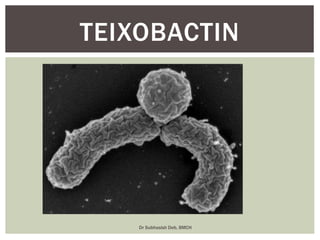
TEIXOBACTIN
Dr Subhasish Deb, BMCH
Discovery in Jan 2015
Published in the journal “Nature”
This discovery is also remarkable for
another reason – development of a
technology iCHIP that can herald the
discovery of many new antibiotics
TEIXOBACTIN
Dr Subhasish Deb, BMCH
A single scoop of soil contains millions of
bacteria & fungi
They survive by fighting each other by
producing what we call antibiotics
PROBLEM?
Only 1% of microbes in the soil (or sea
water) can be readily grown in Lab
conditions.
HOW ICHIP WORKS?
Dr Subhasish Deb, BMCH
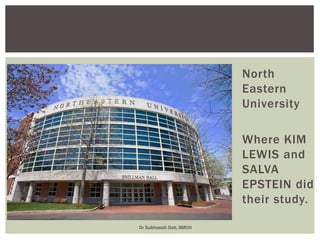
North
Eastern
University
Where KIM
LEWIS and
SALVA
EPSTEIN did
their study.
Dr Subhasish Deb, BMCH
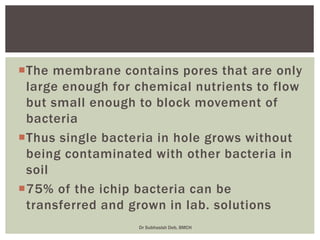
A sample soil is diluted and then poured oh
the iCHIP which consists of hundreds of
small holes
It is hoped that only 1 microbe is caught in
each hole
The chip is then covered with membranes
on both sides and put back into the soil
sample.
Dr Subhasish Deb, BMCH
The membrane contains pores that are only
large enough for chemical nutrients to flow
but small enough to block movement of
bacteria
Thus single bacteria in hole grows without
being contaminated with other bacteria in
soil
75% of the ichip bacteria can be
transferred and grown in lab. solutions
Dr Subhasish Deb, BMCH
One bacteria – Eleftheria terrae was found
to produce the best antibiotic –
TEIXOBACTIN
MOA:
Cell wall inhibition – attaches to essential
precursors required for cell wall synthesis.
It attacks gm+ bacteria that have thick cell
wall but no membrane as in gm-
Dr Subhasish Deb, BMCH
They have shown promise in mice, clinical
trials yet to be undertaken
The greatest developments of science are
often not the discoveries but the
developments that enable them. So while
teixobactin is certainly a remarkable
achievement, the new method to grow soil
bacteria in labs. is an equally important
contribution. Dr Subhasish Deb, BMCH
Thank YouTHANK YOU
Dr Subhasish Deb, BMCH

Teixobactin

  • 1.
    A NEW ANTIBIOTIC AFTER 25YEARS DR SUBHASISH DEB BURDWAN MEDICAL COLLEGE AND HOSPITAL DEPT. OF GENERAL MEDICINE Dr Subhasish Deb, BMCH
  • 2.
  • 3.
    Discovery in Jan2015 Published in the journal “Nature” This discovery is also remarkable for another reason – development of a technology iCHIP that can herald the discovery of many new antibiotics TEIXOBACTIN Dr Subhasish Deb, BMCH
  • 4.
    A single scoopof soil contains millions of bacteria & fungi They survive by fighting each other by producing what we call antibiotics PROBLEM? Only 1% of microbes in the soil (or sea water) can be readily grown in Lab conditions. HOW ICHIP WORKS? Dr Subhasish Deb, BMCH
  • 5.
    North Eastern University Where KIM LEWIS and SALVA EPSTEINdid their study. Dr Subhasish Deb, BMCH
  • 6.
    A sample soilis diluted and then poured oh the iCHIP which consists of hundreds of small holes It is hoped that only 1 microbe is caught in each hole The chip is then covered with membranes on both sides and put back into the soil sample. Dr Subhasish Deb, BMCH
  • 7.
  • 8.
    The membrane containspores that are only large enough for chemical nutrients to flow but small enough to block movement of bacteria Thus single bacteria in hole grows without being contaminated with other bacteria in soil 75% of the ichip bacteria can be transferred and grown in lab. solutions Dr Subhasish Deb, BMCH
  • 9.
    One bacteria –Eleftheria terrae was found to produce the best antibiotic – TEIXOBACTIN MOA: Cell wall inhibition – attaches to essential precursors required for cell wall synthesis. It attacks gm+ bacteria that have thick cell wall but no membrane as in gm- Dr Subhasish Deb, BMCH
  • 10.
    They have shownpromise in mice, clinical trials yet to be undertaken The greatest developments of science are often not the discoveries but the developments that enable them. So while teixobactin is certainly a remarkable achievement, the new method to grow soil bacteria in labs. is an equally important contribution. Dr Subhasish Deb, BMCH
  • 11.
    Thank YouTHANK YOU DrSubhasish Deb, BMCH