Zaira Akbar
Roll # 18
BS Botany 5th semester (evening)
(2015-2019)
University of Education
Township Campus
Department of Science and Technology
Topic to Present:
• Reproduction in Myxomycotes
Fig # 01:
Sub Kingdom Myxomycota:
• Members of Myxomycota are commonly referred to as slime
molds.
Class Myxomycetes:
• Members of this division are referred to as the acellular slime
molds or plasmodial slime molds.
• Acellular slime molds are those slime molds which pass through
a stage in which its cells fuse to form large cells with many
nuclei.
Reproduction in A-cellular Slime Molds:
1. Once a spore is released from the fruiting body it's dispersed, either
by insects, animals, and rain or air movement. On landing on a
suitable location with appropriate moisture and temperature, one to
four protoplasts are germinated.
2. The protoplasts once released from the spore's wall through either a
pore or fissure will be either a flagellated swarm cell if conditions are
wet, or a non-flagellated myxamoebae cell in dryer conditions.
3. If conditions for growth are not suitable, the cells can become
microcysts to survive long periods of time.
Reproduction in A-cellular Slime Molds:
4. A diploid zygote is formed when two compatible myxamoebae or swarm
cells fuse. This is known as plasmogamy and karyogamy.
5. After a time of feeding and growing, the zygote develops into a single
celled multinucleate structure known as a plasmodium.
6. If environmental conditions are not suitable, then the plasmodium can
change into another dormant state known as the sclerotium.
7. When the conditions are right, the mature plasmodium produces one
to many fruiting bodies containing spores depending on species.
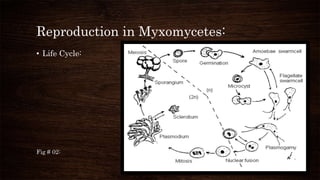
Reproduction in Myxomycetes:
• Life Cycle:
Fig # 02:
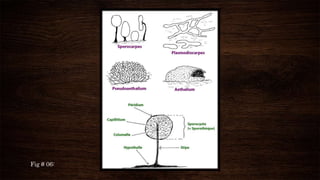
Shapes of Sporophores:
Generally there are following shapes of sporophores:
• Sporangium
• Aethalium
• Pseudoaethalium
• Plasmodiocarp
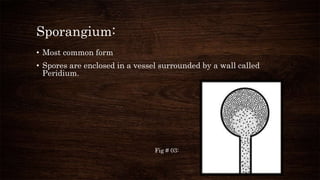
Sporangium:
• Most common form
• Spores are enclosed in a vessel surrounded by a wall called
Peridium.
Fig # 03:
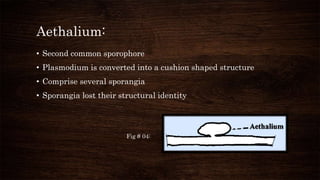
Aethalium:
• Second common sporophore
• Plasmodium is converted into a cushion shaped structure
• Comprise several sporangia
• Sporangia lost their structural identity
Fig # 04:
Pseudoaethalium:
• Several sporangia are grouped together
• Sporangia retain their structural identity and are structurally
distinct
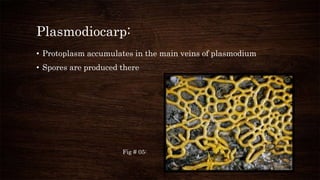
Plasmodiocarp:
• Protoplasm accumulates in the main veins of plasmodium
• Spores are produced there
Fig # 05:
Fig # 06:
Thank You

Myxomycota

  • 1.
    Zaira Akbar Roll #18 BS Botany 5th semester (evening) (2015-2019) University of Education Township Campus Department of Science and Technology
  • 2.
    Topic to Present: •Reproduction in Myxomycotes Fig # 01:
  • 3.
    Sub Kingdom Myxomycota: •Members of Myxomycota are commonly referred to as slime molds. Class Myxomycetes: • Members of this division are referred to as the acellular slime molds or plasmodial slime molds. • Acellular slime molds are those slime molds which pass through a stage in which its cells fuse to form large cells with many nuclei.
  • 4.
    Reproduction in A-cellularSlime Molds: 1. Once a spore is released from the fruiting body it's dispersed, either by insects, animals, and rain or air movement. On landing on a suitable location with appropriate moisture and temperature, one to four protoplasts are germinated. 2. The protoplasts once released from the spore's wall through either a pore or fissure will be either a flagellated swarm cell if conditions are wet, or a non-flagellated myxamoebae cell in dryer conditions. 3. If conditions for growth are not suitable, the cells can become microcysts to survive long periods of time.
  • 5.
    Reproduction in A-cellularSlime Molds: 4. A diploid zygote is formed when two compatible myxamoebae or swarm cells fuse. This is known as plasmogamy and karyogamy. 5. After a time of feeding and growing, the zygote develops into a single celled multinucleate structure known as a plasmodium. 6. If environmental conditions are not suitable, then the plasmodium can change into another dormant state known as the sclerotium. 7. When the conditions are right, the mature plasmodium produces one to many fruiting bodies containing spores depending on species.
  • 6.
    Reproduction in Myxomycetes: •Life Cycle: Fig # 02:
  • 7.
    Shapes of Sporophores: Generallythere are following shapes of sporophores: • Sporangium • Aethalium • Pseudoaethalium • Plasmodiocarp
  • 8.
    Sporangium: • Most commonform • Spores are enclosed in a vessel surrounded by a wall called Peridium. Fig # 03:
  • 9.
    Aethalium: • Second commonsporophore • Plasmodium is converted into a cushion shaped structure • Comprise several sporangia • Sporangia lost their structural identity Fig # 04:
  • 10.
    Pseudoaethalium: • Several sporangiaare grouped together • Sporangia retain their structural identity and are structurally distinct
  • 11.
    Plasmodiocarp: • Protoplasm accumulatesin the main veins of plasmodium • Spores are produced there Fig # 05:
  • 12.
  • 13.