The TEEP
Learning Cycle
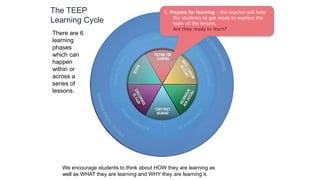
We encourage students to think about HOW they are learning as
well as WHAT they are learning and WHY they are learning it.
1. Prepare for learning – the teacher will help
the students to get ready to explore the
topic of the lesson.
Are they ready to learn?
There are 6
learning
phases
which can
happen
within or
across a
series of
lessons.
The TEEP
Learning Cycle
We encourage students to think about HOW they are learning as
well as WHAT they are learning and WHY they are learning it.
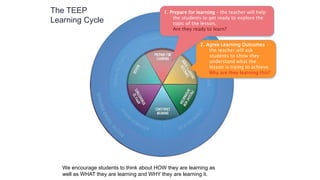
2. Agree Learning Outcomes –
the teacher will ask
students to show they
understand what the
lesson is trying to achieve.
Why are they learning this?
1. Prepare for learning – the teacher will help
the students to get ready to explore the
topic of the lesson.
Are they ready to learn?
The TEEP
Learning Cycle
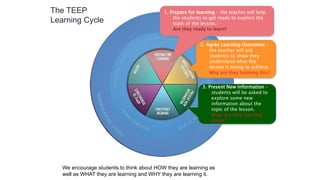
3. Present New Information –
students will be asked to
explore some new
information about the
topic of the lesson.
What are they learning
about?
2. Agree Learning Outcomes –
the teacher will ask
students to show they
understand what the
lesson is trying to achieve.
Why are they learning this?
1. Prepare for learning – the teacher will help
the students to get ready to explore the
topic of the lesson.
Are they ready to learn?
We encourage students to think about HOW they are learning as
well as WHAT they are learning and WHY they are learning it.
The TEEP
Learning Cycle
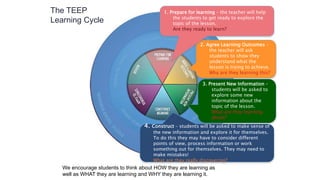
4. Construct – students will be asked to make sense of
the new information and explore it for themselves.
To do this they may have to consider different
points of view, process information or work
something out for themselves. They may need to
make mistakes!
What are they really discovering?
3. Present New Information –
students will be asked to
explore some new
information about the
topic of the lesson.
What are they learning
about?
2. Agree Learning Outcomes –
the teacher will ask
students to show they
understand what the
lesson is trying to achieve.
Why are they learning this?
1. Prepare for learning – the teacher will help
the students to get ready to explore the
topic of the lesson.
Are they ready to learn?
We encourage students to think about HOW they are learning as
well as WHAT they are learning and WHY they are learning it.
The TEEP
Learning Cycle
4. Apply to demonstrate –
students will be asked to
use their learning to answer
questions in different
situations or from different
angles to check that they
understand and can use
what they know.
How can they use what they
know?
4. Construct – students will be asked to make sense of
the new information and explore it for themselves.
To do this they may have to consider different
points of view, process information or work
something out for themselves. They may need to
make mistakes!
What are they really discovering?
3. Present New Information –
students will be asked to
explore some new
information about the
topic of the lesson.
What are they learning
about?
2. Agree Learning Outcomes –
the teacher will ask
students to show they
understand what the
lesson is trying to achieve.
Why are they learning this?
1. Prepare for learning – the teacher will help
the students to get ready to explore the
topic of the lesson.
Are they ready to learn?
We encourage students to think about HOW they are learning as
well as WHAT they are learning and WHY they are learning it.
The TEEP
Learning Cycle
5. Review – the teacher will
have a Big Review and mini
review points during the
lesson where they can
check students are making
good progress in their
learning.
Have they really
understood it?
5. Apply to demonstrate –
students will be asked to
use their learning to answer
questions in different
situations or from different
angles to check that they
understand and can use
what they know.
How can they use what they
know?
4. Construct – students will be asked to make sense of
the new information and explore it for themselves.
To do this they may have to consider different
points of view, process information or work
something out for themselves. They may need to
make mistakes!
What are they really discovering?
3. Present New Information –
students will be asked to
explore some new
information about the
topic of the lesson.
What are they learning
about?
2. Agree Learning Outcomes –
the teacher will ask
students to show they
understand what the
lesson is trying to achieve.
Why are they learning this?
1. Prepare for learning – the teacher will help
the students to get ready to explore the
topic of the lesson.
Are they ready to learn?
We encourage students to think about HOW they are learning as
well as WHAT they are learning and WHY they are learning it.
The Hoe
Devonport Park
Peacock
Meadow
Literacy
Concentrate on
getting full
stops and
capital letters
correct
Learning Journey
How will I know that I have learnt today?
If I complete the paper I will know if I have gained the
E3 Functional Skills qualification
Subject: English Date: 19th October
Shaylyn- E3 writing paper
Josh G- Advanced ARROW spelling assessment
Jack- E3 writing paper
Josh A- E3 writing paper
TEEP

TEEP

  • 1.
    The TEEP Learning Cycle Weencourage students to think about HOW they are learning as well as WHAT they are learning and WHY they are learning it. 1. Prepare for learning – the teacher will help the students to get ready to explore the topic of the lesson. Are they ready to learn? There are 6 learning phases which can happen within or across a series of lessons.
  • 2.
    The TEEP Learning Cycle Weencourage students to think about HOW they are learning as well as WHAT they are learning and WHY they are learning it. 2. Agree Learning Outcomes – the teacher will ask students to show they understand what the lesson is trying to achieve. Why are they learning this? 1. Prepare for learning – the teacher will help the students to get ready to explore the topic of the lesson. Are they ready to learn?
  • 3.
    The TEEP Learning Cycle 3.Present New Information – students will be asked to explore some new information about the topic of the lesson. What are they learning about? 2. Agree Learning Outcomes – the teacher will ask students to show they understand what the lesson is trying to achieve. Why are they learning this? 1. Prepare for learning – the teacher will help the students to get ready to explore the topic of the lesson. Are they ready to learn? We encourage students to think about HOW they are learning as well as WHAT they are learning and WHY they are learning it.
  • 4.
    The TEEP Learning Cycle 4.Construct – students will be asked to make sense of the new information and explore it for themselves. To do this they may have to consider different points of view, process information or work something out for themselves. They may need to make mistakes! What are they really discovering? 3. Present New Information – students will be asked to explore some new information about the topic of the lesson. What are they learning about? 2. Agree Learning Outcomes – the teacher will ask students to show they understand what the lesson is trying to achieve. Why are they learning this? 1. Prepare for learning – the teacher will help the students to get ready to explore the topic of the lesson. Are they ready to learn? We encourage students to think about HOW they are learning as well as WHAT they are learning and WHY they are learning it.
  • 5.
    The TEEP Learning Cycle 4.Apply to demonstrate – students will be asked to use their learning to answer questions in different situations or from different angles to check that they understand and can use what they know. How can they use what they know? 4. Construct – students will be asked to make sense of the new information and explore it for themselves. To do this they may have to consider different points of view, process information or work something out for themselves. They may need to make mistakes! What are they really discovering? 3. Present New Information – students will be asked to explore some new information about the topic of the lesson. What are they learning about? 2. Agree Learning Outcomes – the teacher will ask students to show they understand what the lesson is trying to achieve. Why are they learning this? 1. Prepare for learning – the teacher will help the students to get ready to explore the topic of the lesson. Are they ready to learn? We encourage students to think about HOW they are learning as well as WHAT they are learning and WHY they are learning it.
  • 6.
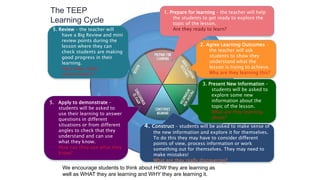
    The TEEP Learning Cycle 5.Review – the teacher will have a Big Review and mini review points during the lesson where they can check students are making good progress in their learning. Have they really understood it? 5. Apply to demonstrate – students will be asked to use their learning to answer questions in different situations or from different angles to check that they understand and can use what they know. How can they use what they know? 4. Construct – students will be asked to make sense of the new information and explore it for themselves. To do this they may have to consider different points of view, process information or work something out for themselves. They may need to make mistakes! What are they really discovering? 3. Present New Information – students will be asked to explore some new information about the topic of the lesson. What are they learning about? 2. Agree Learning Outcomes – the teacher will ask students to show they understand what the lesson is trying to achieve. Why are they learning this? 1. Prepare for learning – the teacher will help the students to get ready to explore the topic of the lesson. Are they ready to learn? We encourage students to think about HOW they are learning as well as WHAT they are learning and WHY they are learning it.
  • 13.
    The Hoe Devonport Park Peacock Meadow Literacy Concentrateon getting full stops and capital letters correct Learning Journey How will I know that I have learnt today? If I complete the paper I will know if I have gained the E3 Functional Skills qualification Subject: English Date: 19th October Shaylyn- E3 writing paper Josh G- Advanced ARROW spelling assessment Jack- E3 writing paper Josh A- E3 writing paper