How Do We Learn
HOW CAN WE HELP OUR LEARNERS ACTIVE INSTEAD OF PASSIVE?
Mission Statement
"to improve our students'
perception of themselves as
learners and help them
participate in the teaching
and learning process more
actively"
How do we learn?
 The first section of our research is based on how
we learn.
 We chose to start here because we need to
remind ourselves of some of the theories around
how we learn. The children need to be aware of
how they learn before we can teach them to
apply that self knowledge.
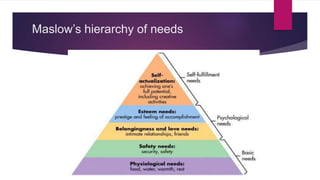
Maslow’s hierarchy of needs
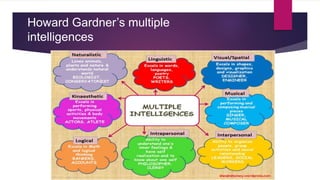
Howard Gardner’s multiple
intelligences
Learning best from experience.
(From The Multigrade Teacher's Handbook, published by the Bureau of Elementary Education, Department of Education,
Culture, and Sports, the Philippines, in cooperation with UNICEF, 1994.)
Children learn by doing, using their senses, exploring their environment of people, things, places and events.
They learn from first-hand and concrete experiences as well as vicarious forms of experiences, (e.g., storytelling,
listening to another person, reading a book and looking at pictures, watching television or listening to the radio).
Children do not learn as effectively when they are passive. Active engagement with things and ideas promotes
mental activity that helps students retain new learning and integrate it with what they already know.
If it is not possible to always provide concrete, first-hand experiences for the student, efforts must always be exerted so
that the student will be able to understand the concept in a clear and concrete way.
http://www.unicef.org/teachers/learner/exp.htm
Many Pathways of Learning
Every child is special, with unique
combinations of abilities and needs that
affect learning. And all children deserve
the opportunity to learn in ways that
make the most of their strengths and
help them overcome their weaknesses.
The uniqueness of each child
Every child is an individual, with special social, emotional, intellectual, and physical qualities.
Children are unique. They are individuals and no two children are alike: physically, emotionally, socially and
intellectually, each child is a unique individual. Because children are unique, even if there are common needs
and characteristics that children of a particular age or stage of development share, they must be understood
by their parents and teachers in their uniqueness, and their individuality must be respected.
For example, even in a single-grade classroom composed of 45 to 50 seven-year-olds, not all of the seven-
year-olds will be reading at precisely the same ability level. They will also differ in the ways they are able to
understand and solve word problems in mathematics. They will have different personalities—some will be
shy, some will be confident, some outgoing, some quiet but competent. They will each have their own life
experiences and feelings about themselves. They will have different likes and dislikes, interests and needs.
However, this does not mean that a teacher has to prepare 45 or 50 different lesson plans whether it is a
single-grade or a multigrid classroom. Instead the teacher must be able to get to know and understand each
of the children and prepare teaching/learning activities that will respond to and reflect these individual needs
of children. As children work individually or independently, in small-groups or as a whole group, they will
each benefit in their own way from these activities. What is most important is that the teacher, who is
primarily responsible for planning the daily activities through which the children will learn, should know every
child and keep track of how well each child is able to learn.
Teep team
Teep team

Teep team

  • 1.
    How Do WeLearn HOW CAN WE HELP OUR LEARNERS ACTIVE INSTEAD OF PASSIVE?
  • 2.
    Mission Statement "to improveour students' perception of themselves as learners and help them participate in the teaching and learning process more actively"
  • 3.
    How do welearn?  The first section of our research is based on how we learn.  We chose to start here because we need to remind ourselves of some of the theories around how we learn. The children need to be aware of how they learn before we can teach them to apply that self knowledge.
  • 4.
  • 5.
  • 6.
    Learning best fromexperience. (From The Multigrade Teacher's Handbook, published by the Bureau of Elementary Education, Department of Education, Culture, and Sports, the Philippines, in cooperation with UNICEF, 1994.) Children learn by doing, using their senses, exploring their environment of people, things, places and events. They learn from first-hand and concrete experiences as well as vicarious forms of experiences, (e.g., storytelling, listening to another person, reading a book and looking at pictures, watching television or listening to the radio). Children do not learn as effectively when they are passive. Active engagement with things and ideas promotes mental activity that helps students retain new learning and integrate it with what they already know. If it is not possible to always provide concrete, first-hand experiences for the student, efforts must always be exerted so that the student will be able to understand the concept in a clear and concrete way. http://www.unicef.org/teachers/learner/exp.htm
  • 7.
    Many Pathways ofLearning Every child is special, with unique combinations of abilities and needs that affect learning. And all children deserve the opportunity to learn in ways that make the most of their strengths and help them overcome their weaknesses.
  • 8.
    The uniqueness ofeach child Every child is an individual, with special social, emotional, intellectual, and physical qualities. Children are unique. They are individuals and no two children are alike: physically, emotionally, socially and intellectually, each child is a unique individual. Because children are unique, even if there are common needs and characteristics that children of a particular age or stage of development share, they must be understood by their parents and teachers in their uniqueness, and their individuality must be respected. For example, even in a single-grade classroom composed of 45 to 50 seven-year-olds, not all of the seven- year-olds will be reading at precisely the same ability level. They will also differ in the ways they are able to understand and solve word problems in mathematics. They will have different personalities—some will be shy, some will be confident, some outgoing, some quiet but competent. They will each have their own life experiences and feelings about themselves. They will have different likes and dislikes, interests and needs. However, this does not mean that a teacher has to prepare 45 or 50 different lesson plans whether it is a single-grade or a multigrid classroom. Instead the teacher must be able to get to know and understand each of the children and prepare teaching/learning activities that will respond to and reflect these individual needs of children. As children work individually or independently, in small-groups or as a whole group, they will each benefit in their own way from these activities. What is most important is that the teacher, who is primarily responsible for planning the daily activities through which the children will learn, should know every child and keep track of how well each child is able to learn.

Editor's Notes

  • #5 Maslow's (1943, 1954) hierarchy of needs is a motivational theory in psychology comprising a five tier model of human needs, often depicted as hierarchical levels within a pyramid. Maslow wanted to understand what motivates people. He believed that people possess a set of motivation systems unrelated to rewards or unconscious desires. Maslow stated that people are motivated to achieve certain needs, and that some needs take precedence over others. Our most basic need is for physical survival, and this will be the first thing that motivates our behaviour. Once that level is fulfilled the next level up is what motivates us, and so on. One must satisfy lower level needs before progressing on to meet higher level growth needs. Every person is capable and has the desire to move up the hierarchy toward a level of self-actualization. Unfortunately, progress is often disrupted by failure to meet lower level needs. Life experiences, including divorce and loss of job may cause an individual to fluctuate between levels of the hierarchy.
  • #6 Howard Gardner’s theory of multiple intelligences The idea that we all learn differently. Our student will most likely not possess one style exclusively but you may be able to see patterns in their learning preferences. For example, a student who is visual may also be a very social and verbal learner and prefers to learn especially difficult topics using their primary skills. Teachers often use their preferred learning style as their main mode of teaching and if students do not share those same preferences then learning can be very difficult and frustrating. As a Special Education teacher it was important for me to understand those differences in order to maximize my students' learning potential. Compare the differences between how they learn Aurally and Visually as well as the other styles outlined above. Compare how they interact with others while learning in a group or by themselves. No student is exclusively one style or another and most utilize a variety of modalities when learning. It is important to expand their abilities to use as many learning styles as possible, helping them to succeed in a world where how one learns often means nothing and only the ability to learn has value.