


Factors of Effective School
Cambodian International Cooperation Institute
Faculty of Language and Art
Foundation of Education
G6,Y4S2
2015
Factors of Effective School
Vichet KEO
Chantra PINH
Phannith YANG
Kompheak CHHAY
Sakada SRUN
Phanny MAN
Submitted to lecturer HENG PLY
Cambodian International Cooperation Institute
Faculty of Language and Art
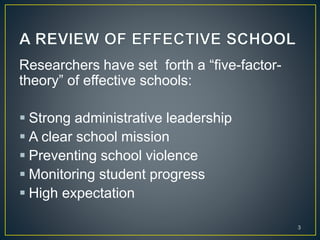
Researchers have set forth a “five-factor-
theory” of effective schools:
 Strong administrative leadership
 A clear school mission
 Preventing school violence
 Monitoring student progress
 High expectation
3
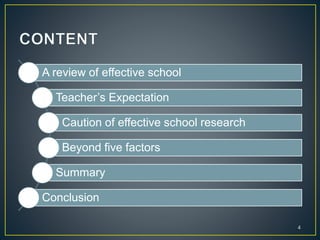
A review of effective school
Teacher’s Expectation
Caution of effective school research
Beyond five factors
Summary
Conclusion
4
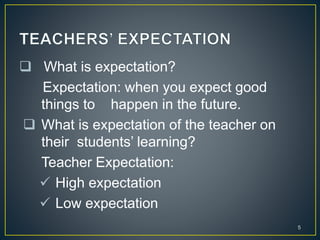
 What is expectation?
Expectation: when you expect good
things to happen in the future.
 What is expectation of the teacher on
their students’ learning?
Teacher Expectation:
 High expectation
 Low expectation
5
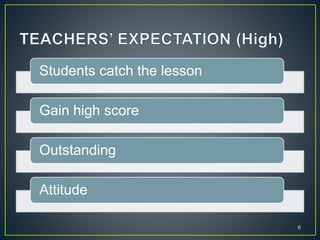
Students catch the lesson
Gain high score
Outstanding
Attitude
6
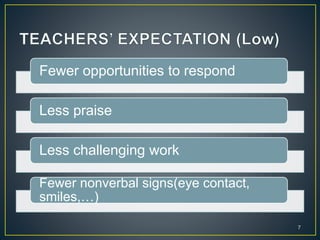
Fewer opportunities to respond
Less praise
Less challenging work
Fewer nonverbal signs(eye contact,
smiles,…)
7
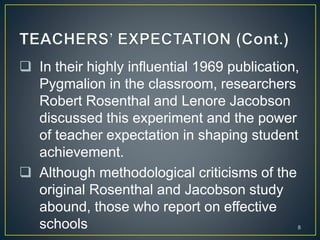
 In their highly influential 1969 publication,
Pygmalion in the classroom, researchers
Robert Rosenthal and Lenore Jacobson
discussed this experiment and the power
of teacher expectation in shaping student
achievement.
 Although methodological criticisms of the
original Rosenthal and Jacobson study
abound, those who report on effective
schools 8
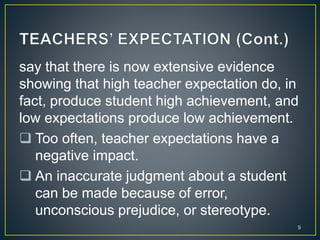
say that there is now extensive evidence
showing that high teacher expectation do, in
fact, produce student high achievement, and
low expectations produce low achievement.
 Too often, teacher expectations have a
negative impact.
 An inaccurate judgment about a student
can be made because of error,
unconscious prejudice, or stereotype.
9
 When teacher hold low expectation for
certain students; typically, they offer such
students:
 Fewer opportunities to respond
 Less praise
 Less challenging work
 Fewer nonverbal signs
10
 In effective schools, teachers hold high
expectations can learn, set objective
work toward mastery objectives, spend
more time on instruction. They are
convinced that students can succeed.
 Finally, in effective schools teachers hold
high expectations for themselves. They
believe that they can deliver high-quality
instruction.
11
Although the research on what makes schools
effective has had a direct impact on national
reform movements, it has limitations as shown
below:
 Disagreement over the definition of an
effective school
 Do not really provide a prescription for
developing successful school
 Much of the research has been conducted
only on lower grades of elementary school
 The generalizability of the research is also
12
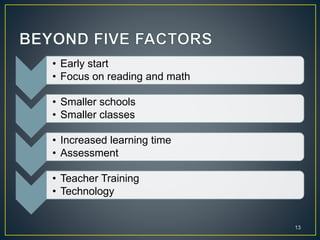
• Early start
• Focus on reading and math
• Smaller schools
• Smaller classes
• Increased learning time
• Assessment
• Teacher Training
• Technology
13
 Early start: The concept that there is a
particular age for children to begin school needs
to be rethought. The earlier schools start
working with children start working with
children, the better children do, during the first
three years of life opportunities for children.
 Focus on reading and math: Children not
reading at grade level by the end of the first
grade face a one-in-eight change of ever
catching up. In math, students who do not
master basic concept find themselves playing14
 Smaller school: Students in small
schools learn more, are more pass their
course, are less prone to resort to
violence, and are more to attend college
than those attending large schools.
 Smaller classes: Studies indicate that
smaller classes are associated with
increased student learning. Children in
classes of fifteen outperform students in
classes of twenty-five, even when have 15
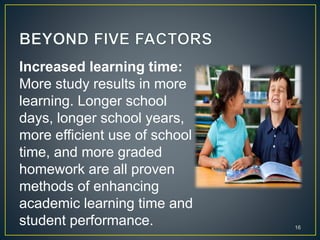
Increased learning time:
More study results in more
learning. Longer school
days, longer school years,
more efficient use of school
time, and more graded
homework are all proven
methods of enhancing
academic learning time and
student performance. 16
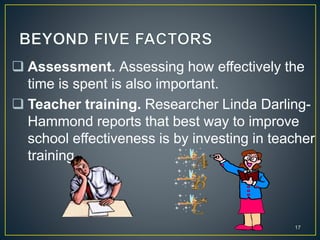
 Assessment. Assessing how effectively the
time is spent is also important.
 Teacher training. Researcher Linda Darling-
Hammond reports that best way to improve
school effectiveness is by investing in teacher
training.
17
 What about technology: School districts
that are hesitant to spend funds on
teacher training, class size reductions, or
early childhood education programs
nevertheless are quick to invest
significant sums in computers and
upgraded technology.
How can we improve school so that
they enhance both psychological well-
being and academic success. 18
o Teachers keep busy in class, while students their
students sitting, waiting and respond by
daydreaming or training themselves to deny their
desire to be active.
o Flanders, Bellack, Goodlad found that teachers
lecture a great deal and ask questions, while
students are reduced to passive listening, active
only when respond to the teachers.
o Goodlad: “when teachers spend more time
teaching, students learn more”.
19
o Being tracked into slower classes has a negative
impact on students’ self-esteem.
o Beginning in elementary school, peer pressure
wields great power in children’s lives.
o Educational reform efforts have focused on
adolescent’s social and personal needs.
o Schools increasing number of roles traditionally
filled by parents, from sex education to drug and
pregnancy counselling.
20
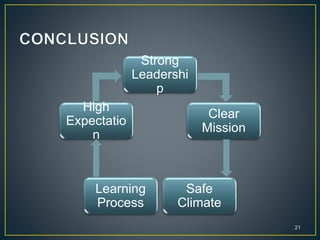
Strong
Leadershi
p
Clear
Mission
Safe
Climate
Learning
Process
High
Expectatio
n
21
22
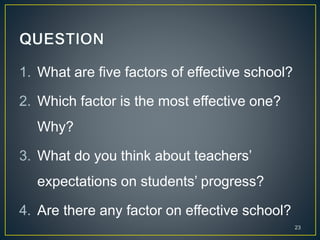
1. What are five factors of effective school?
2. Which factor is the most effective one?
Why?
3. What do you think about teachers’
expectations on students’ progress?
4. Are there any factor on effective school?
23
All right reserved
Group 10 of Foundation of
Education
24

High expectation

  • 1.
    Factors of EffectiveSchool Cambodian International Cooperation Institute Faculty of Language and Art Foundation of Education G6,Y4S2 2015
  • 2.
    Factors of EffectiveSchool Vichet KEO Chantra PINH Phannith YANG Kompheak CHHAY Sakada SRUN Phanny MAN Submitted to lecturer HENG PLY Cambodian International Cooperation Institute Faculty of Language and Art
  • 3.
    Researchers have setforth a “five-factor- theory” of effective schools:  Strong administrative leadership  A clear school mission  Preventing school violence  Monitoring student progress  High expectation 3
  • 4.
    A review ofeffective school Teacher’s Expectation Caution of effective school research Beyond five factors Summary Conclusion 4
  • 5.
     What isexpectation? Expectation: when you expect good things to happen in the future.  What is expectation of the teacher on their students’ learning? Teacher Expectation:  High expectation  Low expectation 5
  • 6.
    Students catch thelesson Gain high score Outstanding Attitude 6
  • 7.
    Fewer opportunities torespond Less praise Less challenging work Fewer nonverbal signs(eye contact, smiles,…) 7
  • 8.
     In theirhighly influential 1969 publication, Pygmalion in the classroom, researchers Robert Rosenthal and Lenore Jacobson discussed this experiment and the power of teacher expectation in shaping student achievement.  Although methodological criticisms of the original Rosenthal and Jacobson study abound, those who report on effective schools 8
  • 9.
    say that thereis now extensive evidence showing that high teacher expectation do, in fact, produce student high achievement, and low expectations produce low achievement.  Too often, teacher expectations have a negative impact.  An inaccurate judgment about a student can be made because of error, unconscious prejudice, or stereotype. 9
  • 10.
     When teacherhold low expectation for certain students; typically, they offer such students:  Fewer opportunities to respond  Less praise  Less challenging work  Fewer nonverbal signs 10
  • 11.
     In effectiveschools, teachers hold high expectations can learn, set objective work toward mastery objectives, spend more time on instruction. They are convinced that students can succeed.  Finally, in effective schools teachers hold high expectations for themselves. They believe that they can deliver high-quality instruction. 11
  • 12.
    Although the researchon what makes schools effective has had a direct impact on national reform movements, it has limitations as shown below:  Disagreement over the definition of an effective school  Do not really provide a prescription for developing successful school  Much of the research has been conducted only on lower grades of elementary school  The generalizability of the research is also 12
  • 13.
    • Early start •Focus on reading and math • Smaller schools • Smaller classes • Increased learning time • Assessment • Teacher Training • Technology 13
  • 14.
     Early start:The concept that there is a particular age for children to begin school needs to be rethought. The earlier schools start working with children start working with children, the better children do, during the first three years of life opportunities for children.  Focus on reading and math: Children not reading at grade level by the end of the first grade face a one-in-eight change of ever catching up. In math, students who do not master basic concept find themselves playing14
  • 15.
     Smaller school:Students in small schools learn more, are more pass their course, are less prone to resort to violence, and are more to attend college than those attending large schools.  Smaller classes: Studies indicate that smaller classes are associated with increased student learning. Children in classes of fifteen outperform students in classes of twenty-five, even when have 15
  • 16.
    Increased learning time: Morestudy results in more learning. Longer school days, longer school years, more efficient use of school time, and more graded homework are all proven methods of enhancing academic learning time and student performance. 16
  • 17.
     Assessment. Assessinghow effectively the time is spent is also important.  Teacher training. Researcher Linda Darling- Hammond reports that best way to improve school effectiveness is by investing in teacher training. 17
  • 18.
     What abouttechnology: School districts that are hesitant to spend funds on teacher training, class size reductions, or early childhood education programs nevertheless are quick to invest significant sums in computers and upgraded technology. How can we improve school so that they enhance both psychological well- being and academic success. 18
  • 19.
    o Teachers keepbusy in class, while students their students sitting, waiting and respond by daydreaming or training themselves to deny their desire to be active. o Flanders, Bellack, Goodlad found that teachers lecture a great deal and ask questions, while students are reduced to passive listening, active only when respond to the teachers. o Goodlad: “when teachers spend more time teaching, students learn more”. 19
  • 20.
    o Being trackedinto slower classes has a negative impact on students’ self-esteem. o Beginning in elementary school, peer pressure wields great power in children’s lives. o Educational reform efforts have focused on adolescent’s social and personal needs. o Schools increasing number of roles traditionally filled by parents, from sex education to drug and pregnancy counselling. 20
  • 21.
  • 22.
  • 23.
    1. What arefive factors of effective school? 2. Which factor is the most effective one? Why? 3. What do you think about teachers’ expectations on students’ progress? 4. Are there any factor on effective school? 23
  • 24.
    All right reserved Group10 of Foundation of Education 24