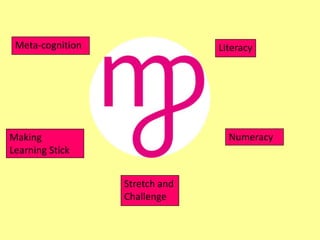
Meta-cognition Literacy
Making
Learning Stick
Stretch and
Challenge
Numeracy
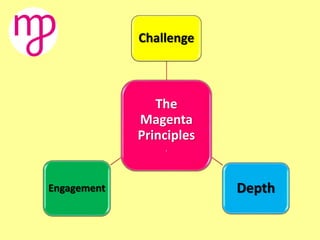
The
Magenta
Principles
‘
Challenge
DepthEngagement
The
Magenta
Principles
Mike Hughes
Challenge
DepthEngagement
What do you ask students to do to/with
information in order to make it more likely that
they will understand it?
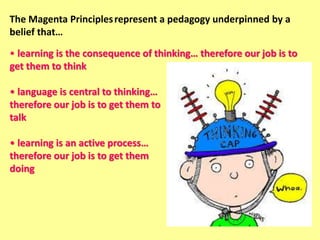
The Magenta Principlesrepresent a pedagogy underpinned by a
belief that…
• learning is the consequence of thinking… therefore our job is to
get them to think
• language is central to thinking…
therefore our job is to get them to
talk
• learning is an active process…
therefore our job is to get them
doing
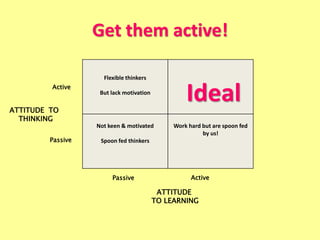
Flexible thinkers
But lack motivation
Ideal
Not keen & motivated
Spoon fed thinkers
Work hard but are spoon fed
by us!
Get them active!
Active
Passive
ActivePassive
ATTITUDE TO
THINKING
ATTITUDE
TO LEARNING
It may look the same but there is a fundamental difference
between:
A) Read page 7
and
B) Have a look at page 7 and tell me which you think is the most
important sentence
Pupils are simply receiving information in scenario A but in
scenario B they have to do something to it.
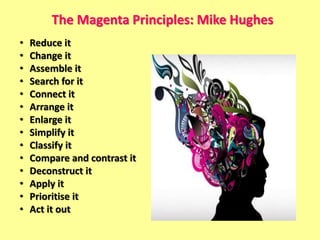
• Reduce it
• Change it
• Assemble it
• Search for it
• Connect it
• Arrange it
• Enlarge it
• Simplify it
• Classify it
• Compare and contrast it
• Deconstruct it
• Apply it
• Prioritise it
• Act it out
The Magenta Principles: Mike Hughes
Magenta Challenges
Have a magenta principles challenge wall…
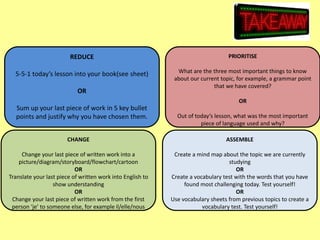
REDUCE
5-5-1 today’s lesson into your book(see sheet)
OR
Sum up your last piece of work in 5 key bullet
points and justify why you have chosen them.
PRIORITISE
What are the three most important things to know
about our current topic, for example, a grammar point
that we have covered?
OR
Out of today’s lesson, what was the most important
piece of language used and why?
CHANGE
Change your last piece of written work into a
picture/diagram/storyboard/flowchart/cartoon
OR
Translate your last piece of written work into English to
show understanding
OR
Change your last piece of written work from the first
person ‘je’ to someone else, for example il/elle/nous
ASSEMBLE
Create a mind map about the topic we are currently
studying
OR
Create a vocabulary test with the words that you have
found most challenging today. Test yourself!
OR
Use vocabulary sheets from previous topics to create a
vocabulary test. Test yourself!
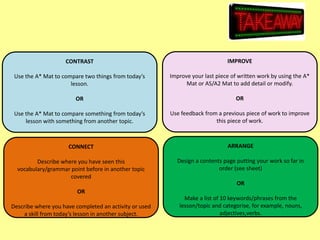
CONTRAST
Use the A* Mat to compare two things from today’s
lesson.
OR
Use the A* Mat to compare something from today’s
lesson with something from another topic.
IMPROVE
Improve your last piece of written work by using the A*
Mat or AS/A2 Mat to add detail or modify.
OR
Use feedback from a previous piece of work to improve
this piece of work.
CONNECT
Describe where you have seen this
vocabulary/grammar point before in another topic
covered
OR
Describe where you have completed an activity or used
a skill from today’s lesson in another subject.
ARRANGE
Design a contents page putting your work so far in
order (see sheet)
OR
Make a list of 10 keywords/phrases from the
lesson/topic and categorise, for example, nouns,
adjectives,verbs.
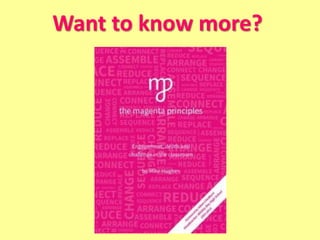
Want to know more?
How do you or could you incorporate The Magenta
Principles into your classroom practice?
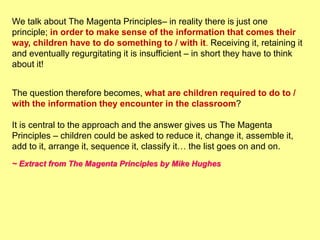
We talk about The Magenta Principles– in reality there is just one
principle; in order to make sense of the information that comes their
way, children have to do something to / with it. Receiving it, retaining it
and eventually regurgitating it is insufficient – in short they have to think
about it!
The question therefore becomes, what are children required to do to /
with the information they encounter in the classroom?
It is central to the approach and the answer gives us The Magenta
Principles – children could be asked to reduce it, change it, assemble it,
add to it, arrange it, sequence it, classify it… the list goes on and on.
~ Extract from The Magenta Principles by Mike Hughes

The magenta-principles v2

  • 1.
  • 2.
  • 3.
  • 4.
    What do youask students to do to/with information in order to make it more likely that they will understand it?
  • 5.
    The Magenta Principlesrepresenta pedagogy underpinned by a belief that… • learning is the consequence of thinking… therefore our job is to get them to think • language is central to thinking… therefore our job is to get them to talk • learning is an active process… therefore our job is to get them doing
  • 6.
    Flexible thinkers But lackmotivation Ideal Not keen & motivated Spoon fed thinkers Work hard but are spoon fed by us! Get them active! Active Passive ActivePassive ATTITUDE TO THINKING ATTITUDE TO LEARNING
  • 7.
    It may lookthe same but there is a fundamental difference between: A) Read page 7 and B) Have a look at page 7 and tell me which you think is the most important sentence Pupils are simply receiving information in scenario A but in scenario B they have to do something to it.
  • 8.
    • Reduce it •Change it • Assemble it • Search for it • Connect it • Arrange it • Enlarge it • Simplify it • Classify it • Compare and contrast it • Deconstruct it • Apply it • Prioritise it • Act it out The Magenta Principles: Mike Hughes
  • 9.
  • 10.
    Have a magentaprinciples challenge wall…
  • 11.
    REDUCE 5-5-1 today’s lessoninto your book(see sheet) OR Sum up your last piece of work in 5 key bullet points and justify why you have chosen them. PRIORITISE What are the three most important things to know about our current topic, for example, a grammar point that we have covered? OR Out of today’s lesson, what was the most important piece of language used and why? CHANGE Change your last piece of written work into a picture/diagram/storyboard/flowchart/cartoon OR Translate your last piece of written work into English to show understanding OR Change your last piece of written work from the first person ‘je’ to someone else, for example il/elle/nous ASSEMBLE Create a mind map about the topic we are currently studying OR Create a vocabulary test with the words that you have found most challenging today. Test yourself! OR Use vocabulary sheets from previous topics to create a vocabulary test. Test yourself!
  • 12.
    CONTRAST Use the A*Mat to compare two things from today’s lesson. OR Use the A* Mat to compare something from today’s lesson with something from another topic. IMPROVE Improve your last piece of written work by using the A* Mat or AS/A2 Mat to add detail or modify. OR Use feedback from a previous piece of work to improve this piece of work. CONNECT Describe where you have seen this vocabulary/grammar point before in another topic covered OR Describe where you have completed an activity or used a skill from today’s lesson in another subject. ARRANGE Design a contents page putting your work so far in order (see sheet) OR Make a list of 10 keywords/phrases from the lesson/topic and categorise, for example, nouns, adjectives,verbs.
  • 13.
  • 14.
    How do youor could you incorporate The Magenta Principles into your classroom practice?
  • 15.
    We talk aboutThe Magenta Principles– in reality there is just one principle; in order to make sense of the information that comes their way, children have to do something to / with it. Receiving it, retaining it and eventually regurgitating it is insufficient – in short they have to think about it! The question therefore becomes, what are children required to do to / with the information they encounter in the classroom? It is central to the approach and the answer gives us The Magenta Principles – children could be asked to reduce it, change it, assemble it, add to it, arrange it, sequence it, classify it… the list goes on and on. ~ Extract from The Magenta Principles by Mike Hughes

Editor's Notes

  • #7  ATTITUDE TO THINKING = If ask for their own ideas; thoughts; how flexible their ideas are. ATTITUDE TO LEARNING= motivation /diligence/effort into cw & hw
  • #11 Challenge wall and extension activities which are not more of doing the same