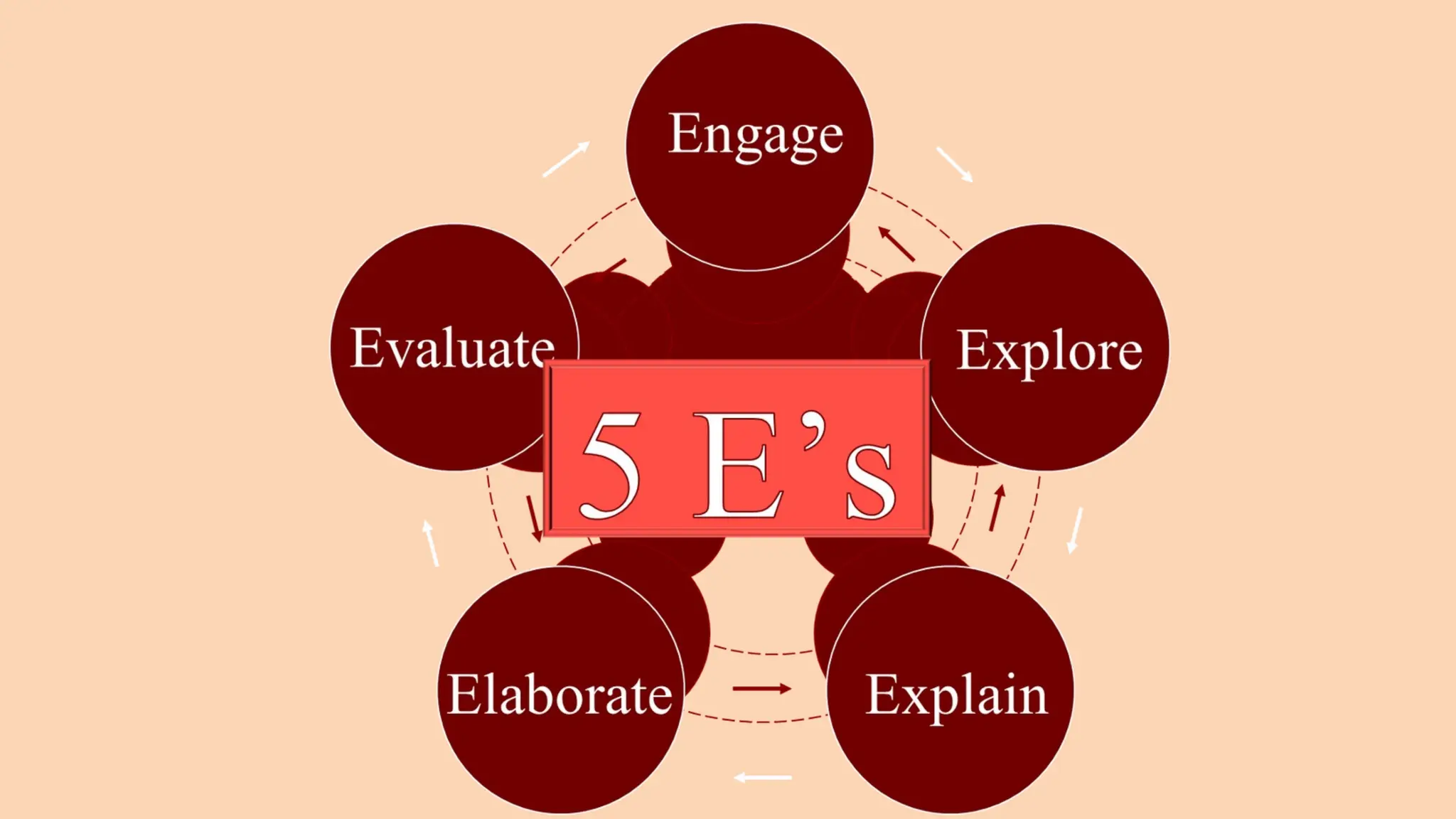
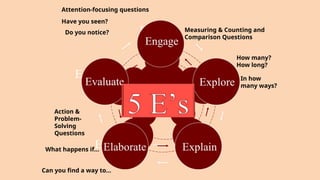
Engage
Explore
Explain
Elaborate
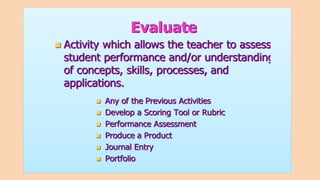
Evaluate
Measuring & Counting and
Comparison Questions
Attention-focusing questions
Action &
Problem-
Solving
Questions
Have you seen?
Do you notice?
How many?
How long?
In how
many ways?
What happens if…
Can you find a way to…
The 5 E's
The 5 E's is an instructional model based on the
constructivist approach to learning, which says
that learners build or construct new ideas on top
of their old ideas. The 5 E's can be used with
students of all ages, including adults.
Each of the 5 E's describes a phase of learning,
and each phase begins with the letter "E":
Engage, Explore, Explain, Elaborate, and
Evaluate. The 5 E's allows students and teachers
to experience common activities, to use and
build on prior knowledge and experience, to
Constructivism is a learning strategy that
draws on students' existing knowledge,
beliefs, and skills. With a constructivist
approach, students synthesize new
understanding from prior learning and new
information.
The constructivist teacher sets up problems
and monitors student exploration, guides
student inquiry, and promotes new
patterns of thinking. Working mostly with
raw data, primary sources, and interactive
material, constructivist teaching asks
students to work with their own data and
learn to direct their own explorations.
The philosophy about learning, that
proposes learners need to build their own
understanding of new ideas, has been
labeled constructivism. Much has been
researched and written by many eminent
leaders in the fields of learning theory and
cognition. Scholars such as Jean Piaget,
Eleanor Duckworth, George Hein, and
Howard Gardener have explored these
ideas in-depth. The Biological Science
Curriculum Study (BSCS), a team whose
Principal Investigator is Roger Bybee
Constructivis
m
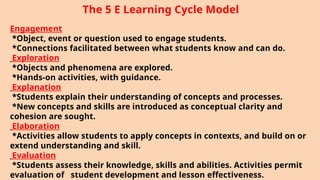
The 5 E Learning Cycle Model
Engagement
*Object, event or question used to engage students.
*Connections facilitated between what students know and can do.
Exploration
*Objects and phenomena are explored.
*Hands-on activities, with guidance.
Explanation
*Students explain their understanding of concepts and processes.
*New concepts and skills are introduced as conceptual clarity and
cohesion are sought.
Elaboration
*Activities allow students to apply concepts in contexts, and build on or
extend understanding and skill.
Evaluation
*Students assess their knowledge, skills and abilities. Activities permit
evaluation of student development and lesson effectiveness.
Questions for Consideration for Each Phase
1. Engagement
• The engagement phase of the 5-E model is intended to provide a focus
for the
lesson and to allow the teacher to probe students’ initial conceptions.
• What do students already know about the concept?
• What do they want to know?
• What will they explore?
2. Exploration
• What is the precise concept that students will explore?
• What activities must the children do to become familiar with the
concept?
• What kinds of observations and records should the children keep?
• What kinds of instructions will the children need? How can you give
the instructions
without telling the concept?
3. Explanation
• What kinds of information or findings should the children talk about?
• How can you help students summarize their findings?
• How can you guide the students and refrain from telling them what
they should have
found, even if their understanding is incomplete?
4. Expansion
• How can you connect with children's prior experiences?
• How does the concept relate to the science program goals?
• What questions can be used to encourage discovery of the concept's
importance?
• What new experiences will help to apply or expand the concept?
• What is the next concept related to the present one?
5. Evaluation
• What are the appropriate learning outcomes you should expect?
• What types of hands-on evaluation techniques can the children do to
demonstrate the
basic process skills?
• What techniques are appropriate for children to demonstrate the
integrated process
skills?
• How can pictures help children to demonstrate how well they can
think through
problems?
• What types of questions will help children to reflect on what they
have discovered?
In the stage Engage, the students first
encounter and identify the instructional task.
Here they make connections between past and
present learning experiences, lay the
organizational ground work for the activities
ahead and stimulate their involvement in the
anticipation of these activities. Asking a
question, defining a problem, showing a
surprising event and acting out a problematic
situation are all ways to engage the students
and focus them on the instructional tasks. If we
were to make an analogy to the world of
marketing a product, at first we need to grab
the customer's attention. We won't have their
Engag
e
In the Exploration stage the students have
the opportunity to get directly involved
with phenomena and materials. Involving
themselves in these activities they develop
a grounding of experience with the
phenomenon. As they work together in
teams, students build a base of common
experience which assists them in the
process of sharing and communicating. The
teacher acts as a facilitator, providing
materials and guiding the students' focus.
The students' inquiry process drives the
Explor
e
The third stage, Explain, is the point at which the learner begins to
put the abstract experience through which she/he has gone /into a
communicable form. Language provides motivation for sequencing
events into a logical format. Communication occurs between peers,
the facilitator, or within the learner himself. Working in groups,
learners support each other's understanding as they articulate
their observations, ideas, questions and hypotheses. Language
provides a tool of communicable labels. These labels, applied to
elements of abstract exploration, give the learner a means of
sharing these explorations. Explanations from the facilitator can
provide names that correspond to historical and standard language,
for student findings and events. For example a child, through her
exploration, may state they have noticed that a magnet has a
tendency to "stick" to a certain metallic object. The facilitator, in
her discussion with the child, might at this stage introduce
terminology referring to "an attracting force". Introducing labels,
after the child has had a direct experience, is far more meaningful
than before that experience. The experiential base she has built
offers the student an attachment place for the label. Common
language enhances the sharing and communication between
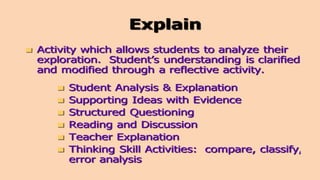
Explain
In stage four, Elaborate, the students expand on the
concepts they have learned, make connections to
other related concepts, and apply their
understandings to the world around them. For
example, while exploring light phenomena, a
learner constructs an understanding of the path
light travels through space. Examining a lamp post,
she may notice that the shadow of the post changes
its location as the day grows later. This observation
can lead to further inquiry as to possible
connections between the shadow's changing
location and the changes in direction of the light
source, the Sun. Applications to real world events,
such as where to plant flowers so that they receive
sunlight most of the day, or how to prop up a beach
umbrella for shade from the Sun, are both
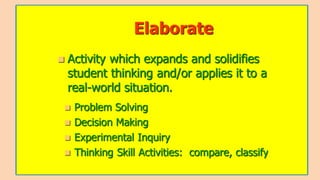
Elabora
te
Evaluate, the fifth "E", is an on-going diagnostic process that allows
the teacher to determine if the learner has attained understanding
of concepts and knowledge. Evaluation and assessment can occur
at all points along the continuum of the instructional process. Some
of the tools that assist in this diagnostic process are: rubrics
(quantified and prioritized outcome expectations) determined
hand-in-hand with the lesson design, teacher observation
structured by checklists, student interviews, portfolios designed
with specific purposes, project and problem-based learning
products, and embedded assessments. Concrete evidence of the
learning proceed is most valuable in communications between
students, teachers, parents and administrators. Displays of
attainment and progress enhance understanding for all parties
involved in the educational process, and can become jumping off
points for further enrichment of the students' education. These
evidences of learning serve to guide the teacher in further lesson
planning and may signal the need for modification and change of
direction. For example, if a teacher perceives clear evidence of
misconception, then he/she can revisit the concept to enhance
Evaluat
e
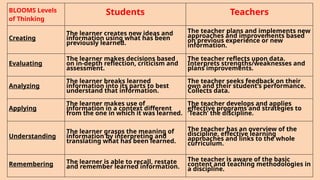
BLOOMS Levels
of Thinking
Students Teachers
Creating
The learner creates new ideas and
information using what has been
previously learned.
The teacher plans and implements new
approaches and improvements based
on previous experience or new
information.
Evaluating
The learner makes decisions based
on in-depth reflection, criticism and
assessment.
The teacher reflects upon data.
Interprets strengths/weaknesses and
plans improvements.
Analyzing
The learner breaks learned
information into its parts to best
understand that information.
The teacher seeks feedback on their
own and their student’s performance.
Collects data.
Applying
The learner makes use of
information in a context different
from the one in which it was learned.
The teacher develops and applies
effective programs and strategies to
‘Teach’ the discipline.
Understanding
The learner grasps the meaning of
information by interpreting and
translating what has been learned.
The teacher has an overview of the
discipline, effective learning
approaches and links to the whole
curriculum.
Remembering The learner is able to recall, restate
and remember learned information.
The teacher is aware of the basic
content and teaching methodologies in
a discipline.
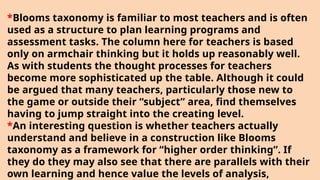
*Blooms taxonomy is familiar to most teachers and is often
used as a structure to plan learning programs and
assessment tasks. The column here for teachers is based
only on armchair thinking but it holds up reasonably well.
As with students the thought processes for teachers
become more sophisticated up the table. Although it could
be argued that many teachers, particularly those new to
the game or outside their “subject” area, find themselves
having to jump straight into the creating level.
*An interesting question is whether teachers actually
understand and believe in a construction like Blooms
taxonomy as a framework for “higher order thinking”. If
they do they may also see that there are parallels with their
own learning and hence value the levels of analysis,
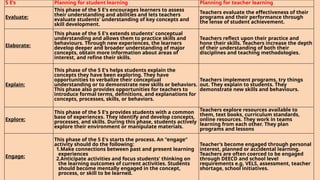
5 E’s Planning for student learning Planning for teacher learning
Evaluate:
This phase of the 5 E's encourages learners to assess
their understanding and abilities and lets teachers
evaluate students' understanding of key concepts and
skill development.
Teachers evaluate the effectiveness of their
programs and their performance through
the lense of student achievement.
Elaborate:
This phase of the 5 E's extends students' conceptual
understanding and allows them to practice skills and
behaviours. Through new experiences, the learners
develop deeper and broader understanding of major
concepts, obtain more information about areas of
interest, and refine their skills.
Teachers reflect upon their practice and
hone their skills. Teachers increase the depth
of their understanding of both their
disciplines and teaching methodologies.
Explain:
This phase of the 5 E's helps students explain the
concepts they have been exploring. They have
opportunities to verbalize their conceptual
understanding or to demonstrate new skills or behaviors.
This phase also provides opportunities for teachers to
introduce formal terms, definitions, and explanations for
concepts, processes, skills, or behaviors.
Teachers implement programs, try things
out. They explain to students. They
demonstrate new skills and behaviours.
Explore:
This phase of the 5 E's provides students with a common
base of experiences. They identify and develop concepts,
processes, and skills. During this phase, students actively
explore their environment or manipulate materials.
Teachers explore resources available to
them, text books, curriculum standards,
online resources. They work in teams
learning from each other. They plan
programs and lessons
Engage:
This phase of the 5 E's starts the process. An "engage"
activity should do the following:
1.Make connections between past and present learning
experiences
2.Anticipate activities and focus students' thinking on
the learning outcomes of current activities. Students
should become mentally engaged in the concept,
process, or skill to be learned.
Teacher’s become engaged through personal
interest, planned or accidental learning.
Teachers are often coerced to be engaged
through DEECD and school level
requirements e.g. VELS, assessment, teacher
shortage, school initiatives.
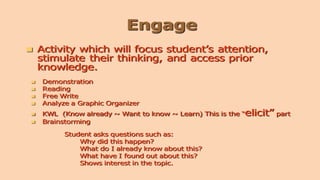
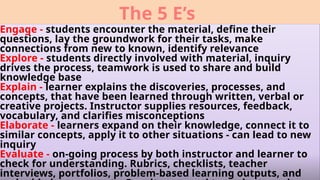
Engage - students encounter the material, define their
questions, lay the groundwork for their tasks, make
connections from new to known, identify relevance
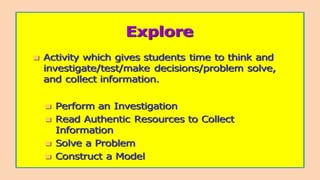
Explore - students directly involved with material, inquiry
drives the process, teamwork is used to share and build
knowledge base
Explain - learner explains the discoveries, processes, and
concepts, that have been learned through written, verbal or
creative projects. Instructor supplies resources, feedback,
vocabulary, and clarifies misconceptions
Elaborate - learners expand on their knowledge, connect it to
similar concepts, apply it to other situations - can lead to new
inquiry
Evaluate - on-going process by both instructor and learner to
check for understanding. Rubrics, checklists, teacher
interviews, portfolios, problem-based learning outputs, and
The 5 E’s
THE 7-E MODEL
1.Elicit
This first step serves as an interest or
motivator. (Identifying prior knowledge)
2.Engagement
It builds curiosity and provides
direction for the remainder of the lesson.
During this stage the question for
investigation is developed, prior knowledge
is activated, and procedures, rules and
safety precautions are outlined. Students
should be able to immediately transition
into the exploration phase
3. Exploration (Explore)
This stage initiates guided discovery.
Students manipulate the materials, make
discoveries and share their findings with
their classmates and teacher. The teacher
provides scaffolding by observing,
questioning and guiding. Exploration
provides concrete experience from which
student learning and knowledge can build.
4. Explanation (Explain)
In this stage, the teacher invite their student
to share their discoveries and explanations.
Based on the descriptions provided by the
students, teachers introduce relevant concepts,
principles, and/or theories. Students and
teachers utilize the concept and the experiences
to describe and explain the phenomenon and
answer the initial question.
5. Elaboration (Elaborate)
Elaboration allows students to create
connections between new concepts,
principles, theories, and real world
experiences by applying them to a new
situation.
6. Evaluation (Evaluate)
Evaluation provides teachers an
opportunity to assess students
knowledge and provide feedback on
performance.
7. Extend
Teachers give additional
activities to the students related to
the topic.
LESSON PLAN
7-E MODEL
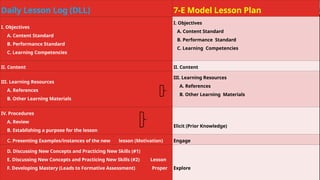
Daily Lesson Log (DLL) 7-E Model Lesson Plan
I. Objectives
A. Content Standard
B. Performance Standard
C. Learning Competencies
I. Objectives
A. Content Standard
B. Performance Standard
C. Learning Competencies
II. Content II. Content
III. Learning Resources
A. References
B. Other Learning Materials
III. Learning Resources
A. References
B. Other Learning Materials
IV. Procedures
A. Review
B. Establishing a purpose for the lesson
Elicit (Prior Knowledge)
C. Presenting Examples/instances of the new lesson (Motivation) Engage
D. Discussing New Concepts and Practicing New Skills (#1)
E. Discussing New Concepts and Practicing New Skills (#2) Lesson
F. Developing Mastery (Leads to Formative Assessment) Proper Explore

Lesson Plan Discussion Technology for Teaching and Learning 2.pptx

  • 2.
    Engage Explore Explain Elaborate Evaluate Measuring & Countingand Comparison Questions Attention-focusing questions Action & Problem- Solving Questions Have you seen? Do you notice? How many? How long? In how many ways? What happens if… Can you find a way to…
  • 3.
    The 5 E's The5 E's is an instructional model based on the constructivist approach to learning, which says that learners build or construct new ideas on top of their old ideas. The 5 E's can be used with students of all ages, including adults. Each of the 5 E's describes a phase of learning, and each phase begins with the letter "E": Engage, Explore, Explain, Elaborate, and Evaluate. The 5 E's allows students and teachers to experience common activities, to use and build on prior knowledge and experience, to
  • 4.
    Constructivism is alearning strategy that draws on students' existing knowledge, beliefs, and skills. With a constructivist approach, students synthesize new understanding from prior learning and new information. The constructivist teacher sets up problems and monitors student exploration, guides student inquiry, and promotes new patterns of thinking. Working mostly with raw data, primary sources, and interactive material, constructivist teaching asks students to work with their own data and learn to direct their own explorations.
  • 5.
    The philosophy aboutlearning, that proposes learners need to build their own understanding of new ideas, has been labeled constructivism. Much has been researched and written by many eminent leaders in the fields of learning theory and cognition. Scholars such as Jean Piaget, Eleanor Duckworth, George Hein, and Howard Gardener have explored these ideas in-depth. The Biological Science Curriculum Study (BSCS), a team whose Principal Investigator is Roger Bybee Constructivis m
  • 6.
    The 5 ELearning Cycle Model Engagement *Object, event or question used to engage students. *Connections facilitated between what students know and can do. Exploration *Objects and phenomena are explored. *Hands-on activities, with guidance. Explanation *Students explain their understanding of concepts and processes. *New concepts and skills are introduced as conceptual clarity and cohesion are sought. Elaboration *Activities allow students to apply concepts in contexts, and build on or extend understanding and skill. Evaluation *Students assess their knowledge, skills and abilities. Activities permit evaluation of student development and lesson effectiveness.
  • 7.
    Questions for Considerationfor Each Phase 1. Engagement • The engagement phase of the 5-E model is intended to provide a focus for the lesson and to allow the teacher to probe students’ initial conceptions. • What do students already know about the concept? • What do they want to know? • What will they explore? 2. Exploration • What is the precise concept that students will explore? • What activities must the children do to become familiar with the concept? • What kinds of observations and records should the children keep? • What kinds of instructions will the children need? How can you give the instructions without telling the concept? 3. Explanation • What kinds of information or findings should the children talk about? • How can you help students summarize their findings? • How can you guide the students and refrain from telling them what they should have found, even if their understanding is incomplete?
  • 8.
    4. Expansion • Howcan you connect with children's prior experiences? • How does the concept relate to the science program goals? • What questions can be used to encourage discovery of the concept's importance? • What new experiences will help to apply or expand the concept? • What is the next concept related to the present one? 5. Evaluation • What are the appropriate learning outcomes you should expect? • What types of hands-on evaluation techniques can the children do to demonstrate the basic process skills? • What techniques are appropriate for children to demonstrate the integrated process skills? • How can pictures help children to demonstrate how well they can think through problems? • What types of questions will help children to reflect on what they have discovered?
  • 9.
    In the stageEngage, the students first encounter and identify the instructional task. Here they make connections between past and present learning experiences, lay the organizational ground work for the activities ahead and stimulate their involvement in the anticipation of these activities. Asking a question, defining a problem, showing a surprising event and acting out a problematic situation are all ways to engage the students and focus them on the instructional tasks. If we were to make an analogy to the world of marketing a product, at first we need to grab the customer's attention. We won't have their Engag e
  • 11.
    In the Explorationstage the students have the opportunity to get directly involved with phenomena and materials. Involving themselves in these activities they develop a grounding of experience with the phenomenon. As they work together in teams, students build a base of common experience which assists them in the process of sharing and communicating. The teacher acts as a facilitator, providing materials and guiding the students' focus. The students' inquiry process drives the Explor e
  • 13.
    The third stage,Explain, is the point at which the learner begins to put the abstract experience through which she/he has gone /into a communicable form. Language provides motivation for sequencing events into a logical format. Communication occurs between peers, the facilitator, or within the learner himself. Working in groups, learners support each other's understanding as they articulate their observations, ideas, questions and hypotheses. Language provides a tool of communicable labels. These labels, applied to elements of abstract exploration, give the learner a means of sharing these explorations. Explanations from the facilitator can provide names that correspond to historical and standard language, for student findings and events. For example a child, through her exploration, may state they have noticed that a magnet has a tendency to "stick" to a certain metallic object. The facilitator, in her discussion with the child, might at this stage introduce terminology referring to "an attracting force". Introducing labels, after the child has had a direct experience, is far more meaningful than before that experience. The experiential base she has built offers the student an attachment place for the label. Common language enhances the sharing and communication between Explain
  • 15.
    In stage four,Elaborate, the students expand on the concepts they have learned, make connections to other related concepts, and apply their understandings to the world around them. For example, while exploring light phenomena, a learner constructs an understanding of the path light travels through space. Examining a lamp post, she may notice that the shadow of the post changes its location as the day grows later. This observation can lead to further inquiry as to possible connections between the shadow's changing location and the changes in direction of the light source, the Sun. Applications to real world events, such as where to plant flowers so that they receive sunlight most of the day, or how to prop up a beach umbrella for shade from the Sun, are both Elabora te
  • 17.
    Evaluate, the fifth"E", is an on-going diagnostic process that allows the teacher to determine if the learner has attained understanding of concepts and knowledge. Evaluation and assessment can occur at all points along the continuum of the instructional process. Some of the tools that assist in this diagnostic process are: rubrics (quantified and prioritized outcome expectations) determined hand-in-hand with the lesson design, teacher observation structured by checklists, student interviews, portfolios designed with specific purposes, project and problem-based learning products, and embedded assessments. Concrete evidence of the learning proceed is most valuable in communications between students, teachers, parents and administrators. Displays of attainment and progress enhance understanding for all parties involved in the educational process, and can become jumping off points for further enrichment of the students' education. These evidences of learning serve to guide the teacher in further lesson planning and may signal the need for modification and change of direction. For example, if a teacher perceives clear evidence of misconception, then he/she can revisit the concept to enhance Evaluat e
  • 19.
    BLOOMS Levels of Thinking StudentsTeachers Creating The learner creates new ideas and information using what has been previously learned. The teacher plans and implements new approaches and improvements based on previous experience or new information. Evaluating The learner makes decisions based on in-depth reflection, criticism and assessment. The teacher reflects upon data. Interprets strengths/weaknesses and plans improvements. Analyzing The learner breaks learned information into its parts to best understand that information. The teacher seeks feedback on their own and their student’s performance. Collects data. Applying The learner makes use of information in a context different from the one in which it was learned. The teacher develops and applies effective programs and strategies to ‘Teach’ the discipline. Understanding The learner grasps the meaning of information by interpreting and translating what has been learned. The teacher has an overview of the discipline, effective learning approaches and links to the whole curriculum. Remembering The learner is able to recall, restate and remember learned information. The teacher is aware of the basic content and teaching methodologies in a discipline.
  • 20.
    *Blooms taxonomy isfamiliar to most teachers and is often used as a structure to plan learning programs and assessment tasks. The column here for teachers is based only on armchair thinking but it holds up reasonably well. As with students the thought processes for teachers become more sophisticated up the table. Although it could be argued that many teachers, particularly those new to the game or outside their “subject” area, find themselves having to jump straight into the creating level. *An interesting question is whether teachers actually understand and believe in a construction like Blooms taxonomy as a framework for “higher order thinking”. If they do they may also see that there are parallels with their own learning and hence value the levels of analysis,
  • 21.
    5 E’s Planningfor student learning Planning for teacher learning Evaluate: This phase of the 5 E's encourages learners to assess their understanding and abilities and lets teachers evaluate students' understanding of key concepts and skill development. Teachers evaluate the effectiveness of their programs and their performance through the lense of student achievement. Elaborate: This phase of the 5 E's extends students' conceptual understanding and allows them to practice skills and behaviours. Through new experiences, the learners develop deeper and broader understanding of major concepts, obtain more information about areas of interest, and refine their skills. Teachers reflect upon their practice and hone their skills. Teachers increase the depth of their understanding of both their disciplines and teaching methodologies. Explain: This phase of the 5 E's helps students explain the concepts they have been exploring. They have opportunities to verbalize their conceptual understanding or to demonstrate new skills or behaviors. This phase also provides opportunities for teachers to introduce formal terms, definitions, and explanations for concepts, processes, skills, or behaviors. Teachers implement programs, try things out. They explain to students. They demonstrate new skills and behaviours. Explore: This phase of the 5 E's provides students with a common base of experiences. They identify and develop concepts, processes, and skills. During this phase, students actively explore their environment or manipulate materials. Teachers explore resources available to them, text books, curriculum standards, online resources. They work in teams learning from each other. They plan programs and lessons Engage: This phase of the 5 E's starts the process. An "engage" activity should do the following: 1.Make connections between past and present learning experiences 2.Anticipate activities and focus students' thinking on the learning outcomes of current activities. Students should become mentally engaged in the concept, process, or skill to be learned. Teacher’s become engaged through personal interest, planned or accidental learning. Teachers are often coerced to be engaged through DEECD and school level requirements e.g. VELS, assessment, teacher shortage, school initiatives.
  • 22.
    Engage - studentsencounter the material, define their questions, lay the groundwork for their tasks, make connections from new to known, identify relevance Explore - students directly involved with material, inquiry drives the process, teamwork is used to share and build knowledge base Explain - learner explains the discoveries, processes, and concepts, that have been learned through written, verbal or creative projects. Instructor supplies resources, feedback, vocabulary, and clarifies misconceptions Elaborate - learners expand on their knowledge, connect it to similar concepts, apply it to other situations - can lead to new inquiry Evaluate - on-going process by both instructor and learner to check for understanding. Rubrics, checklists, teacher interviews, portfolios, problem-based learning outputs, and The 5 E’s
  • 23.
  • 24.
    1.Elicit This first stepserves as an interest or motivator. (Identifying prior knowledge)
  • 25.
    2.Engagement It builds curiosityand provides direction for the remainder of the lesson. During this stage the question for investigation is developed, prior knowledge is activated, and procedures, rules and safety precautions are outlined. Students should be able to immediately transition into the exploration phase
  • 26.
    3. Exploration (Explore) Thisstage initiates guided discovery. Students manipulate the materials, make discoveries and share their findings with their classmates and teacher. The teacher provides scaffolding by observing, questioning and guiding. Exploration provides concrete experience from which student learning and knowledge can build.
  • 27.
    4. Explanation (Explain) Inthis stage, the teacher invite their student to share their discoveries and explanations. Based on the descriptions provided by the students, teachers introduce relevant concepts, principles, and/or theories. Students and teachers utilize the concept and the experiences to describe and explain the phenomenon and answer the initial question.
  • 28.
    5. Elaboration (Elaborate) Elaborationallows students to create connections between new concepts, principles, theories, and real world experiences by applying them to a new situation.
  • 29.
    6. Evaluation (Evaluate) Evaluationprovides teachers an opportunity to assess students knowledge and provide feedback on performance.
  • 30.
    7. Extend Teachers giveadditional activities to the students related to the topic.
  • 31.
  • 32.
    Daily Lesson Log(DLL) 7-E Model Lesson Plan I. Objectives A. Content Standard B. Performance Standard C. Learning Competencies I. Objectives A. Content Standard B. Performance Standard C. Learning Competencies II. Content II. Content III. Learning Resources A. References B. Other Learning Materials III. Learning Resources A. References B. Other Learning Materials IV. Procedures A. Review B. Establishing a purpose for the lesson Elicit (Prior Knowledge) C. Presenting Examples/instances of the new lesson (Motivation) Engage D. Discussing New Concepts and Practicing New Skills (#1) E. Discussing New Concepts and Practicing New Skills (#2) Lesson F. Developing Mastery (Leads to Formative Assessment) Proper Explore