 “Set of management disciplines that allows
organization to manage its technological
fundamentals to create competitive advantage.”
 “The integrated planning, design, optimization,
operation and control of technological products,
processes and services.”
 Stanford University classmates Bill Hewlett and
Dave Packard founded HP in 1939.
 The company's first product was an audio
oscillator—an electronic test instrument used by
sound engineers.
 Technology Portfolio: Personal systems,
Imaging & Printing, Technology solutions,
Financial Services, HP Labs.
 Over 1billion customers in 178 countries
worldwide.
 2009 Fortune 500 ranking: No. 9.
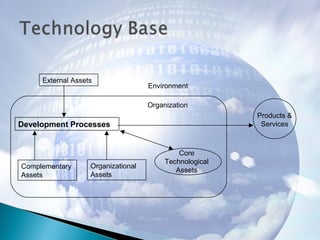
 Technology Base
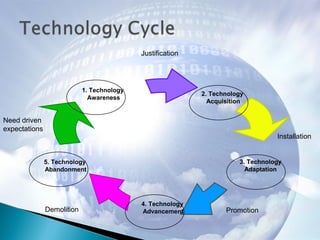
 Technology Cycle
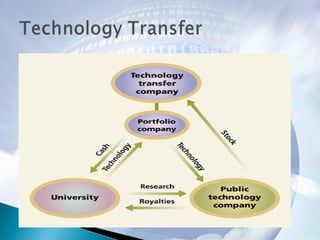
 Technology Transfer
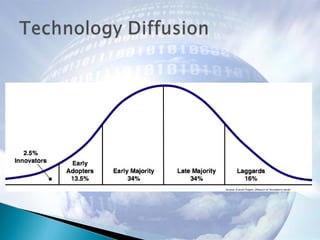
 Technology Diffusion
 Knowledge Mapping
Development Processes
Complementary
Assets
Organizational
Assets
Core
Technological
Assets
Products &
Services
External Assets
Environment
Organization
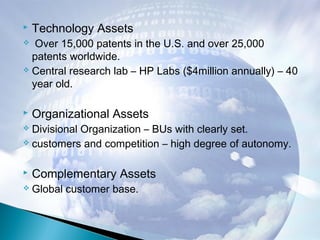
 Technology Assets
 Over 15,000 patents in the U.S. and over 25,000
patents worldwide.
 Central research lab – HP Labs ($4million annually) – 40
year old.
 Organizational Assets
 Divisional Organization – BUs with clearly set.
 customers and competition – high degree of autonomy.
 Complementary Assets
 Global customer base.
1. Technology
Awareness
4. Technology
Advancement
5. Technology
Abandonment
3. Technology
Adaptation
2. Technology
Acquisition
Justification
Installation
PromotionDemolition
Need driven
expectations
 83% recycled materials.
 100% recyclable packaging.
 ENERGY STAR Certified.
 HP Photo smart D5460 - using recycled plastic.
 Technology Transfer Office & Open Innovation
Office.
 119 Acquisitions
 HP Software's leadership in Business
Technology Optimization (BTO) by 2
acquisitions
1. Bristol Technology Inc. (Feb 2007 -
TransactionVision product monitors the
performance and reliability of transactions)
2. Mercury Interactive (Nov 2006 – End to end
management of real-time business
transactions.)
Industry’s broadest portfolio of enterprise IT
management software.
 HP plays Early Majority often.
 Commoditize product for general purpose use.
 Distribute via low cost.
 Use competition based pricing to maximize market
share.
 Position products horizontally as global
infrastructure.
 Portrays a perspective of the players, sources,
flows, constraints and sinks of knowledge within
an organization.
 A navigation aid to both explicit information and
tacit knowledge, showing the importance and the
relationships between knowledge stores and the
dynamics.
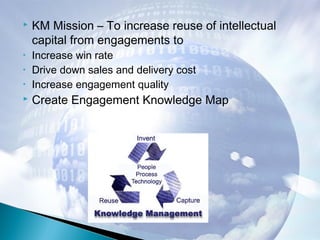
 KM Mission – To increase reuse of intellectual
capital from engagements to
• Increase win rate
• Drive down sales and delivery cost
• Increase engagement quality
 Create Engagement Knowledge Map
Technology management

Technology management

  • 2.
     “Set ofmanagement disciplines that allows organization to manage its technological fundamentals to create competitive advantage.”  “The integrated planning, design, optimization, operation and control of technological products, processes and services.”
  • 3.
     Stanford Universityclassmates Bill Hewlett and Dave Packard founded HP in 1939.  The company's first product was an audio oscillator—an electronic test instrument used by sound engineers.  Technology Portfolio: Personal systems, Imaging & Printing, Technology solutions, Financial Services, HP Labs.  Over 1billion customers in 178 countries worldwide.  2009 Fortune 500 ranking: No. 9.
  • 4.
     Technology Base Technology Cycle  Technology Transfer  Technology Diffusion  Knowledge Mapping
  • 5.
  • 6.
     Technology Assets Over 15,000 patents in the U.S. and over 25,000 patents worldwide.  Central research lab – HP Labs ($4million annually) – 40 year old.  Organizational Assets  Divisional Organization – BUs with clearly set.  customers and competition – high degree of autonomy.  Complementary Assets  Global customer base.
  • 7.
    1. Technology Awareness 4. Technology Advancement 5.Technology Abandonment 3. Technology Adaptation 2. Technology Acquisition Justification Installation PromotionDemolition Need driven expectations
  • 8.
     83% recycledmaterials.  100% recyclable packaging.  ENERGY STAR Certified.  HP Photo smart D5460 - using recycled plastic.
  • 10.
     Technology TransferOffice & Open Innovation Office.  119 Acquisitions  HP Software's leadership in Business Technology Optimization (BTO) by 2 acquisitions 1. Bristol Technology Inc. (Feb 2007 - TransactionVision product monitors the performance and reliability of transactions) 2. Mercury Interactive (Nov 2006 – End to end management of real-time business transactions.) Industry’s broadest portfolio of enterprise IT management software.
  • 12.
     HP playsEarly Majority often.  Commoditize product for general purpose use.  Distribute via low cost.  Use competition based pricing to maximize market share.  Position products horizontally as global infrastructure.
  • 13.
     Portrays aperspective of the players, sources, flows, constraints and sinks of knowledge within an organization.  A navigation aid to both explicit information and tacit knowledge, showing the importance and the relationships between knowledge stores and the dynamics.
  • 14.
     KM Mission– To increase reuse of intellectual capital from engagements to • Increase win rate • Drive down sales and delivery cost • Increase engagement quality  Create Engagement Knowledge Map