PROJECT MANAGEMENT
SUDHEER NANDI
Topic Covered
 Introduction to Project Management
 History of Project Management
 Project Life Cycle.
 Project Analysis: Facets of Project Analysis
 Strategy and Resource Allocation
 Market and Demand Analysis
 Technical Analysis
 Economic and Ecological Analysis
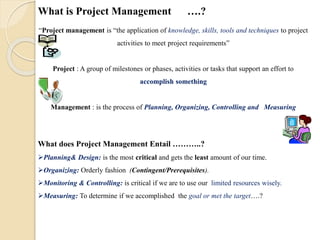
What is Project Management ….?
“Project management is “the application of knowledge, skills, tools and techniques to project
activities to meet project requirements”
Project : A group of milestones or phases, activities or tasks that support an effort to
accomplish something
Management : is the process of Planning, Organizing, Controlling and Measuring
What does Project Management Entail ………..?
Planning& Design: is the most critical and gets the least amount of our time.
Organizing: Orderly fashion (Contingent/Prerequisites).
Monitoring & Controlling: is critical if we are to use our limited resources wisely.
Measuring: To determine if we accomplished the goal or met the target….?
Antiquity of Project Management (EVOLUTION)
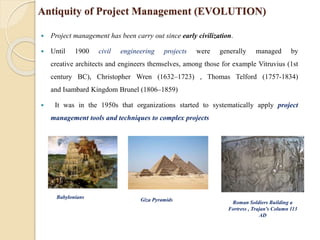
 Project management has been carry out since early civilization.
 Until 1900 civil engineering projects were generally managed by
creative architects and engineers themselves, among those for example Vitruvius (1st
century BC), Christopher Wren (1632–1723) , Thomas Telford (1757-1834)
and Isambard Kingdom Brunel (1806–1859)
 It was in the 1950s that organizations started to systematically apply project
management tools and techniques to complex projects
Roman Soldiers Building a
Fortress , Trajan's Column 113
AD
Babylonians
Giza Pyramids
Antiquity of Project Management (EVOLUTION)
 2570 BC: The Great Pyramid of Giza Completed.
 208 BC: Construction of the Great Wall of China
 1917: The Gantt chart Developed by Henry Gantt (1861-1919)
*Henry Gantt(1861–1919), the father of planning and control techniques( Gantt chart)*
 1956: The American Association of Cost Engineers (now AACE International) Formed
 1957: The Critical Path Method (CPM) Invented by the DuPont Corporation
 1958: The Program Evaluation Review Technique (PERT) Invented for the U.S. Navy's
Polaris Project
 1962: United States Department of Defense Mandate the Work Breakdown Structure
(WBS) Approach
 1965: The International Project Management Association (IPMA) Founded
 1969: Project Management Institute (PMI)Launched to Promote the Project Management
Profession
 1975: PROMPTII Method Created by Impact Systems Limited.
 1975: The Mythical Man-Month: Essays on Software Engineering by Fred Brooks
BC
AD
Antiquity of Project Management (EVOLUTION)
 1984: Theory of Constraints (TOC) Introduced by Dr. Eliyahu M. Goldratt in his Novel "The
Goal“
 1986 Scrum Named as a Project Management Style( Software application New Product
Development Game‘) .
 1987: A Guide to the Project Management Body of Knowledge (PMBOK Guide) Published by
PMI.
 1989: Earned Value Management (EVM) Leadership Elevated to Undersecretary of Defense for
Acquisition
 1989: PRINCE Method Developed From PROMPTII
 1994: CHAOS Report First Published
 1996: PRINCE2 Published by CCTA.
 1997: Critical Chain Project Management (CCPM) Invented
 1998: PMBOK Becomes a Standard
 2001: The Agile Manifesto Written (Software application Method)
 2006: "Total Cost Management Framework“ Release by AACE International.
 2008: 4th Edition of PMBOK (Guide Released)
 2009: Major PRINCE2 Revision by Office of Government Commerce (OGC)
 2012: ISO 21500:2012 Standard for Project Management Released.
 2012: 5th Edition of PMBOK Guide Released
 Still update ……..
Frederick Winslow Taylor‘s
•Frederick Winslow Taylor (March 20, 1856 – March 21, 1915) was an
American Mechanical engineer,.
•Known as the father of scientific management
•Scientific management (also called Taylorism or the Taylor system) is a theory of
management that analyzes and synthesizes workflows, improving labour productivity.
Scientific management focuses on worker and machine relationship.
1. Time Study 2. Motion Study 3. Functional Foremanship
4. Standardization 5. Differential Piece Wage Plan
6. Other Techniques
Henry Gantt & Henri Fayol students of Frederick Winslow Taylor's theories
of scientific management; work project management tools including work breakdown
structure(WBS) and resource allocation
Scientific Management
Techniques of
Scientific
Management
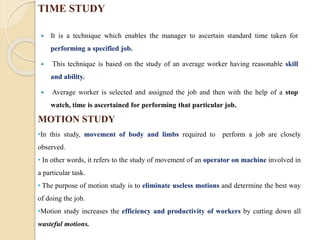
MOTION STUDY
 It is a technique which enables the manager to ascertain standard time taken for
performing a specified job.
 This technique is based on the study of an average worker having reasonable skill
and ability.
 Average worker is selected and assigned the job and then with the help of a stop
watch, time is ascertained for performing that particular job.
TIME STUDY
•In this study, movement of body and limbs required to perform a job are closely
observed.
• In other words, it refers to the study of movement of an operator on machine involved in
a particular task.
• The purpose of motion study is to eliminate useless motions and determine the best way
of doing the job.
•Motion study increases the efficiency and productivity of workers by cutting down all
wasteful motions.
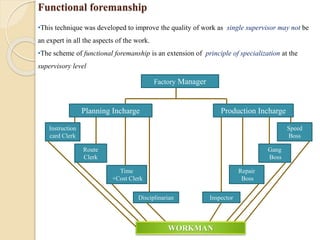
Functional foremanship
•This technique was developed to improve the quality of work as single supervisor may not be
an expert in all the aspects of the work.
•The scheme of functional foremanship is an extension of principle of specialization at the
supervisory level
Factory Manager
Instruction
card Clerk
Route
Clerk
Time
+Cost Clerk
Disciplinarian
Gang
Boss
Repair
Boss
Inspector
Planning Incharge Production Incharge
Speed
Boss
WORKMAN
Standardization
 It implies the physical attitude of products should be such that it meets the
requirements & needs of customers.
 Taylor advocated that tools & equipments as well as working conditions should be
standardized to achieve standard output from workers.
 Standardization is a means of achieving economics of production.
 Standard of performance are established for workers at all levels.
• This tech of wage payment is based on efficiency of worker.
• The efficient workers are paid more wages than inefficient one.
• This system is a source of incentive to workers who improving their efficiency in order to
get more wages.
• It also encourages inefficient workers to improve their performance and achieve their
standards.
Differential Piece WAGE PLAN
Other Techniques
 Various other techniques have been developed to create ordeal relationship between
management and workers and also to create better understanding on part of works.
 Those includes use of instruction cards, strict rules & regulations, graphs, slides, charts
etc, so as to increase efficiency of workers.
•Taylor principles were mostly confined to production management, ignored other functional
areas of management like finance,marketing,personnel and accounting.
• His functional foremanship violates the principle of unity of command.
CRITICISM of Science Management
Henry Gantt
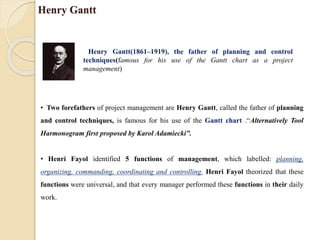
Henry Gantt(1861–1919), the father of planning and control
techniques(famous for his use of the Gantt chart as a project
management)
• Two forefathers of project management are Henry Gantt, called the father of planning
and control techniques, is famous for his use of the Gantt chart .“Alternatively Tool
Harmonogram first proposed by Karol Adamiecki”.
• Henri Fayol identified 5 functions of management, which labelled: planning,
organizing, commanding, coordinating and controlling. Henri Fayol theorized that these
functions were universal, and that every manager performed these functions in their daily
work.
Henry Gantt(1861–1919)
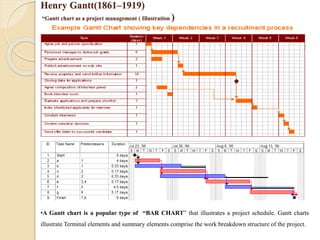
“Gantt chart as a project management ( Illustration )
•A Gantt chart is a popular type of “BAR CHART” that illustrates a project schedule. Gantt charts
illustrate Terminal elements and summary elements comprise the work breakdown structure of the project.
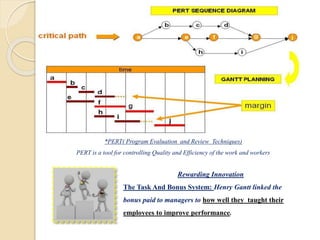
*PERT( Program Evaluation and Review Techniques)
PERT is a tool for controlling Quality and Efficiency of the work and workers
Rewarding Innovation
The Task And Bonus System: Henry Gantt linked the
bonus paid to managers to how well they taught their
employees to improve performance.
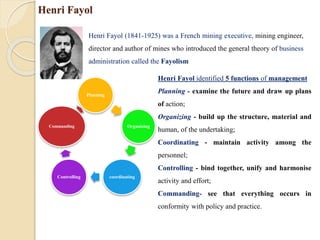
Henri Fayol
Henri Fayol (1841-1925) was a French mining executive, mining engineer,
director and author of mines who introduced the general theory of business
administration called the Fayolism
Henri Fayol identified 5 functions of management
Planning - examine the future and draw up plans
of action;
Organizing - build up the structure, material and
human, of the undertaking;
Coordinating - maintain activity among the
personnel;
Controlling - bind together, unify and harmonise
activity and effort;
Commanding- see that everything occurs in
conformity with policy and practice.
Planning
Organizing
coordinating
Controlling
Commanding
Project Life Cycle[PLC]
 The project management life cycle is usually broken down into four phases:
initiation, planning, execution, and closure.
• Monitoring
• Controlling
closure
• Review
• Project Team
• Acquisition
• Development &
Management
• Detailed Planning
• Estimation &
Scheduling
• Project Definition
• Project constraints
• Problem Statement
Initiation
Phase
Planning
Phase
Project
Closure
Phase
Execution
phase
Project Life Cycle [PLC]
Quality
Scope
Planning
Implementation
Checkout
Initiation
LIFE CYCLE
Project Analysis: Facets of Project Analysis
Facets of Project Analysis
•Market Analysis
Technical Analysis
•Financial Analysis
Economic Analysis
•Ecological Analysis
Market Analysis
Demand
• Market Share
• Consumption
• Elasticity of
Demand
• Consumer
Behavior
• Legal constrains
Technical
Analysis
• Raw materials
• Scale
• Productions
• Layout
• Technology
• capacity
Financial
Analysis
• Cost of capital
• Project
profitability
• Cash flow
statements
• Break Even
Point[BEP]Risk
Economic
Analysis
1.Income of Society
2.Employment
3.Social order
Ecological
Analysis
1.Damage on
Environment.
2.Limits on
Environment if any
3.Restoration
Measures
Project Analysis: Facets of Project Analysis
 Project analysis basically entails the creation, management, and disbursement of
reports that are related to a project. It also incorporates several other aspects such as
the maintenance of project assets, monitoring and evaluation of the project, and
drafting of the relevant report.
 Market analysis: Market analysis is concerned primarily two questions:
A. What would be the aggregate demand of the proposed product or service in
future?
B. What would be the market share of the project under appraisal?
 To answer the above questions, the market analyst requires a wide variety of
information and appropriate forecasting method.
 Technical analysis: Analysis of the technical and engineering aspects of the project
needs to be done continually when a project is formulated. Technical analysis seeks to
determine whether the prerequisites for the success full commissioning of the
project have been considered and reasonably good choices have been made.
Project Analysis: Facets of Project Analysis
 Financial analysis: Financial analysis seeks to ascertain whether the proposed project will
be financially viable in the sense of being able to meet the burden of servicing debt and
whether the proposed project will satisfy the return expectations of those who provide the
capital.
 Economic analysis: Economic analysis also referred to as social cost-benefit analysis is
conceded with judging a project from the larger social point of view. In such an evaluation
the focus is on the social cost and benefits of a project which may often be different from
its monetary costs and benefits.
 Ecological analysis: In recent years, environmental concerns have assumed a great deal of
significance and rightly so. An ecological analysis should be done particularly for major
projects which significant ecological implications and environmental polluting industries.
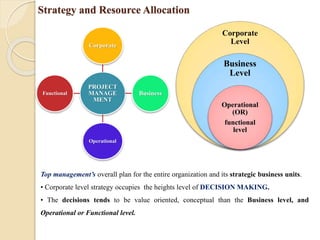
Strategy and Resource Allocation
Corporate
Level
Business
Level
Operational
(OR)
functional
level
Top management’s overall plan for the entire organization and its strategic business units.
• Corporate level strategy occupies the heights level of DECISION MAKING.
• The decisions tends to be value oriented, conceptual than the Business level, and
Operational or Functional level.
PROJECT
MANAGE
MENT
Corporate
Business
Operational
Functional
Strategy and Resource Allocation
Business level :
 A strategy that seeks to determine how an organization should compete in each of its SBUs
(strategic business units).
 At Business-level ALLOCATION of resources among Functional-level an COORDINATE
with the Corporate level to the ACHIEVEMENT of the Corporate level OBJECTIVES.
 Cost leadership: Attaining, then using the lowest total cost basis as a competitive
advantage.
 Differentiation: Using product features or services to distinguish the firm’s offerings
from its competitors.
 Market focus: Concentrating competitively on a specific market segment
Operational or Functional level.
Focus is on improving the effectiveness of operations within a company.
A. Manufacturing. B. Marketing .
C. Materials management . D.Research and development.
E .Human resources.
Strategic Analysis Techniques and Tools
Strategist Many techniques and tools available for strategy analysis
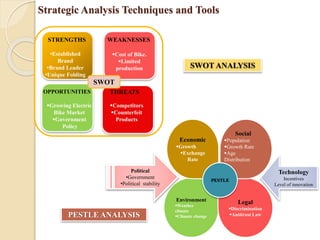
1. SWOT[Strengths, Weaknesses, Opportunities, and Threats] Analysis technique developed at
Stanford in the 1970s
2. PEST Analysis useful tool for understanding market growth or decline, and as such the position,
potential and direction for a business. PEST is an acronym for Political, Economic, Social and
Technological factors. PESTLE Analysis PESTLE (i.e. PEST + Legal & Environment).
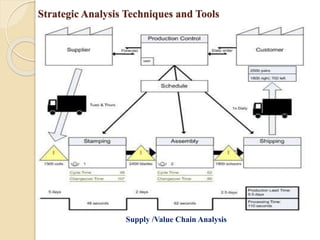
3. Supply /Value Chain Analysis is a way to visually analyze a company's business activities to see
how the company can create a competitive advantage for itself.(Originated in the 1980s by Michael
Porter)
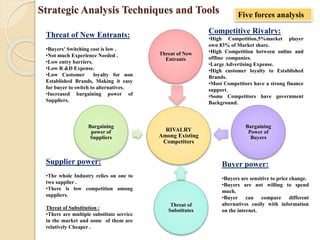
4. Five Forces Analysis Michael Porter developed the Five Forces Model in 1980,a powerful
competitive analysis tool market. within an industry.
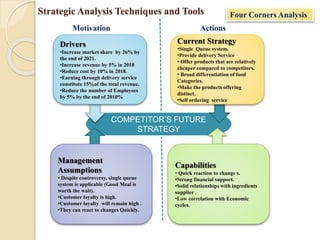
5. Four Corners Analysis developed Michael Porter, is a model well designed to help company
strategists assess a competitor's intent and objectives, and the strengths it is using to achieve them.
6. Business Motivation Model (BMM) an enterprise prescribes a certain approach for its business
activity, it ought to be able to say why and what result(s) is the approach meant to achieve., modeling
notation for support of business decisions about how to react to a changing world.
Strategic Analysis Techniques and Tools
STRENGTHS
•Established
Brand
•Brand Leader
•Unique Folding
WEAKNESSES
Cost of Bike.
Limited
production
OPPORTUNITIES
Growing Electric
Bike Market
Government
Policy
THREATS
Competitors
Counterfeit
Products
SWOT
Environment
Weather
climate
Climate change
Economic
Growth
Exchange
Rate
Legal
Discrimination
Antitrust Law
Political
•Government
•Political stability
Technology
Incentives
Level of innovation
Social
Population
Growth Rate
Age
Distribution
PESTLE
PESTLE ANALYSIS
Strategic Analysis Techniques and Tools Five forces analysis
RIVALRY
Among Existing
Competitors
Threat of New
Entrants
Bargaining
Power of
Buyers
Threat of
Substitutes
Bargaining
power of
Suppliers
Competitive Rivalry:
•High Competition,5%market player
own 83% of Market share.
•High Competition between online and
offline companies.
•Large Advertising Expense.
•High customer loyalty to Established
Brands.
•Most Competitors have a strong finance
support.
•Some Competitors have government
Background.
Buyer power:
•Buyers are sensitive to price change.
•Buyers are not willing to spend
much.
•Buyer can compare different
alternatives easily with information
on the internet.
Threat of New Entrants:
•Buyers' Switching cost is low .
•Not much Experience Needed .
•Low entry barriers.
•Low R &D Expense.
•Low Customer loyalty for non
Established Brands, Making it easy
for buyer to switch to alternatives.
•Increased bargaining power of
Suppliers.
Supplier power:
•The whole Industry relies on one to
two supplier .
•There is low competition among
suppliers.
Threat of Substitution :
•There are multiple substitute service
in the market and some of them are
relatively Cheaper .
Strategic Analysis Techniques and Tools Four Corners Analysis
COMPETITOR’S FUTURE
STRATEGY
Drivers
•Increase market share by 26% by
the end of 2021.
•Increase revenue by 5% in 2018
•Reduce cost by 10% in 2018.
•Earning through delivery service
constitute 15%of the total revenue.
•Reduce the number of Employees
by 5% by the end of 2010%
Management
Assumptions
• Despite controversy, single queue
system is applicable (Good Meal is
worth the wait).
•Customer loyalty is high.
•Customer loyalty will remain high .
•They can react to changes Quickly.
Capabilities
• Quick reaction to change s.
•Strong financial support.
•Solid relationships with ingredients
supplier .
•Low correlation with Economic
cycles.
Current Strategy
•Single Queue system.
•Provide delivery Service
• Offer products that are relatively
cheaper compared to competitors.
• Broad differentiation of food
Categories.
•Make the products offering
distinct.
•Self ordering service
Motivation Actions
Strategic Analysis Techniques and Tools
Supply /Value Chain Analysis
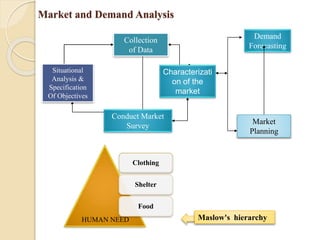
Market and Demand Analysis
Characterizati
on of the
market
Demand
Forecasting
Conduct Market
Survey
Market
Planning
Collection
of Data
Situational
Analysis &
Specification
Of Objectives
Clothing
Shelter
Food
HUMAN NEED Maslow's hierarchy
Market and Demand Analysis
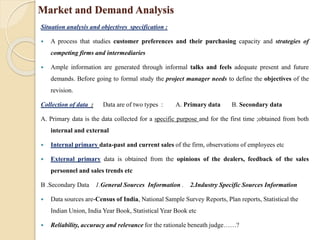
Situation analysis and objectives specification :
 A process that studies customer preferences and their purchasing capacity and strategies of
competing firms and intermediaries
 Ample information are generated through informal talks and feels adequate present and future
demands. Before going to formal study the project manager needs to define the objectives of the
revision.
Collection of data : Data are of two types : A. Primary data B. Secondary data
A. Primary data is the data collected for a specific purpose and for the first time ;obtained from both
internal and external
 Internal primary data-past and current sales of the firm, observations of employees etc
 External primary data is obtained from the opinions of the dealers, feedback of the sales
personnel and sales trends etc
B .Secondary Data 1.General Sources Information . 2.Industry Specific Sources Information
 Data sources are-Census of India, National Sample Survey Reports, Plan reports, Statistical the
Indian Union, India Year Book, Statistical Year Book etc
 Reliability, accuracy and relevance for the rationale beneath judge……?
Market and Demand Analysis
Conduct Market Survey :
 Secondary information, though useful, often does not provide a wide-ranging basis
for market and demand analysis
 There is a need to be supplemented with the primary information through market
survey
 A market survey is useful in determining the total market demand, growth rate in
different segments of the market, understanding the inner motives of the customer and
measuring the unsatisfied needs of the customers
Characterization of the market :
-Heterogeneity of the Geographical Division - Multiplicity Consumer Groups – Design
of Questionnaire Nature of Product (Marred)
 Effective Demand in the earlier period and current
 Production + Imports – Exports – Change in stock level
 [1. Price 2. Methods of Distribution and Sales Promotion 3.Consumers 4. Supply and
Competition 5.Government Policy].
Market and Demand Analysis
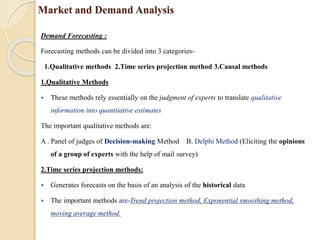
Demand Forecasting :
Forecasting methods can be divided into 3 categories-
1.Qualitative methods 2.Time series projection method 3.Causal methods
1.Qualitative Methods
 These methods rely essentially on the judgment of experts to translate qualitative
information into quantitative estimates
The important qualitative methods are:
A . Panel of judges of Decision-making Method B. Delphi Method (Eliciting the opinions
of a group of experts with the help of mail survey)
2.Time series projection methods:
 Generates forecasts on the basis of an analysis of the historical data
 The important methods are-Trend projection method, Exponential smoothing method,
moving average method.
Market and Demand Analysis
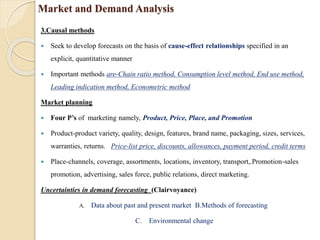
3.Causal methods
 Seek to develop forecasts on the basis of cause-effect relationships specified in an
explicit, quantitative manner
 Important methods are-Chain ratio method, Consumption level method, End use method,
Leading indication method, Econometric method
Market planning
 Four P’s of marketing namely, Product, Price, Place, and Promotion
 Product-product variety, quality, design, features, brand name, packaging, sizes, services,
warranties, returns. Price-list price, discounts, allowances, payment period, credit terms
 Place-channels, coverage, assortments, locations, inventory, transport,.Promotion-sales
promotion, advertising, sales force, public relations, direct marketing.
Uncertainties in demand forecasting (Clairvoyance)
A. Data about past and present market B.Methods of forecasting
C. Environmental change
Technical Analysis
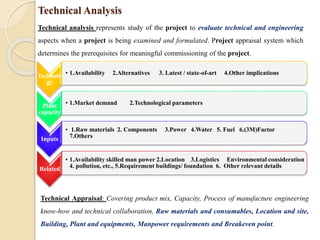
Technical analysis represents study of the project to evaluate technical and engineering
aspects when a project is being examined and formulated. Project appraisal system which
determines the prerequisites for meaningful commissioning of the project.
Technolo
gy
• 1.Availability 2.Alternatives 3. Latest / state-of-art 4.Other implications
Plant
capacity
• 1.Market demand 2.Technological parameters
Inputs
• 1.Raw materials 2. Components 3.Power 4.Water 5. Fuel 6.(3M)Factor
7.Others
Related
• 1.Availability skilled man power 2.Location 3.Logistics Environmental consideration
4. pollution, etc., 5.Requirement buildings/ foundation 6. Other relevant details
Technical Appraisal: Covering product mix, Capacity, Process of manufacture engineering
know-how and technical collaboration, Raw materials and consumables, Location and site,
Building, Plant and equipments, Manpower requirements and Breakeven point.
Economic and Ecological Analysis
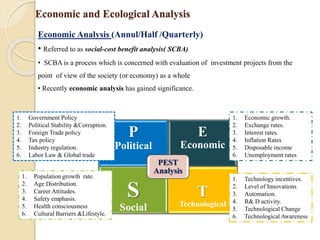
Economic Analysis (Annul/Half /Quarterly)
• Referred to as social-cost benefit analysis( SCBA)
• SCBA is a process which is concerned with evaluation of investment projects from the
point of view of the society (or economy) as a whole
• Recently economic analysis has gained significance.
P
Political
E
Economic
S
Social
T
Technological
PEST
Analysis
1. Economic growth.
2. Exchange rates.
3. Interest rates.
4. Inflation Rates
5. Disposable income
6. Unemployment rates
1. Technology incentives.
2. Level of Innovations
3. Automation.
4. R& D activity.
5. Technological Change
6. Technological Awareness
1. Government Policy
2. Political Stability &Corruption.
3. Foreign Trade policy
4. Tax policy
5. Industry regulation.
6. Labor Law & Global trade
1. Population growth rate.
2. Age Distribution.
3. Career Attitudes.
4. Safety emphasis.
5. Health consciousness
6. Cultural Barriers &Lifestyle.
Ecological Analysis
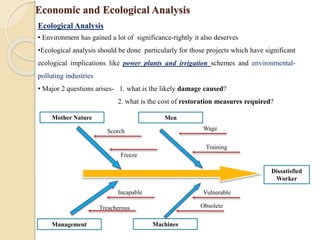
• Environment has gained a lot of significance-rightly it also deserves
•Ecological analysis should be done particularly for those projects which have significant
ecological implications like power plants and irrigation schemes and environmental-
polluting industries
• Major 2 questions arises- 1. what is the likely damage caused?
2. what is the cost of restoration measures required?
Economic and Ecological Analysis
Dissatisfied
Worker
Mother Nature Men
Machines
Management
Scorch Wage
Freeze
Training
Incapable
Treacherous
Vulnerable
Obsolete
TEWI-TOTAL EQUIVALENT WARMING IMPACT
GWP=GLOBAL WARMING POTENTIAL ; ODP =OZONE DEPLECTION POTENTIAL
TEWI=(GWP x L x n)+(GWP x m[1-αRecovery])+(n x Eannual x β)
Leakage Recovery losses Energy Consumption
Direct global warming potential Indirect global warming potential
*Reference :Bitzer International, Germany
*GWP=Global Warming potential [CO2-related]
L =Leakage rate per year [Kg]
N =System operating time [Years]
M = refrigerant charge [kg]
αRecovery =Recycling factor
Eannual =Energy consumption per year [kWh]
β =CO2 –Emission per kWh (Energy-Mix)
*ODP =OZONE DEPLECTION POTENTIAL
Ecological Analysis
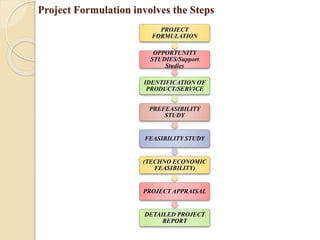
Project Formulation involves the Steps
PROJECT
FORMULATION
OPPORTUNITY
STUDIES/Support
Studies
IDENTIFICATION OF
PRODUCT/SERVICE
PREFEASIBILITY
STUDY
FEASIBILITY STUDY
(TECHNO ECONOMIC
FEASIBILITY)
PROJECT APPRAISAL
DETAILED PROJECT
REPORT
TEXTBOOKS
1. Prasanna Chandra- Project: A Planning Analysis- Tata McGraw Hill Book Company- New Delh-
2. Cleland-Gray and Laudon- Project Management- Tata McGraw Hill Book Company- New Delhi
REFERENCES
1. Jack R. Meredith.- Samuel J. Jr. Mantel.- Project Management - A Managerial Approach- John
Wiley
2. Hass, KB. 2011, The Enterprise Business Analyst: Developing Creative Solutions To Complex
Business Problems, Management Concepts, Inc., Vienna.
3. Kownatzki, M. Walter, J. Floyd, Sw. & Lechner, C. 2013, “Corporate Control And The Speed Of
Strategic Business Unit Decision Making”, Academy of Management Journal, vol. 56, no. 5, pp.
1295–1324. (Source: click here).
4. Paul, D. Yeates, D & Cadle, J. 2010, Business Analysis, 2nd edn, British Informatics Society
Limited, Swindon, United Kingdom. (Source: click here).
THANKS………….

Project Management

  • 1.
  • 2.
    Topic Covered  Introductionto Project Management  History of Project Management  Project Life Cycle.  Project Analysis: Facets of Project Analysis  Strategy and Resource Allocation  Market and Demand Analysis  Technical Analysis  Economic and Ecological Analysis
  • 3.
    What is ProjectManagement ….? “Project management is “the application of knowledge, skills, tools and techniques to project activities to meet project requirements” Project : A group of milestones or phases, activities or tasks that support an effort to accomplish something Management : is the process of Planning, Organizing, Controlling and Measuring What does Project Management Entail ………..? Planning& Design: is the most critical and gets the least amount of our time. Organizing: Orderly fashion (Contingent/Prerequisites). Monitoring & Controlling: is critical if we are to use our limited resources wisely. Measuring: To determine if we accomplished the goal or met the target….?
  • 4.
    Antiquity of ProjectManagement (EVOLUTION)  Project management has been carry out since early civilization.  Until 1900 civil engineering projects were generally managed by creative architects and engineers themselves, among those for example Vitruvius (1st century BC), Christopher Wren (1632–1723) , Thomas Telford (1757-1834) and Isambard Kingdom Brunel (1806–1859)  It was in the 1950s that organizations started to systematically apply project management tools and techniques to complex projects Roman Soldiers Building a Fortress , Trajan's Column 113 AD Babylonians Giza Pyramids
  • 5.
    Antiquity of ProjectManagement (EVOLUTION)  2570 BC: The Great Pyramid of Giza Completed.  208 BC: Construction of the Great Wall of China  1917: The Gantt chart Developed by Henry Gantt (1861-1919) *Henry Gantt(1861–1919), the father of planning and control techniques( Gantt chart)*  1956: The American Association of Cost Engineers (now AACE International) Formed  1957: The Critical Path Method (CPM) Invented by the DuPont Corporation  1958: The Program Evaluation Review Technique (PERT) Invented for the U.S. Navy's Polaris Project  1962: United States Department of Defense Mandate the Work Breakdown Structure (WBS) Approach  1965: The International Project Management Association (IPMA) Founded  1969: Project Management Institute (PMI)Launched to Promote the Project Management Profession  1975: PROMPTII Method Created by Impact Systems Limited.  1975: The Mythical Man-Month: Essays on Software Engineering by Fred Brooks BC AD
  • 6.
    Antiquity of ProjectManagement (EVOLUTION)  1984: Theory of Constraints (TOC) Introduced by Dr. Eliyahu M. Goldratt in his Novel "The Goal“  1986 Scrum Named as a Project Management Style( Software application New Product Development Game‘) .  1987: A Guide to the Project Management Body of Knowledge (PMBOK Guide) Published by PMI.  1989: Earned Value Management (EVM) Leadership Elevated to Undersecretary of Defense for Acquisition  1989: PRINCE Method Developed From PROMPTII  1994: CHAOS Report First Published  1996: PRINCE2 Published by CCTA.  1997: Critical Chain Project Management (CCPM) Invented  1998: PMBOK Becomes a Standard  2001: The Agile Manifesto Written (Software application Method)  2006: "Total Cost Management Framework“ Release by AACE International.  2008: 4th Edition of PMBOK (Guide Released)  2009: Major PRINCE2 Revision by Office of Government Commerce (OGC)  2012: ISO 21500:2012 Standard for Project Management Released.  2012: 5th Edition of PMBOK Guide Released  Still update ……..
  • 7.
    Frederick Winslow Taylor‘s •FrederickWinslow Taylor (March 20, 1856 – March 21, 1915) was an American Mechanical engineer,. •Known as the father of scientific management •Scientific management (also called Taylorism or the Taylor system) is a theory of management that analyzes and synthesizes workflows, improving labour productivity. Scientific management focuses on worker and machine relationship. 1. Time Study 2. Motion Study 3. Functional Foremanship 4. Standardization 5. Differential Piece Wage Plan 6. Other Techniques Henry Gantt & Henri Fayol students of Frederick Winslow Taylor's theories of scientific management; work project management tools including work breakdown structure(WBS) and resource allocation
  • 8.
  • 9.
    MOTION STUDY  Itis a technique which enables the manager to ascertain standard time taken for performing a specified job.  This technique is based on the study of an average worker having reasonable skill and ability.  Average worker is selected and assigned the job and then with the help of a stop watch, time is ascertained for performing that particular job. TIME STUDY •In this study, movement of body and limbs required to perform a job are closely observed. • In other words, it refers to the study of movement of an operator on machine involved in a particular task. • The purpose of motion study is to eliminate useless motions and determine the best way of doing the job. •Motion study increases the efficiency and productivity of workers by cutting down all wasteful motions.
  • 10.
    Functional foremanship •This techniquewas developed to improve the quality of work as single supervisor may not be an expert in all the aspects of the work. •The scheme of functional foremanship is an extension of principle of specialization at the supervisory level Factory Manager Instruction card Clerk Route Clerk Time +Cost Clerk Disciplinarian Gang Boss Repair Boss Inspector Planning Incharge Production Incharge Speed Boss WORKMAN
  • 11.
    Standardization  It impliesthe physical attitude of products should be such that it meets the requirements & needs of customers.  Taylor advocated that tools & equipments as well as working conditions should be standardized to achieve standard output from workers.  Standardization is a means of achieving economics of production.  Standard of performance are established for workers at all levels. • This tech of wage payment is based on efficiency of worker. • The efficient workers are paid more wages than inefficient one. • This system is a source of incentive to workers who improving their efficiency in order to get more wages. • It also encourages inefficient workers to improve their performance and achieve their standards. Differential Piece WAGE PLAN
  • 12.
    Other Techniques  Variousother techniques have been developed to create ordeal relationship between management and workers and also to create better understanding on part of works.  Those includes use of instruction cards, strict rules & regulations, graphs, slides, charts etc, so as to increase efficiency of workers. •Taylor principles were mostly confined to production management, ignored other functional areas of management like finance,marketing,personnel and accounting. • His functional foremanship violates the principle of unity of command. CRITICISM of Science Management
  • 13.
    Henry Gantt Henry Gantt(1861–1919),the father of planning and control techniques(famous for his use of the Gantt chart as a project management) • Two forefathers of project management are Henry Gantt, called the father of planning and control techniques, is famous for his use of the Gantt chart .“Alternatively Tool Harmonogram first proposed by Karol Adamiecki”. • Henri Fayol identified 5 functions of management, which labelled: planning, organizing, commanding, coordinating and controlling. Henri Fayol theorized that these functions were universal, and that every manager performed these functions in their daily work.
  • 14.
    Henry Gantt(1861–1919) “Gantt chartas a project management ( Illustration ) •A Gantt chart is a popular type of “BAR CHART” that illustrates a project schedule. Gantt charts illustrate Terminal elements and summary elements comprise the work breakdown structure of the project.
  • 15.
    *PERT( Program Evaluationand Review Techniques) PERT is a tool for controlling Quality and Efficiency of the work and workers Rewarding Innovation The Task And Bonus System: Henry Gantt linked the bonus paid to managers to how well they taught their employees to improve performance.
  • 16.
    Henri Fayol Henri Fayol(1841-1925) was a French mining executive, mining engineer, director and author of mines who introduced the general theory of business administration called the Fayolism Henri Fayol identified 5 functions of management Planning - examine the future and draw up plans of action; Organizing - build up the structure, material and human, of the undertaking; Coordinating - maintain activity among the personnel; Controlling - bind together, unify and harmonise activity and effort; Commanding- see that everything occurs in conformity with policy and practice. Planning Organizing coordinating Controlling Commanding
  • 17.
    Project Life Cycle[PLC] The project management life cycle is usually broken down into four phases: initiation, planning, execution, and closure. • Monitoring • Controlling closure • Review • Project Team • Acquisition • Development & Management • Detailed Planning • Estimation & Scheduling • Project Definition • Project constraints • Problem Statement Initiation Phase Planning Phase Project Closure Phase Execution phase
  • 18.
    Project Life Cycle[PLC] Quality Scope Planning Implementation Checkout Initiation LIFE CYCLE
  • 19.
    Project Analysis: Facetsof Project Analysis Facets of Project Analysis •Market Analysis Technical Analysis •Financial Analysis Economic Analysis •Ecological Analysis Market Analysis Demand • Market Share • Consumption • Elasticity of Demand • Consumer Behavior • Legal constrains Technical Analysis • Raw materials • Scale • Productions • Layout • Technology • capacity Financial Analysis • Cost of capital • Project profitability • Cash flow statements • Break Even Point[BEP]Risk Economic Analysis 1.Income of Society 2.Employment 3.Social order Ecological Analysis 1.Damage on Environment. 2.Limits on Environment if any 3.Restoration Measures
  • 20.
    Project Analysis: Facetsof Project Analysis  Project analysis basically entails the creation, management, and disbursement of reports that are related to a project. It also incorporates several other aspects such as the maintenance of project assets, monitoring and evaluation of the project, and drafting of the relevant report.  Market analysis: Market analysis is concerned primarily two questions: A. What would be the aggregate demand of the proposed product or service in future? B. What would be the market share of the project under appraisal?  To answer the above questions, the market analyst requires a wide variety of information and appropriate forecasting method.  Technical analysis: Analysis of the technical and engineering aspects of the project needs to be done continually when a project is formulated. Technical analysis seeks to determine whether the prerequisites for the success full commissioning of the project have been considered and reasonably good choices have been made.
  • 21.
    Project Analysis: Facetsof Project Analysis  Financial analysis: Financial analysis seeks to ascertain whether the proposed project will be financially viable in the sense of being able to meet the burden of servicing debt and whether the proposed project will satisfy the return expectations of those who provide the capital.  Economic analysis: Economic analysis also referred to as social cost-benefit analysis is conceded with judging a project from the larger social point of view. In such an evaluation the focus is on the social cost and benefits of a project which may often be different from its monetary costs and benefits.  Ecological analysis: In recent years, environmental concerns have assumed a great deal of significance and rightly so. An ecological analysis should be done particularly for major projects which significant ecological implications and environmental polluting industries.
  • 22.
    Strategy and ResourceAllocation Corporate Level Business Level Operational (OR) functional level Top management’s overall plan for the entire organization and its strategic business units. • Corporate level strategy occupies the heights level of DECISION MAKING. • The decisions tends to be value oriented, conceptual than the Business level, and Operational or Functional level. PROJECT MANAGE MENT Corporate Business Operational Functional
  • 23.
    Strategy and ResourceAllocation Business level :  A strategy that seeks to determine how an organization should compete in each of its SBUs (strategic business units).  At Business-level ALLOCATION of resources among Functional-level an COORDINATE with the Corporate level to the ACHIEVEMENT of the Corporate level OBJECTIVES.  Cost leadership: Attaining, then using the lowest total cost basis as a competitive advantage.  Differentiation: Using product features or services to distinguish the firm’s offerings from its competitors.  Market focus: Concentrating competitively on a specific market segment Operational or Functional level. Focus is on improving the effectiveness of operations within a company. A. Manufacturing. B. Marketing . C. Materials management . D.Research and development. E .Human resources.
  • 24.
    Strategic Analysis Techniquesand Tools Strategist Many techniques and tools available for strategy analysis 1. SWOT[Strengths, Weaknesses, Opportunities, and Threats] Analysis technique developed at Stanford in the 1970s 2. PEST Analysis useful tool for understanding market growth or decline, and as such the position, potential and direction for a business. PEST is an acronym for Political, Economic, Social and Technological factors. PESTLE Analysis PESTLE (i.e. PEST + Legal & Environment). 3. Supply /Value Chain Analysis is a way to visually analyze a company's business activities to see how the company can create a competitive advantage for itself.(Originated in the 1980s by Michael Porter) 4. Five Forces Analysis Michael Porter developed the Five Forces Model in 1980,a powerful competitive analysis tool market. within an industry. 5. Four Corners Analysis developed Michael Porter, is a model well designed to help company strategists assess a competitor's intent and objectives, and the strengths it is using to achieve them. 6. Business Motivation Model (BMM) an enterprise prescribes a certain approach for its business activity, it ought to be able to say why and what result(s) is the approach meant to achieve., modeling notation for support of business decisions about how to react to a changing world.
  • 25.
    Strategic Analysis Techniquesand Tools STRENGTHS •Established Brand •Brand Leader •Unique Folding WEAKNESSES Cost of Bike. Limited production OPPORTUNITIES Growing Electric Bike Market Government Policy THREATS Competitors Counterfeit Products SWOT Environment Weather climate Climate change Economic Growth Exchange Rate Legal Discrimination Antitrust Law Political •Government •Political stability Technology Incentives Level of innovation Social Population Growth Rate Age Distribution PESTLE PESTLE ANALYSIS
  • 26.
    Strategic Analysis Techniquesand Tools Five forces analysis RIVALRY Among Existing Competitors Threat of New Entrants Bargaining Power of Buyers Threat of Substitutes Bargaining power of Suppliers Competitive Rivalry: •High Competition,5%market player own 83% of Market share. •High Competition between online and offline companies. •Large Advertising Expense. •High customer loyalty to Established Brands. •Most Competitors have a strong finance support. •Some Competitors have government Background. Buyer power: •Buyers are sensitive to price change. •Buyers are not willing to spend much. •Buyer can compare different alternatives easily with information on the internet. Threat of New Entrants: •Buyers' Switching cost is low . •Not much Experience Needed . •Low entry barriers. •Low R &D Expense. •Low Customer loyalty for non Established Brands, Making it easy for buyer to switch to alternatives. •Increased bargaining power of Suppliers. Supplier power: •The whole Industry relies on one to two supplier . •There is low competition among suppliers. Threat of Substitution : •There are multiple substitute service in the market and some of them are relatively Cheaper .
  • 27.
    Strategic Analysis Techniquesand Tools Four Corners Analysis COMPETITOR’S FUTURE STRATEGY Drivers •Increase market share by 26% by the end of 2021. •Increase revenue by 5% in 2018 •Reduce cost by 10% in 2018. •Earning through delivery service constitute 15%of the total revenue. •Reduce the number of Employees by 5% by the end of 2010% Management Assumptions • Despite controversy, single queue system is applicable (Good Meal is worth the wait). •Customer loyalty is high. •Customer loyalty will remain high . •They can react to changes Quickly. Capabilities • Quick reaction to change s. •Strong financial support. •Solid relationships with ingredients supplier . •Low correlation with Economic cycles. Current Strategy •Single Queue system. •Provide delivery Service • Offer products that are relatively cheaper compared to competitors. • Broad differentiation of food Categories. •Make the products offering distinct. •Self ordering service Motivation Actions
  • 28.
    Strategic Analysis Techniquesand Tools Supply /Value Chain Analysis
  • 29.
    Market and DemandAnalysis Characterizati on of the market Demand Forecasting Conduct Market Survey Market Planning Collection of Data Situational Analysis & Specification Of Objectives Clothing Shelter Food HUMAN NEED Maslow's hierarchy
  • 30.
    Market and DemandAnalysis Situation analysis and objectives specification :  A process that studies customer preferences and their purchasing capacity and strategies of competing firms and intermediaries  Ample information are generated through informal talks and feels adequate present and future demands. Before going to formal study the project manager needs to define the objectives of the revision. Collection of data : Data are of two types : A. Primary data B. Secondary data A. Primary data is the data collected for a specific purpose and for the first time ;obtained from both internal and external  Internal primary data-past and current sales of the firm, observations of employees etc  External primary data is obtained from the opinions of the dealers, feedback of the sales personnel and sales trends etc B .Secondary Data 1.General Sources Information . 2.Industry Specific Sources Information  Data sources are-Census of India, National Sample Survey Reports, Plan reports, Statistical the Indian Union, India Year Book, Statistical Year Book etc  Reliability, accuracy and relevance for the rationale beneath judge……?
  • 31.
    Market and DemandAnalysis Conduct Market Survey :  Secondary information, though useful, often does not provide a wide-ranging basis for market and demand analysis  There is a need to be supplemented with the primary information through market survey  A market survey is useful in determining the total market demand, growth rate in different segments of the market, understanding the inner motives of the customer and measuring the unsatisfied needs of the customers Characterization of the market : -Heterogeneity of the Geographical Division - Multiplicity Consumer Groups – Design of Questionnaire Nature of Product (Marred)  Effective Demand in the earlier period and current  Production + Imports – Exports – Change in stock level  [1. Price 2. Methods of Distribution and Sales Promotion 3.Consumers 4. Supply and Competition 5.Government Policy].
  • 32.
    Market and DemandAnalysis Demand Forecasting : Forecasting methods can be divided into 3 categories- 1.Qualitative methods 2.Time series projection method 3.Causal methods 1.Qualitative Methods  These methods rely essentially on the judgment of experts to translate qualitative information into quantitative estimates The important qualitative methods are: A . Panel of judges of Decision-making Method B. Delphi Method (Eliciting the opinions of a group of experts with the help of mail survey) 2.Time series projection methods:  Generates forecasts on the basis of an analysis of the historical data  The important methods are-Trend projection method, Exponential smoothing method, moving average method.
  • 33.
    Market and DemandAnalysis 3.Causal methods  Seek to develop forecasts on the basis of cause-effect relationships specified in an explicit, quantitative manner  Important methods are-Chain ratio method, Consumption level method, End use method, Leading indication method, Econometric method Market planning  Four P’s of marketing namely, Product, Price, Place, and Promotion  Product-product variety, quality, design, features, brand name, packaging, sizes, services, warranties, returns. Price-list price, discounts, allowances, payment period, credit terms  Place-channels, coverage, assortments, locations, inventory, transport,.Promotion-sales promotion, advertising, sales force, public relations, direct marketing. Uncertainties in demand forecasting (Clairvoyance) A. Data about past and present market B.Methods of forecasting C. Environmental change
  • 34.
    Technical Analysis Technical analysisrepresents study of the project to evaluate technical and engineering aspects when a project is being examined and formulated. Project appraisal system which determines the prerequisites for meaningful commissioning of the project. Technolo gy • 1.Availability 2.Alternatives 3. Latest / state-of-art 4.Other implications Plant capacity • 1.Market demand 2.Technological parameters Inputs • 1.Raw materials 2. Components 3.Power 4.Water 5. Fuel 6.(3M)Factor 7.Others Related • 1.Availability skilled man power 2.Location 3.Logistics Environmental consideration 4. pollution, etc., 5.Requirement buildings/ foundation 6. Other relevant details Technical Appraisal: Covering product mix, Capacity, Process of manufacture engineering know-how and technical collaboration, Raw materials and consumables, Location and site, Building, Plant and equipments, Manpower requirements and Breakeven point.
  • 35.
    Economic and EcologicalAnalysis Economic Analysis (Annul/Half /Quarterly) • Referred to as social-cost benefit analysis( SCBA) • SCBA is a process which is concerned with evaluation of investment projects from the point of view of the society (or economy) as a whole • Recently economic analysis has gained significance. P Political E Economic S Social T Technological PEST Analysis 1. Economic growth. 2. Exchange rates. 3. Interest rates. 4. Inflation Rates 5. Disposable income 6. Unemployment rates 1. Technology incentives. 2. Level of Innovations 3. Automation. 4. R& D activity. 5. Technological Change 6. Technological Awareness 1. Government Policy 2. Political Stability &Corruption. 3. Foreign Trade policy 4. Tax policy 5. Industry regulation. 6. Labor Law & Global trade 1. Population growth rate. 2. Age Distribution. 3. Career Attitudes. 4. Safety emphasis. 5. Health consciousness 6. Cultural Barriers &Lifestyle.
  • 36.
    Ecological Analysis • Environmenthas gained a lot of significance-rightly it also deserves •Ecological analysis should be done particularly for those projects which have significant ecological implications like power plants and irrigation schemes and environmental- polluting industries • Major 2 questions arises- 1. what is the likely damage caused? 2. what is the cost of restoration measures required? Economic and Ecological Analysis Dissatisfied Worker Mother Nature Men Machines Management Scorch Wage Freeze Training Incapable Treacherous Vulnerable Obsolete
  • 37.
    TEWI-TOTAL EQUIVALENT WARMINGIMPACT GWP=GLOBAL WARMING POTENTIAL ; ODP =OZONE DEPLECTION POTENTIAL TEWI=(GWP x L x n)+(GWP x m[1-αRecovery])+(n x Eannual x β) Leakage Recovery losses Energy Consumption Direct global warming potential Indirect global warming potential *Reference :Bitzer International, Germany *GWP=Global Warming potential [CO2-related] L =Leakage rate per year [Kg] N =System operating time [Years] M = refrigerant charge [kg] αRecovery =Recycling factor Eannual =Energy consumption per year [kWh] β =CO2 –Emission per kWh (Energy-Mix) *ODP =OZONE DEPLECTION POTENTIAL Ecological Analysis
  • 38.
    Project Formulation involvesthe Steps PROJECT FORMULATION OPPORTUNITY STUDIES/Support Studies IDENTIFICATION OF PRODUCT/SERVICE PREFEASIBILITY STUDY FEASIBILITY STUDY (TECHNO ECONOMIC FEASIBILITY) PROJECT APPRAISAL DETAILED PROJECT REPORT
  • 39.
    TEXTBOOKS 1. Prasanna Chandra-Project: A Planning Analysis- Tata McGraw Hill Book Company- New Delh- 2. Cleland-Gray and Laudon- Project Management- Tata McGraw Hill Book Company- New Delhi REFERENCES 1. Jack R. Meredith.- Samuel J. Jr. Mantel.- Project Management - A Managerial Approach- John Wiley 2. Hass, KB. 2011, The Enterprise Business Analyst: Developing Creative Solutions To Complex Business Problems, Management Concepts, Inc., Vienna. 3. Kownatzki, M. Walter, J. Floyd, Sw. & Lechner, C. 2013, “Corporate Control And The Speed Of Strategic Business Unit Decision Making”, Academy of Management Journal, vol. 56, no. 5, pp. 1295–1324. (Source: click here). 4. Paul, D. Yeates, D & Cadle, J. 2010, Business Analysis, 2nd edn, British Informatics Society Limited, Swindon, United Kingdom. (Source: click here).
  • 40.