By 
Mr. Pramod Patil 
Mr. Abhinav S. 
Mr. Yogesh Bokde 
Technology 
management 
@
Why there is need of Management of 
technology? 
2 
• A sound scientific and technological base is essential to economic 
growth in a competitive international environment. 
• With the increasing impact of globalization on business, the scope for 
competition is no longer limited by national boundaries or by the 
definition of a particular industrial sector. 
• Management of technology, innovation and information have also 
emerged as key requirements for success in the 21st century enterprise. 
• Thus, proper management of technological change, particularly at 
the productive enterprise level, has become the most important 
consideration for development.
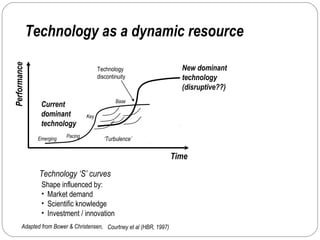
Technology as a dynamic resource 
Adapted from Bower & Christensen, Performance 
Technology 
discontinuity 
Technology ‘S’ curves 
New dominant 
technology 
(disruptive??) 
Current 
dominant 
technology 
‘Turbulence’ 
Time 
Shape influenced by: 
• Market demand 
• Scientific knowledge 
• Investment / innovation 
Courtney et al (HBR, 1997) 
Emerging Pacing 
Key 
Base
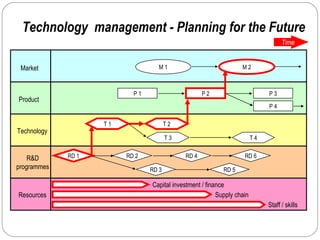
Technology management - Planning for the Future 
Time 
Market M 1 M 2 
Product 
P 1 P 2 P 3 
P 4 
Technology 
T 1 
T 2 
T 3 T 4 
R&D 
programmes 
RD 1 RD 2 RD 4 RD 6 
RD 3 RD 5 
Resources 
Capital investment / finance 
Staff / skills 
Supply chain
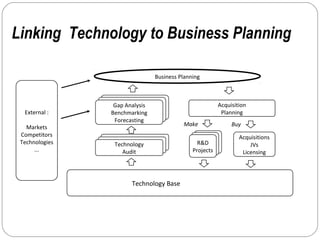
Linking Technology to Business Planning 
Gap Analysis 
Benchmarking 
Forecasting 
Gap Analysis 
Benchmarking 
Forecasting 
Gap Analysis 
Benchmarking 
Forecasting 
Technology 
Technology 
Technology Base 
External : 
Markets 
Competitors 
Technologies 
... 
Business Planning 
Technology 
Audit 
Audit 
Audit 
Acquisition 
Planning 
R&D 
Projects 
Acquisitions 
JVs 
Licensing 
Make Buy
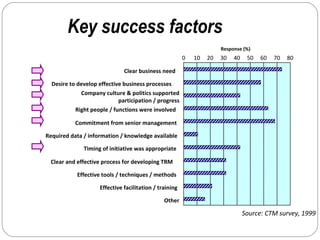
Key success factors 
0 10 20 30 40 50 60 70 80 
Clear business need 
Desire to develop effective business processes 
Company culture & politics supported 
participation / progress 
Right people / functions were involved 
Commitment from senior management 
Required data / information / knowledge available 
Timing of initiative was appropriate 
Clear and effective process for developing TRM 
Effective tools / techniques / methods 
Effective facilitation / training 
Other 
Response (%) 
Source: CTM survey, 1999
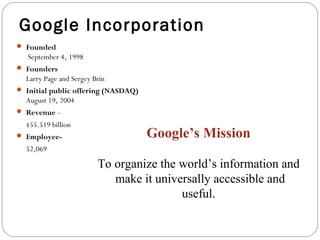
Google Incorporation 
 Founded 
September 4, 1998 
 Founders 
Larry Page and Sergey Brin 
 Initial public offering (NASDAQ) 
August 19, 2004 
 Revenue – 
$55.519 billion 
 Employee- 
52,069 
Google’s Mission 
To organize the world’s information and 
make it universally accessible and 
useful.
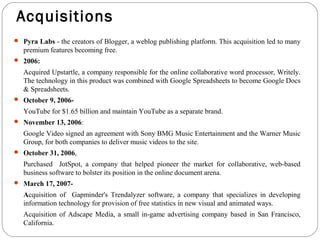
Acquisitions 
 Pyra Labs - the creators of Blogger, a weblog publishing platform. This acquisition led to many 
premium features becoming free. 
 2006: 
Acquired Upstartle, a company responsible for the online collaborative word processor, Writely. 
The technology in this product was combined with Google Spreadsheets to become Google Docs 
& Spreadsheets. 
 October 9, 2006- 
YouTube for $1.65 billion and maintain YouTube as a separate brand. 
 November 13, 2006: 
Google Video signed an agreement with Sony BMG Music Entertainment and the Warner Music 
Group, for both companies to deliver music videos to the site. 
 October 31, 2006, 
Purchased JotSpot, a company that helped pioneer the market for collaborative, web-based 
business software to bolster its position in the online document arena. 
 March 17, 2007- 
Acquisition of Gapminder's Trendalyzer software, a company that specializes in developing 
information technology for provision of free statistics in new visual and animated ways. 
Acquisition of Adscape Media, a small in-game advertising company based in San Francisco, 
California.
Google 
Products
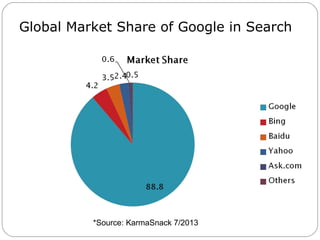
Global Market Share of Google in Search 
*Source: KarmaSnack 7/2013
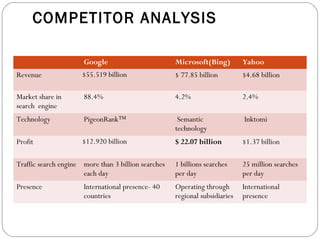
COMPETITOR ANALYSIS 
Google Microsoft(Bing) Yahoo 
Revenue $55.519 billion $ 77.85 billion $4.68 billion 
Market share in 
search engine 
88.4% 4.2% 2.4% 
Technology PigeonRank™ Semantic 
technology 
IMP-NEEDS ADD MORE POINTS IN THIS SLIDE 
Inktomi 
Profit $12.920 billion $ 22.07 billion $1.37 billion 
Traffic search engine more than 3 billion searches 
each day 
1 billions searches 
per day 
25 million searches 
per day 
Presence International presence- 40 
countries 
Operating through 
regional subsidiaries 
International 
presence
12 
Google’s Information Technology
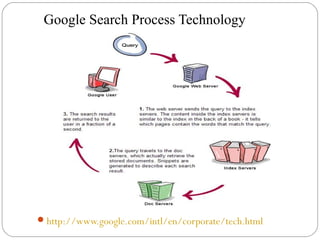
Google Search Process Technology 
http://www.google.com/intl/en/corporate/tech.html
14 
Information technology of Google search 
Page Rank Technology: 
The software behind Google search technology 
conducts a series of simultaneous calculations 
requiring only a fraction of a second. 
Hypertext-Matching Analysis: 
Google’s technology analyzes the full content of a page 
and factors in fonts, subdivisions and the precise location 
of each word.
Information Technology Strategy 
 A unique mix of internally developed software, open source, made-to-order 
hardware, and people management is the secret behind the search engine. 
 Google's great IT advantage is its ability to build high-performance systems that 
are cost efficient (we didn't say cheap) and that scale to massive workloads. 
 Because of that Google enjoys huge cost advantages over competitors such as 
Amazon, eBay, Microsoft, and Yahoo. 
 Google's programmers are 50% to 100% more productive than their peers at other 
Web companies. 
 Competitors have to spend four times as much to keep up.
Uniqueness about Google 
 SEARCH 
 Speed, Accuracy, Objectivity and Ease of use of. 
 Fit between their technology and the consumer behavior. 
 Page Rank technology – Orkut merged. 
 Keeps the search “Up to date” 
 1st to get it right advantage 
 Trade off between “Speed” & “Compression” 
 Best asset utilization (Efficient storage space) 
 R&D expenditure = 50% Net Income(10% of Revenue)
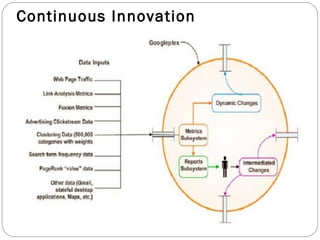
Continuous Innovation
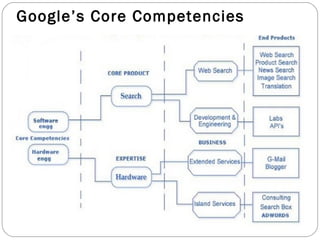
Google’s Core Competencies
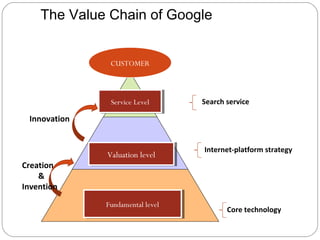
The Value Chain of Google 
CUSTOMER 
SSeerrvvicicee L Leevveell 
VVaaluluaattioionn l elevveell 
FFuunnddaammeenntatal ll elevveell 
Search service 
Internet-platform strategy 
Core technology 
Innovation 
Creation 
& 
Invention
The emphasis about Google develop “Cloud 
Computing” in the future: 
20 
1. Using powerful “Cloud Computing” capability, to help 
clients and network user handle with large information 
immediately. 
2. To offer IaaS (Infrastructure as Service) ,assist business in 
setting up “Cloud Computing” system. 
3. Increasing internet safety to protect secret information. 
4. To decrease electricity and computer operation cost. 
5. Google provide free internet space, and develop more PaaS 
(Platform as a Service)
How Google humanizes technology in the 
workplace? 
 Google encourages to employee to use of technology as the best way to 
communicate in every situation. 
 Let technology support employees in their personal lives 
 leverage technology to give employees greater voice – 
Google sees its workers as the true subject matter experts, and purposely makes 
great use of its shared document technology to eliminate all “top-downness from 
decision making.” 
 Go high-tech and low-tech- 
Almost every meeting held today at Google makes use of the hangout program to 
accommodate employees unable to attend, or who work in other locations. 
 Encourage people to disconnect- “integrators” or “segmentors.”
 Search : Competition from both big web companies and well-funded startups will force Google 
to remain focused on continuing to innovate in search. There is need to establish Google’s 
brand and searching reputation. 
 Other Ad formats - With Google clearly intent on spreading its advertising platform to the 
offline world, go for more acquisitions. 
 Social Networking – Acquire other players. 
 Office Suite – Continuous R&D 
 Continuous Innovation is the key to maintain dominance in such an aggressive environment. 
 Concentrate on BRIC nations. 
. 
Recommendation
Technology Management- Google

Technology Management- Google

  • 1.
    By Mr. PramodPatil Mr. Abhinav S. Mr. Yogesh Bokde Technology management @
  • 2.
    Why there isneed of Management of technology? 2 • A sound scientific and technological base is essential to economic growth in a competitive international environment. • With the increasing impact of globalization on business, the scope for competition is no longer limited by national boundaries or by the definition of a particular industrial sector. • Management of technology, innovation and information have also emerged as key requirements for success in the 21st century enterprise. • Thus, proper management of technological change, particularly at the productive enterprise level, has become the most important consideration for development.
  • 3.
    Technology as adynamic resource Adapted from Bower & Christensen, Performance Technology discontinuity Technology ‘S’ curves New dominant technology (disruptive??) Current dominant technology ‘Turbulence’ Time Shape influenced by: • Market demand • Scientific knowledge • Investment / innovation Courtney et al (HBR, 1997) Emerging Pacing Key Base
  • 4.
    Technology management -Planning for the Future Time Market M 1 M 2 Product P 1 P 2 P 3 P 4 Technology T 1 T 2 T 3 T 4 R&D programmes RD 1 RD 2 RD 4 RD 6 RD 3 RD 5 Resources Capital investment / finance Staff / skills Supply chain
  • 5.
    Linking Technology toBusiness Planning Gap Analysis Benchmarking Forecasting Gap Analysis Benchmarking Forecasting Gap Analysis Benchmarking Forecasting Technology Technology Technology Base External : Markets Competitors Technologies ... Business Planning Technology Audit Audit Audit Acquisition Planning R&D Projects Acquisitions JVs Licensing Make Buy
  • 6.
    Key success factors 0 10 20 30 40 50 60 70 80 Clear business need Desire to develop effective business processes Company culture & politics supported participation / progress Right people / functions were involved Commitment from senior management Required data / information / knowledge available Timing of initiative was appropriate Clear and effective process for developing TRM Effective tools / techniques / methods Effective facilitation / training Other Response (%) Source: CTM survey, 1999
  • 7.
    Google Incorporation Founded September 4, 1998  Founders Larry Page and Sergey Brin  Initial public offering (NASDAQ) August 19, 2004  Revenue – $55.519 billion  Employee- 52,069 Google’s Mission To organize the world’s information and make it universally accessible and useful.
  • 8.
    Acquisitions  PyraLabs - the creators of Blogger, a weblog publishing platform. This acquisition led to many premium features becoming free.  2006: Acquired Upstartle, a company responsible for the online collaborative word processor, Writely. The technology in this product was combined with Google Spreadsheets to become Google Docs & Spreadsheets.  October 9, 2006- YouTube for $1.65 billion and maintain YouTube as a separate brand.  November 13, 2006: Google Video signed an agreement with Sony BMG Music Entertainment and the Warner Music Group, for both companies to deliver music videos to the site.  October 31, 2006, Purchased JotSpot, a company that helped pioneer the market for collaborative, web-based business software to bolster its position in the online document arena.  March 17, 2007- Acquisition of Gapminder's Trendalyzer software, a company that specializes in developing information technology for provision of free statistics in new visual and animated ways. Acquisition of Adscape Media, a small in-game advertising company based in San Francisco, California.
  • 9.
  • 10.
    Global Market Shareof Google in Search *Source: KarmaSnack 7/2013
  • 11.
    COMPETITOR ANALYSIS GoogleMicrosoft(Bing) Yahoo Revenue $55.519 billion $ 77.85 billion $4.68 billion Market share in search engine 88.4% 4.2% 2.4% Technology PigeonRank™ Semantic technology IMP-NEEDS ADD MORE POINTS IN THIS SLIDE Inktomi Profit $12.920 billion $ 22.07 billion $1.37 billion Traffic search engine more than 3 billion searches each day 1 billions searches per day 25 million searches per day Presence International presence- 40 countries Operating through regional subsidiaries International presence
  • 12.
  • 13.
    Google Search ProcessTechnology http://www.google.com/intl/en/corporate/tech.html
  • 14.
    14 Information technologyof Google search Page Rank Technology: The software behind Google search technology conducts a series of simultaneous calculations requiring only a fraction of a second. Hypertext-Matching Analysis: Google’s technology analyzes the full content of a page and factors in fonts, subdivisions and the precise location of each word.
  • 15.
    Information Technology Strategy  A unique mix of internally developed software, open source, made-to-order hardware, and people management is the secret behind the search engine.  Google's great IT advantage is its ability to build high-performance systems that are cost efficient (we didn't say cheap) and that scale to massive workloads.  Because of that Google enjoys huge cost advantages over competitors such as Amazon, eBay, Microsoft, and Yahoo.  Google's programmers are 50% to 100% more productive than their peers at other Web companies.  Competitors have to spend four times as much to keep up.
  • 16.
    Uniqueness about Google  SEARCH  Speed, Accuracy, Objectivity and Ease of use of.  Fit between their technology and the consumer behavior.  Page Rank technology – Orkut merged.  Keeps the search “Up to date”  1st to get it right advantage  Trade off between “Speed” & “Compression”  Best asset utilization (Efficient storage space)  R&D expenditure = 50% Net Income(10% of Revenue)
  • 17.
  • 18.
  • 19.
    The Value Chainof Google CUSTOMER SSeerrvvicicee L Leevveell VVaaluluaattioionn l elevveell FFuunnddaammeenntatal ll elevveell Search service Internet-platform strategy Core technology Innovation Creation & Invention
  • 20.
    The emphasis aboutGoogle develop “Cloud Computing” in the future: 20 1. Using powerful “Cloud Computing” capability, to help clients and network user handle with large information immediately. 2. To offer IaaS (Infrastructure as Service) ,assist business in setting up “Cloud Computing” system. 3. Increasing internet safety to protect secret information. 4. To decrease electricity and computer operation cost. 5. Google provide free internet space, and develop more PaaS (Platform as a Service)
  • 21.
    How Google humanizestechnology in the workplace?  Google encourages to employee to use of technology as the best way to communicate in every situation.  Let technology support employees in their personal lives  leverage technology to give employees greater voice – Google sees its workers as the true subject matter experts, and purposely makes great use of its shared document technology to eliminate all “top-downness from decision making.”  Go high-tech and low-tech- Almost every meeting held today at Google makes use of the hangout program to accommodate employees unable to attend, or who work in other locations.  Encourage people to disconnect- “integrators” or “segmentors.”
  • 22.
     Search :Competition from both big web companies and well-funded startups will force Google to remain focused on continuing to innovate in search. There is need to establish Google’s brand and searching reputation.  Other Ad formats - With Google clearly intent on spreading its advertising platform to the offline world, go for more acquisitions.  Social Networking – Acquire other players.  Office Suite – Continuous R&D  Continuous Innovation is the key to maintain dominance in such an aggressive environment.  Concentrate on BRIC nations. . Recommendation

Editor's Notes

  • #3 MOT is an interdisciplinary field that integrates science, engineering, and management knowledge and practice. Management of technology refers to the design and use of the means needed within organizations achieve economic and social objectives through technological innovation.
  • #4 Benefits Facilitate the integration of new technology into the business Support for company strategy and planning processes Identify new business opportunities for exploiting technology Provide top level information on the technological direction of the business Support communication and co-operation within the business Identify gaps in market and technical knowledge Support sourcing decisions, resource allocation, risk management and exploitation decisions High-level integrated planning and control - a common reference / framework
  • #5 Technology Route Mapping is a planning method which has been successfully applied to balance the short-, medium- and long-term issues facing the business, in terms of technological and product development and evolution. The map shows how current and future technological investments support future product development and delivery, in the context of market trends and drivers, and customer needs, linking to resource requirements and R&D programmes. Foresight provides a means of supporting the medium- to long-term inputs to the TRM.
  • #12 Primary competitors - Microsoft and Yahoo! Inc. Both Microsoft and Yahoo have more employees than Google. – Microsoft 6 times. Microsoft also has significantly more cash resources. Longer operating histories and more established relationships with customers and end users. Microsoft and Yahoo also may have a greater ability to attract and retain users - because they operate Internet portals with a broad range of content products and services.
  • #16 ., a result of the custom libraries Google developed to support programming of massively parallel systems, Arnold says.
  • #21 Cloud Computing Cloud = internet Cloud means the internet. It's a ability could save large data. It's extensive, flexible of IT. Through the internet technology, charge on the basis of user uses how many resources, provided this services to external users. 
  • #23 Strategic challenges Google has a strong franchise in search technology, but that doesn’t mean it will hang onto its lead. Google should be aware of new search engines which promise to improve search experience compared to them. Google strategy is built on a strong foundation of broad differentiation of complementary products but to create a product that customers perceive as different or distinct in an important way. A differentiator strives to differentiate itself along as many dimensions as possible but changing customer needs shall be maintained. Difficulty in maintaining long-term distinctness in customers’ eyes.