MyCharityConnects #mcc11
Developing a Digital Strategy & Roadmap
June 6, 2011 –


Laurie Dillon-Schalk, Digital Strategy Director, JWT –
Copyright © 2011
About me


           © Laurie Dillon-Schalk 2011
DEFINED: What is a digital strategy?


  Digital is an umbrella term used                         Strategy is the recommended
  to capture a broad base of                               approach to achieving a set of
  online or web accessible                                 objectives.
  medias, channels, technologies
  or devices such as websites,
  portals*, banners, social
  networks, digital signage, mobile
  and more…


  Digital strategies provide measurable direction on how use digital to
  achieve a vision and its specific business, brand and/or marketing
  objectives.


  * Portals include general interest sites such as AOL or Yahoo.


                                                                                  © Laurie Dillon-Schalk 2011
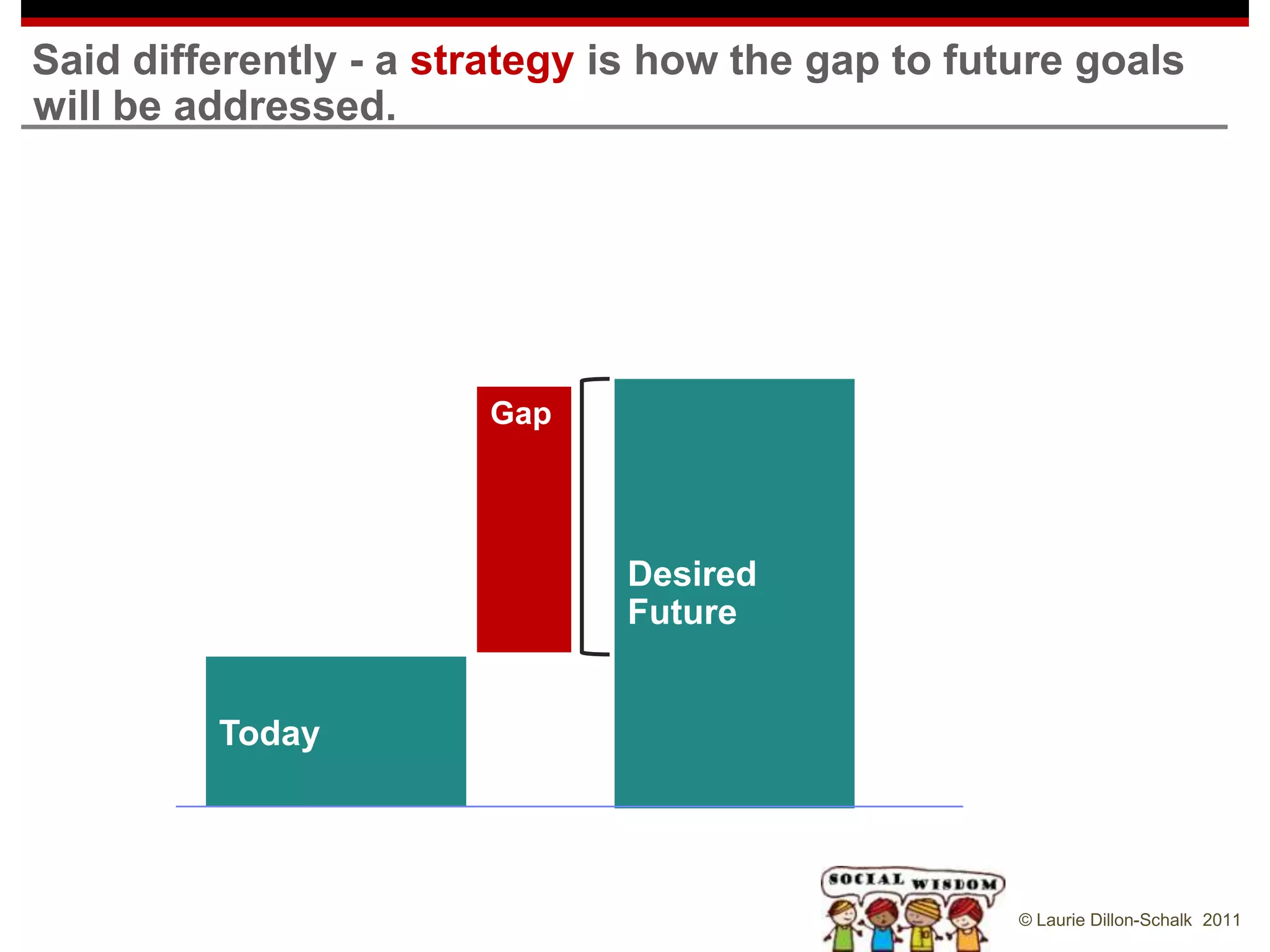
Said differently - a strategy is how the gap to future goals
will be addressed.


                       Gap


                              Desired
                              Future


         Today


                                                   © Laurie Dillon-Schalk 2011
A Digital Strategy exercise is useful to:


   • Address a new vision, unsatisfactory current position, or
     competitive incursions.
   • Identify how the consumer interacts today and digital’s impact
     on that purchasing process or customer experience.
   • Create alignment on digital understanding, opportunities and
     planning.
   • Prioritize the many digital opportunities facing an organization.
   • Understand and address new brand realities – WOM,
     communities, etc
   • ….


                                                                 © Laurie Dillon-Schalk 2011
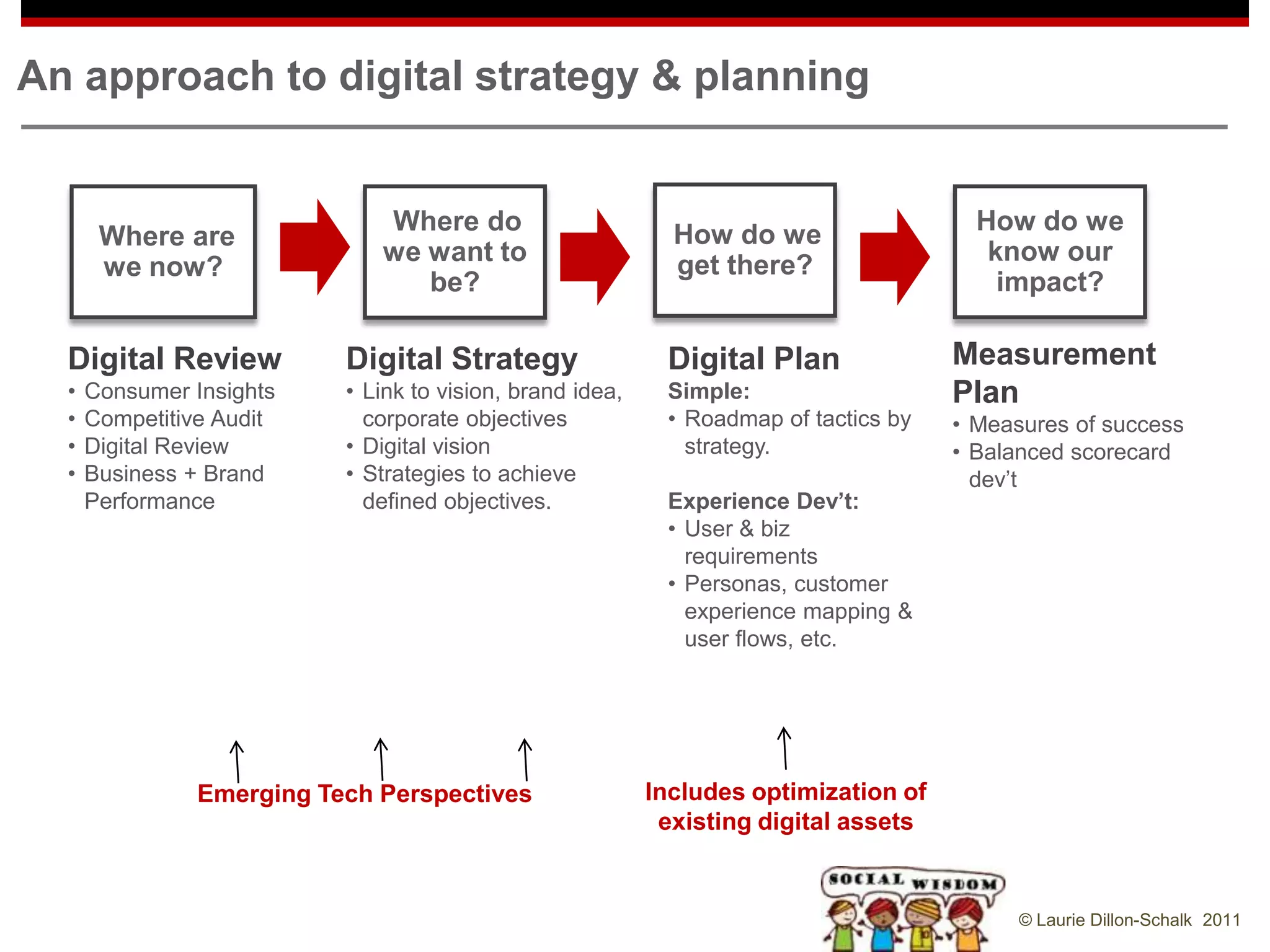
An approach to digital strategy & planning


                              Where do                       How do we                  How do we
       Where are
                              we want to                     get there?                  know our
       we now?
                                 be?                                                      impact?

  Digital Review           Digital Strategy                 Digital Plan              Measurement
  •   Consumer Insights    • Link to vision, brand idea,    Simple:                   Plan
  •   Competitive Audit      corporate objectives           • Roadmap of tactics by   • Measures of success
  •   Digital Review       • Digital vision                   strategy.               • Balanced scorecard
  •   Business + Brand     • Strategies to achieve                                      dev‟t
      Performance            defined objectives.            Experience Dev‟t:
                                                            • User & biz
                                                              requirements
                                                            • Personas, customer
                                                              experience mapping &
                                                              user flows, etc.


                Emerging Tech Perspectives                 Includes optimization of
                                                            existing digital assets


                                                                                            © Laurie Dillon-Schalk 2011
Focus of today

 What is included in a digital review
 How to map customer experiences
 Explanation of how to conduct a digital strategy exercise
 How to plan for changing consumer expectations
  – E.g Social media maturity model
 Planning rules of thumb


                                                              © Laurie Dillon-Schalk 2011
Digital Review


                 © Laurie Dillon-Schalk 2011
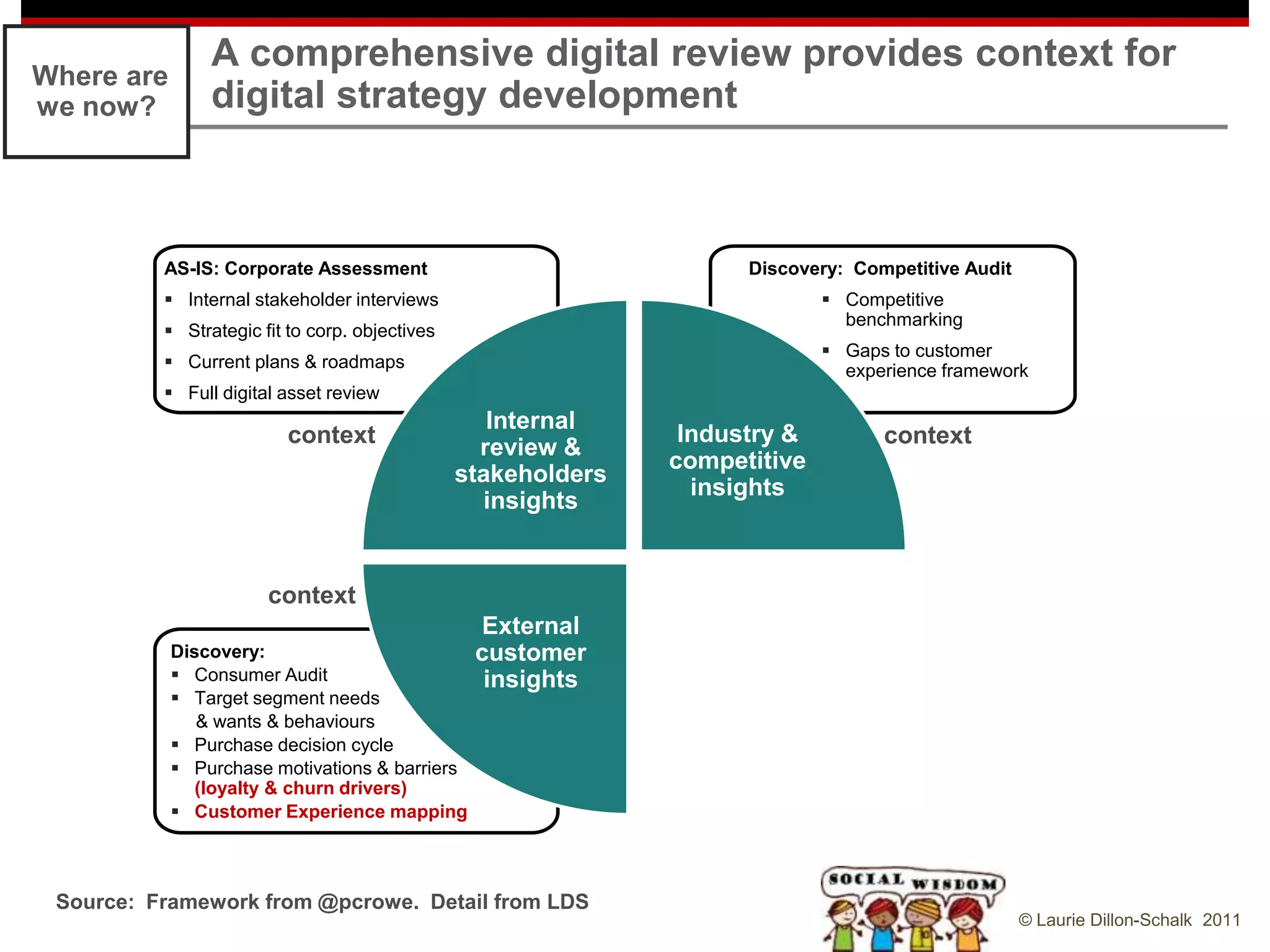
A comprehensive digital review provides context for
Where are
we now?         digital strategy development


          AS-IS: Corporate Assessment                                Discovery: Competitive Audit
           Internal stakeholder interviews                                   Competitive
                                                                               benchmarking
           Strategic fit to corp. objectives
                                                                              Gaps to customer
           Current plans & roadmaps                                           experience framework
           Full digital asset review
                                                   Internal
                         context                                Industry &         context
                                                  review &
                                                               competitive
                                                stakeholders
                                                                 insights
                                                  insights


                       context
                                                 External
            Discovery:                           customer
             Consumer Audit                      insights
             Target segment needs
               & wants & behaviours
             Purchase decision cycle
             Purchase motivations & barriers
               (loyalty & churn drivers)
             Customer Experience mapping


 Source: Framework from @pcrowe. Detail from LDS
                                                                                                    © Laurie Dillon-Schalk 2011
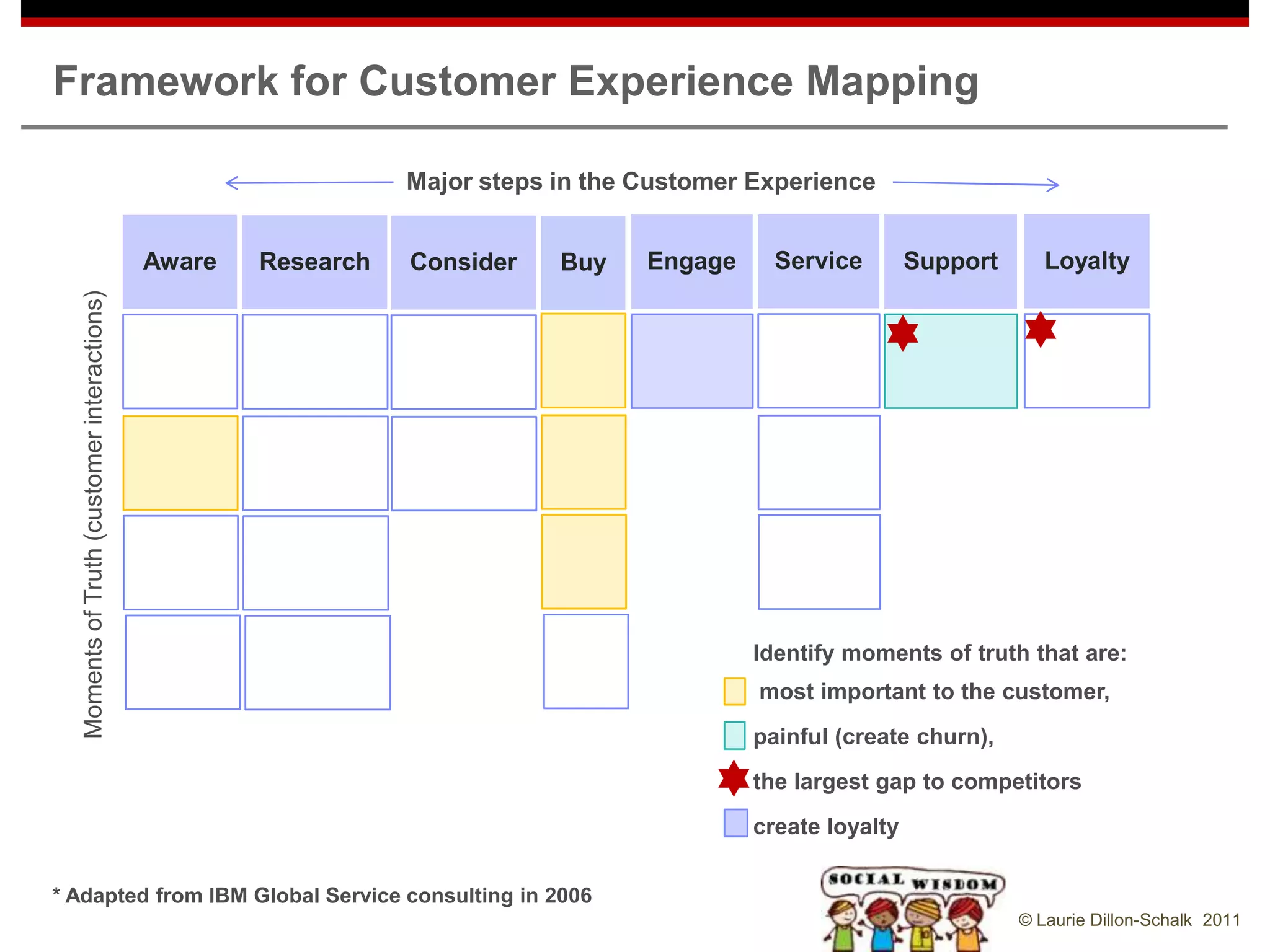
Framework for Customer Experience Mapping

                                                                 Major steps in the Customer Experience


                                              Aware   Research   Consider    Buy    Engage     Service        Support      Loyalty
   Moments of Truth (customer interactions)


                                                                                             Identify moments of truth that are:
                                                                                             most important to the customer,
                                                                                             painful (create churn),
                                                                                             the largest gap to competitors
                                                                                             create loyalty

* Adapted from IBM Global Service consulting in 2006
                                                                                                                        © Laurie Dillon-Schalk 2011
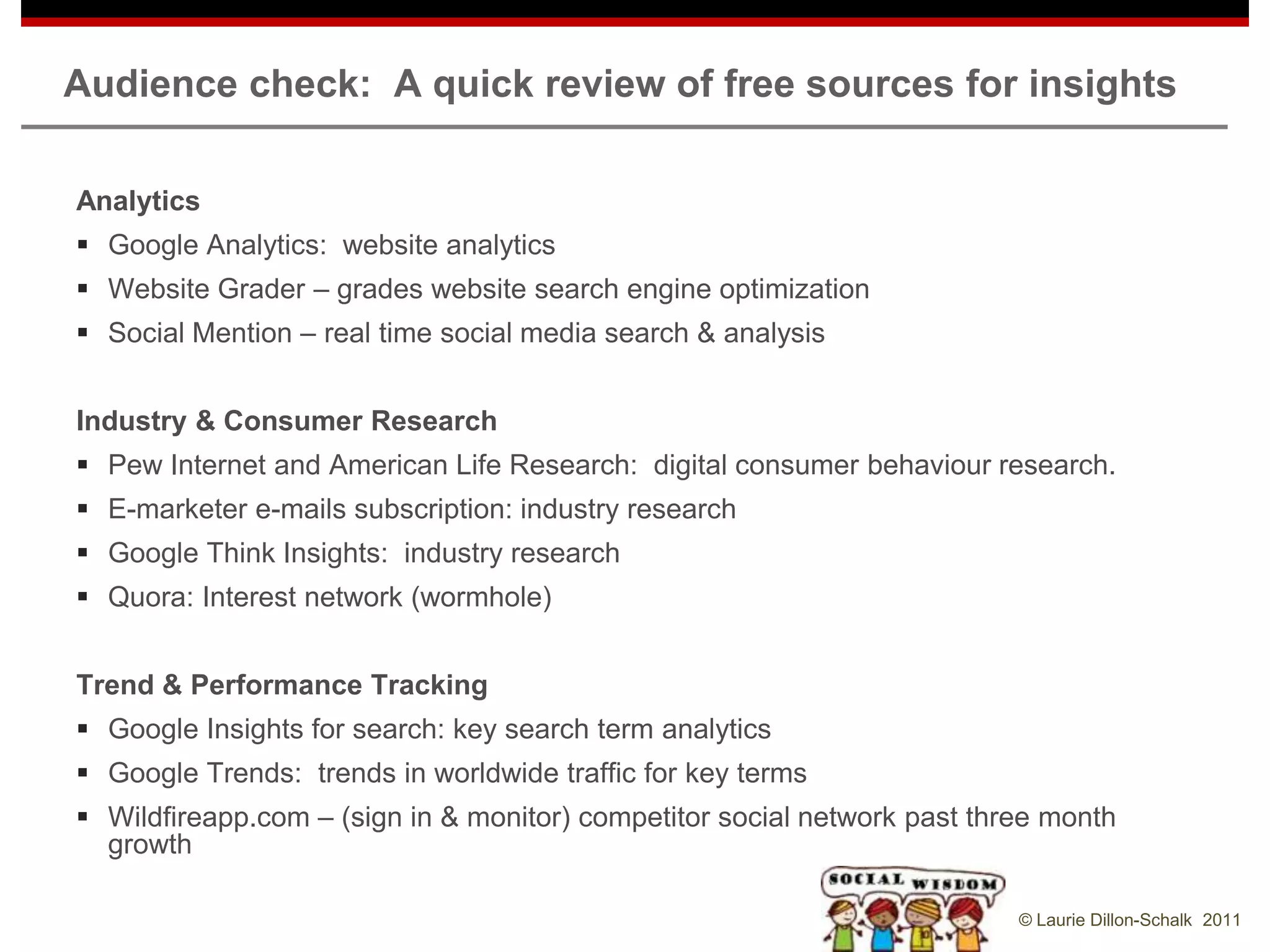
Audience check: A quick review of free sources for insights

Analytics
 Google Analytics: website analytics
 Website Grader – grades website search engine optimization
 Social Mention – real time social media search & analysis


Industry & Consumer Research
 Pew Internet and American Life Research: digital consumer behaviour research.
 E-marketer e-mails subscription: industry research
 Google Think Insights: industry research
 Quora: Interest network (wormhole)


Trend & Performance Tracking
 Google Insights for search: key search term analytics
 Google Trends: trends in worldwide traffic for key terms
 Wildfireapp.com – (sign in & monitor) competitor social network past three month
  growth

                                                                          © Laurie Dillon-Schalk 2011
Where are
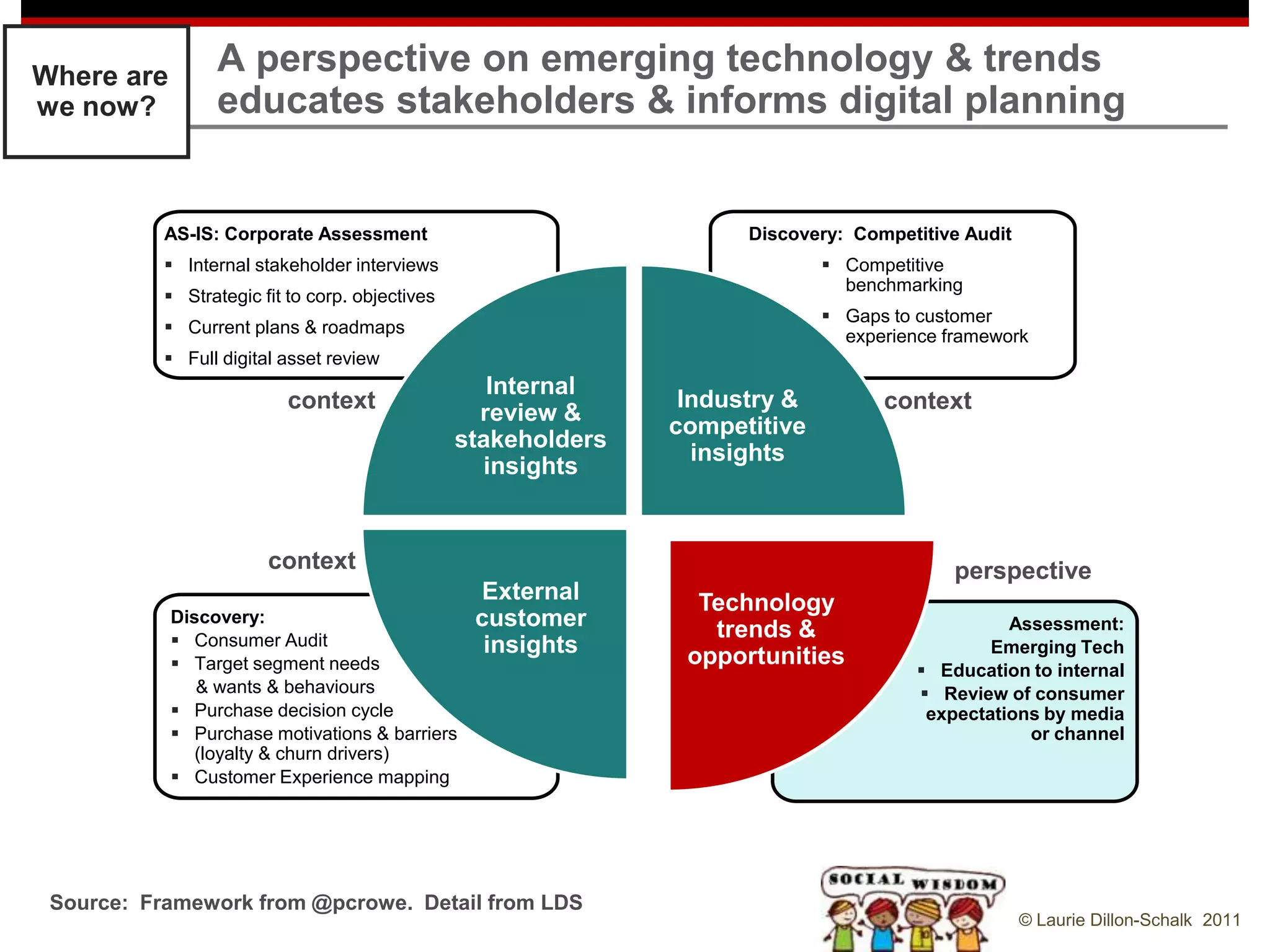
                 A perspective on emerging technology & trends
we now?          educates stakeholders & informs digital planning


           AS-IS: Corporate Assessment                                Discovery: Competitive Audit
            Internal stakeholder interviews                                   Competitive
                                                                                benchmarking
            Strategic fit to corp. objectives
                                                                               Gaps to customer
            Current plans & roadmaps                                           experience framework
            Full digital asset review
                                                    Internal
                          context                                Industry &         context
                                                   review &
                                                                competitive
                                                 stakeholders
                                                                  insights
                                                   insights


                        context                                                             perspective
                                                  External        Technology
            Discovery:                            customer         trends &                       Assessment:
             Consumer Audit                       insights                                     Emerging Tech
             Target segment needs                               opportunities
                                                                                         Education to internal
               & wants & behaviours                                                      Review of consumer
             Purchase decision cycle                                                    expectations by media
             Purchase motivations & barriers                                                       or channel
               (loyalty & churn drivers)
             Customer Experience mapping


 Source: Framework from @pcrowe. Detail from LDS
                                                                                                     © Laurie Dillon-Schalk 2011
How you present a digital review is critical


 Purpose of a review: to provide full information to allow for
  decisions. Strip the opinion, present the facts.
 Do not lump the digital review and the digital strategy (nor
  roadmap) into one deliverable.
 Deliver and facilitate the review in a dedicated “immersion”
  workshop with cross functional, in person participation.
 Allow line of business owners to present their own sections.
 Create a tight presentation
  – No more than 7 bullets, per slide (or categorize)
  – Follow “bullshit !, prove it, so what?” format
  – No more than 1 idea per slide
  – No facebook wall or twitter screen capture dumps!
  – Learn the art of visualization – make complex data easy to read
  – Include the one page pull out

                                                                      © Laurie Dillon-Schalk 2011
Digital Strategy


                   © Laurie Dillon-Schalk 2011
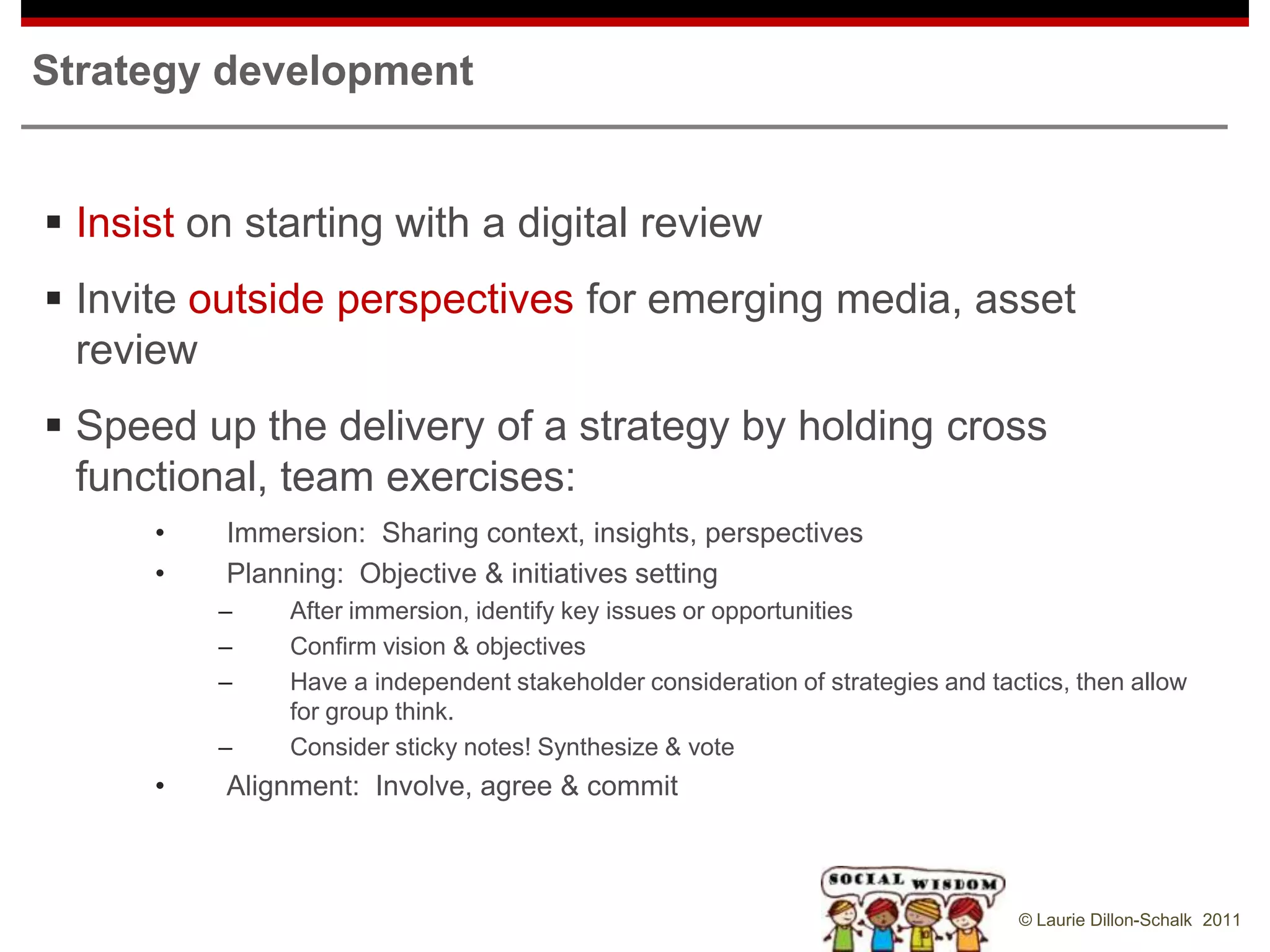
Strategy development


 Insist on starting with a digital review
 Invite outside perspectives for emerging media, asset
  review
 Speed up the delivery of a strategy by holding cross
  functional, team exercises:
      •   Immersion: Sharing context, insights, perspectives
      •   Planning: Objective & initiatives setting
          –   After immersion, identify key issues or opportunities
          –   Confirm vision & objectives
          –   Have a independent stakeholder consideration of strategies and tactics, then allow
              for group think.
          –   Consider sticky notes! Synthesize & vote
      •   Alignment: Involve, agree & commit


                                                                                © Laurie Dillon-Schalk 2011
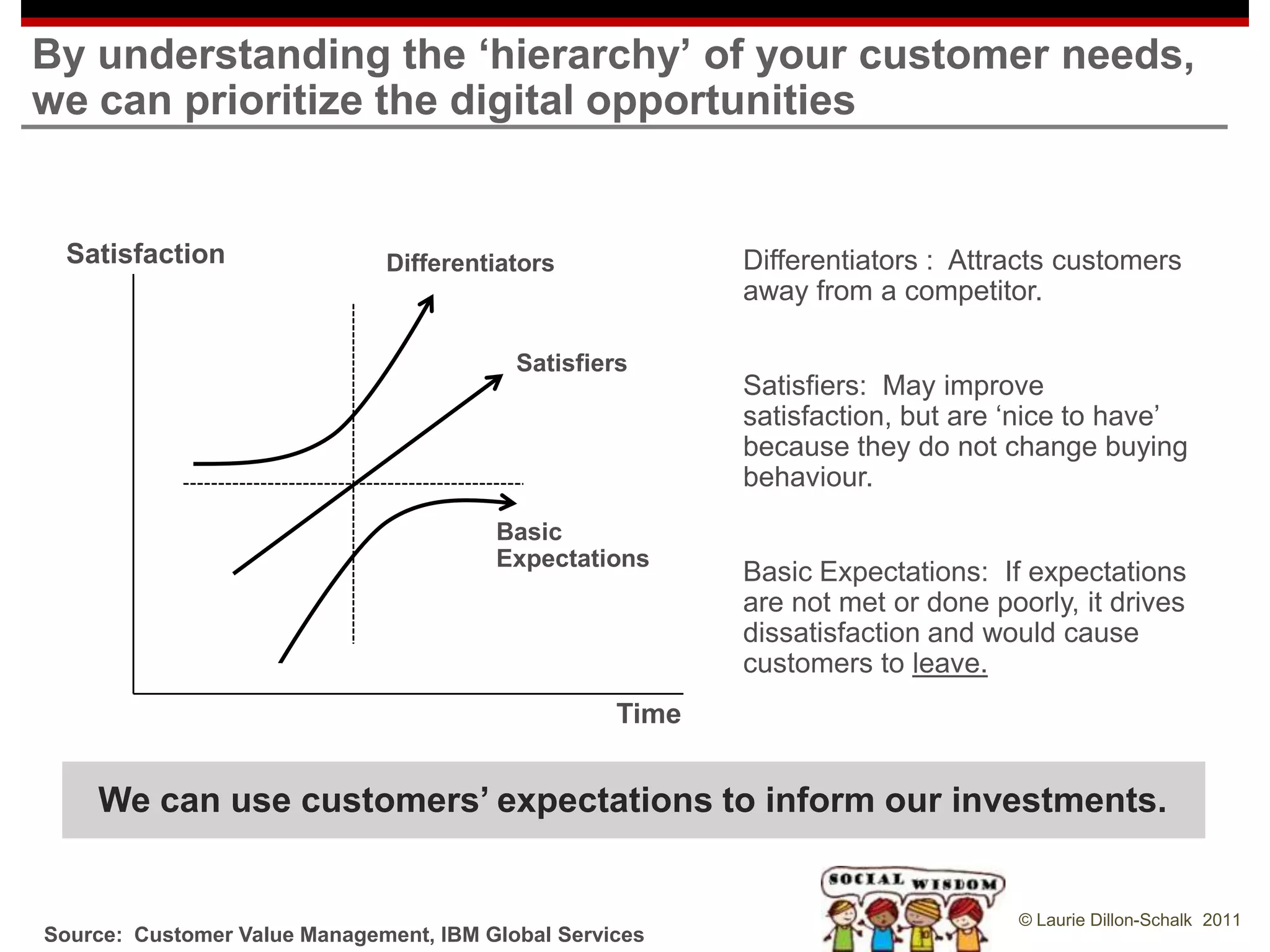
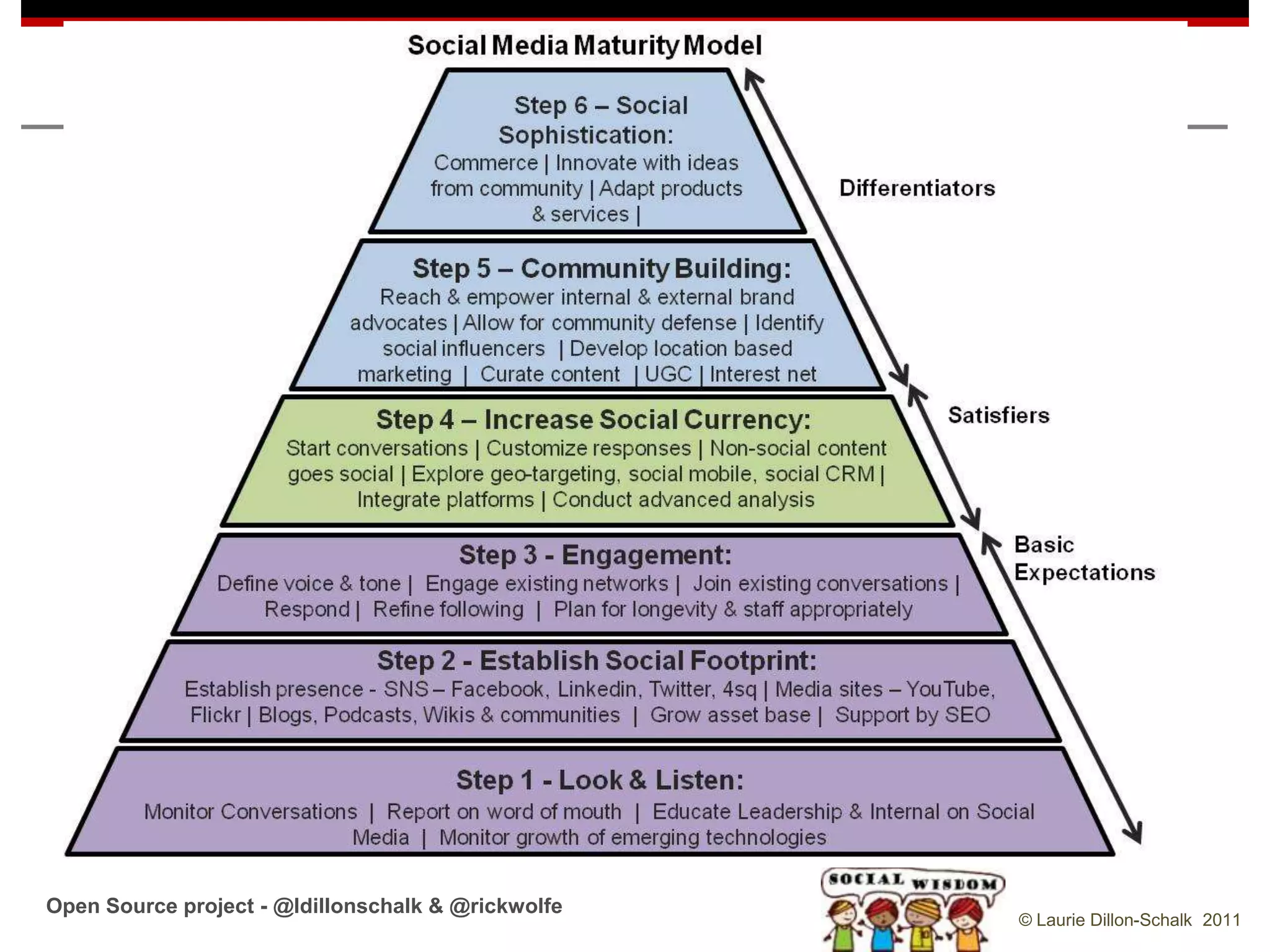
By understanding the „hierarchy‟ of your customer needs,
we can prioritize the digital opportunities


 Satisfaction                 Differentiators             Differentiators : Attracts customers
                                                          away from a competitor.

                                          Satisfiers
                                                          Satisfiers: May improve
                                                          satisfaction, but are „nice to have‟
                                                          because they do not change buying
                                                          behaviour.
                                        Basic
                                        Expectations
                                                          Basic Expectations: If expectations
                                                          are not met or done poorly, it drives
                                                          dissatisfaction and would cause
                                                          customers to leave.
                                                   Time


    We can use customers‟ expectations to inform our investments.


                                                                                 © Laurie Dillon-Schalk 2011
Source: Customer Value Management, IBM Global Services
Open Source project - @ldillonschalk & @rickwolfe
                                                    © Laurie Dillon-Schalk 2011
Digital Plan (Roadmap)


                         © Laurie Dillon-Schalk 2011
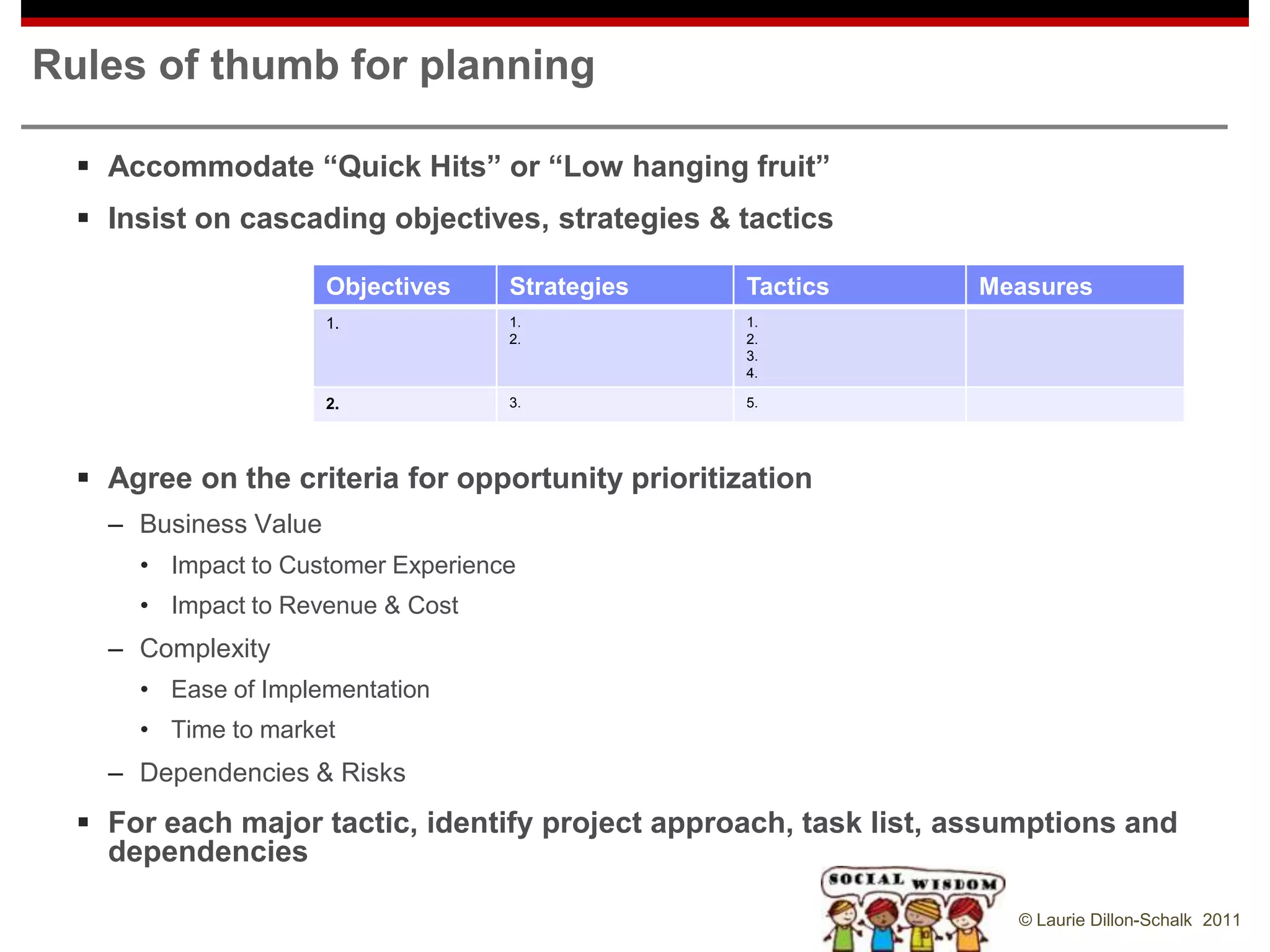
Rules of thumb for planning

   Accommodate “Quick Hits” or “Low hanging fruit”
   Insist on cascading objectives, strategies & tactics

                       Objectives   Strategies     Tactics       Measures
                       1.           1.             1.
                                    2.             2.
                                                   3.
                                                   4.

                       2.           3.             5.


   Agree on the criteria for opportunity prioritization
    – Business Value
      • Impact to Customer Experience
      • Impact to Revenue & Cost
    – Complexity
      • Ease of Implementation
      • Time to market
    – Dependencies & Risks
   For each major tactic, identify project approach, task list, assumptions and
    dependencies

                                                                    © Laurie Dillon-Schalk 2011
Last words

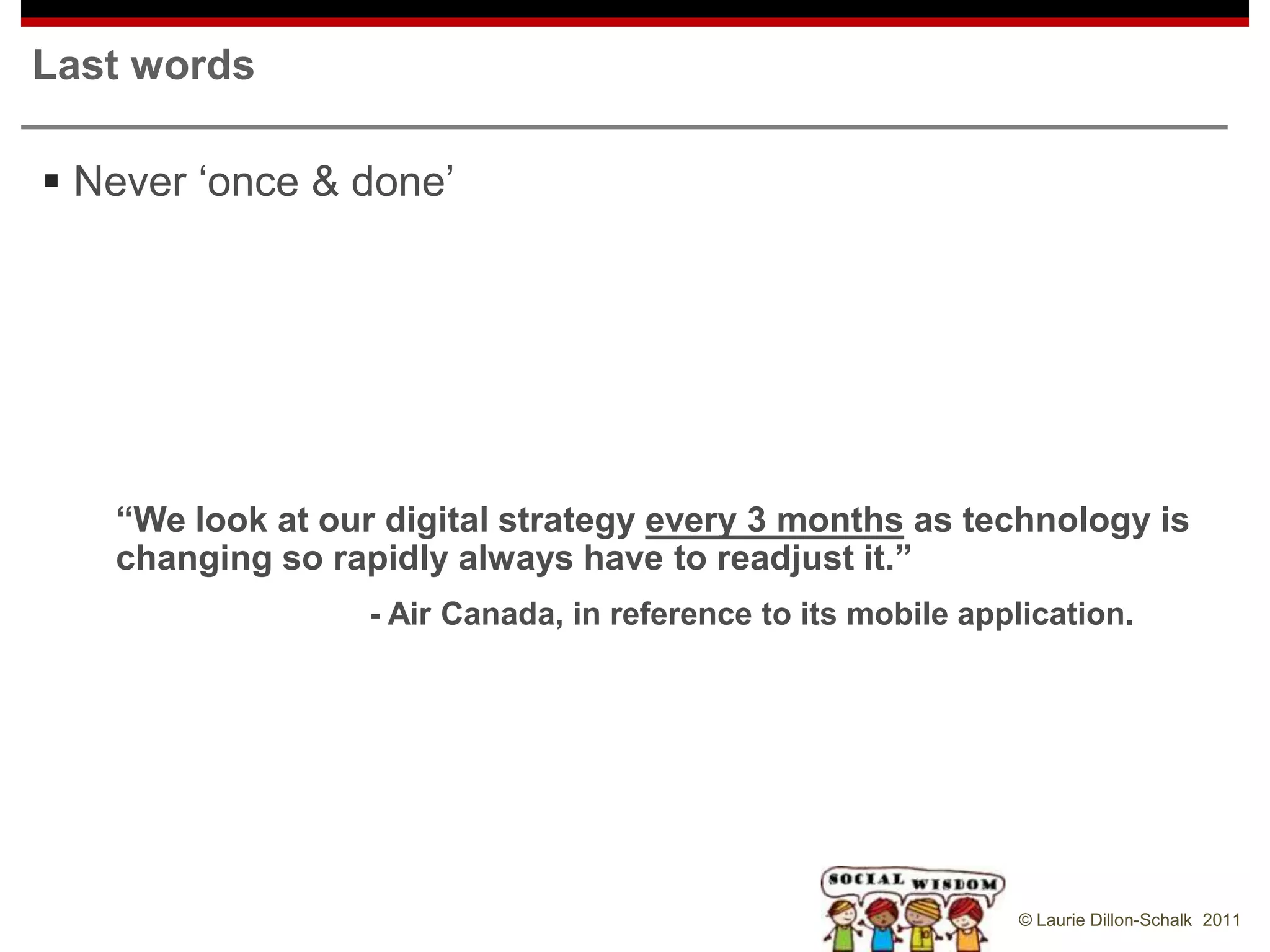
 Never „once & done‟


   “We look at our digital strategy every 3 months as technology is
   changing so rapidly always have to readjust it.”
                  - Air Canada, in reference to its mobile application.


                                                               © Laurie Dillon-Schalk 2011

How to develop a digital strategy

  • 1.
    MyCharityConnects #mcc11 Developing aDigital Strategy & Roadmap June 6, 2011 – Laurie Dillon-Schalk, Digital Strategy Director, JWT – Copyright © 2011
  • 2.
    About me © Laurie Dillon-Schalk 2011
  • 3.
    DEFINED: What isa digital strategy? Digital is an umbrella term used Strategy is the recommended to capture a broad base of approach to achieving a set of online or web accessible objectives. medias, channels, technologies or devices such as websites, portals*, banners, social networks, digital signage, mobile and more… Digital strategies provide measurable direction on how use digital to achieve a vision and its specific business, brand and/or marketing objectives. * Portals include general interest sites such as AOL or Yahoo. © Laurie Dillon-Schalk 2011
  • 4.
    Said differently -a strategy is how the gap to future goals will be addressed. Gap Desired Future Today © Laurie Dillon-Schalk 2011
  • 5.
    A Digital Strategyexercise is useful to: • Address a new vision, unsatisfactory current position, or competitive incursions. • Identify how the consumer interacts today and digital’s impact on that purchasing process or customer experience. • Create alignment on digital understanding, opportunities and planning. • Prioritize the many digital opportunities facing an organization. • Understand and address new brand realities – WOM, communities, etc • …. © Laurie Dillon-Schalk 2011
  • 6.
    An approach todigital strategy & planning Where do How do we How do we Where are we want to get there? know our we now? be? impact? Digital Review Digital Strategy Digital Plan Measurement • Consumer Insights • Link to vision, brand idea, Simple: Plan • Competitive Audit corporate objectives • Roadmap of tactics by • Measures of success • Digital Review • Digital vision strategy. • Balanced scorecard • Business + Brand • Strategies to achieve dev‟t Performance defined objectives. Experience Dev‟t: • User & biz requirements • Personas, customer experience mapping & user flows, etc. Emerging Tech Perspectives Includes optimization of existing digital assets © Laurie Dillon-Schalk 2011
  • 7.
    Focus of today What is included in a digital review  How to map customer experiences  Explanation of how to conduct a digital strategy exercise  How to plan for changing consumer expectations – E.g Social media maturity model  Planning rules of thumb © Laurie Dillon-Schalk 2011
  • 8.
    Digital Review © Laurie Dillon-Schalk 2011
  • 9.
    A comprehensive digitalreview provides context for Where are we now? digital strategy development AS-IS: Corporate Assessment Discovery: Competitive Audit  Internal stakeholder interviews  Competitive benchmarking  Strategic fit to corp. objectives  Gaps to customer  Current plans & roadmaps experience framework  Full digital asset review Internal context Industry & context review & competitive stakeholders insights insights context External Discovery: customer  Consumer Audit insights  Target segment needs & wants & behaviours  Purchase decision cycle  Purchase motivations & barriers (loyalty & churn drivers)  Customer Experience mapping Source: Framework from @pcrowe. Detail from LDS © Laurie Dillon-Schalk 2011
  • 10.
    Framework for CustomerExperience Mapping Major steps in the Customer Experience Aware Research Consider Buy Engage Service Support Loyalty Moments of Truth (customer interactions) Identify moments of truth that are: most important to the customer, painful (create churn), the largest gap to competitors create loyalty * Adapted from IBM Global Service consulting in 2006 © Laurie Dillon-Schalk 2011
  • 11.
    Audience check: Aquick review of free sources for insights Analytics  Google Analytics: website analytics  Website Grader – grades website search engine optimization  Social Mention – real time social media search & analysis Industry & Consumer Research  Pew Internet and American Life Research: digital consumer behaviour research.  E-marketer e-mails subscription: industry research  Google Think Insights: industry research  Quora: Interest network (wormhole) Trend & Performance Tracking  Google Insights for search: key search term analytics  Google Trends: trends in worldwide traffic for key terms  Wildfireapp.com – (sign in & monitor) competitor social network past three month growth © Laurie Dillon-Schalk 2011
  • 12.
    Where are A perspective on emerging technology & trends we now? educates stakeholders & informs digital planning AS-IS: Corporate Assessment Discovery: Competitive Audit  Internal stakeholder interviews  Competitive benchmarking  Strategic fit to corp. objectives  Gaps to customer  Current plans & roadmaps experience framework  Full digital asset review Internal context Industry & context review & competitive stakeholders insights insights context perspective External Technology Discovery: customer trends & Assessment:  Consumer Audit insights Emerging Tech  Target segment needs opportunities  Education to internal & wants & behaviours  Review of consumer  Purchase decision cycle expectations by media  Purchase motivations & barriers or channel (loyalty & churn drivers)  Customer Experience mapping Source: Framework from @pcrowe. Detail from LDS © Laurie Dillon-Schalk 2011
  • 13.
    How you presenta digital review is critical  Purpose of a review: to provide full information to allow for decisions. Strip the opinion, present the facts.  Do not lump the digital review and the digital strategy (nor roadmap) into one deliverable.  Deliver and facilitate the review in a dedicated “immersion” workshop with cross functional, in person participation.  Allow line of business owners to present their own sections.  Create a tight presentation – No more than 7 bullets, per slide (or categorize) – Follow “bullshit !, prove it, so what?” format – No more than 1 idea per slide – No facebook wall or twitter screen capture dumps! – Learn the art of visualization – make complex data easy to read – Include the one page pull out © Laurie Dillon-Schalk 2011
  • 14.
    Digital Strategy © Laurie Dillon-Schalk 2011
  • 15.
    Strategy development  Insiston starting with a digital review  Invite outside perspectives for emerging media, asset review  Speed up the delivery of a strategy by holding cross functional, team exercises: • Immersion: Sharing context, insights, perspectives • Planning: Objective & initiatives setting – After immersion, identify key issues or opportunities – Confirm vision & objectives – Have a independent stakeholder consideration of strategies and tactics, then allow for group think. – Consider sticky notes! Synthesize & vote • Alignment: Involve, agree & commit © Laurie Dillon-Schalk 2011
  • 16.
    By understanding the„hierarchy‟ of your customer needs, we can prioritize the digital opportunities Satisfaction Differentiators Differentiators : Attracts customers away from a competitor. Satisfiers Satisfiers: May improve satisfaction, but are „nice to have‟ because they do not change buying behaviour. Basic Expectations Basic Expectations: If expectations are not met or done poorly, it drives dissatisfaction and would cause customers to leave. Time We can use customers‟ expectations to inform our investments. © Laurie Dillon-Schalk 2011 Source: Customer Value Management, IBM Global Services
  • 17.
    Open Source project- @ldillonschalk & @rickwolfe © Laurie Dillon-Schalk 2011
  • 18.
    Digital Plan (Roadmap) © Laurie Dillon-Schalk 2011
  • 19.
    Rules of thumbfor planning  Accommodate “Quick Hits” or “Low hanging fruit”  Insist on cascading objectives, strategies & tactics Objectives Strategies Tactics Measures 1. 1. 1. 2. 2. 3. 4. 2. 3. 5.  Agree on the criteria for opportunity prioritization – Business Value • Impact to Customer Experience • Impact to Revenue & Cost – Complexity • Ease of Implementation • Time to market – Dependencies & Risks  For each major tactic, identify project approach, task list, assumptions and dependencies © Laurie Dillon-Schalk 2011
  • 20.
    Last words  Never„once & done‟ “We look at our digital strategy every 3 months as technology is changing so rapidly always have to readjust it.” - Air Canada, in reference to its mobile application. © Laurie Dillon-Schalk 2011

Editor's Notes

  • #5 Great definition http://www.easy-strategy.com/strategy-definition.htmlStrategy is the mean by which objectives are consciously and systematically pursued and obtained over time. The word “strategy” derives from the Greek word stratçgos; which derives from two words: - "stratos" – meaning army."ago" – which is the ancient Greek for leading/guiding/moving.In its military aspect, the term had to do with stratagems by which a general sought to defeat an enemy, with plans he made for a campaign, and with the way, he moved and disposed his forces in war. The strategy definition most commonly known today is as the art of analyzing, projecting and directing campaigns. Strategy is not planning. Strategy deals with competitive situation in an uncontrolled environment. Planning deals with situations in a controlled environment.
  • #10 You might question where the brand review, strategy & plan fits within this diagram. Ideally, a business review, strategy & plan and a brand r,s,p have taken place prior to a digital r,s,p. The brand idea & direction informs the strategy.
  • #14 Deliver in a dedicated “immersion” workshop with cross functional, in person participationDo not lump the digital review and the digital strategy into one deliverable. There needs to be stakeholder check points & involvement so that by the project sponsor/approver sees the digital strategy and roadmap, there are no surprises.
  • #17 A well designed digital experiences carefully manages several levels of consumer expectationsDifferentiators : Attacts customers away from a competitor. We need to excel at this to increase market share!Satisfiers: May improve satisfaction, but are ‘nice to have’ because they do not change buying behaviour.Basic Expectations: If expectations are not met or done poorly, it drives dissatisfaction and would cause customers to leave.Must do this – but only to “meet the minimum” - no gain in over-investing.