I
N
D
U
S
T
R
I
E
4.0
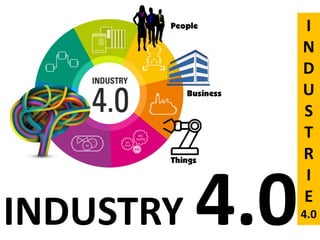
INDUSTRY 4.0
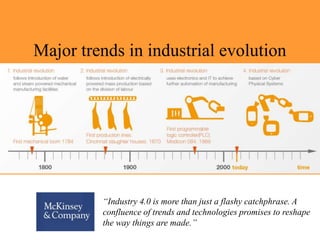
Major trends in industrial evolution
“Industry 4.0 is more than just a flashy catchphrase. A
confluence of trends and technologies promises to reshape
the way things are made.”
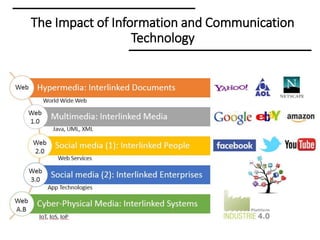
The Impact of Information and Communication
Technology
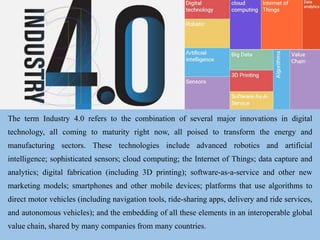
The term Industry 4.0 refers to the combination of several major innovations in digital
technology, all coming to maturity right now, all poised to transform the energy and
manufacturing sectors. These technologies include advanced robotics and artificial
intelligence; sophisticated sensors; cloud computing; the Internet of Things; data capture and
analytics; digital fabrication (including 3D printing); software-as-a-service and other new
marketing models; smartphones and other mobile devices; platforms that use algorithms to
direct motor vehicles (including navigation tools, ride-sharing apps, delivery and ride services,
and autonomous vehicles); and the embedding of all these elements in an interoperable global
value chain, shared by many companies from many countries.
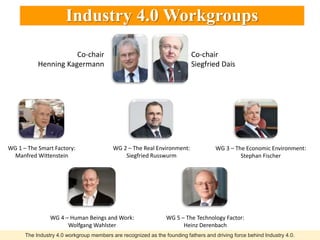
Industry 4.0 Workgroups
Co-chair
Henning Kagermann
Co-chair
Siegfried Dais
WG 1 – The Smart Factory:
Manfred Wittenstein
WG 2 – The Real Environment:
Siegfried Russwurm
WG 3 – The Economic Environment:
Stephan Fischer
WG 4 – Human Beings and Work:
Wolfgang Wahlster
WG 5 – The Technology Factor:
Heinz Derenbach
The Industry 4.0 workgroup members are recognized as the founding fathers and driving force behind Industry 4.0.
How German is industry 4.0?
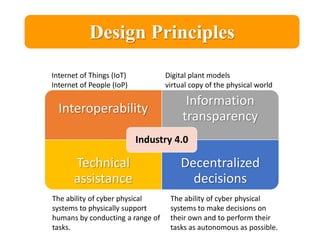
Interoperability
Information
transparency
Technical
assistance
Decentralized
decisions
Industry 4.0
Design Principles
Internet of Things (IoT)
Internet of People (IoP)
Digital plant models
virtual copy of the physical world
The ability of cyber physical
systems to physically support
humans by conducting a range of
tasks.
The ability of cyber physical
systems to make decisions on
their own and to perform their
tasks as autonomous as possible.
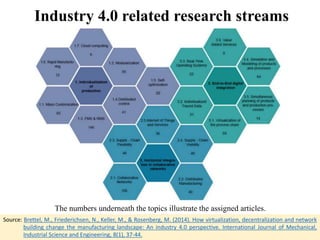
Industry 4.0 related research streams
Source: Brettel, M., Friederichsen, N., Keller, M., & Rosenberg, M. (2014). How virtualization, decentralization and network
building change the manufacturing landscape: An industry 4.0 perspective. International Journal of Mechanical,
Industrial Science and Engineering, 8(1), 37-44.
The numbers underneath the topics illustrate the assigned articles.
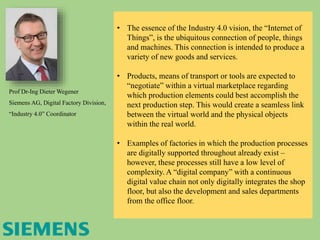
Prof Dr-Ing Dieter Wegener
Siemens AG, Digital Factory Division,
“Industry 4.0” Coordinator
• The essence of the Industry 4.0 vision, the “Internet of
Things”, is the ubiquitous connection of people, things
and machines. This connection is intended to produce a
variety of new goods and services.
• Products, means of transport or tools are expected to
“negotiate” within a virtual marketplace regarding
which production elements could best accomplish the
next production step. This would create a seamless link
between the virtual world and the physical objects
within the real world.
• Examples of factories in which the production processes
are digitally supported throughout already exist –
however, these processes still have a low level of
complexity. A “digital company” with a continuous
digital value chain not only digitally integrates the shop
floor, but also the development and sales departments
from the office floor.
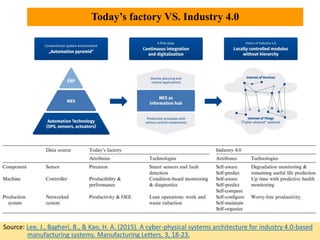
Today’s factory VS. Industry 4.0
Source: Lee, J., Bagheri, B., & Kao, H. A. (2015). A cyber-physical systems architecture for industry 4.0-based
manufacturing systems. Manufacturing Letters, 3, 18-23.
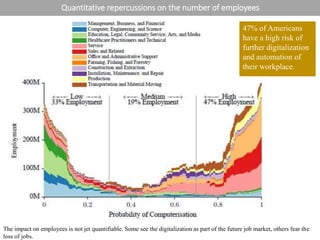
Quantitative repercussions on the number of employees
47% of Americans
have a high risk of
further digitalization
and automation of
their workplace.
The impact on employees is not jet quantifiable. Some see the digitalization as part of the future job market, others fear the
loss of jobs.
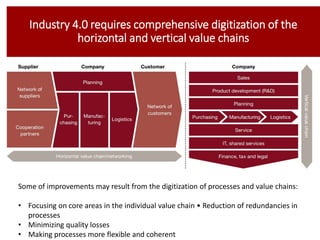
Industry 4.0 requires comprehensive digitization of the
horizontal and vertical value chains
Some of improvements may result from the digitization of processes and value chains:
• Focusing on core areas in the individual value chain • Reduction of redundancies in
processes
• Minimizing quality losses
• Making processes more flexible and coherent
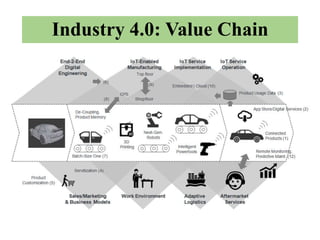
Industry 4.0: Value Chain
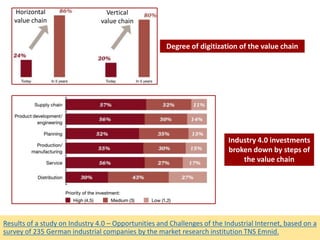
Results of a study on Industry 4.0 – Opportunities and Challenges of the Industrial Internet, based on a
survey of 235 German industrial companies by the market research institution TNS Emnid.
Degree of digitization of the value chain
Horizontal
value chain
Vertical
value chain
Industry 4.0 investments
broken down by steps of
the value chain
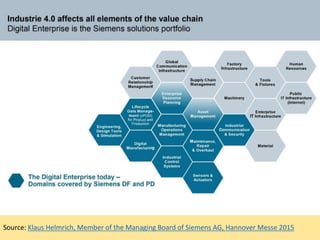
Source: Klaus Helmrich, Member of the Managing Board of Siemens AG, Hannover Messe 2015
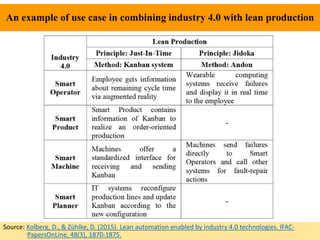
An example of use case in combining industry 4.0 with lean production
Source: Kolberg, D., & Zühlke, D. (2015). Lean automation enabled by industry 4.0 technologies. IFAC-
PapersOnLine, 48(3), 1870-1875.
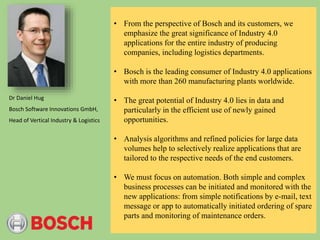
Dr Daniel Hug
Bosch Software Innovations GmbH,
Head of Vertical Industry & Logistics
• From the perspective of Bosch and its customers, we
emphasize the great significance of Industry 4.0
applications for the entire industry of producing
companies, including logistics departments.
• Bosch is the leading consumer of Industry 4.0 applications
with more than 260 manufacturing plants worldwide.
• The great potential of Industry 4.0 lies in data and
particularly in the efficient use of newly gained
opportunities.
• Analysis algorithms and refined policies for large data
volumes help to selectively realize applications that are
tailored to the respective needs of the end customers.
• We must focus on automation. Both simple and complex
business processes can be initiated and monitored with the
new applications: from simple notifications by e-mail, text
message or app to automatically initiated ordering of spare
parts and monitoring of maintenance orders.
What will come next?
Meysam Maleki
maleki@fct.unl.pt

Industry 4.0

  • 1.
  • 3.
    Major trends inindustrial evolution “Industry 4.0 is more than just a flashy catchphrase. A confluence of trends and technologies promises to reshape the way things are made.”
  • 4.
    The Impact ofInformation and Communication Technology
  • 5.
    The term Industry4.0 refers to the combination of several major innovations in digital technology, all coming to maturity right now, all poised to transform the energy and manufacturing sectors. These technologies include advanced robotics and artificial intelligence; sophisticated sensors; cloud computing; the Internet of Things; data capture and analytics; digital fabrication (including 3D printing); software-as-a-service and other new marketing models; smartphones and other mobile devices; platforms that use algorithms to direct motor vehicles (including navigation tools, ride-sharing apps, delivery and ride services, and autonomous vehicles); and the embedding of all these elements in an interoperable global value chain, shared by many companies from many countries.
  • 6.
    Industry 4.0 Workgroups Co-chair HenningKagermann Co-chair Siegfried Dais WG 1 – The Smart Factory: Manfred Wittenstein WG 2 – The Real Environment: Siegfried Russwurm WG 3 – The Economic Environment: Stephan Fischer WG 4 – Human Beings and Work: Wolfgang Wahlster WG 5 – The Technology Factor: Heinz Derenbach The Industry 4.0 workgroup members are recognized as the founding fathers and driving force behind Industry 4.0.
  • 7.
    How German isindustry 4.0?
  • 8.
    Interoperability Information transparency Technical assistance Decentralized decisions Industry 4.0 Design Principles Internetof Things (IoT) Internet of People (IoP) Digital plant models virtual copy of the physical world The ability of cyber physical systems to physically support humans by conducting a range of tasks. The ability of cyber physical systems to make decisions on their own and to perform their tasks as autonomous as possible.
  • 9.
    Industry 4.0 relatedresearch streams Source: Brettel, M., Friederichsen, N., Keller, M., & Rosenberg, M. (2014). How virtualization, decentralization and network building change the manufacturing landscape: An industry 4.0 perspective. International Journal of Mechanical, Industrial Science and Engineering, 8(1), 37-44. The numbers underneath the topics illustrate the assigned articles.
  • 10.
    Prof Dr-Ing DieterWegener Siemens AG, Digital Factory Division, “Industry 4.0” Coordinator • The essence of the Industry 4.0 vision, the “Internet of Things”, is the ubiquitous connection of people, things and machines. This connection is intended to produce a variety of new goods and services. • Products, means of transport or tools are expected to “negotiate” within a virtual marketplace regarding which production elements could best accomplish the next production step. This would create a seamless link between the virtual world and the physical objects within the real world. • Examples of factories in which the production processes are digitally supported throughout already exist – however, these processes still have a low level of complexity. A “digital company” with a continuous digital value chain not only digitally integrates the shop floor, but also the development and sales departments from the office floor.
  • 11.
    Today’s factory VS.Industry 4.0 Source: Lee, J., Bagheri, B., & Kao, H. A. (2015). A cyber-physical systems architecture for industry 4.0-based manufacturing systems. Manufacturing Letters, 3, 18-23.
  • 12.
    Quantitative repercussions onthe number of employees 47% of Americans have a high risk of further digitalization and automation of their workplace. The impact on employees is not jet quantifiable. Some see the digitalization as part of the future job market, others fear the loss of jobs.
  • 13.
    Industry 4.0 requirescomprehensive digitization of the horizontal and vertical value chains Some of improvements may result from the digitization of processes and value chains: • Focusing on core areas in the individual value chain • Reduction of redundancies in processes • Minimizing quality losses • Making processes more flexible and coherent
  • 14.
  • 15.
    Results of astudy on Industry 4.0 – Opportunities and Challenges of the Industrial Internet, based on a survey of 235 German industrial companies by the market research institution TNS Emnid. Degree of digitization of the value chain Horizontal value chain Vertical value chain Industry 4.0 investments broken down by steps of the value chain
  • 16.
    Source: Klaus Helmrich,Member of the Managing Board of Siemens AG, Hannover Messe 2015
  • 17.
    An example ofuse case in combining industry 4.0 with lean production Source: Kolberg, D., & Zühlke, D. (2015). Lean automation enabled by industry 4.0 technologies. IFAC- PapersOnLine, 48(3), 1870-1875.
  • 18.
    Dr Daniel Hug BoschSoftware Innovations GmbH, Head of Vertical Industry & Logistics • From the perspective of Bosch and its customers, we emphasize the great significance of Industry 4.0 applications for the entire industry of producing companies, including logistics departments. • Bosch is the leading consumer of Industry 4.0 applications with more than 260 manufacturing plants worldwide. • The great potential of Industry 4.0 lies in data and particularly in the efficient use of newly gained opportunities. • Analysis algorithms and refined policies for large data volumes help to selectively realize applications that are tailored to the respective needs of the end customers. • We must focus on automation. Both simple and complex business processes can be initiated and monitored with the new applications: from simple notifications by e-mail, text message or app to automatically initiated ordering of spare parts and monitoring of maintenance orders.
  • 19.
    What will comenext? Meysam Maleki maleki@fct.unl.pt