Technology Management
UNIT I
https://www.youtube.com/watch?v=DENG7Q7VRgo
https://www.youtube.com/watch?time_continue=4&v=_OZGlDrionE&feature=emb_logo
Advantages of Advanced Technology in
Domestic Market
•Improved and efficient functioning of various organizations in the nation.
•Technological progress and infusion brings major changes and improvements in the overall functioning of
organizations leading to transformations viz. transformation in Banking Sector, Telecom Sector
etc.
•Enhanced capability to fight foreign competition and thus retaining control over strategic national economic
assets.
•Stability in sales and profits of business firms; stable growth of sales and profits.
•Regular employment generation and high standards of living.
•Lesser probability of occurrence of economic recession and lesser adverse impact of economic recession if it
occurs.
•Relative stability in national income.
•Growth of national economy
Advantages of Advanced Technology in
Global Market
•Technological competitive advantage.
•Boost to exports.
•Forex earnings through exports.
•Disposal of surplus to external markets thus maintaining stability in domestic prices.
•Monopoly & high prices for hi-tech products in the international markets.
•Earnings from external markets provide additional funds for supporting research & development at home.
•Globalisation of operations leading to benefits of economies of scale of mass production, and cost reduction by procuring
low cost resources / inputs from anywhere in the world.
•Facilitates outbound Foreign Direct Investment (FDI) by domestic firms leading to earnings through captive exports,
repatriation of profits, sale of machinery, sale of components and sub-assemblies etc.
•Earnings through technology transfer agreements.
•Employment generation & high standards of living.
•Growth of national economy
Relation of Technology & Wealth of Nation
Technological
Advancement
Efficient Working
Saves Time, Cost
& Maximize Profit
Economical
Growth
Wealth of Nation
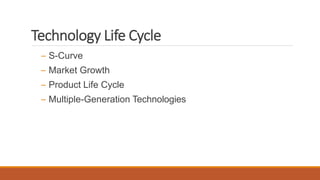
Technology Life Cycle
– S-Curve
– Market Growth
– Product Life Cycle
– Multiple-Generation Technologies
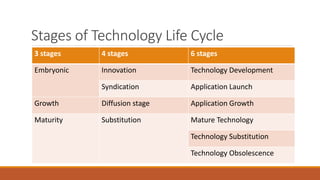
Stages of Technology Life Cycle
3 stages 4 stages 6 stages
Embryonic Innovation Technology Development
Syndication Application Launch
Growth Diffusion stage Application Growth
Maturity Substitution Mature Technology
Technology Substitution
Technology Obsolescence
• When technology reaches the market, it generates income
Market Growth at Different Stages of the Technology LifeCycle
TLC & Market Growth
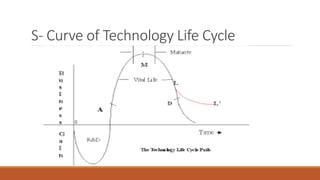
S- Curve of Technology Life Cycle
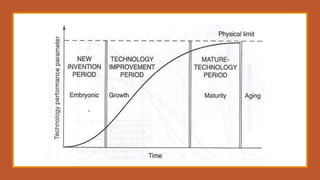
S- Curve of Technology Evolution
Product Life Cycle
Technology Strategy
 Technology strategy is the overall plan which consists of objectives,
principles and tactics relating to use of technologies within a
particular organization.
Such strategies primarily focus on the technologies themselves and
in some cases the people who directly manage those technologies.
SWOT or SWOC?
Strengths Weaknesses
Opportunities Challenges
SWOC
Strengths Weaknesses
Opportunities Threats
SWOT
Porter’s Five Forces
Rivalry
Among
existing
firms
Threat from
New
Entrance
Bargaining
Power of
Customers
Bargaining
power of
Suppliers
Threats from
Substitute
products
Scanning before forecasting & planning
Strategic technology planning
Forecasting technology
Analyze and diagnose the environment
Analyze and predict the market and customer trend and change of trend
Analyze the internal organization
Sketch the vision & mission
Re-design the organizational structure and activity
Execute the plan through operations
Output of planning
A process of top-down & bottom-up dialogue
◦ Decision alternatives—courses of action
◦ Proposed schemes—key entities & relations
◦ Budgeting for R&D, marketing & production
◦ Distribution criteria for appropriate proportions
◦ Long-term: basic research for breakthrough, applied research based on a specific purpose, pioneering or
experimental design & development of 1st stage R&D
◦ Short-term: 2nd R&D on the fabrication, 3rd stage on the commercial design, module manufacturing
Technology forecasting methods
Surveillance
◦ Scan the environment and link to the source of innovation for quick adjustment & adoption
Expert opinions
◦ Use the Delphi method to converge the common focus/foci
Trend analysis
◦ Trace the time-series data and identify the evolutionary pattern and the driving forces
Modeling
◦ Articulate a forecasting function composed several critical influencers
Scenario analysis
◦ Preview possible events and evolution patterns
Technology Policy (2013)
Promoting the spread of scientific temper amongst all
sections of society.
Enhancing skill for applications of science among the
young from all social strata.
Making careers in Science, research and innovation
attractive enough for talented and bright minds.
Establishing world class infrastructure for R&D for gaining
global leadership in some select frontier areas of science.
Positioning India among the top five global scientific
powers by 2020.
Linking contributions of science, research and innovation
system with the inclusive economic growth agenda and
combining priorities of excellence and relevance.
Creating an environment for enhanced Private
Sector Participation in R&D
Enabling conversion of R&D outputs into societal
and commercial applications by replicating
hitherto successful models as well as establishing
of new PPP structures.
Seeding S&T-based high-risk innovations through
new mechanisms.
Fostering resource-optimized, cost-effective
innovations across size and technology domains.
Triggering changes in the mindset and value
systems to recognize, respect and reward
performances which create wealth from S&T
derived knowledge.
Creating a robust national innovation system.

Technology management

  • 1.
  • 2.
  • 3.
    Advantages of AdvancedTechnology in Domestic Market •Improved and efficient functioning of various organizations in the nation. •Technological progress and infusion brings major changes and improvements in the overall functioning of organizations leading to transformations viz. transformation in Banking Sector, Telecom Sector etc. •Enhanced capability to fight foreign competition and thus retaining control over strategic national economic assets. •Stability in sales and profits of business firms; stable growth of sales and profits. •Regular employment generation and high standards of living. •Lesser probability of occurrence of economic recession and lesser adverse impact of economic recession if it occurs. •Relative stability in national income. •Growth of national economy
  • 4.
    Advantages of AdvancedTechnology in Global Market •Technological competitive advantage. •Boost to exports. •Forex earnings through exports. •Disposal of surplus to external markets thus maintaining stability in domestic prices. •Monopoly & high prices for hi-tech products in the international markets. •Earnings from external markets provide additional funds for supporting research & development at home. •Globalisation of operations leading to benefits of economies of scale of mass production, and cost reduction by procuring low cost resources / inputs from anywhere in the world. •Facilitates outbound Foreign Direct Investment (FDI) by domestic firms leading to earnings through captive exports, repatriation of profits, sale of machinery, sale of components and sub-assemblies etc. •Earnings through technology transfer agreements. •Employment generation & high standards of living. •Growth of national economy
  • 5.
    Relation of Technology& Wealth of Nation Technological Advancement Efficient Working Saves Time, Cost & Maximize Profit Economical Growth Wealth of Nation
  • 6.
    Technology Life Cycle –S-Curve – Market Growth – Product Life Cycle – Multiple-Generation Technologies
  • 7.
    Stages of TechnologyLife Cycle 3 stages 4 stages 6 stages Embryonic Innovation Technology Development Syndication Application Launch Growth Diffusion stage Application Growth Maturity Substitution Mature Technology Technology Substitution Technology Obsolescence
  • 9.
    • When technologyreaches the market, it generates income Market Growth at Different Stages of the Technology LifeCycle TLC & Market Growth
  • 10.
    S- Curve ofTechnology Life Cycle
  • 11.
    S- Curve ofTechnology Evolution
  • 12.
  • 13.
    Technology Strategy  Technologystrategy is the overall plan which consists of objectives, principles and tactics relating to use of technologies within a particular organization. Such strategies primarily focus on the technologies themselves and in some cases the people who directly manage those technologies.
  • 15.
    SWOT or SWOC? StrengthsWeaknesses Opportunities Challenges SWOC Strengths Weaknesses Opportunities Threats SWOT
  • 16.
    Porter’s Five Forces Rivalry Among existing firms Threatfrom New Entrance Bargaining Power of Customers Bargaining power of Suppliers Threats from Substitute products
  • 17.
  • 18.
    Strategic technology planning Forecastingtechnology Analyze and diagnose the environment Analyze and predict the market and customer trend and change of trend Analyze the internal organization Sketch the vision & mission Re-design the organizational structure and activity Execute the plan through operations
  • 19.
    Output of planning Aprocess of top-down & bottom-up dialogue ◦ Decision alternatives—courses of action ◦ Proposed schemes—key entities & relations ◦ Budgeting for R&D, marketing & production ◦ Distribution criteria for appropriate proportions ◦ Long-term: basic research for breakthrough, applied research based on a specific purpose, pioneering or experimental design & development of 1st stage R&D ◦ Short-term: 2nd R&D on the fabrication, 3rd stage on the commercial design, module manufacturing
  • 20.
    Technology forecasting methods Surveillance ◦Scan the environment and link to the source of innovation for quick adjustment & adoption Expert opinions ◦ Use the Delphi method to converge the common focus/foci Trend analysis ◦ Trace the time-series data and identify the evolutionary pattern and the driving forces Modeling ◦ Articulate a forecasting function composed several critical influencers Scenario analysis ◦ Preview possible events and evolution patterns
  • 21.
    Technology Policy (2013) Promotingthe spread of scientific temper amongst all sections of society. Enhancing skill for applications of science among the young from all social strata. Making careers in Science, research and innovation attractive enough for talented and bright minds. Establishing world class infrastructure for R&D for gaining global leadership in some select frontier areas of science. Positioning India among the top five global scientific powers by 2020. Linking contributions of science, research and innovation system with the inclusive economic growth agenda and combining priorities of excellence and relevance. Creating an environment for enhanced Private Sector Participation in R&D Enabling conversion of R&D outputs into societal and commercial applications by replicating hitherto successful models as well as establishing of new PPP structures. Seeding S&T-based high-risk innovations through new mechanisms. Fostering resource-optimized, cost-effective innovations across size and technology domains. Triggering changes in the mindset and value systems to recognize, respect and reward performances which create wealth from S&T derived knowledge. Creating a robust national innovation system.