How Has Technology Assisted Bilingual Education
“ … students need to be, parallel to their learning of technology, acquiring an ability for self-discovery, self awarness, understanding of others, and certainly high levels of critical reasoning. ” Alma Flor Ada
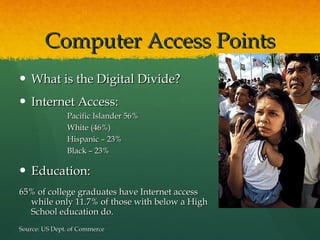
Computer Access Points What is the Digital Divide? Internet Access: Pacific Islander 56% White (46%)  Hispanic – 23% Black – 23% Education: 65% of college graduates have Internet access while only 11.7% of those with below a High School education do. Source: US Dept. of Commerce
Philosophical Views Do all students have equal opportunities to learn? Does access to information translate to power within our society? Can technology be used to create new knowledge, art and act on social realities?
Professional Development Strategies Distance Education Collaboration Learning Communities ePals “ Where in Washington? ” Project Based Learning
Professional Development Technologies Video Conferencing Net Meetings (WebX,  Newsgroups Online Chats Internet Resources
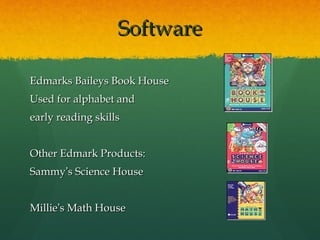
Software Edmarks Baileys Book House  Used for alphabet and  early reading skills Other Edmark Products: Sammy ’ s Science House Millie ’ s Math House
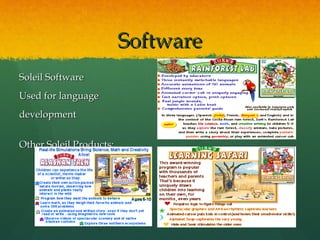
Software Soleil Software  Used for language  development Other Soleil Products:
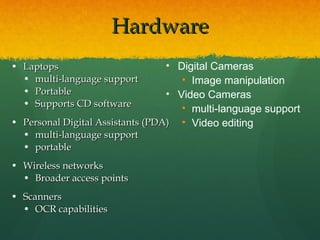
Hardware Laptops multi-language support Portable Supports CD software Personal Digital Assistants (PDA) multi-language support portable Wireless networks Broader access points Scanners  OCR capabilities Digital Cameras Image manipulation Video Cameras multi-language support Video editing
Internet Resources Native Language Web Portals  www.elsabio.com Eduhound in Spanish Online Translations Babelfish Google Translation Image sites Cooltext Animation Factory Picts4learing
Project Based Learning Real world problems Integrated subject areas Students discover knowledge Higher level thinking skills George Lucas Educational Foundation

Technology and bilingual education

  • 1.
    How Has TechnologyAssisted Bilingual Education
  • 2.
    “ … studentsneed to be, parallel to their learning of technology, acquiring an ability for self-discovery, self awarness, understanding of others, and certainly high levels of critical reasoning. ” Alma Flor Ada
  • 3.
    Computer Access PointsWhat is the Digital Divide? Internet Access: Pacific Islander 56% White (46%) Hispanic – 23% Black – 23% Education: 65% of college graduates have Internet access while only 11.7% of those with below a High School education do. Source: US Dept. of Commerce
  • 4.
    Philosophical Views Doall students have equal opportunities to learn? Does access to information translate to power within our society? Can technology be used to create new knowledge, art and act on social realities?
  • 5.
    Professional Development StrategiesDistance Education Collaboration Learning Communities ePals “ Where in Washington? ” Project Based Learning
  • 6.
    Professional Development TechnologiesVideo Conferencing Net Meetings (WebX, Newsgroups Online Chats Internet Resources
  • 7.
    Software Edmarks BaileysBook House Used for alphabet and early reading skills Other Edmark Products: Sammy ’ s Science House Millie ’ s Math House
  • 8.
    Software Soleil Software Used for language development Other Soleil Products:
  • 9.
    Hardware Laptops multi-languagesupport Portable Supports CD software Personal Digital Assistants (PDA) multi-language support portable Wireless networks Broader access points Scanners OCR capabilities Digital Cameras Image manipulation Video Cameras multi-language support Video editing
  • 10.
    Internet Resources NativeLanguage Web Portals www.elsabio.com Eduhound in Spanish Online Translations Babelfish Google Translation Image sites Cooltext Animation Factory Picts4learing
  • 11.
    Project Based LearningReal world problems Integrated subject areas Students discover knowledge Higher level thinking skills George Lucas Educational Foundation