DIGITAL LITERACY
Natália Cristina do Nascimento dos Santos
Concepts
According to The Digital Learning Librarian at the University of
Illinois Digital literacy is:
• The ability to use digital technology, communication tools or
networks to locate, evaluate, use and create information.
• The ability to understand and use information in multiple formats
from a wide range of sources when it is presented via computers.
• A person’s ability to perform tasks effectively in a digital
environment... Literacy includes the ability to read and interpret
media, to reproduce data and images through digital
manipulation, and to evaluate and apply new knowledge gained
from digital environments.
Digital Literacy in Society
“[...] we live today in a society permeated by the digital, where
our actions are frequently mediated by digital tools[...]”
Allan Martin
• It is almost impossible nowadays, to live in the society
without being familiarized with technology.
• The society in general, mainly professor and students have
to be prepared to deal with the new tools the technology
provides.
Digital Literacy in Education
“Technology transforms learning and the conditions for learning.”
Lena Olsson and Eva Edman-Stålbrant
• Digital literacy is a kind of challenge for the teachers.
• They have to be prepared to teach in this new reality and
also, prepare the students.
• Digital literacy expands student’s learning, since it provides
more interaction with the world.
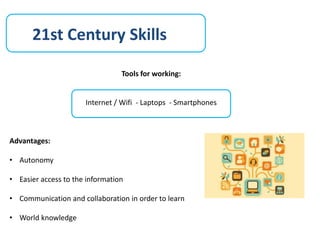
21st Century Skills
Tools for working:
Internet / Wifi - Laptops - Smartphones
Advantages:
• Autonomy
• Easier access to the information
• Communication and collaboration in order to learn
• World knowledge
Global Impact of Digital
Literacy
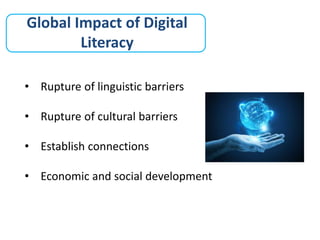
• Rupture of linguistic barriers
• Rupture of cultural barriers
• Establish connections
• Economic and social development
Conclusion
Tecnology is always present nowadays and it brings many
advantages. This way, Digital literacy is very important, since
everything is surrounded by technology. The best way to
people became familiarized to technology is the use of
digital literacy in education, but teachers must be prepared
to deal with it in class and students must be well prepared to
this new world.
Bibliography
Digital Literacy
http://www.library.illinois.edu/diglit/definition.html
Digital Literacy as a Challenge for Teacher Education
http://www.larum.su.se
Digital literacy

Digital literacy

  • 1.
    DIGITAL LITERACY Natália Cristinado Nascimento dos Santos
  • 2.
    Concepts According to TheDigital Learning Librarian at the University of Illinois Digital literacy is: • The ability to use digital technology, communication tools or networks to locate, evaluate, use and create information. • The ability to understand and use information in multiple formats from a wide range of sources when it is presented via computers. • A person’s ability to perform tasks effectively in a digital environment... Literacy includes the ability to read and interpret media, to reproduce data and images through digital manipulation, and to evaluate and apply new knowledge gained from digital environments.
  • 3.
    Digital Literacy inSociety “[...] we live today in a society permeated by the digital, where our actions are frequently mediated by digital tools[...]” Allan Martin • It is almost impossible nowadays, to live in the society without being familiarized with technology. • The society in general, mainly professor and students have to be prepared to deal with the new tools the technology provides.
  • 4.
    Digital Literacy inEducation “Technology transforms learning and the conditions for learning.” Lena Olsson and Eva Edman-Stålbrant • Digital literacy is a kind of challenge for the teachers. • They have to be prepared to teach in this new reality and also, prepare the students. • Digital literacy expands student’s learning, since it provides more interaction with the world.
  • 5.
    21st Century Skills Toolsfor working: Internet / Wifi - Laptops - Smartphones Advantages: • Autonomy • Easier access to the information • Communication and collaboration in order to learn • World knowledge
  • 6.
    Global Impact ofDigital Literacy • Rupture of linguistic barriers • Rupture of cultural barriers • Establish connections • Economic and social development
  • 7.
    Conclusion Tecnology is alwayspresent nowadays and it brings many advantages. This way, Digital literacy is very important, since everything is surrounded by technology. The best way to people became familiarized to technology is the use of digital literacy in education, but teachers must be prepared to deal with it in class and students must be well prepared to this new world.
  • 8.